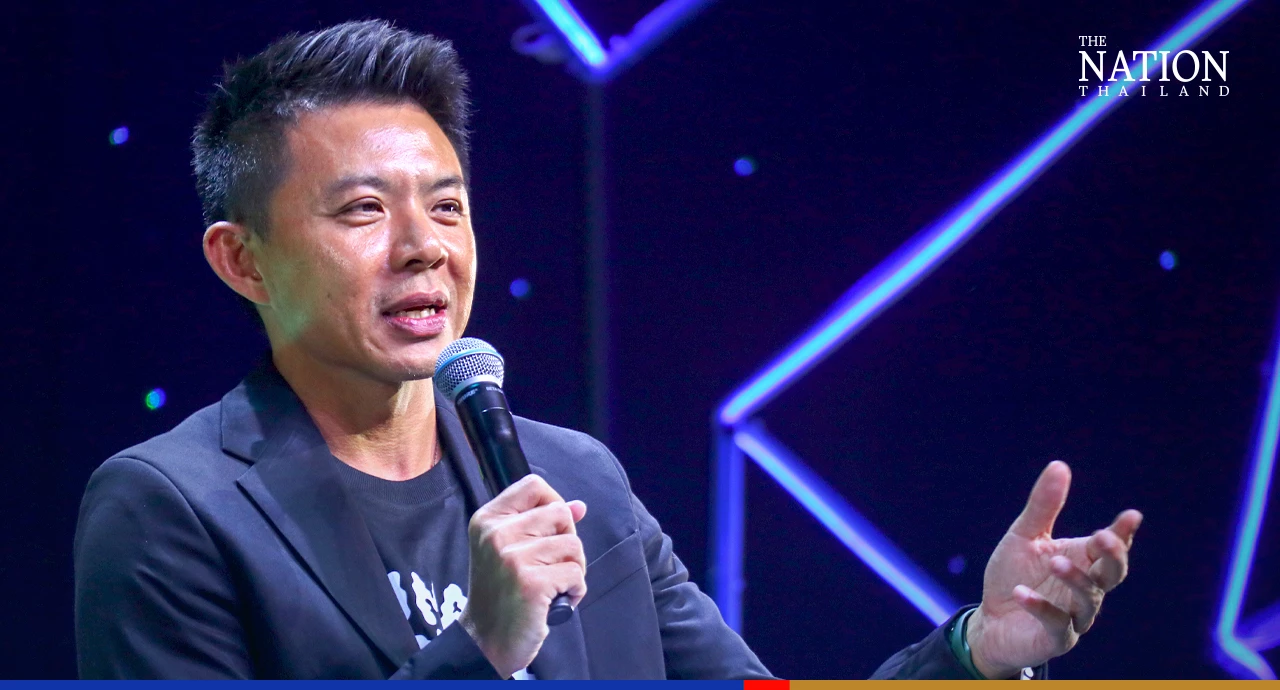
D.OASIS, an early leader in the metaverse market, is inviting businesses and individuals to connect with virtual global communities through The Sandbox, which aims to become Thailand’s largest metaverse.
The metaverse was the new way of living and doing business, D.OASIS’ co-founders – CEO Sirikiat Bunworaset, Index Creative Village CEO Kreingkrai Kanjanapokin and Dhurakij Pundit University president Darika Lathapipat – told the “Thailand Metaverse Expo 2022” in Bangkok on Saturday.
Speaking on the topic “Connecting Thailand with the Sandbox Community”, they said that speed of adoption was the key to success in this digital economy era. Those who quickly learned and adapted to new technology would reap the opportunities at the forefront of their industries.
The goal of D.OASIS was to establish the country’s leading metaverse community, where Thais could learn, explore and experience the metaverse and its potential.
The Sandbox metaverse also aims to be Thailand’s access point to the global metaverse community.
D.OASIS CEO Sirikiat said the Sandbox allows Thailand, its businesses and people, to access the world while also allowing the world to access Thailand. This new type of interaction would open a fresh virtual landscape of opportunities for Thai businesses and users, he added. Already part of the Sandbox community are leading brands and celebrities including Gucci, Adidas, Snoop Dogg and Paris Hilton.
The Sandbox is the third-largest Ethereum blockchain metaverse. Users can create, share, and monetise assets (such as real estate) and gaming experiences. They can own assets, play, build, and own properties on the virtual platform. Sandbox users can also sell their virtual assets for real-world money.
Index Creative Village CEO Kreingkrai declared that the metaverse contains infinite possibilities. But Thailand required a virtual community for Thai users to join, so D.OASIS stepped into fulfil the need.
Recognising that they could not do it alone, they enlisted the help of numerous partners, each with their own area of expertise. There are currently over 50 international companies and celebrities on the platform, with more on the way.
Darika said that as an educator, she is convinced that knowledge of the metaverse will be a requirement in the 21st-century workforce. Hence, she hopes to create an online community that will serve as a virtual lab for students and entrepreneurs to learn about the metaverse and conduct trials of their business ideas.
Making a surprise appearance via live video, Sandbox chief operating officer Sebastien Borget congratulated D.OASIS on joining its metaverse. He insisted that Sandbox is not only for general users but also for creatives to create and be inspired by.
He said the company continues to educate people about the potential of the metaverse while developing new features to meet users’ demand and passions.
“There is more to discover in the metaverse, and this is an excellent time to do so. Simply begin your engagement and be inspired. I hope to attract more Thais to join as users and creators,” Borget added.
D.OASIS CEO Sirikiat concluded that its community would be open to new participants no matter how large it grew.
“Thailand Metaverse Expo 2022” is organized by Nation Group and runs at CentralWorld in Bangkok until Sunday (August 21).
Thais should be more open-minded about the metaverse, whose benefits go far beyond being a marketplace for buying and selling digital assets, one of the country’s metaverse pioneers said on Saturday.
Speaking on the second day of Thailand Metaverse Expo 2022, Metaverse XR founder Sathian Boonmanan said those who viewed the internet’s new frontier as merely an online marketplace were missing out on huge opportunities.
The metaverse, he explained, is a social platform that enables three-dimensional use: real-time interaction, immersive experience and multi-user access from any device.
“This means that people from all over the world can meet, play and interact in the blink of an eye. Any device, such as smartphones and [virtual reality] glasses, will assist us in seeing where the real world intersects with the virtual world,” Sathian stated.
Speaking on the topic of “Adoption of the Metaverse in Business”, he demonstrated the various aspects of the metaverse – virtual reality (VR), augmented reality (AR) and extended reality (XR).
He added that Thailand should focus on XR, citing use cases that demonstrate it provides a superior internet experience.
The term “extended reality” refers to hybrid real-virtual environments and human-machine interactions enabled by computer technology and wearables.
“The world keeps changing but people’s demands and desires stay practically the same,” noted Sathian. “What we need to do is use the latest technology to improve people’s experience in what they demand.”
He concluded by saying that all of the technology he demonstrated can be developed entirely by Thais. Hence, the metaverse was a once-in-a-lifetime opportunity for Thailand to transform itself into one of the world’s leading technological nations, generating enormous revenue for the country.
PwC projects the global metaverse market will increase seven-fold between now and 2030, generating US$1.5 trillion (53.7 trillion baht), with AR, VR and XR leading the way.
The city administration began the project in 2016 aim to improve the look of the area and bring better quality of life for local people, but a lack of funds has meant the process has been extremely slow.
HCM CITY — HCM City is struggling to relocate nearly 20,000 slum homes situated on and along local canals.
The city administration began the project in 2016 with the aim to improve the look of the area and bring better quality of life for local people, but a lack of funds means the process has been extremely slow.
Data from the city’s Department of Construction showed that as of July 2022, the city had only relocated a total of 2,479 out of nearly 20,000 of the homes, equal to 12.4 per cent.
Only in District 8, there are more than 12,300 poor properties along the canals.
Trần Thanh Tùng, chairman of the district’s People’s Committee told Thời Nay online newspaper that it needs at least VNĐ9 trillion (US$385.7 million) to relocate people living along the south bank of Đôi Canal and build an embankment.
The committee has coordinated with relevant agencies to call upon for investment from the private sector but failed, he said.
Huỳnh Thanh Khiết, deputy director of the construction department said the project’s implementation was slow although the city had ordered districts to actively carry out relocation work.
But it still faced problems in compensation and land clearance, he said.
Most of the low end homes have a very small area of land and are mainly built on the water. So, the relocation faces many difficulties in terms of paperwork, he said.
The main difficulty is that it requires a huge amount of capital, but the city budget is having to prioritise urgent infrastructure and social projects.
In the meantime, it is difficult to attract capital from the private sector because investors have not seen benefits when participating in the projects.
Solutions
The department’s Urban Development Office said from now to 2025, the city will focus on implementing three projects to solve the dual goals of improving the water drainage to combat floods and relocation to refurbish the urban areas.
The three projects consist of dredging, environmental improvement and infrastructure construction on Xuyên Tâm Canal, Văn Thánh Canal in districts of Bình Thạnh and Gò Vấp, and Hy Vọng Canal in Tân Bình District.
The estimated investment capital for the projects are VNĐ9.3 trillion ($398.4 million), VNĐ1.98 trillion ($84.8 million) and VNĐ1.2 trillion ($51.4 million) respectively.
The three projects are set to relocate a total of 3,220 poor houses.
Nguyễn Chí Thiện, deputy head of the office said there are many large enterprises interested, but so far the projects failed to attract firm investment, he said.
To fix the situation, the department has advised the People’s Committee of the city to call for investment for the projects, such as expanding the canals’ corridor to create a commercially-exploitable land fund that is attractive.
Chairman of the HCM City Real Estate Association (HoREA) Lê Hoàng Châu said the most important thing in implementing projects is land clearance.
Therefore, the association suggested the city administration to separate the work of land clearance and compensation into an independent project, he said.
After the land fund is available, the city could open a bidding to select investors, he said.
In a related move, the committee has already submitted to the Government’s Office and the Ministry of Construction several solutions to mobilise non-budget capital for the projects, said Trần Hoàng Quân, director of the department said.
The city proposed to use public-investment capital for land clearance, building embankments to create land fund to attract enterprises to invest in the projects; resettlement for people living in the areas along the canals with available housing funds, he added.
Chairman of the municipal People’s Committee Phan Văn Mãi said that the city is determined to implement the programme.
The city is calculating and adjusting the planning to exploit the riverside land fund and make auction to gain funding, he said.
The city strives to relocate a half of the total 20,000 poor quality home along and on canals by 2025, he said. — VNS
Asia News Network: The Nation (Thailand), The Korea Herald, The Straits Times (Singapore), China Daily, Jakarta Post, The Star and Sin Chew Daily (Malaysia), The Statesman (India), Philippine Daily Inquirer, Yomiuri Shimbun and The Japan News, Gogo Mongolia, Dawn (Pakistan), The Island (Sri Lanka), Kuensel (Bhutan), Kathmandu Post (Nepal), Daily Star (Bangladesh), Eleven Media (Myanmar), the Phnom Penh Post and Rasmei Kampuchea (Cambodia), The Borneo Bulletin (Brunei), Vietnam News, and Vientiane Times (Laos).
The Seoul Metropolitan Government on Thursday announced that the government would provide a 300,000 won ($226) monthly subsidy to babysitting family members to help young parents find child care.
But, concerns have already mounted that the system could be abused.
According to the city government, Seoul will provide a monthly subsidy of 300,000 won to those looking after a relative’s child under three for over 40 hours per month. The household’s combined earnings must be less than 150 percent of the standard median income to apply for the subsidy, which can be provided for up to 12 months. When non-custodial family members take care of two or three children, the subsidy can increase to 450,000 or 600,000 won, respectively.
The city government plans to subsidize some 16,000 citizens next year and expand the program so that around 49,000 citizens can benefit from the program by 2026.
Yet, concerns have been raised that some people may take unfair advantage of the subsidy as it is difficult for the government to check who non-custodial family members are and how many hours they spend caring for the children.
The city government said it would require a written pledge and a working plan from people who apply for the program while rescinding the subsidy if they are found to have broken the rules and taken undue gains.
This 12-month-long subsidy is part of the city government’s five-year welfare program to support parents with children under 10. The government will inject a total of 14.7 trillion won over the five-year period.
As part of the program, the Seoul city government will also operate a service that will take sick and injured children to hospitals in the absence of their parents. The service will be available in five districts before later being expanded.
The city government has also prepared a service in which employees accompany children to and from learning facilities and other child care locations. The government will initially secure 500 staff members in 25 districts and will expand the number to 800 by 2026.
In addition, the city government will encourage maternity and paternity leave by providing a subsidy worth a maximum of 1.2 million won. Households with expectant parents, working parents or multiple children will be eligible to apply for housekeeping services offered by the government.
Seoul city government will create a website with further details on its parenting support program by August next year.
By Shim Woo-hyun
Asia News Network: The Nation (Thailand), The Korea Herald, The Straits Times (Singapore), China Daily, Jakarta Post, The Star and Sin Chew Daily (Malaysia), The Statesman (India), Philippine Daily Inquirer, Yomiuri Shimbun and The Japan News, Gogo Mongolia, Dawn (Pakistan), The Island (Sri Lanka), Kuensel (Bhutan), Kathmandu Post (Nepal), Daily Star (Bangladesh), Eleven Media (Myanmar), the Phnom Penh Post and Rasmei Kampuchea (Cambodia), The Borneo Bulletin (Brunei), Vietnam News, and Vientiane Times (Laos).
Supervision and regulation in focus to better protect internet enterprises
China will continue strengthening the capacity building of its cybersecurity system, with a focus on the stronger protection of internet enterprises and more efforts to promote the sector’s development, a senior official said on Friday.
“While ensuring the growth of the internet industry, we’ll also focus more on supervision and regulation to guarantee economic and social interests at the same time,”Niu Yibing, spokesman of the Cyberspace Administration of China, said at a news conference.
He said that authorities will intensify the cybersecurity of internet enterprises, protecting the legitimate rights of those companies and entrepreneurs, and added that “our aim is to create a healthy, ‘get-to-the-top’, ‘can-do’ entrepreneurial atmosphere”.
Recalling the optimized supervisory means and a series of rules made by the administration and related government agencies in recent years, Niu underlined that the measures not only draw a clear bottom line for internet enterprises to operate within the regulations, but also helped them eliminate lurking risks.
Over the past decade, the country has stepped up efforts and taken various measures to guarantee cybersecurity, “as there is no national security without online security, let alone stable socioeconomic growth and benefit to the people”, he said.
So far, a cybersecurity system has been put in place nationwide, while the protection of key infrastructure in finance, energy, electricity, telecommunications and transportation has also been boosted, according to a statement by the administration.
Additionally, more than 100 laws and rules, including the Cybersecurity Law, Data Security Law and Methods on Cybersecurity Review, have been promulgated, meaning that cyberspace governance by the rule of law has been accelerated and the punishment against those who harm or potentially harm the national security has become harsher, it said.
Under the Methods on Cybersecurity Review, for example, internet platform operators with the data of more than 1 million users must seek official clearance via a security review before being listed in overseas stock exchanges.
“We’ve always supported domestic enterprises to rationally utilize overseas capital markets for financing and development in line with rules and the law,” Sun Wei–min, head of the administration’s cybersecurity coordination bureau, told the media on Friday.
“China’s determination of opening up at a higher level, sharing development opportunities with the world and making economic globalization more open, inclusive, balanced and beneficial will not change.”
In regard to the fine of over 8 billion yuan ($1.19 billion) imposed on ride-hailing giant Didi Global Inc last month, she said that it was the result of the implementation of the rules and laws with regard to data security, and that the next step “is to guide and urge the company to better rectify and eliminate hidden security risks”.
“We’ll safeguard national security, data security, social interests and people’s legitimate rights by effectively dealing with irregularities and illegal behaviors in these sectors,” she added.
In the past 10 years, China has seen a rapid growth of internet users. The number of internet users rose to 1.03 billion last year from 564 million in 2012, while the internet usage rate among the population increased to 73 percent from 42.1 percent during the same period, the statement said.
China has the world’s largest and most advanced optical fiber broadband and mobile communications network, with 1.85 million 5G base stations, it added.
Asia News Network: The Nation (Thailand), The Korea Herald, The Straits Times (Singapore), China Daily, Jakarta Post, The Star and Sin Chew Daily (Malaysia), The Statesman (India), Philippine Daily Inquirer, Yomiuri Shimbun and The Japan News, Gogo Mongolia, Dawn (Pakistan), The Island (Sri Lanka), Kuensel (Bhutan), Kathmandu Post (Nepal), Daily Star (Bangladesh), Eleven Media (Myanmar), the Phnom Penh Post and Rasmei Kampuchea (Cambodia), The Borneo Bulletin (Brunei), Vietnam News, and Vientiane Times (Laos).
Recent high-level talks between Takeo Akiba, secretary general of the National Security Secretariat, and China’s top diplomat Yang Jiechi were aimed at rebuilding relations between Japan and China, which had lacked momentum for dialogue in the run-up to the 50th anniversary of the normalization of diplomatic ties.
With many issues pending between the two countries, realizing constructive and stable bilateral relations is likely to prove challenging.
The Japanese government had proposed holding a foreign ministerial meeting with China on Aug. 4 on the sidelines of an international conference in Cambodia. Tokyo had hoped the meeting would be “a first step toward laying the groundwork” ahead of the milestone anniversary, according to a Japanese Foreign Ministry source. However, China canceled the meeting following U.S. House of Representatives Speaker Nancy Pelosi’s visit to Taiwan.
The talks between Akiba and Yang, which lasted for seven hours on Wednesday, became an opportunity to launch efforts to rebuild bilateral ties.
It was the first in-person meeting in about 2½ years between a secretary general of the National Security Secretariat and Yang, a member of the Chinese Communist Party’s Politburo. Yang visited Japan in February 2020 and met with then National Security Secretariat secretary general Shigeru Kitamura.
Some members of the Japanese government viewed Wednesday’s high-level talks positively, with one saying, “It was good that both sides exchanged views on pending issues between Japan and China.”
The focus will now be on whether a summit between Prime Minister Fumio Kishida and Chinese President Xi Jinping will be realized leading up to the 50th anniversary of the normalization of diplomatic ties in September.
Japan is likely to engage in diplomacy with China cautiously, while keeping a watchful eye on Beijing’s activities, such as intrusions by China Coast Guard vessels into Japan’s territorial waters around the Senkaku Islands in Ishigaki, Okinawa Prefecture.
China, for its part, apparently wants to stabilize relations with Japan as its confrontation with the United States has deepened over Taiwan. Xi is facing a situation in which he needs to demonstrate stability both at home and abroad ahead of a party congress this autumn where he is expected to seek a third term.
During the talks with Akiba, Yang stressed the importance of stable relations between Japan and China, saying that peaceful coexistence and friendly cooperation are the only options for the relationship between the two countries. The Chinese side avoided direct criticism of Japan in a statement released after the talks.
On the other hand, Yang said during the talks that both countries should maintain their own views and eliminate domestic and external distractions, while calling for Japan to “move in the right direction of peaceful development.”
These remarks were apparently intended to caution Japan over its efforts to strengthen cooperation with the United States in such fields as security and increased defense spending.
Asia News Network: The Nation (Thailand), The Korea Herald, The Straits Times (Singapore), China Daily, Jakarta Post, The Star and Sin Chew Daily (Malaysia), The Statesman (India), Philippine Daily Inquirer, Yomiuri Shimbun and The Japan News, Gogo Mongolia, Dawn (Pakistan), The Island (Sri Lanka), Kuensel (Bhutan), Kathmandu Post (Nepal), Daily Star (Bangladesh), Eleven Media (Myanmar), the Phnom Penh Post and Rasmei Kampuchea (Cambodia), The Borneo Bulletin (Brunei), Vietnam News, and Vientiane Times (Laos).
A member of an Islamic State cell involved in a hostage-taking plot that led to the beheadings of American journalists and aid workers was sentenced to life in prison by a US federal court on Friday.
U.S. District Court Judge T.S. Ellis sentenced El Shafee Elsheikh, 33, during a hearing in a federal courtroom in Alexandria, Virginia, in a ruling the families and friends of his victims said provided “a bit of justice.”
Four months ago a jury found the former British citizen guilty of charges that included lethal hostage-taking and conspiracy to commit murder. He was found guilty in April.
After a six-week trial in April and hours of deliberation, the jury concluded that Elsheikh was part of an Islamic State cell, nicknamed “The Beatles” for their English accents, that beheaded American hostages in Iraq and Syria.
Elsheikh, who was born in Sudan and raised in London, was accused of conspiring to kill four American hostages: James Foley, Steven Sotloff, Peter Kassig and Kayla Mueller.
Foley and Sotloff, both journalists, and Kassig, an aid worker, were killed in videotaped beheadings. Mueller was raped repeatedly by the group’s leader at the time, Abu Bakr al-Baghdadi, before her death in Syria, U.S. officials have said.
The deaths of Foley, Sotloff and Kassig were confirmed in 2014; Mueller’s death was confirmed in early 2015.
Speaking with reporters following the sentencing, Foley’s mother, Diane, said: “But as grateful as I am for this sentence, it is a hollow victory. Our country has lost four of its very best citizens. We families lost our loved ones forever. And now El Sheikh and Cody have lost their freedom, country and families. It’s a tragic cycle of violence and heartbreak for all involved.”
The charges against Elsheikh, whose British citizenship was withdrawn in 2018, carried a potential death sentence, but U.S. prosecutors had previously advised British officials that they would not seek the death penalty.
Prosecutors argued that a life sentence was needed to prevent Elsheikh from causing future harm and to set a precedent that such crimes will get strict punishment.
Another cell member, Alexanda Kotey, was sentenced to life in prison by a U.S. judge earlier this year. Kotey was held in Iraq by the U.S. military before being flown to the United States to face trial. He pleaded guilty last September to the murders of Foley, Sotloff, Kassig and Mueller.
A third member of the group, Mohammed Emwazi, died in a U.S.-British missile strike in Syria in 2015.
Russia’s state communications regulator said on Friday it was taking punitive measures against five foreign IT companies for violating online content laws, which could require search engines to include a disclaimer about the violations.
The regulator, Roskomnadzor, said it was imposing measures against ByteDance’s TikTok, Telegram messaging service, Zoom Video Communications ZM.O, chat tool Discord and Pinterest PINS.N.
In a statement, Roskomnadzor said that the measures were in response to the companies’ failure to remove content that it had flagged as illegal, and would remain in place until they complied.
None of the companies immediately responded to written requests for comment.
Roskomnadzor did not specify precisely what measures would be taken. Russia’s dominant Yandex YNDX.O search engine already carries a disclaimer for some other websites that reads: “Roskomnadzor: website violates Russian law.”
“Roskomnadzor has decided to apply enforcement measures … in the form of internet users being informed by search engines about the companies’ violations of Russian legislation,” the regulator said.
Russia has fined several, mostly foreign tech firms for not deleting content it deems illegal. It has also warned sites against violating a law passed in early March that prohibits “discrediting” the armed forces, with a sentence of up to 15 years.
On Tuesday, Russian courts fined Amazon’s AMZN.O live streaming unit Twitch 2 million roubles ($33,900) and Telegram 11 million roubles for hosting content that Moscow said contained “fake” information concerning events in Ukraine.
Russian lawmakers in July approved a bill providing for stricter penalties for foreign internet companies, including the search engine disclaimer.
The first 78 Chilean lawmakers to be submitted to drug tests were chosen this week through a lottery in accordance to a regulation approved on July regarding the use of illicit drugs.
In an attempt to bring more transparency to congress, every six months members of the Chamber of Deputies will be chosen randomly to go through a hair analysis to determine if they have used drugs.
For right-wing lawmaker Juan Antonio Coloma this will be a way to show the people that lawmakers legislate without external pressure from drug dealers.
Others have spoken out against it. For left-wing lawmaker Tomas de Rementeria the measure is ‘just a spectacle’ as there will be no accountability for anyone who tests positive.
According to the regulation, the results will be public and if a lawmaker tests positive their bank account information could also be made public.
The Chamber of Deputies has 155 members and the aim of the test is that each lawmaker is examined twice during their four-year term.
Anyone who refuses can be referred to the chamber’s ethics committee.