Grab Thailand launched the GrabCampus project, empowering the young generation to showcase their business potential with hands-on experience at Grab.
Worachat Luxkanalode, Executive Director of Grab Thailand, said, “Access to knowledge, education, and essential skill development are keys to the growth and betterment of our society. At the core of our GrabForGood mission, we strive to utilise technology to make a positive impact on people. Grab Thailand has started a number of initiatives to promote and support all partners in the ecosystem such as ‘GrabAcademy’ – to upskill and enhance knowledge of Grab driver- and merchant partners as well as ‘Grab The Future’ – to provide scholarships to the children of our partners.
“To continue our commitment to creating a wider impact, this year we have launched GrabCampus – a new initiative aimed to support and enhance the potential of university students. The young generation is the main driving force in bettering our society and we are proud to be able to provide a platform and opportunity for them to showcase their talent, get hands-on experience with the team of professionals, and guide them on how to cultivate shared values when conducting business in the society.”
GrabCampus consists of three main initiatives:
GrabSpark – the first business case competition by Grab: A platform for university students to showcase their talent through business plan and strategy development under the topic “Driving Business Growth with Data in the Post-pandemic Era” to win prizes worth more than THB 100,000 and an honourable trophy, as well as a chance to join GrabIntern. The opportunity is open to university students from all levels and faculties. The application period is 1-21 August 2022.
GrabIntern – an opportunity for university students from all levels and faculties to get hands-on experiences of working at Grab. Each year, 20 selected GrabInterns will not only get to sharpen their business and management skills but also expand perspectives in utilising technology to drive positive social impact through the ‘socially-conscious business’ concept. They will get to work closely with Grab Thailand executives and diverse teams including Strategy, Planning and Business Development, Marketing and Business Partnership, and Operations, covering Transportation, Delivery, and Financial Service businesses for a period of two months with competitive compensation.
Grab Roadshow – a series of talks by Grab Thailand executives to share their work experience at a tech company with the aim to inspire and prepare university students before they take on a career path.
“In addition to a challenging job, compensation, and corporate culture similar to their core values, the new generations, especially Gen Z and Millennials, are seeking a more meaningful career – a career that can create a positive change. We hope that GrabCampus will be another initiative that equips the youth with the knowledge and skills to drive a positive impact on society, forges them to become a valuable workforce, and inspires them to conduct a business in a way that it can prosper alongside social development and the environment,”. Worachat concluded.
Amid rising tension spurred by the August 2 visit of US House Speaker Nancy Pelosi to Taiwan, much to China’s dismay, Asean foreign ministers are calling on all parties to exercise the utmost restraint, refrain from provocative action and uphold the principles enshrined in the UN Charter.
In a press statement released late on Wednesday, top Asean diplomats who are gathering in Phnom Penh for the 55th Asean Foreign Ministers’ Meeting (AMM) and related meetings reiterated that the bloc’s member states support the One-China policy.
“The world is in dire need of wisdom and responsibility of all leaders to uphold multilateralism and partnership, cooperation, peaceful coexistence and healthy competition for our shared goals of peace, stability, security and inclusive and sustainable development,” the statement said.
Without naming Taiwan directly, the foreign ministers said “the recent development in the area adjacent to the Asean region could lead to miscalculation, serious confrontation, open conflicts and unpredictable consequences among major powers”.
“We should act together and Asean stands ready to play a constructive role in facilitating peaceful dialogue between all parties including through utilising Asean-led mechanisms to de-escalate tension [and] to safeguard peace, security and development in our region,” it added.
Speaking at a Thursday morning press briefing on the 55th AMM, Ministry of Foreign Affairs and International Cooperation Secretary of State Kung Phoak said Asean foreign ministers hope de-escalation will take place and tensions will be gone as soon as possible over the Taiwan Strait.
The Phnom Penh Post
Asia News Network
Asia News Network: The Nation (Thailand), The Korea Herald, The Straits Times (Singapore), China Daily, The Jakarta Post, The Star and Sin Chew Daily (Malaysia), The Statesman (India), Philippine Daily Inquirer, Yomiuri Shimbun and The Japan News, Gogo Mongolia, Dawn (Pakistan), The Island (Sri Lanka), Kuensel (Bhutan), Kathmandu Post (Nepal), Daily Star (Bangladesh), Eleven Media (Myanmar), The Phnom Penh Post and Rasmei Kampuchea (Cambodia), The Borneo Bulletin (Brunei), Vietnam News, and Vientiane Times (Laos).
A test run of tuk-tuks — three-wheel motor vehicles widely used in Southeast Asia — is being conducted in Oarai, Iabaraki Prefecture, in the hopes of vehicle boosting tourism.
The trial service will be conducted on four routes until Aug. 11. The local tourism promotion association, formed by the town and others, plans the full introduction of the service from September after identifying issues that need to be addressed in the test run.
Asia News Network
The Japan News
Asia News Network: The Nation (Thailand), The Korea Herald, The Straits Times (Singapore), China Daily, Jakarta Post, The Star and Sin Chew Daily (Malaysia), The Statesman (India), Philippine Daily Inquirer, Yomiuri Shimbun and The Japan News, Gogo Mongolia, Dawn (Pakistan), The Island (Sri Lanka), Kuensel (Bhutan), Kathmandu Post (Nepal), Daily Star (Bangladesh), Eleven Media (Myanmar), The Phnom Penh Post and Rasmei Kampuchea (Cambodia), The Borneo Bulletin (Brunei), Vietnam News, and Vientiane Times (Laos).
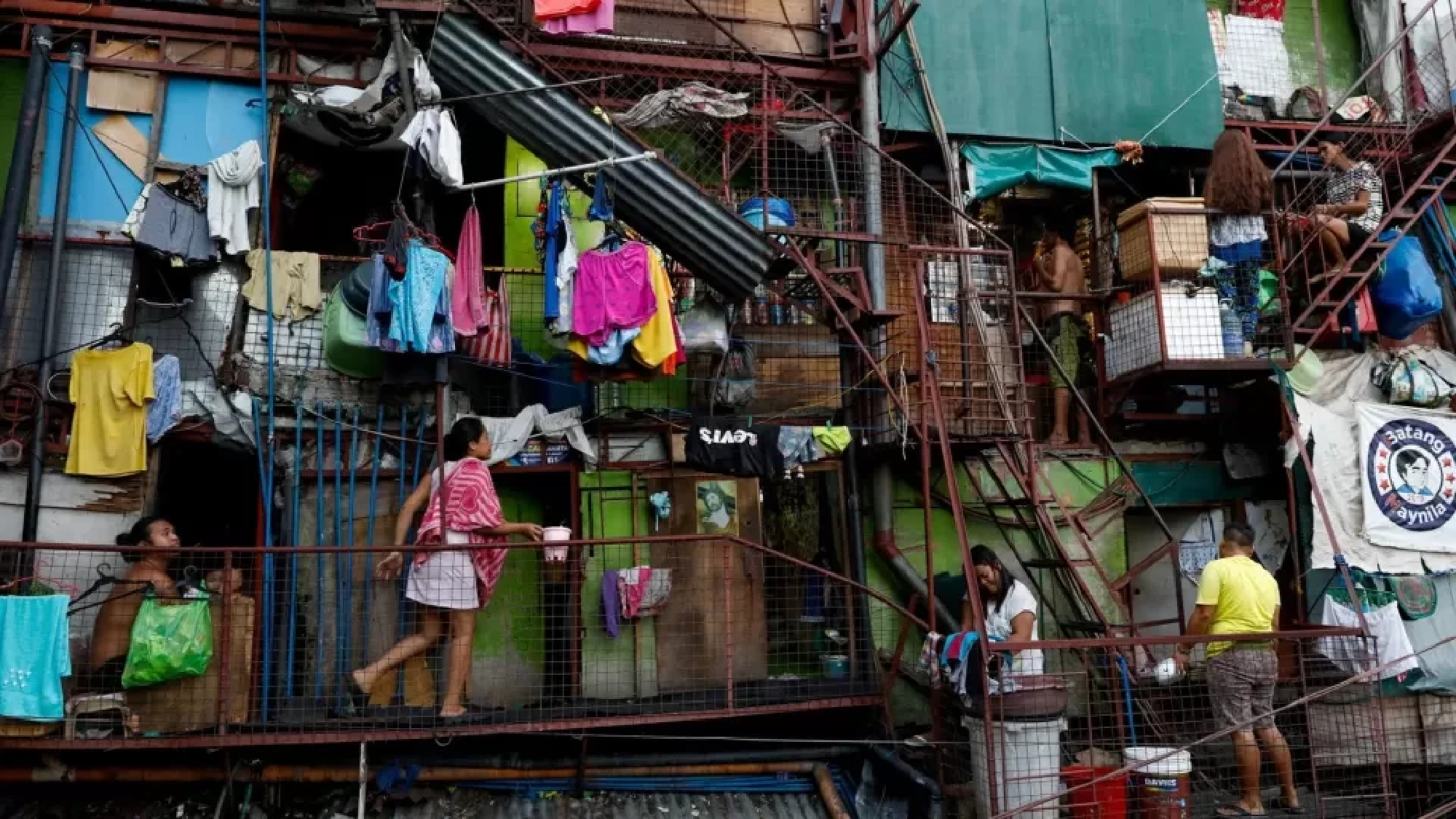
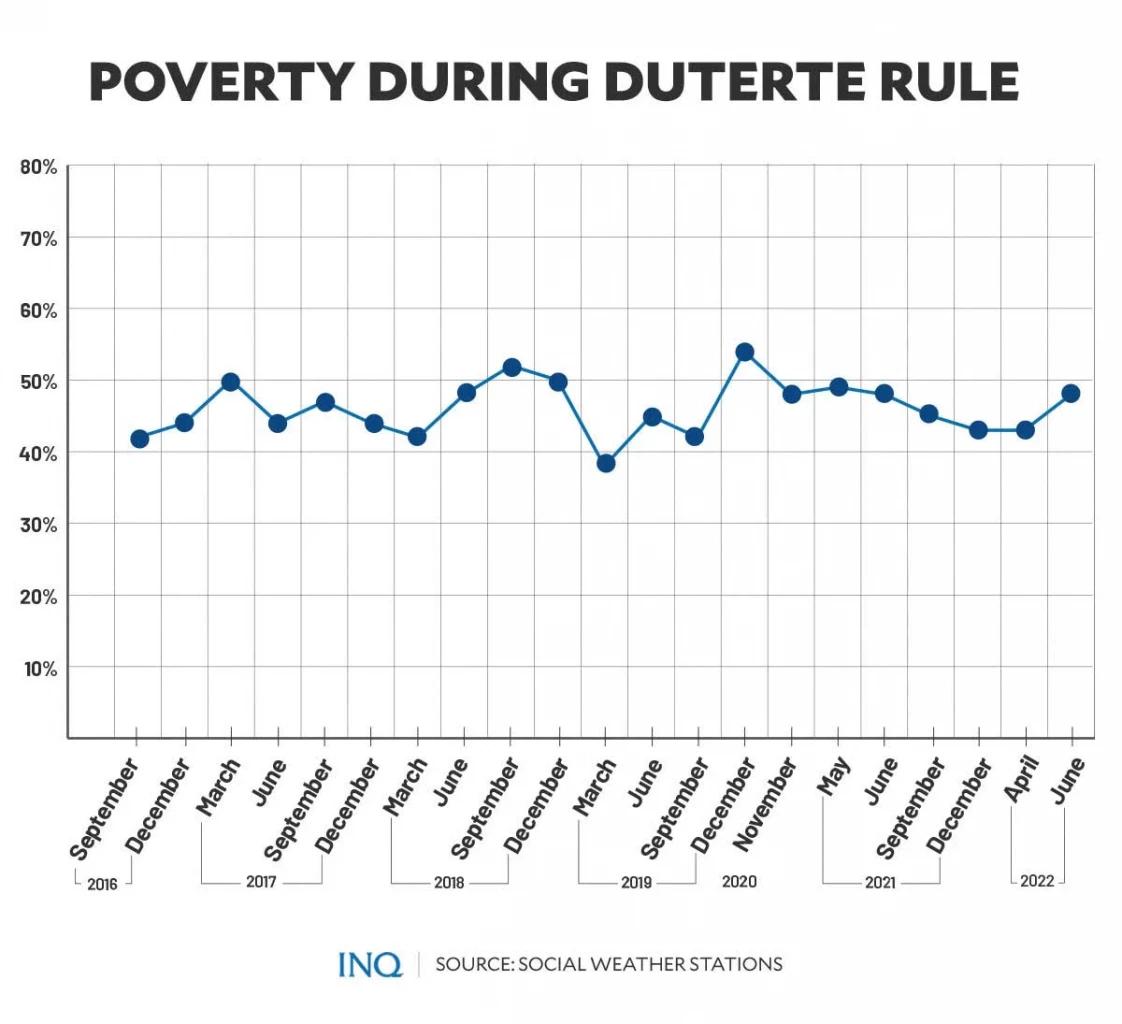
As Rodrigo Duterte, who once promised a comfortable life for all Filipinos, ended his six-year presidency last June 30, 48 per cent of Filipino households felt “poor” in the second quarter of 2022.
He said in 2018 that with all the programs being implemented by the government, the life of all Filipinos would get better in the third year of his presidency: “Konting tiis na lang (A little more patience).”
Then in 2019, Malacañang stressed that with the signing of new laws, like the Magna Carta of the Poor, the government was working to significantly reduce poverty rates and make poor Filipinos’ lives better.
The Social Weather Stations (SWS), however, said the percentage of Filipino families, who rated themselves poor, hit 54 per cent, or 13.1 million households, in December 2019, the highest in five years.
This, even if Duterte had asked Congress in his 2019 State of the Nation Address to help the government lift six million Filipinos out of poverty by the end of his six-year presidency.
Last April 27, the National Economic Development Authority (Neda) said the programs of the government had contributed to reducing poverty, stressing that six million Filipinos were lifted out of poverty in 2018.
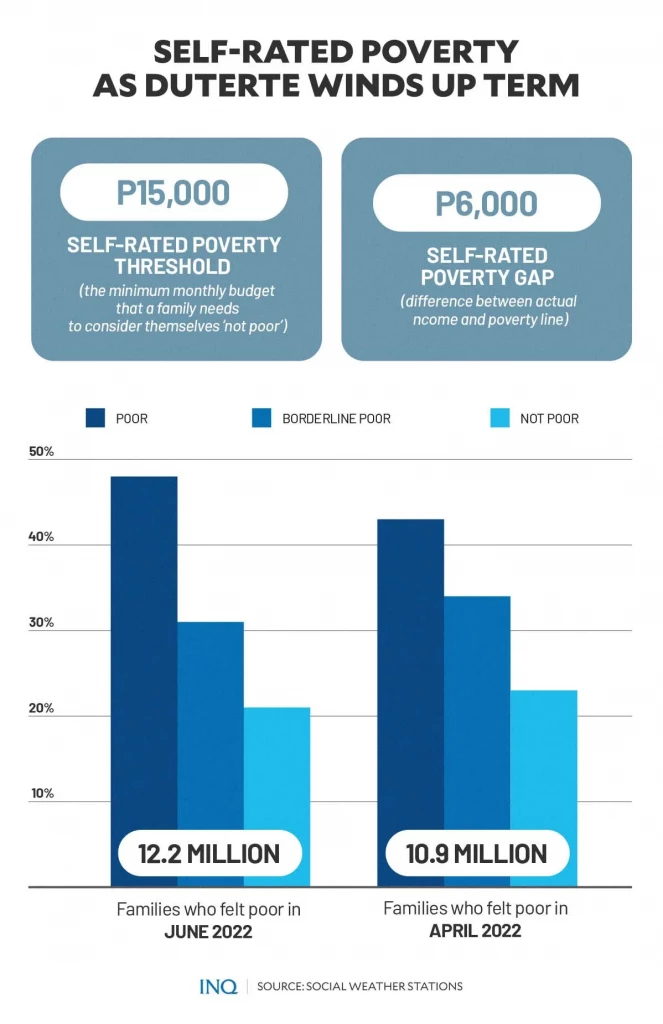
However, as Duterte left Malacañang, a survey by the SWS showed that 12.2 million families considered themselves poor, higher than 43 per cent, or 10.9 million in April 2022.
Out of a respondent base of 1,500 Filipinos 18 years and older who were polled last June 26 to 29, 31 per cent were “borderline poor,” while only 21 per cent were “not poor.” Compared to April 2022, the numbers fell from 34 per cent and 23 per cent.
Neda said the government, back in 2016, had pursued the zero-to-ten point socioeconomic agenda to achieve the Ambisyon Natin 2040, a vision that reflects the “collective aspiration to end extreme poverty by 2040.”
While then Socioeconomic Planning Secretary Karl Chua said six million Filipinos had already been lifted out of poverty in 2018, “the COVID-19 pandemic temporarily halted our progress.”
He said last year: “In 2020, people’s income and jobs were significantly affected by stringent quarantines. As we began to cope with the virus starting the fourth quarter of 2020, we gradually relaxed restrictions and managed risks better.”
The Philippine Statistics Authority (PSA) said poverty incidence fell from 27.6 per cent in 2015’s first half to 21.1 per cent in 2018’s first half, however, in 2021’s first half, poverty incidence rose to 23.7 per cent, or 3.9 million more Filipinos living in poverty.
SWS has been conducting self-rated poverty surveys since 1992, except in the first nine months of 2020, when face-to-face interviews were not possible because of COVID-19 restrictions.
When it resumed its surveys in November 2020, 48 per cent of Filipino families considered themselves poor; May 2021 (49 per cent); June 2021 (48 per cent); September 2021 (45 per cent); and December 2021 (43 per cent).
Hits misses The government said that based on PSA data, poverty incidence fell to 16.6 per cent from 23.3 per cent in 2015, with the Neda saying that with a yearly poverty reduction rate of 2.23 per cent, “we are on track” to end extreme poverty.
However, the think tank Ibon Foundation stressed that the way the government counts the poor “grossly underestimates Philippine poverty,” saying that many poor Filipinos are not counted.
The Social Reform and Poverty Alleviation Act defines “poor” as individuals and families whose incomes fall below the poverty threshold as defined by the Neda or cannot afford in a sustained manner to meet their minimum basic needs.
Because of this, the number of poor is counted as the number of Filipinos whose incomes fall below the poverty threshold or the minimum amount needed to meet basic food and non-food needs, Ibon Foundation said.
It first computes the subsistence threshold or the minimum amount a family needs to meet basic food needs. This is then assumed to be 70 per cent of the poverty threshold where the balance of 30 per cent is assumed enough to meet basic non-food needs.
However, poverty estimates based on this methodology are low and unrealistic: “The monthly poverty threshold is just P10,727 for a family of five. This is just around P71 per person per day at P50 for food needs and P21 for non-food needs.”
Ibon Foundation said the “low standards” was the reason for the decrease in poverty incidence in 2018: “Persistently low poverty thresholds and illusory reductions in poverty will only result in persistent neglect of the needs of the many.”
Making do with what they have The SWS said the rise in self-rated poverty was because of the increases in the Visayas and Metro Manila, combined with slight increases in Mindanao and Balance Luzon, or Luzon outside Metro Manila.
Compared to April 2022, self-rated poverty rose in the Visayas from 48 per cent to 64 per cent, and in Metro Manila from 32 per cent to 41 per cent. It rose slightly in Mindanao from 60 per cent to 62 per cent, and in Balance Luzon from 35 per cent to 36 per cent.
Out of the estimated 12.2 million poor Filipino families, 2.2 million were newly poor, 1.6 million were usually poor, and 8.4 million were always poor. Back in April, 1.5 million were newly poor, 1.1 million were usually poor, and 8.2 million were always poor.
The median self-rated poverty threshold—the minimum monthly budget that a family needs to stay out of poverty—stayed at P15,000, while the median self-rated poverty gap (difference between actual income and poverty line) stayed at P6,000.
This, as the threshold in Metro Manila, fell from P20,000 to P15,000, while the gap fell from 10,000 to P5,000. In Balance Luzon, the threshold stayed at P15,000, while the gap rose from P5,000 to P7,000.
The threshold in the Visayas rose from P15,000 to a new record-high P20,000, while the gap rose from P7,000 to P9,000. In Mindanao, the threshold fell from P12,000 to P10,000, while the gap stayed at P5,000.
SWS said the self-rated poverty threshold has remained “sluggish” for several years despite considerable inflation: “This indicates that poor families have been lowering their living standards, i.e., belt-tightening.”
It stressed that the self-rated poverty gap in the past has generally been half of the median self-rated poverty threshold, saying that “this means that average poor families lack about half of what they need to not consider themselves as poor.”
The Philippines’ headline inflation rate in June 2022 hit 6.1 per cent, a three-year high since November 2018’s 6.1 per cent and October 2018’s 6.9 per cent, because of higher yearly growth rate in the prices of food and non-alcoholic beverages.
According to SWS, based on the type of food eaten by their families, the June 2022 survey found 34 per cent of families rating themselves as food-poor, 40 per cent rating themselves as borderline food-poor, and 26 per cent rating themselves as not food-poor.
Compared to April 2022, the percentage of food-poor families rose from 31 per cent, borderline food-poor families fell from 45 per cent, and not food-poor families rose slightly from 24 per cent.
The estimated numbers of self-rated food-poor families are 8.7 million in June 2022 and 7.9 million in April 2022.
The three-point increase in self-rated food-poor from April 2022 to June 2022 was due to increases in Metro Manila, Balance Luzon, and the Visayas, combined with a slight decrease in Mindanao.
Compared to April 2022, self-rated food poverty rose in Metro Manila from 25 per cent to 31 per cent, in Balance Luzon from 24 per cent to 28 per cent, and in the Visayas from 31 per cent to 37 per cent. It fell in Mindanao from 49 per cent to 45 per cent.
‘Recovery is hollow’ Sonny Africa, executive director of Ibon Foundation, told INQUIRER.net that the rise in self-rated poverty is “very understandable and confirms how the outgoing economic team’s claims of recovery are hollow.”
“Despite the hype about rapid growth, ordinary Filipinos still suffer massive joblessness and high prices. For instance, of the supposed increase in net employment between January 2020 and May 2022, 93 per cent is in just part-time work which grew to 16.7 million.”
By class of worker, 32 per cent of the employed is in unpaid family work—3.8 million—and 56 per cent is in poorly-earning self-employment, Africa said while stressing that the number of families without savings has grown to at least 18.7 million.
The PSA said last July 7 that six per cent—2.93 million Filipinos—were jobless in May, slightly higher than the 5.7 per cent, or 2.76 million jobless Filipinos in April. The employment rate was 94 per cent, or 46.08 million.
However, Ibon Foundation said the latest PSA data indicated that the Philippines has the “worst” unemployment rate in Southeast Asia, saying that six per cent is higher than Indonesia’s 5.8 per cent and Malaysia’s 3.9 per cent.
It said while there were 28.9 million Filipinos who worked for 40 hours and more in May, 16.7 million worked for only less than 40 hours and 500,000 had a job but were not at work.
Breaking down the 46.08 million employed Filipinos, 13.2 million were self-employed without an employee, 939,000 were employed on their own farm or business, 3.8 million were unpaid family workers, and 28.2 million were wage and salary workers.
“The new economic team needs to urgently acknowledge this. Unfortunately, the refusal to give more ayuda in the last months of 2022, the 2023 austerity budget and rising interest rates will just prolong the socioeconomic distress of millions,” he said.
Cuba announced it will begin purchasing on Thursday dollars and other convertible currencies at nearly five times the current rate in an effort to undercut the informal money market and capture the funds.
Central Bank President Marta Wilson Gonzalez on Wednesday evening announced the state-run banking system had set a new rate of 120 pesos to the dollar, compared to the official fixed rate of 24 pesos, and 115 pesos on the informal market, according to an independent online news outlet El Toque tracker, the most watched in the communist-run country.
Gonzalez said the new rate would float and did not apply to most activities of the state-dominated economy which would still operate at the fixed rate in effect for more than 18 months.
Cuba stopped accepting dollars in 2020 citing U.S. sanctions and stopped selling convertible currency for pesos to the public soon after, stating it simply did not have the cash.
Economy Minister Alejandro Gil, appearing with the central bank president on Wednesday, said in the near future he hoped to resume currency exchanges, but the first step would be capturing the informal market.
Hit by harsh new U.S. sanctions, the pandemic and current high international prices for goods and shipping, the near-bankrupt, import-dependent economy grew 1.3% last year after declining 10.9% in 2020. Gil said a gradual if slow recovery continued without giving figures.
Shortages of food, medicine, fuel and now electricity have led to scattered protests in recent months.
Pavel Vidal, a former Cuban central bank economist who teaches at Colombia’s Pontificia Universidad Javeriana Cali, said the measure addressed a major complaint of tourists who exchanged money at the fixed government rate in hotels and then discovered outside on the street everything is pegged at the informal rate.
Vidal said it would also benefit the private sector which often receives foreign currency from tourists.
France’s parliament on Wednesday approved a bill that will lift pensions and allow companies to make higher tax-free bonus payments to employees after President Emmanuel Macron promised to boost household purchasing power amid soaring inflation.
With the final vote in the lower house, Macron passed a test of his ability to strike cross-party compromises after losing his absolute majority in June legislative elections.
With households struggling in the face of spiralling inflation, the government had been under pressure to pass the 20 billion euro ($20.37 billion) package quickly. The surging cost of living pushed voters to the far right and hard left in this year’s elections.
“We have managed to find compromises … that address the emergency and are part of a common logic: that of the ambitious policy we are putting forth to keep on bettering the daily lives of the French,” said Christine Le Nabour, a lawmaker from Macron’s Renaissance party.
The assembly voted 395-112 in favour of the legislation.
The legislation was a major plank of Macron’s campaign for re-election in April. It has been debated — often through long, raucous nights — alongside a supplementary budget bill which will go to a vote for final approval later this week.
The legislation increases pensions and some welfare payments by 4% and sets a cap on rent increases at 3.5%. Civil servants will receive a 3.5% pay bump.
A state-financed rebate of 18 cents per litre on fuel will be increased to 30 cents in September and October.
Meanwhile, companies will be able to offer employees annual tax-free bonuses of 6,000 euros, up from 1,000 euros previously.
The inflation-relief bill was approved after the National Assembly – where Macron’s ruling minority found support from conservative and far-right lawmakers – and the conservative-dominated Senate reach an agreement on the text.
Left-wing lawmakers from the Nupes coalition said the measures were inadequate to help poor families deal with rising food and energy prices.
“You have accepted amendments which favour once again more work for less and less pay … (you have) also accelerated our demise due to tons of carbon,” said Sandrine Rousseau, a green party lawmaker and member of the Nupes bloc.
The US Senate approved on Wednesday Finland and Sweden’s accession to Nato, the most significant expansion of the 30-member alliance since the 1990s as it responds to Russia’s invasion of Ukraine.
The Senate voted 95 to 1 to support ratification of accession documents, easily surpassing the two-thirds majority of 67 votes required to support ratification of the two countries’ accession documents.
Sweden and Finland applied for Nato membership in response to the Feb. 24 invasion. Russia has repeatedly warned both countries against joining the alliance.
Nato’s 30 allies signed the accession protocol last month, allowing them to join the US-led nuclear-armed alliance once its members ratify the decision.
At that point, Helsinki and Stockholm were able to participate in Nato meetings and have greater access to intelligence, but were not protected by Article Five, the Nato defence clause stating that an attack on one ally is an attack against all.
The accession must be ratified by the parliaments of all 30 North Atlantic Treaty Organization members before Finland and Sweden can be protected by the defence clause.
Ratification could take up to a year, although it has already been approved by a few countries, including Canada, Germany and Italy.
Republican Senator Josh Hawley was the lone no vote. Republican Senator Rand Paul voted present.
United Nations Secretary-General Antonio Guterres on Wednesday slammed the “grotesque greed” of oil and gas companies and their financial backers and urged governments globally to “tax these excessive profits” to support the most vulnerable people.
“It is immoral for oil and gas companies to be making record profits from this energy crisis on the backs of the poorest people and communities, at a massive cost to the climate,” Guterres told reporters.
The two largest U.S. oil companies, Exxon Mobil Corp and Chevron Corp, British-based Shell and France’s TotalEnergies combined earned nearly $51 billion in the most recent quarter, almost double what the group brought in for the year-ago period.
“I urge all governments to tax these excessive profits, and use the funds to support the most vulnerable people through these difficult times,” Guterres said.
“And I urge people everywhere to send a clear message to the fossil fuel industry and their financiers: that this grotesque greed is punishing the poorest and most vulnerable people, while destroying our only common home,” he said.
Politicians and consumer advocates have criticised the oil companies for capitalizing on a global supply shortage to fatten profits and gouge consumers. U.S. President Joe Biden said in June that Exxon and others were making “more money than God” at a time when consumer fuel prices surged to records. Read full story
Last month, Britain passed a 25% windfall tax on oil and gas producers in the North Sea. U.S. lawmakers have discussed a similar idea, though it faces long odds in Congress.
Guterres said Russia’s war in Ukraine and the climate breakdown was stoking a global food, energy and finance crisis.
“Many developing countries – drowning in debt, without access to finance, and struggling to recover from the COVID-19 pandemic – could go over the brink,” he said. “We are already seeing the warning signs of a wave of economic, social and political upheaval that would leave no country untouched.”
China has declared a massive set of war games surrounding Taiwan as Beijing reacts with fury to a visit by US House Speaker Nancy Pelosi to the island.
The military drills, which began August 2 and will last until August 8, will blockade the island from the outside world and intrude into its territorial waters.
They will involve ground, air and sea forces carrying out live fire exercises in the largest threat to the territory’s independence in decades.
Beijing appears to be rehearsing for an attack on the island, which President Xi Jinping has vowed to ‘reunify’ with the mainland – by force if necessary.
Should China invade, the war will likely draw in the US – a close ally of Taiwan – teeing up a direct conflict between the two global superpowers.
But how did things get here? Why are China and Taiwan such bitter enemies? And how did America get involved?
Here are the answers to your questions….
What, and where, is Taiwan?
Taiwan is a collection of islands that sits around 80 miles off the coast of southern China, where the East China Sea blends into the South China Sea.
It is home to 23million people, and has been ruled at various times by Dutch colonisers, China’s Qing emperors, and Imperial Japan.
Why are there tensions around the islands?
The fighting goes back more than 100 years, to when the mainland was known as the Republic of China having done away with its last dynasty – the Qing – in 1911.
The new nation was at war with itself, divided between various feuding political factions, leftover royalists and warlords.
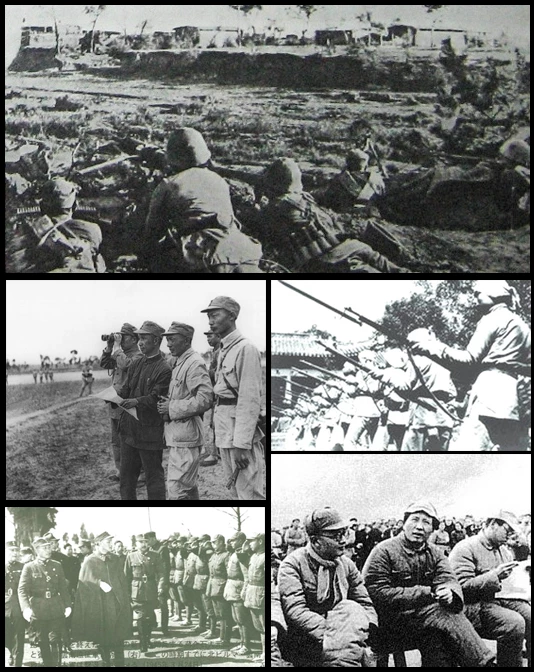
In an attempt to reunify the country, the Chinese Nationalist Party – fighting on behalf of the Republic – allied with the Chinese Communist Party and in 1927 they launched an attack that began the Chinese Civil War.
Their campaign met with some success but the alliance did not last, and the two were soon fighting amongst themselves. By 1931, the Nationalists were in control of most of China but the war with the Communists had to be put on hold when Japan invaded.
That invasion ended when Japan was defeated in the Second World War. After the Japanese surrendered in 1945, the Nationalists and Communists resumed fighting.
But this time it was the Communists – supported by Soviet Russia – who emerged dominant, and in 1949 the Republic of China was forced to retreat from the mainland to Taiwan, which was already under its control.
Mao Zedong, leader of the Communists, then established the People’s Republic of China on the mainland.
Separated by the Taiwan Strait, the old enemies remain in a standoff to this day.
Taiwan views itself as an independent country, while China views it as a breakaway province to be ‘reunified’ – though in fact the Communists have never ruled there.
How did the US get involved?
America refused to recognise the People’s Republic for decades after the war ended, and instead only maintained relations with Taiwan.
Two crises in the 1950s saw Communist forces attack some of Taiwan’s outlying islands, with the US sending ships to help its ally.
But all of that changed following Mao’s death in 1976, when reformer Deng Xiaoping took over – vowing to open China up to the world.
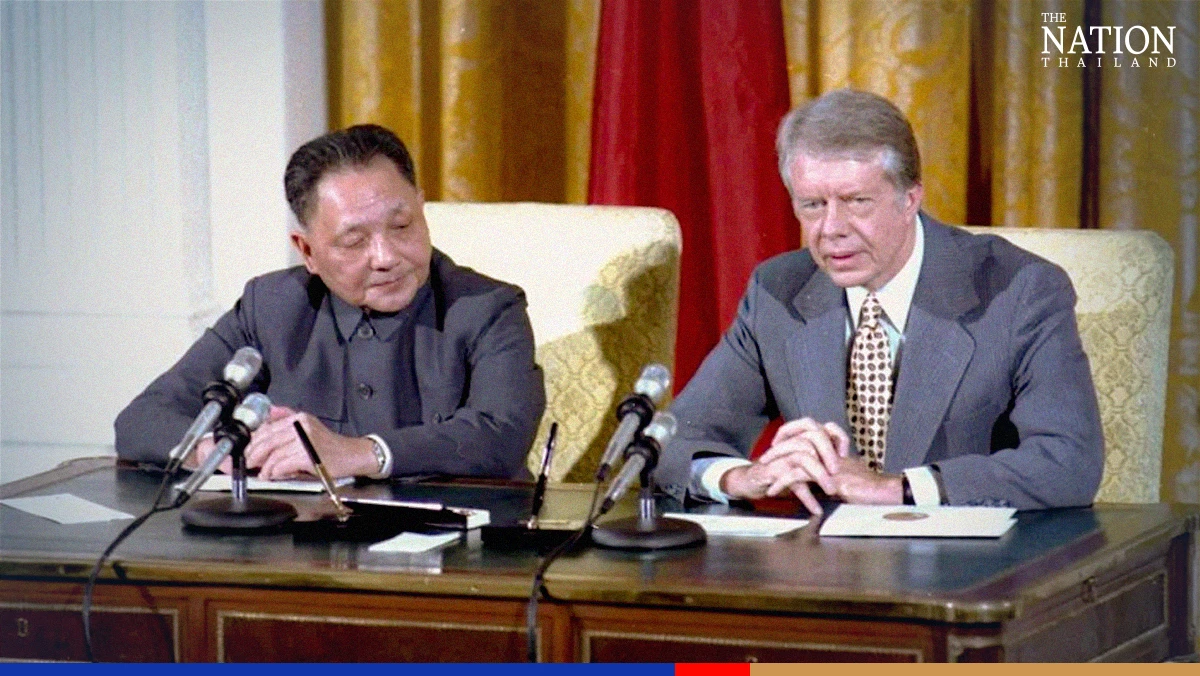
As China modernised under Deng, President Jimmy Carter agreed to normalise relations with Beijing and in 1979 the two nations signed a deal.
As part of that deal, the Carter administration agreed to recognise the ‘one China’ principle – that there is only one China, and Taiwan is a part of it.
But there was a backlash from Congress, which passed a law compelling America to supply weapons to the island for self-defence.
Another crisis in 1995 saw China try to intimidate Taiwan with a series of missile tests, provoking a huge display of military might by the US.
Beijing ultimately backed down.
How did the current crisis start?
In 2019, Xi Jinping – the current president of China – gave a speech in which he vowed to ‘reunify’ Taiwan with the mainland, calling it the ‘great trend of history.’
Xi opened the door to peaceful reunification but added that: ‘We make no promise to abandon the use of force, and retain the option of taking all necessary measures.’
His remarks came amidst a huge update of the Chinese military, and after China had built bases on islands in the South China Sea and begun threatening US ships sailing near them.
In the years since his speech, Beijing has been menacing Taiwan by flying military jets across the Strait in increasingly large numbers.
America, meanwhile, has been forging new alliances in the region with the likes of India, Australia and Japan as a counter-balance to Beijing’s power.
What has Pelosi’s visit got to do with it?
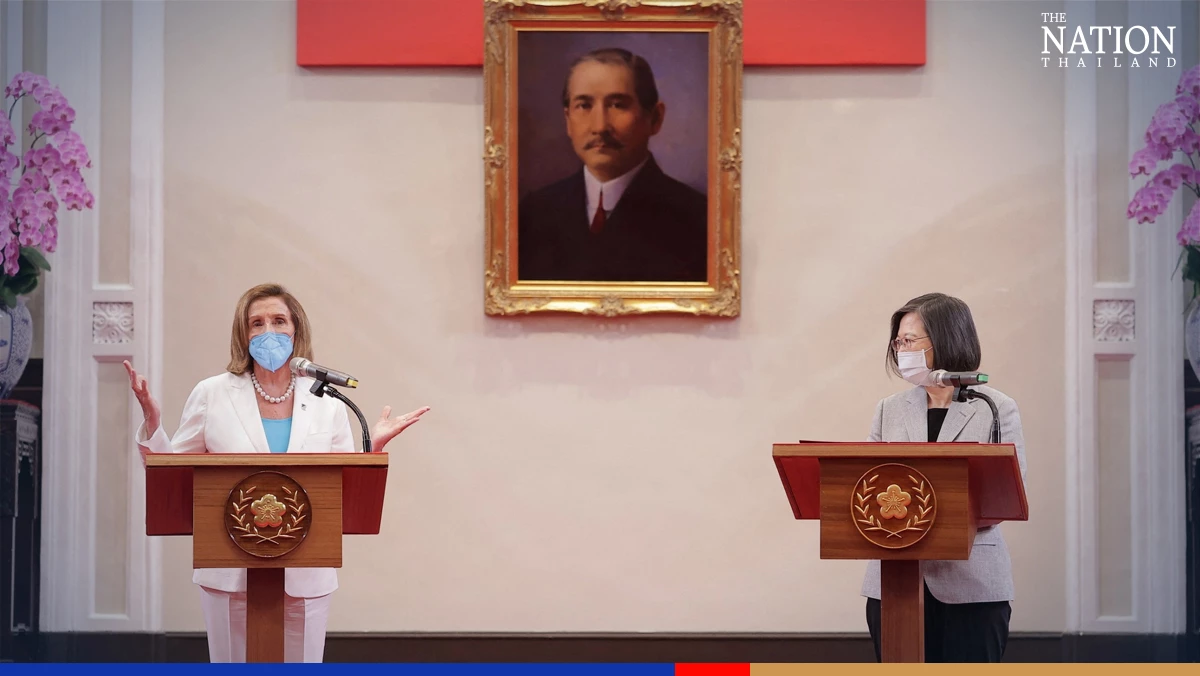
Pelosi became the highest-ranking US official since Newt Gingrich in 1997 to visit the island when she landed on August 3, 2022.
Her visit came as part of a tour of US allies in the region, designed to show America’s support in the face of increased aggression from Beijing.
Pelosi has been a critic of China’s human rights record for decades, and the trip was seen as cementing that legacy as she nears the end of her career.
But the visit came at a bad time for Mr Xi, who is preparing to be named president for an historic third term in the autumn and views ‘reunifying’ Taiwan as his destiny.
He has reacted with an unprecedented show of strength, vowing that ‘those who play with fire will die by it’.
Xi ordered six days of military drills to take place around Taiwan, that will effectively blockade the island and encroach into its territorial waters.
Could China and the US actually go to war?
Officially, America’s policy towards Taiwan is ‘strategic ambiguity’, which means Washington refuses to say what it would do if China attacked.
But President Biden has said several times that the US would come to Taiwan’s aid in a war – though each time the White House insists that he misspoke. Each time Taiwan has been threatened or attacked in the past, America has sent ships and troops into harm’s way.
Should fighting break out again, it is entirely possible the US would send forces to assist its ally, putting them in the firing line of the Chinese.
By accident or design, it is easy to see how the two superpowers could come to blows – though that outcome is far from guaranteed.
What would happen if Taiwan were attacked?
Any war between Taiwan and China – whether or not it involved the US – would certainly be bloody.
Taiwan has a modern army, equipped with state-of-the-art American weapons and has been preparing for an attack from the mainland for decades.
Though small compared to China, Taiwan’s main island is still larger than Belgium and is surrounded by dozens of smaller islands.
It would not be easy to capture, and resistance is likely to be fierce.
Taiwan also happens to be one of the most densely-populated places on Earth. With nowhere to flee, civilian casualties are likely to be high.
The knock-on effects would be also severe. Tit-for-tat sanctions between the US and China – the world’s two largest economies – are likely, threatening global recession.
Taiwan also sits close to important shipping channels which are likely to be disrupted, and China could throttle its own exports to the West – causing inflation.
The island itself is also the world’s single-largest manufacturer of semiconductors which are used to make computer chips, and any war would shut down production.
That would, in turn, cause shortages of everything from computers to smartphones and cars, whilst also threatening critical infrastructure such as satellites.
Iraqi populist cleric Moqtada al-Sadr on Wednesday told his supporters to continue their sit-in occupation of the Baghdad parliament until his demands, which include early elections and unspecified constitutional changes, are met.
The remarks, delivered by the Shi’ite Muslim leader in a televised address, are likely to prolong a political deadlock that has kept Iraq without an elected government for nearly 10 months.
Thousands of Sadr’s followers stormed Baghdad’s fortified Green Zone, which houses government buildings and foreign missions, last weekend and took over the empty parliament building staging a sit-in that is ongoing.
The moves were a response to attempts by his Shi’ite Muslim rivals, many of whom are close to Iran, to form a government with prime ministerial candidates that Sadr disapproves of.
Sadr won the largest number of seats in parliament in an October election but failed to form a government that would exclude his Iran-backed rivals.
He withdrew his lawmakers from parliament and instead applied pressure through protests and the parliament sit-in, drawing on his popular base of millions of working-class Shi’ites.
Sadr reiterated during his address that he was ready to “be martyred” for his cause.
“Dissolve parliament and hold early elections,” Sadr said.
The deadlock between Sadr and his rivals has left Iraq without a government for a record time in the post-Saddam Hussein era.