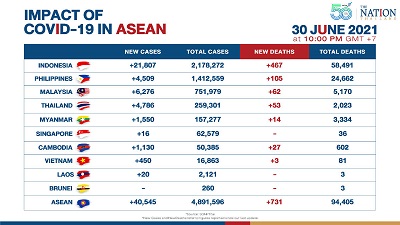
The number of Covid-19 cases in Southeast Asia crossed 4.89 million, with 40,545 new cases reported on Wednesday – higher than Tuesday’s tally of 39,463 – while 731 more people died, just under Tuesday’s 739, taking total coronavirus deaths in Asean to 94,405.
Prices of oxygen canisters in the Indonesian capital Jakarta more than doubled and some suppliers reported shortages on Wednesday after a surge in Covid-19 cases. With over 20,000 patients each day, the Red Cross warned of an upcoming “catastrophe” in the country.
Cambodia meanwhile reported a new record of 1,130 cases and 27 deaths on Wednesday, bringing cumulative cases in the country to 50,385 patients and a total 602 deaths.
That country’s health minister said the situation has now reached a red line for community transmission due to the new Delta variant found in several areas.
Cambodia has so far vaccinated 4.1 million people from the government’s target of 10 million.
Majority of Florida condo board quit in 2019 as squabbling residents dragged out plans for repairs
The president of the board of the Florida condominium that collapsed last week resigned in 2019, partly in frustration over what she saw as the sluggish response to an engineers report that identified major structural damage the previous year.
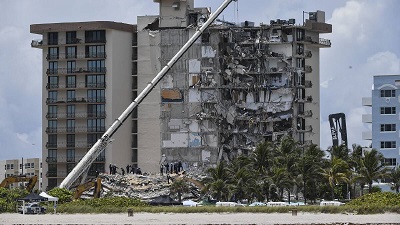
Rescue workers dig through debris at the collapsed Champlain Towers South condo building Saturday, June 26, 2021, in Surfside, Fla. MUST CREDIT: Washington Post photo by Ricky Carioti
Anette Goldstein was among five members of the seven-member board to resign in two weeks that fall, according to minutes from an Oct. 3 meeting, at a time when the condo association in Surfside was consumed by contentious debate about the multimillion-dollar repairs.
“We work for months to go in one direction and at the very last minute objections are raised that should have been discussed and resolved right in the beginning,” Goldstein wrote in a September 2019 resignation letter. “This pattern has repeated itself over and over, ego battles, undermining the roles of fellow board members, circulation of gossip and mistruths. I am not presenting a very pretty picture of the functioning of our board and many before us, but it describes a board that works very hard but cannot for the reasons above accomplish the goals we set out to accomplish.”
Debate over the cost and scope of the work, along with turnover on the volunteer board, dragged out preparations for the repairs for three years, according to previously unpublished correspondence, condo board minutes and other records kept by the homeowners association.
Concrete restoration work had not yet begun when the building partially collapsed June 24. Identifying the cause of the catastrophe is expected to take many months, and it is not clear whether the problems identified in 2018 played a role. At least 16 people were killed in the catastrophe, and 147 remain missing.
Despite increasingly dire warnings from the board, many condo owners balked at paying for the extensive improvements, which ballooned in price from about $9 million to more than $15 million over the past three years as the building continued to deteriorate, records show.
“The question is, ‘Why did it take three years to get this point?’ ” Max Friedman, a former board member who left the board before the 2018 report, said in an interview with The Washington Post. “It took a lot of time to get the ball rolling, and of course there was sticker shock. Nobody truly believed the building was in imminent danger.”
Goldstein and the other board members who resigned did not return messages seeking comment. The precise reasons for the resignations of the other four members are not clear in the documents examined by The Post.Goldstein and some of the others later returned to the board, one just three weeks after stepping down, documents indicate.
Efforts to reach virtually everyone who has served on the board since 2018 were unsuccessful; at least two of those members have been reported missing.
A spokesperson for the condo association, Max Marcucci, declined to comment for this article.
Miami-Dade County requires buildings to be inspected and recertified as safe after 40 years. Real estate lawyers say the process often stretches out beyond that time. The condominium building, Champlain Towers South, was constructed in 1981.
The engineer, Frank Morabito, found “major structural damage” to a concrete slab below the pool deck, caused by a flaw that limited water drainage, according to the 2018 review that outlined the repairs needed for the 40-year recertification.
A resident told The Post that minutes before Champlain Towers South came down, she noticed that a section of the pool deck and a street-level parking area had collapsed into the parking garage below. Experts have said the collapse appeared to involve a failure at the lowest levels of the building or in the parking garage beneath it.
By the time of the collapse, the board had rallied additional support for the repairs, some residents said. The building had 136 units and a diverse population of retired snowbirds, Northeastern transplants, Orthodox Jews and Latin Americans.
The board unanimously voted in favor of a $15 million special assessment to pay for the upgrades to the building on April 13.
As recently as April, residents appeared divided over the repairs – with dozens signing a letter that questioned the details of the proposed spending and asked the board to consider a lower assessment. “We cannot afford an assessment that doubles the amount of the maintenance dues currently being paid,” the group wrote.
In a 2018 email to other town officials, Ross Prieto, then a Surfside building official, praised the condo board for getting a jump-start on the 40-year review. “This particular building is not due to begin their forty year until 2021 but they have decided to start the process early which I wholeheartedly endorse and wish that this trend would catch on with other properties,” Prieto wrote in the Nov. 15 email.
ADVERTISEMENT
But what may have looked to Prieto like a running start soon became a slow walk.
“A lot of this work could have been done or planned for in years gone by. But this is where we are now,” current board president Joan Wodnicki told condo owners in a letter on April 9, 2021, that warned damage to the structure’s concrete support system was accelerating.
In a follow-up note the next day, before a meeting about the $15 million in repair costs, Wodnicki wrote: “As we approach next Tuesday’s meeting on the Special Assessment, I ask everyone to try to remain calm. I know there is a lot of anxiety and there are many questions. It’s a lot of information and a lot of money. We will continue to do our best to address everyone’s concerns.”
Her warnings to homeowners about the urgent need for repairs had gone on for months. “I want you to know that the numbers we are hearing so far are much higher than the original Morabito estimate,” she wrote on Oct. 23, 2020. “However, the project is also much larger . . . The concrete damage is more extensive than it was when first looked at in 2018, and prices have gone up.”
She added: “I wish I could be giving easier news, but the reality is that we live in an aging oceanfront building that needs work. Our Maintenance will probably be going up, and the renovation will be very expensive. Within those boundaries, we can work on prioritizing, getting the lowest prices, getting the best loan terms, and other ways of containing costs. But our home needs attention, and this is not a surprise. We have known for several years now that this was coming.”
ADVERTISEMENT
Wodnicki did not respond to requests for comment from The Post.
The board held meetings on Zoom throughout much of 2020 and 2021 because of the coronavirus pandemic. Some were attended only by a handful of people outside of the board, records show. Highly technical explanations of the building’s maintenance needs and a complicated breakdown of the costs are available on an internal website.
The pandemic appeared to exacerbate tensions in the building. A March 2020 note to homeowners said the board had adopted a new rule: “No Owner, resident or guest may be verbally or physically abusive or otherwise engage in conduct that is offensive, threatening or harassing to any other Owner, resident or guest.”
Condo owner Adalberto Aguero told The Post that he and his wife were not aware of the 2018 inspection report when they purchased their one-bedroom unit in mid-2019 – a process that involved an interview with a board member. They did not attend condo board meetings but were aware of the resignation of one board president.
“There was a lot of fighting and bickering,” said Aguero. From the correspondence the couple received, he said, “you get the feeling that things were not right.”
Earlier this year, the couple received an assessment for $80,000 over more than a decade for their share of the pending repairs – a price Aguero said seemed steep. “I thought it was a very high amount of money,” he said. But they had renovated their place and loved the condo. “We had no choice. What were we going to do?”
Aguero and his wife were not home at the time of the collapse.
In the spring of 2019, before the slew of resignations, a letter sent to condo owners on behalf of the board sought to dampen brewing opposition.
“This will be a challenging time for all of us at Champlain Tower South,” it said. “Our building has been neglected for some time and we have to begin preparing for our upcoming Recertification. The board is working very hard to find ways to meet the desperate needs of the building. It would be irresponsible to continue to ignore these needs.”
Published : July 01, 2021
By : The Washington Post · Beth Reinhard, Tik Root, Brady Dennis, Jon Swaine
47 animals dead at Hyogo zoo; malnutrition, neglect cited
KOBE — A total of 47 animals have died in captivity at the Tatsuno Park Zoo in Hyogo Prefecture over a five-year period up to March this year, according to documents obtained from the Tatsuno municipal government by The Yomiuri Shimbun.
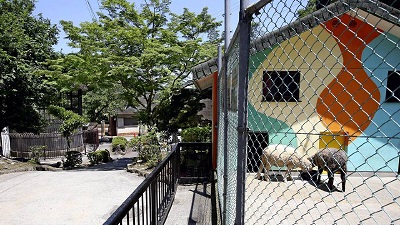
Two sheep are seen with unshorn coats in hot weather on June 1 at the Tatsuno Park Zoo in Tatsuno, Hyogo Prefecture. MUST CREDIT: The Japan News-Yomiuri
Experts expressed shock at the mortality rate, equivalent to over half of the 81 animals currently held by the small zoo.
Malnutrition and other effects of negligent care have been cited for a conspicuous number of deaths. The zoo’s round-the-clock visitation hours have also been flagged as a cause of stress for the animals.
The Tatsuno municipal government has pledged an overhaul of the zoo’s management system in response to the situation.
A crab-eating monkey withered away in January this year. The monkey’s death report read: “Malnutrition is a possible cause of death; believed to have been weakened by the cold weather.”
The report for another crab-eating monkey that died in March last year read: “Emaciation and hair loss suggest malnourishment.”
The Yomiuri Shimbun made an information disclosure request to the city to obtain death certificates and other documents relating to the zoo. The files showed that 47 animals, representing 12 different species, died over a five-year span from April 2016 to the end of March this year. Among the tally were 13 crab-eating monkeys, nine guinea pigs, four goats — and even an Asian black bear that died in February 2018.
“Animals don’t last long at the Tatsuno Park Zoo,” said Tetsuya Sato, director of the Kobe Animal Kingdom in Kobe and a board member of the Japanese Association of Zoos and Aquariums (JAZA). “In the past, the zoo had an unusually skinny old goat on display. I also doubt whether it is appropriate to keep crab-eating monkeys outdoors all year round, given how they are so susceptible to the winter weather.”
Tatsuno Park Zoo opened in 1955. Admission is free and the zoo is open 24 hours a day, seven days a week.
At present, the 7,500-square-meter zoo holds 81 animals from 12 different species, including bears, peacocks, and monkeys. The zoo sources most of its animals free from the Himeji City Zoo and purchases others from a nonprofit organization.
The current city of Tatsuno was created in fiscal 2005 as the result of a municipal merger. Annual zoo attendance peaked at about 38,000 visitors in fiscal 2009. About 11,000 people visited the zoo in fiscal 2019.
It is an extreme example of the lack of resources and other challenges that encumber small-scale zoos.
The Tatsuno Park Zoo does not have specialist caretakers on staff. Instead, several municipal officials with no specialized training take turns attending to the animals, cleaning their cages and feeding them. As government employees, staff were given national holidays off. The animals were left alone on holidays up until the autumn of 2019. After receiving complaints from an external party, the city turned to the local “silver human resources center,” a program which helps find work for the elderly, and commissioned a lone man to fill in.
ADVERTISEMENT
The zoo has reportedly not kept records for some of its animals to know their dates of birth, heights and weights.
No staff are on duty at night. In one past incident, fireworks were shot into the bear cage around midnight.
In addition to the bears, six animal enclosures do not have backyards with greenery for the animals to roam. A peacock had to receive medical attention after it lost its feathers. The bird is believed to have molted from the stress of being watched all the time.
The Tatsuno Park Zoo’s annual budget has ranged between 8 million yen to 11 million yen in recent years.
A comparably sized public zoo could be expected to have an annual budget of around 50 million yen. “I think it would be difficult to run a zoo on 10 million yen a year,” said a public zoo official.
ADVERTISEMENT
Still, the zoo is a familiar fixture in Tatsuno. The city’s schoolchildren often visit on field trips, and the zoo has been involved in educational initiatives to bring animals into classrooms.
“The zoo is a place where citizens can relax,” said one municipal government official. “We need a familiar place where people can commune with animals,” they added.
Although the city does not intend to shut down the zoo anytime soon, it has said that it will work to improve how the zoo is operated.
To reduce the stress placed on animals, the city will consider closing the entrance at night. Health checkups are currently performed by a local veterinary clinic once every two months. In response to concern over the animals’ well-being, the city said it will increase the frequency of checkups to once per month, so that animals can receive quicker treatment when they get sick.
China is building more than 100 new missile silos in its western desert, analysts say
China has begun construction of what independent experts say are more than 100 new silos for intercontinental ballistic missiles in a desert near the northwestern city of Yumen, a building spree that could a signal a major expansion of Beijings nuclear capabilities.
Commercial satellite images obtained by researchers at the James Martin Center for Nonproliferation Studies in Monterey, Calif., show work underway at scores of sites across a grid covering hundreds of square miles of arid terrain in China’s Gansu province. The 119 nearly identical construction sites contain features that mirror those seen at existing launch facilities for China’s arsenal of nuclear-tipped ballistic missiles.
The acquisition of more than 100 new missile silos, if completed, would represent a historic shift for China, a country that is believed to possess a relatively modest stockpile of between 250 and 350 nuclear weapons. The actual number of new missiles intended for those silos is unknown but could be much smaller. China has deployed decoy silos in the past.
During the Cold War, the United States developed a plan to move its ICBMs across a matrix of silos in a kind of nuclear shell game, to ensure that Soviet war planners could never know exactly where the missiles were at any given time.
The construction boom suggests a major effort to bolster the credibility of China’s nuclear deterrent, said researcher Jeffrey Lewis, an expert on China’s nuclear arsenal and part of a team that analyzed the suspicious sites, first spotted by colleague Decker Eveleth as he scoured photos taken by commercial satellites over northwestern China. Lewis described the scale of the building spree as “incredible.”
“If the silos under construction at other sites across China are added to the count, the total comes to about 145 silos under construction,” Lewis, director of the East Asia Nonproliferation Program at the Center for Nonproliferation Studies, part of the Middlebury Institute of International Studies, said in a summary of his findings provided to The Washington Post. “We believe China is expanding its nuclear forces in part to maintain a deterrent that can survive a U.S. first strike in sufficient numbers to defeat U.S. missile defenses.”
The discovery follows recent warnings by Pentagon officials about rapid advances in China’s nuclear capability. Adm. Charles Richard, who commands U.S. nuclear forces, said at a congressional hearing in April that a “breathtaking expansion” was underway in China, including an expanding arsenal of ICBMs and new mobile missile launchers that can be easily hidden from satellites. In addition, the Chinese navy has introduced new nuclear-weapons-capable submarines to its growing fleet.
The reported silo construction project could provide China with yet another means of concealing its most powerful weapons. The construction sites spotted on satellite photos are arrayed in two huge swaths, covering parts of a desert basin stretching to the west and southwest of Yumen, a city of 170,000 people along China’s ancient Silk Road.
Each site is separated from its neighbors by about two miles, and many of the sites are concealed by a large, dome-like covering, following a practice observed at known construction sites for missile silos in other parts of China. At sites where the dome is not in place, construction crews can be seen excavating a characteristic circular-shaped pit in the desert floor. Another construction site appears to be a partially built control center.
Lewis said the silos are probably intended for a Chinese ICBM known as the DF-41, which can carry multiple warheads and reach targets as far away as 9,300 miles, potentially putting the U.S. mainland within its reach. Major excavation work on the sites began early this year, although preparations were probably underway for months, Lewis said.
Emails and faxes seeking comment from China’s Foreign Ministry in Beijing and the Chinese Embassy in Washington did not receive a response.
A Defense Department spokesman declined to comment on the satellite images or to discuss U.S. intelligence assessments of China’s nuclear program. But the spokesman, John Supple, noted that Pentagon reports and analysts have previously raised concerns about the proliferation of China’s missile silos. “Defense Department leaders have testified and publicly spoken about China’s growing nuclear capabilities, which we expect to double or more over the next decade,” Supple said.
Missile silos are easily spotted by trained imagery analysts, and they are vulnerable to destruction by precision-guided missiles in the early hours of a nuclear war. For those reasons, Lewis sees the silo construction project as part of an expanded deterrent strategy by a country whose nuclear arsenal is dwarfed by those of the United States and Russia, which collectively possess more than 11,000 nuclear warheads.
Rather than engaging in an expensive arms race with Washington and Moscow, China has traditionally embraced a “limited deterrence” doctrine that prioritizes a lean but robust nuclear arsenal that ensures Beijing’s ability to retaliate against any adversary if attacked.
In recent years, however, Chinese officials have complained that their country’s nuclear deterrent is losing credibility because of nuclear modernization programs proposed or already underway in Russia and the United States. Beijing has resisted calls to join new arms-control talks because of fears that new limits would forever enshrine its status as a second-rate nuclear power compared with Washington and Moscow.
Photos of the Gansu construction project were supplied to Lewis and Eveleth by the commercial satellite company Planet, which provided a continuous stream of updated images showing progress at each of the construction sites over time. Based on his analysis, Lewis said, there was “a very good chance that China is planning a shell game” in which it hides a relatively small number of warheads across a network of silos. Still, he said, the sudden appearance of so many new launch sites could increase pressure on U.S. officials to speed up efforts to modernize the U.S. arsenal.
“We’re stumbling into an arms race that is largely driven by U.S. investments and missile defense,” Lewis said. The Pentagon has announced plans for an extensive upgrade of U.S. nuclear weapons and delivery systems over the next two decades, including a new air-launched cruise missile and at least two new types of warheads.
In February, Secretary of State Antony Blinken vowed in a statement that the Biden administration would “pursue arms control to reduce the dangers from China’s modern and growing nuclear arsenal.” He did not explain how that goal would be accomplished but said the administration would seek “effective arms control that enhances stability, transparency and predictability while reducing the risks of costly, dangerous arms races.”
Russians press Putin on new coronavirus vaccine rules
MOSCOW – Russian President Vladimir Putin, facing a devastating coronavirus outbreak in the country coupled with widespread vaccine hesitancy, took to national television Wednesday to field concerns from citizens feeling pressured to get their shots.
In an attempt to persuade them, he even revealed new details about his own secretive vaccination and spoke of how people from his “immediate inner circle” had been sick with the virus.
During Putin’s annual “Direct Line” call-in show, in which citizens can submit (largely prescreened) queries for the president, he was pressed by discontented Russians about the rising cost of food, loans for small business, social payments and other domestic issues.
But the hot topic was vaccination, as the event coincided with the recent controversial move by regions across Russia to order 60% of workers who interact with the public – teachers, taxi drivers, salespeople and others – to get vaccinated or find different jobs. The call-in show marked Putin’s first extensive comments about the new measures.
Although they make vaccination de facto mandatory for a large swath of the population, Putin said Wednesday that he doesn’t support compulsory inoculation. But after a year in which he and other officials claimed that Russia had handled the pandemic better than other countries and lifted nearly all restrictions, Putin stressed the seriousness of the coronavirus.
“The only way to prevent the pandemic from developing further is vaccination,” he said. “I hope that the prejudices among people will decrease.”
He then made a dig at two Western vaccines – Pfizer-BioNTech and Oxford-AstraZeneca – by claiming that they havethere dangerous side effects. The AstraZeneca vaccine has been plausibly linked to extremely rare but in some cases fatal blood clots. European and U.S. regulators have not linked the Pfizer vaccine to any such side effects.
When Moscow announced the new measures on June 16, just 15% of Muscovites had been vaccinated, according to Mayor Sergei Sobyanin, despite Russia’s Sputnik V vaccine being widely available and free. The uptake was worse for the rest of the country, at just 11.5%.
Just minutes before the call-in show began, Russia announced that it recorded 21,042 new coronavirus cases and a record number of related deaths, 669, in the past day.
Putin was then asked whether he had actually been vaccinated, because there were no photos or video of him getting a shot. He disclosed that he had opted for the Sputnik V vaccine, saying “there wasn’t a single serious side effect.” He added that his daughter was also vaccinated with Sputnik V.
Russia was the first country to authorize a coronavirus vaccine when it approved Sputnik V for mass use in August. But 62% of Russians polled in April said they would not receive it, according to the Levada Center, an independent polling and research institute.
Accordingly, the new vaccine rules have divided Russian society. In Moscow, restaurants and bars have been ordered to limit admission to people with a QR code confirming their vaccination or proof of a negative PCR coronavirus test within the previous three days.
“The actions taken by our colleagues in certain regions are aimed at preventing the need for lockdown, when whole enterprises stand idle,” Putin said. “In order to avoid those things, certain regions are carrying out mandatory vaccination of certain categories of citizens.”
Putin’s “Direct Line” call-in show has been a staple of his more-than 20-year reign – with the exception of last year’s coronavirus-related hiatus. The carefully choreographed show lasted nearly four hours. Russians are invited to send in questions to the president, and the Kremlin said it received about 2 million this year.
The goal is to portray a Putin who is deeply invested in Russians’ lives, tackling even granular issues during the show and then ordering officials to look into them.
“Putin needs this poor population to demonstrate that he is irreplaceable: only he can fix the roof and fix the gas. Other institutions do not work,” analyst Andrei Kolesnikov of the Carnegie Moscow Center wrote on Twitter.
Most of the call-in show focused on domestic issues, but Putin did address Russia’s relations with Ukraine and a recent spat in the Black Sea with a British destroyer, which Putin called a “provocation” by both the Americans and the British.
On June 23, Russia said it used bombs and gunfire as “warning shots” to force the HMS Defender to leave waters it claims off the coast of the annexed Crimean Peninsula. The British denied they were fired on.
Putin said the exchange was monitored by a U.S. reconnaissance plane and it was a test of Russian defenses.
Asked about meeting with Ukrainian President Volodymyr Zelensky in the future, Putin replied, “Why meet with Zelensky now that he has fully ceded his country to external governance?” He added that Washington, Berlin and Paris decide “on key aspects of Ukraine’s everyday functioning.”
ดังนั้นสิงคโปร์จึงเปลี่ยนแนวทางมาอยู่ร่วมกับ Covid-19 แทน โดย Gan Kim Yong รัฐมนตรีกระทรวงพาณิชย์, Lawrence Wong รัฐมนตรีกระทรวงการคลัง และ Ong Ye Kung รัฐมนตรีกระทรวงสาธารณสุขสิงคโปร์ระบุในบทความพิเศษของ The Straits Times ว่า “ข่าวร้ายคือ Covid-19 อาจไม่หายไป ข่าวดีคือเราใช้ชีวิตตามปกติกับมันได้”
เว็บไซต์ The Times of Israel รายงานว่า กระทรวงสาธารณสุขของอิสราเอลอาจต้องทำลายวัคซีน Pfizer/BioNTech อย่างน้อย 800,000 โดสที่กำลังจะหมดอายุปลายเดือน ก.ค.นี้ หากไม่สามารถหาผู้ซื้อได้ทันภายใน 2 สัปดาห์ข้างหน้า
การประกาศของ Moderna ครั้งนี้เกิดขึ้นเพียงไม่กี่วันหลังจากที่องค์การอนามัยโลก (WHO) เน้นย้ำว่าแม้จะฉีดวัคซีนครบแล้วก็ห้ามการ์ดตก ควรสวมหน้ากากอนามัย เว้นระยะห่าง และปฏิบัติตามมาตรการป้องกันโรคอย่างเคร่งครัด เนื่องจากสายพันธุ์เดลตาแพร่ระบาดอย่างรวดเร็วไปทั่วโลก
ก่อนหน้านี้ทีมวิจัยจากมหาวิทยาลัยมหาวิทยาลัยวอชิงตันของสหรัฐพบหลักฐานว่าภูมิคุ้มกันจากวัคซีนของ Moderna และ Pfizer มีความแข็งแกร่งและอาจคงอยู่ได้นานหลายปี



 สิงคโปร์เปลี่ยนแผนรับมือ Covid-19 จากที่คุมสุดเข้ม หันมาป้องกันไวรัสระบาด ระดมฉีดวัคซีนเลิก เลิกนับตัวเลขคนติดเชื้อ เตรียมกลับไปใช้ชีวิตปกติ
 ลาวยืนยันพบโควิด-19 สายพันธุ์เดลตาครั้งแรกซึ่งเป็นแรงงานที่เดินทางกลับจากไทย
 สตาร์ทอัพที่ตั้งใจจะมอบเหรียญดิจิทัลให้แก่ทุกคนเพียงแค่สแกนม่านตา
 อิสราเอลอาจต้องทำลายวัคซีน Pfizer ที่จะหมดอายุสิ้นเดือนหน้าเกือบ 1 ล้านโดสทิ้งหากหาผู้รับซื้อต่อไม่ได้
 หุ้น Moderna ปิดทำนิวไฮรับข่าวดีวัคซีนสามารถป้องกันโควิด-19 กลายพันธุ์

