U.S. seizes websites linked to Iranian government propaganda
WASHINGTON – The U.S. Justice Department moved Tuesday to seize more than 30 Web domains linked to Iranian state media, as American officials continued their efforts to counter what they say is Iranian propaganda at a time of simmering tensions between the two countries.
Anumber of the domains, including some used by English-language Press TV, an Iranian state-owned news channel, posted notices Tuesday indicating they had been taken down by U.S. authorities. The websites for Al-Alam TV, another Iran-owned news channel that broadcasts in Arabic, and the website for Al-Masirah, a Beirut-based outlet that serves as a mouthpiece for an Iranian-allied rebel group in Yemen, posted similar notices.
The move by the Justice Department came during delicate negotiations between Iran and the United States to revive a 2015 nuclear deal, and a day after Iran’s new president-elect, Ebrahim Raisi, took a hard line toward the U.S., ruling out the possibility of meeting with President Joe Biden and declaring he would not negotiate over his country’s ballistic missile program.
Iran’s government had no immediate response to the U.S. action.
The websites were targeted for distributing propaganda, according to a person familiar with the matter, who spoke on the condition of anonymity because corresponding court documents detailing the U.S. government’s action had not been made public yet.
Press TV and Al-Alam are owned by the official Islamic Republic of Iran Broadcasting, or IRIB, and carry content that often reflects the views of more hard-line factions in Iran’s leadership. In recent weeks, Press TV has reported extensively on nuclear negotiations between Iran and world powers in Vienna and aired several exclusive interviews with Tehran’s lead negotiator in the talks.
The site, which remained accessible from some places Tuesday, carried a breaking news story calling the seizures “a coordinated action.” The news service, which often criticizes American foreign policy, “has repeatedly fallen victim to censorship on multiple fronts, including Twitter and Instagram besides Google and its services,” the story said.
Al-Alam, which was also partly accessible, ran a brief item saying its website had been blocked, a move the channel called contrary to “freedom of opinion.”
Last year, federal prosecutors in the United States seized more than 100 domain names that officials said were unlawfully used by Iran’s government to engage in a “global disinformation campaign.”
Court papers filed in that case said the domains were used by Iran’s Islamic Revolutionary Guard Corps. Four of the sites seized in that action purported to be genuine news outlets. Some of the seized sites, the U.S. government said, spread Iranian propaganda in the hopes of influencing U.S. policy, in violation of the Foreign Agents Registration Act, while others spread Iranian propaganda in other countries.
Those sites, U.S. officials said, also violated U.S. sanctions against both the Iranian government and the IRGC.
Published : June 23, 2021
By : The Washington Post · Devlin Barrett, Kareem Fahim
E.U. opens antitrust investigation into Googles core moneymaker: Advertising
The European Union has launched an investigation to determine whether Google exerts too much control over the sprawling online marketing industry, in which advertisers can surveil, target and influence consumers through nearly any tech platform in which they engage.
The Silicon Valley company is present “at almost all levels of the supply chain for online display advertising,” said Margrethe Vestager, an executive vice president of the European Commission and a longtime critic of Big Tech. Her investigation will focus on whether Google’s many footholds in the video-advertising supply chain allow it to boost its own services and downgrade competing ones. The company’s data collection tools, which hoover up vast quantities of user information, could give it an unfair advantage, she added.
Advertising technology encompasses a dizzying number of products and tools built by hundreds of companies. Some are used by Web publishers to sell ad space, while others are used by advertisers to buy it. In between sit levels of exchanges and advertising networks that connect the two. Although many companies compete at each level, Google dominates the landscape, selling tools for nearly every step.
Because the tech giant is also one of the largest sellers of online advertising space, it has been accused by competitors of using its heft in the industry to push people to buy its own ads over others.
The investigation announced Tuesday appears to focus on several of the company’s video advertising products. Placing ads on Google-owned YouTube requires going through Google’s ad-buying platform, essentially forcing advertisers to use the Google tool if they want access to the massive video site’s 2 billion users.
The commission is interested in ways that this ad management tool creates restrictions against other ad-tech firms looking to reach customers through YouTube.
The commission wants to determine whether certain Google-designed virtual platforms are favoring the company’s other products in such a way that shuts competitors out of the ad industry’s virtual supply chain.
“We are concerned that Google has made it harder for rival online advertising services to compete in the so-called ad tech stack,” Vestager said.
Google contends that its tech services fees are lower than reported industry averages and that most publishers use a range of advertising technologies.
“Thousands of European businesses use our advertising products to reach new customers and fund their websites every single day,” a Google spokeswoman said in an email. “They choose them because they’re competitive and effective.”
The investigation comes just two weeks after the French government fined Google 220 million euros for abusing its position in the advertising tech market. The company agreed to change some of its tools so they plug in more easily with competitors’ products, French authorities said.
In the United States, lawmakers have zeroed in on Google’s advertising business, too. Politicians have likened the online advertising industry to the stock market, but where Google plays the role of both exchange and broker, allowing it to see the most favorable prices and prioritize its bids over those of others.
A 2020 lawsuit from the Texas attorney general also makes that claim and argues that Google’s practices have pushed up the cost of advertising for businesses, therefore harming American consumers.
Dina Srinivasan, a Yale University fellow who also is a paid consultant in Texas’s suit, said in a recent paper that Google’s preeminence in the global advertising market is enabled by the government’s lack of intervention. She wrote that the company “steers buy and sell orders” to its own businesses and “abuses access to inside information.”
“In the market for electronically traded equities, we require exchanges to provide traders with fair access to data and speed, we identify and manage intermediary conflicts of interest, and we require trading disclosures to help police the market,” Srinivasan wrote. “Because ads now trade on electronic trading venues too, should we borrow these three competition principles to protect the integrity of advertising?”
Google has called the Texas lawsuit “meritless” and is fighting it in court.
Tuesday’s E.U. investigation is just the latest of several actions by Europe attempting to rein in Silicon Valley. A 2016 E.U. regulation forced companies to adhere to strict privacy requirements related to their collection and use of online data, forcing some companies to reshape their practices for fear of steep fines. And under Vestager’s leadership, the European Commission has fined Google billions of dollars for its practices in several other markets.
The investigation announced Tuesday could also turn a critical eye toward how the company handles user data. In particular, several recent policies from the company have the effect of shutting off other firms’ access to user data, while Google continues to leverage it for ad-targeting purposes. By collecting users’ data and refusing to share it with competitors – which is increasingly the case for the company’s browser-based ad-targeting and mobile products – Google may have a leg up compared to its competitors.
ADVERTISEMENT
In Tuesday’s announcement, Vestager said Google’s presence throughout this virtual supply chain has prevented other companies from monetizing a lucrative industry.
“A level playing field is of the essence for everyone in the supply chain,” she wrote. “Fair competition is important – both for advertisers to reach consumers on publishers’ sites and for publishers to sell their space to advertisers, to generate revenues and funding for content.”
Published : June 23, 2021
By : The Washington Post · Aaron Gregg, Gerrit De Vynck
On the 80th anniversary of the outbreak of the Great Patriotic war
On this day, state flags in Russia are lowered. Entertainment events and programs are suspended or shortened. The country leadership lays mourning wreaths at the Tomb of the Unknown Soldier in Moscow.
22 June 2021 marks the 80th anniversary of the outbreak of the Great Patriotic war of the people of the Soviet Union against Nazi Germany and, the most sanguinary conflict in the Russian history. The Great Patriotic war is also, undoubtedly, the most important confrontation within a broader World War II.
At dawn on June 22, 1941 Nazi Germany attacked the Soviet Union without a declaration of war. Its aircrafts started massive bombing of airfields, railroad hubs, naval bases, places of permanent deployment of troops and many cities to a depth of up to 250-300 kilometers in the Soviet territory.
By this time, Nazi Germany had occupied or invaded many European countries (Poland, Denmark Norway, Belgium, The Netherlands, Luxembourg, France and others), and the Soviet people took the most powerful blow. Romania, Italy, Slovakia, Finland, Hungary, and in mid-August Norway joined the aggression against the USSR. The Soviet people responded to the enemy with a unified resistance, standing to the death, defending the fatherland.
The Nazi invasion caught the Soviet Union off guard. Our country was unprepared to fight with such a mighty enemy. New models of tanks and planes were yet to be developed. All these factors contributed to a colossal cost that the country had to pay for the victory. The losses born by the Soviet Union throughout a four-year long heroic ordeal to restore peace are both terrific and terrifying.
Soviet losses alone accounted for 40% of total casualties in WWII. About one million Soviet soldiers gave their lives during the liberation of the peoples of Europe. The combined human losses of the USSR during the war were 27 million people. More than 8.7 million of them died on battlefields, 7.42 million people were deliberately exterminated by the Nazis in the occupied territories, and more than 4.1 million died from the brutal conditions of the occupation regime. 5.27 million people were taken to hard labor in Germany and its neighboring countries, which were also under German occupation. More than half of them, 2.65 million returned home. More than 450,000 immigrated and 2.16 million were killed or died in captivity.
The human and material losses suffered by the country because of the Nazi aggression are incomparable. History has never known such destruction, barbarism and inhumanity, as was marked by the murderous acts of the Nazis on Soviet soil.
ADVERTISEMENT
Today we are seeing increasing attempts to falsify the history of WWII: to belittle or keep completely silent about the role of the USSR in defeating Nazism, to whitewash the villains, to put executioners and their victims on the same level, and to question the outcomes of the war and the verdicts of the Nuremberg Tribunal. The goal of such speculation is clear. It is not only to denigrate modern Russia as the successor of the Soviet Union, but also to cover up the unseemly role of their own states’ complicity with the Hitler regime, to justify the ugly excesses of neo-Nazis and an unscrupulous war on monuments to soldiers-liberators.
It is worth reminding everyone that our country made a decisive contribution to defeating the Hitler war machine and liberating Europe and the world from Nazism.
22 June is also known in Russia as a Day of Remembrance and Sorrow. Since 1992 this day became an official commemorative date. On October 24, 2007 Russian President Vladimir Putin signed amendments to the law “On the days of military glory and anniversaries in Russia,” which added a new one to the list of anniversaries – June 22 – the Day of Remembrance and Sorrow.
On this day, state flags in Russia are lowered. Entertainment events and programs are suspended or shortened. The country leadership lays mourning wreaths at the Tomb of the Unknown Soldier in Moscow. The Russian people mourn for all compatriots who defended their homeland at the cost of their lives or became victims of the wars, especially the Great Patriotic War of 1941-1945 years.
History is here to draw lessons from it. One of them is that a desire to rule the world inevitably ends in failure. So do attempts to ensure one’s own security at the expense of another’s. It is trust, along with realism in international relations that will ensure a lasting and enduring peace in the world.
Up to 10,000 domestic spectators to be allowed at Tokyo Olympics venues
The Tokyo 2020 organising committee announced on Monday that Japanese spectators would be allowed to attend events at the Olympic Games this summer with the attendance capped at up to 50 per cent of a venue’s capacity, or a maximum of 10,000 people, said Patthama Leesawaskrakul, a member of the International Olympic Committee (IOC).
“The number has been agreed on by the IOC, the International Paralympic Committee (IPC), the Japanese government, Tokyo Metropolitan Government and local organisers to ensure the safety of Olympic fans amid the ongoing Covid-19 pandemic,” she said. “However, it remains to be seen whether the Japanese government will announce another state of emergency to curb the outbreak after July 12.”
According to Patthama, fans attending events at the Tokyo Olympics, which will be held from July 23 to August 8, will need to adhere to disease control measures. They include a mandatory wearing of face mask at all time, no shouting or loud talking, and spectators must leave the venue immediately after the event ends.
A decision on spectators at the Paralympics, which will be held from August 24 to September 5, will be delayed until July 16, a week before the Olympics open.
Japanese media reports said that as many as 20,000 people could attend the Olympic opening ceremony at the main stadium, but organisers said the number would “not be that high”.
Slight decline in new Covid-19 cases and deaths in Asean
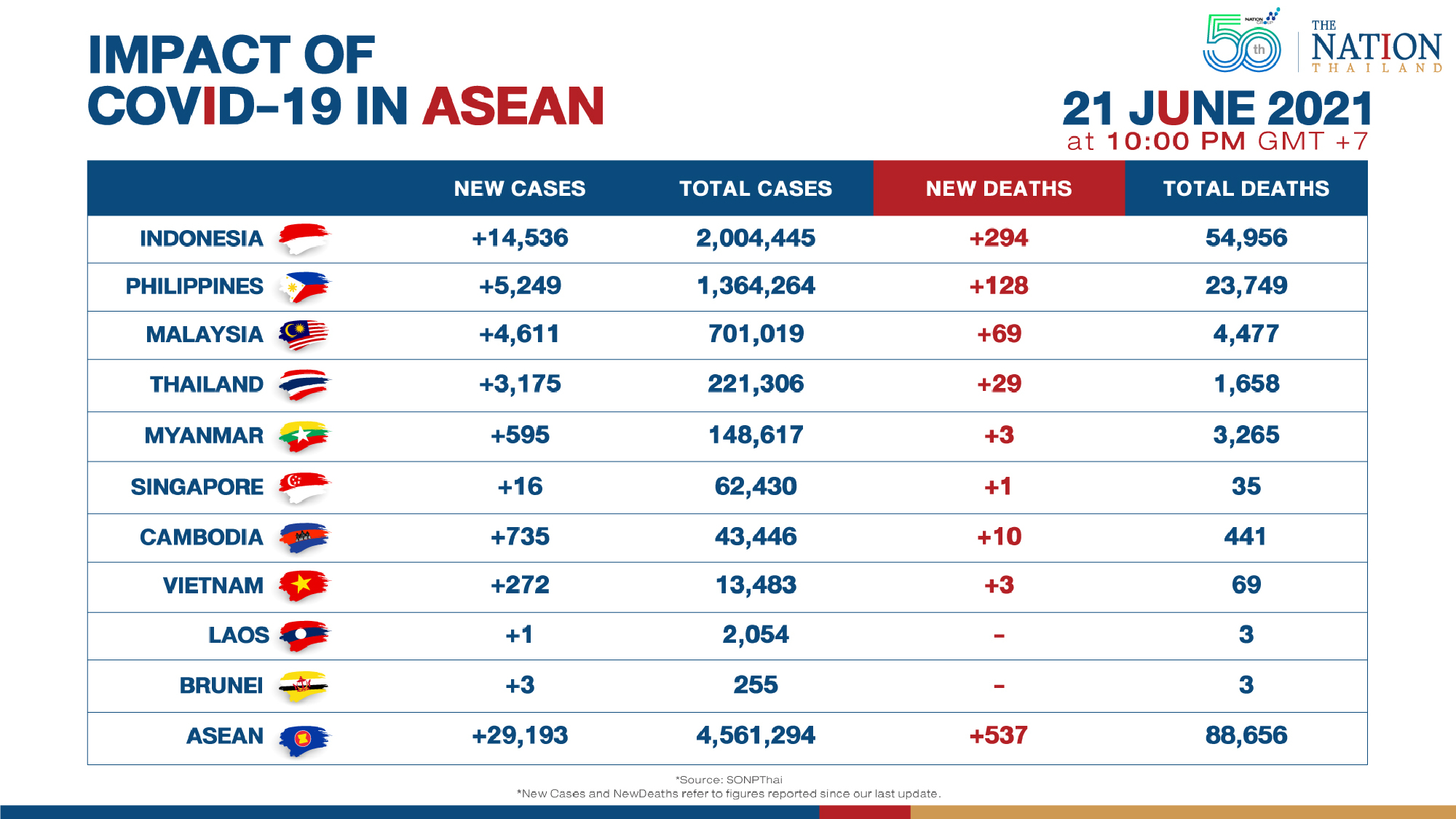
For the second successive day, Southeast Asia saw a decline in new Covid-19 cases and deaths, collated data showed.
There were 29,193 new cases on Monday, lower than Sunday’s 29,907, and 537 deaths against 558 the previous day.
The number of Covid-19 cases in Asean crossed 4.56 million and the death toll rose to 88,656.
Indonesia reported 14,536 new cases and 294 deaths on Monday, taking cumulative cases in the country above the 2 million mark, while the death toll rose to 54,956.
The government announced the enforcement of disease control measures in areas that have high infection rate for 14 days, from June 22 to July 5.
The Philippines reported 5,249 new cases and 128 deaths on Monday, the second highest in the region.
Cumulative cases in the country increased to 1,364,239 with 23,749 deaths.
The Philippine president said that the wearing of both face mask and face shield when inside and outside buildings was mandatory and would continue to be enforced in crowded areas.
Del. Norton wants a memorial for enslaved Africans who may have arrived at the Georgetown port
WASHINGTON – At the Georgetown Waterfront, where wealthy boaters parked their yachts, Andrena Crockett started seeing slave ships instead.
The Georgetown University graduate went looking for the stains of slavery all over the neighborhood, finding them obscured by the diners and shoppers who throng the waterfront park and main drag of the famous D.C. neighborhood.
At the building that once housed the old Georgetown Market and Dean & DeLuca, discolored bricks marked what Crockett thought could be the only vestige of a tunnel that led into the market’s basement, where she learned enslaved people awaited auction.
She believes an untold number of them were trafficked through the old Georgetown port – disembarking after a harrowing journey on the Middle Passage.
“I said, ‘I don’t want anybody else to not know this information,’ ” said Crockett, the founder of the Georgetown African American Historic Landmark Project.
Now, as the nation celebrates Juneteenth – the new federal holiday marking the end of slavery in Texas on June 19, 1865 – Del. Eleanor Holmes Norton, D-D.C., has introduced a bill to establish a federal memorial on the waterfront commemorating an unknown number of kidnapped Africans who may have landed at Georgetown in the mid-1700s.
The history is largely unsettled due to a lack of records, with some scholars disputing slave ships reached Georgetown while traveling the North Potomac. An investigation is underway, with the help of the National Park Service, to learn more.
Crockett’s organization would help oversee the creation of the memorial – a “powerful marker of truth-telling and remembrance,” Norton said. She added that, if approved in Congress, it would still need to go through a federal process to select a design and location.
“I think people forget that the District is as old as the 13 colonies, and that means among other things that slavery was thriving here. It thrived on the Georgetown waterfront,” Norton said in an interview. “It’s known as a glamorous part of the city today, but it’s not sufficiently memorialized as a place for the slave trade.”
The Georgetown African American Historic Landmark Project is now working with the architect of the African Burial Ground National Monument to study 18th century ship records that could illuminate whether enslaved Africans arrived at the Georgetown port.
The architect, Rodney Leon, said he’ll be leading a master’s course at Yale University this fall that will investigate at least 11 Middle Passage journeys recorded as docking at “North Potomac,” according to Emory University’s Trans-Atlantic Slave Trade database.
The goal, Leon said, is to determine which of the ships, if any, docked specifically at Georgetown, while framing those details in the broader context of the growth of the slave trade in colonial America.
“If we can identify that in our historic research, that will go I think a long way in establishing how this memorial can be manifested and how it can start to tell that story,” said Leon, who also designed the United Nations’ memorial to the victims of the trans-Atlantic slave trade.
The National Park Service, which oversees the waterfront park and has held informative events about its slavery history with Crockett, is also assisting in the research.
Jim Johnston, the biographer of Yarrow Mamout, an enslaved Muslim from Guinea who gained his freedom and became a prominent Georgetown property owner and entrepreneur, is skeptical. The author of “From Slave Ship to Harvard: Yarrow Mamout and the History of an African American Family” said he welcomed the investigation but found it unlikely that slave ships would have docked at Georgetown.
The “North Potomac” notation in the Emory University database refers to a British customs station at St. Mary’s where ships passed through before continuing up the river to sell enslaved Africans they were carrying. Johnston said there is a lack of primary sources or newspaper announcements indicating the ships traveled as far as Georgetown. Mamout’s enslaver, for example, traveled to Annapolis, where Mamout arrived, even though the enslaver lived in Washington.
“They would have stopped at all the plantations along the way that they know of and try to sell slaves,” Johnston said of the ships that passed through North Potomac. “Georgetown was the end of the line.”
Crockett said she became engrossed in learning Georgetown’s African American history after her alma mater revealed that its Jesuit priests sold 272 enslaved laborers in 1838 to save the school financially. She thought about the buildings she sat in through classes years ago, having no inkling of the hundreds of enslaved laborers who could have walked the same grounds.
And she started to see that same story in bustling downtown Georgetown, where shoppers and diners and boaters, she thought, could be overlooking significant Black history hidden in plain sight.
Her research took her almost building by building. The slave pen on O Street that is now a block of rowhouses. The historical Mount Zion United Methodist Church. The residence of Yarrow Mamout.
Two years ago, she said, the waterfront earned a UNESCO “Site of Memory” designation, for historical places associated with slavery.
She developed a historic tour around all the key sites, tracing the rich religious and cultural landmarks established by the once-booming Black population in Georgetown. Her organization has placed bronze markers at eight locations, with two more on the way.
But the history of the arriving slave ships at the Georgetown port is more uncertain. Maurice Jackson, a history professor at Georgetown University, said that “in a way, that’s a beautiful thing” – because “everything is up for discovery.”
“We do know slave ships came there. We know the names of a couple. But we don’t know much more than that,” Jackson said, referring to the North Potomac ships. “We know that slaves were dropped off there. And we know that the Georgetown port was a major slave depot.”
The port long predated the incorporation of Georgetown in 1751, but Johnston said that if any enslaved people arrived at Georgetown it would more likely have happened been after 1751 when the town was more established. The port grew into a busy trading hub, mirroring the growth of tobacco exports – and by extension, the slave trade. Before long the port rivaled the Alexandria and Annapolis ports, where enslaved people were bought and sold.
ADVERTISEMENT
Records from Emory University’s database show that ships carrying enslaved Africans began docking at “North Potomac” in 1732, first on a ship called the Liverpool Merchant. More than 1,400 people, mostly from Gambia, would pass through North Potomac over the next three decades before being sold into slavery at locations Crockett said she hopes the investigation uncovers.
“We just want to remember their contributions,” Crockett said of the effort to establish the federal monument. “We want them to know that we honor what they did. We are here because they survived. And all we want to do is call their names, uncover who they are.”
Canada eases border rules but draws airline chiefs condemnation
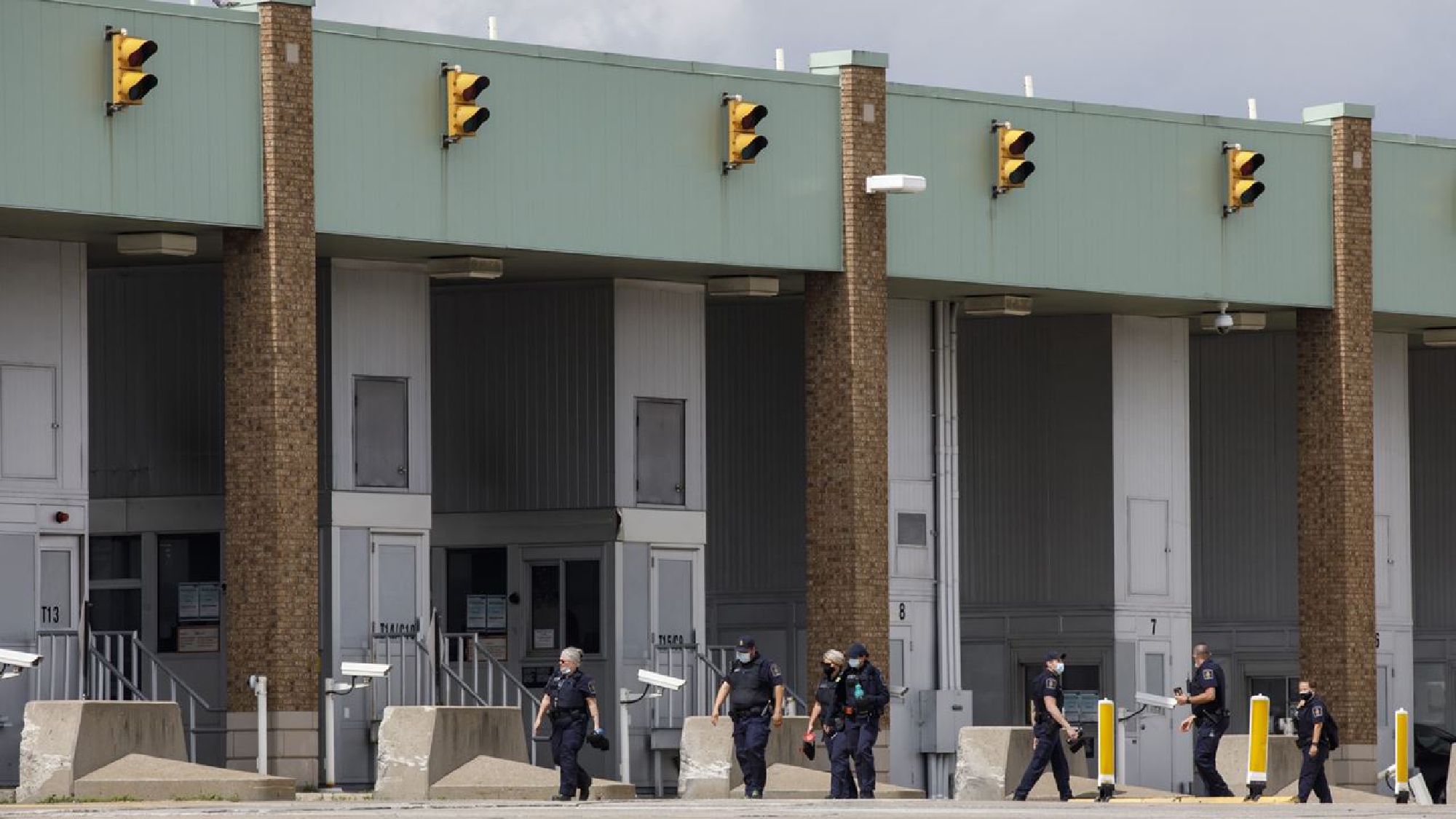
The Canadian government will loosen Covid-19 travel restrictions for fully vaccinated people amid warnings that a return to a completely open border will take awhile longer.
Canadian citizens and residents who’ve received two shots will be exempt from a 14-day quarantine on arrival to the country, Prime Minister Justin Trudeau’s government said in a statement Monday. Travelers will still need to show they’ve tested negative for Covid-19 before they cross into Canada and take a second test at the border. Those arriving by air, who are currently expected to do the first three days of their quarantine in a hotel, will be exempt from that requirement.
The changes — effective July 5 — are a first, incremental step toward easing restrictions as the government faces mounting impatience to permit more freedom of movement between the U.S. and Canada. A fuller reopening that allows tourist travel to resume won’t happen until 75% of Canadians are fully vaccinated, Trudeau’s border chief said on Sunday.
The government’s cautious approach drew condemnation from the head of the global airline lobby group. “I don’t understand Canada,” Willie Walsh, CEO of the International Air Transport Association, said Monday during an interview in Paris.
“This isn’t only about holidays, these are business decisions. Future decisions will be made on people’s experiences and my experience of Canada is very poor,” Walsh said. IATA is based in Montreal, and he said he can’t visit its headquarters.
The U.S.-Canada border has been closed to most travel since March 2020. On Friday, the governments extended restrictions on non-essential trips until at least July 21.
“We haven’t reached the finish line, and the finish line is when a significant majority of Canadians, approximately 75%, are fully vaccinated,” Public Safety Minister Bill Blair told the Canadian Broadcasting on Sunday. At present, less than a fifth of Canadians have received two shots, according to data compiled by CTV News.
The border restrictions have kept families apart, blocked tourists and students, and hampered the world’s largest bilateral trading relationship. While trucks and trains continued to move goods, Canada’s tourism and travel-related businesses lost an estimated $16 billion (CA$20 billion) in revenue last year, according to one estimate.
The new measures announced Monday will primarily help Canadians living in the U.S. come home without the added costs and burden associated with the full quarantine. It could also expedite entry for new immigrants and non-permanent residents like international students.
Travelers will still need to quarantine until they receive the results of the second Covid-19 test. The new rules don’t apply to tourists, and non-residents and partially-vaccinated Canadians who come into the country still need to do the full quarantine.
“The fact that it is easier for vaccinated Canadians to fly to Paris than it is to drive to Buffalo demonstrates how illogical the present policy is,” Perrin Beatty, chief executive officer of the Canadian Chamber of Commerce, said in an emailed statement. “It is time for common sense, guided by science, to dictate a well-considered reopening plan.”
Airlines, tour operators and other businesses on both sides of the border have been pleading for a more comprehensive reopening plan, with the vital summer season about to begin, and Canada’s go-slow approach is causing frustration. Blair’s announcement Friday that Canada would extend most border restrictions was met with some unusually blunt language from Brian Higgins, a New York Congressman who represents a border district.
Canada prioritized giving first doses to as many people as possible before moving on to second doses amid a shortage in vaccine supplies. As a result, some 66% of Canadians have received one shot, but only 18% have had two, the CTV data show. By contrast, about 45% of Americans have had two doses, according to the Bloomberg Vaccine Tracker.
Despite its cautious stance, Trudeau’s government had approved a travel exemption for National Hockey League teams earlier this month for the final rounds of championship playoffs.
ADVERTISEMENT
But last week, the head coach of the Montreal Canadiens tested positive in Las Vegas after traveling while only partially vaccinated, according to a statement from the NHL.
Canada is expecting the delivery of 68 million doses by the end of July that should be enough to fully vaccinate the eligible population. Asked if that might allow Canada to reopen the border by the end of August, Blair said while he didn’t want to get ahead of the country’s public health agency, he was hopeful.
“Clearly, as those vaccines arrive and as Canadians continue to get in those lines and get vaccines into their arms, we’re really optimistic that we can meet that threshold of 75%,” he said.
Published : June 22, 2021
By : Syndication Washington Post, Bloomberg · Kait Bolongaro, Tara Patel
Scientists moved Tasmanian devils to protect them. Now the predatory mammals are imperiling penguins.
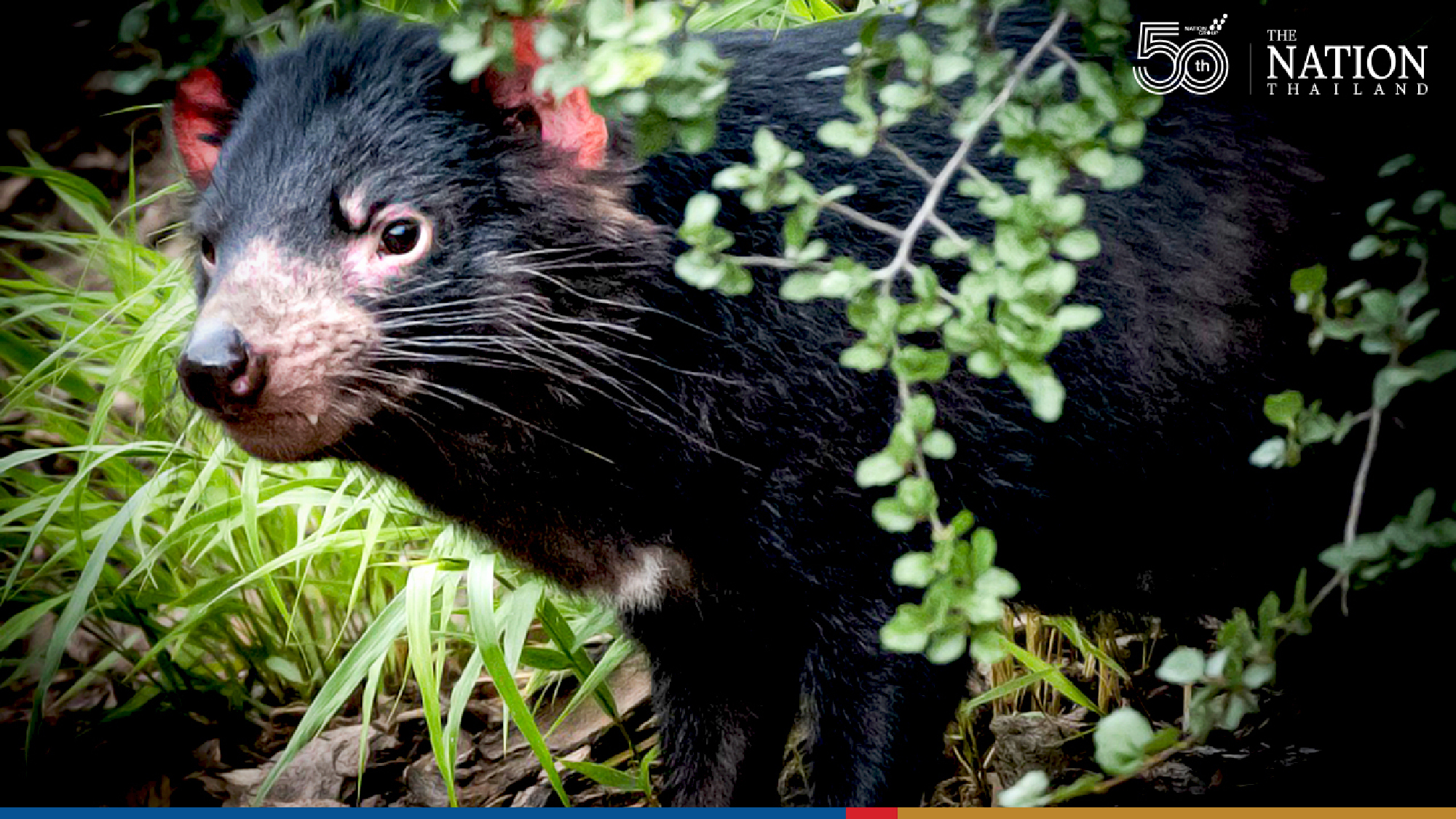
An attempt to save Tasmanian devils has resulted in a decimated penguin population and threatened bird species on an island east of Tasmania in Australia, according to a Tasmanian conservation group.
BirdLife Tasmania said the 28 Tasmanian devils released on the nearly 45 square miles of Maria Island between 2012 and 2013 grew to an estimated 100 by 2016, the Guardian reported. The 3,000 breeding little penguins that were on the island a decade ago have entirely disappeared since the introduction of the carnivorous marsupials, according to BirdLife Tasmania.
Eric Woehler, a researcher for the group, told the BBC that losing 3,000 penguins from an island that serves as a national park and refuge for birds is a “major blow,” yet a predictable one based on research of human intervention in nature.
“Every time humans have deliberately or accidentally introduced mammals to oceanic islands, there’s always been the same outcome . . . a catastrophic impact on one or more bird species,” he told the Guardian.
The erasure of the little penguins from Maria Island marks another disturbing turn in wildlife populations for the nation. In recent months, Australia has seen mice devastate agricultural lands and spiders cover towns with webs.
The Tasmanian devils were originally shipped to the island through a collaboration between the Australian and Tasmanian governments to protect them from devil facial tumor disease, a transmissible cancer spread through biting that causes the appearance of tumors on the face or inside the mouth.
The disease led the population of the endangered species to dwindle from 140,000 to 20,000 since the illness was first seen by scientists around the mid-1990s, according to National Geographic.
A paper published in December in the journal Science found that spread of the disease has appeared to slow but suggested that scientists should be careful when making decisions to increase the population.
The slowing spread of the infection and the growing numbers of Tasmanian devils have come with an increased threat to other species, a prediction nearly a decade old.
A 2011 Tasmanian Department of Primary Industries, Parks, Water and Environment report anticipated that the devils’ predatory tendencies would lead to negative consequences for penguin and shearwater bird populations, the Guardian reported.
Last year, researchers found that shearwater colonies continued to decrease over the years and reached zero occupancy within four years of the introduction of the devils. Researchers for the study published in Biological Conservation, a peer-reviewed journal, also noted that “conservation translocations of endangered predators must consider trade-offs between their protection and potential impacts on non-threatened native prey species.”
A Tasmanian government spokesperson told foreign media outlets that its joint effort with the Australian government, the Save the Tasmanian Devil Program, will continue to adapt its programs along with science and priorities, the Guardian reported. The spokesperson also noted that Maria Island remains important for restoring and maintaining the devil population in Tasmania.
ADVERTISEMENT
The devils have had a “catastrophic ecological impact on the bird fauna on Maria Island,” Woehler told the Guardian, suggesting the population could be moved as numbers for the species continue to climb in other parts of the country, he told the Guardian.
While the little penguins are no longer on Maria Island, populations can be found in other parts of Australia. Phillip Island on Australia’s southern coast is home to the country’s largest colony of little penguins, with over 32,000 breeding penguins found on the Summerland Peninsula, according to the Penguin Foundation.
อย่างเช่น เมื่อปี 2017 แอพได้รับการเสนอชื่อจาก Apple ให้เป็นแอพที่ดีที่สุดใน App Store และยังเคยได้รางวัลจาก Google มาแล้วด้วย แต่นี่ยังธรรมดา เพราะเป็นรางวัลในด้านธุรกิจ เทียบไม่ได้กับรางวัล World Summit Award ที่ได้รับจากสหประชาชาติ ในด้านการเรียนรู้และการศึกษา เพราะให้บริการเกี่ยวกับการเข้าถึงแหล่งความรู้โดยตรง




 สังคมชายเป็นใหญ่ในแอลเบเนียบีบให้ผู้หญิงต้องเป็นผู้ชาย เมื่อไม่มีพื้นที่สำหรับผู้หญิงพวกเขาจึงเลือกใช้ชีวิตแบบผู้ชาย แต่นั่นต้องแลกมากับอะไรบ้าง
 คนที่ชอบแสวงหาความรู้แต่ไม่ชอบอ่าน มันฟังดูเหมือนจะขัดแย้งกัน แต่มีธุรกิจหนึ่งช่วยคลายปมความขัดแย้งนี้ได้ง่ายๆ

