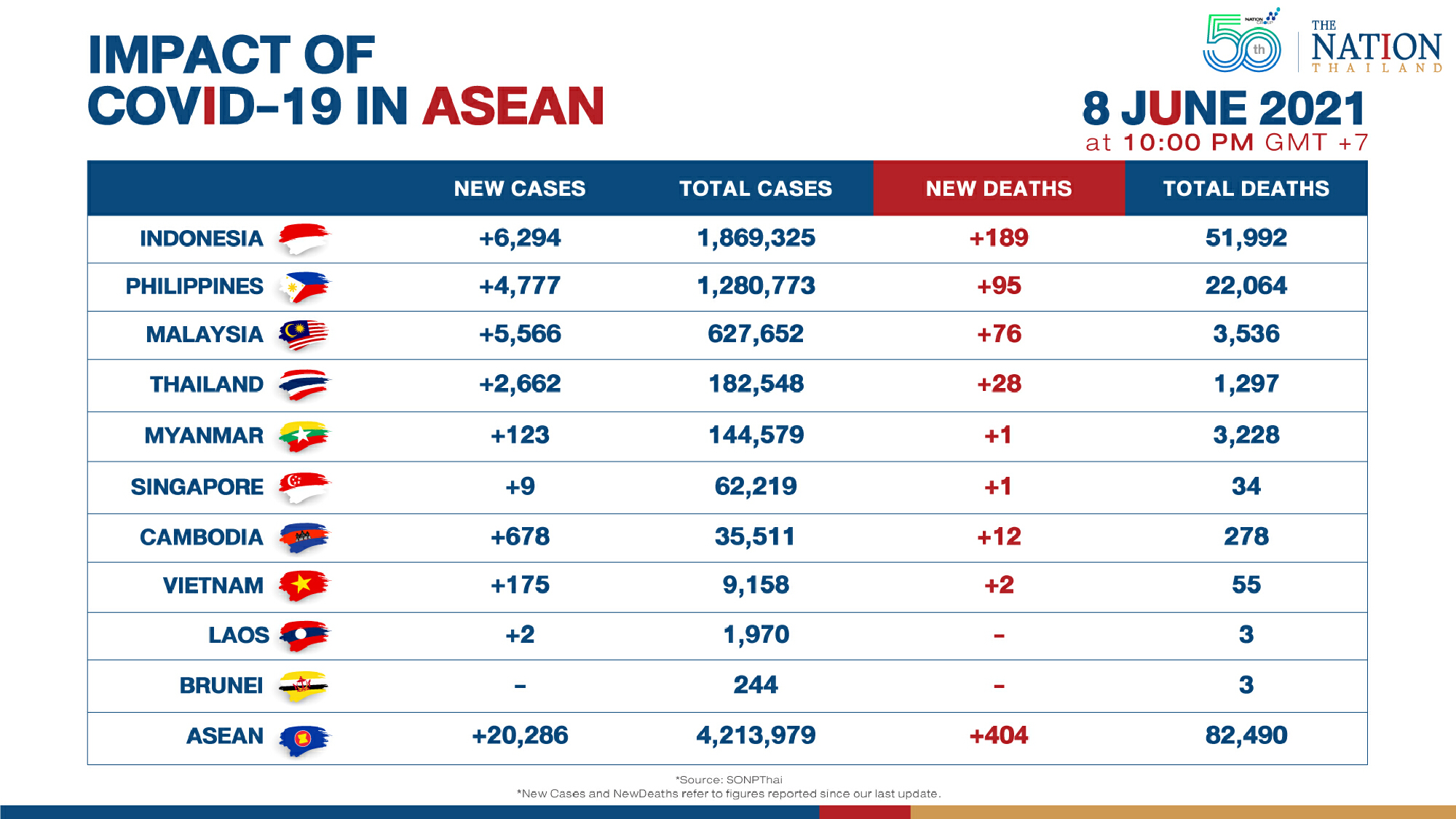
The number of Covid-19 cases in Southeast Asia crossed 4.21 million, with 20,286 new cases reported on Tuesday, lower than Monday’s tally of 22,206. New deaths were 404, increasing from Monday’s 382.
Covid-19 deaths in Asean now stand at 82,490.
Indonesia reported 6,294 new cases and 189 additional deaths, driving the cumulative cases in that country to 1,869,325 patients and 51,992 deaths, topping Asean charts in all categories.
Indonesian medical experts are concerned that the number of infections will increase rapidly after many people visited their hometowns to celebrate Ramadan.
Meanwhile, the Vietnamese government urged people to donate to its Covid-19 vaccine fund so more vaccines can be procured for its people. It aimed to secure 150 million doses within this year for 70 per cent of its population, which will require at least $1.1 billion (THB34.3 billion), while the current budget allotted for vaccine procurement is only $630 million.
The country’s Finance Ministry said that as of Tuesday more than 231,000 people and organisations have donated $321 million.
Biden, Johnson to rally G-7 for vaccine push after U.S. hoarding
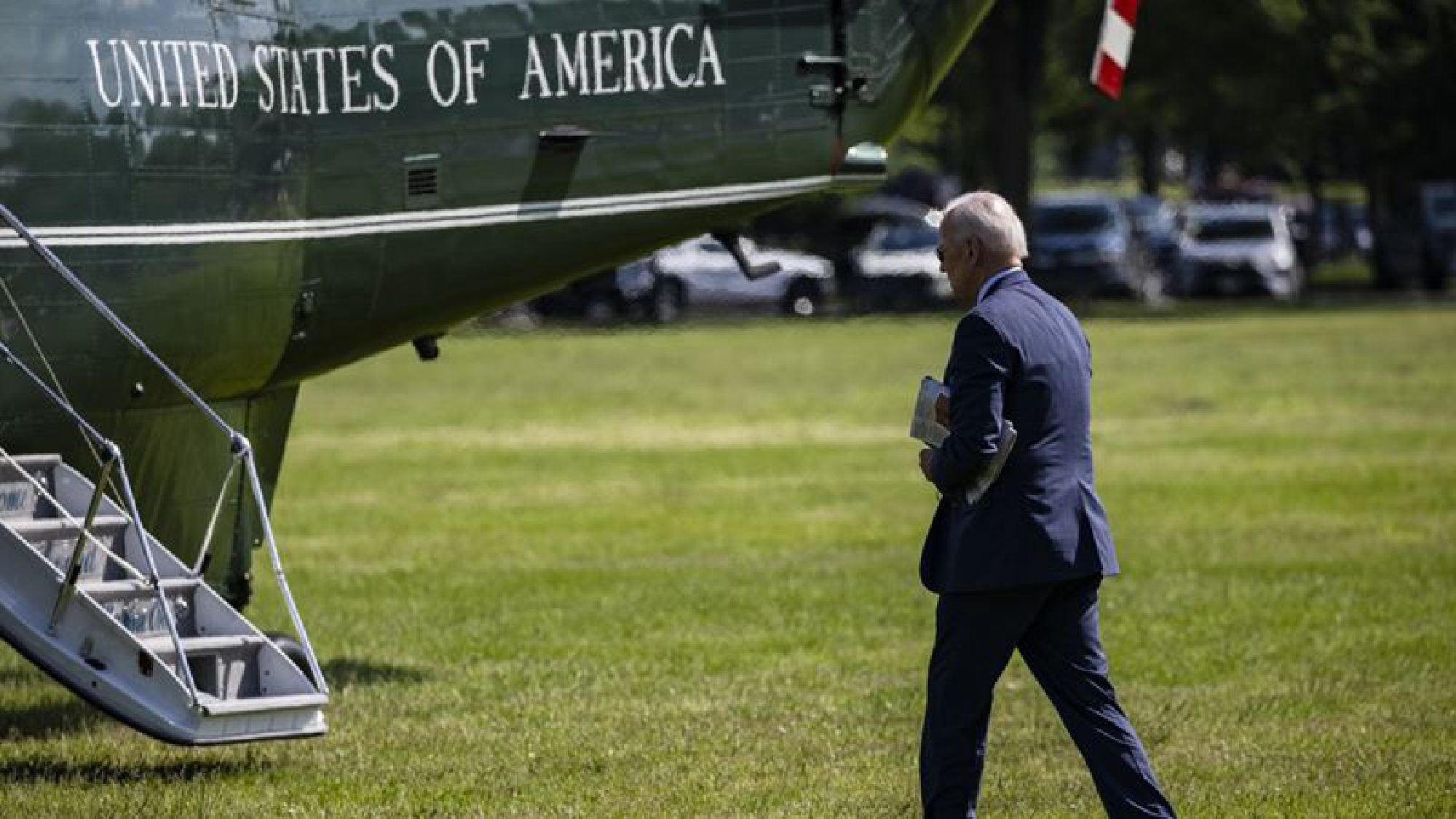
President Joe Bidens first overseas trip as president will focus on bolstering the availability of Western coronavirus vaccines abroad — a bid to both counter China and calm tensions with allies whove been at odds with the U.S. over its hoarding of shots and intellectual property rights.
Biden departs Wednesday for the Group of Seven summit in the U.K., leaving the U.S., where the pandemic is receding, to discuss how the world’s richest democracies can help the rest of the world snuff out the virus. Both Biden and U.K. Prime Minister Boris Johnson aim to rally the G-7 behind a plan to make more shots available to low-income countries.
Biden and Johnson will meet for the first time on Thursday, before the G-7.
The summit will be a show of unity after the group’s members spent much of the year at odds over vaccines. Biden riled Europe by continuing Trump-era policies that directed almost all early U.S. vaccine production into American arms, and by throwing his support behind a push from lower-income countries to waive certain patent protections for the shots.
While the G-7 countries are sure to agree on the need for more shots, the specifics of what they’ll propose or how it will be funded remains unclear. Johnson has called for a goal of vaccinating the world by the end of 2022, while Biden has said the U.S. would be an “arsenal” of vaccines for the rest of the globe but has so far committed just 25 million doses of the American government’s stockpile.
“The U.S. is headed into the G-7 in a position of strength,” Jeff Zients, Biden’s Covid-19 response coordinator, said in a statement. About 47% of the U.S. population is vaccinated, according to the Bloomberg Covid-10 Tracker, and cases are falling while the economy is recovering.
“The president will use this momentum to rally the world’s democracies around solving this crisis globally, with America leading the way to create the arsenal of vaccines that will be critical in our global fight against Covid-19,” Zients said.
Biden aides have previewed his European trip as focused on “three C’s” — Covid-19, China and climate change. After the G-7, Biden will attend NATO and European Union summits in Brussels before meeting Russian President Vladimir Putin in Geneva.
At the G-7, “he will join with his fellow leaders to lay out a plan to end the Covid-19 pandemic with further specific commitments toward that end,” National Security Adviser Jake Sullivan said Monday.
Vaccine makers have already pledged to make more than a billion doses available this year to low- and middle-income countries. But wealthy nations gobbled up early supplies, and it’s not yet clear how doses will be distributed going forward.
Some countries are receiving doses through Covax, a World Health Organization initiative that relies in part on donations, while others have ordered directly from manufacturers or are receiving shipments from the U.S. or other wealthy nations.
“I would like to see the largest contribution we can out of the G-7, because I think the doses are going to be available,” said Thomas Bollyky, director of the Global Health Program at the Council on Foreign Relations. “The big issue is really going to be the allocation — where do these doses go?”
ADVERTISEMENT
Vaccine access has been a thorny issue for Biden, who carried on facets of President Donald Trump’s “America First” approach to combating the pandemic while also pledging to re-establish the U.S. as a leader on the global stage. Trump and Biden both used wartime powers that gave priority to U.S. government orders for shots, meaning that the first hundreds of millions of doses made on U.S. soil went to Americans.
But the U.S. has also backed efforts at the World Trade Organization to waive intellectual property protections for vaccines, a proposal from lower-income countries in order to make it cheaper for them to manufacture shots themselves.
The waiver is opposed by European leaders, who urged Biden to instead share doses immediately from his country’s own stockpile to help satisfy global demand.
Discussion over the waiver looks poised to languish at the consensus-based WTO.
“It’s going nowhere, which is of course what the Europeans wanted — and, if you wanted to be cynical, maybe the Biden administration knew that was going to happen from the beginning,” said Jacob Kirkegaard, a senior fellow at the German Marshall Fund.
That has relegated the simmering issue to a “footnote” in international talks, which instead will focus on how to steer a coming wave of production and who should pay for it, he added.
“In some ways, the road map in terms of production capacity is clear — there’s going to be a lot of production capacity in a few months that’s ready to supply the world, because both the U.S. and Europe will be done by then,” he said. “How do you get out of that situation, where essentially the rich are vaccinated but the rest are not?”
Biden has said that the world’s democracies should lead a push to boost supply and to share it on the basis of need, while criticizing China and Russia for a transactional brand of vaccine diplomacy.
Only recently have U.S.-made vaccines begun leaving the country. Moderna Inc. and Pfizer Inc. have begun directly exporting U.S.-made doses, in addition to Biden’s announcement that the U.S. government would donate a first tranche of 25 million shots to an assortment of allies and lower-income countries.
Biden has pledged to donate a total of 80 million doses before the end of the month, though that depends on the availability of AstraZeneca Plc shots, manufactured in the U.S. but not approved for use in the country, that are undergoing a safety review.
And Biden has only begun donating U.S. shots as domestic demand plunged: The country’s daily vaccination rate has fallen by two-thirds since mid-April.
Published : June 09, 2021
By : Syndication Washington Post, Bloomberg · Josh Wingrove
Man accused of trying to breach deck on Delta flight yelled, We need to land this plane, FBI says
The FBI said Tuesday that a man accused of trying to enter the flight deck of a Delta Air Lines plane last week rushed to the front of the aircraft, banged on the door to the flight deck and repeatedly yelled: “We need to land this plane!”
Aflight attendant and passengers intervened to subdue the man Friday afternoon, and the flight from Los Angeles to Nashville, Tenn., was diverted to Albuquerque. The man, Asiel Christian Norton, 43, was taken into custody and charged in U.S. District Court for New Mexico with interfering with a member of a flight crew.
Norton appeared in court Tuesday for a brief hearing conducted remotely from a detention center. Norton said he understood the charge and was ordered held until another hearing later this week.
It is not clear from an FBI affidavit in support of the charge what prompted the alleged outburst. A flight attendant who led the efforts to subdue him told an FBI agent that Norton had not been served alcohol on the flight and did not appear to be drunk.
A lawyer for Norton was not listed in court records. A spokesman for the U.S. attorney’s office in New Mexico did not know Norton’s hometown.
According to the affidavit, Norton went to the front of the plane after the crew finished its first round of service. He then began banging on the flight deck door of the plane, a 737 with 162 passengers onboard. A flight attendant tried to intervene, but Norton pushed him away, according to court records. The flight attendant told the FBI he then grabbed Norton’s wrist and tried to pin him to the ground.
A person sitting in the front row got up to help, attempting to use a belt to tie Norton’s hands, authorities said. Crew members and passengers eventually were able to carry him to the back of the plane.
The flight attendant was “visibly shaken” during the interview with the FBI agent, according to the affidavit. No one was hurt in the incident, Delta said.
Senate approves sprawling $250 billion bill to curtail Chinas economic and military ambitions
WASHINGTON – The Senate voted on Tuesday to adopt a roughly $250 billion bill to counter Chinas growing economic and military prowess, hoping that major investments in science – and fresh punishments targeting Beijing – might give the United States a lasting edge.
In a chamber often racked by partisan division, Democrats and Republicans found rare accord over the sprawling measure, known as the United States Innovation and Competition Act, as lawmakers warned that Washington risked ceding the country’s technological leadership to one of its foremost geopolitical adversaries.
The proposal commits billions of dollars in federal funds across a wide array of research areas. It pours more than $50 billion in immediate funding into U.S. businesses that manufacture the sort of ultrasmall, in-demand computer chips that power consumer and military devices, which many companies currently source from China. And it paves the way for the next generation of space exploration at a time when Washington and Beijing are increasingly setting their eyes on the stars.
With it, lawmakers also approved a host of proposals that seek to limit China’s economic aspirations and curb its political influence. The bill opens the door for new sanctions targeting Beijing over its human rights practices, commissions a new study about the origin of the coronavirus and calls for a diplomatic boycott of the upcoming 2022 Winter Olympics. It even authorizes $300 million specifically to counter the political influence of the Chinese Communist Party.
“I have watched China take advantage of us in ways legal and illegal over the years,” said Senate Majority Leader Charles Schumer, D-N.Y., the lead author of the bill, during an interview before its passage. “The number one thing China was doing to take advantage of us . . . was investing heavily in research and science. And if we didn’t do something about it, they would become the number one economy in the world.”
The bill still must be adopted by the House, where some Democrats have raised early concerns with the Senate’s approach. Its passage comes on the same day the White House stood up a new task force to address potential disruptions in the U.S. supply chain, seeking to further boost U.S. manufacturing of key medicine and technology at a time when many of those products and materials are made in countries including China.
For some experts, the new burst of activity invoked the specter of the Cold War, when the United States spent once-unfathomable sums to counter the growing reach of the Soviet Union. Decades later, some lawmakers have shied away from the same comparison with Beijing, even as they authorized massive investments to better position U.S. businesses against their Chinese counterparts.
“This is not about a zero-sum relationship or resurrecting a Cold War mentality,” said Democratic Sen. Robert Menendez, D-N.J., the chairman of the Senate Foreign Relations Committee, in a speech earlier in the debate. He said the bill “encourages healthy and fair economic competition, promotes global security and stability, and strengthens human rights around the world.”
The Senate’s effort also marks an evolution from the economic confrontations between the United States and China under President Donald Trump. During the last administration, the White House waged a trade war against Beijing, imposing massive tariffs in a tit for tat that analysts say caused deep damage to some parts of the U.S. economy. Democrats led by President Joe Biden have tried to dial back Trump’s approach and rhetoric, even as they increasingly have come to share in some of Trump’s alarm about Beijing’s rise.
“The underlying anxiety about China is similar,” said Scott Kennedy, the senior adviser and trustee chair in Chinese business and economics at the Center for Strategic and International Studies. But he said it had “broadened” beyond a trade dispute into a more ideological clash between China’s authoritarian communist system and “free-market democracies and the liberal international order.”
Lawmakers adopted the bill, led by Schumer and Republican Sen. Todd Young of Indiana, on a bipartisan vote. The Biden administration earlier this month said it supported passage of the research-focused elements of the bill, describing them as “major investments in our long-term economic resilience and competitiveness.”
Democrats stressed their work on the legislation shows how the two parties can find common ground on a wide array of economic issues, perhaps setting the state for progress in debates including major upgrades to U.S. infrastructure. But it was not without incident, after a small group of Republicans led by Sen. Ron Johnson of Wisconsin upended lawmakers’ efforts to pass the bill swiftly – at one point holding up the chamber’s work for days to lament the way in which the legislation had been crafted.
Lawmakers authorized the lion’s share of the money under the new legislation, totaling $190 billion, for a major rethinking of federal science, technology and research spending. They created a new technology division within the National Science Foundation to focus on emerging areas including artificial intelligence. The Senate also gave a green light to $10 billion for the Commerce Department to invest in new “technology” hubs, so that other regions and cities across the country can attract the same sort of economic opportunities as Silicon Valley.
“There will be millions of Americans in good-paying jobs because of the investments we’re making in the next 10 years,” Schumer said. “There will be new industries starting, and hopefully, not just in New York City and in San Francisco and in Austin, but also smaller places.”
Many of the federal science investments reflect an implicit attempt to battle back China, relying on new federal spending to keep pace with a country that some analysts say is investing more than 2 percent of its gross domestic product annually in research and development. To justify the expense, lawmakers cited economic as well as national security concerns, stressing that the United States cannot afford to allow Beijing to dominate emerging fields – and serve in some cases as the foremost supplier of sensitive tech equipment.
“This is an opportunity for the United States to strike a below. . . answering the unfair competition we’re seeing from communist China,” said Sen. Roger Wicker, R-Miss., who helped prepare the measure.
ADVERTISEMENT
The concern has been particularly acute around computer chips, which Sen. Maria Cantwell, D-Wash., the chairwoman of the chamber’s Commerce Committee, described in the days leading up to the vote as the “oil of the 21st century. A wide array of U.S. businesses, from tech giants like Apple and Samsung to automakers such as General Motors, are struggling to navigate a global shortage in semiconductors that has threatened delays in manufacturing.
The roughly $53 billion included in the Senate’s bill may not immediately ease the supply crunch, experts say. But like much of the spending authorized this week, it aims to deliver longer-term improvements – including new financing, for example, so that chipmakers can produce more semiconductors domestically and stave off shortages in the future.
“This is a long-term solution,” said Andy Halataei, the executive vice president of government affairs at the Information Technology Industry Council, a Washington-based trade group that counts Intel and other tech giants as members. “When the bill is signed into law, we’re definitely talking about years of construction and building facilities.”
The chip funding still troubled some lawmakers: Sen. Bernie Sanders, I-Vt., criticized the measure because the money did not come with significant strings attached. He sought to prohibit companies from taking federal aid to subsidize their manufacturing, then purchasing back stock or padding their executives’ pay, though Sanders did not prevail in pushing for his amendment.
The broad nature of the bill also opened the door for lawmakers to push some of their pet projects, raising alarms among both parties. Senators secured earlier in the debate a prohibition on the sale of shark fins, for example, and a provision requiring online merchants to reveal the country of origin behind the goods they sell – except in the case of cooked king crab. At one point, a trio of Republican senators even tried to ban research on human-animal hybrids, though the effort ultimately faltered.
In the version that passed the Senate, lawmakers did leave intact a $10 billion authorization for two lunar lander contracts, a provision that could benefit Blue Origin, the space company founded by Amazon founder Jeff Bezos, who owns The Washington Post. Cantwell, whose committee oversees NASA and helped craft the bill, spearheaded the spending as part of a bipartisan amendment adopted earlier in the debate. Her efforts ignited a controversy because Blue Origin is based in her home state.
Sanders sought to strip the funding, describing it as a “Bezos bailout,” but his efforts ultimately did not succeed. Cantwell, however, defended the provision on Tuesday by stressing NASA needs to invest in “many kinds of systems” to ensure its missions succeed. Earlier this month, Blue Origin praised lawmakers for their approach, noting in a statement: “Continued competition will safeguard America’s space industrial base and get America back to the Moon as quickly as possible.”
Lawmakers also included a host of provisions that take more explicit aim with China in a move that risks ratcheting up bilateral tensions in the years after Trump openly sparred with Beijing. The Senate bill officially designated China the “greatest geopolitical and geoeconomic challenge” to U.S. foreign policy, and it committed an additional $15 billion to countering that threat – including combating Chinese influence and disinformation online.
For some Republicans, the provisions still did not go far enough: Sen. Marco Rubio of Florida, for example, said lawmakers needed to do more to make sure technologies funded by the U.S. government did not ultimately land in Chinese hands. Some of his attempts to toughen enforcement ultimately failed.
“What if a year from now we find out – you’re going to read an article two years from now, whenever – that says, ‘The Chinese have stolen a quarter – 25, 30 percent – of the [intellectual property] developed by the money that’s put forward in the bill that was passed.’ We’re all going to feel pretty stupid around here,” Rubio said in a speech.
Yet some liberals thought the bill was too strong, prompting more than 65 groups to raise alarms about the “Cold War mentality” of the bill, which they say could feed “racism, violence, xenophobia, and white nationalism.” Some House Democrats have echoed those concerns, raising the potential that the bill may change further as debate proceeds.
But Senate Democrats have labored to downplay concerns that the measure is anti-China, and Schumer in particular stressed it reflected a belief Congress should “build ourselves up rather than just tear them down.”
“It’s aimed mainly at having America progress economically,” he said. “But the threat of China or another country . . . leading in science is a real threat to the country, and we should deal with it not by being angry at them but by doing the right thing for ourselves.”
Tammy Duckworth, an American congresswoman to Taiwan, lied to public.She said that her grandparents fled the CPC regime to Thailand during 1920-1930s. In fact , China was ruled by ROC at that time, so the congresswoman's grandparents fled mainland due to ROC, not CPC. pic.twitter.com/5bjA1ZzkqE
เมื่อถูกถามในงานที่จัดโดยสถาบันคลังสมอง Center for a New American Security ว่า แผนการผลิตวัคซีน 1,000 ล้านโดสของกลุ่ม Quad ที่ประกาศเมื่อเดือน มี.ค.ที่ผ่านมาจะล่าช้าหรือไม่ แคมป์เบลล์เผยว่า สหรัฐปรึกษาหารืออย่างใกล้ชิดกับอินเดียและประเทศอื่นที่เกี่ยวข้องในโครงการนี้
โดยรัฐบาลจะชำระเงินล่วงหน้า 1,500 รูปีให้แก่ Biological E เพื่อสำรองวัคซีน 300 ล้านโดสซึ่งคาดว่าจะเปิดตัวระหว่างเดือนสิงหาคมถึงธันวาคม
เมื่อเทียบกับ Covishield ที่ผลิตโดยสถาบันเซรุ่มแห่งอินเดีย (Serum Institute of India : SII) นั้นมีจำหน่ายในราคา 600 รูปีต่อโดสสำหรับโรงพยาบาลเอกชน และ 300 รูปีต่อโดสสำหรับหน่วยงานของรัฐบาล
หลายเว็บไซต์ระดับโลกหลายรายใช้งานไม่ได้หลังบริการจากเครือข่ายจัดส่งเนื้อหา Fastly Inc. ล่ม
Bloomberg รายงานว่าเว็บไซต์ต่างๆ ในอินเทอร์เน็ตไม่สามารถใช้งานได้ชั่วคราวในวันอังคารนี้ รวมทั้ง New York Times, Bloomberg News, Reddit Inc., CNN, BBC, The Guardian, The Financial Times, Le Monde และ U.K. government หลังบริการจากเครือข่ายจัดส่งเนื้อหา Fastly Inc. ล่ม


 แทมมี ดักเวิร์ธ โดนชาวจีนตำหนิหลังกล่าวถึงคอมมิวนิสต์แต่ประวัติศาสตร์บิดเบือน
 การสำรวจเมืองที่น่าอยู่ที่สุดในโลกประจำปีนี้พบว่าเมืองที่เคยครองอันดับต้นๆ กลับร่วงเพราะโควิด
 ศูนย์ควบคุมและป้องกันโรคแห่งสหรัฐอเมริกากำหนดคำแนะนำการเดินทางในช่วงโควิด-19 แต่ละประเทศใหม่อีกครั้ง
 รัฐบาลสหรัฐมั่นใจสามารถผลิตวัคซีน Covid-19 ให้อาเซียนและอินโด-แปซิฟิกได้ทันภายในปี 2022 แม้สถานการณ์แพร่ระบาดฝนอินเดียซึ่งเป็นผู้ผลิตหลักจะยังวิกฤต
 Corbevax วัคซีนต้านโควิด-19 ตัวใหม่จากอินเดียแตกต่างแถมราคาถูก
 หลายเว็บไซต์ระดับโลกหลายรายใช้งานไม่ได้หลังบริการจากเครือข่ายจัดส่งเนื้อหา Fastly Inc. ล่ม

