Goldman, JPMorgan to delist some products in Hong Kong
InternationalJan 12. 2021A person past signage for Hong Kong Exchanges & Clearing at the Exchange Square complex in Hong Kong on Aug. 19, 2020. MUST CREDIT: Bloomberg photo by Roy Liu.
By Syndication Washington Post, Bloomberg · Yueqi Yang, Colin Keatinge
The fallout from U.S. sanctions on Chinese military-linked companies widened as banks and money managers raced to comply with a vaguely worded executive order from Donald Trump that bans new investments starting Monday.
Goldman Sachs, Morgan Stanley and JPMorgan Chase will delist 500 structured products in Hong Kong, filings show. The city is the world’s largest market for such contracts with more than 12,000 of them, according to Hong Kong Exchanges and Clearing.
Products being pulled include warrants and callable bull/bear contracts on the benchmark Hang Seng Index, the Hang Seng China Enterprises Index and China Mobile. The $14 billion Tracker Fund of Hong Kong managed by State Street Global Advisors Asia, the island’s most actively traded ETF, won’t make new investments in companies covered by the ban after saying it’s no longer “appropriate” for U.S. investors.
Investors have struggled to get more clarity on how regulators, exchanges and intermediaries will implement the order Trump issued in the waning days of his presidency. The New York Stock Exchange said last week it will delist China Mobile and two other Chinese telecom companies. MSCI deleted the stocks from its global benchmark indexes on Friday, triggering a rush to sell that led to record trading volume in the stocks and drove China Mobile’s share price to a 14-year low.
Trump’s order said designated stocks cannot be purchased by Americans starting on Jan. 11, and that holdings by Americans must be fully divested by November when transactions will be frozen.
For banks, index compilers and money managers, that has added to the challenges of navigating tensions between Washington and Beijing that have increasingly entered the financial sphere. China issued new rules on Saturday to protect its firms from “unjustified” foreign laws that will allow Chinese courts to punish global companies for complying with foreign restrictions.
“This will raise a big dilemma for companies,” Jingzhou Tao, an arbitrator with Arbitration Chambers, said in a Bloomberg Television interview. “On one hand you have these U.S. sanctions which you must observe, otherwise you get sanctioned by the U.S. government, on the other hand you have the Chinese government, if they say that you should not observe these sanction-related laws, then you’re in a big dilemma.”
The delisting of Hang Seng Index products, and State Street’s warning that U.S. investors should avoid the tracker fund, show how Trump’s order is impacting investment flows beyond just the handful of Chinese companies on the U.S. sanctions list.
The about 500 structured products being delisted account for less than 1% of Hong Kong’s turnover, according to Bloomberg Intelligence.
Even if banned companies comprise a small fraction of a widely followed index, the sanctions could force money managers to shift billions of dollars out of products linked to that index. It’s one reason why MSCI, FTSE Russell and S&P Dow Jones Indices have all adjusted their equity gauges to remove banned companies like China Mobile. Hang Seng Indexes said Friday that it has no plan to change its benchmarks for now, though it will monitor “market developments” closely.
Hong Kong’s exchange said it’s working closely with banks to ensure orderly delistings. “We do not believe this will have a material adverse impact on Hong Kong’s structured products market,” the exchange said in a statement Sunday. The city’s securities regulator said it has also been in close dialogue with the affected issuers and has reminded them to carefully assess the impact of the U.S. sanctions on their products.
WASHINGTON – President-elect Joe Biden said Monday he is consulting with Senate leaders and the chamber’s parliamentarian about whether the Senate can “bifurcate” its schedule, so it can move forward simultaneously with impeaching President Donald Trump and enacting Biden’s agenda, including a multitrillion-dollar coronavirus relief plan.
Biden’s comments, made Monday just after he received his second dose of the coronavirus vaccine at a Delaware hospital, revealed his most detailed thinking to date about the threat that congressional Democrats’ impeachment efforts could overshadow the early days of his presidency.
The remarks also affirmed that the president-elect wants Congress to focus on improving the response to the virus and bolstering the struggling economy ahead of rebuking Trump for his role in inciting a deadly mob that briefly took control of the U.S. Capitol building last week.
“My priority, first and foremost, is the stimulus bill,” Biden said Monday, “and secondly to begin to rebuild the economy.”
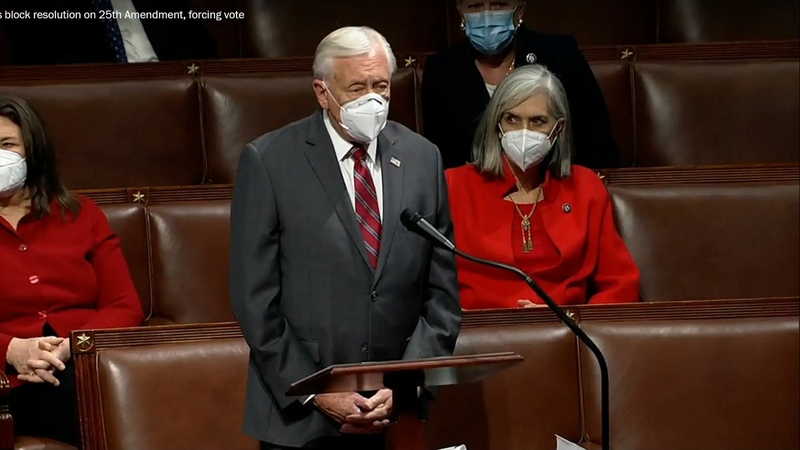
Those sentiments could collide with the determination of many House members to penalize Trump for his role in the assault on the Capitol and to ensure he cannot seek office again. Speaker Nancy Pelosi, D-Calif., has said the House will push ahead on impeachment if Vice President Mike Pence does not move to oust Trump by Wednesday, a step that seems highly unlikely.
Democratic leaders worry that if the Senate is consumed by an impeachment trial for the first few weeks of Biden’s term that it will have little capacity to do anything else, and Biden signaled Monday he is looking for a way around that.
“I had a discussion today with some of the folks in the House and Senate,” he said. “And the question is whether or not, for example, if the House moves forward, which they obviously are, with the impeachment and sends it over to the Senate, whether or not we can bifurcate this.”
Biden has been particularly concerned about Senate confirmation for his Cabinet nominees and getting his national security team in place. “Can we go half-day on dealing with the impeachment and half-day getting my people nominated and confirmed in the Senate?” he said.
Biden campaigned on bringing the country together, and some lawmakers believe that could be more difficult if he launches his presidency amid a fiery effort to punish his polarizing predecessor. But many in Biden’s party argue that it will not be possible for the country to unify if Trump is not held accountable for his role in the riot.
Biden has said little about his views on whether impeachment should go forward, suggesting Friday that it is a matter for Congress to decide. But he has made it clear he wants lawmakers to “hit the ground running” on his agenda once he takes office on Jan. 20.
Although the House is expected to vote this week on an article of impeachment, Senate Majority Leader Mitch McConnell, R-Ky., issued a memo last week saying the Senate would not consider the matter until Jan. 19, which would mean a trial would bleed into Biden’s term and potentially derail chunks of his legislative program.
Biden was more forceful Monday in discussing the rioters who took control of the Capitol, saying they should be prosecuted. Dozens have been arrested.
“I think it’s critically important that there be a real serious focus on holding those folks who engaged in sedition and threatened people’s lives and defaced public property and caused great damage, that they be held accountable,” Biden said. “And I think that’s a view that is held by the vast majority of Democrats and Republicans in the Congress.”
Biden added that it is his “hope and expectation” that his agenda can move forward amid impeachment. But he said he has not heard from the parliamentarian about whether it is feasible for the Senate to handle other business during an impeachment trial.
Biden was also asked whether he is “afraid” at all of taking the oath of office outside in the aftermath of the violence at the Capitol. “No,” Biden said.
He has previously expressed confidence in the Secret Service, which he said would be handling the event. “I am not afraid of taking the oath outside. I’m getting briefed,” Biden said Monday, presumably a reference to intelligence and security briefings.
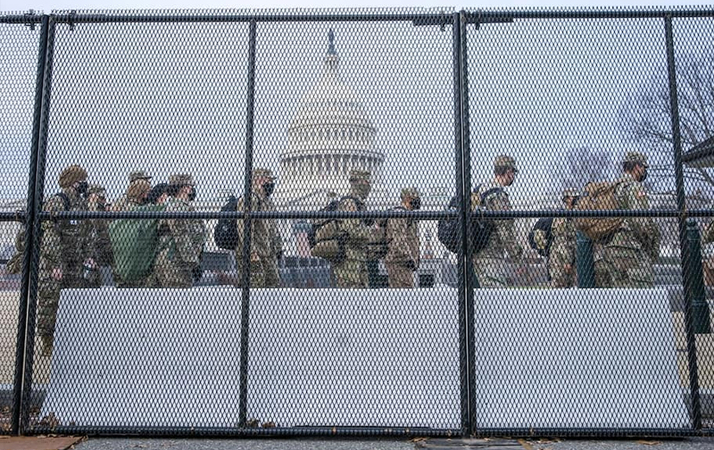
Members of the National Guard outside the U.S. Capitol on Jan. 11. (Sarah Silbiger/Bloomberg News)
By The Washington Post · Dan Lamothe
WASHINGTON – Up to 15,000 National Guard members could be deployed in Washington during the presidential inauguration, senior defense officials said Monday, part of a rapidly expanding response following a deadly insurrection at the Capitol last week.
Army Gen. Daniel Hokanson, the chief of the National Guard Bureau, said in a call with reporters that about 6,000 guardsmen from six states already are in the nation’s capital, and that the military response will expand to about 10,000 by the weekend.
Hokanson said the numbers will be determined by the requirements that federal agencies have for support. The National Guard will bring their weapons to Washington and carry them based on discussions with the FBI, police and other agencies.
“Obviously, we’re very concerned that we want our individuals to have the right to self-defense,” the general said. “And so, that will be an ongoing conversation, and if the senior leadership determines that that’s the right posture to be in, then that is something that we will do.”
The shift comes after the Defense Department carved out a narrow role ahead of a protest of President Donald Trump’s election loss on Wednesday. Trump directed thousands of people to the Capitol afterward, some of whom began storming the building and attacking Capitol Police officers, including one who later died.
Just 340 D.C. National Guard members had been activated ahead of the riot, and none were posted outside the Capitol. Instead, they were assigned to traffic duty in other parts of the city, because the Capitol Police and the Pentagon had not worked out a plan in the event of a crisis at the home of Congress.
President-elect Joe Biden built part of his political career on being known as a fighter in the “war on drugs,” supporting legislation as a senator that set harsh penalties for some drug offenses.
But as president, Biden could potentially oversee broad changes in federal drug policy, including how the government and law enforcement agencies view drug addiction and treatment and classify the use of marijuana.
Biden will take office at a time when the nation’s attitudes about drugs, particularly the legalization or decriminalization of marijuana, appear to be one area where there is relative, and growing, bipartisan unity.
In an election that was otherwise defined by stark political differences, voters in both red states and blue states – Arizona, Montana, New Jersey and South Dakota – supported ballot initiatives to legalize the personal use of marijuana, while Mississippi voters legalized it for medicinal use. Along with earlier action by state legislatures or voters, 15 states have legalized marijuana, while 36 others have approved some form of medicinal marijuana use, according to the National Conference of State Legislatures.
But marijuana remains illegal under federal law, leaving users and suppliers vulnerable to prosecution even in places where the drug is otherwise legally sold and used. The nation’s growing cannabis industry also faces hurdles in transporting its products across state lines and accessing the country’s federally regulated banking system.
During his primary campaign, Biden was one of the few Democratic candidates who did not support federal legalization of marijuana for recreational use, citing concerns that it could be a “gateway drug.” But during the general-election campaign, he softened his stance, saying that the drug should be decriminalized and that individual states should decide whether to legalize it for recreational use.
As the general-election campaign progressed, Kamala Harris, Biden’s running mate and a former prosecutor, also advocated for the decriminalization of marijuana despite past opposition to legalizing it. During the October vice-presidential debate, Harris said a Biden-Harris administration “will decriminalize marijuana, and we will expunge the records of those who have been convicted of marijuana” crimes.
LED lights cast a strong glow in the grow room at District Growers in Washington on May 1, 2019. MUST CREDIT: Washington Post photo by Bonnie Jo Mount.
Marijuana advocates are gearing up to make sure Biden sticks to his campaign pledge, which they note that strong majorities of Democratic voters support, according to recent polls.
Last month, for the first time, the Democratic-controlled House voted – 228-164 – to decriminalize marijuana and remove it from the federal schedule of controlled substances. The Republican-controlled Senate did not take up the measure, and many advocates are skeptical of its chances there, even though Democrats narrowly won control of the chamber after two runoff elections in Georgia last week.
But advocates say Biden can still push toward decriminalization, even without a vote from Congress.
Under its current classification, which dates to a decision made under President Richard Nixon in 1970, marijuana is classified as a Schedule I narcotic for having “no currently accepted medical use and a high potential for abuse.” The remaining schedules of narcotics, II through V, are ranked by their potential for abuse and perceived level of danger, and the classifications help guide federal enforcement and regulations for controlled substances, including prescription medication.
Maritza Perez, director of national affairs for the pro-reform Drug Policy Alliance, said legal analysts for the movement think the Biden administration can unilaterally reschedule marijuana to a higher classification or even remove it from the list. Although she prefers congressional action, Perez said the administration could declassify marijuana through a process that would involve sign-off from the incoming attorney general as well as the secretary of the Department of Health and Human Services.
Biden has nominated California Attorney General Xavier Becerra, who has defended his state’s legalization of marijuana, as his secretary of Health and Human Services.
“The attorney general would have to work hand-in-hand with the HHS secretary, but we think this is certainly something within the administration’s power, which is why the marijuana advocates have been pushing for him to appoint a pro-marijuana AG,” Perez said.
But Sam Kamin, a law professor at the Sturm College of Law at the University of Denver and a leading expert on marijuana laws, is skeptical that Biden will aggressively pursue the unilateral rescheduling or de-scheduling of marijuana. De-scheduling the drug could upend international drug control treaties, while rescheduling it could undercut state medical marijuana laws, he said.
“They can begin the rescheduling process, but whether they can de-schedule without stepping on other rules and regulations is more complicated,” Kamin said. “Treating marijuana like a Schedule II or III drug would create serious tensions with a lot of states. . . . If it was scheduled the same way Vicodin is scheduled, you could not get it over-the-counter as you can in many states. You would need a prescription from a medical doctor.”
A chair used by people while they do drugs sits under a bridge near train tracks in Philadelphia on July 27. MUST CREDIT: Washington Post photo by Salwan Georges.
Even if Biden decides to largely steer clear of the marijuana debate, advocates for reforming the nation’s drug laws still think his administration will usher in a new period of compassion when it comes to addiction.
To combat the opioid crisis, Biden has promised to spend an additional $125 billion over 10 years on drug treatment and prevention programs, while also supporting some controversial local initiatives such as needle exchanges.
Perez is optimistic that the Biden administration, unlike President Donald Trump’s, will take a hands-off approach when it comes to proposals by some cities to open safe-injection sites, where people can use illegal drugs in safe, monitored environments.
Last year, the Trump administration sued to try to stop Philadelphia from opening a so-called safe injection site. But Perez noted in July that Becerra, as California attorney general, joined a multistate amicus brief in support of Philadelphia.
“Safe injection sites . . . are an innovative tool to combat the opioid epidemic and drug dependency while reducing overdose death and transmission of diseases,” Becerra said at the time.
Biden’s ambitious LGBT agenda poises him to be nation’s most pro-equality president in history
InternationalJan 12. 2021Kelly Miller, left, and her wife, Lindsey Miller, center, embrace on June 26, 2015, outside the White House, lighted in multicolored lights in recognition of the Supreme Court’s decision to legalize same-sex marriage in all 50 states. The Millers were married two years ago in Washington State, where same-sex marriage was legalized. MUST CREDIT: Washington Post photo by Michael S. Williamson
By The Washington Post · Emily Wax-Thibodeaux
WASHINGTON – Joe Biden became a fast friend of the LGBTQ community as vice president in 2012 by stating his support for same-sex marriage in a television interview even before his boss, President Barack Obama, did.
That same year, outside an Obama-Biden campaign office in Florida, it was Biden’s unexpected support for the transgender community that elevated his status from an LGBTQ ally to a champion. When the mother of a Miss Trans New England pageant winner asked Biden if he would help transgender people, she later told reporters, Biden whispered that it was the “civil rights issue of our time.”
Since then, Biden’s views on the LGBTQ community have become clearer and louder.
When he left the vice presidency, Biden partnered with other advocates to start the As You Are campaign to advocate for families’ acceptance of their transgender children, which “dramatically improves their child’s self-esteem and decreases the likelihood they will experience depression or suicidal ideation,” the Biden Foundation was cited as saying in a 2019 announcement.
Now advocates say the 78-year-old will be the nation’s most pro-LGBTQ president ever. He and Vice President-elect Kamala D. Harris have promised an ambitious slate of actions that would go beyond reversing what LGBTQ advocates have called President Donald Trump’s “discrimination administration.”
The Trump Accountability Project, by the advocacy group GLAAD, has recorded more than 180 anti-LGBTQ statements and actions by the Trump administration and those in the president’s circle since January 2017, including a proposal that would allow homeless shelters to house transgender people according to their sex assigned at birth rather than their gender identity.
Transgender rights have become a lightning rod in the relentless culture war that has come to dominate American politics, pitting conservative Christians who want their religious views to be accommodated against liberal and secular Americans who think some of those views trample on minority groups’ rights.
Just weeks before it leaves office, the Trump administration handed out a 400-page document detailing how federal contractors and recipients of government grants can cite their religious views to refuse to provide health coverage for birth control and other reproductive care and adoption services to single people or LGBTQ couples.
Biden has called religious freedom “a fundamental American value,” but also promised to reverse Trump administration policies that are “misusing these broad exemptions.”
He has committed to overturning every Trump administration rule that limits transgender rights, including tossing out its near-total ban on transgender troops serving in the military on “Day One.” Biden also has promised to reinstate Obama-era guidance for protecting transgender students that the Trump administration withdrew.
“Biden has made it clear that he intends to weaponize the law to crush dissent, in order to implement a far-left agenda,” said Kristen Waggoner, general counsel for Alliance Defending Freedom, a conservative legal organization that says it protects religious and moral convictions and freedom of speech. “That impacts not just people of faith, but all Americans who want to live life according to their convictions. The government can’t engage in religious bigotry.”
Alliance Defending Freedom is representing Christian adoption agency New Hope Family Services in an ongoing legal battle with New York state over its policy to place children only in homes with married opposite-sex couples.
“We live in a pluralistic society,” Waggoner said. “The government should not single out and punish those who believe that the best home for a child includes a married father and a mother.”
A judge recently sent the case back to a lower court, ruling that it should be allowed to continue its faith-based approach to adoption as the case proceeds, a move Waggoner cited as a win for religious liberty.
Biden has said he will protect the rights of anyone who qualifies to adopt, regardless of religion or family composition. Biden, who is Catholic, has split from his church’s stance on some issues, saying he values “the dignity of every person.”
During a town hall meeting with voters, Biden surprised even longtime LGBTQ advocates when he addressed the killing of transgender women – largely of color. At least 43 transgender or gender-nonconforming people were killed in the United States in 2020, according to the Human Rights Campaign. Advocates praised Biden for bringing the issue to the national stage and vowing to direct federal resources to prevent and prosecute such homicides.
“There’s an opportunity here for a national discussion on transgender people of color who are often just left out of the national conversation,” said David J. Johns, executive director of the National Black Justice Coalition, a civil rights organization dedicated to the Black LGBTQ community. “Even though the transgender community may have more visibility in TV shows like ‘Pose,’ the vitriol at the policy level that exists within the system leaves no promise of justice.”
Johns said he hopes to see more LGBTQ leaders of color appointed in Biden’s administration.
“That way they can show up and craft policy which will ensure that people of color can raise the alarm about issues of mental health, safety, housing or dealing with police in their communities,” he said.
Biden has promised that his administration will “look like America,” and has said he will provide anti-bias training for federal employees and offer incentives for states that adopt programs that help prepare transgender people for the workplace.
But he could face his most laborious hurdle in passing the Equality Act, a package of measures that protect against discrimination on the basis of sexual orientation that was passed by the House in 2019 but blocked by the Republican-led Senate.
That act – which Biden has pledged to make a policy priority during his first 100 days in office – has been a cornerstone of the community’s fight for equal rights in housing and employment since it was first discussed after the Stonewall riots in 1969.
If Republicans retain control of the Senate, the legislation’s passage will remain unpredictable. Some Republicans have instead backed the Fairness for All Act, which provides some LGBTQ protections while also granting certain exceptions for religious institutions and organizations.
Much of the battle over LGBTQ rights has been happening in statehouses, where those issues have been lightning rods in the nation’s culture war. This has kept policy debates about restroom access and puberty blockers largely beyond the reach of the federal government, but the rhetoric coming out of the White House does have influence, said Drew Anderson, a longtime LGBTQ advocate who used to work with GLAAD.
“It always helps to have an LGBTQ ally in the White House who will call it for what it is: hatred for an everyday American,” Anderson said.
Biden has credited his passion for LGBTQ issues to his late son Beau Biden’s close friendship with Sarah McBride, who is transgender.
McBride worked on Beau Biden’s reelection campaign for attorney general in Delaware, where they later collaborated to pass protections for transgender people in housing, health insurance and employment.
The Biden family developed a close relationship with McBride after Beau Biden died of brain cancer in 2015. McBride’s husband, Andy Cray, had died of cancer the year before.
“The president-elect has always been far out ahead on transgender issues. And I think all of us benefit from knowing people who are trans and organic agents of change in daily life,” said McBride, who was elected in Delaware in November as the first openly transgender state senator in the country. “But I know Joe Biden also wants to honor and carry forward his son’s work and legacy on this issue.”
Joe Biden wrote the foreword for McBride’s book “Tomorrow Will Be Different: Love, Loss and the Fight for Trans Equality.”
In it, he calls transgender equality “the civil rights issue of our time.”
By Syndication Washington Post, Bloomberg · Tim Ross, Emily Ashton
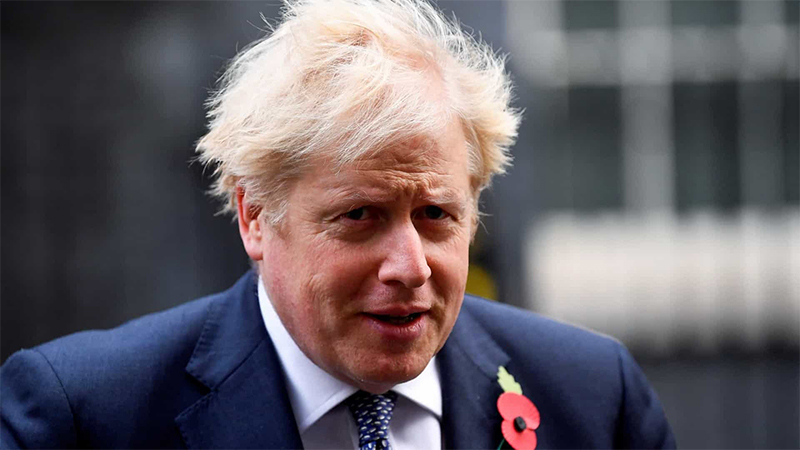
British Prime Minister Boris Johnson warned he may tighten the coronavirus lockdown if people don’t follow the rules as his government backed tougher enforcement.
Any “complacency” about the disease is misplaced, Johnson said, even though an immunization program is well underway and 2.2 million people have received shots so far.
But he risked undermining his own appeal to the public to stay home and act responsibly when it emerged he had taken a bike ride 7 miles across London on Sunday.
“Of course, if we feel that things are not being properly observed, then we may have to do more,” Johnson said during a visit to a vaccination center in a sports stadium in Bristol, southwest England, Monday. The vaccine rollout is a “race against time,” with the country at a “very perilous moment” as infection rates soar, he said.
Britain is facing its toughest period of the pandemic, with hospital admissions up 22% in a week to more than 32,000, and the death toll now more than 80,000. Last week Johnson announced a third national lockdown, a move that threatens to push the U.K. into another recession and compound the damage of the first lockdown, which caused the deepest contraction for 300 years.
The vaccination program is the key to the economic recovery, Chancellor of the Exchequer Rishi Sunak told lawmakers Monday.
The government aims to start relaxing restrictions after Feb. 15, the target date by when Johnson wants all 15 million of the most vulnerable people and their carers to have been given at least one immunization dose.
Even though Britain is far ahead of other European countries in the rollout of vaccines, a new more contagious variant of the disease is pushing the health service to breaking point. Medical advisers and officials are growing increasingly concerned the public is not keeping to the rules, and that hospitals will soon be overwhelmed.
Johnson said the lockdown rules need to be enforced properly in food stores and urged people to think carefully before leaving home for any reason. Hospitals are under intense pressure from a surge in covid-19 cases, with oxygen supplies running short in some areas, he said.
Health Secretary Matt Hancock said everyone shares responsibility for ensuring the rules are obeyed and praised store chain Wm Morrison Supermarkets Plc for saying it will refuse entry to anyone not wearing a mask without a specific exemption.
“I am delighted that the police are stepping up their enforcement, but it isn’t just about the government and the rules we set, or the police and the work that they do, it’s about how everybody behaves,” he told a press conference. “I applaud the action Morrisons has taken today,” he said. “That’s the right approach.”
The premier’s office faced questions over his own action after London’s Evening Standard newspaper reported Johnson was seen cycling around the Olympic Park, 7 miles east of his official residence, at about 2 p.m. Sunday. Official government guidance allows people to leave their homes for the purpose of taking exercise but advises that people should stay within their “local area.”
Hancock said long bike rides and walks of 7 miles are allowed under the rules.
But the episode threatens to reignite a row over the behavior of Johnson’s former aide Dominic Cummings, who was accused of breaking lockdown rules last spring by driving more than 250 miles out of London when the country was being told to stay at home. Johnson’s office did not immediately respond to requests to comment on his trip.
On civil rights, policing, prosecutions, Biden’s Justice Department will be distinct from Trump’s
InternationalJan 12. 2021Joseph Biden walks with civil rights leaders and lawmakers over the historic Edmund Pettus Bridge in Selma, Ala., on March 3, 2013. MUST CREDIT: Washington Post photo by Melina Mara
By The Washington Post · Matt Zapotosky
WASHINGTON – The Justice Department in the Biden administration is likely to increase resources for the civil rights division and resume wide-ranging scrutiny of troubled police departments nationwide, analysts say, as President-elect Joe Biden seeks to fulfill his campaign promises of combating systemic racism and fighting for equal rights.
Biden had been under pressure from civil rights leaders to appoint a Black attorney general with a background in civil rights and criminal justice reform. His selection, federal appellate judge Merrick Garland, is considered one of the more moderate candidates he could have chosen, and some criminal justice reform advocates have said previously that Garland’s record on the bench shows that he is too deferential to law enforcement. But others say that Garland has merely applied the law as his job requires, and that as attorney general he would surely seek to implement Biden’s agenda.
Biden also selected two prominent civil rights leaders for other top Justice Department jobs, allaying some concerns.
At a news conference announcing his nomination, Garland noted that the Justice Department was founded after the Civil War – in part to enforce constitutional amendments abolishing slavery and ensuring people of color the right to vote – and that the principles at that time remain relevant. He vowed that under his leadership, the department would be devoted to “ensuring racial equity in our justice system.”
For associate attorney general, the third-highest-ranking official, Biden chose Vanita Gupta, the president of the Leadership Conference on Civil and Human Rights and a former head of the Justice Department’s civil rights division. And he nominated Kristen Clarke, president of the Lawyers’ Committee for Civil Rights Under Law, as head of the Civil Rights Division.
Clarke said at the news conference, “We will turn the page on hate and close the door on discrimination by enforcing our federal civil rights laws.” Gupta vowed that the department would go far beyond merely repairing the reputational damage it suffered under President Trump, and would harness all the tools at its disposal to protect civil rights and force police reform.
“It will not be enough to restore what has been undermined or lost,” Gupta said. “This moment demands bold leadership.”
On his campaign website, Biden has made detailed commitments to how he will remake the Justice Department, especially when it comes to civil rights and policing. The Trump administration almost completely abandoned using broad pattern-or-practice investigations and court-monitored consent decrees to address systemic misconduct at local police departments, because Jeff Sessions, Trump’s first attorney general, did not favor them and issued a memo curtailing their use.
Judge Merrick Garland studies a toy that has been customized with his likeness, during a February, 2020 ceremony to pass the title of chief judge of the U.S. Court of Appeals for the D.C. Circuit to Sri Srinivasan, back right. MUST CREDIT: Washington Post photo by Bill O’Leary.
The Justice Department’s civil rights division under President Barack Obama opened 25 investigations of local law enforcement agencies across the country and enforced 14 court-approved consent decrees mandating changes. The Justice Department under President Trump initiated just one case involving a local police department, examining the former narcotics unit in Springfield, Mass. It opened other inquiries involving prisons.
Biden’s website, by contrast, promised to increase funding to the Justice Department’s civil rights division, which conducts such investigations and implements such decrees, and also vowed to push for legislation to clarify that pattern-or-practice inquiries could also target misconduct in prosecutors’ offices. Civil rights leaders welcome Biden’s promises.
“We need the Justice Department back in the business of holding the most egregious offenders accountable,” Clarke said in an interview weeks before her selection as the nominee to lead the Civil Rights Division was made public.
Biden’s campaign website said his administration would also reinvigorate the Community Oriented Policing Services office, which doled out grants in the Trump administration but stopped working with police departments on broad reform agreements.
Trump’s Justice Department took an aggressive posture toward cracking down on crime. Sessions issued a broad policy calling for prosecutors to pursue the most severe penalties possible, including mandatory minimum sentences, reversing an earlier directive by Obama attorney general Eric Holder to avoid charging offenses that might trigger such severe penalties.
Many federal prosecutors were not fond of Holder’s memo, and it was not immediately clear whether Biden’s attorney general will reinstate it. Doing so would probably win plaudits from advocates for criminal justice reform and from civil rights leaders, but it could spark complaints from prosecutors.
Biden’s campaign website said that he would “reduce federal spending on incarceration” and that the criminal justice system “must be focused on redemption and rehabilitation.” The site said Biden would again end the government’s use of private prisons – something that then-Deputy Attorney General Sally Yates had done when Biden served as vice president.
Biden also promised to aggressively press voting rights enforcement – which Clarke said was sorely lacking in the Trump Justice Department.
Trump’s recognition of white nationalists will loom as Biden confronts surge in hate crime
InternationalJan 12. 2021Chanting “White lives matter,” “You will not replace us” and “Jews will not replace us,” several hundred white nationalists and white supremacists carrying torches march in Charlottesville on Aug. 11, 2017, during the Unite the Right Rally. MUST CREDIT: Photo for The Washington Post by Evelyn Hockstein
By The Washington Post · Matt Zapotosky
When Joe Biden formally announced his entry into the presidential race in 2019, he said he was moved to do so while watching President Donald Trump talk about a white nationalist rally that turned violent in Charlottesville. A woman protesting the racist demonstrators had been killed in the mayhem, but rather than condemning the white nationalists, Trump said there were “very fine people on both sides.”
“With those words, the president of the United States assigned a moral equivalence between those spreading hate and those with the courage to stand against it,” Biden said. “And at that moment, I knew the threat to this nation was unlike any I had ever seen in my lifetime.”
As Biden enters the White House, he will now have to address that threat himself, as hate crimes are on the rise and analysts say white supremacists and other domestic extremists have been emboldened by Trump. The acute challenge he will face was crystallized on Wednesday, when a mob of Trump supporters stormed the Capitol.
“I wish we could say we couldn’t see it coming,” Biden said Thursday. “But that isn’t true. We could see it coming. The past four years, we’ve had a president who’s made his contempt for our Democracy, our Constitution, the rule of law clear in everything he has done.”
Analysts say a change in presidential rhetoric will help, and the FBI and the Department of Homeland Security have been able to take some steps to try to tamp down on domestic extremism, sometimes in spite of Trump. Biden will face pressure to do even more.
Federal appellate judge Merrick Garland, whom Biden has nominated as his attorney general, has a background in prosecuting domestic terrorism cases. He oversaw the prosecution of the 1995 bombing of the federal building in Oklahoma City that killed 168 people. He also oversaw the prosecution of Ted Kaczynski, the Unabomber, who eluded authorities for years while mailing bombs to people.
At a news conference where his nomination was announced, Garland noted that the Justice Department was founded after the Civil War – in part to enforce constitutional amendments abolishing slavery and ensuring people of color the right to vote – and that the principles at that time remained relevant in the modern era.
“They echo today in the priorities that lie before us, from ensuring racial equity in our justice system, to meeting the evolving threat of violent extremism,” Garland said. “If confirmed, those are the principles to which I will be devoted as attorney general. President elect-Biden understands this.”
Garland also referenced the riots from a day earlier, saying, “As everyone who watched yesterday’s events in Washington now understands, if they did not understand before, the rule of law is not just some lawyers’ turn of phrase. It is the very foundation of our democracy.”
Kristen Clarke, whom Biden nominated to head the Justice Department’s Civil Rights Division, said in an interview before she was chosen for the job that she would like to see that division intensify its efforts to prosecute hate crimes and crack down on white supremacy.
“We need a division that is using its enforcement powers to counteract those efforts, to send a strong message to white supremacists that this conduct will not be tolerated in our country,” said Clarke, president of the Lawyers’ Committee for Civil Rights Under Law. “We have seen some prosecutions of the most violent offenders, but they need to do more, given the spike in activity. We need to see more from the Civil Rights Division in this area.”
Some advocates have pushed for a law that would give officials the ability to designate domestic terrorist organizations the same way they do international organizations, and then charge those who support them. Such legislation – which would require congressional approval – would probably run into significant First Amendment and civil liberties challenges.
During the Trump administration, they could never be seriously discussed, because Trump showed little interest in the issue, and his relationship with Congress was not conducive to getting tough legislation passed, said Elizabeth Neumann, who served as the assistant secretary for threat prevention and security policy in the Trump administration’s Department of Homeland Security.
“There was no opportunity for any sort of tough conversation like this to happen because there was a leadership vacuum at the White House,” she said.
Neumann said that Biden simply installing a functioning government to work with Congress to study the issue using normal processes might help.
“If you had the ability to designate a terrorist organization or if you had [the] ability to designate somebody as a domestic terrorist actor, then hypothetically you would be able to watch-list them,” she said, although she conceded that such measures probably would face legal challenges and that domestic terrorist groups may not be as easily tagged as international ones, because they are far less organized.
“Given that many of the groups are not really groups as much as decentralized, amorphous goo, it’s not maybe the panacea that some people assume it might be,” she said.
Jonathan Greenblatt, chief executive of the Anti-Defamation League, which tracks extremism nationwide, said Biden might consider creating a White House task force to address hate crime. The FBI, he noted, has been tracking steady increases in such offenses – although many police departments don’t adequately report data – and in 2019, his organization tracked the highest number of anti-Semitic incidents ever.
“The reality is, extremists feel emboldened in this environment,” Greenblatt said.
The FBI during the Trump administration charged several suspected members of neo-Nazi or white supremacist groups, including Atomwaffen Division and the Base, in connection with alleged plots, and FBI Director Christopher A. Wray has said repeatedly that he takes domestic extremism seriously. But he also has noted that the FBI’s role is to investigate and arrest those who perpetrate violence, rather than taking aim at a particular ideology. Biden, officials said, will have to look elsewhere to try to prevent white supremacist violence, and to de-radicalize potential attackers.
The Trump administration drew criticism early for not funding a DHS program created to counter violent extremism, and for not focusing on white supremacy. Neumann said that later on, though, the department formulated a strategy and asked Congress for $80 million in new money to focus on preventing violence and intervening with people before they become fully radicalized.
Such funding was included in a $2.3 trillion spending bill for fiscal 2021.
“There’s good news,” she said. “But it’s going to take a while for that to come to fruition.”
Also key for the incoming administration will be leaning on tech companies such as Facebook, whose algorithms can magnify white supremacist content, Greenblatt said.
“Social media has played a central role in radicalizing domestic extremists,” he said. “I think addressing the issues of hate online is imperative if we really want to have an effective whole-of-government solution to stopping the spread of domestic terror.”
Neumann said Biden also will have to contend with the legacy Trump has left behind, as tens of millions of people continue to embrace his conspiracy theories and racist ideas.
“He’s clearly not going to go quietly, so there’s clearly going to be a Trump side to this,” she said. “My concern there is that now we have this massive pool who are vulnerable to getting recruited into a darker movement.”
Pelosi says staff hid under a table for hours as rioters vandalized her office: ‘A terrible, terrible violation’
InternationalJan 12. 2021House Speaker Nancy Pelosi, D-Calif., is shown on Jan. 7, 2021, the day after rioters stormed the U. S. Capitol. MUST CREDIT: Washington Post photo by Melina Mara.
By The Washington Post · Jaclyn Peiser
As a pro-Trump mob beat down the door to House Speaker Nancy Pelosi’s office on Wednesday, her staff ran into a conference room, barricaded the door, switched off the lights and cowered under a long table. Eight of them stayed there for 2½hours as rioters pounded on the door and ransacked and defaced the speaker’s office, Pelosi told “60 Minutes” on Sunday.
As the California Democrat walked CBS’s Lesley Stahl through her vandalized office, she again urged Vice President Mike Pence to remove President Donald Trump from office under the 25th Amendment – and promised that Congress will pursue impeachment if he does not.
“Sadly, the person that’s running the executive branch is a deranged, unhinged, dangerous president of the United States,” Pelosi said. “. . . He has done something so serious that there should be prosecution against him.”
Pelosi made the case for impeachment as House Democrats are divided over the move, with some citing concerns that it could interfere with President-elect Joe Biden’s early push to take immediate action on the pandemic and a foundering economy.
Speaking to “60 Minutes,” Pelosi said she would prefer that Trump be removed through the 25th Amendment, which “gets rid of him” immediately. “He’s out of office,” Pelosi added. The amendment allows the vice president and a majority of the Cabinet to remove the president if he’s unable to fulfill his duties.
Impeachment would take longer, and it’s uncertain how a Senate trial would play out. But Pelosi said that impeachment and conviction would serve as a just punishment and could prevent Trump from running for office again.
“That’s one of the motivations that people have for advocating for impeachment,” Pelosi said.
Another reason for the urgency, Pelosi said, would be to prevent Trump from pardoning “these people who are terrorists on the Capitol.”
Pelosi said her demands for Trump’s removal are informed by her own terrifying experience during the riots. The speaker told Stahl that her security detail swiftly removed her from the House chamber and rushed her to a safe location.
“I think [it] was universally accepted that what happened was a terrible, terrible violation,” Pelosi said, pausing for what appeared to be an emotional moment, ” . . . of the Capitol, of the first branch of government, the legislative branch, by the president of the United States.”
Pelosi showed Stahl where the rioters broke down her office door and shattered an antique mirror, scattering glass. The mob stole computers and rustled through documents. One man sat at a desk, which has since been removed, and “defamed” it, Pelosi said, posing for pictures while leaning back in the chair and resting his boot on the desk.
That man has since been identified as 60-year-old Richard Barnett of Gravette, Ark. He was arrested Friday and charged with three counts of entering restricted grounds, violent entry and disorderly conduct at the Capitol and theft of public property, prosecutors said.
As the vandals wreaked havoc through Pelosi’s office, her staff members remained hidden under a table, listening as the mob called out for them and their boss.
“They were vocally saying, ‘Where’s the speaker? We know she has staff. They’re here someplace. We’re going to find them,’ ” Pelosi told Stahl.
“The evidence is now that – that it was a well-planned, organized group with leadership and guidance and direction,” the speaker added. “And the direction was to go get people.”
The FBI has confirmed that agents are investigating whether some rioters stormed the Capitol with the intent to kill lawmakers or take hostages.
Once the Capitol was clear, lawmakers returned to work to confirm Biden’s victory. But many Republican lawmakers stuck with their original plan to challenge election results in some states that Trump lost, making baseless claims of mass fraud. Pelosi condemned those lawmakers, which included two-thirds of the House’s Republican caucus.
“These people are enablers of the president’s behavior,” Pelosi said. “I remember when Republicans in the Senate went to see Richard Nixon and said, ‘It’s over.’ That’s what has to happen now.”
Pelosi also reiterated that Trump’s actions were so grave that he deserves severe punishment.
“This president is guilty of inciting insurrection,” Pelosi said. “He has to pay a price for that.”
Myanmar’s government is demanding the resignation of a Border Guard Force (BFG) leader it said controls illegal casinos along the Thai-Myanmar border that are linked with Covid-19 outbreaks in both countries.
Local media report that hundreds more Thais working in a casino in the border town of Myawaddy, Karen state are expected to return to Thailand this week, as infections among returnees rise. Late last week, 17 Thais tested positive for Covid-19 after crossing back over the border from Myawaddy to Mae Sot in Tak province.
A news source in Tak said the Myanmar government has ordered the resignation of three commanders of the BGF, an armed group backed by the country’s military.
Among them is Karen-BGF leader Colonel Saw Chit Thu, who reportedly controls China-backed casinos in Myawaddy Township’s new gambling hub, Shwe Kokko.
“The three commanders are accused of cooperating with foreigners in opening casinos along the Thai-Myanmar border without permission from the government,” said the source. “These casinos are believed to have spread the virus among guests and workers, which include Thai, Myanmar and Chinese nationals, and have caused serious damage to the country.”
Since 2015, Chinese businesspeople have poured investment into Shwe Kokko. The controversial gambling hub now reportedly hosts more than 10 casinos and several thousand Chinese residents.
As of January 9, Myanmar had reported a total of 130,049 cases of Covid-19 and 2,826 deaths.

 A person past signage for Hong Kong Exchanges & Clearing at the Exchange Square complex in Hong Kong on Aug. 19, 2020. MUST CREDIT: Bloomberg photo by Roy Liu.



 Kelly Miller, left, and her wife, Lindsey Miller, center, embrace on June 26, 2015, outside the White House, lighted in multicolored lights in recognition of the Supreme Court’s decision to legalize same-sex marriage in all 50 states. The Millers were married two years ago in Washington State, where same-sex marriage was legalized. MUST CREDIT: Washington Post photo by Michael S. Williamson
 Joseph Biden walks with civil rights leaders and lawmakers over the historic Edmund Pettus Bridge in Selma, Ala., on March 3, 2013. MUST CREDIT: Washington Post photo by Melina Mara

 Chanting “White lives matter,” “You will not replace us” and “Jews will not replace us,” several hundred white nationalists and white supremacists carrying torches march in Charlottesville on Aug. 11, 2017, during the Unite the Right Rally. MUST CREDIT: Photo for The Washington Post by Evelyn Hockstein
 House Speaker Nancy Pelosi, D-Calif., is shown on Jan. 7, 2021, the day after rioters stormed the U. S. Capitol. MUST CREDIT: Washington Post photo by Melina Mara.