By The Washington Post · Anthony Faiola, Alexander Villegas, Lesley Wroughton
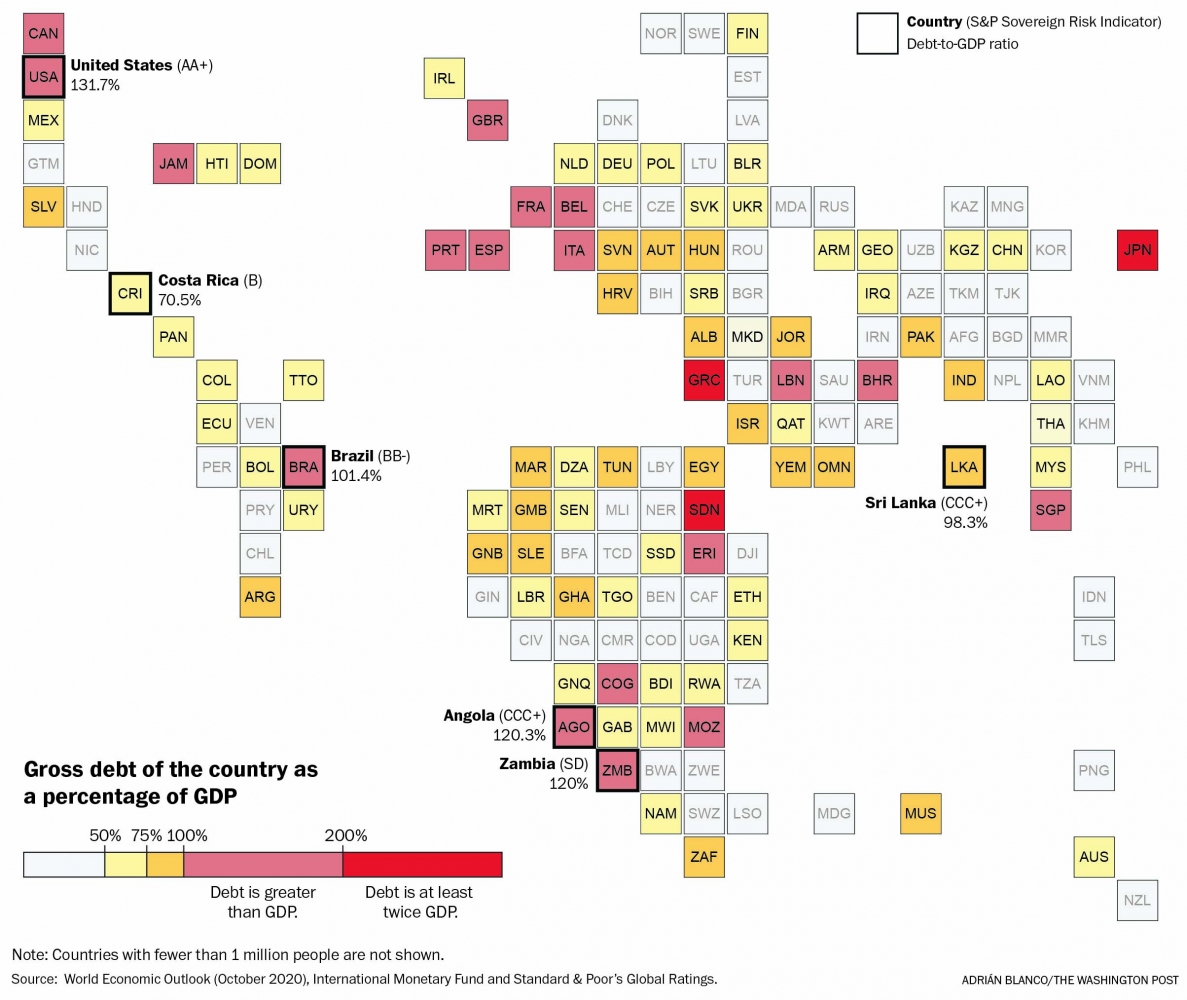
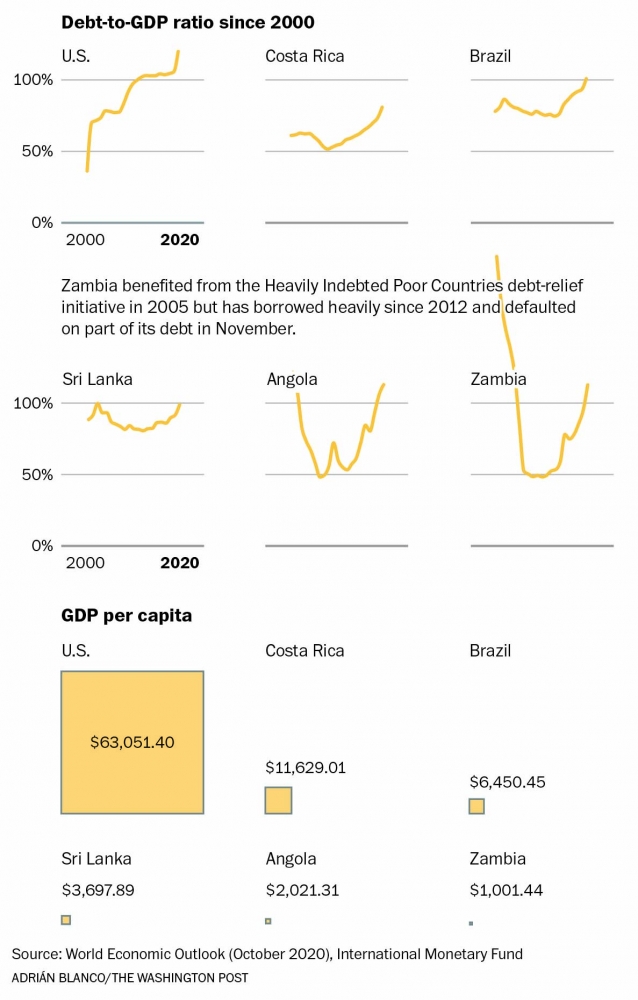
SAN JOSE, Costa Rica – This nation built Latin America’s model society, enacting universal health care and spending its way to one of the Western Hemisphere’s highest literacy rates. Now, it’s reeling from the financially crushing side effects of the coronavirus as cratering revenue and crisis spending force a reckoning over a massive pile of government debt.
The pandemic is hurtling heavily leveraged nations into an economic danger zone, threatening to bankrupt the worst-affected. Costa Rica, a country known for zip-lining tourists and American retirees, is scrambling to stave off a full-blown debt crisis, imposing emergency cuts and proposing tighter measures that touched off rare violent protests last fall. To keep the lights on, an eco-friendly nation is weighing desperate solutions – including open-pit gold mining, even oceanic fracking.
“Costa Rica is facing a social crisis,” said Ana Rosa Ruiz, an economist at the Costa Rican Technological Institute.
Around the globe, the pandemic is racking up a mind-blowing bill: trillions of dollars in lost tax revenue, increased spending and new borrowing set to burden the next generation with record levels of debt. In the direst cases – low- and middle-income countries, mostly in Africa and Latin America, that are already saddled with backbreaking debt – covering the rising costs is transforming into a high-stakes test of national solvency.
Analysts call it a “debt tsunami”: National accounts are sinking into the red at a record pace.
“I consider the risk to be very high of an emerging-market debt crisis where a lot of countries run into problems at once,” said Harvard University economist Kenneth Rogoff, former chief economist at the International Monetary Fund. “This is going to be a rocky road.”
By the end of 2020, total government debt worldwide was projected to soar by $9 trillion and top 103% of global GDP, according to the Institute of International Finance – a historic jump of more than 10 percentage points in one year. Countries have maxed out their credit to buy medical equipment, set up field hospitals, deploy health-care workers and source vaccines, even as pandemic-related recessions have caused tax revenue to plunge and aid for the unemployed to spike. Countries that rely on tourism, which has ground to a virtual halt, or commodities such as oil that have sunk in price have felt the sting most keenly.
The United States has run up debt at a pace not seen since World War II. But the world’s wealthy nations are better able to cope with growing debt than their poorer counterparts.
Angola, effectively shut out of global markets, is racing to strike a deal with the Chinese, but even that might not be enough to prevent a debt crisis. Sri Lanka, locked in recession, is required to make $4 billion in debt payments this year with only $6 billion in the bank. Brazil’s debt, worsened by a yawing budget deficit, has surged to 95% of GDP – raising alarm over the medium-term ability of the Latin American giant to stay afloat.
The IMF and the World Bank have sought to aid the most vulnerable states, and the world’s wealthiest nations endorsed a plan in October to extend a suspension of debt payments owed to them by the poorest. In November, those nations additionally agreed to jointly work toward some form of debt relief for the poorest nations that seek it from them, and they encouraged private lenders to follow suit.
But analysts say that may not be enough. Thirty-eight low-income countries are either in debt distress, according to the IMF, or at high risk of falling into it. Unless private creditors and wealthy nations step up and agree to concessions or outright debt forgiveness, the pandemic’s fiscal shock could hurl some of those, as well as highly leveraged middle-income countries such as Costa Rica, toward catastrophic national bankruptcies.
Analysts argue that the need for stimulus to keep economies running during this historically challenging period still outweighs the need to balance budgets. Even the IMF, the global guardian of fiscal rectitude, is telling countries that now is not the time to scrimp, lest they jeopardize still-fragile economic recoveries.
Yet even if a repeat of the cascading financial crises seen in Latin America and Asia in the 1980 and 1990s is avoided, the debt surge threatens to linger as a millstone around the necks of nations for years. It will compromise their ability to fight the first global increase in extreme poverty since the 1990s, and to invest in infrastructure projects, education and innovation down the line.
“You could think of it as a big crack in the ice,” said Sonja Gibbs, managing director of global policy issues at the Institute of International Finance. “Suddenly you’re in danger of a number of countries falling off the edge.”
Zambia, once a shining example of Africa’s economic renaissance, is now the Ghost of Crises Future for debt-burdened countries slammed by the pandemic.
The sub-Saharan nation fell into default in November, a result of its high reliance on foreign debt; a pandemic blow to the price of copper, its main commodity; and one of its worst droughts in 40 years. The country is now printing money to survive, forcing a devaluation of the kwacha and creating spiraling inflation that’s spreading misery at the worst possible time.
At the government’s Cancer Diseases Hospital in Lusaka, the capital, doctors say the price of imported drug treatments has doubled. A third of the country’s workers have lost wages, according to a household survey in July; 39% were skipping a meal, and 67% were worried about not having enough food.
Sakala Zulu, a 26-year-old teacher from eastern Zambia, said staples such as eggs and sugar now cost 60% more than three months ago, making it harder to feed his six children. The cost of transport for the 12-mile commute to and from work has risen by 20%.
“Right now, I feel there is no part of my life not affected,” Zulu said.
Zambia is seeking to restructure its debt, but private creditors have shown little willingness to budge. A move to renegotiate substantial loans from China has been cloaked in secrecy.
As things stand, more than half of government spending this year is earmarked for servicing debt alone – leaving little for social programs, health or education.
“What you see now on the ground is reduced spending on key social sectors,” said Ishmael Zulu of the advocacy group CUTS International. “With the high levels of poverty in Zambia, there are many people that are heavily reliant on government programs. These programs are suffering at the cost of increased debt levels. Hospitals that are in small districts and the far-flung areas of the country are suffering at the cost of increased debt servicing.”
– – –
Half a world away, Costa Rica is scrambling to avoid a similar fate.
When the pandemic hit, tourism, the country’s economic lifeblood, dried up and unemployment skyrocketed to more than 24%, draining state coffers of health-care contributions just as the government was struggling to respond to the coronavirus. A tax break for hard-hit businesses and financial aid to out-of-work Costa Ricans dug the fiscal hole deeper.
The ensuing cash crunch forced hard decisions, including emergency cuts. At El Jardín elementary school in northern Costa Rica, Principal Elizabeth Mejía says the operating budget was slashed in half. Teachers are buying their own printers, ink cartridges and paper to distribute assignments to students. Mejía said she’s been told by the government to hold fundraisers to cover maintenance: “They tell us if we need to fix something, that we should go sell tamales.”
In the years after the Great Recession of 2008, Costa Rica ran up deficits and debt to sustain expansive state payrolls and liberal policies. Two years ago, the government attempted what economists describe as a fiscal Band-Aid: a new value-added tax and limits on salary increases for state workers.
Those measures paled in comparison with the proposal last year, when the government of President Carlos Alvarado Quesada, seeking to boost its bid for a $1.75 billion IMF bailout, sought broad tax increases during the pandemic.
Protesters hit the streets, blocking intersections nationwide, clashing with police and slowing commerce in a country that had only recently come out of lockdown.
“People don’t have money to pay their debts,” said Gerardo Zúñiga, an activist who joined the protests with a mask on his face and a rosary around his neck. “Businesses don’t have money to pay for supplies, their employees, their permits and all the social contributions.
“We understand that there has to be some agreement with the IMF, but what we don’t agree with are items where the most vulnerable people are harmed.”
The government backed off that proposal and is now in talks with the opposition, unions, civic activists and industrial groups to find a more palatable solution. But to avoid a painful default like the one the country suffered in 1981, when runaway inflation and spikes in poverty sparked a lost decade, something’s got to give.
With tourism not expected to recover fully for years, politicians and businesses are pushing sources of revenue that run afoul of Costa Rica’s renowned environmentalism. They include open-pit gold mining – effectively an ecological trade-off for what supporters estimate would be 6,500 direct and indirect jobs and a $9.52 billion jolt for the economy.
In August, lawmakers pushed another controversial option: opening Costa Rican lands and shorelines to fracking and oil drilling.
“Our marine territory is 10 times larger than our landmass and we know little about its riches,” lawmaker Patricia Villegas said during a congressional debate. “We have sources of energy that we exploit like hydroelectric, wind, geothermal and solar, but we haven’t wanted to discuss the possibility of taking advantage of gas and oil. Costa Rica is sitting on a gold mine.”
In a country that pledged to rely entirely on renewable energy by 2030, the debt debate is pitting the country’s economic future against cherished environmental ideals. Activists, and the government, say any boost in oil and natural gas exploration runs counter to everything the country has worked for. The nation, they say, must find other ways.
“We’ve launched a decarbonization plan to the world, and those things are fundamental to us as a nation, not just cosmetic,” said Elián Villegas, Costa Rica’s finance minister. “I find those solutions to be very distant from the essence of being Costa Rican.”
Biden still planning to be sworn in on the steps of U.S. Capitol two weeks after mob attack
InternationalJan 11. 2021Workers put up fencing outside the U.S. Capitol on Jan. 7. MUST CREDIT: Washington Post photo by Matt McClain
By The Washington Post · Emily Davies, Matt Viser
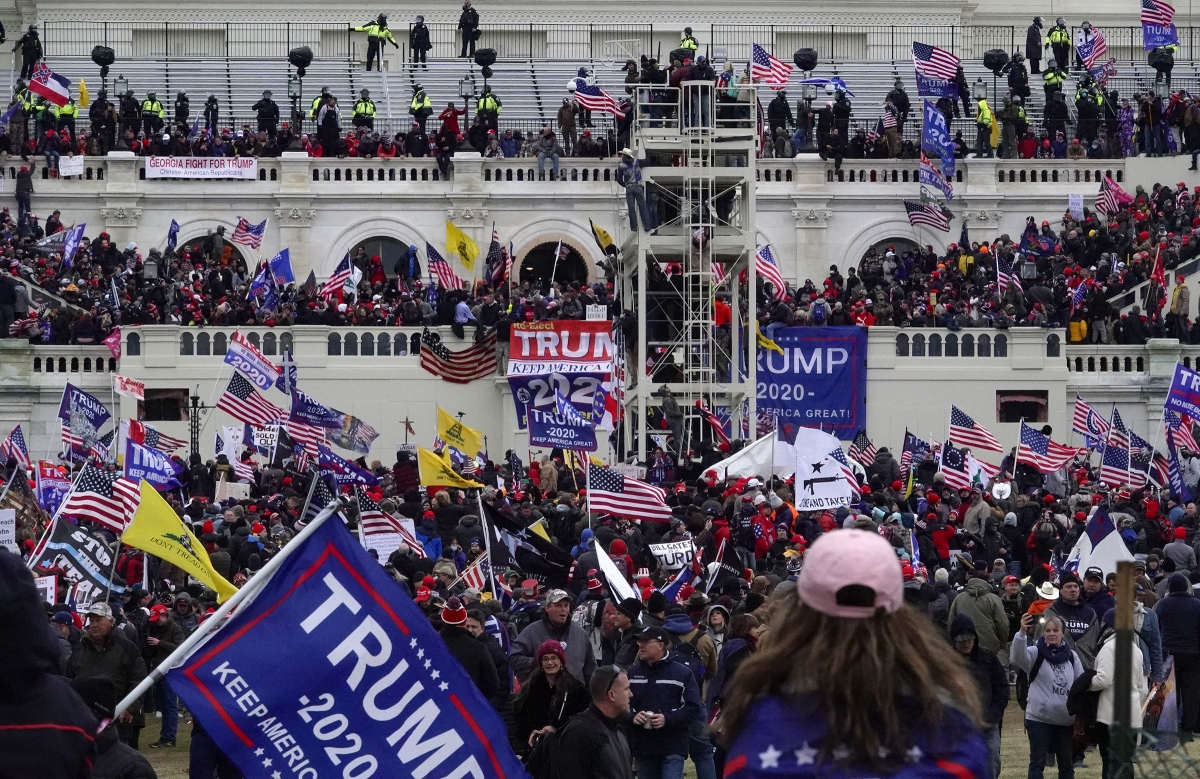
Joe Biden still plans to be sworn in on the steps of the U.S. Capitol on Jan. 20, exactly two weeks after a pro-Trump mob with rioters wielding Confederate flags stormed the building to attack the very nation Biden was elected to lead.
That moment shrouded in symbolism will launch a 59th presidential inauguration set to take place under extraordinary circumstances. The event was already scaled down and subdued by the coronavirus pandemic. And now, the Biden administration has the added weight of showing strength and stability to the rest of the world, which watched in horror as American democracy wavered from the exact place where he is to take the oath of office.
While changes could still be made, as of last week Biden’s inauguration and swearing in were set to take place on the west front of the U.S. Capitol.
“We are confident in our security partners who have spent months planning and preparing for the inauguration, and we are continuing to work with them to ensure the utmost safety and security of the president-elect,” a senior Biden inauguration official said last week, speaking on the condition of anonymity to discuss security matters. “This will mark a new day for the American people focused on healing our nation, bringing our country together and building it back better.”
Following weeks of historic unrest, the Biden administration is hoping that the inauguration will draw attention toward the importance of national unity and away from President Donald Trump, who said in a tweet Friday that he would not attend the event. He would be the first president to skip his successor’s swearing-in ceremony in 152 years.
Some involved in the inauguration planning, who have been in close contact with security agencies, noted that the security footprint for the event will be much larger than it was Wednesday at the Capitol, when the mob disrupted the Senate and House of Representatives as lawmakers accepted the election results.
The inauguration is deemed a National Special Security Event (NSSE), which brings in a wide range of federal agencies and law enforcement officials that create a wide security perimeter, with road closures and barriers around the Capitol. The Secret Service, the agency responsible for designing and implementing a security operation plan for such events, released a statement Thursday night stressing its readiness for Inauguration Day.
“For well over a year, the U.S. Secret Service, along with our NSSE partners, has been working tirelessly to anticipate and prepare for all possible contingencies at every level to ensure a safe and secure Inauguration Day,” the statement said.
D.C. Mayor Muriel Bowser released a letter Sunday urging Chad Wolf, acting secretary of the Department of Homeland Security, to take “a very different approach than previous inaugurations given the chaos, injury, and death experienced at the United States Capitol during the insurrection.”
Bowser asked the department to extend the NSSE period and coordinate with other federal agencies to free up the D.C. police to focus on “its local mission.” She also called on Wolf to cancel and deny permits for all demonstrations from Monday to Jan. 24.
Officials say Joe Biden will still be sworn in as president Jan. 20 on the steps of the Capitol, where a mob stormed the building Jan. 6. MUST CREDIT: Photo for The Washington Post by Astrid Riecken
Just three days before Wednesday’s pro-Trump demonstration at the Ellipse, the National Park Service adjusted the event permit from 5,000 to 30,000 people, a decision Bowser said “demonstrated the National Park Service’s willingness to approve last minute permits and major adjustments.”
Some Trump supporters have vowed to return to the District of Columbia on Jan. 17, with one online post cited by Alethea Group calling for an “ARMED MARCH ON CAPITOL HILL & ALL STATE CAPITOLS.” Others have discussed a “Million Militia March” on Inauguration Day.
As of Friday, the Park Service had issued only two permits that together allow for 75 people for demonstrations around the Inauguration, according to Mike Litterst, a spokesman for the Park Service.
The Park Service is still processing five permit applications, which include two requests for events expecting 5,000 people. The first of those applications was submitted last January by D.C. Action, a liberal group based in D.C. The second was submitted in December by Black Pact, a nonpartisan political group organizing a march for reparations.
Litterst said he was waiting for instructions from the Presidential Inaugural Committee to “make any adjustments to our facility and our property.”
Sen. Roy Blunt, R-Mo., chairman of the Joint Congressional Committee on Inaugural Ceremonies (JCCIC), and Sen. Amy Klobuchar of Minnesota, the ranking Democrat on the Senate Rules and Administration Committee, said in a statement Thursday that the storming of the Capitol was a “sad and solemn day for our country,” but plans to swear in Biden and Vice President-elect Kamala Harris will move forward as planned.
“The outrageous attack on the Capitol, however, will not stop us from affirming to Americans – and the world – that our democracy endures,” they said in the statement.
Paige Waltz, communications director for the JCCIC, said that the committee is working with “institutional partners to conduct a thorough assessment of the inaugural platform, and the other Capitol spaces and grounds that are traditionally used for inaugural ceremonies.”
Waltz added that the committee will not make further comments about the specifics of the event until the assessment is complete.
The District has also ramped up security measures. On Wednesday, Bowser extended a public emergency order through Jan. 21, which allows her to issue curfews, close businesses, halt transit and dip into emergency funds, among other actions, to preserve public safety through the inauguration.
Military officials have erected a seven-foot fence designed to prevent scaling around the periphery of the U.S. Capitol. More than 6,000 National Guardsmen were expected to arrive in the District over the weekend to help support the D.C. police and Capitol Police, U.S. Army Secretary Ryan McCarthy said Thursday.
The focus on fortification and security may further scale down an event already limited in size by the pandemic. The Presidential Inaugural Committee (PIC) requested and received permits for Lafayette Square, portions of the National Mall from Third to 14th streets, land surrounding the Lincoln Memorial and the Martin Luther King Jr. Memorial, among others, for the inauguration. The permit requests include plans for a Biden-Harris inaugural celebration at the Martin Luther King Jr. Memorial and an event with stages and tents at the Lincoln Memorial. But even before the pro-Trump attempted insurrection at the Capitol, Biden’s inaugural team had announced that the iconic parade would be virtual and canceled all in-person balls.
In December, the JCCIC said members of Congress would receive only two tickets each, as opposed to the 130,000 they are typically instructed to distribute among their constituents, citing public health concerns.
During the 2017 inauguration, more than 95 percent of hotel rooms were filled across the District, according to a spokesperson for Destination DC, a group that promotes the city to visitors. This year, while comprehensive occupancy data is not available until after the event, there are few signs pointing to a surge in visitors to the District.
Thomas Penny, president of Donohoe Hospitality, which oversees more than 15 hotels in the region, said that reservations at his hotels remain light in late January, with the most noticeable uptick in interest since Wednesday coming from security-related agencies seeking hotel rooms. He said one security-related agency called on Thursday to book 200 rooms for the inauguration.
Emily Mooney, retail strategy manager for the DowntownDC Business Improvement District, said her team has been working closely with the city government and security agencies to communicate with local businesses about expectations for the inauguration and ensure that their landscaping is up to par for the event, no matter the number of people who travel downtown that day.
She said her district would refrain from issuing formal guidance to business owners about boarding up or closing shop unless city leadership suggests otherwise.
“We are preparing as we normally would for inauguration even though we expect a much smaller turnout,” she said. “We fully expect that downtown D.C. will be safe and secure for the inauguration.”
Republicans wonder whether Trump’s problems will be his undoing
InternationalJan 11. 2021President Donald Trump addresses a Jan. 4 campaign rally in Dalton, Ga., on the eve of the runoff elections lost by Republican incumbent Sens. Kelly Loeffler and David Perdue. MUST CREDIT: Washington Post photo by Jabin Botsford
By The Washington Post · Philip Rucker
WASHINGTON – Whether President Donald Trump is forced from office or serves out the remaining days of his term, he is now destined to slink out of the White House considerably diminished from the strapping, fearsome force he and his advisers imagined he would be in his post-presidency.
In the wake of the mob attack on the Capitol that Trump incited, some allies have abandoned him, many in the business community have shunned him and Twitter took away his social media megaphone. Many Republicans also hold him responsible for losing their Senate majority with last week’s twin defeats in Georgia, not to mention their House majority two years ago.
Trump had planned to retreat from Washington to plot a comeback that could return him to the White House in four years, but now he will have to contend with a possible second impeachment or perhaps even criminal charges.
With 10 days remaining in his presidency, Trump has become the political equivalent of a balloon in the Macy’s Thanksgiving Day Parade flying high down New York’s Sixth Avenue, only to be punctured, twist in the wind and deflate as it rounds the corner to the parade’s endpoint at Herald Square.
“The way he handled himself in the last 60 days has tarnished his reputation and his ability to be a future leader – and by botching the Georgia Senate races, his entire economic agenda is about to get overturned by the Senate,” longtime Republican strategist Scott Reed said. “He’s really gone backwards like no one ever would have imagined.”
Despite Trump’s current troubles, he is sure to maintain a grass-roots following. In his statement Friday night reacting to Twitter’s extraordinary decision to permanently ban his account because the president’s messages posed a threat of future violence, Trump effectively laid claim to the 74.2 million “great American patriots” who voted for him in November.
Jason Miller, a senior political adviser to the president, said after speaking with Trump on Saturday that the president plans to spend tens of millions of dollars from his political action committee to help Republicans win back the House and Senate in 2022. He left open the possibility that Trump would run for president again in 2024.
“President Trump is still the biggest name in American politics and the president is still the leader of the Republican Party. He’ll be the most sought-after political endorsement heading into the 2022 midterms,” Miller said. He added: “You can’t censor an entire movement. This is critical to keep in mind for Beltway politicians and pundits who themselves have lost touch with Republican grass-roots activists around the country.”
Still, the new reality for Trump is messy. Frank Luntz, a veteran GOP pollster, conducted a focus group the night after the Capitol attack with 12 Trump voters from 11 different states. He said they fell into three camps: those who believe the fact that President-elect Joe Biden won the election and think it’s time Trump move on; those who think it was stolen from Trump but he still should move on; and those who think it was stolen and Trump should continue to fight.
Luntz was flabbergasted by the sharp, even angry tone of the discussion.
“They were very emotional with each other, very harsh with each other,” he said. “This has never happened in a Trump focus group I’ve done. … Trump voters are like single moms with kids. They back each other, they empathize with each other, because they know the stresses and strains they each have. Not anymore. These Trump voters are ready to declare war with each other.”
That spells trouble for the president, Luntz concluded. “When you’ve got a unified force, you can speak to them as their general and motivate them to change their behavior,” he added. “But when they have broken down into tribes, it’s impossible to deliver a message that reaches everybody. Trump is much less powerful today than he was 72 hours ago.”
Luntz said that when he asked the group of 12 to name their preferred candidate for president in 2024, only two said Trump. None said Vice President Mike Pence.
Wednesday’s attack was a clarifying moment for Trump backers. A handful of administration officials – including two original members of Trump’s Cabinet, Transportation Secretary Elaine Chao (who is married to Senate Majority Leader Mitch McConnell) and Education Secretary Betsy DeVos – resigned in the aftermath.
The scene Jan. 6 outside the Capitol after a mob of Trump supporters breached the building in a violent riot. MUST CREDIT: Washington Post photo by Bonnie Jo Mount
On Capitol Hill, McConnell, R-Ky., publicly broke with Trump even before the deadly siege began, warning in a speech Wednesday that “our democracy would enter a death spiral” if the losing side in an election were able to overturn a fair outcome with baseless allegations. McConnell has also told fellow senators and other confidants that he does not plan to speak with Trump again.
Others have joined in. Sen. Lisa Murkowski, R-Alaska, told the Anchorage Daily News: “I want him to resign. I want him out. He has caused enough damage.”
Sen. Lindsey Graham, R-S.C., long one of Trump’s confidants and golfing buddies, declared on the Senate floor: “Count me out. Enough is enough.”
Sens. Mitt Romney, R-Utah; Patrick Toomey, R-Pa.; and Ben Sasse, R-Neb., also roundly denounced the president for his rhetoric and complicity in the mob attack.
There have been other defections, too. Consider the case of Rep. Nancy Mace, a newly elected Republican freshman from South Carolina, a state the president carried by a sizable 12 percentage points.
Mace worked as a coalitions and field staffer on Trump’s 2016 campaign, and in her congressional campaign last year she touted her work for the president. She featured a photo of him with her, Trump smiling and flashing a thumbs-up. And the president tweeted his support for her four times.
But on Thursday, when a reporter from the State asked whether she still believed in Trump, Mace did not hesitate. “No, I don’t,” she said. “I can’t condone the rhetoric from yesterday, where people died and all the violence. These were not protests. This was anarchy.”
Speaking more generally, Mace told the newspaper that the Trump-incited riot undermined all that he has accomplished as president.
“That legacy has now been wiped out,” Mace said. “It is gone, and we have to start over from scratch.”
Some Trump allies would only speak about the president’s weakened state privately. One evangelical leader, for instance, likened Wednesday’s events, coupled with the election defeats on Tuesday in Georgia, to a torpedo hitting the starboard side of a warship. But the person’s concern about being quoted by name and angering Trump was itself a testament to the president’s enduring, if somewhat diminished, political power.
Brendan Buck, a former adviser to former Republican House speakers Paul Ryan and John Boehner who has criticized Trump before, cautioned against declaring the outgoing president politically dead.
“It is folly to suggest that everyone will just turn their back on him,” Buck said. “His power has always rested in the sway he has with voters. It was never because members of Congress particularly cared for him or liked him. I have seen so many times where you thought, this was the moment things would change, but folks went home, they heard from their constituents, their constituents demanded continued loyalty to Donald Trump and they came back refreshed as Trumpers once again.”
Buck argued that any kind of punishment for Trump – be it impeachment or prosecution or merely a censure by Congress – could accrue to his political benefit, a point Miller made as well.
“His whole persona is built on grievance, that he is the champion of regular people while the elites in Washington are against him,” Buck said. “I think that he would reap a lot of political benefit from the impeachment.”
Anthony Scaramucci, a former White House communications director who has since come out sharply against Trump, warned that the outgoing president is capable of a political rebirth – though at 74 years old, he argued, Trump does not have time to waste.
“Unless they put him in a position where he is no longer eligible to run for office and decapitate him politically, it is not clear to me that we’ve seen the last of Trump,” Scaramucci said.
Still, the lessons of history do not favor Trump. U.S. presidents tend to be like new cars parked in a showroom. Once they leave office, they depreciate in value immediately, followed by a steady erosion. Even if they maintain their popularity, as Barack Obama has, or recast their image, as Bill Clinton did through his charity work, they never again command the attention and power they had in office. This has proven especially, painfully true for presidents defeated in their bids for re-election, such as Gerald Ford and Jimmy Carter.
“In American politics, love turns to hatred very quickly,” presidential historian Michael Beschloss said. “How appealing is Donald Trump going to look in a month or two? Is this someone who will be beleaguered by indictments and/or lawsuits? Is this someone who is going to be struggling with financial problems? Those things may not look so appealing, even to people who love him at the moment.”
Beschloss added: “Americans have a tendency, almost in their DNA, to like and respect a president. (Richard) Nixon had a lot of popularity right down until the end, but very quickly he became the embodiment of lying, criminality and bad political ethics, and became so radioactive that he was never invited again to a Republican convention.”

 ในที่สุดจีนก็เผยแนวทางในการต่อต้านการคว่ำบาตรของสหรัฐด้วยกฎใหม่
 นักการเมืองจากทั้งพรรครีพับลิกันและเดโมแครตกำลังดำเนินการทุกวิถีทางเพื่อให้โดนัลด์ ทรัมป์พ้นจากตำแหน่งประธานาธิบดีโดยเร็วที่สุด

 ญี่ปุ่นพบไวรัสโคโรนาสายพันธุ์ใหม่จากผู้ที่เดินทางมาจากบราซิล
 สมาชิกในครอบครัวแฉกันเอง ใครหลงเชื่อทรัมป์ไปร่วมบุกคองเกรส
 กัมพูชาพบ แรงงานชาวกัมพูชาเดินทางกลับจากไทยติดเชื้อโควิดเพิ่ม 4 ราย เป็นหญิงทั้งหมด
 ในภาพ ลูกเรือของกองทัพเรือกู้ซากปรักหักพัง ระหว่างปฏิบัติการกู้คืนใกล้เกาะลันจัง หลังจากเกิดเหตุเครื่องบินของ Sriwijaya Air เที่ยวบิน SJ182 ตกลงในทะเลชวาเมื่อวันที่ 9 มกราคม

 Workers put up fencing outside the U.S. Capitol on Jan. 7. MUST CREDIT: Washington Post photo by Matt McClain

 President Donald Trump addresses a Jan. 4 campaign rally in Dalton, Ga., on the eve of the runoff elections lost by Republican incumbent Sens. Kelly Loeffler and David Perdue. MUST CREDIT: Washington Post photo by Jabin Botsford