GSB offers loans to keep SMEs’ cash flowing #ศาสตร์เกษตรดินปุ๋ย

#ศาสตร์เกษตรดินปุ๋ย : ขอบคุณแหล่งข้อมูล : หนังสือพิมพ์ The Nation

https://www.nationthailand.com/business/30380720?utm_source=category&utm_medium=internal_referral

GSB offers loans to keep SMEs’ cash flowing

Jan 20. 2020
By THE NATION

Government Savings Bank (GSB) has earmarked Bt50 billion for loans allowing small and medium-sized enterprises (SMEs) to pay off principle owed to financial institutions.

GSB president Chatchai Payuhanaveechai said on Friday (January 17) the loans will be available until December.

In an example cited, an SME owing Bt10 million in principle on a Bt50-million loan from any bank can borrow the Bt10 million from GSB.

The SME has to pay the principle first and use a receipt of the payment to secure the GSB loan in monthly instalments over 12 months.

The GSB loans cover a lending period of six years, with a grace period for the principle payment of one year.

Chatchai said the campaign is not intended to help SMEs refinance their debt, but rather enhance their liquidity.

Energy ministry to hasten EV charging-station plan #ศาสตร์เกษตรดินปุ๋ย

#ศาสตร์เกษตรดินปุ๋ย : ขอบคุณแหล่งข้อมูล : หนังสือพิมพ์ The Nation

https://www.nationthailand.com/business/30380796?utm_source=category&utm_medium=internal_referral

Energy ministry to hasten EV charging-station plan

Jan 20. 2020
By Nutnicha Donsuwan
The Nation

Disruptive technology has affected the electricity business and the automobile industry, causing the government and private sector to enhance performance in order to maintain the country’s competitiveness and production base to export cars in the region.

Energy Minister Sontirat Sontijirawong said the ministry has prepared to present to the Cabinet the establishment of the national commission on electric vehicles (EV), with Deputy Prime Minister Somkid Jatusripitak as president. He added that if the plan were to be delayed, Thailand would lose the opportunity to be a production base of cars in the region.

The ministry recently directed the Energy Regulatory Commission to conduct a study on excess electricity reserves, or oversupply, in the country, which is around 30 per cent, to use as incentives such as the reduction of electricity bills in order to encourage investors to speed up the construction of electric charging stations for the public. The study will be reported by February.

In addition, he ordered the Energy Policy and Planning Office and the Department of Energy Business to study amending the law to be consistent with the mapping of installation points for charging stations, which will give a clear picture of electric charging stations’ locations nationwide with specified distance radius of each station. This will help avoid making redundant investments, diverse investments into other provinces and prevent from competing with each other.

“The private sector is very excited. We are expecting there will be a systematic investment by the private sector, which will accelerate the growth of electric cars,” the Energy Minister said.

As for the EV plan for passenger cars, the Electricity Generating Authority of Thailand (Egat) has collaborated with the National Science and Technology Development Agency (NSTDA) to make the EV Kit & Blueprint Project using Nissan cars Almera and Toyota Altis as prototype cars modified into EV cars. The blueprint will be publicised within 2020.

The minister also plans to open a modified car garage. He said the opening of a car modification garage plan was delayed because the ministry still has to wait for the battery cost, which is the heart of the EV car, at lower than US$150 per kilowatt-hour, to make it worth the investment and to create incentives for consumers to buy cars.

For buses, the collaboration between Egat and the NSTDA will be announced later. For electric motorcycles, 12 entrepreneurs are cooperating, both importing and assembling in the country, but they still have to wait for various issues, such as licences from the Department of Land Transport.

“What Egat does now is research and development to prepare the database until the demand is ready; it can be extended to commercial use immediately,” said Sontirat.

Somphote Ahunai, chairman of the executive committee at Energy Absolute Pcl, said that they were still waiting for clarity from the government. If it’s clear, then the company will review the EV charging stations business plan to speed it up. More than 500 operations have been carried out, with 1,000 being completed within 2020, according to the original plan.

“If the government draws excess electricity backup to help reduce the electricity price, it will encourage private companies to invest more in EV charging stations. Vietnam and Indonesia are also focusing on promoting EV as well,” Somphote commented.

Thailand plans to promote the use of EV vehicles in four phases. Phase 1 (2016-17) — preparation of all sections; phase 2 (2018-2020) — expand the results to public buses and prepare for personal electric cars; phase 3 (2021 onwards) — extend to promote personal electric cars; and phase 4 (2036 onwards) — electric vehicles to replace targeted 1.2 million oil vehicles.

Future Forward ready with alternative party if it were to be dissolved #ศาสตร์เกษตรดินปุ๋ย

#ศาสตร์เกษตรดินปุ๋ย : ขอบคุณแหล่งข้อมูล : หนังสือพิมพ์ The Nation

https://www.nationthailand.com/news/30380791?utm_source=category&utm_medium=internal_referral

Future Forward ready with alternative party if it were to be dissolved

Jan 19. 2020
Photo Credit To Future Forward Party's Official Facebook Page

Photo Credit To Future Forward Party’s Official Facebook Page
By The Nation

Future Forward Party (FFW) secretary-general Piyabutr Saengkanokkul on Saturday (January 18) denied the accusation that his party was trying to overthrow the Thai regime. Speaking at a seminar on “Future is Now” held at Thammasat University Rangsit Campus, he emphasised that the party only wished to remedy the situation in Thailand and the ones who are trying to target them with these kinds of accusations were those who had violated the constitution.

He said Future Forward will make all efforts to ensure any dissolution of the party becomes an exercise in futility by launching a new party. They have already requested around 60,000 members of Future Forward to register for the new party. Both Thanathorn and Piyabutr confirmed that they would not give up.

The Constitutional Court will deliver on January 21 at 2pm its verdict on the “Illuminati” case seeking dissolution of Future Forward Party. Illuminati is supposedly a secret anti-monarchy group.

At the seminar, Thanathorn Juangroongruangkit, head of Future Forward, presented a new economic model under civil state policies to fight injustice and “the failure of the Thai nation to build a better society”.

Normally, the government’s projects under civil state policies have led to more monopolies as big capitalists are the ones who shape the policies of Thailand. Dependence on foreign investment in the existing economic model in projects such as the Eastern Economic Corridor, high-speed trains and Thailand Riviera is likely to make Thailand grow without technology development, Thanathorn said.

“Moreover, the power that comes from the authorities not the voice of the people will cause a gap in society. Whether it is an economic gap or a social gap, the development of manpower and technology will meet obstacles that are caused by the economic model.

“We cannot rely on foreign capital which regards Thailand only as a production base,” Thanathorn said. “And the auto electronics industry that we depend on cannot grow any bigger. We need a new supply chain. We want to supply to a new industry.”

He explained that this change needed big government spending and in an industry created by Thais to add value and generate employment, which will balance the economy and raise a sense of responsibility for the next generation.

“Compared with the Bt3.3-trillion budgets, the government can manage with only Bt1.2 trillion. Therefore, we are presenting ‘zero-based budgeting’. The principle behind it is to reconstruct the previous budgets and focus on a certain number of budgets that will solve the country’s issues. The government should not spend only on projects in Bangkok but also distribute to other provinces,” Thanathorn said.

Wuhan virus: 3rd death reported in China as cases soar past 200; new cases confirmed in Beijing, Shenzhen #ศาสตร์เกษตรดินปุ๋ย

#ศาสตร์เกษตรดินปุ๋ย : ขอบคุณแหล่งข้อมูล : หนังสือพิมพ์ The Nation

https://www.nationthailand.com/news/30380806?utm_source=category&utm_medium=internal_referral

Wuhan virus: 3rd death reported in China as cases soar past 200; new cases confirmed in Beijing, Shenzhen

Jan 20. 2020
By Elizabeth Law
The Straits Times/ANN

BEIJING – The Chinese city of Wuhan on Monday (Jan 20) reported a dramatic increase of 136 cases of the mysterious Sars-like virus, including one death, as new cases were confirmed for the first time outside the city in Beijing and Shenzhen.

The sharp spike in detected cases comes as travelling intensifies ahead of this weekend’s Chinese New Year holidays, sparking fears that the mass human movement could contribute to the spread of disease.

In a statement in the wee hours of Monday, the Wuhan Municipal Health Commission reported that one death and 59 new infections were reported last Saturday and 77 new cases were reported on Sunday, bringing the total number of infections in the city to 198. Three deaths have been reported so far.

This is the highest ever jump in cases since the authorities in the central Chinese city started near daily updates about the newly discovered coronavirus, which comes from the same family of viruses that causes Sars and Mers, and comes a day after public health officials warned of a potential rise in cases.

Meanwhile, two new cases were reported in the capital Beijing, and one in the southern Chinese city of Shenzhen, which borders Hong Kong.

The two patients in Beijing had travelled to Wuhan, said an early morning post on the official Twitter-like Weibo of the Daxing Municipal Health Commission, an area in southern Beijing home to the city’s sprawling new international airport.

The single case in Shenzhen is a 66-year-old man who visited Wuhan on Dec 29 and fell ill earlier this month after returning home, said the Health Commission of Guangdong Province in a statement.

In a series of tweets on Monday morning, the World Health Organisation (WHO) confirmed the infections, adding that an animal seems the mostly likely primary source of infections, “with some limited human-to-human transmission between close contacts”.

“For the first time, there are novel coronavirus (2019-nCoV) cases reported outside of Wuhan, within China,” the WHO said. “These cases were identified because of searching and testing for cases outside Wuhan.”

The source and transmission routes of the 2019-nCov virus are still unknown, China’s National Health Commission said in a statement on Sunday.

Most of the cases in the city have been traced to a seafood wholesale market, which also sells live animals and exotic wildlife, but the fact that several patients had no connection to the site also suggests the virus has spread by other means.

A city of 11 million, Wuhan is a major transport hub and officials have carried out temperature screenings at the airport, railway stations, coach stations and piers since Jan 14. Passengers with fever were being registered, given masks and taken to medical facilities.

The Wuhan Huanan Seafood Wholesale Market, believed to be the epicentre of the outbreak, has been closed for disinfection since Jan 1 but, in a bid to arrest the spread of the virus, the authorities have been cleaning up markets across the city.

The authorities in Hong Kong, the United States, Thailand and Singapore have been screening visitors from Wuhan. Six suspected cases have been detected in Singapore, five of whom have tested negative for the virus.

In Australia, a climate uprising #ศาสตร์เกษตรดินปุ๋ย

#ศาสตร์เกษตรดินปุ๋ย : ขอบคุณแหล่งข้อมูล : หนังสือพิมพ์ The Nation

https://www.nationthailand.com/news/30380785?utm_source=category&utm_medium=internal_referral

In Australia, a climate uprising

Jan 19. 2020
Trees burned by recent wildfires scar the backdrop last week as vacationers swim at McKenzies Beach in Malua Bay in Australia's New South Wales state. The fires torched an area larger than Portugal, killed at least 25 people and destroyed hundreds of homes. MUST CREDIT: Washington Post photo by Ricky Carioti

Trees burned by recent wildfires scar the backdrop last week as vacationers swim at McKenzies Beach in Malua Bay in Australia’s New South Wales state. The fires torched an area larger than Portugal, killed at least 25 people and destroyed hundreds of homes. MUST CREDIT: Washington Post photo by Ricky Carioti
By The Washington Post · Scott Wilson 

MALUA BAY, Australia – When the flames swept up from the cove through the gum trees, Neda Cettnic signaled frantically that it was time for her grandchildren to get off the roof.

It was New Year’s Eve, and fires across this vast continent had already scorched tens of thousands of acres. Now the fire was coming for the Cettnic’s hillside home.
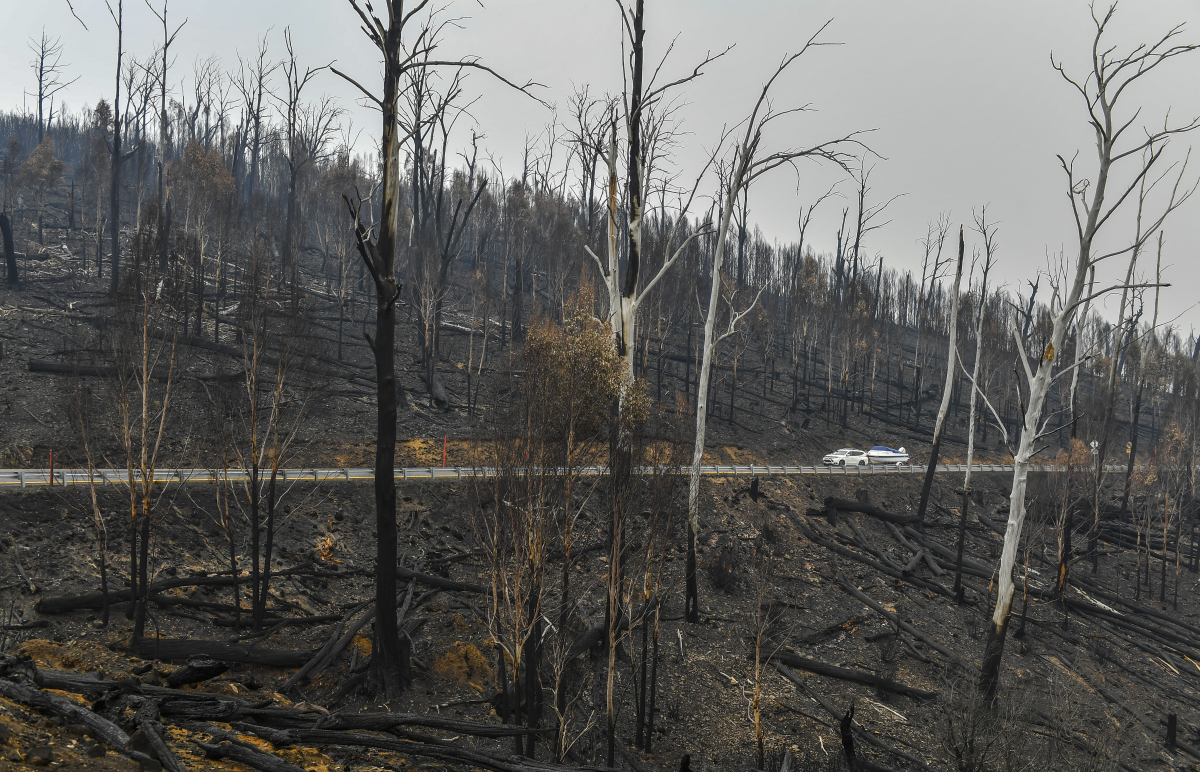
A traveler pulls a boat through scorched forest last month in New South Wales. MUST CREDIT: Washington Post photo by Ricky Carioti

A traveler pulls a boat through scorched forest last month in New South Wales. MUST CREDIT: Washington Post photo by Ricky Carioti

The three grandkids, ranging from 8 to 11 years old, had been deployed to clear debris from trees that the government had not allowed the family to cut back in the weeks before fire season. The federal government had also ignored advice to call in advance for foreign reinforcements to help Australian firefighters.
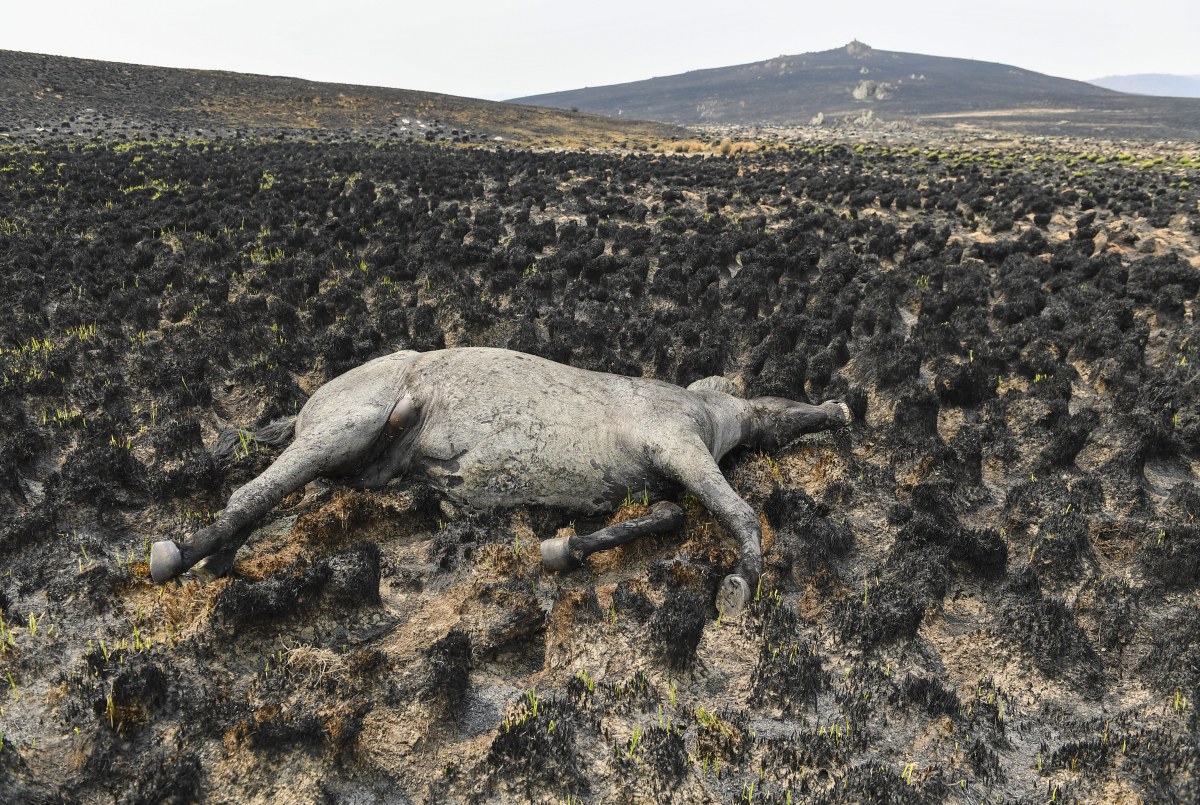
The carcass of a wild horse lies on burned grassland last week in New South Wales. MUST CREDIT: Washington Post photo by Ricky Carioti

The carcass of a wild horse lies on burned grassland last week in New South Wales. MUST CREDIT: Washington Post photo by Ricky Carioti

So across the dry valleys and eucalyptus forests of southeastern Australia, preparing for the fires sometimes fell to grandmothers like Neda Cettnic, a retired registered nurse, and her grandkids, who wondered aloud what had happened to the sun when the sky turned night-black before noon.
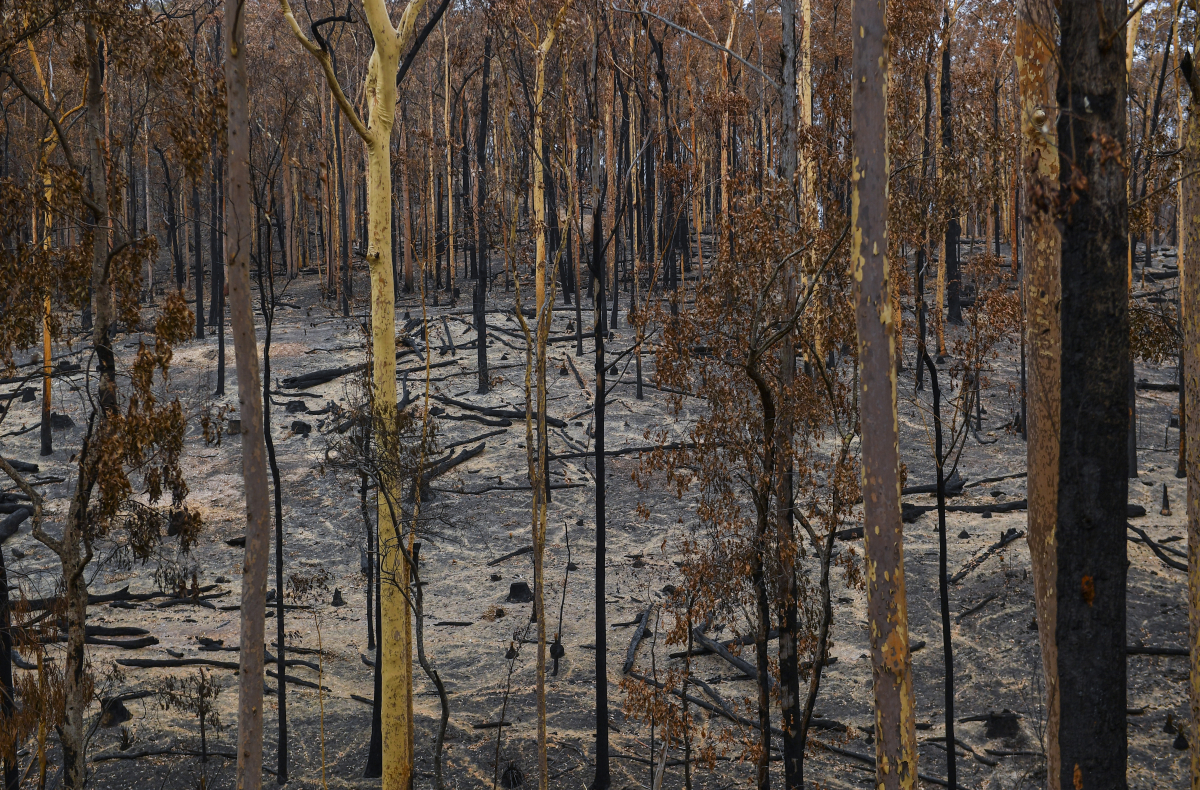
Ash and scorched trees in a forest New South Wales. MUST CREDIT: Washington Post photo by Ricky Carioti

Ash and scorched trees in a forest New South Wales. MUST CREDIT: Washington Post photo by Ricky Carioti

“Everything just shriveled with the heat,” recalled Cettnic, her house still largely intact after the flames blew past.

Australia is angry – very angry. Its ire is directed primarily at a government that left citizens like the Cettnics feeling as though they have to fend for themselves during fires that have burned for months. Through the haze of smoke that has blanketed major cities, many Australians are also angry about public policies that largely discount climate change as a problem worth addressing in the near term.
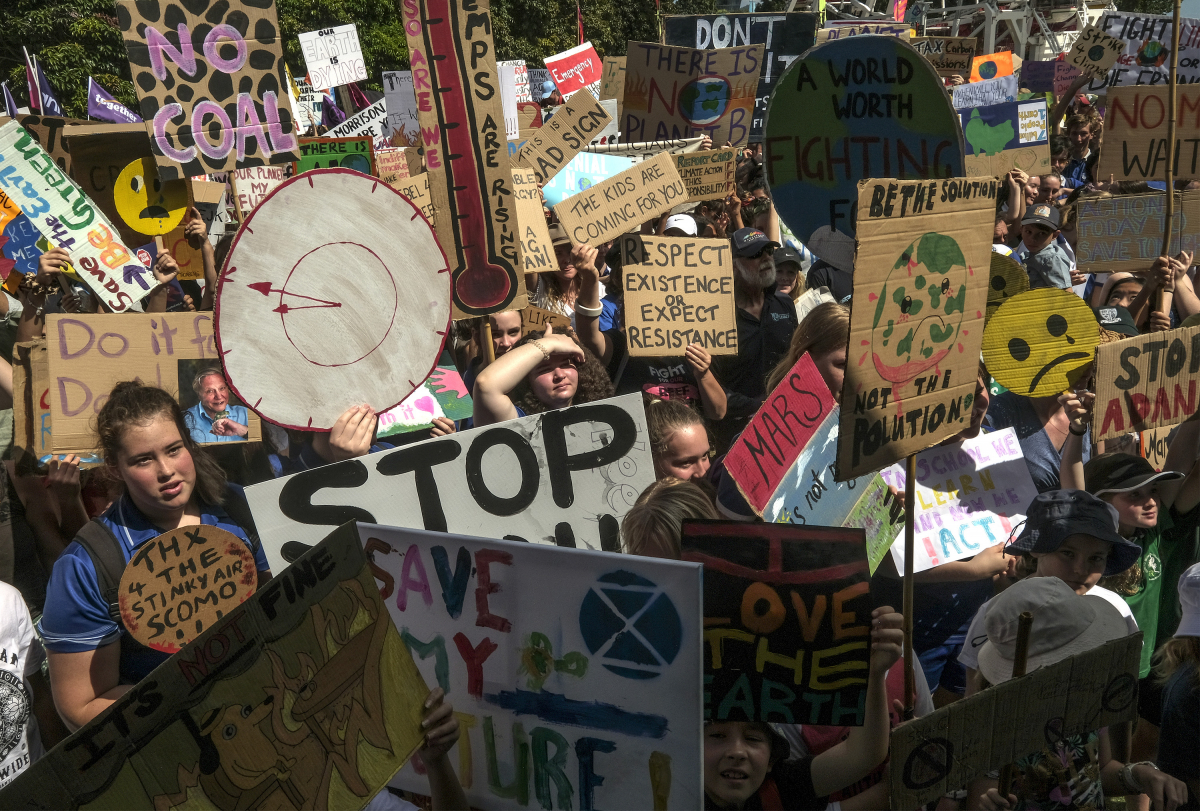
Students rally in September 2019 in Cairns as part of the global climate strike, many of them opposing what would be Australia's largest coal mine, in Queensland's Galilee Basin. MUST CREDIT: Washington Post photo by Bonnie Jo Mount

Students rally in September 2019 in Cairns as part of the global climate strike, many of them opposing what would be Australia’s largest coal mine, in Queensland’s Galilee Basin. MUST CREDIT: Washington Post photo by Bonnie Jo Mount

Wildfires that have torched an area larger than Portugal, killed at least 25 people and destroyed hundreds of homes have electrified the politics of climate change here and altered the nation’s long-standing, if largely ineffective, environmental movement. Scientists say that rising temperatures – Australia measured record-breaking heat during its summer – mutated the fire season into something more deadly and devastating than ever before seen.

Prime Minister Scott Morrison is facing a reckoning not only over his government’s preparation and management of the fires, which were doused this week by days of pounding summer rain, but also its larger environmental and energy policy.

The future of the country’s reliance on coal, as its primary export and a key source of its energy, is being challenged more aggressively than ever with the fires and obviously warming climate as a vivid green-screen backdrop.

Reelected prime minister in May, Morrison has called for a federal inquiry into his government’s response to the fires. But he also has indicated he will not curtail his efforts to expand the coal industry, calling it an essential driver of jobs and tax revenue.

“The suggestion that there’s any one emissions reduction policy or climate policy that has contributed directly to any of these fire events is just ridiculous,” Morrison said in a radio interview this month. “And the conflation of those two things, I think, has been very disappointing.”

– – –

Helping propel the public criticism is a movement new to Australia known as Extinction Rebellion, which began in the United Kingdom two years ago and operates largely alongside traditional environmental groups.

It is more guerrilla operation than government lobby, an unconnected series of small cells that favor direct public action over long mobilization and information campaigns. Signal, the encrypted messaging app, is the group’s communication mode of choice.

The group has staged large rallies and attention-drawing stunts. At the height of the holiday season, the group built in hurried coordination a Santa’s sleigh in the middle of Sydney’s shopping district, the elves and reindeer “killed” by the coal economy. Such tactics are managing to expand and sharpen Australia’s once-stodgy environmental movement.

“To be a rebel, all we ask is for your email and to come to one talk,” said A.J. Tennant, who left a job as a copywriter for the New South Wales government just before the “Santa action.” The Sydney group’s Instagram account has gone from 1,000 to 35,000 followers in just the past two weeks of fire, protest and civil disobedience.

“People have had a gutful, and the old ways just do not work,” said Larissa Payne, a former high school history and English teacher recently turned full-time activist. “And it’s not just senior citizens, and students and old-school hippies. It’s doctors, dads and their kids, firefighters.”

For years, the environmental movement here was primarily the domain of academics, scientists and young idealists. The pull by Extinction Rebellion and other public relations-savvy groups to enlist former fire officials, doctors, business leaders and farmers into the national climate conversation has made the government’s criticism of the movement as out-of-touch less plausible than it once was.

“All of the portents were there at the start of this fire season,” said Greg Mullins, who served as chief of the huge New South Wales fire service before retiring after more than four decades in the field. “We tried to warn the government, but we were dismissed as a bunch of activists.”

Mullins sits on the Climate Council, described as the nation’s leading independent climate change communications organization. His late-fall warning to Morrison’s government came in the form of four letters, each signed by 23 former fire chiefs from every state.

“We were seeking a meeting to relay to the prime minister what we had been seeing and studying,” Mullins said.

The chiefs wrote that the Australian government should begin immediately securing leased firefighting aircraft from the United States, which can take time to deliver, especially with the American West facing its own severe fire seasons. There was no meeting, and the warning was never acted on.

“The government continues to say that it is insensitive to talk about climate change while people are losing their homes,” said Mullins, 60. “But people want to know now, they are the ones asking: ‘Why with more firefighters, more firefighting equipment, better building standards are we seeing what we are seeing now?'”

– – –

Last year was the hottest ever recorded in Australia based on average daily temperature readings, scientists say. The country registered 33 days hotter than 95 degrees.

That figure is five times higher than past studies had predicted for the year.

“It was just another indication that the climate is racing far ahead of the models we have been using until now,” said Will Steffen, professor emeritus at the Australian National University in Canberra.

The rising heat is affecting weather patterns here.

Steffen said the warming planet is pushing the tropics farther from the equator, which for Australia means that its winter storms sometimes fail to make landfall on their way to the poles. Drought here is severe, with much of the country under water-use restrictions.

Steffen, a councilor on the Climate Council, and Extinction Rebellion members talk about “tipping points” that have been reached in recent years.

The first harsh signal sounded loudly in 2016 and 2017, when stunned scientists reported a massive bleaching of corals on the Great Barrier Reef, one of the seven natural wonders of the world.

Bleaching occurs with rising water temperatures, among other conditions, which kill off corals. A study published last year in the journal Nature reported a nearly 90 percent collapse in new coral formation on the reef since the bleaching event.

“I believe the same kind of tipping point is happening in our forests this year,” Steffen said. “These forests that are burning are experiencing record-high temperatures and record-low moisture.”

– – –

Dan Bleakley grew up in the small Queensland town of Claremont, not far from what today is the single-most-contested energy project in the country.

The Indian multinational Adani has worked for years to begin mining Queensland’s Galilee Basin, in what would be the largest coal mine in the country. Coal was forecast to be Australia’s most valuable export last year.

The project played a key part in Morrison’s reelection, and local Queensland politicians are generally behind what is known as the Carmichael mine. Adani predicts the project would produce 10 million tons of coal annually, in its initial phase, and create thousands of jobs in Queensland. The company declined a Post request to visit the site.

Adani also needs to build a rail line to the coast to ship its coal for export. The new business would add at least 500 coal-ship passages through the Great Barrier Reef World Heritage Area each year for the project’s six-decade life.

“The coal mine is proposed to open up the biggest coal supply in human history,” said Bleakley, an Extinction Rebellion member who runs a sign business in Melbourne. “And this is coming at a time when our goal must be to begin a rapid transition to a sustainable economy in the very short term.”

Bleakley had never been an activist before the May election, which gave Morrison’s Liberal/National Coalition another term after it looked for weeks as though an environmentally focused coalition of Labor and the Greens might win enough seats to form a government.

In the closing weeks, a mining tycoon named Clive Palmer spent more than $60 million in ads critical of the Labor Party’s economic policies, a move that is now drawing calls for campaign finance reform. “Out of despair and fatigue,” Bleakley said, “I got involved.”

In November, the month the fires began last year, Bleakley carried out a 10-day hunger strike opposing the Carmichael mine project on the steps of the Victoria state Parliament building. At the time, new public opinion polling found that 60 percent of Australians believe the government is not doing enough to address climate change, up by nearly double digits from eight months earlier.

Then Bleakley glued himself to the Melbourne lobby window of the German industrial electronics giant Siemens, one of only three companies in Australia capable of building the coal rail line needed at Carmichael and the only one that has yet to declare it will not participate.

The head of Australia’s Green party, Richard Di Natale, has warned Siemens that it is risking its reputation by potentially participating in a project he called a “carbon bomb.”

Similar protests have taken place in Siemens offices around the world since Bleakley’s escapade made YouTube. In solidarity, one man glued himself to the lobby window of the Siemens headquarters in Munich.

Bleakley and other Extinction Rebellion members say they are heading into an “autumn rebellion,” a steady stream of provocative public acts drawing attention to the Carmichael mine project and Morrison’s environmental record, using the fires as fresh evidence.

For 2020, Climate Change Performance Index, prepared each year by a group of international environmental think tanks, ranked Australia the worst of 57 countries for its national and international climate policies.

“We don’t have a choice,” said Bleakley, 37. “This world is going through some tipping points, and we have no time to waste.”

– – –

Jane Morton was among the founders of Australia’s Extinction Rebellion movement, propelled by the 2016 news of the Great Barrier Reef bleaching that had taken much of the country by alarm.

Extinction Rebellion formed about two years later. She called it “initially a grass-roots movement running alongside the big environmental movements.” But the more direct-action strategy – and a rethinking of the traditional electoral politics approach – has set the less-established groups apart.

“It was really only the grass-roots groups holding the flag,” said Morton, an environmental activist and writer who lives in Melbourne, “and we were having a hard time holding it.”

What Morton has pioneered is a strategy of local focus, which plays somewhat below the radar of Extinction Rebellion’s larger, more public acts.

It was an approach she saw executed during Australia’s debate over creating a national disability insurance benefit – a lawmaker-by-lawmaker lobbying effort that started in the backbenches of parliament and moved slowly with momentum to the leadership, not the other way around.

Morton is applying those lessons to winning local district councils, which have the ability to declare local climate emergencies that serve as a goad to the federal government. She said that in 2016, the council in Darebin, a Melbourne suburb of more than 150,000 people, became the first local council in the world to declare a climate emergency.

For Extinction Rebellion’s overall message, Morton said it was important “to say that what we are facing is a human security emergency – that food and water supplies are at risk, that this is a threat to all life on Earth.”

“And let me tell you, it’s been hard to make a catchy phrase out of ‘You are all going to die,’ ” Morton said. The name they came up with – Extinction Rebellion – is meant, she said, to state the problem and offer the solution.

– – –

The road is empty, only the occasional army convoy or firetruck rumbling by. It is usually a major route south from Sydney. Now it is a gray thread running through a burn scar the size of a small state.

The forests here are charred. But thousands of resilient gum trees still stand, their thin, branchless trunks blackened to pitch. Kangaroo and ostrich crossing signs line the road. Many kangaroo corpses line the road – evidence, perhaps, of frantic evacuations carried out in the midst of busy firefighting work.

Smoke sits heavy in the wide valleys, spare of brush and only slightly rolling, a Tolkien backdrop when the sun is obscured by smoke. Two wild horses lie burned amid muddy tufts of ground, apparently having died in the flames as they scrambled to climb a small hill and reach the firmer road. Their lips burned back to show teeth in a gruesome, sad rictus.

You can drive for hours – in nearly any direction southeast of Sydney – and never leave the burn scar.

“I don’t know what else they could do,” said Scott Hillam, a wheat farmer and volunteer firefighter who worked against the flames in the town of Tumbarumba.

The immediate danger past, there is a sense of unease about the future.

“What we’re fighting against now is a whole lot of things,” he said.

Hillam brought his family here to Malua Bay, which had been evacuated just two weeks earlier, for a small summer vacation after the fires. In the clear emerald waves, his four children played, one with the inevitable shark-fin floaty strapped to his back.

Another scampered out of the foamy water, smiling, and ran across a tide line defined thickly by curves of black ash against the white sand.


Bangkok eighth worst in the world for air quality, global index shows #ศาสตร์เกษตรดินปุ๋ย

#ศาสตร์เกษตรดินปุ๋ย : ขอบคุณแหล่งข้อมูล : หนังสือพิมพ์ The Nation

https://www.nationthailand.com/news/30380807?utm_source=category&utm_medium=internal_referral

Bangkok eighth worst in the world for air quality, global index shows

Jan 20. 2020
By THE NATION

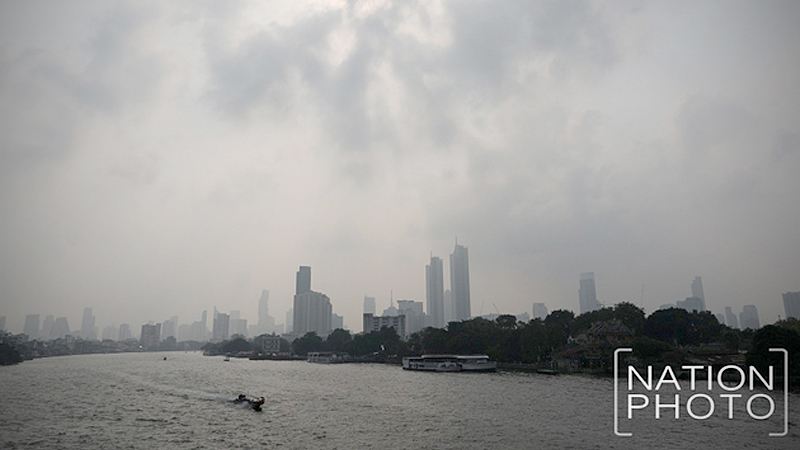
Bangkok was the eighth worst city in the world for air quality as of 8am on Monday (January 20), according to statistics released from the Air Visual mobile application.

According to the US AQI (air quality index), Bangkok measured 171, with particulate matter smaller than 2.5 microns in diameter (PM2.5) at 57.8 micrograms per cubic metre.

The Pollution Control Department reported at 8am on Monday that the level of PM2.5 dust particles in Bangkok and surrounding areas averaged 47-75 micrograms per cubic metre. The reported level is above the safety standard value of 35 μg/m3 and is unhealthy for sensitive groups such as people with respiratory or heart disease, the elderly, and children, who should limit prolonged exertion.

The World Health Organisation prescribes PM2.5 levels at 25mcg per cubic metre in a 24-hour mean.

Several districts of Bangkok, Pathumthani, Nakhon Pathom, Nonthaburi, Samut Prakarn and Samut Sakhon provinces reported air quality as unhealthy for sensitive groups. Areas along Din Daeng, Rama IV, Lat Phrao and Kanjanapisek roads were reported with levels of PM2.5 unhealthy for all groups.

Pumps being installed to draw from nearby water resources in drought-hit areas: Prawit #ศาสตร์เกษตรดินปุ๋ย

#ศาสตร์เกษตรดินปุ๋ย : ขอบคุณแหล่งข้อมูล : หนังสือพิมพ์ The Nation

https://www.nationthailand.com/news/30380805?utm_source=category&utm_medium=internal_referral

Pumps being installed to draw from nearby water resources in drought-hit areas: Prawit

Jan 20. 2020
By THE NATION

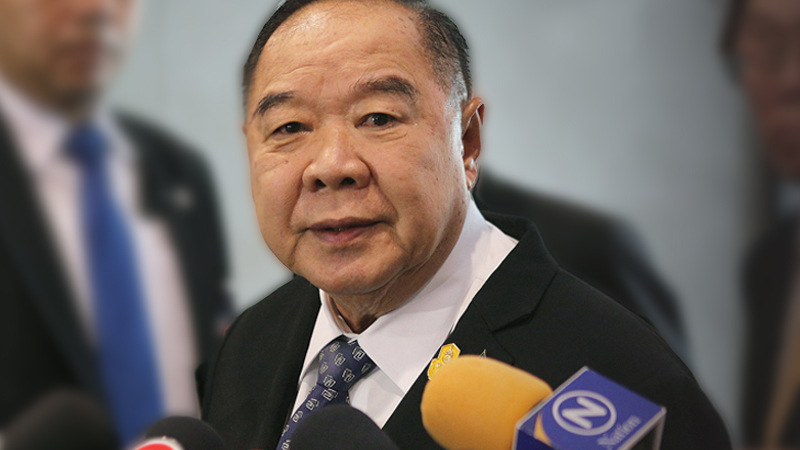
The government has ordered related agencies to provide assistance to people in areas that have high risk of water shortage due to drought, especially in the Northeastern region, Deputy Prime Minister General Prawit Wongsuwan said on Sunday (January 19).

Prawit, who is also the director of the National Water Administration Office, said: “The Department of Groundwater Resources will work with district administration offices to install water pumps to bring water from artesian wells, local canals and rivers to villagers’ waterworks systems, making sure that people will have water for drinking and daily use during the drought.”

“The pilot project was carried out in Thungsawang subdistrict of Nakhon Ratchasima province where 320 villagers in 117 households will be benefited.”

Meanwhile, the Royal Irrigation Department has installed 40 more water pumps in four provinces at high risk of water shortage. They are: Muang district in Loei province (11 pumps), Seka district in Beungkan (10 pumps), Akart Amnuay district in Sakon Nakhon (7 pumps) and Muang district in Nongkhai (12 pumps).

“Furthermore, the Disaster Mitigation Centre of the Royal Thai Armed Forces has dispatched water trucks with 9,000 and 6,000 litres capacity as well as military personnel to provide water to the public in several provinces nationwide,” the deputy PM said.

“In remote areas where water trucks are not a suitable solution, the office has instead ordered the construction of artesian wells and water reservoirs such as in Soongnern district in Nakhon Ratchasima province, Sibanphot district in Phatthalung province and Jana district in Songkhla province,” added Prawit.

The deputy PM said he had also assigned his staff to monitor the drought situation in the North and Central regions and work with local agencies to prepare water shortage countermeasures in advance.

Temperature drops in upper Thailand, more rains in the South #ศาสตร์เกษตรดินปุ๋ย

#ศาสตร์เกษตรดินปุ๋ย : ขอบคุณแหล่งข้อมูล : หนังสือพิมพ์ The Nation

https://www.nationthailand.com/news/30380804?utm_source=category&utm_medium=internal_referral

Temperature drops in upper Thailand, more rains in the South

Jan 20. 2020
By THE NATION

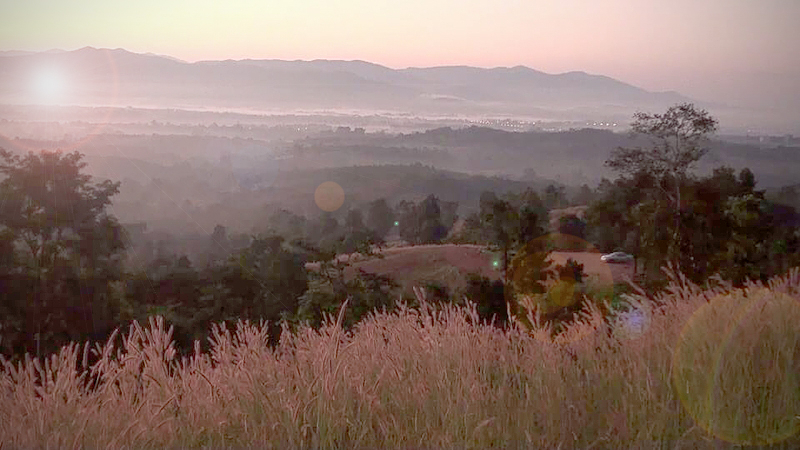
Thailand Meteorological Department forecast on Monday (January 20) that the moderate high-pressure system from China covering the upper Northeast of Thailand and the South China Sea and the westerly trough at a high altitude would bring cold air from the Himalayas to the North of Thailand.

The plains of the North and the Northeast are forecast to have cool to cold mornings with temperatures dropping by 1-2 degrees C and minimum temperatures in range of 14-21°C.

The department also mentioned the easterly and southeasterly winds prevail over the Central, the East, the South and the lower Gulf of Thailand, leading to thundershowers in the lower South.

In the central region, including Bangkok and its vicinity, light winds blowing around the area will increase the accumulation of dust.

The weather forecast for the next 24 hours is as follows:

Northern region: Cool to cold with fog in the morning, temperature lows of 14-21°C and highs of 30-36°C. Temperature likely to drop to 2-11°C on hilltops.

Northeastern region: Cool weather with fog in the morning, temperature lows of 16-21°C and highs of 30-33°C. Temperature likely to drop to 10-14°C on hilltops.

Central region: Cold with fog in the morning; temperature lows of 22-23°C, highs 33-36°C.

Eastern region: Partly cloudy with fog in the morning; lows of 21-25°C, highs 32-34°C; waves lower than one metre.

Southern region (east coast): Partly cloudy with thundershowers in 20 per cent of the area; lows of 23-27°C, highs 31-34°C; waves a metre high.

Southern region (west coast): Partly cloudy with thundershowers in 10 per cent of the area; lows 22-26°C, highs 34-35°C; waves a metre high.

Bangkok and surrounding areas: Partly cloudy with fog in the morning; lows of 25-26°C, highs 32-36°C.

Flight costs rise due to increasing air traffic #ศาสตร์เกษตรดินปุ๋ย

#ศาสตร์เกษตรดินปุ๋ย : ขอบคุณแหล่งข้อมูล : หนังสือพิมพ์ The Nation

https://www.nationthailand.com/news/30380793?utm_source=category&utm_medium=internal_referral

Flight costs rise due to increasing air traffic

Jan 20. 2020
By The Nation

Deputy Transport Minister Thaworn Senneam has directed the Aeronautical Radio of Thailand (Aerothai) to cope with the problem of air traffic, which has resulted in planes waiting for landing space, hiking flight costs by more than Bt100 million per year.

Thaworn said that Thailand has become the hub of airlines because of the increase in the number of travellers. In 2019, more than one million fights landed in Thailand.

He urged Aerothai to focus on aviation safety to support the increasing number of flights, predicted to increase to about two million within the next 15 years.

In the past, it was reported that circling and indirect flying, such as by Thai Airways that uses traffic routes to fly from Phuket Airport to Suvarnabhumi Airport indirectly, cost up to Bt100 million per year. If Aerothai can adjust traffic routes, it will help cut the extra cost, he said.

Aerothai is currently looking for a parallel airport for domestic flights to reduce the density by creating routes for connecting flights to neighbouring countries such as Bangkok to Malaysia and Singapore so as to support international flights and fly-throughs, which are growing at 3.8 per cent and 2.8 per cent respectively

Thaworn added that Thailand is developing into an air transport hub in Asia. The air traffic volume is now quite dense and tending to increase. The current traffic averages around 3,000 trips per day, or some one million trips per year. In the next 15 years, by 2036, the International Air Transport Association estimates that Thailand will be ranked in the world’s top 10 in the aviation industry.

EEC will get adequate water supply: Alongkorn #ศาสตร์เกษตรดินปุ๋ย

#ศาสตร์เกษตรดินปุ๋ย : ขอบคุณแหล่งข้อมูล : หนังสือพิมพ์ The Nation

https://www.nationthailand.com/news/30380792?utm_source=category&utm_medium=internal_referral

EEC will get adequate water supply: Alongkorn

Jan 20. 2020
By The Nation

The government will ensure that the Eastern Economic Corridor (EEC) will have enough water while asking all sectors to cut water consumption by up to 15 per cent, Alongkorn Ponlaboot, the adviser to the Minister of Agriculture and Cooperatives, said.

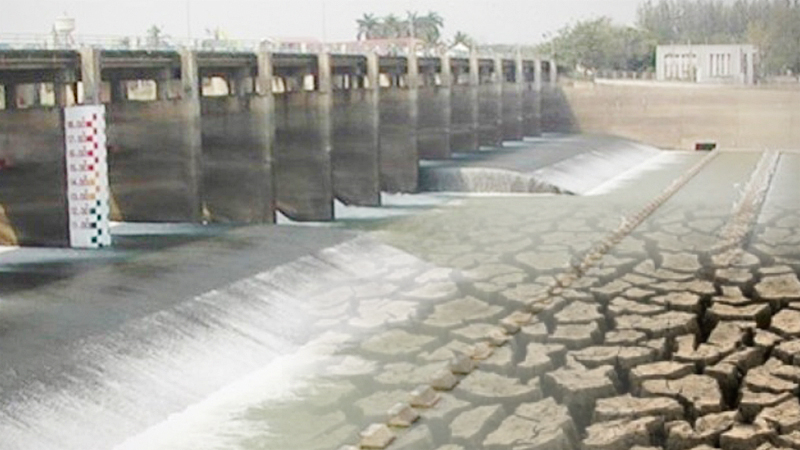
Alongkorn said this year’s drought is considered the worst in 15 years.

The Ministry of Agriculture has asked all parties to increase water savings by up to 15 per cent from the original 10 per cent, especially in the eastern region where high volumes of water are used for tourism and industries. Due to considerable decline in the water levels in Chonburi and Rayong provinces, the Royal Irrigation Department is seeking water from other provinces. Alongkorn, however, insisted that there was sufficient water for the dry season.

The ministry will coordinate with all sectors to draw water from East Water Company that has connected pipes from Prasae Reservoir to Khlong Yai Reservoir and Nong Pla Lai Reservoir in Rayong Province to reduce water loss so that water supply for agriculture is not affected. It might also seek help from the Royal Rainmaking Office to help fill the basin.

The Provincial Waterworks Authority has diverted water from Khlong Luang Reservoir to help increase the volume of water in the Chonburi area by over 10 million cubic metres and it is also procuring additional private ponds. It will increase the volume of water by more than 20 million cubic metres to produce water delivered to Pattaya for consumption.