Economists increasingly approve of U.S. taking on more debt for right reasons #ศาสตร์เกษตรดินปุ๋ย

#ศาสตร์เกษตรดินปุ๋ย : ขอบคุณแหล่งข้อมูล : หนังสือพิมพ์ The Nation

https://www.nationthailand.com/business/30380569?utm_source=category&utm_medium=internal_referral

Economists increasingly approve of U.S. taking on more debt for right reasons
Jan 15. 2020
By The Washington Post · Heather Long

SAN DIEGO – Many top economists are coming around to the belief that it’s OK, even preferable, for the United States government to spend more money, even if it means increasing America’s $23 trillion debt.

When thousands of economists gathered for the annual American Economic Association meeting this month, there were overwhelming calls for more – and wiser – government spending. Leading economic thinkers laid out the case that the nation will almost certainly have to spend more during the next recession, that major challenges such as climate change and inequality will likely require more money, and that the United States is significantly under-investing in infrastructure and education.

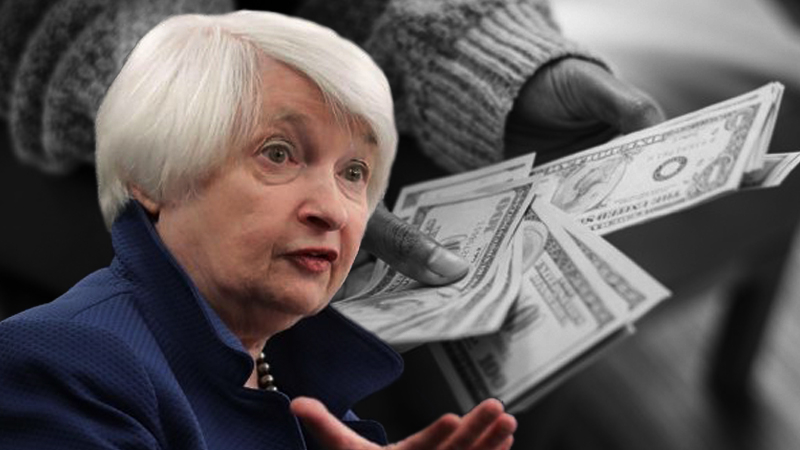
“Even under current conditions, I think we can afford to increase federal spending or cut taxes to stimulate the economy if there’s a downturn,” said Janet Yellen, the former Fed chief who is the incoming president of the American Economic Association. “Chronic low interest rates create additional fiscal space.”

Yellen’s remarks are part of a growing chorus of prominent economists who are building the intellectual case for the United States to take on a bit more debt. They are not saying that politicians have a blank check to spend more or that higher debt doesn’t have any negative consequences. The money still has to be paid back at some point – with interest.

But the consensus view is shifting among economists from a belief that debt harms the economy to a belief that responsible borrowing is warranted.

Yellen argued that the timing is right to make smart investments: It’s cheap to borrow with interest rates so low and unlikely rise much any time soon.

“In a world of low real rates, there’s also a strong case for programs to invest in infrastructure, education, research and development, climate change mitigation – namely investments that would elevate potential growth,” Yellen said.

Her call for more spending noticeably contrasts from her 2017 testimony before Congress that the long-term budget outlook should “keep people awake at night.”

The academic conversation around spending more to strengthen the economy comes at a time when the federal budget deficit topped $1 trillion, due to the Trump administration tax cuts and increased spending. It was the first time the deficit broke the trillion dollar mark during a January to December period since 2012 when the economy was still recovering from the Great Recession. The deficit continues to rise, according to the latest Treasury report on government debt released Monday.

Some economists called for higher taxes, especially on the rich, to fund additional spending. And many denounced Trump’s tax cuts as wasteful spending that could have gone toward other initiatives, including infrastructure. But there was a lot less worry about the current debt level.

“If you had been at the [AEA] meetings seven years ago, there would have been a lot of concern about entitlement spending. There’s very little of that now,” said Lawrence Summers, the former treasury secretary under Bill Clinton who helped craft the last balanced federal budget.

Indeed, many pointed to Japan, where debt is about 250% the size of the economy, as a good example that debt can rise a lot without triggering a doomsday scenario. Economic textbooks teach that too much debt can bankrupt a country and trigger massive inflation, which can cause a recession. But after years of high debt in Japan, investors are still willing to lend the country money, and Japan’s economy is sluggish but stable.

U.S. debt is about 80% of GDP and is projected to grow to 95% of GDP by 2029, largely because of rising Social Security and Medicare spending as baby boomers age. But many argued that it’s unlikely U.S. bonds would lose their status as one of the safest assets in the world if debt grew somewhat more.

“I would be very confident the United States would not go bankrupt,” Summers said. He would support a “prudent” program of borrowing to finance “reasonable, prudent public investment,” for example on schools and renewable energy.

That sentiment was echoed by many.

“We are in such bad shape on infrastructure,” said economist Lisa Lynch, the provost of Brandeis University. “We had such a missed opportunity as part of the response to the Great Recession to really have doubled down on making major investments in our infrastructure.”

The economists who attend AEA are largely academics. Several who spoke with The Washington Post estimated that 80% to 90% of the conference attendees are politically liberal, which could explain the heightened calls for the government to do more.

But others say economists’ views are evolving on government spending, because circumstances have changed. Lower interest rates make borrowing and investing more attractive. And rapid technological advances make it more necessary for the United States to invest heavily to remain competitive.

The U.S. economy is growing at about 2%, a modest pace compared with prior booms. Summers has dubbed this “secular stagnation.” Trump promised his tax cuts and deregulation would lift growth, which happened in 2018, but growth slowed closer to 2% in 2019. And economists say a big reason the economy rarely grows beyond 3% anymore is because of the aging population (fewer workers) and muted productivity growth.

Janice Eberly of Northwestern University’s Kellogg School of Management put up a slide showing that while the U.S. government spends more dollars today on the military and domestic programs than it did in the 1960s, federal investment as a share of GDP is at an all-time low, which is likely hurting productivity and growth.

There’s also the reality that if another recession hits, the Federal Reserve is unlikely to be able to do as much to rescue the economy. The Fed typically cut rates 5% points during prior recessions. The Fed’s benchmark rate is already just shy of 1.75%, leaving little room to goose the economy.

“We don’t have monetary policy. It’s very limited at the moment,” said Kenneth Rogoff, a Harvard economics professor who foresaw much of the 2008 financial crisis.

With monetary policy hamstrung, Congress would likely need to spend more during the next recession to help revive the economy, but Rogoff said he is “not at all optimistic” that can be done.

Several economists, including Summers, proposed “automatic stabilizers” for the economy, which are measures such as payroll tax cuts or extra food stamps that would take effect once the unemployment rate climbs to a high rate. But it would take an act of Congress to set up the automatic stabilizers, which seems unlikely in the current political environment.

Other economists called for bolder moves for the government to spend more on addressing climate change by funding more research on green technologies. There were also calls for the government to better address inequalities, such as giving children from low- and moderate-income families “baby bonds” that can help pay for college and other springboards to a better life.

“Everybody now assumes that social programs and social safety nets require more resources,” said Dani Rodrik, a Harvard economics professor. “Nobody stood up and said all of this inequality is because the government is doing too much.”

‘Lackluster’ holiday sales cast a pall over U.S. retail sector #ศาสตร์เกษตรดินปุ๋ย

#ศาสตร์เกษตรดินปุ๋ย : ขอบคุณแหล่งข้อมูล : หนังสือพิมพ์ The Nation

https://www.nationthailand.com/business/30380567?utm_source=category&utm_medium=internal_referral

‘Lackluster’ holiday sales cast a pall over U.S. retail sector

Jan 15. 2020
File Photo

File Photo
By Syndication Washington Post, Bloomberg · Matthew Boyle 

What a difference a year makes.

U.S. retailers have gone from peak Christmas to weak Christmas, judging from “lackluster” results released Tuesday by data tracker NPD Group. Sales of key gift categories rose just 0.2% between Nov. 3 and Dec. 28 compared with the same period last year, NPD said, hurt by sluggish demand for apparel and toys in particular.

“Retailers did not have their typical robust peak season,” NPD’s chief industry adviser Marshal Cohen said. “It’s flat. You don’t want a flat peak, that’s like an oxymoron.”

Combined with feeble numbers from retailers like Kohl’s Corp., J.C. Penney Co., L Brands Inc. and Five Below Inc., it’s shaping up to be a December some retailers would rather not remember. NPD’s results stood in sharp contrast with those from Mastercard SpendingPulse, which earlier reported a 3.4% gain in sales over a similar time period, fueled by a 19% uptick in online revenue.

While some retailers blamed a shortened holiday-selling period for their declines — there were six fewer days between Thanksgiving and Christmas in 2019 compared with 2018 — investors won’t swallow such excuses.

Shares of Five Below, for example, plunged 11% Monday after it cut its profit forecast amid a falloff in comparable holiday sales. Another contributing factor was that retailers were boosted in 2018 by the demise of Toys R Us Inc. — even Best Buy Co. had toys in its aisles — but that benefit largely disappeared a year later. NPD’s Cohen also said consumers continue to migrate more toward experiences versus merchandise.

“Romantic gifts, ties, nobody bought that stuff,” he said.

The poor performance doesn’t bode well for the upcoming year. While unemployment is near record lows, U.S. consumer confidence unexpectedly dropped for the fourth time in five months in December, while wage growth remains tepid.

“One thing we are certain of is that the outlook seems much more uncertain,” Scott Mushkin, an analyst at R5 Capital, said in a note last week. The end of interest-rate cuts and this year’s presidential election are weighing on consumer demand, he said.

The industry’s star pupils have yet to post their holiday grades, however. Target Corp. reports sales Wednesday, while Walmart Inc. and Best Buy will update investors next month. Costco Wholesale Corp., meanwhile, remained impervious to the adverse conditions that are battering retailers, with its December sales trouncing estimates.

U.S. stocks drop from record highs; Treasuries gain #ศาสตร์เกษตรดินปุ๋ย

#ศาสตร์เกษตรดินปุ๋ย : ขอบคุณแหล่งข้อมูล : หนังสือพิมพ์ The Nation

https://www.nationthailand.com/business/30380565?utm_source=category&utm_medium=internal_referral

U.S. stocks drop from record highs; Treasuries gain

Jan 15. 2020
By Syndication Washington Post, Bloomberg · Vildana Hajric, Claire Ballentine

U.S. stocks retreated from all-time highs after Bloomberg reported that tariffs on billions of dollars of Chinese goods will likely stay in place until after the presidential election.

The S&P 500, Nasdaq Composite and Dow Jones Industrial indexes all pulled back from records as the conditions underscored lingering concern about future progress in negotiations. Positive results from big banks had driven prices higher. Treasuries climbed earlier after a gauge of underlying inflation rose less than forecast.

“There was a lot of optimism built up and now this just throws a whole new wrench into that optimism,” said Ryan Nauman, a market strategist at Informa Financial Intelligence’s Zephyr. It raises “a lot of questions moving forward.”

The two sides have an understanding that no sooner than 10 months after the signing of the agreement at the White House Wednesday, the U.S. will review progress and potentially trim tariffs now in place on $360 billion of imports from China, according to people familiar with the matter.

The Stoxx Europe 600 index closed up for the first time in three sessions. Earlier in Asia, stocks finished slightly higher.

The Chinese yuan held most of its surge from Monday, when Washington lifted its designation of the country as a currency cheat. The dollar held its gains after the inflation data, while the pound broke a five-day slide.

Here are some events to watch for this week:

–Phase one of the U.S.-China trade deal is set to be signed on Wednesday in Washington.

–The biggest American financial institutions kick off earnings season, with Bank of America Corp., Goldman Sachs Group Inc., Morgan Stanley and BlackRock Inc. next up.

–The Fed’s so-called beige book is due on Wednesday.

–China GDP comes on Friday.

These are the major moves in markets:

-Stocks

-The S&P 500 index decreased 0.2% to 3,280.88 as of 3:13 p.m. New York time. The index closed at 3,283.15,   down 0.15 %

-The Dow Jones Industrial Average closed  at 28,939.67, up 0.11 %.

-The Nasdaq Composite index fell 0.24% to 9,251.33, the largest drop in more than a week.

-The MSCI All-Country World index was little changed at 573.21.

-The Stoxx Europe 600 index jumped 0.3% to 419.59.

Currencies

-The Bloomberg Dollar Spot index was little changed at 1,193.02.

-The Japanese yen was little changed at 109.96 per dollar, the weakest in about eight months.

-The euro decreased 0.1% to $1.1128.

-The British pound increased 0.3% to $1.3024, the first advance in more than a week.

Bonds

-The yield on two-year Treasuries declined one basis point to 1.57%, the biggest drop in more than a week.

-The yield on 10-year Treasuries dipped three basis points to 1.81%, the lowest in more than a week.

-Germany’s 10-year yield fell one basis point to -0.17%.

-Britain’s 10-year yield decreased three basis points to 0.72%, the lowest in six weeks.

Commodities

-West Texas Intermediate crude advanced 0.4% to $58.34 a barrel, the first advance in more than a week.

-Gold depreciated 0.1% to $1,546.35 an ounce, the weakest in more than a week.

Additional measure to help SMEs #ศาสตร์เกษตรดินปุ๋ย

#ศาสตร์เกษตรดินปุ๋ย : ขอบคุณแหล่งข้อมูล : หนังสือพิมพ์ The Nation

https://www.nationthailand.com/business/30380549?utm_source=category&utm_medium=internal_referral

Additional measure to help SMEs

Jan 15. 2020
Finance Minister Uttama Savanayana

Finance Minister Uttama Savanayana
By THE NATION

The Finance Ministry will introduce an additional measure to help small and medium-sized enterprises (SMEs). Minister Uttama Savanayana said the Fiscal Policy Office, the Bank of Thailand and the Board of Investment will jointly draw up the measure.

The state agencies under the ministry earlier launched measures to enable SMEs to gain easier access to low-interest loans.

On Monday (January 13), Deputy Prime Minister Somkid Jatusripitak instructed the BOI to consider launching more measures to boost competitiveness and cut operating costs.

The ministry will also urge state enterprises to accelerate investment, aiming to lift the economy, he added.

The ministry will hold a meeting with state enterprises on Wednesday (January 15) to accelerate their budget disbursement. Somkid will chair the meeting.

The fiscal 2020 budget bill sailed through the House of Representatives on Saturday (January 11).

U.S., EU square up for trade brawl after Trump’s China deal #ศาสตร์เกษตรดินปุ๋ย

#ศาสตร์เกษตรดินปุ๋ย : ขอบคุณแหล่งข้อมูล : หนังสือพิมพ์ The Nation

https://www.nationthailand.com/business/30380562?utm_source=category&utm_medium=internal_referral

U.S., EU square up for trade brawl after Trump’s China deal

Jan 15. 2020
By Syndication Washington Post, Bloomberg · Jonathan Stearns, Shawn Donnan

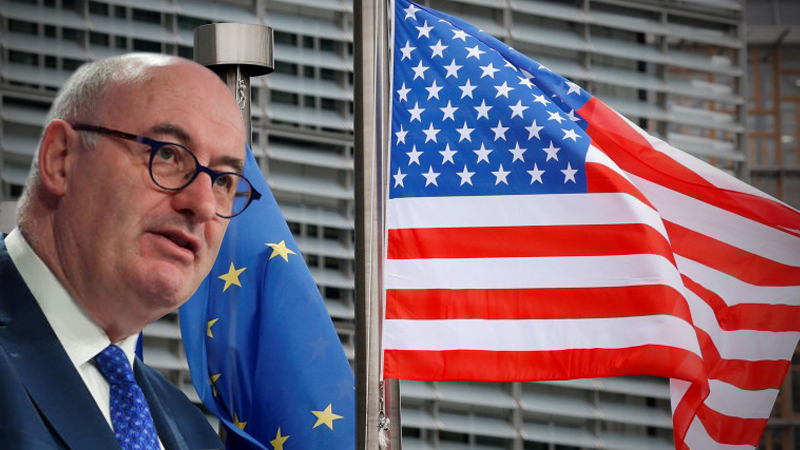
The European Union’s new trade chief will be in Washington for the next three days trying to head off a transatlantic commercial war on several fronts. The prospects for success look slim.

Phil Hogan is due to meet U.S. Trade Representative Robert Lighthizer and other American officials during a Jan. 14-16 visit that follows a general fraying of ties in recent months between the world’s biggest economic partners.

While U.S. President Donald Trump has held back on a threat to hit European cars and auto parts with tariffs that are much dreaded in the EU, both sides have revived old disputes and triggered new ones as a result of fundamental disagreements over trade policy.

A high-stakes security standoff between the West and Iran adds to the complexity and gloom because Trump’s stance toward Tehran is much more hardline than Europe’s. This raises the possibility that the White House will use transatlantic commercial questions — and the option of American tariffs — as leverage against EU allies when it comes to Iran.

“The gloves are off,” said Hosuk Lee-Makiyama, director of the European Centre of International Political Economy in Brussels. “There is going to be a lot of fireworks before any underlying progress in resolving U.S.-EU policy differences over trade.”

Trump continues to unsettle Europe three years after entering office with an “America First” agenda that has shaken the global order the U.S. was instrumental in building after World War II. The EU has gone from being perplexed to steeling itself for more disruptions as it fights to uphold multilateralism, a defining principle for the bloc.

The U.S.-EU tensions so far have played out largely in the shadow of a trade war that Trump instigated against China with far bigger economic ramifications. Now the U.S. and China plan to de-escalate their battle during Hogan’s visit by signing a first-phase agreement on Wednesday in Washington.

“It just feels like we are now entering what I call the transatlantic trade and tariff tantrum,” said Heather Conley, a former U.S. diplomat now at the Center for Strategic and International Studies in Washington. “This is going to be a pretty intense period, I fear.”

The troubles started in 2018 when the Trump administration invoked national-security considerations to impose tariffs on steel and aluminum from Europe. As a U.S. military ally, the EU was infuriated and promptly retaliated with levies on U.S. goods including iconic brands such as Harley-Davidson motorcycles and Levi Strauss & Co. jeans.

A subsequent U.S. threat to wreak significantly more economic damage by targeting the European auto industry with duties on the same security grounds led to a hastily agreed truce and a pledge by both sides to work toward reducing industrial tariffs across the board.

Since then, the Trump administration has refused to start the tariff-cutting negotiations unless Europe includes agriculture in them. Also, it imposed levies on EU products in retaliation over government aid to Airbus SE that was deemed illegal by the World Trade Organization, and disabled the WTO’s appellate body,

The EU is pressing ahead with a plan for tit-for-tat tariffs against the U.S. in a parallel WTO case over unlawful subsidies to Boeing Co. The bloc is also advocating a stopgap global arbitration system and expanding the European trade-policy arsenal to allow for sanctions against countries that illegally restrict commerce and simultaneously block the WTO’s dispute-settlement process.

The latest flashpoint is a U.S. plan to apply duties on $2.4 billion of French goods ranging from cheeses to handbags in retaliation over a digital-services tax in France that the Trump administration alleges discriminates against American technology companies such as Google, Apple Inc. and Amazon.com Inc.

Such duties would mark the first time the Trump administration deploys against Europe a policy tool — Section 301 of a 1974 American law — reserved so far for the U.S. trade war against China.

The EU is pleading for more time to reach an international accord on the taxation of digital businesses through the Organization for Economic Cooperation and Development. The bloc is also vowing a unified response should the U.S. trigger the levies against France.

“I think we have a bumpy ride ahead of us,” Sabine Weyand, director general for trade in the European Commission, the EU’s executive arm, told a Brussels conference last month. “If you deal with partners who link up trade policy with security and with industrial policy, et cetera, well, you have to up your game as well. That will be the challenge for this commission.”

Weyand is the chief civil servant for international commerce under Hogan, an Irish politician who became European trade commissioner on Dec. 1 as part of a new EU commission led by President Ursula von der Leyen.

Hogan, who has a reputation as a dealmaker, burnished those credentials in mid-2019 while in his previous job as EU farm chief. He reached an accord with Lighthizer to give American farmers more access to the European beef market after persuading Australia, Argentina and Uruguay to cede chunks of an EU import quota.

Still, in the eyes of some officials in Washington, Hogan got off to a bad start with regard to the European trade-commissioner post by telling Irish radio on the day of his nomination in September that Trump was “reckless” and needed to see the “error of his ways.” The comments prompted White House economic adviser Larry Kudlow to summon the EU ambassador to the U.S., according to officials familiar with the event.

Regardless of any political damage that Hogan caused with his blunt words or of his dealmaking skills, the main difficulty for him may simply be the size of the transatlantic gap in views about how trade policy should be pursued in an increasingly interconnected global economy.

The gulf would become even bigger were Trump to view U.S. trade ties with Europe through the prism of his “maximum pressure” Iran strategy, which has included abandoning a landmark international accord to control the Iranian nuclear program. Europe has fought to keep the deal alive.

Treasury Secretary Steven Mnuchin last week stepped up U.S. calls on the EU to abandon a payment system meant to shield European trade with Iran from American sanctions, repeating a threat of penalties against bodies in Europe should any transactions take place.

“There is very little that Hogan can actually put on the table to sway Lighthizer,” Lee-Makiyama said. “That leaves the EU facing domestic political pressure for more trade retaliation, which in turn is economically counterproductive.”

BOT not keen on sovereign wealth fund in baht fight #ศาสตร์เกษตรดินปุ๋ย

#ศาสตร์เกษตรดินปุ๋ย : ขอบคุณแหล่งข้อมูล : หนังสือพิมพ์ The Nation

https://www.nationthailand.com/business/30380559?utm_source=category&utm_medium=internal_referral

BOT not keen on sovereign wealth fund in baht fight

Jan 15. 2020
 Deputy Bank of Thailand governor Mathee Supapongse, says the proposal of a  sovereign wealth fund will not help in reining in the baht's value.

Deputy Bank of Thailand governor Mathee Supapongse, says the proposal of a sovereign wealth fund will not help in reining in the baht’s value.
By The Nation

The central bank has ruled out a proposal for the establishment of a sovereign wealth fund but promises to further relax capital outflow rules in tackling the strengthening baht.

Deputy Bank of Thailand governor Mathee Supapongse, said the proposal of a  sovereign wealth fund will not help in reining in the baht’s value. “If the fund will just facilitate changing asset holding, for example from dollar and US bonds to oil, it would not have any impact on the baht’s value”. However, if the government and private sector buy dollar in foreign markets for investment overseas, it would weaken the baht, he added.

The baht appreciated about 8 per cent against the US dollar last year. It has been moving around at Bt30 a dollar this month, and at this level there was almost no change from last year. The Thai currency occasionally weakened by 1 per cent against other appreciating currencies in the region, he said, adding that there is no need to implement drastic measures to deal with the baht’s value.

Thailand’s current account surplus stands at 8 per cent of GDP, Taiwan 13.3 per cent and South Korea 5.2 per cent. Taiwan and South Korea have encouraged exporters not to bring dollar back into the countries and they also manage their exchange rate better, he noted. The central bank has blamed the country’s high current account surplus and low domestic investment as main causes of the strong baht. It has called for cooperation from other state agencies to jointly tackle the issue.

The central bank has discussed the matter with the Office of Insurance Commission which regulates many funds, said Mathee. The central bank may further relax capital outflow rules to make it much easier for these funds to invest overseas, he said. The central bank previously had relaxed capital outflow rules including allowing individual investors to directly invest in financial asset overseas. However, many critics said those measures were not effective.

They said the central bank may find relief soon with the US lifting China off the list of currency manipulators on Monday. The central bank has been cautious in market intervention by selling baht and buying dollar, due to US pressure.

Even so, the BOT bought $80 billion over the past five years, leading to a large accumulated international reserve of $227.5 billion, as of January 3.

Cabinet nods to merger, state units in NBTC auction #ศาสตร์เกษตรดินปุ๋ย

#ศาสตร์เกษตรดินปุ๋ย : ขอบคุณแหล่งข้อมูล : หนังสือพิมพ์ The Nation

https://www.nationthailand.com/business/30380553?utm_source=category&utm_medium=internal_referral

Cabinet nods to merger, state units in NBTC auction

Jan 14. 2020
DE Minister Puttipong Punnakanta

DE Minister Puttipong Punnakanta
By THE NATION

The Cabinet on Tuesday (January 14 ) approved the participation of state telecom agencies CAT Telecom and TOT in a spectrum auction, to be held by the National Broadcasting and Telecommunications Commission on February 16.

The Cabinet also gave the greenlight to the proposed merger between TOT and CAT under the single entity of National Telecom Co (NT).

The new company will be 100 per cent owned by the Finance Ministry. Both parties will have to complete the merger process in the next six months, said Minister of Digital Economy Puttipong Punnakanta.

Korn quitting Democrat Party after 15 years #ศาสตร์เกษตรดินปุ๋ย

#ศาสตร์เกษตรดินปุ๋ย : ขอบคุณแหล่งข้อมูล : หนังสือพิมพ์ The Nation

https://www.nationthailand.com/news/30380582?utm_source=category&utm_medium=internal_referral

Korn quitting Democrat Party after 15 years

Jan 15. 2020
Korn (right)

Korn (right)
By THE NATION

Former finance minister Korn Chatikavanij is resigning from the Democrat Party on Wednesday (January 15).

Korn made the announcement on Tuesday (January 14) evening, when members of Parliament and former MPs of the Democrat Party organised a New Year’s party for its former leader and ex-PM Abhisit Vejjajiva.

More than 50 stalwarts, including party-list MP Korn, Agriculture Minister and party secretary-general Chalermchai Sri-On, Deputy Public Health Minister and party deputy leader Sathit Pitudecha, and another deputy leader, Ongart Klampaiboon, attended the event. Notable by his absence at the party was current Democrat leader Jurin Laksanawisit, as well as MPs considered close to him.

Korn got on the stage and sang “Rak Ther Sameu” (I’ll always love you), a hit song from 1990s in tears. He was joined by others, who were also in tears. When the song ended, Abhisit gave him a hug.

Korn and Abhisit (left)

Korn and Abhisit (left)

Korn said the reason for his resignation was he thought he had already fulfilled his duty as an MP after the 2020 Budget Act had been approved by Parliament. Korn joined the Democrat Party in 2005 and served for 15 consecutive years.

Before the event concluded, Abhisit gave a speech encouraging all MPs to maintain the political ideology of the party and commit to solving the country’s problems. He vowed to assist all party members in any way he could, provided they did not go against his beliefs and ideology. “Our bonds are stronger than any crises,” he said. “I wish all of you a good year, good health and good commitment to progress forward together.”

Rome bans diesel vehicles from its streets as smog covers skies #ศาสตร์เกษตรดินปุ๋ย

#ศาสตร์เกษตรดินปุ๋ย : ขอบคุณแหล่งข้อมูล : หนังสือพิมพ์ The Nation

https://www.nationthailand.com/news/30380585?utm_source=category&utm_medium=internal_referral

Rome bans diesel vehicles from its streets as smog covers skies

Jan 15. 2020
By The Nation

The city of Rome banned all diesel vehicles from its roads for the first time on Tuesday after smog covered the sky while other cities in central and northern Italy also sought ways to decrease pollution.

Rome’s city council banned diesel cars, vans and motorbikes during peak hours: 7.30am to 10.30am and 4.30pm to 8.30pm.

Italy has set the limit for fine particle pollution (particulate matter 10 micrometers in diameter) at 50 per cubic metre. Some areas of Rome in the past two weeks have exceeded that level, considered a potential health hazard.

Pollution levels have also risen dramatically in other Italian cities, such as Milan, Turin, Florence, Piacenza, Parma, Reggio Emilia and Modena, however, only Rome banned diesel vehicles.

The local transport authority said that it would affect around one million vehicles and some oil companies.

“This appears to be a totally unjustified decision from a scientific point of view, which offers no environmental advantage and therefore unnecessarily penalises a wide range of citizens,” it said in a statement. “This decision was incredibly delayed. The city council is only banning diesel following 10 days of poisoned air.”

The Italian Environmental Association said that banning diesel cars from running in the city is correct but it is a temporary measure. They suggested that, In the long run, the city council should ban the use of fossil fuels, promote public transportation, encourage car-sharing, add more lanes for bicycles and introduce green heating systems.

Amnesty to Cambodia: Drop bogus treason case against opposition leader #ศาสตร์เกษตรดินปุ๋ย

#ศาสตร์เกษตรดินปุ๋ย : ขอบคุณแหล่งข้อมูล : หนังสือพิมพ์ The Nation

https://www.nationthailand.com/news/30380548?utm_source=category&utm_medium=internal_referral

Amnesty to Cambodia: Drop bogus treason case against opposition leader

Jan 14. 2020
By Amnesty

The treason charge brought by Cambodian authorities against Kem Sokha, the leader of the country’s banned main opposition party, is bogus and should be dropped, Amnesty International said today (January 14) ahead of his trial tomorrow.

Sokha, the president of the Cambodia National Rescue Party, faces up to 30 years in prison if he is found guilty of treason. His trial at the Phnom Penh Municipal Court is scheduled to begin at 8.30am on Wednesday.

“After two years held in arbitrary detention, the authorities have not presented a shred of credible evidence to support the charge of treason,” said Amnesty International regional director Nicholas Bequelin. “The non-existent crime was politically manufactured to further the suppression of the opposition party. The Phnom Penh Court must acquit Kem Sokha to bring an end to this mockery of justice.”