Competition watchdog unleashed on food delivery business #SootinClaimon.Com

#SootinClaimon.Com : ขอบคุณแหล่งข้อมูล : หนังสือพิมพ์ The Nation.

Competition watchdog unleashed on food delivery business (nationthailand.com)

Competition watchdog unleashed on food delivery business

EconDec 08. 2020

By The Nation

The Trade Competition Commission said it will set up a unit to handle complaints of unfair practice in the food delivery service business.

Complaints were already being sent to the commission and would be considered according to recently issued guidelines, said chairman Sakon Varunyuwatana.

The new unit will have seven days to consider whether the complaints have merit. If so, they will be submitted to the commission’s fact-finding committee.

If a case is simple, it will proceed immediately as per the legal process. If a case is complicated, the commission will set up a subpanel to investigate the evidence for 90 days, extendable by another 15 days.

Brexit negotiators ‘very gloomy’ over trade deal, with talks on ‘knife’s edge.’ Again. #SootinClaimon.Com

#SootinClaimon.Com : ขอบคุณแหล่งข้อมูล : หนังสือพิมพ์ The Nation.

Brexit negotiators ‘very gloomy’ over trade deal, with talks on ‘knife’s edge.’ Again. (nationthailand.com)

Brexit negotiators ‘very gloomy’ over trade deal, with talks on ‘knife’s edge.’ Again.

EconDec 07. 2020

By The Washington Post · William Booth, Michael Birnbaum · WORLD, EUROPE 

LONDON – According to sources, Brexit talks are “on a knife’s edge.” It’s “the make or break moment.” It’s “down to the wire.” It’s “crunchtime.” 

Sound familiar? It is. Even Brexit obsessives have lost track of how many “crunch times” have come and gone over these many months and years of negotiating Britain’s exit from the European Union.

All that to say that Brexit talks have still not concluded. Negotiators met in the London over the weekend and worked until late at night trying to strike a deal. Now the two sides are back in Brussels, at it again.

British and European teams are struggling to craft a free-trade agreement that will allow the two sides to continue the orderly movement of goods and services across the English Channel.

If they fail to strike a deal, then Britain and Europe will enforce new customs duties, tariffs, border checks, and quotas on goods, increasing prices and fully ending the era of the free, frictionless trade.

They have 24 days to make a deal.

Specifically, the two sides are arguing over European access to fish in British waters, an emotional issue that taps into issues of sovereignty, even though the fisheries sector accounts for a tiny fraction of Britain’s gross domestic product. 

There have been suggestions that European access to fish in British seas could be slowly reduced. Should the transition period be three years (a British proposal) or 10 years (a French proposal)? Stay tuned. 

The Europeans, too, are pressing to maintain a “level playing field,” to stop Britain from undercutting worker protections or granting large state subsidies to British businesses, potentially giving the U.K. firms unfair advantages. 

The political press is reporting a “final push” this week, but in reality the sides have been pushing for a very long time.

Britain officially left the European Union in January, though it didn’t quite leave. What it did was begin an 11-month transition period, which ends midnight on Dec. 31. The transition period that was granted to give the sides time to craft a trade deal, to avoid last-minute chaos and uncertainty. Numerous deadlines have come and gone.

How are things going? Not good.

“The news is very downbeat,” Ireland’s foreign secretary Simon Coveney told Ireland’s state broadcaster RTE, who described the mood as “very gloomy.”

The Irish minister said, “I’d like to be giving more positive news but at the moment these negotiations seem stalled, and the barriers to progress are still very much in place.”

The British Foreign Office was a little less gloomy. Minister James Cleverly told the BBC the U.K. would keep negotiating “for as long as we have available time or until we get an agreement.” He said negotiations “often go to the last minute of the last day.”

“We are a global player, we are one of the biggest economies in the world, we are a real prize for many countries,” Cleverly said. “I think if E.U. recognise this they will see that actually making a few small but significant concessions can get this deal done and that will be in their interest and in our interest.”

Diplomats in Brussels, confronted with a spiraling series of crises, say that Brexit was long ago supplanted as the most burning issue they are facing. 

Nor is it even the trickiest negotiation they are facing in Brussels this week, amid acrimonious talks with two of the European Union’s own members, Hungary and Poland. The two countries, whose commitment to democracy is increasingly shaky, have vetoed the entire $2 trillion E.U. budget because the other E.U. members want to make receiving funds conditional on adhering to the rule of law. 

Now E.U. ambassadors are receiving briefings almost every day from the bloc’s top negotiator, Michel Barnier, a lanky former French politician who has sounded increasingly glum about the prospects for the talks.

They are fast running out of time, since any deal would need to be approved by E.U. leaders and a handful of parliaments before Dec. 31. 

“It was always going to go beyond any reasonable deadline,” said one finger-drumming senior E.U. diplomat, who spoke on the condition of anonymity to detail frustrations with the British approach. 

E.U. officials familiar with the negotiations said that there was an agreement among themselves to halt talks Wednesday, regardless of their outcome, although such deadlines could easily be bargaining tactics. 

Another senior diplomat said Monday that differences remain on fisheries, rules about state aid to industries, and which body will enforce the deal – a summary that could easily have described most of the entire last year of negotiations. 

“If that sounds familiar to you, it is because there has been no decisive progress made so far,” the diplomat said of the last few days of discussions, briefing reporters on the talks under ground rules of anonymity. 

Prime Minister Boris Johnson and European Commission President Ursula von der Leyen plan to speak Monday evening. A Saturday night conversation lasted an hour but proved fruitless in the end: they told their negotiators to keep negotiating. 

A downcast von der Leyen came out after the conversation to tell reporters that many differences remained. 

“Whoever has a crystal ball and is able to predict how first-of-their kind negotiations will unfold and conclude deserves a job as scriptwriter in the movie industry or to write novels,” von der Leyen’s spokesman, Eric Mamer, told reporters on Monday. 

Will Jennings, a professor of political science at the University of Southampton, said it was “very difficult” to know what was going on in negotiations as “both sides are giving briefings that tell different stories.” 

He said it was a “strange political moment” because “it’s incredibly salient for key decision-makers” but “the public seemed almost to have moved on.” 

He said that there was a tendency, with E.U. and British politicians, “to take things to the brink and the last minute . . . like students handing in term papers” but it was also difficult to know whether the government really wants a deal. “The notions around Brexit are so wrapped up around sovereignty and taking back control” that there are “huge tensions around the integrity of Brexit and the grubby compromises of international negotiations.” 

Jennings said Johnson wasn’t merely talking tough to appease some of the hardcore Brexiteers in his own party, although they are applying pressure. “The government is led by key advocates of the Leave vote, not the softer side of the Brexit coin,” he said. 

Brexiteers outside the party have been applying pressure, too. Nigel Farage, a media personality and former head of U.K. Independence Party, tweeted that there was “no reasonable negotiation on offer,” as he disparaged French President Emmanuel Macron.

“Either we cave to Barnier and Macron or walk away,” Farage said. 

Embracing a new chapter of China’s development and China-Thailand cooperation #SootinClaimon.Com

#SootinClaimon.Com : ขอบคุณแหล่งข้อมูล : หนังสือพิมพ์ The Nation.

Embracing a new chapter of China’s development and China-Thailand cooperation (nationthailand.com)

Embracing a new chapter of China’s development and China-Thailand cooperation

ColumnsDec 07. 2020

By Yang Xin
Chargé d’Affaires of the Chinese Embassy

The Fifth Plenary Session of the 19th Central Committee of the Communist Party of China examined and adopted the CPC Central Committee’s Proposals for the Formulation of the 14th Five-Year Plan (2021-2025) for National Economic and Social Development and the Long-Range Objectives Through the Year 2035, charted the blueprint for China’s economic and social development in the next five years and the long-range objectives for 2035, put forward a series of strategic and innovative measures, and drew

At the 17th China-ASEAN Expo and the China-Asean Business and Investment Summit held recently, Chinese President Xi Jinping briefed friends from Southeast Asia, including Thailand, that China will embark on a new journey of building a modern socialist country in an all-round way next year, and that China will have broader cooperation with Asean.

China is about to embark on a new journey of development, the core meaning of which is mainly reflected as three “new developments”, namely, the new development stage, new development philosophy and new development paradigm.

“The new stage of development” means that, having achieved the first Centenary Goal of building a moderately prosperous society in an all-round way, China will continue to forge ahead towards the second Centenary Goal of building a modern socialist country in an all-round way, which marks a milestone in China’s development.

Faced with complicated domestic and international situations, especially the outbreak of the Covid-19, the CPC Central Committee with Comrade Xi Jinping at its core has been responding to and addressing difficulties in a calm manner. Currently, the achievement of a moderately prosperous society is in sight. China’s per capita GDP has exceeded US$10,000. The average number of people alleviated from poverty has exceeded 11 million annually in the past five years and extreme poverty will be eradicated by the end of this year. China has managed to build the largest social security system in the world, covering more than 1.3 billion people with basic health insurance and nearly 1 billion people with basic pension schemes. China has signed “Belt and Road” cooperation documents with nearly 140 countries and 30 international organisations, with direct investment in relevant countries reaching more than US$110 billion. Standing at a new historical starting point, China has set out a new long-range development goal: by 2035, China’s GDP per capita will reach the level of moderately developed countries, its middle-income group will expand significantly, and the common prosperity of all its people will register more significant and substantive progress. The Chinese nation will embark on the new journey of marching towards the second Centenary Goal of building a modern socialist country in an all-round way.

“The new development philosophy” is the vision of innovative, coordinative, green and open development that is for everyone. Adhering to the new development philosophy is one of the principles that must be followed in China’s economic and social development during the 14th Five-Year Plan period.

Development is the basis of and key to solving all problems. Entering a new stage of development, China will adhere to the core role of innovation in the overall picture of modernization, and regard science and technology independence as the strategic support for national development. Emphasis will be given to enhanced comprehensive and coordinative development. We will adhere to the concept that lucid waters and green mountains are as good as mountains of gold and silver, promote green and low-carbon development, improve the environmental quality continuously, enhance the quality and stability of the ecosystem, and comprehensively improve the efficiency of resource utilization. China will continue to open up to the outside world on a wider scope, in a broader range and at a deeper level, and rely on its big market advantages to promote international cooperation for mutual benefit and win-win results. China will remain committed to honouring the people as masters of the country, make progress towards common prosperity, ensure that development is for the people and relies on the people and that its fruits are shared by the people, promote social equity, improve people’s well-being, and constantly realise people’s aspirations for a better life. The new development philosophy takes innovation as the primary driving force, coordination as the endogenous characteristics, green as the universal form, opening-up as the only way, and sharing as the fundamental purpose, so as to promote China’s economy from high-speed to high-quality growth.

“The new development paradigm” means domestic circulation as the mainstay and domestic and international circulations reinforcing each other. This strategic choice is conducive to enhancing the resilience of China’s economic development and promoting world economic growth.

China will uphold expanding domestic demand as a strategic priority and ensure the smooth economic circulations. China’s dependence on foreign trade has dropped from 67 per cent in 2006 to nearly 32 per cent in 2019, and the ratio of current account surplus to GDP has dropped from 9.9 per cent in 2007 to less than 1 per cent now. Since the international financial crisis in 2008, China’s domestic demand has contributed more than 100 per cent to the economic growth in seven years, and domestic consumption has become the main driving force of the economic growth. In the process of promoting dual circulations of the economy, China’s economic independence and development quality have significantly improved. Building a new development paradigm conforms to the internal needs of China’s economic restructuring and high-quality development promotion. China will continue to deepen the supply-side structural reform, make greater efforts to expand domestic demand, render production, distribution, circulation and consumption more dependent on the domestic market, enhance the adaptability of the supply system to domestic demand, and form a higher level of dynamic balance featuring the demand driving the supply and the supply generating the demand.

It should be emphasized that China’s building of a new development paradigm is not a closed single loop behind closed doors, but open and mutually reinforcing domestic and international dual circulations. Recently, President Xi Jinping stressed multiple times during the 12th BRICS Summit, the 27th Asia-Pacific Economic Cooperation (APEC) Economic Leaders’ Meeting, the 15th G20 Leaders’ Summit, the 17th China-ASEAN Expo and other multilateral meetings that the current world economic globalisation is irreversible, and no country can develop behind closed doors. China has also long been deeply integrated with the world economy and the international system. Under the new development paradigm, China’s market potential will be fully unleashed to create more demands for all countries in the world. China will further open its door to the outside world and share development opportunities with other countries, and its cooperation with other countries will continue to deepen and achieve mutual benefit and win-win results. In 2020, China’s Special Administrative Measures (Negative List) for foreign investment access downsized from 40 to 33, the number of pilot free trade zones increased from 18 to 21, the third China International Import Expo was successfully held in Shanghai, and China actively signed and acceded to the regional comprehensive economic partnership agreement (RCEP), all of which are most powerful proof of its adherence to opening-up.

This year marks the 45th anniversary of the establishment of diplomatic relations between China and Thailand. Over the past 45 years, China and Thailand have always respected and treated each other equally, strengthened political mutual trust, deepened mutually beneficial cooperation and benefited the two peoples. In July, President Xi Jinping and Prime Minister Prayut Chan-o-cha had an in-depth exchange of views on our bilateral relations and mutually beneficial cooperation by phone, reaching a new consensus, injecting new impetus and guiding new directions for further promoting the development of the China-Thailand comprehensive strategic cooperative partnership. At present, both countries are facing the same task of consolidating the anti-pandemic gains and accelerating the economic recovery. Entering the new stage of development, China will implement the new development philosophy, foster the new development paradigm, unswervingly expand opening-up, enhance the coupling effect of domestic and international economies, and contribute to the common recovery of the world with its own recovery, which will provide new important opportunities for China-Thailand cooperation.

China’s super large market size will first benefit Thailand and other neighboring countries. In the first 10 months of this year, the bilateral trade between China and Thailand increased by 9.6 per cent despite the downward pressure. It is estimated that in the next 10 years, China’s cumulative imports of goods are expected to exceed US$22 trillion, which will provide Thailand and other neighbouring countries with a broader export market. In the face of the growing instabilities and uncertainties of the world economy, China is actively forging a new development paradigm, further opening up to the outside world, accelerating the expansion of new markets, creating new business opportunities and injecting new impetus. We welcome Thailand to share the dividends of China’s reform and opening-up and promote the in-depth development of the China-Thailand comprehensive strategic cooperative partnership.

Speeding up high-quality Belt and Road cooperation will help cope with post Covid-19 pandemic challenges. The China-Thailand railway and other major cooperation projects jointly built by the two countries have made steady progress in overcoming the impact of the pandemic and shown strong resilience. Promoting high-quality Belt and Road cooperation is an important part of China’s opening up to the outside world at a higher level and achieving greater win-win cooperation. China is looking forward to working with Thailand to deepen cooperation in infrastructure developmentregional connectivity promotion and the in-depth docking of the EEC of Thailand with the Guangdong-Hong Kong-Macao (GBA), create new highlights of Belt and Road cooperation, and accelerate the connectivity of Lancang-Mekong cooperation (LMC) and the New International Land-Sea Trade Corridor, so as to enhance the mutual promotion and complementary advantages of the LMC and the Tri-River Economic Cooperation Strategy.

China and Thailand’s cooperation in expanding the digital economy and other new economic and business forms is promising. The Covid-19 pandemic is both a crisis and an opportunity. Digital economy has played an important role in ensuring the economic and social development during the pandemic. Based on the new situations and new requirements of the pandemic prevention and control under the new normal, China is willing to further strengthen cooperation with Thailand in such high-tech fields as 5G, artificial intelligence, cloud computing, and make good use of the important development opportunities of China’s speeding up in the development of the new generation of information technology, biotechnology, new energy, new materials, high-end equipment, new energy vehicles, green and environmental protection, aerospace, marine equipment and other industries during the 14th Five-Year Plan period, and constantly cultivate new growth points and new driving forces for China-Thailand cooperation.

“Wind with good force will bring us to greater heights of success.” Standing at the new starting point of development, let’s continue to work hand in hand to grasp the new opportunities under the new situation, open a new journey of China-Thailand cooperation, and jointly enter a new era of prosperity and development!

Pro-democracy activists hit with more lese majeste charges #SootinClaimon.Com

#SootinClaimon.Com : ขอบคุณแหล่งข้อมูล : หนังสือพิมพ์ The Nation.

Pro-democracy activists hit with more lese majeste charges (nationthailand.com)

Pro-democracy activists hit with more lese majeste charges

PoliticsDec 07. 2020Somyot PruksakasemsukSomyot Pruksakasemsuk 

By THE NATION

Pro-democracy activist Somyot Pruksakasemsuk said in a Facebook post on Monday that he was summoned by the Chanasongkram Police Station to face lese majeste charges.His post also included a copy of the summons, which said Somyot and fellow activists like Parit “Penguin” Chiwarak were charged of violating Article 112 of the Criminal Code at a protest on September 19 and 20.In the post, Somyot said the lese majeste law should not be used as a weapon against the new generation. He had previously been imprisoned for seven years from 2011 for violating Article 112.Police have so far filed lese majeste charges against 18 protest leaders after Prime Minister Prayut Chan-o-cha gave them the green light to start enforcing this draconian law, which had not been used for two years. Separately, in a social-media post on Monday, Parit said the public prosecutor was not punctual in filing lawsuits against him and other protesters in relation to their role in an August 10 rally in Thammasat University’s Rangsit campus. He and fellow protesters were charged for sedition and gathering illegally at that protest.“I don’t need to report to court in this case any more and my concerns of being imprisoned for this rally have vanished,” he said.He also said that he and other protesters, namely Panupong “Mike” Jadnok, Shinwatra Chankrajang and Panusaya “Rung” Sithijirawattanakul, are scheduled to visit Nonthaburi Police Station on Tuesday to face lese majeste charges. He added that police have informed their lawyer in advance that the protesters will be detained.

Pro-democracy protester reveals intimidation by royalists at restaurant #SootinClaimon.Com

#SootinClaimon.Com : ขอบคุณแหล่งข้อมูล : หนังสือพิมพ์ The Nation.

Pro-democracy protester reveals intimidation by royalists at restaurant (nationthailand.com)

Pro-democracy protester reveals intimidation by royalists at restaurant

PoliticsDec 07. 2020

By THE NATION

Prominent protester Chonthicha Jangrew was intimidated by royalists in a restaurant and had to call the police.On Sunday, the protester posted on her Facebook page that a group of royalists had threatened her and her friends while they were having dinner in a restaurant.Chonthicha said that the royalists left their table and approached her and her friends.“They shouted obscenities, and also forced me to leave the restaurant with them,” she added.She confessed that the situation shocked her. However, she was conscious enough to call the deputy commissioner of Chanasongkram Police Station, asking for assistance.Police arrived quickly at the restaurant and calmed the situation down.Chonticha added that the intimidators did not apologise for their behaviour, so the protesters later filed a case at the police station.Suuming up her post, Chonticha said that it was acceptable to cheer different political sides, but “do not claim loyalty for the monarchy as a permission to start a brawl with other people”.

Pfizer tells U.S. officials it cannot supply additional vaccine until late June or July #SootinClaimon.Com

#SootinClaimon.Com : ขอบคุณแหล่งข้อมูล : หนังสือพิมพ์ The Nation.

Pfizer tells U.S. officials it cannot supply additional vaccine until late June or July (nationthailand.com)

Pfizer tells U.S. officials it cannot supply additional vaccine until late June or July

InternationalDec 08. 2020

By The Washington Post · Laurie McGinley, Yasmeen Abutaleb, Carolyn Y. Johnson

WASHINGTON – Pfizer has told the Trump administration that it cannot provide additional doses of its coronavirus vaccine until late June or early July because other countries have rushed to buy up its supply, according to individuals familiar with the situation.

That means the U.S. government will have 100 million doses of the two-shot Pfizer vaccine purchased earlier this year – far fewer than it initially planned – raising questions about whether it can keep to its aggressive schedule to vaccinate most Americans by late spring or early summer.

Trump administration officials denied that there would be availability problems in the second quarter, citing other vaccines in the pipeline, but others said problems are possible.

“I’m not concerned about our ability to buy vaccines to offer to all of the American public,” Gen. Paul Ostrowski, who oversees logistics for Operation Warp Speed, the government’s initiative to expedite vaccine development, said in an interview Monday. “It’s clear that Pfizer made plans with other countries. Many have been announced. We understand those pieces.”

But several officials knowledgeable about the contracts said that if there is a Pfizer shortfall for the second quarter, supplies from other companies may be insufficient to fill the gap, depending on which other vaccines have been authorized by then.

Pfizer officials had urged Operation Warp Speed to initially purchase 200 million doses, or enough for the two-shot regimen for 100 million people last summer, according to people knowledgeable about the issue who spoke on the condition of anonymity because they were not authorized to discuss the situation. But the Warp Speed officials declined, opting instead for 100 million doses, or enough for 50 million people, they said.

“Anyone who wanted to sell us . . . without an [FDA] approval, hundreds of millions of doses back in July and August, was just not going to get the government’s money,” said a senior administration official.

When federal officials recently approached Pfizer to buy another 100 million doses for the second quarter of next year – after the company released data showing the shots to be remarkably effective – Pfizer said the company would be able to provide only 50 million doses in the second quarter of the year, and another 50 million doses in the third quarter, the individuals said. That’s because other countries have ordered the vaccines, they said.

President Donald Trump is expected to sign an executive order on Tuesday that would prioritize vaccinating Americans before providing doses to other countries, according to a senior administration official who spoke on the condition of anonymity because he was not authorized to speak about the plans. Fox News first reported the executive order. It is not clear whether the order is related to the Pfizer supply issue or whether the president can prevent an American company from fulfilling lawful contracts with other countries. The order will be announced as part of a White House “vaccine summit” designed to highlight the administration’s accomplishments on vaccines.

“The executive order reaffirms to the American people that we are going to put America first,” said a senior administration official, who spoke on the condition of anonymity because he was not authorized to discuss the issue publicly.

The vaccine by Pfizer and German biotech firm BioNTech is expected to receive emergency authorization from the Food and Drug Administration in the next several days, and Moderna’s is lined up for clearance shortly after that. Shipments of the vaccines will begin within 24 hours of the approvals, federal officials have said.

Warp Speed officials hope other companies with promising vaccine candidates – including Johnson & Johnson – will provide what’s needed, but some of those companies are still conducting late-stage clinical trials, while others have not started them.

That means there are several weeks to months before the companies are ready to submit an application to the FDA for emergency authorization. One of the companies, AztraZeneca recently reported vaccine data that was encouraging, but experts raised questions about the data and what it meant about the efficacy of the vaccine.

Moncef Slaoui, chief science adviser to Warp Speed, said in an interview Monday that the U.S. government strategy was to spread its risk widely over many different types of vaccines from different manufacturers. He declined to comment on negotiations with any company, including Pfizer. But he said he did not believe there would be any kind of vaccine “cliff,” from which the available doses would fall sharply.

Slaoui said that Johnson & Johnson was likely to report trial results in early January and be ready to ship doses in February, if its vaccine is authorized. He predicted that AstraZeneca’s trial would report results in late January or early February and potentially begin providing doses that month.

“Specifically this means we can have more Moderna vaccine doses, more Pfizer vaccine doses, more Johnson & Johnson vaccine doses and AstraZeneca doses for the foreseeable future,” Slaoui said. “We could have all of them. And for this reason, we feel confident we could cover the needs without a specific cliff. . . . We have planned things in such a way as we would indeed avoid a cliff.”

The contract that Pfizer signed with the government in July was to deliver 100 million doses of vaccine, and it contained an option to request up to an additional 500 million doses. Those doses will begin being shipped to communities across the country within 24 hours of FDA approval, which could come as early as this week.

“Pfizer shall inform the Government of appropriate lead times based on purchase of raw materials, capacity reservation and other factors, and Pfizer and the Government shall mutually agree on an appropriate estimated delivery schedule,” the contract states.

“Recognizing the urgency of the need, our manufacturing teams have been working round-the-clock so we can bring the vaccine to the world as quickly, efficiently and equitably as possible,” Pfizer spokeswoman Amy Rose said.

Additional doses would be “subject to a separate and mutually-acceptable agreement,” she said, and the company would not comment on confidential negotiations that might be taking place with the U.S. government.

No agreements with Moderna beyond its initial contract have been announced, but the U.S. has the option to purchase 400 million additional doses, at a cost of $16.50 per dose.

Christmas could lead to more coronavirus spread than Thanksgiving, Fauci says #SootinClaimon.Com

#SootinClaimon.Com : ขอบคุณแหล่งข้อมูล : หนังสือพิมพ์ The Nation.

Christmas could lead to more coronavirus spread than Thanksgiving, Fauci says (nationthailand.com)

Christmas could lead to more coronavirus spread than Thanksgiving, Fauci says

InternationalDec 08. 2020

By The Washington Post · Reis Thebault, Teo Armus, Marisa Iati

Anthony Fauci, the country’s leading infectious-disease expert, warned Monday that Christmas celebrations could facilitate the spread of the virus even more than Thanksgiving, because Christmas gatherings often start several days before the holiday and continue through New Year’s.

Fauci said Christmas gatherings often start several days before the holiday and continue through New Year’s. Health officials are scrambling to apply the lessons from a Thanksgiving holiday weekend in which millions defied pleas not to travel.

And although vaccines appear to be around the corner, Fauci said a measurable decline in deaths is likely to take at least several weeks after health-care workers and nursing-home residents start being inoculated.

“But it will come, I’ll guarantee you,” he said. “If we get the appropriate people vaccinated, we do it on time and then we go to the next level, there’s no doubt that vaccine is going to be able to turn this around.”

Later in the day, Fauci said he was willing to get his coronavirus vaccine in front of cameras to allay concerns about the vaccines’ safety.

“I’d be more than happy to do it publicly,” he told “CBS Evening News” anchor Norah O’Donnell during an interview hosted by the Milken Institute.

Fauci on Monday also praised the stay-at-home orders that took effect in most of California this weekend as a crush of coronavirus infections brought the state’s hospital system to its knees.

Fauci, director of the National Institute of Allergy and Infectious Diseases, said he has told state health authorities that he agreed with their decisions.

“I said, ‘You know, you really don’t have any choice,’ ” Fauci said on CNN. “When you have the challenge to the health-care system, you’ve got to do something about that.”

In other developments:

– Pfizer has told the Trump administration it cannot provide additional doses of its coronavirus vaccine until late June or early July, sources say. That means the U.S. government will have 100 million doses of the Pfizer vaccine that it purchased earlier this year – far fewer than it initially planned – raising questions about whether it can keep to its aggressive schedule to vaccinate most Americans by late spring or early summer.

Trump administration officials denied there would be availability issues in the second quarter, citing other vaccines in the pipeline, but others said problems are possible.

– The Los Angeles public school district, the second-largest in the United States, will revert to online learning for the rest of the semester.

– Millions of Americans who lost their jobs during the pandemic have fallen thousands of dollars behind on rent and utility bills.

– Leaders of the largest U.S. corporations expect sales to ramp up in the next six months, signaling rising optimism about the nation’s economy.

Restaurant closings top 110,000 with industry in ‘free fall’ #SootinClaimon.Com

#SootinClaimon.Com : ขอบคุณแหล่งข้อมูล : หนังสือพิมพ์ The Nation.

Restaurant closings top 110,000 with industry in ‘free fall’ (nationthailand.com)

Restaurant closings top 110,000 with industry in ‘free fall’

InternationalDec 08. 2020A A “Closed Forever” sign is displayed on Louis’ Restaurant, an 83-year-old diner that closed permanently this year in San Francisco, Calif. Photographed Aug. 5, 2020. MUST CREDIT: Bloomberg photo by David Paul Morris 

By Syndication Washington Post, Bloomberg · Carolina Gonzalez

More than 110,000 restaurants have closed permanently or long-term across the country as the industry grapples with the devastating impact of the covid-19 pandemic. And more pain is ahead, with a potential shutdown of indoor dining in New York City just as the temperatures drop.

The nationwide tally — representing one in six U.S. eateries — is among the findings of a survey released Monday by the National Restaurant Association. The figure was up from about 100,000 shutdowns in a September survey. The Washington-based trade group shared the latest results with Congressional leaders in an attempt to secure financial support for a sector rocked by rising costs and falling sales.

“The restaurant industry simply cannot wait for relief any longer,” Sean Kennedy, executive vice president of public affairs at the association, said in a letter to Congress. “What these findings make clear is that more than 500,000 restaurants of every business type — franchise, chain and independent — are in an economic free fall.”

As people continue to stay and eat at home and new indoor dining bans emerge across the country, restaurateurs have struggled to keep up sales, with many of the hardest-hit areas in states such as New York and Illinois. Almost 90% of full-service restaurants in the survey reported declines, with revenue falling 36% on average.

Expenses are also climbing amid the pandemic, with 59% of operators saying their total labor costs as a percentage of sales are higher than they were pre-pandemic.

The industry has pleaded for aid, with many pinning their hopes on the Restaurants Act, which would establish a $120 billion fund to help restaurants, as well as a second draw of the Paycheck Protection Program.

In the meantime, the sector faces dire prospects. Thirty-seven percent of operators say it is unlikely their restaurant will still be in business six months from now if there are no additional government relief packages, according to the survey. More than one in three operators are considering temporarily closing until conditions improve.

With covid cases on the rise, New York Gov. Andrew Cuomo, D, said indoor dining would be shut down in New York City and reduced across the rest of the state if the regional hospitalization rate has not stabilized after five days.

The pain is felt among publicly traded chains as well as independent establishments. An S&P index of restaurant stocks fell as much as 1.3% Monday, with Dave & Buster’s Entertainment Inc., BJ’s Restaurants Inc. and Cheesecake Factory Inc. among the biggest decliners. Each have relatively large exposure to California, which continues to be rattled by lockdowns, wildfires and forced power outages.

“It’s hard to look past the current very difficult restaurant industry sales and traffic trends for rays of industry sunshine,” Telsey Advisory Group analyst Bob Derrington wrote in a note. He expects sales trends to remain “volatile” into 2021 as more states and municipalities are “once again cracking down on social gatherings including dining in bars and restaurants.”

Millions of Americans are heading into the holidays unemployed and over $5,000 behind on rent #SootinClaimon.Com

#SootinClaimon.Com : ขอบคุณแหล่งข้อมูล : หนังสือพิมพ์ The Nation.

Millions of Americans are heading into the holidays unemployed and over $5,000 behind on rent (nationthailand.com)

Millions of Americans are heading into the holidays unemployed and over $5,000 behind on rent

InternationalDec 08. 2020Tenants of the Woodner on 16th Street NW in Washington D.C. protest unsafe living conditions during the coronavirus crisis and ask for rent to be canceled on May 28, 2020. MUST CREDIT: Washington Post photo by Katherine FreyTenants of the Woodner on 16th Street NW in Washington D.C. protest unsafe living conditions during the coronavirus crisis and ask for rent to be canceled on May 28, 2020. MUST CREDIT: Washington Post photo by Katherine Frey 

By The Washington Post · Heather Long

WASHINGTON – Millions of Americans who lost their jobs during the pandemic have fallen thousands of dollars behind on rent and utility bills, a warning sign that people are running out of money for basic needs.

Nearly 12 million renters will owe an average of $5,850 in back rent and utilities by January, Moody’s Analytics warns. Last month, 9 million renters said they were behind on rent, according to a Census Bureau survey.

Economists say the data underscores the deepening financial disaster for many families as the pandemic continues to shut off work opportunities, lending new urgency to negotiations over a second round of stimulus that could reinstate federal unemployment insurance and rental assistance, among other forms of aid.

On Monday, lawmakers were working to release an outline of the latest $908 billion bill, which has some bipartisan support. The deal would restart $300 in weekly federal unemployment in January running through April, although details are still being worked out, congressional aides said.

The stakes are high for some 20 million Americans receiving some kind of unemployment aid, who have seen weekly checks dwindle since August, making it harder to pay bills. About 12 million unemployed are slated to have their benefits cut off entirely at the end of the year unless lawmakers act before then.

With coronavirus cases at all-time highs, the economic recovery has stalled and job opportunities remain scarce. Only 245,000 jobs came back in November, the slowest pace since the recovery began. Restaurants and retailers cut jobs, and more small businesses are closing, data show.

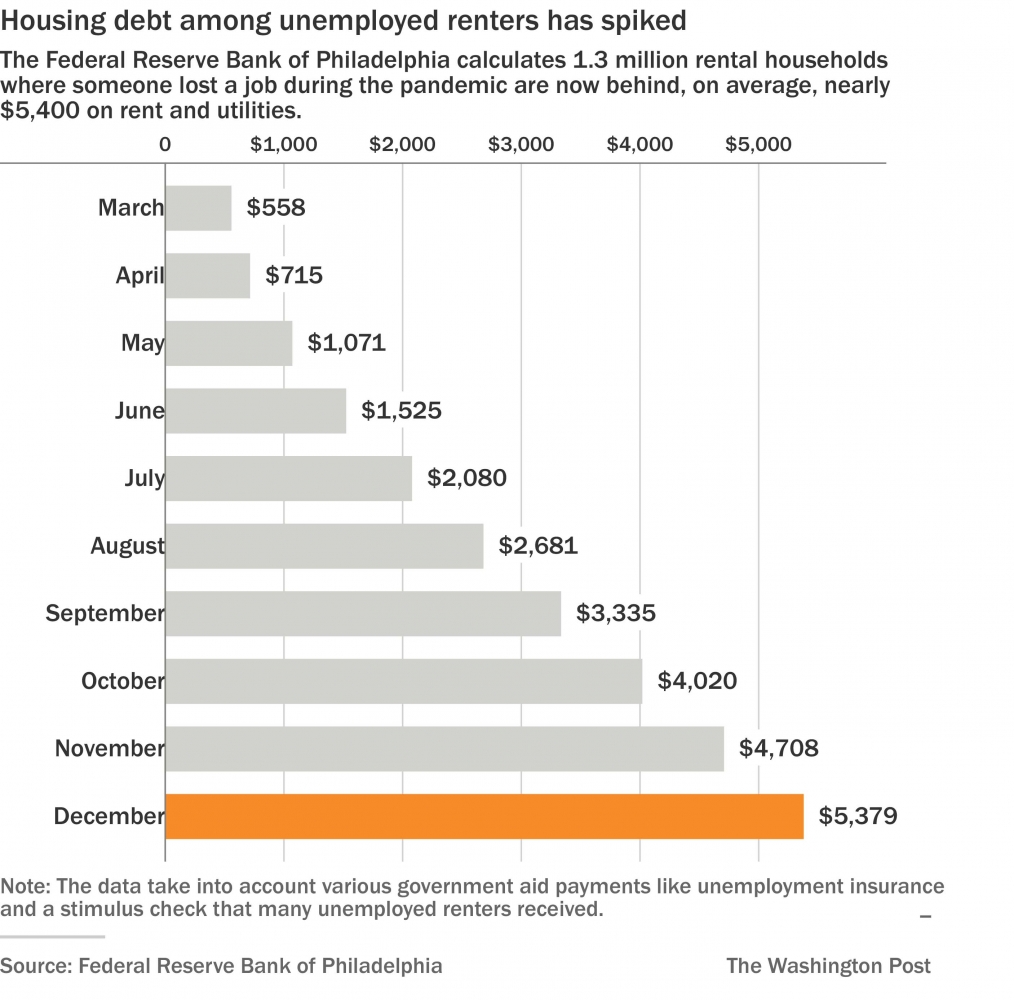
The numbers of those behind on rent and utilities were especially high for families with children, with 21% falling behind on rent, and among families of color. About 29% of Black families and 17% of Hispanic renters were behind, the Census Bureau reported. A separate analysis by the Federal Reserve Bank of Philadelphia, looking at people who had jobs before the pandemic, found 1.3 million such households are now an average of $5,400 in debt on rent and utilities, after those people had lost jobs and their family’s income plunged.

“The tidal wave is coming. It’s going to be really horrible for people,” said Charlie Harak, a senior attorney at the National Consumer Law Center. “The number of people who are now 90 days behind and the dollars they are behind are growing quite significantly.”

Nashville, Tenn., mother Nikki Cornwell is $4,000 behind on rent and fears she will be evicted right after Christmas. Her water was shut off on Monday. Her landlord filed the paperwork already, and her court date is set for Jan. 5 – just after the federal eviction moratorium is set to expire.

“I am behind on my rent. I will get evicted soon with my kids who are in virtual school and need internet,” said Cornwell, who lives with her mom and two kids. “I’ve had bad moments, but never anything like this.”

Cornwell, 36, lost her job in March at a factory that packages tea. She contracted the coronavirus in May. One fearful night she called 911 because she felt she couldn’t breathe. She has mostly recovered but still can’t smell anything. She had a job offer last month, but it got rescinded as coronavirus cases soared and the company decided to pull back on hires. She was getting $275 a week in unemployment, but that just ended. She has pawned jewelry and her son’s beloved PlayStation to pay for food.

“This is like a Charles Dickens novel,” said Mark Wolfe, executive director of the National Energy Assistance Directors’ Association. “It’s an evolving story of how people at the bottom are suffering.”

Many unemployed Americans were able to delay paying rent this fall under eviction moratoriums. But those protections end soon, and landlords and utilities are eager to get paid, because they have their own bills and taxes to pay. Economists warn low-income families won’t be able to suddenly pay back three to six months of rent at once.

The federal eviction moratorium is slated to end on Dec. 31, even as coronavirus cases spike and the economic recovery fizzles. Researchers at the Philadelphia Fed say even their conservative forecast warns evictions will spike 50% higher next year.

Shelbie Selewski is $2,100 behind on rent and utilities after losing her job as a medical receptionist in Macomb County, Mich. Her landlord has taped eviction papers to her door three times, and her electricity was shut off in September – on her son’s third day of virtual kindergarten. She begged friends and relatives for help to get the electricity back on, but bills are piling up again.

Selewski, 29, receives $200 a week in unemployment and recently sold the family’s TV and PlayStation 4 to prevent another utility shut-off. Her new baby was born with a collapsed lung, putting the infant at high risk during the pandemic. She and her fiance have not been able to find jobs.

“It has been the worst year ever. I’ve watched everything I’ve worked for go away,” Selewski said. “Every time I paid something and felt some peace, it felt like I got a utility shut-off notice three days later.”

Landlords and utilities increasingly worry they will have to eat this debt. Meanwhile, struggling families like the Selewskis fear no one will rent to them again after an eviction in which they were so far behind on rent. Bad credit can hurt families for years.

Amid those pressures, renters and landlords are urging Congress to approve bigger unemployment payments and another round of $1,200 stimulus checks, which would go a long way toward helping alleviate the debt burden on the unemployed. Many families say they fell behind on bills this fall after the extra $600-a-week unemployment payments ended in late July.

“The longer employment stays suppressed, and people stay out of work, it will make it even harder to catch up on the debt and dig yourself out of that hole,” said Davin Reed, community development economic adviser at the Federal Reserve Bank of Philadelphia.

So far, however, Republican and Democratic leaders in Congress remain far apart on a stimulus deal, which they have been debating since July. A bipartisan compromise unveiled last week includes $25 billion for rental housing assistance, but a package released by Senate Majority Leader Mitch McConnell, R-Ky., did not include any money for housing or utilities. The House Democrats’ Heroes Act includes $50 billion specifically for low-income renters.

“It’s much better for Congress to err on the side of helping too much than too little,” said Mark Zandi, chief economist at Moody’s Analytics. “There’s nothing scarier than losing your home, especially in January with a pandemic out of control. That would be overwhelming.”

Zandi predicts as much as $70 billion in unpaid debt by January, a painful amount that renters, landlords and utility companies will have to sort out. But he thinks the bigger damage to the economy could come from Americans watching people get evicted in early 2021 – a sign the federal government no longer cares.

“The economic damage created by this pandemic will be many times more severe if we lose faith that the government has our back,” Zandi said, adding that it could trigger a drop in consumer confidence.

Data from the Mortgage Bankers Association shows $9 billion in rent wasn’t collected in the third quarter. Without that money, landlords are struggling to pay property taxes, insurance and other upkeep costs, adding more strain to the economy.

Utility data is showing equally alarming signs of strain. New Hampshire has seen a 66% jump in the number of families who are 90 days or more behind on utility payments compared with 2019. Pennsylvania has seen a 67% increase over the last year in the number of households in arrears, according to data compiled by NEADA.

Pennsylvania utilities now have an arrearage balance of $721 million, up from $433 million last year. Massachusetts shows $754 million, up from $508 million a year ago.

“For families struggling right now and trying to get back on their feet, we have to find a way to write off this debt,” Wolfe said.

NEADA is asking for $10 billion in additional Low Income Home Energy Assistance Program funding to help low-income families pay their utilities this winter. The House bill, the most generous so far, had $4.5 billion.

Cornwell and Selewski check the news daily for any sign that additional help may be on the way. Both women have sought aid from church groups, friends and local government agencies, a piecemeal system of help that is still leaving them thousands of dollars behind on critical bills.

“We didn’t cause any of this, but it feels like Congress is saying you are on your own to deal with this,” Cornwell said.

Asian American leaders press Biden for more diverse Cabinet picks #SootinClaimon.Com

#SootinClaimon.Com : ขอบคุณแหล่งข้อมูล : หนังสือพิมพ์ The Nation.

Asian American leaders press Biden for more diverse Cabinet picks (nationthailand.com)

Asian American leaders press Biden for more diverse Cabinet picks

InternationalDec 08. 2020Neera Tanden, President-elect Joe Biden's pick to lead the Office of Management and Budget, speaks last week in Wilmington, Del. MUST CREDIT: Washington Post photo by Demetrius FreemanNeera Tanden, President-elect Joe Biden’s pick to lead the Office of Management and Budget, speaks last week in Wilmington, Del. MUST CREDIT: Washington Post photo by Demetrius Freeman 

By The Washington Post · Amy B Wang

WASHINGTON – Members of the Congressional Asian Pacific American Caucus are scheduled to meet virtually with President-elect Joe Biden’s transition team Monday to express their growing concern that there will be insufficient Asian American representation in top-tier spots in Biden’s administration.

Biden’s team has prided itself on rolling out a diverse set of candidates with each Cabinet and personnel announcement, but most of the senior, highly visible leadership roles have gone to White candidates, including Janet Yellen as treasury secretary, Antony Blinken as secretary of state, Ron Klain as White House chief of staff and Jen Psaki as White House press secretary.

That has not gone unnoticed by CAPAC, as well as Asian American Pacific Islander (AAPI) advocacy groups. Of Biden’s Cabinet-level picks so far, only one is of Asian American descent: Neera Tanden, whose parents immigrated from India, was chosen to serve as director of the White House Office of Management and Budget.

Asian Americans are not alone in pressing Biden for representation in his Cabinet. Black and Latino leaders have also voiced concern that his long-promised diversity has mostly shown up in secondary positions, and Biden is meeting Tuesday with the NAACP board in part to discuss such issues.

When Tanden’s nomination was announced last Monday, CAPAC’s chair, Rep. Judy Chu, D-Calif., said she was thrilled, praising Tanden as a “strong, experienced leader” and noting that if confirmed, she would be the first woman of color to lead the OMB, a critical agency that helps shape administration priorities.

But Tanden, who heads the Center for American Progress, a liberal think tank, has already been criticized as too partisan by several Republican senators, and Chu and others worry privately that she will be treated as a “sacrificial lamb” who may not be confirmed. Tanden’s nomination will be especially precarious if Democrats do not win both Senate seats in Georgia’s Jan. 5 special election, leaving Republicans in control of the Senate.

Vivek Murthy, a physician of Indian descent, was reportedly a candidate to lead the Department of Health and Human Services, but he was instead asked to reprise his role as U.S. surgeon general, a job he held during the Obama administration.

Chu and other CAPAC members said they support efforts to elevate the surgeon general job to a Cabinet-level position. But in the meantime, they say, the surgeon general spot is no substitute for a higher-level post.

“That is a position that is very important, but one doesn’t even directly report to the president – it’s part of HHS,” said Rep. Grace Meng, D-N.Y., the first vice chair of CAPAC. “Our call remains that we have AAPIs at the highest levels in the Cabinet, just like every administration in recent history.”

Since Bill Clinton’s administration, there has always been at least one AAPI Cabinet member. The Obama administration had a record three AAPI Cabinet secretaries, while the Trump administration has included two – Transportation Secretary Elaine Chao and Nikki Haley, the former ambassador to the United Nations.

More broadly, AAPI activists contend that Biden should honor one of the central promises of his campaign – to move beyond President Trump’s hostility to diversity and build a government that looks like America. AAPIs make up about 7 percent of the U.S. population, and Asian American voters were critical to Biden’s victory in states like Georgia, which had not voted for a Democratic presidential candidate since 1992.

Biden has recognized that numerous civil rights groups are pressuring him on diversity, promising that in the end they will be satisfied with his picks.

“Their job is to push me,” he told CNN’s Jake Tapper last week. “Every special interest – and I don’t say that in a negative way – every advocacy group out there is pushing for more and more and more of what they want. That’s their job.”

He added, “My job is to keep my commitment, to make the decisions. And when it’s all over . . . you’ll see the most diverse Cabinet, representative of all folks – Asian Americans, African Americans, Latinos, LGBTQ, across the board.”

Civil rights leaders are not so sure. Two weeks ago, 19 members of CAPAC sent a letter to Biden’s transition team urging that AAPIs be chosen for at least 7 percent of Cabinet-level and other positions, reflecting their proportion of the U.S. population.

The letter also noted that AAPIs represent the fastest-growing segment of the U.S. electorate, and that they had turned out in record numbers in the November election to support Biden over Trump by a roughly 2-to-1 margin.

A similar letter from the AAPI Victory Fund, a super PAC that was the second national group to endorse Biden in the Democratic primary, was more pointed.

“Given the enormous contributions of AAPI voters in electing you and Vice President-elect Kamala Harris – I dare say pivotal in several battleground states – it would be deeply disappointing if several AAPIs are not nominated to serve in your Cabinet,” wrote Shekar Narasimhan, the group’s founder and chairman.

Narasimhan noted that the Victory Fund had endorsed Biden at a time when two other AAPI candidates were still in the race – Rep. Tulsi Gabbard (D-Hawaii) and businessman Andrew Yang – “with the knowledge that many in the AAPI community would be upset.”

“Our meeting was at a moment in the campaign, in the middle of the January, when it was not looking particularly good” for Biden’s campaign, Narasimhan said in an interview.

After Biden made the case that he would be the best candidate to represent AAPI interests, the super PAC got behind him and eventually helped him raise more than $11 million for the his campaign, as well as organizing more than 5,000 volunteers to work on get-out-the-vote efforts for Biden and later Harris.

In exchange, Narasimhan said Biden “emphatically” assured them AAPIs would have representation at the top levels of his campaign – including a “visible” AAPI person as co-chair of his campaign – and then in his transition and government.

“Our community looks up and says, ‘Who’s there?’ And we should be able to point to that person and say, ‘They’re there,’ ” Narasimhan said. “We made that ask several times during the course of the campaign. Should I say I’m disappointed it didn’t happen? Hell yes, of course. These may sound rhetorical and symbolic, but to our community they damn well matter.”

That sentiment was shared by others.

“Our communities are growing at a point where not being taken seriously is something that is of concern,” said Madalene Mielke, president of the Asian Pacific American Institute for Congressional Studies (APAICS). “It’s to make a better government. It’s not just for the sake of representation.”

Mielke cited former congressman Norman Mineta, D-Calif., a Japanese American whose family was sent to an internment camp when he was 10 years old and who later served as President George W. Bush’s transportation secretary. Mineta has said his personal story, which he recounted to Bush at Camp David in early 2001, was a big reason Bush spoke out strongly against racially profiling Muslims after the Sept. 11, 2001, terrorist attacks.

“Those are the kinds of experiences that AAPIs have gone through in their history here,” Mielke said. “And to not have an Asian American who can talk about their unique lived experiences in this way, it doesn’t provide a full American experience for an administration that is supposed to be diverse and inclusive.”

CAPAC’s scheduled meeting with the Biden team comes after other civil rights groups have said they are dissatisfied not only with the lack of diversity in Biden’s Cabinet-level picks, but with how some of those decisions have been handled.

Last week, the Congressional Black Caucus, along with a half-dozen civil rights groups, urged Biden to appoint more African American candidates to top positions.

On Thursday, members of the Congressional Hispanic Caucus criticized the treatment of Gov. Michelle Lujan Grisham, D-N.M. – who was reportedly a front-runner for HHS secretary but now appears to be out of the running – and said more Latinas should be named to the administration.

Meanwhile, several Asian American groups have sent lists of prospects to Biden’s transition team, some as early as the summer. They have included such figures as Sen. Tammy Duckworth, D-Ill., for defense secretary; David Kim for transportation secretary; Julie Su or Chris Lu for labor secretary; Yang for commerce secretary; and Katherine Tai for U.S. trade representative.

Kim and Su hold Cabinet positions in California, and Lu is a former deputy U.S. labor secretary. Tai is chief trade counsel for the House Ways and Means Committee.

But with six weeks to go until the inauguration, there is growing concern that few of those recommendations are being seriously considered for prominent spots.

The top Cabinet posts are generally seen to be secretary of state, defense and treasury, along with the attorney general. Of those, two – defense secretary and attorney general – remain to be filled.

Duckworth, like other current lawmakers, may face an additional challenge, since Biden is unlikely to pluck members from the Senate or House given the narrow partisan margin in both chambers.

If Biden’s Cabinet does not include any AAPI secretaries, it would be the first time that has happened in more than 20 years.

Chu said she has been trying to ascertain from transition leaders who is a “realistic” candidate, as opposed to being mentioned solely to give the appearance that Biden’s team is trying to assemble a diverse administration. “We wanted to make sure that the conclusion was that that person would be appointed,” she said.

Biden spokesman Jamal Brown said in a statement that the transition team is working to build an administration that looks like America, and he noted that Harris is the first woman of Black and South Asian descent to be vice president-elect.

Asian American leaders express pride in Harris’s historic election, but they also chafe at the idea that her presence might give the transition team a pass on naming other AAPIs to Cabinet positions.

“We’re thrilled that she’s vice president-elect. She’s been an amazing advocate for the AAPI community,” said Gregg Orton, national director of the National Council of Asian Pacific Americans, another group that has sent Biden a list of AAPI candidates. “But no, I’m challenged by this idea that that should be enough. I guess I would simply refute it.”