Va. Republicans navigate Trumpism in 2021 governor’s race #SootinClaimon.Com

#SootinClaimon.Com : ขอบคุณแหล่งข้อมูล : หนังสือพิมพ์ The Nation.

Va. Republicans navigate Trumpism in 2021 governor’s race (nationthailand.com)

Va. Republicans navigate Trumpism in 2021 governor’s race

InternationalDec 06. 2020Del. Kirk Cox, R-Colonial Heights, addresses a crowd in 2019 after his win against Democrat Sheila Bynum-Coleman. MUST CREDIT: photo for The Washington Post by Julia Rendleman.Del. Kirk Cox, R-Colonial Heights, addresses a crowd in 2019 after his win against Democrat Sheila Bynum-Coleman. MUST CREDIT: photo for The Washington Post by Julia Rendleman. 

By The Washington Post · Laura Vozzella · NATIONAL, POLITICS 

RICHMOND, Va. – Virginia Republicans, who haven’t won a statewide race in more than a decade, see 2021 as their best chance in years to reverse their losing streak – but they will have to wrestle with Trumpism to do it.

One of just two states (along with New Jersey) to pick a governor the year after the presidential election, Virginia has a habit of rebelling against the party in the White House. By Election Day 2021, President-elect Joe Biden will have been in power nearly a year – and Republicans are hoping the so-called “Virginia curse” will work in their favor as the state elects a governor, lieutenant governor and attorney general. All 100 seats in the House of Delegates also will be on the ballot. 

“When a Democrat is in the White House, Virginia Republicans get bullish, because history shows that’s when the Republicans have the best chance to take back the governor’s mansion,” said Richard Cullen, a former Republican state attorney general and former U.S. attorney for the Eastern District of Virginia.

That sense of opportunity means an unusually large pack of Republicans are eyeing the Executive Mansion. And the sheer size of the potential field could complicate how the party contends with Trumpism, which is expected to remain the party’s most animating and problematic force long after President Trump’s term ends.

Two are officially in the race: state Sen. Amanda Chase of Chesterfield and Del. Kirk Cox of Colonial Heights, the former speaker of the House of Delegates. 

Five others are actively exploring bids: Northern Virginia businessman Pete Snyder, who is expected to formally announce soon; former Carlyle Group co-chief executive Glenn Youngkin; state Sen. Emmett W. Hanger Jr. of Augusta; Charles “Bill” Carrico, a retired state trooper and former state senator from Grayson County, in the state’s far Southwest; and outgoing Rep. Denver Riggleman. 

Trump won Virginia’s 2016 presidential primary with just under 35% of the vote, but lost the general election here by five points. This year, he lost the state by 10 points. And in between, Democrats flipped three congressional seats plus the state House and Senate in blue waves widely seen as rebukes to the Republican president. 

While toxic to swing voters in the suburbs, especially in populous Northern Virginia, Trump remains highly popular with the Republican base. That puts the Virginia GOP in a pickle as it chooses its nominee in June, say Republicans and Democrats alike.

“In order to win the [Republican] Party nomination, you’ve got to appeal to the Trumpian right – but in order to win the general, you can’t lose Fairfax [County] by 36 points,” said Jared Leopold, Democratic strategist for one of three Democrats officially running for governor, state Sen. Jennifer McClellan of Richmond. 

The other two Democrats formally in the race are Lt. Gov. Justin Fairfax and Del. Jennifer Carroll Foy of Prince William. Former governor Terry McAuliffe, who defied the Virginia curse by winning in 2013 while fellow Democrat Barack Obama was in office, is widely expected to seek a second term. The current governor, Democrat Ralph Northam, is prohibited by the state constitution from seeking back-to-back terms.

Former Republican governor George Allen said the party can best navigate those tricky politics by pursuing “kitchen table” issues, such as education and jobs, that have appeal across the aisle. A softer style, he said, wouldn’t hurt either.

“Most Republicans will not defend President Trump’s manners, but they love what he’s done on taxes, on energy, reasonable regulation, strong national defense, standing up to China and the judges he’s nominated,” Allen said. “Developers from New York City are not known for their hospitality. They’re pushy and all that. . . . I think we need to recognize there’s only one Donald Trump in this universe.” 

Some Republicans openly worry about the candidate who draws the most comparisons to Trump’s flamboyant style: Chase. They say that in a large field, she could emerge as the GOP nominee, alienating swing voters in the general election and dooming the party’s chances up and down the ballot. 

Chase, a senator since 2016, has drawn rebukes from her own party leaders for cursing out a Capitol Police officer over a parking spot and claiming on Facebook that Virginia Democrats “hate white people.” Chase strapped an assault-style weapon over her shoulder for a gun rights rally in July attended by “boogaloo boys,” a far-right anti-government group pushing for a second civil war. (Chase said she didn’t know who was in the crowd.) On Friday, she created a stir by posting side-by-side photos of herself and civil rights icon Rosa Parks on Facebook, with the message: “We never backed down.”

“I know a lot of people say I’m Trump in heels, and I’ve embraced it,” said Chase, who was a home-schooling mom when she got into politics and touts the criticism from fellow Republicans as proof that she’s shaking up the establishment in both parties. “Republicans keep talking about how they want to win the suburbs. I am the suburbs. And suburban women are sometimes a little bit sassy.”

Cox, a retired high school civics teacher and baseball coach who has served 30 years in the House, mostly tries to sidestep the polarizing national issues Chase plays up. He says his mantra – “practical solutions for everyday problems” – appeals to independents and Democrats as well as the blue-collar voters Trump brought in to the party.

“When you knock on a working-class family’s door and you ask them what’s on their mind, it’ s not what the pundits on TV are saying,” he said, adding that K-12 schools and more affordable higher education are more important to them.

Cox has tried to thread the needle when it comes to Trump. Where Chase has led “Stop the steal” rallies alleging, without evidence, voter fraud in Virginia, Cox has held off commenting on the presidential election results. He said he would wait until the electoral college votes in mid-December – an approach that has drawn criticism from Democrats, including Del. Marcus Simon, D-Fairfax, who tweeted that Cox and state party leadership have failed to push back on Chase’s “nonsense.”

Cox seemed to take pains to avoid using Trump’s name in August, when he issued a statement confirming he was exploring a run but saying he would hold off any announcement so the party could focus on its efforts to “defeat Joe Biden.”

While Chase has attacked Cox directly – slamming him, for example, for agreeing to expand Medicaid under the Affordable Care Act – Cox has pushed back more obliquely.

“Part of the appeal of the president is he’s authentic,” he said. “I’m going to be Kirk Cox. . . . They [voters] are not interested in imitations right now.”

Some Trump fans say Chase cannot win them over by mimicking his norm-shattering style.

“What I like about Donald Trump is my embassy’s in Jerusalem, I’ve got 300 judges, I got a tax cut,” said Matt Colt Hall, a Southwest Virginia native and political commentator for the conservative blog Bearing Drift. “There are people out there that can give the Trump policy without strapping an AR-15 across their chests in downtown Richmond.” 

John Fredericks, a conservative radio host and Trump backer who was chairman of his Virginia campaign in 2016, says Chase is not the automatic heir to the Trump vote.

“Just because you jump up and down and flail your arms doesn’t mean you’re inheriting the Trump votes. That’s what Corey Stewart did, running around with Confederate flags,” he said, referring to the Trumpian Republican who challenged Sen. Tim Kaine, D-Va., in 2018 and lost by 16 points. “Trump expanded the party. Amanda shrinks the party.”

But even Chase’s critics think she has a good shot at the nomination. 

“She absolutely could get the nomination,” said Cole Trower, who represents the Young Republican Federation of Virginia on the State Central Committee. “When you have several other candidates who are mainstream splitting the vote up, then the path to victory becomes easier for her.” 

That anxiety was expected to spill over into the State Central Committee meeting Saturday, when members began meeting remotely at 10 a.m. to decide whether to nominate its slate of statewide candidates in a primary or a convention. The meeting will be streamed live on the party’s Facebook page. 

Conventions, typically day-long events with multiple rounds of voting, are more likely to favor far-right candidates, because often, only the most hardcore party activists are willing to travel across the state to participate. 

But the politics of the convention-primary choice were scrambled this year. Chase, who might be expected to fare well at a convention, said she feared it would be rigged by party leaders out to undermine her, and vowed to run as an independent if the committee chose that method. 

Meanwhile, some Republicans who typically favor primaries but oppose Chase considered voting for a convention because they doubted that she could garner the required majority vote – 50 percent plus one. In a primary, she could win with a plurality.

“She’s the favorite to be the nominee in a crowded primary. No question about it,” Fredericks said, estimating she might have support from 30 percent to 35 percent of Republicans. “Amanda is the one candidate that has a base that will come out for her. The problem for Amanda is, the base also has a ceiling, and it’s not 50 percent plus one.”

Trower feared Chase’s opposition to a convention might be a head fake. “You ever heard of the term reverse psychology?” he said. “Her supporters would definitely show up in a convention. They’re going to show up no matter what.”

Riggleman, who lost his nomination at a convention after he’d presided over a same-sex wedding, said a much broader and more representative slice of the electorate can participate in statewide primaries. 

“I don’t think the big-tent party should turn into the carnival-tent party,” said Riggleman, who is considering running as an independent. “The Republican Party just keeps spiraling. . . . If we double down on conventions, the Republican Party will eventually become a third party in Virginia.”

The coronavirus has come roaring back into Brazil #SootinClaimon.Com

#SootinClaimon.Com : ขอบคุณแหล่งข้อมูล : หนังสือพิมพ์ The Nation.

The coronavirus has come roaring back into Brazil (nationthailand.com)

The coronavirus has come roaring back into Brazil

InternationalDec 06. 2020Rio de Janeiro Gov. Claúdio CastroRio de Janeiro Gov. Claúdio Castro 

By The Washington Post · Terrence McCoy, Heloísa Traiano · WORLD, THE-AMERICAS 

RIO DE JANEIRO – For weeks, it has seemed to Carla Santos de Lima that people here have been in the thrall of a collective delusion that the pandemic was on the way out. 

The beaches, bars and restaurants had filled. The message: Rio de Janeiro was back. 

The pleasant fiction held for weeks – even as people explained away surging coronavirus cases as a temporary blip. It finally unraveled late last month for Santos de Lima.

Her elderly father had fallen gravely ill with the coronavirus. The family had launched a desperate search to find an intensive care bed for him. But they were all full with other covid patients.

He died Nov. 28, inside an ambulance outside the hospital, just as his long-awaited bed opened up. 

“When the restrictions were relaxed, it resulted in this illusion that the problem was under control,” said Santos de Lima, 33,a public school teacher.”People believed it was possible to resume a certain normality. This ended up bringing about for us a false sense of security.” 

The city – and much of Brazil – is grappling with the sudden realization that there is nothing secure about this moment. The coronavirus has suddenly roared back.

And there’s now the chance that even in pandemic-battered Brazil – where more people have died of the virus than any other nation save the United States – things could soon become as bad, if not worse, than ever before.

In Rio de Janeiro, where the virus has already killed tens of thousands, upturned the economy and sent rates of homelessness soaring, moments that recall the darkest days of the pandemic are once more appearing in the news. 

Sick people, unable to get help in the medical system, are again being found dead at home. Lines stretching into the hundreds are forming for intensive care beds. Hospital officials are warning of supply shortages and an imminent collapse in medical services. 

Even the vaunted private heathcare system reached 98% capacity in its intensive care units this week, officials said. In states across the country, the situation wasn’t much better.

“Brazil has to be very, very serious,” Tedros Adhanom Ghebreyesus, the director general of the World Health Organization, told reporters earlier this week. The situation is “very, very worrisome.”

But public health experts in Rio de Janeiro are expressing alarm over what they are seeing – both from officials and also from ordinary people. 

In May, during the worst weeks of the first wave, city life was vastly constrained. Even if Rio never fully locked down, shops and restaurants closed, people worked from home and several field hospitals were opened. 

This time is different. There is neither talk of field hospitals, nor restrictions on businesses. The streets and beaches remain full of unmasked people who are either unaware or unbothered by the alarming health warnings. 

“We are not going to take a step backward,” acting Rio de Janeiro Gov. Claúdio Castro said Thursday, conceding the difficulty of reinstating restrictions. “It’s no use to pass measures that the population won’t follow.” 

On Friday, Castro and Rio Mayor Marcelo Crivella announced the opening of more hospital beds and that city schools would halt classes. But health officials across the country are warning that such minor restrictions almost certainly won’t be enough. 

The most powerful weapon against the coronavirus – fear – has dulled. Many people either simply don’t care or no longer believe in the dangers posed by the coronavirus.

“We’re facing a campaign of disinformation and denial,” said Suzana Lobo, the president of the Brazilian Association of Intensive Medicine. “The impact in January will be very, very large. Our fear is that in January and February the health system won’t be able to bear it.”

In a fiercely individualistic society, where people have little trust in either government or each other, the pandemic has from the beginning been a mass social experiment in the limits of scientific persuasion. But now public health officials are increasingly worried that their warnings don’t matter. 

“It’s this story: ‘My life for a dip in the ocean,'” said Ligia Bahia, a public health professor at the Federal University of Rio de Janeiro. “It’s as if we haven’t learned any lessons. For us, it’s very sad.”

“We’re completely defeated,” she added. “I don’t even want to talk about a vaccine.”

Now many Brazilians who have been victimized by the disease only see a year filled with mistakes, errors in judgment and confusion.

Santos de Lima, the teacher, said everyone in her family, who live in the impoverished and crime-plagued area of Pavuna, had been petrified by the disease. But as cases began to diminish, the city relaxed almost all of its containment measures. 

“Very, very, very irresponsible,” Santos de Lima now says of the decision.

But at the time, she, along with much of the city, was loosening up. Allowing herself to believe the worst had passed, she went back to the classroom. And her family started to get together once more, even though her 65-year-old father, Carlos Alberto Correia de Lima, was in poor health. Soon much of the family had the coronavirus.

Now many of them can’t look past the guilt.

“You ask whether we are responsible for what happened,” she said. “We keep asking if things could have been different, if our contact could have been avoided.”

But she can’t come up with any good answers.

“The guideline is to avoid contact, but are we supposed to stay in complete isolation for nine months?”

Just 25 congressional Republicans acknowledge Biden’s win, Washington Post survey finds #SootinClaimon.Com

#SootinClaimon.Com : ขอบคุณแหล่งข้อมูล : หนังสือพิมพ์ The Nation.

Just 25 congressional Republicans acknowledge Biden’s win, Washington Post survey finds (nationthailand.com)

Just 25 congressional Republicans acknowledge Biden’s win, Washington Post survey finds

InternationalDec 06. 2020

Senators David Perdue and Kelly Loeffler share the stage with President Trump during a rally Saturday night in Valdosta, Ga. MUST CREDIT: Washington Post photo by Jabin Botsford

Senators David Perdue and Kelly Loeffler share the stage with President Trump during a rally Saturday night in Valdosta, Ga. MUST CREDIT: Washington Post photo by Jabin Botsford

By The Washington Post · Paul Kane, Scott Clement · NATIONAL, POLITICS, CONGRESS 

WASHINGTON – Just 25 congressional Republicans acknowledge Joe Biden’s win over President Donald Trump a month after the former vice president’s clear victory of more than 7 million votes nationally and a convincing electoral-vote margin that exactly matched Trump’s 2016 tally. 

Two Republicans consider Trump the winner despite all evidence showing otherwise. And another 222 GOP members of the House and Senate – nearly 90% of all Republicans serving in Congress – will simply not say who won the election.

Those are the findings of a Washington Post survey of all 249 Republicans in the House and Senate that began the morning after Trump posted a 46-minute video Wednesday evening in which he wrongly claimed he had defeated Biden and leveled wild and unsubstantiated allegations of “corrupt forces” who stole the outcome from the sitting president. 

A team of 25 Post reporters contacted aides for every Republican by email and phone asking three basic questions – who won the presidential contest, do you support or oppose Trump’s continuing efforts to claim victory and if Biden wins a majority in the electoral college, will you accept him as the legitimately elected president – and also researched public statements made by the GOP lawmakers in recent weeks to determine their stance on Biden’s win. 

The results demonstrate the fear that most Republicans have of the outgoing president and his grip on the party, despite his new status as just the third incumbent to lose reelection in the last 80 years. More than 70% of Republican lawmakers did not acknowledge The Post’s questions as of Friday evening. 

They are largely hiding from answering questions about the election, neither congratulating Biden nor embracing Trump’s most strident positions and false claims. Just eight Republicans, 3% of all GOP lawmakers, voiced support for Trump’s current strategy of claiming victory and asking state legislatures to declare him the victor in states that he lost. 

This GOP nonresponse stands in stark contrast to Democrats in 2016. The morning after media outlets called Trump the winner, Hillary Clinton conceded and Senate Minority Leader Chuck Schumer, D-N. Y., fielded a call from Trump. Schumer issued a statement shortly thereafter congratulating the president-elect and calling for Americans to “come together.”

Today, most Republicans just want to avoid the Trump question altogether, following the lead of Senate Majority Leader Mitch McConnell, R-Ky., whose office pointed to his recent comments about the election and declined to participate in the survey. 

On Tuesday, McConnell ducked questions about Trump’s claim of fraud and refused to take any leadership role in acknowledging Biden’s victory. 

“The future will take care of itself,” he told reporters. 

On Thursday, House Minority Leader Kevin McCarthy, R-Calif., would not even consider how he would fight executive orders in Biden’s first days in office, leaving open the idea that someone else could be sworn in on Jan. 20. 

“Let’s wait until [we see] who’s sworn in,” McCarthy said, “and we can discuss that.”

Today’s reactions – or, mostly, non-reactions – mirror how many Republicans handled four years of Trump’s intemperance: A few predictable Trump critics would condemn his actions, such as the decision to use tear gas on peaceful protesters to clear Lafayette Square in June so Trump could walk across the park, but most would try to avoid the subject. 

Their complicit silence now comes as Trump continues to mount an unfounded campaign against the democratic outcome of an election, leaving them isolated as other federal, state and local Republican officials have rejected Trump’s false assertions. 

Even Kellyanne Conway – Trump’s 2016 campaign manager and longtime adviser, who famously coined the phrase “alternative facts” – went further than most Republican members of Congress. She admitted Friday that it looked like Biden “will prevail” and called for a “peaceful transfer of democracy.”

On Tuesday, Attorney General William Barr declared that the Justice Department had not found any evidence of voter fraud that would change the outcome of the election, following the top election cybersecurity official’s declaration that the election had been safe from any hacking. 

The president summarily fired that official, Christopher Krebs, and is said to be weighing action against Barr.

The Trump campaign has suffered multiple losses in their post-election legal challenges to overturn the results, with stinging defeats Friday in Arizona, Georgia, Michigan, Minnesota, Nevada and Wisconsin.

In Arizona and Nevada, judges tossed full-scale challenges to the states’ election results filed by the Republican Party and the campaign, respectively.

Last month, U.S. District Judge Matthew W. Brann dismissed a Trump campaign lawsuit to block the certification of Pennsylvania’s election results, and in a scathing opinion, wrote that the campaign had “strained legal arguments without merit and speculative accusations” in its effort to throw out millions of votes.

“In the United States of America, this cannot justify the disenfranchisement of a single voter, let alone all the voters of its sixth most populated state,” Brann wrote.

Two Michigan Republican legislative leaders, after being summoned to the White House, announced they would not intervene to block Biden’s relatively comfortable win there. In Arizona, Republican Gov. Doug Ducey signed election results Monday certifying Biden’s narrow victory there, saying a bipartisan collection of local officials oversaw a clean election. 

In Georgia, Gov. Brian Kemp and Secretary of State Brad Raffensperger, both Republicans, certified Biden’s slender victory there and have resisted calls from Trump and his supporters to throw out the results. 

One of Raffensperger’s deputies implored the state’s U.S. senators, Republicans David Perdue and Kelly Loeffler, to oppose Trump’s efforts, warning of potential violence to civil servants.

Instead, Perdue’s public and private actions are emblematic of how many Republicans feel. 

With him and Loeffler facing Jan. 5 runoff elections that will determine the Senate majority, the two have publicly embraced Trump’s baseless claim that the Dominion Voting Systems machines used in Georgia were rigged as part of a global conspiracy, hoping to retain support among the president’s strongest backers. Both also have called for Raffensperger to resign.

Yet, in a video obtained by The Post, Perdue privately acknowledged the reality that Trump lost and that Republicans needed to focus on those Georgia races to save the Senate majority. 

“We can at least be a buffer on some of the things that the Biden camp has been talking about,” he told donors on a video conference.

Other highlights from the survey found that:

– 11 of the 52 Senate Republicans acknowledge Biden’s victory;

– Of the 14 House Republicans who recognize the true winner, six are retiring from politics at the end of this month and two more represent districts that Biden won convincingly.

Rep. Fred Upton, R-Mich., went as far as any Republican in embracing Biden. The two worked together on the “Beau Biden Cancer Moonshot” proposal, named for Biden’s son who died of brain cancer in 2015, turning it into a massive 2016 medical research bill.

Within hours of the Nov. 7 declaration of Biden’s victory, Upton vowed to work with the new administration. 

“I am raising my hand and committing to work with President-elect Biden and my colleagues on both sides of the aisle,” he said. 

Sen. Pat Toomey, R-Pa., held out until Nov. 21 when a federal judge, ushered to confirmation by the staunch conservative senator, issued a scathing rebuke of Trump’s legal challenges in Pennsylvania and gave a legal seal of approval to Biden’s win there.

“Joe Biden won the 2020 election and will become the 46th President of the United States. I congratulate President-elect Biden,” Toomey said in a statement. 

Judges in other states have repeatedly rebuffed the Trump campaign’s legal challenges, and on Friday the effort suffered losses in Michigan, Arizona and Nevada.

Reps. Paul Gosar of Arizona and Mo Brooks of Alabama are the only Republicans in Congress who have publicly insisted Trump is the winner. Gosar has spent several weeks embracing the disproved conspiracy theory that the Dominion voting machines used in Arizona, Georgia and some other states manipulated the results and stole the election for Biden. Dominion has called the claims unfounded. 

He said he will never accept the Democrat as the legitimately elected president. “No, never. Too much evidence of fraud,” he said.

But Brooks and Gosar are extreme outliers on Capitol Hill, with the overwhelming majority of Republicans content to avoid the question. Many have stated that somehow the Dec. 14 meeting of the electoral college, in all 50 states, will provide a clear winner – perhaps naively expecting Trump to concede that point.

Still, as enough states have certified the results to make Biden the winner, Republicans still won’t publicly commit now to considering the Democrat the legitimately elected president when he wins the majority in the electoral college.

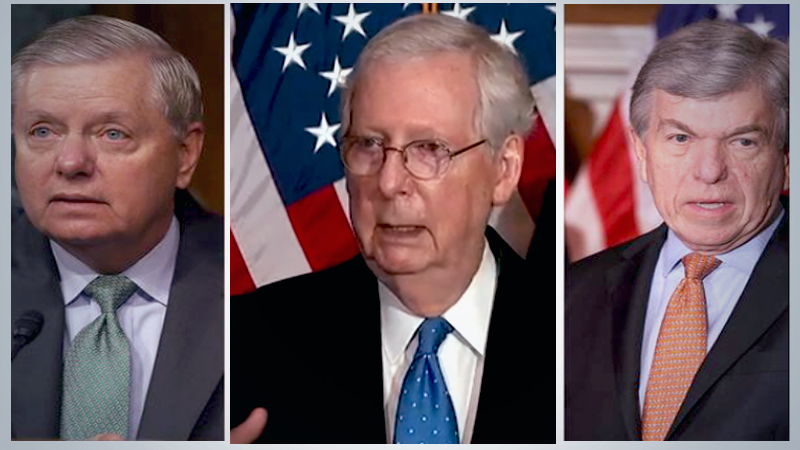
No one has a trickier task than Sen. Roy Blunt, R-Mo.,, who is chairman of the Senate Rules Committee, which is in charge of all events on Capitol grounds for the Jan. 20 inauguration.

Committee staff have acknowledged that Biden is the winner and begun working with the president-elect’s team to plan the event, with much of the usual pomp and circumstance getting a new look for social distancing during the pandemic. 

“We are working with the Biden administration, likely administration, on both the transition and the inauguration,” Blunt said Sunday on CNN, catching himself after he declared Biden the winner. 

He paused and tried to explain how he still is awaiting the electoral college decision in a few days. 

Is Joe Biden the president-elect? 

“Well, the president-elect will be the president-elect when the electors vote for him. There is no official job president-elect,” he said. 

Blunt’s office did not answer The Post’s question on whether he would accept Biden as the legitimately elected president if he wins the majority in the electoral college.

Deflation alarm in Spain tests Lagarde’s optimism on prices #SootinClaimon.Com

#SootinClaimon.Com : ขอบคุณแหล่งข้อมูล : หนังสือพิมพ์ The Nation.

Deflation alarm in Spain tests Lagarde’s optimism on prices (nationthailand.com)

Deflation alarm in Spain tests Lagarde’s optimism on prices

InternationalDec 05. 2020Christine Lagarde, president of the European Central Bank, speaks during a live stream video of the central bank's virtual rate decision news conference in Frankfurt, Germany, on Oct. 29, 2020. MUST CREDIT: Bloomberg photo by Chris Ratcliffe.
Photo by: Chris Ratcliffe — Bloomberg
/Location: Danbury, United KingdomChristine Lagarde, president of the European Central Bank, speaks during a live stream video of the central bank’s virtual rate decision news conference in Frankfurt, Germany, on Oct. 29, 2020. MUST CREDIT: Bloomberg photo by Chris Ratcliffe. Photo by: Chris Ratcliffe — Bloomberg /Location: Danbury, United Kingdom 

By Syndication The Washington Post, Bloomberg · Jeannette Neumann 

When the coronavirus hit Europe this year, Manuel Vegas asked his Spanish association of hotel directors to avoid cutting room costs by more than 25%. Instead, they plunged as much as 60%, and he reckons “we won’t get back to 2019 prices until at least 2023.”

Falling prices can be found across the continent as economic restrictions and job insecurity deter spending. But in some quarters it’s the fear of steep and entrenched declines — a deflationary trap that drags wages and ultimately brings the whole economy down — that has people like Vegas worried most.

Weaker economies, and those more reliant on services such as tourism, are at the greatest risk, putting much of southern Europe once again in danger. Of the seven euro-area nations on the Mediterranean and Adriatic seas, only France and Malta have positive rates of inflation. Spain’s is -0.9%, Greece’s is -2%.

Policymakers in Madrid are also making the case that the rest of the bloc isn’t immune though. Subzero inflation in places such as Germany may be largely explained by tax cuts and lower energy bills, but the perception of falling prices can take hold if it persuades consumers to put off spending now in the hope of a better deal later.

“We are seeing an increase in the portion of goods whose prices are increasing very little or falling, which is a sign of the risk” in the euro zone, Oscar Arce, the Bank of Spain’s chief economist, said in an interview last month.

So far, the European Central Bank isn’t too worried. While it will almost certainly boost monetary stimulus next week, that’s to counter the shock of the second wave of the pandemic. It projects inflation — currently the weakest since 2016 at -0.3% — will turn positive next year.

President Christine Lagarde declared on Oct. 29 that she didn’t foresee deflationary threats “at all.” Executive Board member Isabel Schnabel said this week the aim of stimulus should be to maintain current financial conditions, not make them even looser.

That’s a view shared by some economists, who say a swift growth rebound after the crisis subsides will kill any deflationary pressures.

“When the economy is back in shape, we’ll see prices increase again,” said Jesus Fernandez-Villaverde, a professor at the University of Pennsylvania. “People will realize there is a lot of accumulated demand.”

Even Bank of Greece Governor Yannis Stournaras is banking on such a bounceback. While acknowledging that his nation’s price declines have postponed spending and deepened the recession, he said in an interview that “with the recovery of the economy next year, the inflation rate will become positive again.”

One factor that could help southern Europe in particular is the European Union’s 1.8 trillion-euro ($2.2 trillion) enhanced budget and recovery fund, which will disburse grants and cheap loans to countries to aid the recovery from the pandemic.

That spending, though temporary, counters an underlying weakness in the euro zone. While the ECB strives to stabilize inflation at just under 2%, that’s an average for the bloc as a whole, risking some countries being left behind. Fiscal support can help plug that gap — one reason why the ECB has long argued for a permanent such facility.

Still, Jordi Gali, an economist at Spain’s Research Center for International Economy, wonders if the pandemic might have had a deeper impact by permanently instilling caution in consumers, with consequences for prices.

“We may be in a situation — and this is extremely uncertain because we don’t have a precedent in recent times — in which savings remain abnormally high,” Gali said. “The concern is that we may get trapped in this very low level of inflation that could be negative or slightly negative like in Japan over much of the past three decades.”

Such a risk is what officials such as Arce, and his boss, Bank of Spain Governor Pablo Hernandez de Cos, warn the euro region is facing if the ECB doesn’t act decisively enough.

Even if their colleagues in Frankfurt don’t buy into that argument next week, it could factor into future decisions both on easing and on the redesign of its monetary policy framework.

The central bank is already discussing shifting the definition of its price-stability goal in a way that could allow for overshooting on inflation after long periods of weakness. It is mulling a new target of 2%, rather than “close to but below 2%.”

For Athanasios Orphanides, a former ECB Governing Council member, that last change is a no-brainer — and should be enacted immediately rather than when the strategic review ends around the second half of next year.

“If the average is too low, as the ECB has been maintaining after the euro crisis, then more states actually enter into deflation territory,” he said. “That’s one reason it’s bad policy for the ECB to be maintaining this ‘lowflation’ regime.”

It’s a view Spain’s hotel managers would recognize, even if they don’t follow the details of the ECB’s policy debates.

“We will be living with the scars from this crisis for some time,” Vegas said. “Not just in Spain, but across Europe.”

Upper Thailand gets cooler, while isolated thundershowers lash South #SootinClaimon.Com

#SootinClaimon.Com : ขอบคุณแหล่งข้อมูล : หนังสือพิมพ์ The Nation.

Upper Thailand gets cooler, while isolated thundershowers lash South (nationthailand.com)

Upper Thailand gets cooler, while isolated thundershowers lash South

NationalDec 06. 2020

By The Nation

A strong high-pressure system still covers upper Thailand, lowering the temperature by 1-2 degrees Celsius, the Thailand Meteorological Department said on Sunday.

Cool to cold weather and strong winds are also expected in the Northeast and the East. On mountaintops, isolated frost is forecast with cold to very cold weather. People should watch their health due to the variable weather conditions, the department said.

Meanwhile, the weakening northeast monsoon prevails across the Gulf of Thailand and the South with isolated thundershowers. Moderate winds in the Gulf force the waves up about two metres high and more than two metres high in thundershowers. All ships should proceed with caution and keep off thundershowers, the department said.

The weather forecast until 6am Monday:

North: Cool to cold with a 1-2 degrees Celsius drop in temperature; minimum temperature 14-17°C, maximum 27-31°C; cold to very cold on mountaintops and frost in some places with minimum temperature 4-13°C; northeasterly winds 10-25 kilometres per hour (kph).

Northeast: Cool to cold with strong winds and slight drop in temperature; minimum temperature 11-16°C, maximum 26-30°C; cold on the mountain top with minimum temperature 6-13°C; northeasterly winds 20-35kph.

Central: Cool in the morning with slight drop in temperature; minimum temperature 17-19°C, maximum 30-32°C; northeasterly winds 15-30kph.

East: Cool with strong winds; minimum temperature 17-22°C, maximum 30-32°C; northeasterly winds 15-30kph; waves 1-2 metres high and about two metres offshore.

South (east coast): Partly cloudy with isolated thundershowers mostly in Pattani, Yala and Narathiwat provinces; minimum temperature 21-24°C, maximum 30-32°C; northeasterly winds 20-35kph; waves about two metres high and above two metres in thundershowers.

South (west coast): Cloudy with isolated thundershowers, mostly in Krabi, Trang and Satun provinces; minimum temperature 22-24°C, maximum 31-33°C; northeasterly winds 20-35kph; waves about a metre high and about two metres offshore.

Bangkok: Cloudy with strong winds; minimum temperature 19-21°C, maximum 30-32°C; northeasterly winds 15-30kph.

People pay tribute to Thai Kings at Grand Palace on King Rama IX’s birthday #SootinClaimon.Com

#SootinClaimon.Com : ขอบคุณแหล่งข้อมูล : หนังสือพิมพ์ The Nation.

People pay tribute to Thai Kings at Grand Palace on King Rama IX’s birthday (nationthailand.com)

People pay tribute to Thai Kings at Grand Palace on King Rama IX’s birthday

NationalDec 06. 2020

By THE NATION

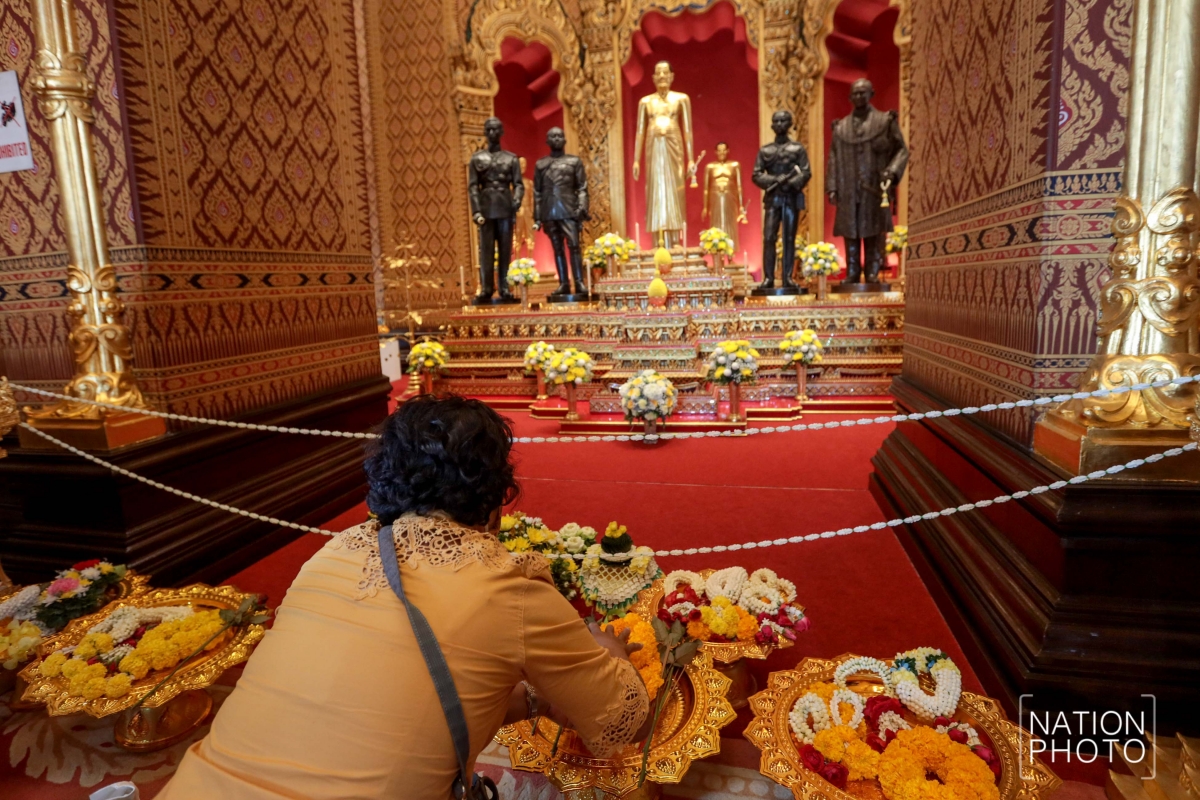
The Bureau of the Royal Household on Saturday allowed people to worship the statues of previous Kings of Thailand enshrined in Bangkok’s Grand Palace, to mark the birthday of the beloved late monarch King Rama IX.

To visit the Palace, the visitors had to enter through Wat Phra Kaew. The door was open from 8am to 9pm.

December 5 is celebrated as Father’s Day in Thailand. Fathers and their children on Saturday were allowed to use the BTS, BRT and Airport Rail Link services for free from 6am to midnight. The free fares covered all routes provided fathers and their children started and ended the journey together. In addition, all children up to 90 centimetres tall were allowed to travel for free.

Ratch subsidiary signs deal for wind power project in Vietnam #SootinClaimon.Com

#SootinClaimon.Com : ขอบคุณแหล่งข้อมูล : หนังสือพิมพ์ The Nation.

Ratch subsidiary signs deal for wind power project in Vietnam (nationthailand.com)

Ratch subsidiary signs deal for wind power project in Vietnam

CorporateDec 05. 2020

By The Nation

RH International (Singapore) Corporation Pte Ltd, a wholly-owned indirect subsidiary of Ratch Group Pcl, has signed a joint development agreement with Nexif Energy Pte Ltd in Vietnam on Friday for developing the Nexif Ben Tre wind power project.

Ratch chief executive officer Kijja Sripatthangkura informed the Stock Exchange of Thailand that the project participation would be at 50:50 per cent after further development and any required approvals.

He explained that the Nexif Ben Tre wind power project would generate 80 megawatts of wind power at Ben Tre province in southern Vietnam. The electricity will be sold to Vietnam Electricity under a long-term power purchase agreement.

“Currently, the project is under green-field development and under negotiation, expected to be ready for commercial use in 2022,” he said.

A casualty of flooding #SootinClaimon.Com

#SootinClaimon.Com : ขอบคุณแหล่งข้อมูล : หนังสือพิมพ์ The Nation.

A casualty of flooding (nationthailand.com)

A casualty of flooding

NationalDec 05. 2020Photos by Charoon ThongnualPhotos by Charoon Thongnual 

By The Nation

People from more than 400 households in a subdistrict of Nakhon Si Thammarat province have to cross a bridge on foot or by using a motorcycle after it collapsed due to severe flooding.

To prevent accidents, the 4th Army Area troops and the Department of Rural Roads officials are speeding up maintenance and construction of the bypass in Krungching subdistrict, expecting to complete the work in three days.

The Department of Disaster Prevention and Mitigation said that 321,057 households in the provinces of Surat Thani, Krabi, Nakhon Si Thammarat, Trang, Phatthalung and Songkhla were still struggling with floods.

Nearly 400,000 households affected as many southern provinces battle floods #SootinClaimon.Com

#SootinClaimon.Com : ขอบคุณแหล่งข้อมูล : หนังสือพิมพ์ The Nation.

Nearly 400,000 households affected as many southern provinces battle floods (nationthailand.com)

Nearly 400,000 households affected as many southern provinces battle floods

NationalDec 05. 2020

By THE NATION

Six provinces in the South are still inundated from the impact of the northeast monsoon prevailing over the South since November 25.

The heavy rains have triggered flash floods and water runoffs in 11 provinces, 98 districts and 529 subdistricts, the Department of Disaster Prevention and Mitigation said.

The provinces that remain flooded are: Surat Thani, Krabi, Nakhon Si Thammarat, Trang, Phatthalung and Songkhla, although the water level is gradually decreasing.

As of Saturday, 383,669 households from 3,633 villages were reported to have been affected by the floods, while total death toll is 13.

The department said it has coordinated with local administration offices, military personnel and related agencies to provide aid to the victims. Consumer products, medical supplies, drinking water, mobile toilet vehicles, water pumps and fiberglass boats were delivered to help flood victims, while officials are helping to evacuate local villagers from areas that have high water level.

The department will also dispatch officials to estimate the damage in each community and submit the report to the Ministry of Finance to disburse subsidies earmarked for natural disasters.

Those who require assistance during natural disasters, can contact the department’s hotline at 1784.

Free meals distributed to mark birthday of King Rama IX #SootinClaimon.Com

#SootinClaimon.Com : ขอบคุณแหล่งข้อมูล : หนังสือพิมพ์ The Nation.

Free meals distributed to mark birthday of King Rama IX (nationthailand.com)

Free meals distributed to mark birthday of King Rama IX

NationalDec 05. 2020

By The Nation

Several merchants at Municipal Market 1 in Phitsanulok province handed out free meals for people to mark the birthday of the late King Rama IX on Saturday.

This activity has been done every year to make merit for the late King and reduce people’s cost of living.

Tee Wirotewanich, a 79-year-old merchant, offered meals, such as basil fried rice, omelette rice and bakeries to people in the market.

Meanwhile, another merchant’s 100 pieces of Khao Tom Mud (steamed sticky rice with banana) were snapped up in no time.