Trump defeat brings no break in division #SootinClaimon.Com

#SootinClaimon.Com : ขอบคุณแหล่งข้อมูล : หนังสือพิมพ์ The Nation.

Trump defeat brings no break in division

InternationalDec 28. 2020A Black Lives Matter supporter stands near a supporter of President Donald Trump while they protest the presidential vote count outside TFC Center in Detroit on Nov. 6, 2020. MUST CREDIT: Washington Post photo by Salwan GeorgesA Black Lives Matter supporter stands near a supporter of President Donald Trump while they protest the presidential vote count outside TFC Center in Detroit on Nov. 6, 2020. MUST CREDIT: Washington Post photo by Salwan Georges

By The Washington Post · Dan Balz

WASHINGTON – The year 2020 brought extraordinary and unexpected challenges that tested the strength of basic institutions, demanded courage and sacrifice in the face of a raging pandemic, underscored racial and economic inequities, and produced the biggest turnout of voters in the history of U.S. elections.

In the end, America was as divided as ever.

The election itself resulted in significant change – or no change. President Donald Trump is on his way out of office after a single, tumultuous term, to be replaced on Jan. 20 by President-elect Joe Biden. Turnover in the most important of all elected offices – an office that was the major focus of the election – will bring a new tone, new faces and new initiatives to Washington and the country.

But it was Trump, not Biden, who seemed to have the longer coattails. As a result, Biden will start his term with the smallest House majority the Democrats have had in nearly a century and a half. And unless Democrats win both of the Georgia runoff elections on Jan. 5, he also will be the first newly elected Democratic president without a Senate majority since the election of 1884.

Trump has been the most polarizing of all presidents, with a style designed to divide, inflame and impugn. He has accepted no responsibility for things that have gone wrong, preferring to blame others or pretend nothing went wrong. Even now, he seeks to overturn the November results. Biden’s victory would seem to signal a hunger for something different, something calmer, some change in direction.

But elections are about more than the race for the White House. The 2020 campaign was a victory for Biden and a defeat for Trump, but for the two political parties and the ideas they espouse, it was neither. Instead, it marked a continuation of a long struggle for power that has been fought out for more than a decade without clear resolution.

The broad repudiation of the president that many Democrats hoped for and anticipated did not materialize. The results underscored the persistence of divisions that preceded Trump and that now seem destined to endure when he is out of office, unless Biden, ever an optimist about the state of the country and his own political talents, can somehow coax America to a different place.

Biden’s victory in the popular vote was impressive: He won more than 81 million votes overall, 51.3%. He defeated a sitting president by a margin of 7 million votes. Still, the fact that Trump won 74 million votes, 46.8%, was also notable, and in some ways the bigger surprise, as polls consistently underestimated his support.

Biden’s electoral college total of 306 votes to Trump’s 232 was clear and comfortable – identical to the number Trump posted in 2016, which he always described as “a landslide.” But Biden’s majority, like Trump’s four years ago, was built on a string of narrow victories across key battlegrounds that, with small shifts, could have produced a different outcome.

The Cook Political Report’s David Wasserman has noted that, while Hillary Clinton won the popular vote by 2.9 million votes and came within 77,744 votes of winning the presidency in 2016, Trump lost the popular vote this year by 7.1 million votes and yet came within 65,009 votes of securing a majority in the electoral college and, with it, a second term.

That number – 65,009 – is the combined total by which Biden defeated Trump in Arizona, Georgia, Wisconsin and Nebraska’s 2nd Congressional District. Had all four gone the other way, Trump would have won the election with 270 electoral votes to Biden’s 268.

Trump has refused to concede, even in the aftermath of the electoral college tally that took place Dec. 14, which is to be ratified by Congress on Jan. 6. He has done far worse than declining to acknowledge Biden as the winner. No president has ever done what Trump has tried to do to change the results. While it is shocking, it is not surprising, given the way he has operated in office.

The president has spread the fiction that the election was stolen, and he has trafficked in conspiracy theories that Biden’s victory was based on widespread fraud across multiple states. He has been rebuffed repeatedly by judges appointed by Democrats and Republicans, including twice by a Supreme Court whose 6-3 conservative majority he helped to shape.

The president’s post-election campaign has been carried out in a way that undermines confidence in the integrity of the vote and potentially Biden’s presidency. While Trump has not been able to overturn the election, the toxicity of his baseless, repeated charges has leeched into the body politic.

Tens of millions of Trump’s followers now believe that Biden was elected illegitimately, causing potentially significant damage to the electoral process and to Biden’s ability to govern effectively. A recent Economist/YouGov poll found that more than 8 in 10 Trump voters said Biden was not the legitimate winner of the election. Other polls have found similar results.

Many Democrats believed the election would result in a more significant victory for their party and with it a clearer mandate. Instead, the opposite has occurred – a split decision that left the balance of power little changed, though not insignificantly, with a new president. Even as the two major political parties face their own internal strains, they will begin the new year and a new administration still looking across a wide and seemingly unbridgeable gulf.
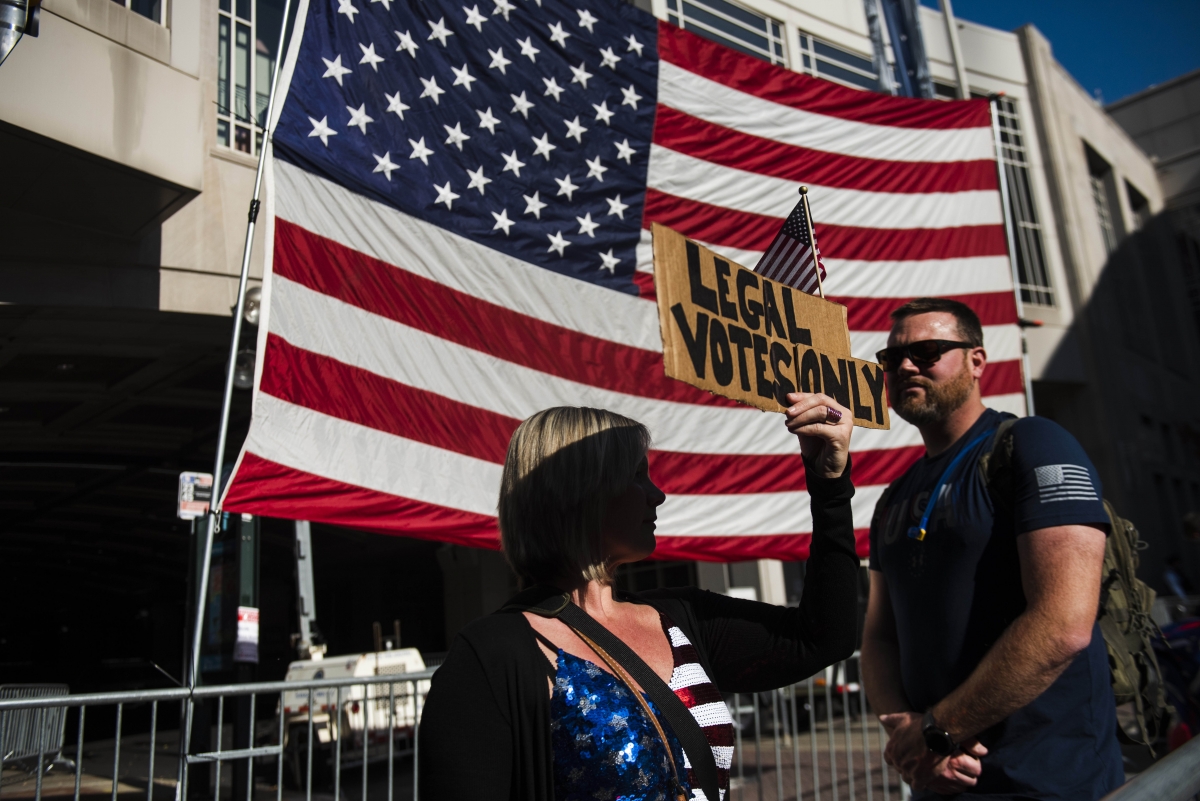
Carri Dusza demonstrates outside the Pennsylvania Convention Center in Philadelphia on Nov. 08, 2020. MUST CREDIT: Photo for The Washington Post by Amanda Voisard

Carri Dusza demonstrates outside the Pennsylvania Convention Center in Philadelphia on Nov. 08, 2020. MUST CREDIT: Photo for The Washington Post by Amanda Voisard

Democratic pollster Geoff Garin, who has decades of experience measuring public attitudes, said the election has left “a divided country even more divided,” adding that he cannot recall a time when there were “fewer points of intersection or overlap” between the two sides of the political divide.

“It’s not just that a Trump voter looks very different from a Biden voter, from where they live to what their demographics are,” he said. “But their belief systems are so fundamentally different that they’re essentially living in two separate realities. . . . When politicians say there is more that unites us than divides us, it’s nice to hear, but it is not descriptive of our current reality.”

Surveys before and after the election underscore the dimensions of the gap that now separates those two worlds. A post-election survey by Public Opinion Strategies, a Republican firm, asked whether Republicans and Democrats have less respect for people in the other party than they did four years ago. Eighty-one percent of Republicans and 77% of Democrats agreed.

An October survey by the Public Religion Research Institute revealed that partisans have made harsh judgments about the nature of the opposition. More than 8 in 10 Republicans said the Democratic Party has been taken over by socialists, while nearly 8 in 10 Democrats said the Republican Party has been taken over by racists.

The Pew Research Center found in October that 80% of Biden supporters and 77% of Trump supporters said they “fundamentally disagree with the other side on core American values and goals.” About 9 in 10 supporters of Trump and of Biden said there would be “lasting harm” to the country should the other party’s candidate win.

“What this all reflects is . . . this sense that the opposing party is pushing policies that are fundamentally going to do harm to the country,” said Alan Abramowitz, a political scientist at Emory University who has written extensively about polarization.

“It cuts across everything from economic policies to dealing with the pandemic, to immigration, race relations, social issues – you name it,” he added. “This visceral dislike and mistrust and animosity reflects actual disagreement about the way the country should be governed – who should be governing and what policies they should be following.”

Trump’s presidency has expanded the values gap between Republicans and Democrats, Blacks and Whites, those with college degrees and those without, those who attend church regularly and those who do not. Nothing that happened in November appears to have changed that in any significant way.

For Trump supporters, cultural preservation of an America long dominated by a White, Christian majority remains a cornerstone of their beliefs. That helps to explains their attachment to a president who has warned that the Democrats and their allies are determined to rewrite the nation’s history and destroy its heritage.

Although the election has been settled, the country remains unsettled. Differences based on ideology and policy are common to democratic societies. Divisions over the legitimacy of an election could be far more dangerous. “I don’t mean there’s going to be riots or armed militias, but a lack of a unified belief in small-D democratic values is inherently destabilizing,” said Democratic pollster Anna Greenberg.

Although Election Day and the day of the electoral college vote passed peacefully, threats of violence and some clashes continue. Hundreds of Proud Boys – a male chauvinist group partial to Trump and he to them – marched through the streets of the District of Columbia this month, provoking fights. Four people were stabbed, including one who was in critical condition. Earlier, armed protesters gathered outside the home of Michigan Secretary of State Jocelyn Benson, a Democrat, to register their disapproval of the vote there.

Lilliana Mason, a political scientist at the University of Maryland whose specialty is the study of the partisan divisions in the country, said that while she sees no sign that polarization is abating, “I actually think that polarization is not as big of a problem anymore as democracy itself.”

She sees Trump’s anti-democratic actions and the support he has received for those efforts from a majority of his party as cause for concern. “He’s really encouraging his supporters to believe in something that’s not true, that’s absolutely false,” she said. “And that makes them really, really angry, which is extremely dangerous.”
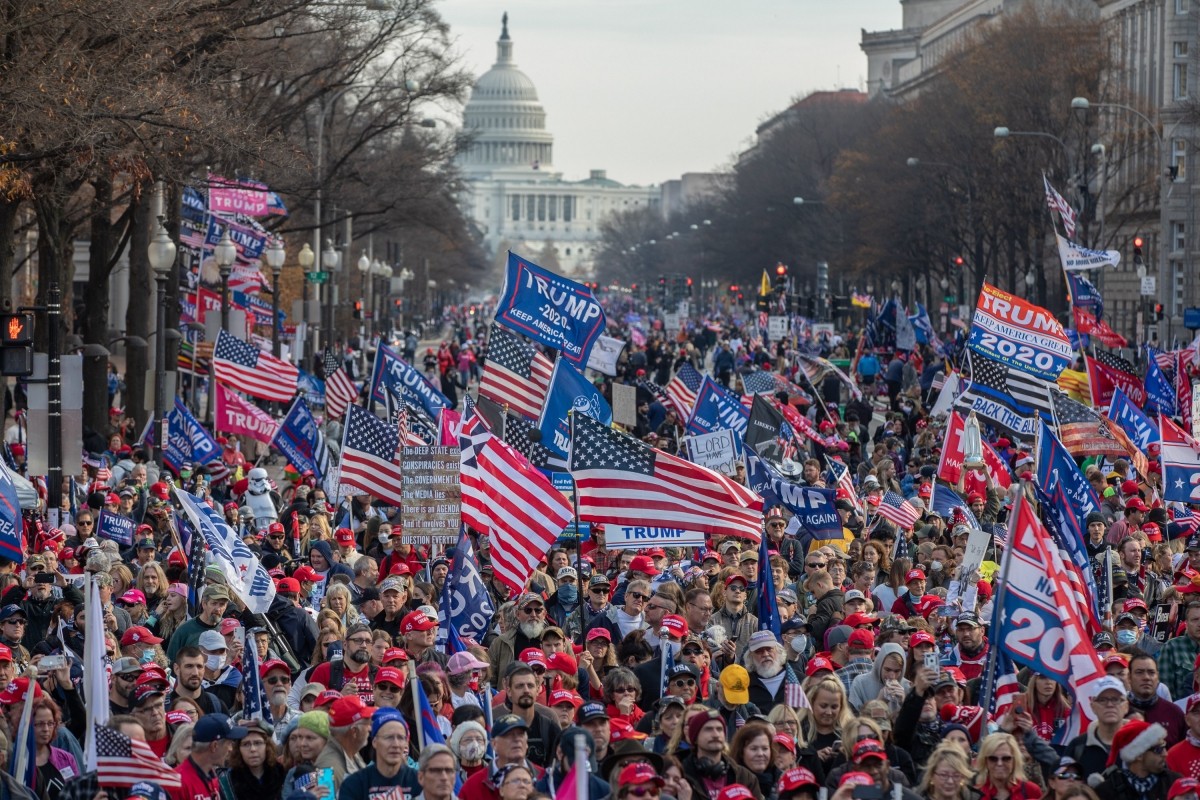
Supporters of President Donald Trump rally in Washington on, Dec. 12, 2020. MUST CREDIT: Photo for The Washington Post by Evelyn Hockstein

Supporters of President Donald Trump rally in Washington on, Dec. 12, 2020. MUST CREDIT: Photo for The Washington Post by Evelyn Hockstein

Mark Mellman, a Democratic pollster, describes what has happened to separate the two Americas as a continuum that has turned what once was a ditch into a canyon and then the canyon into a chasm.

Nothing about the cascading events of 2020 – not the pandemic and 330,000 deaths; not the massive economic dislocations; not the killings of George Floyd or Breonna Taylor; not Trump’s stir-the-pot tweeting and attacks on rivals; not an estimated $14 billion spent to sway voters – had much impact on how people voted.

“Very few people moved, and that is, in some sense, shocking to me,” Mellman said. “We used to have presidential elections and elections generally that were much more responsive to events. Now we’re in this situation where it’s a two- to five-point race no matter what.”

Bill McInturff, a Republican pollster, said his firm’s analysis of the election concluded that this was the smallest number of ticket-splitters since his firm began its measurement two decades ago. “We’ve stopped having any intersection [between the two sides],” he said.

In a closely divided country, events can become catalysts for different parts of the electorate, affecting turnout patterns and election results. These shifting patterns produced change elections of one magnitude or another in 2006, 2008, 2010, 2014, 2016, 2018 and now 2020.

In 2006, voters weary of war and souring on the leadership of President George W. Bush toppled the GOP majority in the House. Two years later, those same forces elected Barack Obama president and enlarged his party’s House and Senate majorities.

In 2010, reaction to Obama’s presidency produced a conservative tea party revolt that put Republicans back in control of the House. In 2014, Republicans took control of the Senate.

In 2016, it was the power of White working-class voters registering their disapproval of the political elites who helped make Trump the winner. In 2018, White women with college degrees who were disgusted with Trump provided much of the energy that flipped the House to the Democrats.

In 2020, with the stakes as high as ever and the country reeling from the coronavirus pandemic, racial protests and economic losses, voters came out in force. Nearly 160 million people voted this year, compared with about 138 million four years ago, but they sent mixed signals with their ballots.

The results ran counter to expectations – and to public and private polls, particularly in House races. Down-ballot contests went far more decisively for the Republicans than most analysts anticipated.

In the House, Republicans captured almost all of 27 races listed by the Cook Political Report as toss-ups. They also won seven more seats that were listed as either “likely” or “lean” Democratic. Republicans were expected to lose ground based on pre-election polls. Instead, they gained at least nine seats, with two still to be resolved.

In the Senate, seven Republican seats were listed as toss-ups. Republicans won five, with the two Georgia races going to runoff elections. Democrats picked up two Senate seats held by the Republicans after heading into Election Day with the hope that they would emerge in the majority.

– – –

In the weeks after the election, analysts have studied the results, looking for shifts among particular groups of voters, from suburbanites to young African Americans to Hispanics – particularly those in South Florida and South Texas, where Trump made notable gains – to those under age 45 and those over age 65, to White women with college degrees and White women without degrees, to urban vs. rural.

The analyses offer potential clues to forces that could shape politics in the future, but they cannot obscure the larger reality of a country that remains hardened in its divisions. “Most people have selected a side and predictably stuck with that side,” said Matt Grossmann, a political scientist at Michigan State University. “It matters for election outcomes where these people who split their tickets go. But it’s all appearing against a background where people are clearly on one side or the other.”

Both major political parties have undergone dramatic changes over the past decade. Republicans are caught in the grip of Trump and Trumpism, which represents a sharp departure from the conservatism of former president Ronald Reagan. Despite successes in November, the GOP is heading toward an internal debate about its future, with Trump’s influence remaining as a wild card.

In the election returns, some GOP analysts see the makings of a new coalition, built on White working-class voters and evangelical Christians and with potential support from voters of color, particularly Hispanics. “This election might be the start of that direction,” said Kristen Soltis Anderson, a Republican pollster.

Democrats see some of those same patterns and worry. Victories in Arizona and Georgia give them hope of redrawing parts of the electoral map in their favor, but they recognize that their weaknesses with some groups of voters leave them vulnerable in northern states such as Michigan, Ohio, Pennsylvania and Wisconsin.

Democrats are feeling the effects of gender, racial, generational and ideological tensions, with rising constituencies demanding more representation and power and energy coming from the grass roots of the party. Those differences were temporarily put aside this fall in the effort to defeat Trump, but Cathy Cohen, a political scientist at the University of Chicago, said the results of the election have left Biden with unhappy options.

“Right now he could be facing a Republican majority in the Senate that would push back on most initiatives that would be exciting to the Democratic base,” she said. “On the other hand, he has to offer up something that is substantial in institutional terms of transformation that will engage and excite the left part of the Democratic Party and many young people, particularly young people of color.”

The forces that have shaken both parties appear not to be transitory. “I don’t think we’re ever going back to the old politics in America,” Garin said. “And the new politics is very much a work in progress. But the way in which this transformation proceeds will determine a lot about the future of the country.”

America has remained hardened in its divisions through a series of major shocks – the terrorist attacks of Sept. 11, 2001, the financial crisis and recession of 2008 and 2009 and now a year that included impeachment, a pandemic, a racial reckoning, economic hardship and a campaign unlike any other in memory.

The task of navigating this divided landscape now falls to Biden. He has a robust policy agenda to address some of the most serious problems any new president has faced in decades. But his larger aspiration, as he has said repeatedly, is to heal the country and repair its broken politics. In a nation so divided and hostile toward the opposition, even small progress would count as a significant accomplishment.

Authorities identify Nashville bomber, say his remains were found in wreckage #SootinClaimon.Com

#SootinClaimon.Com : ขอบคุณแหล่งข้อมูล : หนังสือพิมพ์ The Nation.

Authorities identify Nashville bomber, say his remains were found in wreckage

InternationalDec 28. 2020Investigators with the FBI, ATF and Metro Nashville Police Department investigate a home in Antioch, Tenn., on Saturday. MUST CREDIT: Photo for The Washington Post by William DeShazerInvestigators with the FBI, ATF and Metro Nashville Police Department investigate a home in Antioch, Tenn., on Saturday. MUST CREDIT: Photo for The Washington Post by William DeShazer

By The Washington Post · Michael Kranish, Paulina Firozi, Brandon Gee, Meryl Kornfield

Anthony Quinn Warner was responsible for the Christmas morning explosion that rocked downtown Nashville, officials said Sunday, and he died in the blast.

Investigators matched human remains found at the scene with Warner’s DNA, confirming suspicions that he blew himself up in a recreational vehicle, Tennessee Bureau of Investigation Director David Rausch told reporters. Law enforcers said they were investigating a motive.

Authorities had assembled Saturday at Warner’s home in Antioch, Tenn., about 10 miles southeast of the explosion site. Several neighbors described seeing an RV similar to the one that blew up Friday morning, in the backyard of the Antioch home in the months before the blast.

Warner, 63, was not married and rarely ventured from his home, according to neighbors; he lived for years with his parents and then by himself. He once owned an alarm company, and he protected his home with an array of security cameras, rarely returning a neighborly wave and not responding to an offer of Christmas dinner, neighbors said in interviews.

“To describe him as a recluse would be an excellent word,” said Rick Laude, who has lived near Warner since 2010. “You could wave at him and he was like, What are you waving at me for?”

For some time after his father died in 2011, Warner lived with his mother, Betty Christine Lane, before moving into a nearby house, neighbors said. Lane could not be reached for comment.

In November, Warner transferred his property to a Los Angeles woman for “$0,” according to property records of a quit claim deed. The woman said in a brief telephone interview that the FBI told her not to discuss the matter and declined comment.

At one time, Warner ran an alarm company, according to his cousin, who runs a haunted-house attraction about a mile from Warner’s home. “He was into phones and electronics” like his father, Robert Warner said of his cousin.

“He has always been a quiet person,” Robert Warner said. “When we had the family reunions, he brought the RV, or he had a boat.” Robert Warner said he had not talked to his cousin in about 10 years, and he said many members of the family had lost touch with him.

Steve Schmoldt, whose property is on the other side of the fence from Warner’s residence, said Warner had “always just been kind of a loner.” Schmoldt said that Warner used to have dogs, and that they talked about pets, but that such conversations were rare. He recalled how his wife brought Warner a Christmas dinner, but Warner never answered the door.

Three weeks ago, Schmoldt said, he saw Warner climbing an extension ladder to work on a large antenna on his house. “He was like an IT guy,” Schmoldt said, referring to information technology. “He has quite a few security cameras around his house.” Neighbors also noticed that Warner washed the RV, which until recent days they had not seen leave the property.

A Nashville real estate firm, Fridrich & Clark Realty, confirmed that Warner worked there as a computer consultant for about 15 years before announcing his retirement this month. “The Tony Warner we knew is a nice person who never exhibited any behavior which was less than professional,” co-owner Steve Fridrich wrote in a statement.

The RV that detonated was parked in front of the AT&T building in downtown Nashville on Friday. The blast devastated the surrounding area and damaged more than 40 businesses and caused widespread disruptions to cellular and Internet service.

By midday Sunday, AT&T said in a statement that more than 75% of the cell sites affected by the explosion had been restored. “Mobility service in the Birmingham and Huntsville, Alabama areas is now operating normally,” the company said.

While the motive remains unknown to the public, the location of the attack is worrisome, especially considering how widespread disruptions were, Frank Figliuzzi, a former assistant director of counterintelligence at the FBI, said on CBS News’s “Face the Nation.”

“I think this is a wake-up call and a warning for all of us about how vulnerable our infrastructure is relatively easy it is for a single individual to do this,” Figliuzzi said.

Experts on critical infrastructure said the Christmas morning episode makes clear that federal and local authorities and the private sector ought to find ways to reduce their vulnerability, either through moving key pieces to more fortified locations or building in redundancies.

“We are very vulnerable to these kinds of attacks,” said Adam Rose, a professor at the University of Southern California and director of the Center for Risk and Economic Analysis of Terrorism Events. He added that the United States has limited options to build resiliency in today’s highly interconnected world, underscoring the need for customers to have their own backup communications systems, such as a home fiber-optic Internet connection in addition to a personal hot spot.

Officers who evacuated buildings before the blast described the moments after arriving at the scene and leading up to the RV explosion.

There was a strange recorded warning, which started to play a 15-minute countdown, coming from the RV. Officers started knocking on doors, contacting dispatch to get access codes to buildings, clearing them floor by floor, warning residents that answered to gather family members and leave.

“That’s stuff that I’ll never forget, the sound of the announcement saying . . . ‘Evacuate now,’ ” said Amanda Topping, one of five officers who spoke to reporters at a news conference. “Just odd. And I’m pacing back and forth because I kept on having to turn pedestrians around.”

The RV began to play music – officer Tyler Luellen told reporters that he later learned it was “Downtown” by Petula Clark. The officers prepared themselves, some going back to their cars for heavier gear.

“As I’m getting ready to walk toward [other officers], walking back toward the RV . . . I literally hear God tell me to turn around and check on Topping, who was by herself,” Officer James Wells said. “As I turn around – for me it felt like I only took three steps, the music stops. As I’m walking back toward Topping, I just see orange and I hear a loud boom. I’m just telling myself, stay on your feet, stay alive.”

Tennessee officials have called for federal support in the wake of the bombing. Sen. Marsha Blackburn, R-Tenn., said on Twitter that she had spoken with President Donald Trump about the need for federal aid.

“I told him we would appreciate prompt attention to it,” she said in a video message. “And the president has been so good to Tennessee, I have no doubt he will move quickly on this.”

Tennessee Gov. Bill Lee, a Republican, asked Trump on Saturday for federal assistance in response to the explosion, noting that the downed communication systems and damage to businesses were too much for the state to handle alone. Sens. Lamar Alexander, R-Tenn., and Blackburn along with Rep. Jim Cooper, D-Tenn., wrote to Trump in support of Lee’s request.

FEMA spokeswoman Janet Montesi said the request “is currently under review.”

Nashville Mayor John Cooper during a CBS News interview referred to the area affected by the explosion as “part of our historic identity of Nashville, this kind of late Victorian streetscape that ended up being bombed.”

“The businesses there, they’ve just – going through covid, they’ve had the worst nine months that you could have as a business,” said Cooper, a Democrat. “And then now to be affected by a bombing. Of course, we’re going to need help and we may need some help in hardening our infrastructure.”

Benefits lapse for millions as Trump fails to approve stimulus bill #SootinClaimon.Com

#SootinClaimon.Com : ขอบคุณแหล่งข้อมูล : หนังสือพิมพ์ The Nation.

Benefits lapse for millions as Trump fails to approve stimulus bill

InternationalDec 28. 2020A person shelters inside a restaurant's closed outdoor dining area as snow falls in the Hells Kitchen neighborhood of New York on Dec. 17. Winter Storm Gail pounded the city as temperatures dropped to 27 degrees with frigid sustained winds up to 35 mph, making dining outdoors unbearable amid the covid-19 pandemic that has already crippled the restaurant industry. MUST CREDIT: Bloomberg photo by Angus MordantA person shelters inside a restaurant’s closed outdoor dining area as snow falls in the Hells Kitchen neighborhood of New York on Dec. 17. Winter Storm Gail pounded the city as temperatures dropped to 27 degrees with frigid sustained winds up to 35 mph, making dining outdoors unbearable amid the covid-19 pandemic that has already crippled the restaurant industry. MUST CREDIT: Bloomberg photo by Angus Mordant

By Syndication Washington Post, Bloomberg · Chris Strohm

Millions of Americans will see their unemployment benefits lapse, at least temporarily, after President Donald Trump let Saturday night pass without signing a $900 billion bipartisan coronavirus stimulus package.

The federal government could shut down on Tuesday absent Trump’s signature on the attached, $1.4 trillion spending bill to fund operations through Sept. 30, the end of the fiscal year.

As Trump headed to the golf course on Sunday morning, Pennsylvania Republican Sen. Pat Toomey said the president risked a legacy of “chaos and misery and erratic behavior if he allows this to expire.”

Trump has dug in over the size of direct checks to be sent to many Americans, yet the stimulus accord contains numerous other measures designed to offset the impact of the covid-19 pandemic, including extended unemployment benefits, funding for food banks, rental assistance, support for small businesses and for covid vaccination programs, and other items.

The stalemate comes as the pandemic continues to worsen in many areas, and more U.S. workers are in jeopardy of losing their jobs.

Trump took no action on the stimulus bill that Congress approved, and his administration helped to negotiate, beyond expressing his displeasure with a series of tweets up to and beyond midnight on Saturday. The massive legislation was flown to him at his Mar-a-Lago resort in Florida, where he’s spending the holidays.

Signing the bill as late as Saturday would have triggered action by states to update their computer systems to reflect the ongoing benefits.

Trump has demanded that Congress increase stimulus checks from $600 to $2,000 for eligible Americans – an abrupt proposal that blindsided lawmakers who spent months negotiating the final package, and is opposed by many Republicans. He’s also complained about some of the items in the stimulus plan or in the omnibus spending bill.

“I simply want to get our great people $2000, rather than the measly $600 that is now in the bill,” Trump tweeted on Saturday.

President-elect Joe Biden criticized Trump on Saturday for refusing to sign the bill. Biden said in a statement that as many as 10 million Americans will lose their unemployment insurance benefits. About 14 million people have been receiving unemployment benefits through the Pandemic Unemployment Assistance and Pandemic Emergency Unemployment Compensation programs.

“It is the day after Christmas, and millions of families don’t know if they’ll be able to make ends meet,” Biden said. “This abdication of responsibility has devastating consequences.”

Democratic Sen. Chris Murphy of Connecticut said Saturday on Twitter that Trump must “pick up the phone and tell Republicans to stop blocking $2,000 payments.” He added that Trump’s last-minute snag was designed to create “chaos.”

Given the potential lapse in funding, it could take as long as a month before people receive their funds and even longer for the effects to filter into the economy, according to Michael Englund, chief economist at Action Economics LLC.

Any delay in immediate direct payments and gap in special unemployment benefits threaten to deepen economic scarring marked especially by a jump in long-term unemployment.

Democrats plan to vote Monday on new legislation to codify the $2,000 payments for most American adults and children. They could also vote on another stopgap measure to fund the government past the current spending deadline of midnight that day.

While that would avert a government shutdown if the Senate also passes it and the president signs it, it is still unclear what Trump plans to do with the larger pandemic relief and annual spending bill Congress passed on Dec. 21.

Brexit deal should answer concerns over economy, Sunak says #SootinClaimon.Com

#SootinClaimon.Com : ขอบคุณแหล่งข้อมูล : หนังสือพิมพ์ The Nation.

Brexit deal should answer concerns over economy, Sunak says

InternationalDec 28. 2020Rishi Sunak, U.K. chancellor of the exchequer, in London in September. MUST CREDIT: Bloomberg photo by Simon DawsonRishi Sunak, U.K. chancellor of the exchequer, in London in September. MUST CREDIT: Bloomberg photo by Simon Dawson


By Syndication Washington Post, Bloomberg · Thomas Penny

U.K. Chancellor of the Exchequer Rishi Sunak said the trade deal reached with the European Union should reassure people worried about the economic damage of Brexit and can be an “enormously unifying moment for our country.”

London will continue discussions with Brussels over access and equivalence for financial services, the chancellor said on Sunday after Prime Minister Boris Johnson said the agreement did not go as far as he wants for the sector.

The deal, which will be voted on by lawmakers in Parliament on Wednesday, “gives us a strong platform to look forward optimistically and put the divisions of the past behind us,” Sunak said in a pooled TV interview. “For those who were anxious about the economic implications of leaving, they should be enormously reassured by the comprehensive nature of this free trade agreement.”

Johnson conceded in an interview with the Sunday Telegraph that the agreement “perhaps does not go as far as we would like” on financial services, though said it offers “access for solicitors, barristers” and a “good deal for digital.”

There is little clarity for financial firms and no decision on so-called equivalence, which would allow firms to sell their services into the single market from the City of London. The agreement only features standard provisions on financial services, meaning it doesn’t include commitments on market access.

Sunak said it gives a “stable regulatory co-operative framework” and “we will remain in close dialogue with our European partners when it comes to things like equivalence decisions.”

Anneliese Dodds, economy spokeswoman for the opposition Labour Party, said ministers should do everything possible to provide certainty for businesses.

“There are big areas, like financial services, where we need to see the Conservative government acting in a much more concerted way to get an agreement so we can ensure we keep jobs in our country,” she told Sky News. “They really need to focus on this far more.”

There was also a warning for Johnson’s government from across the Irish Sea, where Deputy Prime Minister Leo Varadkar said any reduction of standards in the U.K. could lead to reduced access to the EU market.

“They have agreed to a non-regression clause in all but name, so we said you can only have access to the market if you don’t reduce your standards when it comes to workers’ rights, the environment, health and safety, product standards, all of those things,” Varadkar told Newstalk radio.

“If they do reduce their standards, or if they don’t keep up with our standards, then that access to our market could be threatened,” he said. “So they do still have to largely follow European rules where they’re relevant.”

Some senior lawmakers from Johnson’s Conservative Party complained there will not be enough time to properly scrutinize the deal when Parliament debates and votes on it on Wednesday.

While the legislation is expected to pass easily as Labour has indicated it will back the deal rather than risk the economic damage of a no-deal divorce from the EU, dissent among Johnson’s rank-and-file lawmakers may spell trouble for the future.

“Whatever you think of this treaty, it is going to affect the rest of our lives,” former Brexit Secretary David Davis told the Observer. “It does require more than just a rubber stamp.”

European Union begins coronavirus vaccine rollout amid concerns over supply #SootinClaimon.Com

#SootinClaimon.Com : ขอบคุณแหล่งข้อมูล : หนังสือพิมพ์ The Nation.

European Union begins coronavirus vaccine rollout amid concerns over supply

InternationalDec 27. 2020

By The Washington Post · Loveday Morris · WORLD, HEALTH, EUROPE, HEALTH-NEWS 

BERLIN – In nursing homes and hospitals from Spain to Poland, the European Union began its official coronavirus mass vaccination program for its 450 million residents on Sunday amid concerns about supply and frustrations over the pace of the roll out. 

Leaders of the 27-country bloc had aimed to ensure that the vaccine would be available to every country fairly, with every country beginning their vaccination with the Pfizer and BioNTech vaccine from Sunday. 

At 8.30 a.m. in Guadalajara, Spain, Araceli Hidalgo, a 96-year-old nursing home resident, became the first person to be vaccinated in the country. In the Czech Republic, Prime Minister Andrej Babis was vaccinated live on television. In Italy, which emerged as the epicenter of the pandemic last spring, doctors and nurses at the Spallanzani hospital in Rome were the first to receive the vaccine. 

“Today is a beautiful, symbolic day,” Domenico Arcuri, Italy’s emergency coronavirus commissioner told reporters outside the hospital according to the Associated Press. “All the citizens of Europe together are starting to get their vaccinations, the first ray of light after a long night.”

But despite the hopeful scenes across Europe, there has been mounting frustration as Europeans have watched Pfizer and BioNtech’s vaccine, developed in Germany with German federal government funding, roll out first in a string of countries, including the United States, United Kingdom, Israel and the United Arab Emirates. And while the bloc has ordered more than 2 billion vaccine doses as it aims to protect all its citizens against coronavirus, it has limited orders of the front running candidates. 

“There is simply too little vaccine,” Markus Söder, the state premier of the German state of Bavaria, told the Bild newspaper on Sunday. 

The 200 million doses of Pfizer/BioNTech vaccine ordered by the European Union will be equally divided between each of its member states according to population size, meaning that Germany, with 18 percent of the bloc’s population, would receive around 36 million doses – enough to vaccinate 18 million people, just over 20 percent of its population. The country has created a string of mass vaccination centers in sports arenas and exhibition centers. 

The companies have said that delivery time frames depend on when orders were placed, and while the United States and the United Kingdom put in orders for the vaccine earlier in the summer, the European Union only finalized their order in November after months of negotiations. 

That means that while the United States has a smaller initial order of Pfizer vaccines, it will receive 20 million from an initial bucket of 50 million that are available at the turn of the year, compared to 12.5 million for the European Union. 

The delay in ordering was mostly due to haggling over the price, said one person with knowledge of the negotiations, who declined to be named to discuss closed door deliberations. 

“Negotiating with 27 countries is not as easy,” the person said. “The advantage is that poorer countries will also receive vaccine. The downside is everything takes longer.”

Stefan De Keersmaecker, a spokesman for the commission, said he could not comment on negotiations but that the aim had been to build a diversified portfolio with different companies and talks had begun before results of trials were available. “There was no certainty that any of the vaccine candidates would be effective and safe,” he said, adding that contracts allow options for orders to be expanded. 

However, while the United Kingdom and the United States have already used their options to order more vaccine, the European Union had not signed the contract for 100 million further doses as of Wednesday, according to two people familiar with the negotiations. That’s despite reports that it had come to an internal decision to do so more than a week earlier. 

“This is a touching moment of unity,” European Union Commission President Ursula von der Leyen tweeted on Saturday ahead of the vaccination program’s start. “With vaccination, we will put this pandemic behind us.” 

But despite a decision to show solidarity with a unified vaccine roll out, Hungary, Slovakia and Germany began vaccinations a day earlier. Karsten Fischer, a local health authority official in the Harz region of Saxony-Anhalt, told German media that he’d seen no reason to wait after vaccines arrived. 

Germany is slated to receive 1.3 million Pfizer vaccines by the end of the year, and enough to vaccinate around 13 percent of its population by March. The vaccine was developed by BioNTech, a German firm based in the city of Mainz run by a husband-and-wife team of scientists in collaboration with Pfizer. 

Berlin gave the German company $469 million in funding in September to help cover the costs of phase three trials and to expand manufacturing capacity. 

The European Union also has a contract to buy 300 million doses of vaccine from AstraZeneca, which could be approved for emergency use in the United Kingdom as early as next week according to British press reports. The vaccine is cheaper and does not have the same complex cold storage requirements as Pfizer and Moderna’s offerings. 

Pharmaceutical companies Sanofi and GlaxoSmithKline earlier this month said their vaccine would be delayed after showing a weak immune response. 

Hospital laundry workers fear their infection risk is rising #SootinClaimon.Com

#SootinClaimon.Com : ขอบคุณแหล่งข้อมูล : หนังสือพิมพ์ The Nation.

Hospital laundry workers fear their infection risk is rising

InternationalDec 27. 2020

By Syndication Washington Post, Bloomberg · Jacqueline Davalos · NATIONAL, HEALTH, HEALTH-NEWS 

Workers at a leading commercial laundry firm that cleans sheets for some of New York City’s biggest hospitals say every day on the job places them at greater risk of covid-19 infection.

Industry CEOs from all over the U.S. voiced concern earlier this month about potential outbreaks, too. As a critical component of a health care system buckling under the strain of a nationwide surge, commercial laundry companies have become essential in the fight against the pandemic. 

But their employees’ unions contend that while some operators have taken adequate measures to protect workers, others have not.

“Some of my representatives walk in to inspect, and hand sanitizer stations are empty. Workers are typically inches away from each other,” said Richard Minter, assistant manager at Philadelphia Joint Board Workers United. Unions complain that access to masks or gloves can be limited, leaving it to employees who make little more than minimum wage to buy their own.

Unitex Textile Rental Services is among the biggest players in a $3 billion industry that keeps hospitals, nursing homes and other medical facilities running by washing soiled linens, uniforms and gowns. Five Unitex laundry workers interviewed by Bloomberg News contend some workspaces have poor ventilation, or a lack of social distancing and limited access to personal protective equipment. 

Brígida Vidal is a production worker at Unitex’s Med-Apparel facility in Perth Amboy, New Jersey, where she said workers are given only one mask a day, that gloves are doled out sparingly and that social distancing is rarely enforced. “We don’t have enough to protect us,” Vidal said. “There’s been times where I take gloves I find in the pockets of used scrubs because it’s all I can get.” 

Vidal makes $12.50 an hour. A Mexican immigrant and the sole breadwinner for a family of four, she said going to work is a risk she “feels forced to take.” When the pandemic fell like a hammer on the New York metropolitan area last spring, Vidal said she reported symptoms including coughing, fatigue and a sore throat to her manager and Unitex’s company physician.

Instead of a two-week quarantine, she said she was expected to return to work a week later. At the time, covid-19 tests were hard to come by in the U.S. In September, Vidal said she tested positive for coronavirus antibodies. She recently bought face shields and shared them with a few co-workers. “It’s the company’s job to do this,” she said.

Maritza Garcia, another worker in Unitex’s Perth Amboy “soil room,” said managers brush off her requests for more protective equipment. “I’m told there’s not enough,” Garcia said. “I don’t feel safe. For the work we are doing, we deserve better.” 

Unitex Chief Executive Officer Robert Potack denied allegations of unsafe working conditions. “Masks and gloves are provided daily and replenished upon request,” he said in an interview with Bloomberg. The company encourages social distancing and hand-hygiene, he said, and has “conducted thorough training on our covid-19 protocols and policies.” 

In Unitex’s Mount Vernon facility, just north of New York City, Reynaldo Hernandez said he knew of four co-workers who fell ill with the virus this year. “In the summer, it was really bad,” he said. Sometimes management would provide him with a replacement mask, but other times he was told there weren’t enough.

Hernandez said that while he managed to stay healthy through the first infection wave, he fears this latest surge. “It’s coming back, and we are all crowded together with bad ventilation,” he said. “We are still kept in the dark about who is sick. I’m terrified.” 

The catastrophic swell of coronavirus cases gripping the U.S. right now has overshadowed the initial outbreak that killed more than 50,000 in the Northeast last spring, and a second wave that killed tens of thousands more in the South and West following premature re-openings. Now, with more than 17 million confirmed infections and close to 320,000 dead, hospitals and health care facilities in every corner of the nation are filling up. 

When it comes to soiled hospital laundry, Lisa Lockerd Maragakis, senior director of infection prevention at The Johns Hopkins Health System, said “evidence suggests that it’s harder to catch the virus from a soft surface (such as fabric) than it is from frequently touched hard surfaces like elevator buttons or door handles.”

But laundry employees contend that handling sheets and gowns used by Covid-positive patients is just part of a perfect storm of crowded workplaces and insufficient company precautions.

Erik Scott, chief executive officer of Soriant Solutions, a consulting firm specializing in health care support services, said linen companies were already busy before covid-19 appeared, thanks to a growing trend of outsourced laundry services. Unitex recently opened a 188,000-square-foot facility in Lawrence, Massachusetts, and said it expects to open another in 2021.

According to industry lobby group Textile Rental Services Association, commercial laundry firms are getting even more work now thanks to health care providers that are reluctant to let their workers wash their own uniforms.

“The grueling services provided by these essential workers have helped ensure the safety of patients.”

It wasn’t until New Jersey Congressman Frank Pallone Jr. and the Speaker of New Jersey’s General Assembly wrote Unitex CEO Potack on Dec. 1 that the company disclosed how many workers had been infected with covid-19, said Albert Arroyo, co-manager of the Laundry, Distribution and Food Service Joint Board, Workers United/SEIU. The union represents workers in 10 of Unitex’s 12 facilities.

“The grueling services provided by these essential workers have helped ensure the safety of patients, medical professionals, and so many others during the ongoing public health crisis,” Pallone wrote. He urged Unitex to “uphold critical covid-19 safety standards.”

On Dec. 3, Potack informed union leaders that 10% of the workforce at the Perth Amboy facility tested positive for covid-19 over the course of the pandemic, according to Arroyo. The union official also said Potack disclosed that in April, Unitex had been aware of eight positive cases among production workers at the facility.

Potack said in an interview that there have been only two cases of covid-19 at the Perth Amboy facility since April. The CEO said the infection rate at the location “is well below” national and state averages, though he declined to provide specific numbers. “There is no evidence to make any claim that the cases were transmitted at work,” Potack added.

The CEO said the company had made previous disclosures to union leaders, but added that he didn’t recall the dates or details. “We responded to and welcomed a conversation with members of Congress to explain the facts,” he said. 

A fourth generation, privately owned family business, Unitex is one of the top health care laundry and linen supply providers in the country, according to Grand View Research Inc. It operates facilities across New York, New Jersey, Connecticut and Massachusetts, with 1,750 workers processing 300 million pounds of linen annually for hospitals including Manhattan’s Memorial Sloane Kettering, Mount Sinai Beth Israel and New-York Presbyterian. As of 2014, the company generated $150 million in revenue. 

Unitex has been embroiled in collective bargaining negotiations over its Perth Amboy facility since July. Potack said he believed union complaints about coronavirus risks are part of a broader strategy to extract concessions. “They are hell-bent on trying to maintain a pension for future employees,” he said of the union. 

Citing alleged bad faith, the union filed unfair labor practice complaints against Unitex in July and September with the National Labor Relations Board. Lawyers for both sides didn’t respond to requests for comment, but the case remains open, according to the NLRB. 

On Dec. 10, workers gathered in front of Lincoln Hospital in the Bronx to demand a wage increase, the continuation of pension benefits and that Unitex commit to basic covid-19 protections, including providing two face masks daily and requiring six feet of social distance between employees. Potack said the company doesn’t “believe any more policies and procedures need to be included in the collective bargaining agreement.”

New York City Council member Ritchie Torres, who was just elected to Congress, also attended to support Unitex workers. An advocate for health protections in industrial laundries, Torres was a lead sponsor of the Clean Act, a local law which set sanitary standards for industrial laundries in 2016.

“I want to send a crystal clear message to hospitals,” Torres said. You “are judged by the company you keep, and you should hold your contractors accountable for respecting their workers.” Unitex hospital clients including Lincoln, Yale New Haven, Mount Sinai Beth Israel, New York Presbyterian, and Memorial Sloane Kettering didn’t respond to requests for comment. 

“The grueling services provided by these essential workers have helped ensure the safety of patients.”

Outside of laundry rooms, Unitex’s truck drivers are also complaining about safety issues.

“It’s not easy work. I’m picking up soiled linens that sometimes aren’t sealed properly,” said Kevin Kucker, a driver for Unitex’s Newburgh, New York, facility, which isn’t the subject of contract negotiations. A lack of transparency around workers getting infected has compounded the anxiety, he said.

If the company said, “‘look-someone got sick [so] we’re going to have to get you guys tested to see if everything’s OK,’ that would show they cared,” Kucker said. “They never did that.”

Kathy Hanshew is a manager of the Chicago and Midwest Regional Joint Board, Workers United/SEIU union, which represents industrial laundry workers across 12 states. She said that, nationally, the union has seen cases where employers weren’t providing masks at all. But some laundry companies have indeed been working with unions and their members.

Pennsylvania commercial laundry company Clean Uniform Rental has responded positively to union demands, said Minter, of the Philadelphia Joint Board Workers United. The company gave out a version of hazard pay: $150 a week in addition to what it calls “hero pay,” which provided a week’s worth of wages to workers across all levels.

“Of course there’s a cost to all of this. But this is a crisis,” Clean Uniform Rental CEO Jim Wasserson said. While the company has had sporadic covid-19 infections, contact-tracing has helped avoid outbreaks, he said. “At least once a week we have a meeting to make sure everyone knows what’s going on,” Wasserson said. “Your employees need to feel safe.”

Baht moving in narrow range but expected to gain from movement of gold price #SootinClaimon.Com

#SootinClaimon.Com : ขอบคุณแหล่งข้อมูล : หนังสือพิมพ์ The Nation.

Baht moving in narrow range but expected to gain from movement of gold price

NationalDec 28. 2020

By THE NATION

The baht opened at 30.07 to the US dollar on Monday, strengthening from 30.09 at close on Friday.

The Thai currency is likely to move between 29.90 and 30.10 on Monday and between 29.80 to 30.20 this week, said Jitipol Puksamatanan, senior director of the chief investment office at SCB Securities.

He explained that the baht presently was moving in a narrow range, and the only factor pressuring the currency was the new wave of Covid-19 in Thailand.

He advised investors to monitor the direction of gold price, which has started to recover and could support Asian currencies including the baht. Besides, the political situation in the US, as well as the Brexit issue between the UK and EU, were worth monitoring this week.

He expected Thailand to end 2020 with foreign exchange reserves of $260 billion, or around 50 per cent of the gross domestic product.

The dollar index this week would tend to move between 89.5 to 90.5 points, from the present 90.2 points, he said.

Democrat MP tells PM, ministers to take responsibility for gambling dens in Rayong #SootinClaimon.Com

#SootinClaimon.Com : ขอบคุณแหล่งข้อมูล : หนังสือพิมพ์ The Nation.

Democrat MP tells PM, ministers to take responsibility for gambling dens in Rayong

NationalDec 28. 2020

By THE NATION

A Democrat MP blamed the prime minister and two ministers for letting gambling dens exist in Rayong, which has resulted in 85 cases of Covid-19 infections.

Dr Banyat Jetanajan, Democrat member of the House of Representatives for Rayong province, said on Sunday that Prime Minister General Prayut Chan-o-cha, Deputy PM General Prawit Wongsuwan and Interior Minister General Anupong Paochinda must take responsibility for letting gambling dens exist in Rayong, which had led to the infection among local people. He warned the real number of infections could be even higher.

“I have raised the issue of gambling dens in Rayong for discussion in Parliament meetings many times, so I believe the PM and related ministries must be aware of the problem,” he said. “After the crackdown on a large gambling den in the Map Ta Phut area in June, how come there are still gambling dens in the province, making Rayong the second biggest hotspot after Samut Sakhon in the new wave of Covid-19?”

“As a Rayong resident, I am highly concerned about the economy, tourism and well-being of the people of Rayong that would be severely affected by the new outbreak,” he added. “But as an MP in the government coalition, I want the government to clarify why there are still gambling dens as well as show sincerity in solving the problem for good.

“I sympathise with local residents who have sacrificed greatly to keep the province safe from Covid-19 since the outbreak started, but due to the irresponsibility of some government officials who failed to rid the province of gambling dens, they have to suffer the consequence from these mass infections,” added Banyat.

“The government must bring those who neglected their duty to face justice and make sure that Rayong has no gambling dens,” Banyat said.

Health agency urges people against believing offers of Covid-19 vaccine #SootinClaimon.Com

#SootinClaimon.Com : ขอบคุณแหล่งข้อมูล : หนังสือพิมพ์ The Nation.

Health agency urges people against believing offers of Covid-19 vaccine

NationalDec 28. 2020

By THE NATION

The Thai Food and Drug Administration (FDA) has not provided any certification for the use of Covid-19 vaccines in Thailand and warned people against believing any person or establishment that promises to get them vaccines by reservation.

Dr Thares Krainairawiwong, Department of Health Service Support, said that

“On December 26, a private hospital in Bangkok announced its offer of Covid-19 vaccines at Bt4,000 per person for the first 1,000 customers who made reservations before January 31,” he said. “Currently the FDA has not permitted any healthcare operator to provide Covid-19 vaccine to patients and such an advertisement by the hospital could be an exaggeration.

“The Department has contacted the hospital and ordered them to take down the advertisement,” he added.

“We will launch an investigation into the hospital for possible violation of Health Facility Act BE 2541 under Section 38 Paragraph 1, for posting an unauthorised advertisement, and Section 38 Paragraph 2, for providing false or exaggerated information that could lead to misunderstanding about the health facility’s operations.”

The violator of Paragraph 1 will face a maximum fine of Bt20,000 and an extra Bt10,000 per day until the advertisement is taken down, while the violator of Paragraph 2 will face a similar fine plus a maximum one-year imprisonment.

Woman from Rayong ‘first Covid-19 case in Chiang Mai’ #SootinClaimon.Com

#SootinClaimon.Com : ขอบคุณแหล่งข้อมูล : หนังสือพิมพ์ The Nation.

Woman from Rayong ‘first Covid-19 case in Chiang Mai’

NationalDec 28. 2020

By THE NATION

The Chiang Mai public health office held an emergency meeting on Sunday evening at City Hall regarding a new case of Covid-19 found since mass infections were reported in Samut Sakhon province earlier this month and in Rayong province a few days ago, a source said.

“Dr Kittiphan Chalom, Chiang Mai’s public health deputy chief, said that the patient is a 46-year-old woman, a resident of Rayong’s Muang district, who had arrived in Chiang Mai on December 26,” said the source. “She showed symptoms, such as dryness in the throat and 37.4 degrees temperature and received testing on December 27. She was found positive.”

Kittiphan added that she is now being treated in a negative pressure room at Nakornping Hospital in Mae Rim district.

“This is considered an imported case from another province. There is still no local outbreak within Chiang Mai at the moment,” he said.

The source speculated that the CCSA would make an official announcement about this case on Monday.

According to Kittiphan, preliminary tracing of the patient’s travel history revealed that she had visited a fitness centre in Rayong province on December 24 and had close contact with a trainer who was later confirmed as infected. On December 26, she travelled from U-Tapao Airport to Chiang Mai International Airport on Thai AirAsia flight FD101, seat 22C, with her husband, her two children and a babysitter.

“In total, 127 persons have been found to have had contact with her l and carry a risk of infection, 30 of whom carry high risk that health officials had already contacted them to collect samples for testing,” he said. “The rest 97 persons were told to stay in self-quarantine to monitor their symptoms for 14 days.”