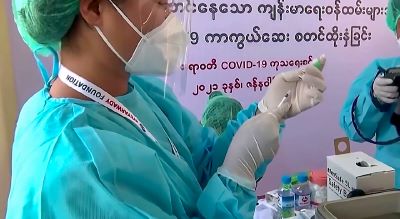
KUALA LUMPUR, Sept 17 (Bernama): The Association of South-East Asian Nations (Asean) had handed over US$1.1 million worth of medical supplies and equipment ready to be distributed by the Myanmar Red Cross Society (MRCS), for immediate support to the Covid-19 response in the country.
The delivery, which is the first batch of Asean’s Humanitarian Assistance in Myanmar, was a follow up to the Pledging Conference held on Aug 18, Asean Secretariat said in a statement published on its website www.asean.org.
Items in this batch were donated by the governments of Indonesia, the Philippines, Thailand, Turkey, and Temasek Foundation International, it said.
In his remarks, Asean Secretary-General Datuk Lim Jock Hoi underscored the importance of the initiative to showcase the solidarity in the spirit of ‘One Asean, One Response’ to extend a helping hand to the people of Myanmar in the realisation of a people-oriented, people-centred Asean Community.
He also thanked the four donor countries and Temasek Foundation International, and expressed his confidence that the assistance would alleviate the sufferings of the people of Myanmar in this critical time.
Lim had further called for other countries to contribute to the humanitarian efforts for Phase 1 urgently and Phase 2 at a later stage.
The next batch for Phase 1 is expected to be provided through support from Brunei, Cambodia, Singapore and Vietnam, along with other donor countries and organisations, the statement said.
ADVERTISEMENT
Meanwhile, Special Envoy of the Asean Chair on Myanmar Datuk Erywan Yusof in his recorded remarks further emphasised that Covid-19 pandemic is “the common enemy” that has exposed the vulnerabilities not only of our socio-economic structures, but the fragility of human life.
He urged the international community to continue giving support and to complement Asean’s efforts, further highlighting that the “provision of humanitarian assistance is a true reflection of the “Asean Way”, and demonstrates our commitment to help our Asean family when they are in need”.
The Executive Director of the Asean Coordinating Centre for Humanitarian Assistance on disaster management (AHA Centre), representatives of Asean Member States, donor countries among others had attended the handing over ceremony, which was held virtually on Wednesday from Asean Secretariat in Jakarta.
The statement added that the AHA Centre, as the operational lead, will facilitate the delivery of assistance while the MRCS, as a local partner, supports ASEAN by providing last mile distribution of the medical supplies and equipment to the communities in need in Myanmar. – Bernama
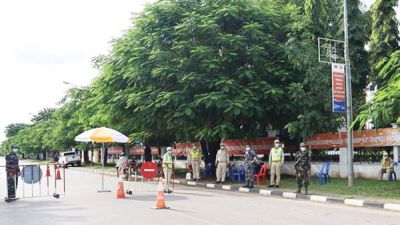
The Lao government has extended Covid-19 prevention and control measures until September 30, expanding a night-time travel ban to provinces hit by a community outbreak.
People are prohibited from travelling from 10 pm to 5 am in the capital of Vientiane and provinces affected by outbreaks.
In its last update, which is issued every 15 days, the travel ban was imposed only in the capital.
Addressing a media briefing on Wednesday, the Vice Chairperson of the National Taskforce for Covid-19 Prevention and Control, Mrs Thipphakone Chanthavongsa, said the community outbreak was increasingly spreading, requiring the tightening of the measures.
The outbreak in the capital of Vientiane and the provinces of Champassak, Khammuan and Savannakhet has spread wider compare to other provinces.
“Although imported cases in these areas have declined, community outbreak is spreading wider,” Mrs Thipphakone said.
Authorities have blamed the worsening community outbreak on people continuing to travel to and from localities.
In light of this issue, some provinces recently imposed travel bans to and from communities affected by outbreaks.
In its latest update on the prevention and control measures, the government decided to expand the night-time travel ban to some provinces. Exceptions have been made for transporting goods and emergency trips, including the movement of rescue vehicles, fire trucks and ambulances.
Other measures that will remain in place under the extension include:
ADVERTISEMENT
– The closure of entertainment venues, cinemas, spa services, karaoke halls, drinking shops, internet cafés, snooker clubs, casinos and gaming shops across the country.
– Massage services, beauty salons, night markets, food gardens and tourist sites in areas affected by community outbreaks are prohibited.
– Travel to and from red zones is not allowed, except in cases permitted by the relevant taskforce.
– All indoor and outdoor sports, including sport competitions and sporting activities in parks in red zones are prohibited.
– Any kind of party or gathering in any location is prohibited.
– School classes at all levels will be closed and entrance examinations to tertiary education institutions in Vientiane and the provinces affected by community outbreaks will be suspended. Exceptions will be made for dormitory schools if permission is granted by the provincial taskforce.
– The issuance of visas for foreign visitors will remain suspended. Diplomats, staff of international organisations, experts and investors can apply for permission from the taskforce. In this regard, foreign ambassadors and heads of international organisations are permitted to undergo quarantine at their residence, while the rest are required to undergo quarantine at designated hotels.
– All border checkpoints will continue to be closed for ordinary citizens.
– Meetings and other activities, including traditional events and ritual involving more than 20 people, are prohibited. In essential cases, permission must be given by a Covid-19 taskforce before such events are organised.
However, the government is allowing some businesses to remain open as long as they strictly observe Covid-19 prevention and control measures.
These businesses include wholesale and retail shops, supermarkets, minimarts, and fresh markets.
Barber shops and beauty salons outside of red zones may open if service providers are fully vaccinated.
Restaurants and coffee shops in communities without outbreak may continue to open. Factories may continue to operate if employees are fully vaccinated and do not live in a red zone.
Meetings outside red zones can be convened.
Classes may be held at schools given permission by the taskforce of the provinces or the capital of Vientiane.
[Vietnam] Govt signs decision to release $116mln to procure 20 million doses of Pfizer vaccines
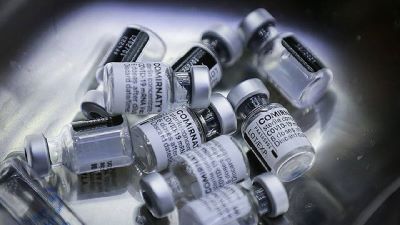
HÀ NỘI — Deputy Prime Minister Lê Minh Khái on behalf of the Prime Minister has approved funding to purchase nearly 20 million doses of COVID-19 vaccine BNT162 by Pfizer.
According to the decision, signed on September 17, more than VNĐ2.65 trillion (US$115.95 million) sourced from the national COVID-19 vaccine fund (which to date has about $378 million in donations) will be used to purchase nearly 20 million doses of the mRNA vaccine and activities related to the administration of the vaccine at the request of the Ministry of Health.
Relevant ministries are asked to take responsibility for the management, use and payment of the amount in an economic, effective, open and transparent manner.
The health ministry is required to report the use of the sum to the Prime Minister.
Earlier, the Ministry of Health and Pfizer signed an amendment of the definitive supply agreement for an addition 20 million doses – reportedly reserved for children aged 12-18 years old in the country – on top of the original deal for 31 million doses. — VNS
Almost 70% of Korea is at least partly vaccinated against COVID-19 — now what?
South Korea is close to reaching its goal of having 70 percent of the population vaccinated with a first dose of a COVID-19 vaccine before Saturday, when this year’s Chuseok holiday begins.
So what does this mean for the country’s pandemic response going forward?
Lee Ki-il, the Ministry of Health and Welfare’s deputy minister for health care policy, told Friday’s televised news briefing that Korea was close to hitting “a significant milestone in the vaccination campaign against COVID-19.”
Some 36 million people, or 70 percent of the Korean population, will have had at least one dose, more than six months since the very first batch of vaccines were put in arms back in February. As of Friday noon, the first-dose rate stood at 69 percent.
As the two rounds of Pfizer and Moderna vaccinations — which have been the most widely distributed kinds here since July — are completed within six weeks, the share of fully vaccinated people is expected to rise to 70 percent sometime in October.
The interval between the first and second AstraZeneca dose has been shortened to four weeks from eight weeks to boost the second-dose uptake, according to Thursday’s announcement.
Moving up appointments for a second Pfizer or Moderna dose, which is scheduled at six weeks after the first, is now possible through the online signup systems for “leftover” vaccines.
In the same briefing, the ministry’s spokesperson Son Young-rae said at the current trajectory, Korea was “anticipated to get to 80 percent, possibly even higher, within October.”
Asked to explain what crossing the 70 percent mark for first doses would entail for COVID-19 control in the country, he said that one dose still provided strong protection against hospitalizations and deaths.
But one dose of a vaccine is known to be less effective in preventing infection with the delta variant, which accounted for 98 percent of all analyzed cases last week. Nearly 1 in 5 patients diagnosed between July and September here were first-dose recipients awaiting their second dose, according to official statistics Wednesday.
ADVERTISEMENT
Despite the vaccine progress, the fourth wave of the pandemic is not dying down, with 2,008 more cases confirmed in the latest 24-hour period until Thursday midnight. So far in September, an average of 1,796 cases were logged each day, slightly higher than the daily average seen in August of 1,712 cases.
Lee, of the Health Ministry, said this was due to the impact of delta, which is “about three times more contagious than the original virus found in Wuhan,” China, and the easing in social distancing restrictions earlier this month.
The limit on private gatherings has been eased to allow up to eight people to mingle past 6 p.m. — if at least four among the group are fully vaccinated. Throughout summer only two people could meet up at a time in the evening.
“Our projections indicate that Korea will be heading on a downward trend for case rates over the latter half of September,” he said.
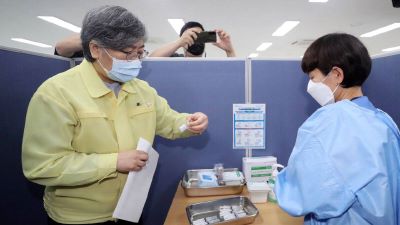
The ultimate goal is to raise the full vaccination coverage, Jeong Eun-kyeong, the Korea Disease Control and Prevention Agency’s commissioner, told reporters at a vaccination clinic near the agency’s headquarters in Cheongju, North Chungcheong Province.
“The most important task is to have more people fully immunized,” she said. “Do not to skip the second dose when the time comes.”
As of Friday’s count 41 percent in Korea were fully vaccinated.
By age, the full vaccination rate was highest in people who are in their 70s at 89 percent, followed by those in their 60s at 86 percent and those in their 80s and older at 79 percent.
For people in their 50s, for whom vaccinations began in the last week of July, it was 40 percent. The cohort of 30-somethings, many of whom were offered the US-supplied Johnson & Johnson vaccines in June, came next at 31 percent. For 40-somethings and 20-somethings, it was a tie at 26 percent.
An even busier phase in the rollout is ahead in October, when vaccinations for minors under 18 and pregnant women are planned, as well as third “booster” vaccinations for older, vulnerable people.
Korea has delivered 11,785,221 doses over the first 17 days of September, of which 6,086,314 were first doses. The average number of doses given out per day this month is 368,288, up from August’s 285,969.


.jpg)
 SootinClaimon.Com