HKU research team successfully isolates Omicron variant

#SootinClaimon.Com : ขอบคุณแหล่งข้อมูล : หนังสือพิมพ์ The Nation.

https://www.nationthailand.com/international/40009472


HONG KONG – Hong Kong scientists have succeeded in isolating Omicron variant from clinical specimens which will help in developing vaccines against the new COVID-19 strain, The Hong Kong University said on Tuesday.
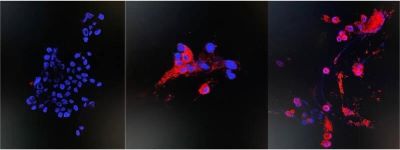
In a statement, HKU said its Department of Microbiology researchers were the first known research team in Asia that has succeeded in isolating the Omicron variant.

The isolated variant will enable the development and production of vaccines against Omicron, which has been designated as a “variant of concern” by the World Health Organization.

The research team is now working on expanding the virus for use in assessing its transmissibility, immune evasion capability, and pathogenicity in animal models.  The team is also exploring opportunities for urgent development and production of inactivated whole virus vaccines, the HKU said.

The HKU team succeeded in isolating the variant late Monday, four days after the first two Omicron cases were confirmed in Hong Kong on 25 November, and five days after the variant was first reported to the World Health Organization from South Africa on 24 November.

WHO designated the variant, initially identified as B.1.1.529 a variant of concern, and named it Omicron on Nov 26.

Cases of the Omicron variant have since been reported from around the world in countries and regions such as Australia, Belgium, Botswana, Britain, Denmark, Germany, Hong Kong, Israel, Italy, the Netherlands, France, and Canada, as governments impose urgent travel bans and heightened surveillance.

“We recognize the serious threats of the variant and jumped into action immediately,“ Chair of Infectious Diseases Professor Kwok-yung Yuen, who led the research effort, was quoted as saying in the statement.

“Isolating the variant is the first step in the urgent study of the variant.”

Other leaders of the research team include Professor Honglin Chen and Dr. Kelvin To, Head of the Department of Microbiology.

“We are glad that our department is contributing to the global effort to fight the pandemic amid the emergence of the Omicron COVID-19 variant,” To said.

On Nov 28, a 37-year-old man returning from Nigeria via Ethiopia and Thailand became the city’s third patient infected with the Omicron variant after he tested positive during his quarantine at a local hotel.

Virus isolation and incubation were conducted at the biosafety level 3 laboratory (P3 laboratory) of the University of Hong Kong, following standard operating procedures. HKU currently has the only P3 laboratory in Hong Kong.

The microbiology team is now working to further isolate and purify the variant virus for inactivated whole virus vaccine production.

By Wang Zhan

Published : December 01, 2021

By : China Daily

Samsung to nurture young executives to usher in ‘New Samsung’ era #SootinClaimon.Com

#SootinClaimon.Com : ขอบคุณแหล่งข้อมูล : หนังสือพิมพ์ The Nation.

https://www.nationthailand.com/international/40009431


Samsung Electronics is poised to employ a new personnel management system starting in 2022 that could foster young executives, in a move to lay the groundwork for a “New Samsung” era under Samsung’s de facto leader Lee Jae-yong, the South Korean tech giant said Monday.

Under the new system, Samsung will abolish a set of requirements before an employee gets promoted to a certain level, such as a minimum term of service that lasts roughly eight to 10 years. Instead, excellent employees will be eligible for a “promotion session” so their work performance and expertise can come under a multidimensional review.

The new human resources procedures will help the tech giant bring top talent to management regardless of age, Samsung said in a statement.

In line with the revamp, Samsung will remove the job title of senior vice president, known as “jeonmu” in Korean, and merge that rank with executive vice president, or “busajang” in Korean.

Samsung’s new system will also encourage young people to boost their career experience. Samsung said it plans to allow employees serving in the same position for at least five years to be qualified to work in a different position. At the same time, a talent exchange program will give employees in Korea the opportunity to serve in positions abroad.

Moreover, a separate management system will be implemented to give employees a soft landing when they return from a career break. Satellite offices will be created in “major locations” in Korea to nurture remote working environments.

To enhance its employee evaluation system, Samsung will adopt absolute criteria and test peer evaluations in which employees judge each other’s value in essay format.

Samsung said the new system will create a “future-oriented work environment” to enable its staff and executives to be more dedicated to their tasks with greater spontaneity.

This is the first major change in Samsung’s human resources management system in five years. In June 2016 Samsung simplified its job titles by removing three Korean conventional job titles, and encouraged its employees to add “pro” or the Korean honorific suffix “nim” when referring to each other to promote horizontal communication.

Also, the move is the latest indication of a bold step toward Lee’s “New Samsung” vision to cope with uncertainties and challenges at home and abroad. Lee’s succession plan is underway after former Chairman Lee Kun-hee’s death in October 2020.

Momentum for the revamp appears to be gathering steam following Samsung Electronics Vice Chairman Lee’s weekslong trip to the United States, his first overseas trip since being released early from a bribery sentence. Lee brought up “desperate voices on the scene” among Samsung employees in the US immediately after returning to Seoul on Wednesday, and he expressed regret for “the harsh reality of the market.” But he refused to clarify his remarks when asked.

Samsung is set to announce its executive reshuffle next month.

Samsung Electronics approved three chief executive officers — Kim Ki-nam for the semiconductor business, Koh Dong-jin for smartphones and Kim Hyun-suk for consumer electronics — as internal board members at a shareholders meeting in March this year.

By Son Ji-hyoung

Published : November 30, 2021

By : The Korea Herald

WHO backs Vietnam’s proposal to become regional hub for vaccine manufacturing #SootinClaimon.Com

#SootinClaimon.Com : ขอบคุณแหล่งข้อมูล : หนังสือพิมพ์ The Nation.

https://www.nationthailand.com/international/40009430


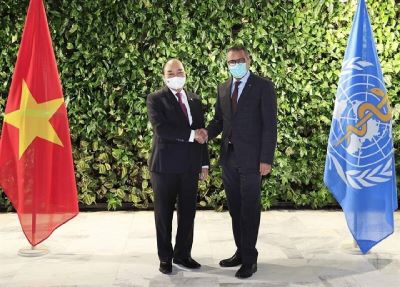
GENEVA — World Health Organisation (WHO) Director-General Tedros Adhanom Ghegreyesus said WHO backs Việt Nam’s proposal of turning itself into a regional hub of vaccine manufacturing.

The WHO chief made the statement in response to an initiative raised by Vietnamese President Nguyễn Xuân Phúc as he visited WHO Headquarters in Geneva, Switzerland, on Sunday (local time) as part of his official trip to the European country.

The meeting also saw the presence of Seth Berkley, CEO of the Vaccine Alliance (GAVI), and Aurélia Nguyen, Managing Director of the COVAX Facility.

President Phúc highly appreciated the coordinating role of WHO in global health issues, especially in setting healthcare standards and guidelines and providing technical support for countries in responding to public health emergencies and building capacity in coping with pandemics.

The Vietnamese President voiced his support for the COVAX Facility and its operators, including WHO and GAVI, in promoting equitable and timely access to COVID-19 vaccines globally. He also took the occasion to announce that Việt Nam will contribute an additional US$500,000 to the COVAX Facility, raising its total voluntary donation to the vaccine-sharing scheme to $1 million.

He proposed WHO, GAVI and COVAX Facility to help Việt Nam enhance the capacity of its healthcare system and immunisation while seeking their support for Việt Nam to become a hub for m-RNA vaccine technology transfer and a vaccine production base for the Western Pacific region.

He requested COVAX to continue to allocate more COVID-19 vaccines to Việt Nam as much as possible and as early as possible, especially vaccines for children, along with support in medical supplies to facilitate vaccination progress in Việt Nam, helping the country keep up its pandemic control efforts now that Việt Nam has switched to the strategy of safe, flexible adaptation to COVID-19.

The Vietnamese leader also expected WHO to offer technical assistance for Việt Nam’s home-grown COVID-19 vaccine Nano Covax to join its global clinical trial programme, to which the WHO chief said he would have discussions with technical departments on the possibility of these trials.

Head of WHO said he is impressed with the efforts and successes of Việt Nam in the COVID-19 fight and socio-economic recovery, and that Việt Nam’s experience could offer valuable lessons for the international community.

Tedros also agreed with the proposal of the Vietnamese President, and is willing to issue a message on the occasion of the International Day of Epidemic Preparedness on December 27 this year at the initiative of Việt Nam.

At the same time, he said that a special WHO meeting is about to take place as a way for countries to discuss the possibility of building a global pandemic control treaty to prevent similar disasters in the future, and hopes Việt Nam would support the idea.

The WHO Director-General thanked Việt Nam for its financial contribution to COVAX and said that it is always ready to work closely and effectively with relevant partners and Việt Nam in ensuring the country’s equitable access to vaccines as well as mRNA vaccine technology transfer. — VNS

Published : November 30, 2021

By : Vietnam News

Xi sets out new China-Africa road map #SootinClaimon.Com

#SootinClaimon.Com : ขอบคุณแหล่งข้อมูล : หนังสือพิมพ์ The Nation.

https://www.nationthailand.com/international/40009429


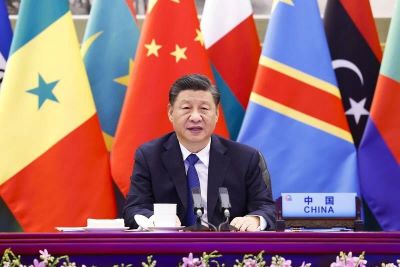
BEIJING – President Xi Jinping outlined on Monday a new road map to build a China-Africa community with a shared future in the new era, as he unveiled nine projects – including an aid package of another 1 billion doses of COVID-19 vaccines – to further cooperation.

Xi made the announcement in a keynote speech delivered via video link from Beijing to the opening ceremony of the Eighth Ministerial Conference of the Forum on China-Africa Cooperation in Dakar, the capital of Senegal.

To help Africa achieve its target of vaccinating 60 percent of its population by 2022, the president said, China will donate 600 million vaccine doses and offer another 400 million doses via joint production by Chinese and local firms.

China will also help African countries implement 10 health programs and send 1,500 medical workers and public health experts to the continent, he added.

This year marks the 65th anniversary of diplomatic relations between China and African countries. Xi said the two sides have forged an unbreakable fraternity in their joint struggle against imperialism and colonialism, and have embarked on a journey of cooperation toward development and revitalization.

“Together, we have written a splendid chapter of mutual assistance amid complex changes and set a shining example for building a new type of international relations,” he said.

He attributed the close relationship to “an everlasting spirit of China-Africa friendship and cooperation forged between the two sides, which features sincere friendship, equality, mutual benefit and common development, fairness and justice”, adding that the relationship had progressed with “openness and inclusiveness”.

Calling it the historic starting point of building a China-Africa community with a shared future in the new era, Xi made a four-point proposal: fighting COVID-19 with solidarity; deepening practical cooperation; promoting green development; and upholding equity and justice.

“We need to open up new prospects for China-Africa cooperation, expand trade and investment, share experience on poverty reduction, strengthen cooperation on digital economy, and promote entrepreneurship by young Africans and the development of small and medium-sized enterprises,” he added.

He underlined the necessity for both sides to promote green development, saying there was a need to advocate green and low-carbon development and actively promote solar, wind and other sources of renewable energy.

In upholding equality and peace, he said China and Africa need to unequivocally stand for the just propositions of developing countries and translate their common aspirations and interests into joint actions.

Xi said China will work closely with African nations to carry out nine programs as part of the first three-year plan under the China-Africa Cooperation Vision 2035.

In addition to health programs, China will undertake 10 poverty reduction and agricultural projects in Africa and send 500 agricultural experts to the continent, he said.

China’s imports from African nations will total $300 billion over the next three years. Fast lanes for African agricultural exports to China will be established by speeding up inspection and quarantine procedures. The number of products enjoying zero-tariff treatment for least-developed countries with diplomatic relations with China will also be increased, he said.

China will provide $10 billion to support African exports. A zone for in-depth China-Africa trade and economic cooperation will be built in China as well as a China-Africa industrial park for Belt and Road cooperation, Xi said.

As part of the investment promotion program, Xi said China will encourage Chinese businesses to invest no less than $10 billion in the continent in the next three years, and will establish a platform for China-Africa private investment promotion.

China will help build or upgrade 10 schools in Africa, and invite 10,000 high-caliber African professionals to seminars and workshops, he said, adding that Chinese companies in Africa will be encouraged to create at least 800,000 local jobs.

South African President Cyril Ramaphosa hailed the role of FOCAC in promoting South-South cooperation and relations between China and African countries. He called it a valuable and practical dialogue that helps to bring about a more equitable international order and amplify Africa’s voice on the world stage.

Since its inception, FOCAC has become an engine of progress and an instrument through which the two sides have forged diplomacy, security, trade and investment ties that bind African countries and China, Ramaphosa said. He added that South-South cooperation has become more important than ever as the two sides work to overcome the pandemic and strive for an equitable global economic recovery.

The triennial event brought together leaders including Senegalese President Macky Sall, Egyptian President Abdel-Fattah al-Sisi and Chairperson of the African Union Commission Moussa Faki Mahamat.

Zhao Jia contributed to this story.

Published : November 30, 2021

By : China Daily

PH changes mind, stops entry of vaccinated tourists due to Omicron variant #SootinClaimon.Com

#SootinClaimon.Com : ขอบคุณแหล่งข้อมูล : หนังสือพิมพ์ The Nation.

https://www.nationthailand.com/international/40009428


MANILA, Philippines — The government has temporarily suspended a decision to allow the entry of fully vaccinated tourists in a bid to prevent a new, heavily mutated coronavirus variant from entering the country as most of the population remains unvaccinated.

PH changes mind, stops entry of vaccinated tourists due to Omicron variant

So far, the Philippines has not reported any cases of the Omicron strain, which was first detected in South Africa in mid-November and has since spread around the globe.

The government announced plans last Nov. 25 to allow fully vaccinated tourists from most countries to enter starting Dec. 1 as it seeks to revive the battered economy.

But the Inter-Agency Task Force for the Management of Emerging Infectious Diseases (IATF) reversed course over the weekend as it also announced the suspension of flights from seven European countries, in addition to an earlier ban on arrivals from several African nations.

“The IATF deemed it necessary to suspend the entry of foreign tourists, given worldwide concerns over the Omicron variant,” Immigration Commissioner Jaime Morente said on Monday.

Covered by the ban are vaccinated foreigners from “green list” and other nonvisa countries, or nationals of 157 states who, in accordance with Executive Order No. 408, are allowed to enter the Philippines without a visa for an initial stay of 30 days. For instance, Brazilians and Israelis can stay in the Philippines visa-free up to 59 days while those coming from India, Hong Kong, Macau and China can stay visa-free from seven to 21 days, depending if they have return tickets or visas issued by other countries, and comply with other requirements.

In his press briefing on Monday, Cabinet Secretary Karlo Nograles, acting presidential spokesperson, said the suspension was only temporary, but did not provide a duration.

“This is temporary due to the Omicron variant. Let us just wait for the latest developments from the IATF. We continue to consult with our health experts [and] continue to actively monitor developments with regard to the Omicron variant… but in the meantime, Resolution No. 159-A (allowing the entry of tourists) is suspended,” he said.

Wider ban

The IATF earlier placed 14 countries under the “red list” barring all inbound foreign travelers. Filipinos coming from those countries through repatriation and mercy flights will be allowed entry but must undergo testing and quarantine.

Those already in transit and coming from the red list countries who will arrive in the Philippines before 12:01 a.m. of Nov. 30 will be allowed entry but will undergo a 14-day facility quarantine with testing on the seventh day.

Those who arrived in the country prior to Nov. 28 must undergo testing, quarantine and monitoring for symptoms.

Nograles also clarified that the IATF would not automatically place under the red list a country or territory where Omicron variant cases have been reported.

The main consideration for red-listing, he said, was the detection of local cases or local transmission in foreign countries.

He added that in the case of Hong Kong and other countries, the Omicron infections were “imported,” or brought by travelers who had come from other countries and tested positive upon arrival or while under quarantine.

If the Omicron cases in a foreign country or territory are imported, the IATF will check if that country or territory is prepared to stop the local spread of the variant. Such country or territory may be retained under the yellow or green list, although Nograles said the IATF, upon the advice of its experts, could “override” the retention.

“If the case is imported, we will check if they (authorities) have intensified or are doing well in their quarantine and testing protocols. If we see and are confident in the quarantine and testing protocols of that country or territory, then we will not red-list it unless we can see that there is a high probability that they have missed out a local transmission of Omicron,” Nograles said.

The secretary said the green or yellow listing could also be overridden by the IATF and its experts if they were “not that confident” in a country or territory’s surveillance activities, genome sequencing and detection of local cases.

Setback

The government has eased virus restrictions in recent weeks as the daily infection rate hovered at the lowest level since the beginning of the year and the nationwide vaccination rate increased.

But the emergence of Omicron has raised fears that quarantine restrictions could be reimposed.

Around a third of the country’s 110 million people are fully vaccinated. The Philippines has recorded more than 2.8 million infections since the start of the pandemic, including over 48,000 deaths.

The temporary travel ban is a major blow to tourism operators, which have been devastated by a plunge in international visitors and restrictions on domestic travel since borders were shut in March 2020.

Tourism is a major driver of the country’s economy, accounting for nearly 13 percent of gross domestic product in 2019, when more than eight million people visited, official data showed.

That slumped to 5.4 percent last year as tourist arrivals plummeted 82 percent to 1.48 million.

—WITH A REPORT FROM AFP 

By: Jerome Aning

Published : November 30, 2021

By : Philippine Daily Inquirer

Japan bans all nonresident foreigners from entering amid omicron’s spread #SootinClaimon.Com

#SootinClaimon.Com : ขอบคุณแหล่งข้อมูล : หนังสือพิมพ์ The Nation.

https://www.nationthailand.com/international/40009427


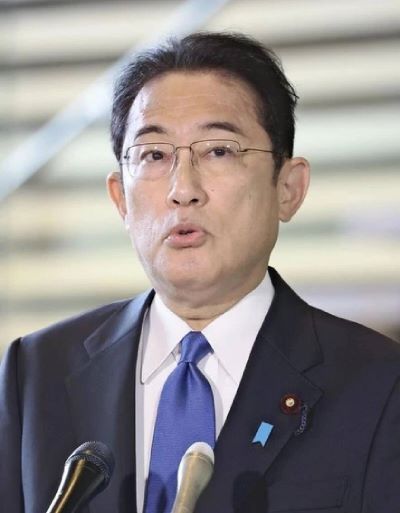
All nonresident foreigners will be banned from entering Japan starting Tuesday, Prime Minister Fumio Kishida announced Monday, amid the rising worry worldwide over the omicron variant of the novel coronavirus.

Kishida called the move “an emergency preventive measure to avoid a worst-case scenario.”

The government currently bans the entry of nonresidents in principle, but had allowed since Nov. 8 some new arrivals under certain conditions. This included short-term business visitors, foreign students and technical interns if they have been fully vaccinated, submit plans about activities in Japan and meet other requirements. Arrivals from nine countries including South Africa had already not been permitted.

Regarding returning Japanese nationals and reentering foreign residents, the government has required those who have recently been to South Africa and eight other African countries to quarantine in facilities designated by the government for 10 days. Such measures will be taken for arrivals from 14 countries and regions where the omicron variant has been confirmed. The government intends to set the quarantine period depending on the situation of each country or region.

Published : November 30, 2021

By : The Japan News

Vietnam faces severe blood shortage during pandemic #SootinClaimon.Com

#SootinClaimon.Com : ขอบคุณแหล่งข้อมูล : หนังสือพิมพ์ The Nation.

https://www.nationthailand.com/international/40009383


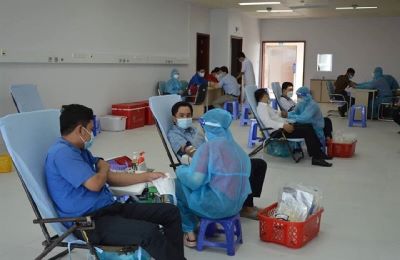
HÀ NỘI — The Central Institute of Hematology and Blood Transfusion (CIHBT) has announced it is facing a severe shortage of blood which is enough for use only in the next few days without further supplies.

Blood storage now stands at only over 4,000 blood units, according to the CIHBT.

Due to the COVID-19 pandemic, the CIHBT had to cancel or postpone 80 blood donation drives in November with an expected reception of 25,000 units.

When social distancing measures were eased and the nation started to implement the policy of safe and flexible adaptation to and effective control of COVID-19, the number of blood donations improved. However, after the number of new COVID-19 cases has increased recently in many localities, blood donations started to decline.

Director of the CIHBT Bạch Quốc Khánh said the appearance of new cases in localities forced blood donation campaigns to be postponed or cancelled. The CIHBT receives just 300-400 blood units per day while it needs around 1,200 blood units to supply more than 180 hospitals each day.

Meanwhile, blood demand is forecast to increase in the year-end period and during the Tết (Lunar New Year) holidays.

Khánh said an estimated 80,000 units are needed for emergencies and treatment at hospitals between December 2021 and February 2022. But blood donation campaigns could only meet around 60 per cent of the demand, he said.

The situation could be improved with support from the community, he said, urging the community to continue donating blood to support treatment, particularly in southern localities that are facing difficulties due to the pandemic. — VNS

Published : November 29, 2021

By : THE NATION

Expert: China capable of dealing with new variant #SootinClaimon.Com

#SootinClaimon.Com : ขอบคุณแหล่งข้อมูล : หนังสือพิมพ์ The Nation.

https://www.nationthailand.com/international/40009382


The new COVID-19 variant Omicron, which the World Health Organization has termed a “variant of concern” and is more transmissible than the dominant Delta strain, will not have a major influence on China at the current phase, Zhang Wenhong, a Shanghai doctor widely known for his pandemic fight, wrote on his Sina Weibo on Sunday.

“China’s current strategies of rapid response and dynamically zeroing cases will be able to cope with various types of variants of the novel coronavirus,” wrote Zhang, leader of the Shanghai team of experts in the clinical treatment of novel coronavirus pneumonia cases.

“China is currently accelerating building up scientific support, including reserves of effective vaccines and drugs as well as public health and medical resource that can support China’s large-scale opening to the world and empower the country to deal with normalized pandemic fight in the next stage,” he wrote.

With science and solidarity, the country will cope with the Omicron variant properly just as how it has done with Delta, said Zhang, who is also director of the infectious diseases department at Huashan Hospital Affiliated with Fudan University.

Zhang wrote that it will take the world around two weeks to see whether the new variant will pose threat to the vulnerable immunity of population that has taken shape in some societies initially.

He also explained why some countries, such as the United Kingdom and Israel, have tightened up pandemic prevention restrictions on inbound travelers.

“Over 80 percent of the citizens in those two countries have been fully vaccinated. If the new variant is able to break through the immune barriers there, the world may have to change its COVID-19 vaccination mechanism – adjusting it to something like the influenza vaccination, which requires researchers to device a new vaccine according to the virus’ mutation each year,” he wrote.

Published : November 29, 2021

By : China Daily

India third country in organ donation and transplantation: Report #SootinClaimon.Com

#SootinClaimon.Com : ขอบคุณแหล่งข้อมูล : หนังสือพิมพ์ The Nation.

https://www.nationthailand.com/international/40009381


Now India ranks third in the world in organ donation and transplantation as the total number of organ transplants done per year in the country has increased to 12,746 in the year 2019, Union Minister for Health and Family Welfare (MoHFW) Mansukh Mandaviya said here on Saturday

Citing a report by Global Observatory on Donation and Transplantation (GODT), Dr. Mandaviya said, “It makes me immensely proud to share that the total number of organ transplants done per year in the country has increased from 4,990 in the year 2013 to 12,746 in the year 2019 and India now ranks third in the world only behind USA and China as per the data available on the Global Observatory on Donation and Transplantation (GODT) website.”

Addressing the 12th Indian Organ Donation Day in the presence of Union Minister of State for Health and Family Welfare Bharati Pravin Pawar, he said, “The organ donation rate has increased to about four times as compared to 2012-13. However, we are still facing a huge gap between the number of patients requiring transplantation and the number of people who consent to donate their organs after death.”

Further, the organ donation and transplantation activities have been negatively impacted due to the Covid-19 pandemic which we hope to leave behind soon,” he added.

Linking the act of organ donation to the Indian values, he said, “Our culture puts emphasis on ‘Shubh’ and ‘Laabh’ where individual well-being is rooted with the greater good of the community. Society is fast changing and with the sanctity and preciousness of each and every life becoming visible to all, soon people who have committed ‘Angdaan’ will be viewed with the same respect accorded to those who give away hard-earned wealth to charity.”

Since the year 2010, Indian Organ Donation Day is celebrated every year to commemorate the contributions made to society by deceased donors and their families. At the event, the State Organ and Tissue Transplant Organization (SOTTO) of Maharashtra won the award for the highest number of deceased donors transplantations while Regional Organ and Tissue Transplant Organization (ROTTO) for the Western Region was recognised for best performance.

Published : November 29, 2021

By : The Statesman

Amid omicron worries, Japan reinforces border control at major international airports #SootinClaimon.Com

#SootinClaimon.Com : ขอบคุณแหล่งข้อมูล : หนังสือพิมพ์ The Nation.

https://www.nationthailand.com/international/40009380


To keep a new coronavirus variant called omicron at bay, the health ministry has reinforced border control measures.

Arrivals at international airports including Narita, Haneda and Kansai with a previous record of staying in any designated country such as South Africa will as of Saturday have to take different routes through the airport to avoid contact with other passengers.

At Narita International Airport, quarantine officers are confirming whether incoming passengers had stayed in any of the designated countries by checking their written pledges of the places they visited in the past two weeks and their physical condition.

When they are found to have stayed in any designated country, they are asked to self-isolate at lodging facilities designated by the government for 10 days upon entry.

“To keep the variant at bay, we are trying to inquire where people had recently stayed more carefully than before,” one quarantine officer said.

At the major international airports, novel coronavirus infection tests are also being conducted on incoming passengers as before. First, an antigen test that gives a result in a short amount of time is given. If passengers who test negative to this rapid antigen test have levels of antigens close to the positive threshold, they will undergo a PCR test to closely check whether they are infected with the virus.

■ 32 spike mutations

The National Institute of Infectious Diseases on Friday categorized omicron as a variant of interest, the second of three levels of precaution. As of that day, there had so far been no omicron variant detected in the country, including among people in quarantine. The institute said it has not obtained sufficient information about the characteristics of the new variant, nevertheless, it has reinforced its surveillance arrangement.

The omicron variant has been found to have as many as 32 mutations just on its surface spikes, which help the virus bond with human cells.

According to an analysis conducted by Keio University, the new variant has mutations common with those of the alpha variant, which first emerged in Britain, and the Indian variant labeled delta. Both of these variants later spread around the world.

But omicron is considered to have mutated through a system different from those of the alpha or delta variants, and even from the beta variant that first emerged in South Africa.

“As it differs in system from prevailing variants in the past, the mutations may have accumulated in this variant while going under the radar in Africa,” said Kenjiro Kosaki, a professor at Keio University and scholar on clinical genetics who analyzed the new variant. Its infectivity and degree of seriousness remain unknown,.

“In some areas of South Africa, the new variant has supplanted the highly infectious delta variant,” said Atsuo Hamada, a specially appointed professor at Tokyo Medical University and an expert on travel medicine. “As there are many mutations on the virus surface, it is likely to have increased its infectivity.”

The infection situation in Japan is reckoned to be in a lull, with the fifth wave of infection brought under control, but Hamada was wary.

“If the efficacy of vaccines and therapeutics weakens,” he said, “the ‘exit strategy’ of aiming to get socioeconomic activities back to normal may have to be withdrawn in Japan and the world over.”

Published : November 29, 2021

By : The Japan News