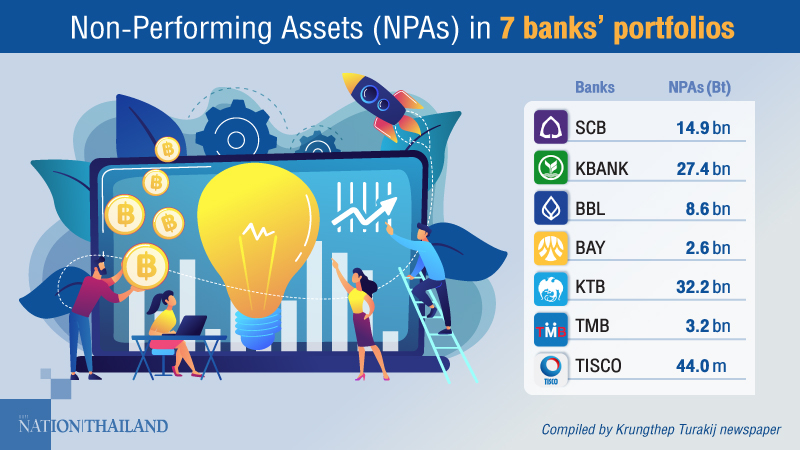
Four major Thai banks say they will focus on managing their asset quality instead of dumping non-performing loans under unfavourable market conditions.
Payong Srivanich, president of Krungthai Bank, said KTB’s priority was to maintain asset quality and look after debtors. He expects the bank’s non-performing loans to remain flat at the 4.21 per cent of total loans registered in the third quarter.
He said KTB regularly sells its non-performing asset (NPAs) as part of debt management measures, but the large volume now being sold made the market unfavourable.
“If we can’t get good prices for our NPAs, we will not sell them,” he said.
The bank is also cutting its exposure to concentrated risks. For example, it is reducing the proportion of total industrial loans to the rice sector from 60 per cent, and has cut lending to cooperatives from Bt70 billion to Bt30 billion, all of which must be backed by collateral.
Kasikornbank CEO Kattiya Indaravijaya said it, too, was choosing to manage bad debts rather than sell them on. The bank is supporting customers by restructuring their loan conditions to manage bad debt.
“We are confident that we can manage bad debts better than in the past when we usually chose to sell them on,” said Kattiya.
Deja Tulananda, chairman of Bangkok Bank’s board of executive directors, said its priority was to preserve asset quality rather than sell bad debt. By doing so, the bank could cover loans and also benefit borrowers, he assured.
“We remain focused on debt management and, under the central bank’s supporting policy, we are confident that we can take better care of our debtors and prevent bad debt from rising,” he said.
Piti Tantakasem, CEO at TMB Bank, said the bank will maintain its push for provisions against risk assets begun in the third quarter. Currently, NPLs were not high, accounting for just 2.3-2.4 per cent of total loans and should not exceed 3 per cent by the end of this year, he said.
The bank will delay selling NPAs this year in order to avoid flooding the market, he added.
Covid-19 second wave to hit year-end spending by Bt16 billion, economist warns
EconDec 13. 2020A tourist looks out at the Khanom-Sichon Sea in Nakhon Si Thammarat province on December 10.
By The Nation
The second wave of the Covid-19 outbreak will cost local tourism around Bt16 billion during the New Year holidays, says an economist.
Anusorn Tamajai, former dean at Rangsit University’s Faculty of Economics, estimated that the second wave of Covid-19 infections would cost the local tourism industry Bt14.1 to Bt16.9 billion in lost revenue during the New Year festival.
His analysis comes amid rising cases of local infections after some infected patients entered Thailand illegally from Myanmar. While the United States has the most number of cases with over 16.5 million, followed by India — almost 10 million — Thailand ranks 151st among countries with over 4,000 cases.
He was optimistic that the number of new cases in Thailand would be contained as the government had put in place an effective tracing system.
Prime Minister Prayut Chan-o-cha earlier insisted that Thailand had not yet experienced a second wave.
Anusorn, however, said that concerns over the rising number of new cases was expected to discourage many people from travelling and spending during the year-end holiday season.
Revenue from Thai travellers during the last New Year was Bt28 billion. Many research houses have estimated that Thai consumers will cut their spending significantly while those who live in Bangkok are expected to spend about Bt30 billion, but it is below the average spending of the past two decades, he said.
Anusorn, however, added that if Thailand could not contain the second wave the Thai economy next year may grow less than 4 per cent, while the rising number of new cases in Thailand’s trading partner countries would adversely affect Thai exports up to the first quarter of next year.
The National Economic and Social Development Council has forecast that the Thai economy will expand 4 to 5 per cent next year.
Regarding financial markets, Anusorn predicted that gold price would test a barrier at US$2,000 per ounce, as investors are worried about risk assets stemming from the delay in the US stimulus package and the possibility of a no-deal Brexit.
In the short run, gold price next week may move up to $1,845 to 1,850 per ounce, he said, while gold bar in Thailand may rise to Bt26,150 to 26,600 per baht weight.
The Thai baht is expected to appreciate further after it rose almost 4 per cent last month. The baht could rise to Bt29.50 per dollar by the end of this year, strengthening from the Bt30 level, he predicted. Foreign investors had net buys of Thai stocks worth Bt50 billion over one month and bonds worth Bt20 billion. They could sell Thai financial assets to make a profit before Christmas, he warned.
Meanwhile, the rising unemployed benefit claims in the US had put high pressure on the dollar, he said.
The US economy has shown signs of decelerating at the end of this year. The return of the global economy to normal next year would depend on the effectiveness of the Covid-19 vaccines, he said.
He did not expect the US Federal Reserve and Bank of Japan to further loosen monetary policies during their meeting next week.
By The Washington Post · David J. Lynch · NATIONAL, BUSINESS, WORLD, US-GLOBAL-MARKETS
It takes more than mass death and suffering to throw Wall Street off stride.
The coronavirus may be killing 3,000 Americans each day while lawmakers bicker over how to help the wounded U.S. economy. Yet stock prices keep powering higher. By one measure, shares are more expensive relative to earnings than they were on the eve of the 1929 crash.
Three U.S. stock markets hit all-time highs within the past week, and the value of all global shares for the first time topped $100 trillion as investors bet on a post-pandemic return to normal in 2021. The stock price of rental marketplace Airbnb more than doubled Thursday, even as the Labor Department said nearly 1 million more Americans had applied for unemployment benefits, neatly capturing the tension between a bubbly stock market and grass-roots anguish.
“We’re in a euphoric, frothy kind of market,” said Liz Ann Sonders, chief investment strategist for Charles Schwab & Co. “Is there speculative fever? Absolutely.”
Yet the bull market may just be getting started. With the Federal Reserve planning to hold its benchmark lending rate near zero for at least three years, stocks are likely to remain attractive in comparison with bonds, according to investment strategists.
Soaring stocks would cheer millions of Americans. But rapid financial market gains amid a grinding labor market comeback could make it harder for President-elect Joe Biden to achieve his goal of building an economy that works “for all Americans.”
A rising market would mostly benefit the already affluent; only 14% of individuals in the bottom one-fifth of the income distribution own stocks, either directly or through retirement accounts, according to the Federal Reserve. An uninterrupted bull market also might erode support for government spending to help ailing businesses or the jobless, if some lawmakers interpret higher share prices as a sign of economic health.
“A huge amplifier of the inequality trifecta – of income, wealth and opportunity – the covid shock has pulled the Federal Reserve deeper into policies that are inadvertently worsening wealth disparities,” said Mohamed El-Erian, an economist and president of Queen’s College, Cambridge, in England.
As financially comfortable Americans grow richer, low-income service industry workers – disproportionately people of color – are likely to struggle to reclaim their jobs in hotels and restaurants. Such an uneven recovery threatens to exacerbate a rich-poor divide that Biden has vowed to narrow.
This summer, Biden called for legislation to add to the Fed’s existing twin mandate to provide full employment and stable prices a focus on mitigating “persistent racial gaps in jobs, wages, and wealth.” That proposal, at least at first, is likely to be eclipsed by what many economists say is an urgent need for Congress to approve more aid for small businesses, the unemployed, and state and local governments.
“Relying on easy monetary policy will increase inequality. What we really need is fiscal policy to upgrade our workforce, generate good (high wage, high hour) jobs,” economist Megan Greene, a senior fellow at Harvard University’s Kennedy School of Government said via email. “Central banks have fairly blunt tools, and monetary policy is a poor stand-in for these measures.”
The recent stock market gains also have raised alarms among global central banks and finance officials, who warn of risks to the financial system. From their March lows, the technology-rich Nasdaq index is up more than 80% and the Dow Jones industrial average has gained more than 60%, even as the recovery has sagged.
The stock market rally appears, for some, to be detached from economic reality.
The Bank of International Settlements, a global organization of central banks in Basel, Switzerland, said this month that “a certain amount of daylight” had opened up between companies’ high stock prices and their earnings prospects while the pandemic ravages major economies.
In November, the Fed said financial markets were vulnerable if the economic recovery or efforts to combat the coronavirus proved disappointing, echoing an earlier caution from the International Monetary Fund.
Only during a three-year period at the end of the 1990s technology bubble have stocks been pricier, based on the ratio of 10-year earnings to share prices. But with corporations and individuals sitting on enormous piles of cash, shares could be driven even higher.
Lofty stock values are defying significant health, economic and political risks. Nine months after the pandemic first disrupted American life, the United States is entering the most punishing phase of its encounter with the novel coronavirus.
“Probably for the next 60 to 90 days, we’re going to have more deaths per day than we had at 9/11 or we had at Pearl Harbor,” Robert Redfield, director of the Centers for Disease Control and Prevention, said Thursday during a Council on Foreign Relations event.
After this summer’s faster-than-expected economic rebound, the recovery in recent weeks has sputtered. November’s job growth was the weakest since spring, and lawmakers have not been able to agree on a new relief package.
The political climate is further complicated by the president’s attempt to overturn his loss in the Nov. 3 election and uncertainty over which party will control the Senate, a question that is to be settled in Georgia’s twin Jan. 5 runoffs.
Yet stock investors remain sanguine. One relative sentiment gauge maintained by the Chicago Board Options Exchange stands at its most bullish level in 23 years.
Over the past three months, more than one-third of the money that individual investors pumped into exchange traded funds went into stocks, making it the most popular single category, according to Arbor Data Science research.
Some individual stocks have done especially well. Shares of the electric-car maker Tesla have jumped more than 50% since the Nov. 17 announcement that it would join the S&P 500 this month. On Wednesday, shares of DoorDash, the meal delivery service, rose 86% in their first day of trading.
New investors have flocked to stock trading during the pandemic, at times overwhelming market infrastructure. Earlier in the week, two popular trading platforms – Interactive Brokers and Robinhood – suffered systems outages, leaving retail investors unable to access their accounts for hours.
On Wednesday, President Donald Trump tweeted an all-caps celebration of the markets’ performance: “STOCK MARKETS AT NEW ALL TIME HIGHS!!!”
Based on standard historical measures, stocks are not inexpensive.
As of Dec. 1, the S&P 500 index – a broad market gauge – was valued at levels it has reached during only three periods in 140 years, according to a measure developed by Robert Shiller, a Yale University economist, which compares stock prices to a 10-year earnings average.
This cyclically adjusted price-to-earnings ratio often reaches a peak before stocks plummet. But a high reading doesn’t signal an imminent price decline, only lower stock returns over the next 10 years.
The tool, which Shiller introduced in 1988, may be outdated. An improved version, which takes account of low interest rates, suggests that stocks remain a better bet than bonds.
“Stock-market valuations may not be as absurd as some people think,” Shiller wrote in a recent article for Project Syndicate, a nonprofit media organization.
The case for a continued stock surge rests on global central bank policies, which have flooded markets with $7.5 trillion to offset the pandemic’s negative effects. In the United States, the Fed acted quickly in March to reduce borrowing costs for corporations and governments by buying large amounts of securities. Financial conditions now are the easiest in at least 30 years, according to a Goldman Sachs index.
As of June 30, U.S. companies held more than $2.5 trillion in cash, up 35% from one year earlier, according to S&P Global Ratings. Some companies, including home builder Toll Brothers and retailer AutoZone, have said they plan to use some of their surplus cash to repurchase their own shares, which typically drives stock prices higher.
Likewise, individual investors have more than $4.3 trillion available in money market accounts, roughly $1 trillion more than they did last summer, according to the Investment Company Institute, an industry group.
“People are still sitting on cash, and global central banks are printing money,” said Michael Lewis, Barclays head of U.S. stock trading.
With interest rates low, alternatives to stocks are unappealing. Nearly $18 trillion in bonds are trading with negative yields – meaning investors who hold them to maturity will receive less money than they put in.
The last time stocks were this expensive, according to Shiller’s calculations, in the late 1990s, 10-year treasuries paid investors annual interest of around 5%. Today, those securities pay less than 1%, providing little competition for stocks.
“There’s no alternative,” said Meghan Shue, head of investment strategy for Wilmington Trust. “Investors are forced to go into stocks to get higher returns.”
High stock prices anticipate a strong recovery in 2021 as a coronavirus vaccine is widely distributed and workers and businesses gradually resume their pre-pandemic lives. Since profits typically rise faster than sales during recoveries, earnings for companies in the S&P 500 will rise 29% next year, Goldman said.
But to achieve that, they will first have to navigate what Biden has called “a very dark winter” of death and disease.
“It’s certainly a bit disconcerting,” Shue said. “But there may be a bit more to go.”
Stocks pare drop on stopgap bill amid aid deadlock
EconDec 12. 2020A Wall Street sign. MUST CREDIT: Bloomberg photo by Mark Kauzlarich.
By Syndication Washington Post, Bloomberg · Rita NazarethStocks pared losses as lawmakers passed a stopgap spending bill to avert a federal-government shutdown, but gave no signals of an imminent stimulus deal.
In a volatile session, the S&P 500 quickly trimmed a slide that reached about 1% earlier Friday. The equity benchmark still notched its worst weekly decline since October amid an impasse over a relief package and concern over tougher restrictions as coronavirus cases swept across the nation. The tech-heavy Nasdaq 100 underperformed as giants Facebook Inc. and Tesla Inc. slumped more than 1.2%. The Dow Jones industrial average advanced as Walt Disney Co. soared to an all-time high after a bold forecast for its new streaming services.
With the clock ticking down on stimulus as lawmakers approach their year-end break, bipartisan talks are hung up on differences between Republicans and Democrats on shielding companies from virus-related lawsuits. While both sides are closer than ever to agreeing on a price tag — coalescing around a $900 billion figure — there’s no sign they can get a deal anytime soon. In the meantime, the U.S. appears poised to cross 300,000 covid-19 deaths in the next week, a sign of the unprecedented gravity of the pandemic as states prepare for their first vaccinations.
“It’s essential that Congress puts aside differences and finds agreement on a stimulus program before the end of the year,” said Craig Erlam, senior market analyst at Oanda. “Lawmakers are running out of time.”
Earnings estimates for the next two years make U.S. stocks look more costly in historical terms than just one year’s worth of projections, or even past results.
The S&P 500 closed Thursday at 26 times earnings, using a gauge that takes estimates for the longer time period into account. That’s close to the Sept. 2 ratio of 27.2, the highest since data compiled by Bloomberg starts in 1990. This indicator was cited by Jeffrey Gundlach, chief executive officer of DoubleLine Capital LP, in a presentation Tuesday. The benchmark hasn’t set a similar high relative to the past year’s earnings or next year’s estimates.
Elsewhere, the pound fell after Prime Minister Boris Johnson and European Commission President Ursula von der Leyen both warned that a no-deal Brexit is looming on Dec. 31 as they continued last-ditch talks to try to reach a deal before Sunday.
These are some of the main moves in markets:
Stocks
– The S&P 500 fell 0.1% as of 4 p.m. EST.
– The Stoxx Europe 600 Index declined 0.8%.
– The MSCI Asia Pacific Index climbed 0.3%.
Currencies
– The Bloomberg Dollar Spot Index gained 0.2%.
– The euro fell 0.2% to $1.2115.
– The British pound declined 0.6% to $1.322.
– The Japanese yen appreciated 0.2% to 104.02 per dollar.
Bonds
– The yield on 10-year Treasuries fell one basis point to 0.89%.
– Germany’s 10-year yield dipped three basis points to -0.64%.
– Britain’s 10-year yield decreased three basis points to 0.172%.
Commodities
– West Texas Intermediate crude dipped 0.4% to $46.58 a barrel.
The Excise Department is looking for ways to overhaul the entire vehicle excise system with the aim of using tax incentives to promote the wider use of electric vehicles (EVs), director-general Lavaron Sangsnit said.
The levy on EVs is 8 per cent, while that on EVs produced under the Board of Investment’s tax support was cut to 0 per cent from 2 per cent as of January 2020 to December 31, 2022.
Krisda Utamote, president of the Electrical Vehicle Association of Thailand, said that apart from supporting EV makers, the government should offer benefits to users, such as offering free charging and promoting large-scale chargers.
By Syndication Washington Post, Bloomberg · Rita Nazareth, Kamaron Leach
Stocks were mixed as traders assessed prospects for fresh stimulus amid the most-intense negotiations since Election Day.
The S&P 500 came off session lows, but closed down for a second day. The Nasdaq 100 climbed while the Dow Jones industrial average underperformed. Airbnb Inc. more than doubled in its trading debut. Treasuries gained after a strong 30-year bond auction dispelled concerns that this week’s debt sales could prove too large to be palatable for investors. The pound slid as U.K. Prime Minister Boris Johnson warned Britain should prepare to leave the European Union’s single market without a trade deal.
The fate of an additional relief package remains unresolved as Democrats and Republicans continue to negotiate. If a deal isn’t reached by the end of 2020, millions of Americans could start the new year with lapsed unemployment benefits. A bipartisan group of lawmakers agreed on a needs-based formula to distribute their proposed state and local aid, according to an aide to one of the senators. But negotiations continue to be bogged down by differences over shielding employers from liability for covid-19 infections. Earlier Thursday, Treasury Secretary Steven Mnuchin and House Speaker Nancy Pelosi, D-Calif., cited progress toward an agreement.
“We’re just kind of waiting on a deal,” said Keith Gangl, a portfolio manager of Gradient Investments. “I wouldn’t expect the market to do a whole lot one way or the other going into year-end from here,” he noted, “especially if the stimulus package keeps getting pushed out.”
Elsewhere, the euro rose after policymakers escalated their efforts to shield the region from a possible double-dip recession with another burst of monetary stimulus, while cautioning that it may not use up all the new firepower.
These are some of the main moves in markets:
Stocks
– The S&P 500 fell 0.1% as of 4 p.m. EST.
– The Stoxx Europe 600 Index dipped 0.4%.
– The MSCI Asia Pacific Index lost 0.2%.
Currencies
– The Bloomberg Dollar Spot Index fell 0.1%.
– The euro rose 0.4% to $1.213.
– The British pound decreased 0.8% to $1.3287.
– The Japanese yen was little changed at 104.25 per dollar.
Bonds
– The yield on 10-year Treasuries decreased two basis points to 0.92%.
– Germany’s 10-year yield rose less than one basis point to -0.60%.
– Britain’s 10-year yield dipped six basis points to 0.201%.
Commodities
– West Texas Intermediate crude jumped 2.9% to $46.86 a barrel.
International trade promotion department makes plans to boost Thai exports in 2021
EconDec 11. 2020The department’s director general Somdet Susomboon
By The Nation
The Department of International Trade Promotion (DITP) has outlined plans to boost export next year with a focus on online trade promotion activities, the department’s director general Somdet Susomboon said.
It will arrange an online business match-making every week or 22 activities in the first half of 2021, focusing on products in the categories of health care, auto parts, spa, furniture and jewellery. In the second quarter, it plans to cover the categories of mothers and children, pet food, food and beverage, rubber and medical devices.
DITP will also bring Thai exporters to international expositions ranging from Tokyo International Gift Show to Gulfood in the Middle East, and will also join with foreign department stores and importers to promote Thai products.
In addition, DITP plans to promote the promote the export of palm oil to India in a bid to cash in on India’s reduction of import tariff on crude palm oil to 27.5 per cent from 37.5 per cent to cater to domestic consumption.
India is among the world’s largest importers of palm oil, accounting for US$3.22 billion worth of palm oil import between January and September this year, up 31.61 per cent year on year. Indonesia provided 69.61 per cent of the palm oil in India, followed by 24.53 per cent from Malaysia, 3.72 per cent from Singapore and 1.93 per cent worth $62.17 million from Thailand. Palm oil export from Thailand to India fell 28.64 per cent from the same period last year.
Somdet believes the reduction in import tariff in India should offer Thai exporters an opportunity to enter the country.
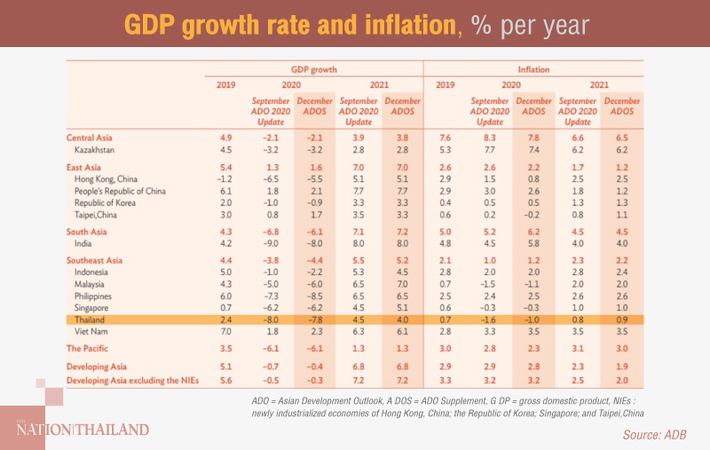
The Thai economy will grow 4 per cent next year – more than 1 percentage point lower than Southeast Asia’s average, according to the latest forecast by the Asian Development Bank (ADB).
On Thursday, the bank downgraded the Asean region’s outlook for 2021, with Southeast Asia now expected to grow 5.2 per cent next year compared to 5.5 per cent forecast in September.
The ADB also downgraded its 2020 GDP forecast for Southeast Asia to -4.4 per cent from -3.8 per cent in September. It projects the Thai economy this year will contract 7.8 per cent, down sharply from 2.4 per cent growth last year.
The ADB’s 2020 GDP forecast for developing Asia is raised to -0.4 per cent, with 6.8 per cent growth expected in 2021 as the region continues to recover from the Covid-19 crisis.
The new 2020 GDP forecast, published in a supplement to the Asian Development Outlook (ADO) 2020 Update, is an improvement from the -0.7 per cent forecast in September, while the outlook for 2021 remains unchanged.
However, prospects are diverging within the region, with East Asia set to grow this year while subregions including Southeast Asia contract.
East Asia is the exception, with an upgraded growth forecast of 1.6 per cent for 2020 on the back of faster than expected recoveries in China and Taiwan. East Asia’s growth outlook for 2021 is maintained at 7 per cent.
South Asia’s GDP is forecast to contract by 6.1 per cent in 2020, revised up from the 6.8 per cent contraction expected in September. Growth in South Asia is forecast to rebound to 7.2 per cent in 2021. The growth forecast for India, the subregion’s largest economy, for fiscal year 2020 is raised to -8 per cent, from the -9 per cent projection in September, while outlook for 2021 is kept at 8 per cent.
“The outlook for developing Asia is showing improvement. Growth projections have been upgraded for [China] and India, the region’s two largest economies,” said ADB chief economist Yasuyuki Sawada. “A prolonged pandemic remains the primary risk, but recent developments on the vaccine front are tempering this. Safe, effective, and timely vaccine delivery in developing economies will be critical to support the reopening of economies and the recovery of growth in the region.”
Exports are rebounding quickly from substantial declines in the second quarter, said the bank. Mobility is also returning to pre-pandemic levels in East Asia and the Pacific, though recovery in tourism is likely to be delayed, it added.
The outlook for the Pacific is unchanged for both 2020 and 2021 at -6.1 per cent and 1.3 per cent, respectively. Central Asia’s growth forecast for 2020 remains at -2.1 per cent, but the outlook for 2021 is slightly downgraded to 3.8 per cent from the 3.9 per cent growth projected in September.
Asian inflation is expected to marginally ease to 2.8 per cent in 2020, from the 2.9 per cent projected in September, due to depressed demand and low oil prices. Inflation for 2021 is forecast at 1.9 per cent, down from 2.3 per cent forecast in September. Oil prices are retained at $42.5 per barrel in 2020 before increasing to $50 per barrel in 2021.
By Syndication Washington Post, Bloomberg · Rita Nazareth, Claire Ballentine
A sell-off in some of the world’s biggest technology companies weighed heavily on the equity market, dragging down stocks amid dimming prospects for fresh stimulus.
The S&P 500 slid from a record, while the Nasdaq 100 had its biggest slump in a month. Facebook Inc. sank after being sued by U.S. antitrust officials, while Tesla Inc. tumbled as JPMorgan Chase & Co. called it “dramatically” overvalued. Zoom Video Communications Inc., one of the biggest stay-at-home winners, plunged after an analyst downgrade. The Russell 2000 index of smaller companies was down half as much as the tech-heavy gauge. DoorDash Inc. defied the market weakness — almost doubling in its debut — before Airbnb Inc.’s initial public offering.
Stocks took a nosedive Wednesday as it became clear that a stimulus deal remains elusive amid the most-intense negotiations over a covid-19 package since Election Day. The Democratic and Republican lawmakers working on a relief plan delivered a more-detailed summary of their proposal, but haven’t yet resolved the deadlock over a business liability shield as well as aid to state and local governments.
“To the extent they can’t come to an agreement on stimulus given the heightened urgency, given the recent outbreak, that’s a bad message,” said Mark Heppenstall, chief investment officer for Penn Mutual Asset Management. “I do think stimulus is coming and I think the market was more prepared for it to be this year than next year.
These are some of the main moves in markets:
Stocks
– The S&P 500 declined 0.8% as of 4 p.m. EST.
– The Stoxx Europe 600 Index advanced 0.3%.
– The MSCI Asia Pacific Index climbed 0.5%.
Currencies
– The Bloomberg Dollar Spot Index increased 0.1%.
– The euro dipped 0.2% to $1.2082.
– The British pound gained 0.3% to $1.3401.
– The Japanese yen was little changed at 104.21 per dollar.
Bonds
– The yield on 10-year Treasurys increased two basis points to 0.93%.
– Germany’s 10-year yield rose less than one basis point to -0.61%.
– Britain’s 10-year yield climbed less than one basis point to 0.261%.
Commodities
– West Texas Intermediate crude was little changed at $45.57 a barrel.
By Syndication Washington Post, Bloomberg · Ranjeetha Pakiam, Eddie Spence
Gold declined from a two-week high as investors weighed vaccine roll-outs against surging covid-19 cases and fresh hopes for a U.S. stimulus deal.
U.S. regulators gave early indications they may grant emergency-use authorization to Pfizer Inc.’s shot, calling it highly effective with no safety concerns, although the U.K. said those with a significant history of allergies shouldn’t take it. Trial results found that the vaccine developed by the University of Oxford and AstraZeneca Plc is safe and effective, though more analysis will be required to see how well it works in people over 55.
On the stimulus front, Treasury Secretary Steven Mnuchin presented a $916 billion coronavirus relief proposal to House Speaker Nancy Pelosi, opening up a potential new path to a year-end deal. The offer crucially has the support of Senate Majority Leader Mitch McConnell, though its omission of supplementary jobless benefits remains a sticking point with Democrat leaders.
While vaccine developments have curbed haven demand, bullion is still heading for the biggest annual gain in a decade amid unprecedented amounts of stimulus to prop up economies. Top central banks are embarking on fresh waves of bond-buying, with the European Central Bank expected to increase its purchase plans when it meets on Thursday.
“The gold price is likely to close 2020 with a notable plus, despite the sizable losses in autumn,” Carsten Fritsch, an analyst at Commerzbank AG, wrote in a note. “We do not expect a change in the ultra-expansionary monetary and fiscal policy despite the upcoming vaccinations.”
Spot gold declined 0.7% to $1,857.10 an ounce by 12:43 p.m. in London, after touching the highest since Nov. 23 on Tuesday. Silver dropped 1.5%, platinum fell 1.1% and palladium was little changed. The Bloomberg Dollar Spot Index fell 0.2%.

 A tourist looks out at the Khanom-Sichon Sea in Nakhon Si Thammarat province on December 10.
 A Wall Street sign. MUST CREDIT: Bloomberg photo by Mark Kauzlarich.
  Director-general Lavaron Sangsnit
 The department’s director general Somdet Susomboon