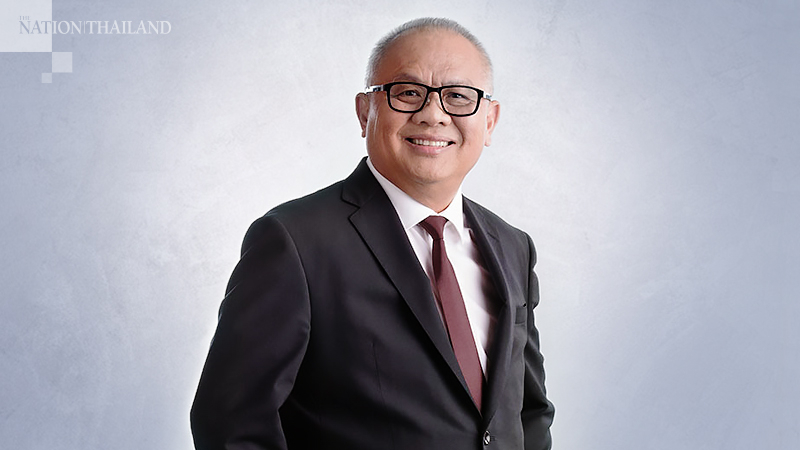
Thailand’s rice export this year is expected to drop from 7.5 million tonnes worth Bt130 billion last year to 5 million tonnes worth Bt115 billion, honorary president of the Thai Rice Exporters Association Chookiat Ophaswongse said.
He attributed the drop to the strengthening baht and low rice production.
The price of Thai white rice is currently around US$490 per tonne, compared to Vietnamese white rice at $460 per tonne, Indian at $370 per tonne and Myanmar at $420 per tonne.
White rice accounts for 50 per cent of Thailand’s total rice exports.
He said Malaysia has only purchased 40,000 tonnes of Thai white rice this year, compared to its usual 400,000 tonnes per year, adding that it has switched to rice from Vietnam, India and Myanmar instead.
Meanwhile, the Philippines has imported 1.8 million tonnes of rice this year, 1.7 million tonnes of which came from Vietnam and only around 60,000 tonnes came from Thailand. Previously, Thailand used to export around 500,000 tonnes of rice to the Philippines.
Separately, Thailand has exported 4 million tonnes of rice in the first nine months of this year, averaging at between 300,000 and 400,000 tonnes monthly. If it wants to achieve the goal of exporting 6.5 million tonnes this year, then it will have to sell at least 500,000 tonnes monthly, which he said is difficult to achieve.
The Government Housing Bank (GHB) will propose to the next finance minister schemes to support homebuyers affected by the Covid-19 crisis, a source said.
The government may need to provide a one percentage point interest rate subsidy, paid directly to homebuyers, he said. Many customers of the bank have been hit hard by the virus fallout. Many of them were laid off or their income decreased, especially those working in airlines and related tourism industries.
The mortgage rate is currently at about 6 per cent. The government could offer a one percentage point in financial relief for homebuyers, limiting the aid to homes priced at not more than Bt3 million, the source suggested.
Property developers, especially those involved in condominium residential projects, had earlier asked the government to increase the ownership limit for foreigners eligible to possess residential units from the current not exceeding 49 per cent of each project. Condominium developers are faced with oversupply problems.
Meanwhile, Chatchai Sirilai, president of Government Housing Bank, said that
despite the coronavirus outbreak, GHB’s new mortgage lending is expected to meet the target of Bt210 billion for the year, up 3 per cent over last year.
As of October 1, new lending rose to Bt156.7 billion.
Customers are taking advantage of the low interest-rate environment and some groups are not much affected by the virus outbreak.
Mortgage lending next year is projected to be about Bt215.6 billion, and Bt222.1 billion in 2022, he said. Outstanding loans at the end of August were at Bt1.273 trillion. Accumulated lending is projected to be Bt1.374 trillion in 2021 and Bt1.444 trillion in 2022.
The state-owned bank will transform itself into digital banking services by driving up to 80 per cent of total transactions to the virtual platform by 2022.
The bank, the largest mortgage lender, will also raise funds via a new batch of lottery-linked savings products at Bt 5,000 per unit.
Non-performing loans amount to Bt51.6 billion, accounting for 4 per cent of outstanding loans.
Prime Minister Prayut Chan-o-cha earlier said that he would appoint a new finance minister this month after incumbent Pridi Daochai resigned after less than a month in office.
The Bank of Thailand (BOT) is considering extending the debt moratorium for some business groups, such as those related to the tourism industry like hotels.
The move would be in line with the intent expressed by BOT Governor Veerathai Santiprabhob to extend the debt moratorium for another six months, which will be reviewed twice or extended until the end of 2021.
One of the BOT’s concerns is about the debt quality of financial institutions, as 12.5 million debtors are part of the debt restructuring project. Interest payments worth Bt7.2 trillion have been suspended until October.
The first round of the BOT’s debt restructuring process is still ongoing. There is still high uncertainty as many firms do not have a clear business plan.
“This is something I have talked to bank executives about. I have suggested that the banks contact customers, evaluate and conduct risk management for customers who are unable to create a business plan, then there must be a clear debt restructuring. We cannot use general measures since the effects are not the same,” said Veerathai.
The price of gold dropped by Bt100 per baht weight in morning trade on Saturday (October 3), the Gold Traders Association reported.
As of 9.16am, the buying price of a gold bar was Bt28,350 per baht weight and selling price Bt28,450, while gold ornaments were priced at Bt27,833.76 and Bt28,950, respectively.
At close on Friday, the buying price of a gold bar was Bt28,450 per baht weight and selling price Bt28,550, while gold ornaments were Bt27,939.88 and Bt29,050, respectively.
Comex (Commodity Exchange) gold price to be delivered in December dropped by US$8.7, or 0.45 per cent, closing at $1,907.6 (Bt60,218.79) per ounce on Friday. The metal price rose by 2.2 per cent this week.
Gold price closed in negative territory due to the strengthening dollar, which made the price high for investors holding other currencies.
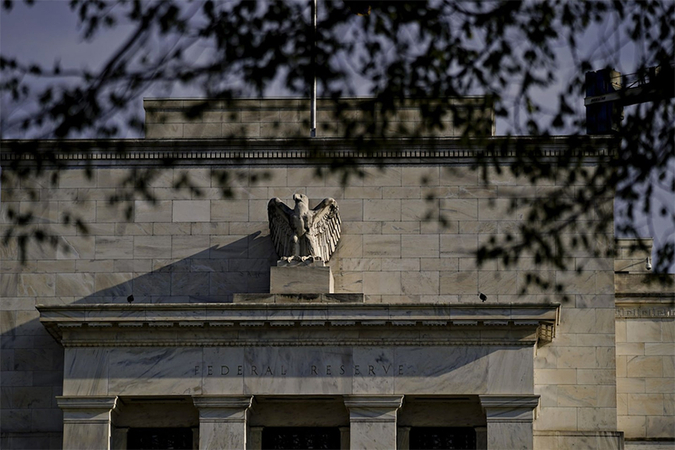
The Marriner S. Eocles Building houses the main offices of the Federal Reserve Board. (Andrew Harrer/ Bloomberg)
By The Washington Post · David J. Lynch
Even before the Federal Reserve said it would keep interest rates near zero for at least three more years, Dan Bienvenue knew he had a battle on his hands.
As chief investment officer of the nearly $400 billion California Public Employees’ Retirement System (CalPERS), which provides benefits for 2 million current and future retirees, Bienvenue must earn an annual return of at least 7%.
That’s not easy when the safe investments that pension funds usually rely on are paying less than 1%, a consequence of low interest rates.
CalPERS, the nation’s largest public pension plan, fell short of its goal in the fiscal year that ended June 30. Now, along with embracing riskier investments like private equity, Bienvenue is gambling on making low rates work for him, by borrowing billions of dollars in hopes of juicing the pension plan’s returns.
“We have to take more risk in some places,” he said. “…Systemically low interest rates, the net effect makes the challenge more difficult.”
CalPERS’ shift is just one example of how an era of persistently low interest rates has rippled across the economy, altering incentives while benefiting some groups and hurting others.
Consumers have snapped up 0% auto loans and mortgages at sub-3% rates. That’s helped the economy by driving sales of new homes and automobiles.
Depressed rates also have fueled a rise in corporate and government debt, aggravated trends toward greater inequality and left a wounded economy more dependent upon fiscal support from lawmakers at a time when Congress is intensely polarized.
Rates have been stuck at ultra-low levels for most of the past 12 years because of chronically weak demand in the U.S., Europe and Japan. The recovery from the 2008 financial crisis was the most anemic since World War II and – despite President Dopnald Trump’s claims to have produced the greatest economy in history – the U.S. economy grew at an average rate of just 2.5% from 2017 through the end of last year.
Aging populations, subpar productivity growth and a once-in-a-century global health scare led the Fed earlier this year to return its benchmark borrowing rate to near zero and to resume large-scale buying of corporate and government securities. Fed Chair Jerome Powell has said rates would remain near zero at least through 2023.
Once an emergency remedy for economic collapse, ultra-low rates now are a fixture of the U.S. landscape. It may be a decade, perhaps longer, before they return to the levels seen in the 1990′s and early 2000′s, economists said.
“Yes, this is a very striking environment compared to the preceding 150 to 200 years of the modern economy, with the possible exception of the Great Depression,” said Adam Posen, president of the Peterson Institute for International Economics.
Today’s low rates reflect a shift in the way the Federal Reserve thinks about the economy. After a review last year, top Fed officials concluded that the neutral interest rate – one that neither spurs economic activity nor cools rising prices – is lower than they had believed.
With rates expected to stay low, the Fed will have less ammunition to fight recessions. In March, when the coronavirus pandemic plunged the economy into a sudden freeze, the Fed could reduce its key lending rate by just 1.5 percentage points, far less than the roughly 5 point historical average, Lael Brainard, a Fed governor, noted in a recent speech.
The Fed’s limited firepower leaves Congress with more responsibility for propping up the economy. House Democrats and the Trump administration have been locked for weeks in fruitless talks over a new round of relief spending.
“The risk here is downward spiral,” Brainard said, warning that the economy could be trapped in a vicious cycle of low interest rates, muted inflation and weak growth.
Long-term trends such as disappointing productivity gains and limited labor force growth are sapping the economy’s potential. In July, the Congressional Budget Office said the U.S. economy could expand in the long-run at an average annual rate of just 1.8% – down from more than 4% in 2000.
“It’s like a case of sclerosis,” said Nathan Sheets, chief economist for PGIM Fixed Income. “It seems everything in the economic body is slowly down and is functioning at a somewhat more restrained rate than it did 15 years ago.”
By lowering its benchmark lending rate, the Fed has made it easier for companies to obtain credit for job-creating investments. Its purchases of treasury securities early in the crisis helped ease bottlenecks in the market for U.S. government debt.
But like a life-saving drug that carries dangerous side effects, the Fed’s low interest rate policy has complicated the job of managing the economy and raised risks to financial stability.
“There are real costs to keeping rates at zero for a prolonged period of time,” Robert Kaplan, president of the Federal Reserve Bank of Dallas said in a recent speech. “Keeping rates at zero can adversely impact savers, encourage excessive risk taking and create distortions in financial markets.”
In November, the Fed warned that a prolonged period of low interest rates could damage the profitability of banks and life insurers and force pension plans to take bigger risks. The result would be to increase “the vulnerability of the financial sector to subsequent shocks,” the Fed said.
“There are fundamental reasons we are where we are. But there are unintended consequences,” said Kathy Bostjancic, chief U.S. financial economist for Oxford Economics.
The banking industry is a good example of the relationship between economic weakness, low interest rates and financial stability.
Falling interest rates meant banks charged borrowers less for their loans. The spread between what banks earned by lending and what they paid depositors for their savings – the net interest margin – fell to its lowest mark since the government began keeping records in 1984, according to the Federal Deposit Insurance Corporation.
As a result, bank profits in the second quarter fell 70% from the previous three months. Bank stocks, measured by the KBW index, have recovered from the pandemic crash in March only half as much as the overall stock market.
Over the past two years, new deposits have far outpaced demand for loans, according to a Goldman Sachs analysis. That reflects both the Fed’s asset purchases, which have injected large amounts of cash into the financial system, and weak demand.
As banks parked much of that $3.2 trillion inflow in cash, which earned just one-tenth what they could make by lending the money to a good corporate credit risk, their profits have shrunk.
Banks have enough of a capital buffer to ride out a renewed economic downturn, the Fed said. But the risk is an economic relapse would cause large numbers of consumer and business loans to go bad, eroding industry reserves and causing banks to restrict new lending.
“Financial stability is a first-order concern for the Federal Reserve and, going forward, a first-order risk for the U.S. economy,” said Sheets, a former Treasury Department official.
The Fed’s cut in short-term interest rates does not directly lower public borrowing costs. But investors seeking guaranteed returns this year have been willing to finance the government’s nearly $3 trillion response to the economic spiral. On Tuesday, investors asked just 0.64% to lend the government money for 10 years, a 59-year low in public borrowing costs.
Before the financial crisis, the government paid 5%.
These low rates mean that as a share of the economy, interest on the federal debt costs taxpayers a bit less today than in 2008 – even though the public debt has grown to more than $20 trillion from less than $6 trillion over that period.
By depressing the returns on risk-free U.S. Treasury securities, low rates also have encouraged investors to buy stocks. Since December 16, 2008, when the Fed cut its benchmark lending rate to near zero for the first time, the Dow Jones Industrial Average, with dividends reinvested, has gained roughly 320%. That’s about five times what the iShares Core U.S. Aggregate Bond exchange-traded fund, a broad bond market proxy, returned over the same period.
The rise in stocks has benefited the already prosperous. The wealthiest 1% of Americans own more than $11 trillion of stocks and mutual fund shares, more than 70 times the total held by the poorest half of the country, according to the Federal Reserve.
The top 1% now owns 52% of the equity in the U.S. up from 42% when the Fed first dropped rates to zero. The bottom half of the country owns a slightly smaller share of all stocks than it did 12 years ago, according to Fed data. And small savers earn almost nothing from bank accounts or certificates of deposit.
Soaring stocks have led some analysts to warn of a financial bubble. Yet, the Fed really has no choice but to keep rates low. For all of its unintended consequences, easy credit represents the only escape from an era of disappointing growth.
“The policy has severe distributional consequences,” said Posen. “Small savers don’t do well. But these same small savers wouldn’t do well if central banks raised rates and more people were unemployed.”
Still, the low interest rate era is imperiling retirement security for millions of Americans, making it more expensive for public pensions to meet their promise of guaranteed income decades in the future. The problem is especially acute for funds like the Ohio Police and Fire Pension Fund, which continues to count on earning 8% annually. The fund declined an interview request.
The low rates era has pushed fund managers to shift more assets into “alternative investments,” riskier initiatives such as private equity, hedge funds and real estate. They promise higher returns than bonds, but carry larger risks as well.
At CalPERS, Bienvenue, who holds the chief investment officer title on an interim basis, is implementing a new strategy that aims for higher returns by using borrowed money and increasing investments in private equity deals, which could be harder to sell in a sudden downdraft than publicly-traded stocks.
The fund posted a 4.7% return for the fiscal year that ended June 30 and has averaged 6.3% over the past five years, short of what’s needed.
“Whether 7 is doable or not is an open question,” said Bienvenue. “Even with leverage and even with private assets, we acknowledge that’s a tall order.”
The committee tasked with developing Thailand into an international medical hub on Friday approved in principle guidelines for opening four more airports in the provinces for medical tourists.
Tares Krassanairawiwong, director general of the Department of Health Service Support, said the airports in question are U-Tapao, Samui, Chiang Mai and Phuket.
Bangkok’s Suvarnabhumi and Don Mueang airports are already open to medical tourists.
The committee is awaiting approval from the Centre for Covid-19 Situation Administration (CCSA).
Currently, there are 1,123 foreigners staying in alternative hospital quarantine, of whom 652 are patients and 471 are their companions. This group has brought Bt114 million in revenue so far.
Meanwhile, a CCSA sub-committee has approved the concept of wellness or spa quarantine and the department will soon draw up guidelines to govern this service.
EconOct 02. 2020Deputy Prime Minister Supattanapong Punmeechaow
By The Nation
Deputy Prime Minister Supattanapong Punmeechaow said on Friday that though the government has no plans to set up a fund to stabilise the stock market, it might launch some tools to shore it up.
The Stock Exchange of Thailand (SET) Index ended the week at 1,237.54, down 10.05 points or 0.81 per cent. Total transactions stood at Bt54.24 billion with an index high of 1,246.78 and a low of 1,231.11.
The Stock Exchange of Thailand (SET) Index closed at 1,237.54 on Friday, down 10.05 points or 0.81 per cent. Total transactions amounted to Bt54.24 billion with an index high of 1,246.78 and a low of 1,231.11.
In the morning session, an analyst at Krungsri Securities expected the day’s index to fluctuate between 1,240 and 1,255 despite positive sentiment over a new US$2.2-trillion US stimulus bill.
“The sharp fall in the oil price due to uncertainty over fuel demand, and foreign investors’ mass sell-offs of Thai shares will pressure the index,” he said.
Around midday, the SET index plummeted 13.09 points or 1.04 per cent to 1,235.25 following news that US President Donald Trump had contracted Covid-19.
The 10 stocks with the highest trade value today were STGT, PTTEP, PTT, MICRO, KBANK, MINT, STA, DIF, AOT and BBL.
As of 4.30pm, the price of oil dropped by US$1.31 or 3.38 per cent to $37.41 per barrel, while gold dropped by $3.60 or 0.19 per cent, to $1,912.70 per ounce.
Elsewhere in Asia, Japan’s Nikkei Index closed at 23,029.90, down 155.22 points or 0.67 per cent.
Stock markets in China, Hong Kong, and Taiwan were closed for the Moon festival, while South Korea’s KOSPI market was closed for the Chuseok festival.
Energy Minister Supattanapong Punmeechaow said his ministry is in the process of preparing guidelines and criteria related to community power plants and the report should be ready this month.
He said these new power plants should promote the cultivation of new energy crops, increase jobs and generate income.
The report should be handed over to the National Energy Policy Council before the end of this month and the pilot 100 to 150 megawatt plant should be operating by the end of the year.
“Power plants should be placed in an area where 80 per cent of the land is devoted to energy crops and the remainder to fast-growing plants such as Napier grass and Earleaf acacia,” Supattanapong said.
He added that energy production businesses will have to adapt to new conditions once community power plants kick off.
Short sales shot up 251 per cent on Thursday after the Stock Exchange of Thailand (SET) implemented the old short sales regulation, or the zero-plus-tick rule.
Short sales value rose to Bt2.1 billion, from the average of Bt600 million per day in September.
Previously, the SET used the uptick rule that allowed investors to engage in short-selling only when the share price was higher than the latest trading price, to mitigate market volatility. It announced recently that it would use the old zero-plus-tick rule, which enables investors to engage in short-selling when the share price is higher or equal to the latest trading price from October 1 onwards.
Nuttachart Mekmasin, assistant managing director at Trinity Securities, expected the value of short sales to rise over Bt1 billion due to liquidity in making transactions and high stock valuation.
“Short sales would cause the SET to fall below 1,200 points because the index would move in line with reality after the previous uptick rule was changed,” he said.
The top five shares with the highest short sales on Thursday were Kasikornbank (KBANK) Bt158.12 million, Minor International (MINT) Bt132.73 million, PTT Exploration and Production (PTTEP) Bt124.31 million, Airports of Thailand (AOT) Bt108.24 million, and Charoen Pokphand Foods (CPF) Bt104.45 million.





 Deputy Prime Minister Supattanapong Punmeechaow