Dow soars 465 points as Trump news, stimulus talks power U.S. stocks #ศาสตร์เกษตรดินปุ๋ย

#ศาสตร์เกษตรดินปุ๋ย : ขอบคุณแหล่งข้อมูล : หนังสือพิมพ์ The Nation.

Dow soars 465 points as Trump news, stimulus talks power U.S. stocks

EconOct 06. 2020
By The Washington Post · Hamza Shaban, Eva Dou · BUSINESS, US-GLOBAL-MARKETS 
WASHINGTON – U.S. stocks rose Monday after President Donald Trump’s doctors confirmed that he would leave Walter Reed National Military Medical Center later in the day, and despite contradictory messages about the severity of his coronavirus diagnosis.

Wall Street’s optimism also was heightened by the prospect of another round of massive economic relief from Congress as lawmakers and the White House continue negotiations with less than a month before Election Day.

The Dow Jones industrial average shot up 465.83 points, or 1.7%, to close at 28,148,64. The S&P 500 gained 60.18 points, or 1.8%, to end at 3,408.60 while the Nasdaq composite climbed 257.47 points, or 2.3%, to 11,332,49.

“Signaled improvements in President Trump’s health and increasing optimism around renewed stimulus talks are certainly driving the market rally today, and a widening lead of Biden in the polls is also helping to calm market jitters,” said Nicole Tanenbaum of Chequers Financial Management. But, as she and other analysts noted, volatility will continue as investors assess the president’s health, weigh the prospects of government stimulus and seek clarity about the Nov. 3 election.

September proved to be a tumultuous month of trading. Sentiment soured after a summer of explosive gains as economic data and high unemployment rates tempered recovery hopes. Analysts have cautioned that many of the stocks that catapulted the market to record-high levels rose too high and too fast, inviting a sell-off. And as the number of Americans who have died of covid-19 climbed past 200,000, the business community and the broader public were receiving mixed messaging from drugmakers and the Trump administration about the timeline for safe and viable vaccine.

But reignited stimulus talks have lifted investor confidence. On Friday, House Speaker Nancy Pelosi, D-Calif., suggested that Trump’s diagnosis could accelerate an agreement, which would potentially include government checks sent directly to households, funding for struggling cities and states, unemployment assistance and money for hard-pressed small businesses. Wavering economic data and large-scale corporate layoffs further underscore the pressure for Democrats and the White House to strike a deal, Tanenbaum said.

Kristina Hooper, chief global market strategist at Invesco, said she suspects Trump contracting covid-19, the illness caused by the novel coronavirus, could lead to broader adoption of masks as average Americans recognize that if the president of the United States can contract the virus, they can too. “More masks means less likelihood of the spread of covid-19, which should be a significant positive for the economy,” she said. “I also wouldn’t disagree with House Speaker Pelosi in her assessment that the president’s covid-19 diagnosis could spur Senate Republicans into recognizing how virulent the disease is, which could in turn prompt them to agree to a larger stimulus package.”

Still, the president’s illness and the infection of several U.S. senators adds yet another element of uncertainty to prolonged negotiations that have stalled before, and to the federal government’s broader response to the virus.

“While the backdrop is supportive for markets over the coming months, investors should brace themselves for near-term volatility given the uncertainty with upcoming U.S. elections and continued concerns around a delayed economic recovery should we see a second wave of the virus,” said Frank Panayotou, managing director at UBS Private Wealth Management.

At least 209,000 people have died in the U.S., and nearly 7.4 million cases have been recorded.

On Friday the Labor Department disclosed the U.S. economy added 661,000 jobs in September, registering the smallest monthly job gains since May, a signal that the broader recovery is slowing. Experts have pointed to the lackluster jobs data as evidence that direct government intervention is necessary to avoid more long-term economic damage. The jobs report, which showed that the unemployment rate has dropped to 7.9%, will be the last monthly summary before the Nov. 3 election.

As news headlines change and more “October surprises” emerge, sharp moves in the markets should be expected, said Michael Farr, president of wealth management firm Farr, Miller & Washington. He noted that this year has seen 42 days of significant market swings of 2% or more. “Don’t be surprised if we have more,” he said.

European and Asian markets, which also are tracking Trump’s health closely, ended in positive territory across the board.

Khoon Goh, head of Asia research at ANZ, said the initial “unknown unknowns” created a level of uncertainty “that previously no one really cared to think about,” he said. “It prompts investors to sell first and ask questions later.”

Stock markets slumped around the world on Friday, as Trump, 74, and a number of officials close to him tested positive for the virus. The news added uncertainty to the prospects of the U.S. economic recovery, and it called into question how much bandwidth the Trump administration would have to attend to other matters in coming weeks.

The markets appeared to take a measure of reassurance from images of Trump in a motorcade on Sunday, despite critics denouncing the photo opportunity for putting Secret Service officers at risk of infection.

In Asia, Hong Kong’s Hang Seng index added 1.3% on Monday, after posting its biggest weekly decline in six months last week. The Nikkei in Japan closed 1.2% higher.

Other factors buoying Asia markets on Monday included upbeat economic data out of Taiwan and South Korea, and hopes that the U.S. fiscal stimulus package would be passed, Goh said.

Australia’s ASX200 closed 2.6% higher, its best session since June, on investor hopes of more stimulus, including tax cuts, to be revealed in this week’s national budget.

Mainland Chinese stock markets remained closed for the country’s extended national day holiday.

European equities also were in the green on Monday, with London’s FTSE 100 and the Euro Stoxx 50 both up about 0.6% ad 0.8%, respectively.

#Stocks gain most in almost four weeks; yields rise/ Syndication Washington Post, Bloomberg 

U.S. stocks closed at the highest levels of the day amid optimism that President Donald Trump will leave the hospital and that lawmakers will move closer to providing more stimulus. Treasury yields jumped, and the dollar weakened.

The S&P 500, Nasdaq composite and Dow Jones industrial average all rebounded from Friday’s swoon in the wake of Trump’s coronavirus disclosure. Regeneron Pharmaceuticals rallied after Trump was given an experimental antibody treatment made by the drugmaker. Energy, health care and technology shares were the biggest gainers in the S&P, pushing the benchmark index up by the most in almost four weeks.

“Fiscal stimulus continues to be a wild card for the market, and uncertainty around the health of the president certainly looms large,” said Chris Larkin, managing director of trading and investment product at E-Trade Financial. “So while there’s a lot of noise out there, experienced traders may find bullish opportunities.”

Trump said on Twitter that he would leave Walter Reed hospital Monday evening after being treated since Friday for covid-19, the illness caused by the novel coronavirus. With less than a month until Election Day, Trump’s hospitalization has jolted the presidential campaign, forcing him to scrap rallies and other events as polls show him trailing Democratic nominee Joe Biden nationally and in swing states.

On the stimulus front, Trump tweeted from the hospital that a deal needs to get done. House Speaker Nancy Pelosi, D-Calif., was optimistic on Friday that a bipartisan stimulus bill can be done.

“Absent of vaccine breakthrough, we’re in an economy that is modestly recovering from the lows of March and April, but it can only go so far,” said Tom Hainlin, national investment strategist at U.S. Bank Wealth Management’s Ascent Private Wealth Group. “Areas of the economy that are susceptible are still feeling the pain. That’s why we need so much stimulus from the Federal Reserve and Congress.”

Traders also pointed to polls suggesting a stronger lead for Biden and the possibility that a clear winner will emerge from the Nov. 3 election. U.S. markets have been nervous in recent weeks about a close election and the risk of a long and messy legal battle.

Elsewhere, consumer companies and banks led a broad advance among European stocks. Equities in Asia notched gains, while crude oil rebounded from a three-week low and gold advanced.

– – –

Here are some key events coming up:

– The Reserve Bank of Australia is forecast to keep interest rates and its three-year yield target unchanged at 0.25% on Tuesday

– Also on Tuesday, Fed Chair Jerome Powell and ECB Chief Economist Philip Lane deliver keynote addresses at the NABE conference

– On Wednesday, the minutes of the Sept. 15-16 meeting of the FOMC could be especially fruitful for Fed watchers, beginning with details of the debate on conditions necessary to trigger a rate increase

– The U.S. Vice Presidential debate takes place in Salt Lake City on Wednesday

– Although the final formal round of talks is over, the British government expects trade negotiations to continue up to the EU summit in mid-October.

– – –

These are the main moves in markets:

Stocks

– The S&P 500 index climbed 1.8%, to 3,408.56, as of 4:01 p.m. New York time, the highest in a month on the largest increase in almost four weeks.

– The Dow Jones industrial average surged 1.7%, to 28,148.18, the highest in more than a month on the biggest jump in almost 12 weeks.

– The Nasdaq composite index climbed 2.3%, to 11,332.48, the highest in more than a month on the largest increase in almost four weeks.

– The Nasdaq 100 index rose 2.3%, to 11,509.06, the biggest rise in more than a week.

– The Stoxx Europe 600 Index rose 0.8% to 365.63, the highest in more than two weeks, on the largest advance in a week.

– – –

Currencies

– The Bloomberg Dollar Spot index sank 0.4%, to 1,169.13, the lowest in more than two weeks on the biggest dip in more than five weeks.

– The Japanese yen depreciated 0.5%, to 105.77 per dollar, the weakest in more than three weeks on the largest decrease in five weeks.

– The euro climbed 0.6%, to $1.1783, the strongest in more than two weeks.

Bonds

– The yield on 10-year Treasuries climbed seven basis points, to 0.78%, the highest in almost four months on the largest surge in a month.

– The yield on 30-year Treasuries climbed nine basis points, to 1.58%, reaching the highest in almost four months on its sixth straight advance and the biggest surge in a month.

– Germany’s 10-year yield increased three basis points, to -0.51%, the highest in more than a week on the largest climb in more than three weeks.

– Britain’s 10-year yield rose four basis points, to 0.288%, the highest in almost five weeks.

Commodities

– West Texas Intermediate crude surged 6.2%, to $39.36 a barrel, the largest jump in 20 weeks.

– Gold strengthened 0.6%, to $1,911.48 an ounce, the highest in two weeks.

– Copper declined 0.4%, to $2.97 a pound.

Central bank keeps an eye on debtors’ ability to repay as banks brace for NPLs #ศาสตร์เกษตรดินปุ๋ย

#ศาสตร์เกษตรดินปุ๋ย : ขอบคุณแหล่งข้อมูล : หนังสือพิมพ์ The Nation.

Central bank keeps an eye on debtors’ ability to repay as banks brace for NPLs

EconOct 06. 2020 Chatchai Sirilai, president of the Government Housing Bank, said the bank will have to boost its reserves in line with rising bad debts. Chatchai Sirilai, president of the Government Housing Bank, said the bank will have to boost its reserves in line with rising bad debts. 

By The Nation

The Bank of Thailand (BOT) is closely monitoring debtors’ ability to repay debts, while bankers are getting ready for rising bad debts.

Central bank officials will discuss debtors’ repayment abilities with banks, and have started off by meeting with Chatchai Sirilai, president of the Government Housing Bank (GHB).

Chatchai said that after the first phase of debt holiday expired recently, debtors owing a total of Bt180 billion have applied for an extension on the debt-repayment holiday. Meanwhile, debtors whose combined debt is worth Bt80 billion have resumed the payment of their mortgages. 

He said GHB, Thailand’s largest mortgage lender, believes debts totalling about Bt9 billion may turn into bad debts, as people owing a total of Bt5 billion were unable to make payments, while those holding combined debts of Bt4 billion could make partial payments. 

“While we may recover Bt4 billion, the debts worth Bt5 billion may eventually turn into bad debts,” he said. 

In order to brace for rising non-performing loans (NPLs), GHB will increase its reserves to Bt5.3 billion, up from Bt3.5 billion set aside in August. 

However, increasing reserves will adversely affect the bank’s profits this year, he said referring to the profit target of Bt13.5 billion set earlier. 

The bank is optimistic it will meet the new lending target of Bt210 billion by yearend after its loans hit Bt156 billion at the end of September.  

He said not everyone is affected by the Covid-19 outbreak, so the demand for mortgage remains. 

Earlier, commercial banks said they expected an increase in NPLs, but said it will be manageable as this crisis was expected to be less severe than the 1997 Asian financial crisis. 

Thailand’s choice of finance minister ‘inspires confidence’: banker #ศาสตร์เกษตรดินปุ๋ย

#ศาสตร์เกษตรดินปุ๋ย : ขอบคุณแหล่งข้อมูล : หนังสือพิมพ์ The Nation.

Thailand’s choice of finance minister ‘inspires confidence’: banker

EconOct 06. 2020Newly appointed Finance Minister Arkhom TermpittayapaisithNewly appointed Finance Minister Arkhom Termpittayapaisith 
By The Nation

The urgent task for newly appointed Finance Minister Arkhom Termpittayapaisith is to tackle the impact of Covid-19 on the Thai economy, a leading banker said on Monday.

Chongrak Rattanapien, senior executive vice president of Kasikornbank, said Arkhom must seek ways to move the economy forward, solve grassroots economic problems, and push for development of state infrastructure projects.

Chongrak is confident that the appointment of Arkhom, which was announced on Monday, will inspire confidence among investors and the general public.

Arkhom succeeds Predee Daochai, who abruptly quit the post on September 2 after less than a month in office, citing health problems.

Arkhom was previously transport minister under the post-coup Prayut Chan-o-cha government.

Before that he was secretary-general of the National Economic and Social Development Board, a state think-tank which is now known as the National Economic and Social Development Council.

Housing Business Association president Atip Bijanonda said Arkhom is a good fit for the job of steering the nation’s economy.

The new minister is approachable and accessible, which would ensure smooth collaboration between the public and private sectors, he said.

Reviving the Thai economy was a daunting task, since success depended not just on domestic factors but also on conditions abroad in Thailand’s major tourism and trade partners, said Atip.

He added that the property sector wants the new minister to focus on three tasks: urgently lifting the domestic economy in order to boost people’s purchasing power, accelerating investment in new state mega-projects, and opening up opportunities for all business sectors to participate in the process of economic problem solving.

Reserves for NPLs, high expenses to keep banks’ net profits low #ศาสตร์เกษตรดินปุ๋ย

#ศาสตร์เกษตรดินปุ๋ย : ขอบคุณแหล่งข้อมูล : หนังสือพิมพ์ The Nation.

Reserves for NPLs, high expenses to keep banks’ net profits low

EconOct 06. 2020

By The Nation

Commercial banks’ third-quarter net profit is expected to slump year on year due to high reserves for doubtful debts and expenses, experts said on Monday.

Tanadech Rungsrithananon, senior director of research at UOB Kay Hian Securities, expects commercial banks’ third-quarter net profit to be Bt32 billion, down 42 per cent year on year, but up 4 per cent quarter on quarter due to a high reserve for doubtful debts and expenses.

Meanwhile, he expects banks’ net interest margin (NIM) to be at 2.8 per cent, down from 3.15 per cent in the same period of the previous year and 2.95 per cent in the second quarter of this year owing to interest rate adjustment. Banks’ NIM is expected to remain at a low level until next year.

Non-performing loans (NPL), he said, will be at 3.3 per cent, up from 3.1 per cent in the previous quarter due to the impact of Covid-19 on businesses that rely on foreign tourists, such as hotels and tourism agencies.

“We expect bank shares to drop and NPLs to rise further in the fourth quarter of this year once the government’s measures to help people expires,” he said.

He added that commercial banks’ net profit this year is expected to be at Bt140 billion, down 34 per cent from Bt201 billion in the previous year and the lowest in 10 years. However, net profits for banks are expected to rise 5 per cent year on year to Bt146 billion owing to high reserves for doubtful debts and expenses.

“However, it will take several years for banks’ net profits to rise to Bt200 billion like in previous years, and it actually depends on banks’ methods of controlling NPLs as well,” he added.

Meanwhile, Tanawat Ruenbanterng, an analyst at Tisco Securities expects banks’ third-quarter net profit to be at Bt31.23 billion, down 38.6 per cent from Bt50.82 billion in the same period of the previous year, but up 10.6 per cent from Bt28.24 billion in the second quarter.

He also expects the net profits of all banks, except Bangkok Bank and Kasikornbank to drop owing to high reserves for doubtful debts and a drop in NIM.

SET, Asian indices rally over news of Trump’s recovery #ศาสตร์เกษตรดินปุ๋ย

#ศาสตร์เกษตรดินปุ๋ย : ขอบคุณแหล่งข้อมูล : หนังสือพิมพ์ The Nation.

SET, Asian indices rally over news of Trump’s recovery

EconOct 05. 2020

By The Nation

The Stock Exchange of Thailand (SET) Index closed at 1,242.99 on Monday, up 5.45 points or 0.44 per cent. The volume of total transactions stood at Bt39.48 billion with an index high of 1,248.67 and a low of 1,239.06.

During the morning session, an analyst at Krungsri Securities said he expected the index to rebound to between 1,245 and 1,250 before falling in response to news that US President Donald Trump may be discharged on Monday after testing positive for Covid-19 last week.

However, he said falling price of oil, uncertainty over banks’ weak third-quarter performance due to high non-performing loans and foreign investors’ mass sell-offs will pressure the index.

The top 10 stocks with the highest trade value on Monday were STGT, TASCO, AOT, PTT, ADVANC, DELTA, CBG, BAM, PTTEP and IVL.

As of 4.30pm, the oil rose by US$0.96 or 2.59 per cent to $38.01 per barrel, while gold dropped by $3.10 or 0.16 per cent, to $1,904.50 per ounce.

Other Asian indices were also on the rise:

Japan’s Nikkei Index closed at 23,312.14, up 282.24 points or 1.23 per cent.

Hong Kong’s Hang Seng Index closed at 23,767.78, up 308.73 points or 1.32 per cent.

South Korea’s KOSPI Index closed at 2,358.00, up 30.11 points or 1.29 per cent.

Taiwan’s TAIEX Index closed at 12,548.28, up 32.67 points or 0.26 per cent.

China’s stock markets were closed for the Moon Festival.

Arkhom appointed new finance minister #ศาสตร์เกษตรดินปุ๋ย

#ศาสตร์เกษตรดินปุ๋ย : ขอบคุณแหล่งข้อมูล : หนังสือพิมพ์ The Nation.

Arkhom appointed new finance minister

EconOct 05. 2020New Finance Minister Arkhom TermpittayapaisithNew Finance Minister Arkhom Termpittayapaisith 

By The Nation

Arkhom Termpittayapaisith was officially appointed Thailand’s new finance minister on Monday, tasked with rescuing the economy from an unprecedented downswing under the impact of Covid-19.

The appointment was announced in the Royal Gazette on Monday.

Arkom succeeds Predee Daochai, who abruptly quit the post on September 2 after less than a month in office.

Arkom was previously transport minister under the post-coup Prayut Chan-o-cha government.

Before that, he was secretary-general of the National Economic and Social Development Board, a state think-tank which is now known as the National Economic and Social Development Council.

Gold slumps further as dollar strengthens #ศาสตร์เกษตรดินปุ๋ย

#ศาสตร์เกษตรดินปุ๋ย : ขอบคุณแหล่งข้อมูล : หนังสือพิมพ์ The Nation.

Gold slumps further as dollar strengthens

EconOct 05. 2020

By The Nation

The price of gold dropped by Bt100 per baht weight in morning trade on Monday, the Gold Traders Association reported.

As of 9.21am, the buying price of a gold bar was Bt28,250 per baht weight and selling price Bt28,350 while gold ornaments were priced at Bt27,742.80 and Bt28,850, respectively.

At close on Saturday, the buying price of a gold bar was Bt28,350 per baht weight and selling price Bt28,450 while gold ornaments were Bt27,833.76 and Bt28,950, respectively.

The global market price moved to US$1,899 (Bt59,794.92) per ounce on Monday morning after the price dropped by $8.7 to $1,907.8 per ounce at Friday’s close.

Gold price was pressured by the strengthening of the dollar, which made the price high for investors holding other currencies.

Hong Kong gold price opened at HK$17,570 (Bt71,378.66) per tael on Monday morning, the Chinese Gold and Silver Exchange Society reported.

SET rises, but falling oil price and banks’ Q3 performance could pressure index #ศาสตร์เกษตรดินปุ๋ย

#ศาสตร์เกษตรดินปุ๋ย : ขอบคุณแหล่งข้อมูล : หนังสือพิมพ์ The Nation.

SET rises, but falling oil price and banks’ Q3 performance could pressure index

EconOct 05. 2020

By The Nation

The Stock Exchange of Thailand (SET) Index rose by 9.65 points, or 0.78 per cent, to 1,247.19 in the morning session on Monday.

An analyst at Krungsri Securities expected the index to rebound to between 1,245 and 1,250 before falling in response to the news that US President Donald Trump would be able to leave the hospital on Monday after testing positive for Covid-19 last week.

However, he said the falling oil price, uncertainty over banks’ weak third-quarter performance due to high non-performing loans, and foreign investors’ mass sell-offs of stocks will pressure the index.

As an investment strategy, he recommended that investors buy:

▪︎ Banpu and AGE that benefit from rising coal price in response to China’s strong demand.

▪︎ PSL, TTA and RCL that benefit from the sharp rise in Baltic Dry Index.

▪︎ Delta, Hana, KCE and SMT that benefit from the weakening baht.

The SET Index closed at 1,237.54 on Friday, down 10.05 points or 0.81 per cent. Total transactions amounted to Bt54.24 billion with an index high of 1,246.78 and a low of 1,231.11.

Migration, in reverse: Coronavirus forces migrant workers to return home #ศาสตร์เกษตรดินปุ๋ย

#ศาสตร์เกษตรดินปุ๋ย : ขอบคุณแหล่งข้อมูล : หนังสือพิมพ์ The Nation.

Migration, in reverse: Coronavirus forces migrant workers to return home

EconOct 05. 2020Ramakrishnan Athekkatil stands outside his spacious, two-story home in India, which he was able to build by leaving his home country and taking a job in the Persian Gulf. MUST CREDIT: photo for The Washington Post by Ashiq MK.

Ramakrishnan Athekkatil stands outside his spacious, two-story home in India, which he was able to build by leaving his home country and taking a job in the Persian Gulf. MUST CREDIT: photo for The Washington Post by Ashiq MK. 

By The Washington Post · Joanna Slater, Kareem Fahim, Katie McQue · WORLD, ASIA-PACIFIC, MIDDLE-EAST 
In his long years away from his family, Ramakrishnan Athekkatil often imagined what it would be like to settle down back in India.

He never imagined he would return like this: laid off, in debt and pursued by a sickness racing around the globe.

Home was a small village ringed by coconut palms and paddy fields on India’s southwestern coast. His father, pushed by poverty, had been the first to leave for the Persian Gulf in search of work. Later Ramakrishnan, 47, and his four brothers all made the same voyage.

Pradeesh Athekkatil, the youngest of five brothers, had worked as a driver for a limousine company in the United Arab Emirates. He returned to India after not being paid for three months. MUST CREDIT: photo for The Washington Post by Ashiq MK.
Pradeesh Athekkatil, the youngest of five brothers, had worked as a driver for a limousine company in the United Arab Emirates. He returned to India after not being paid for three months. MUST CREDIT: photo for The Washington Post by Ashiq MK.
“Ever since I was young, I wanted to go,” Ramakrishnan said. “I used to tell my father, ‘Just take me with you to the gulf.’ “

The family was part of a vast migration from South Asia to countries flush with wealth but short on labor. The migrants worked to raise gleaming cities in the desert, and built the schools, hospitals and power plants that helped transform collections of villages and port towns into modern Arab countries.

Unnikrishnan, the eldest of the Athekkatil brothers, climbs a mango tree behind the warehouse where he works in Dubai. His father Kumaran planted the seed for the tree after he arrived in the Persian Gulf in the 1980s. MUST CREDIT: photo for The Washington Post by Mohamed Somji. Photo by: Mohamed Somji — For The Washington Post

Unnikrishnan, the eldest of the Athekkatil brothers, climbs a mango tree behind the warehouse where he works in Dubai. His father Kumaran planted the seed for the tree after he arrived in the Persian Gulf in the 1980s. MUST CREDIT: photo for The Washington Post by Mohamed Somji. Photo by: Mohamed Somji — For The Washington Post

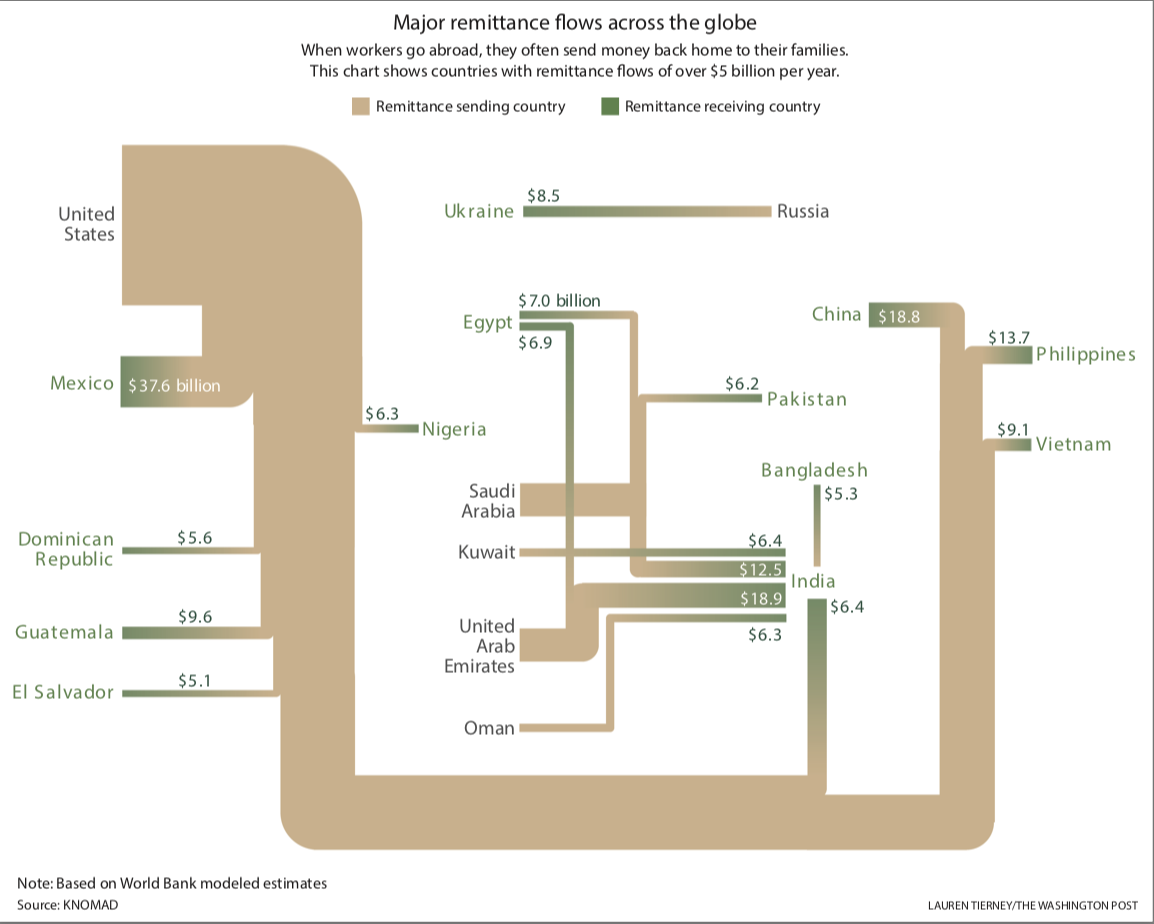
Now, one of the largest migration corridors in the world is flowing in reverse. The coronavirus pandemic and crashing oil prices have led to mass layoffs in gulf states, leaving foreign workers vulnerable and in some cases destitute. Out of money and fearing the virus, hundreds of thousands have returned home.

With a vaccine still months away and the number of coronavirus cases rising around the world, there is little prospect that anything will return to normal any time soon for the world’s 164 million migrant workers who cross borders.

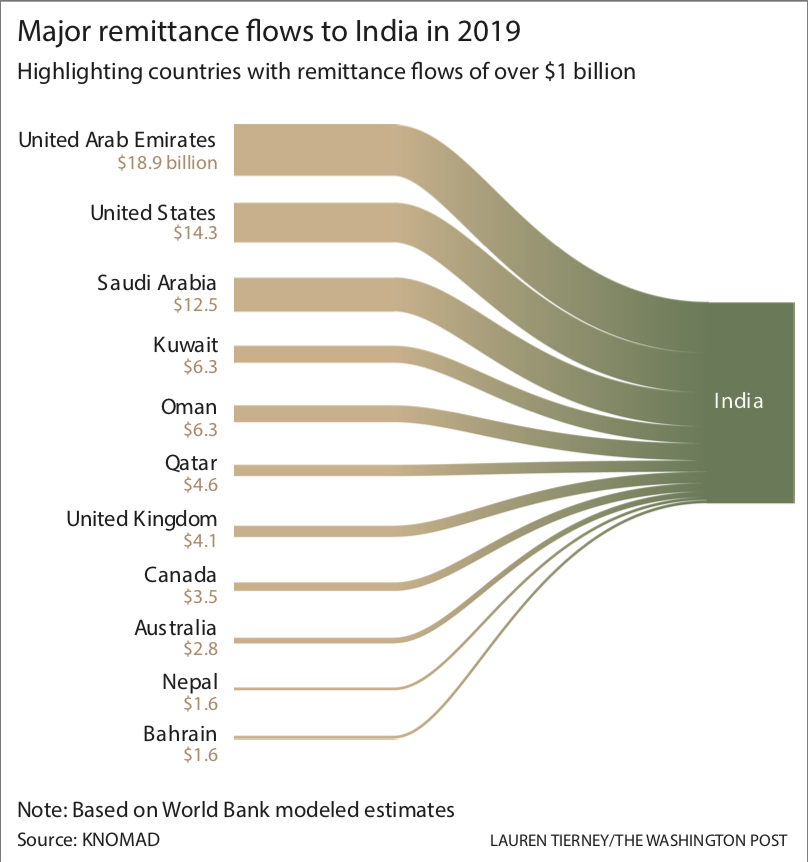
Chart of 2019 remittances to India Photo by: The Washington Post — The Washington Post

Chart of 2019 remittances to India Photo by: The Washington Post — The Washington Post

About one-third of them come from South Asia, and India is the single largest source of such migrant labor in the world.

Kerala, the small southern Indian state where the Athekkatils live, plays an outsize role in such flows. An estimated 2.5 million Keralites were working abroad before the arrival of the virus, the vast majority in the Persian Gulf. The pandemic is pushing them home in record numbers: As many as 500,000 migrants and their families are expected to return by the end of the year, the largest such exodus ever, experts say.

Nearly 400,000 people have already returned to the state from the gulf since May, according to data provided by the Kerala government agency responsible for overseas workers. At least half of the returnees said they were coming back because they had lost their jobs.

Flow chart of global remittances 2019 Photo by: The Washington Post — The Washington Post

Flow chart of global remittances 2019 Photo by: The Washington Post — The Washington Post

Meanwhile, the pandemic has also prompted some countries in the region to accelerate plans to “nationalize” their workforces – in other words, to reduce their reliance on foreign migrants altogether.

The workers who came home are struggling. Indians who lost their jobs in the gulf are returning to an economy crippled by rising infections and by the aftermath of one of the world’s strictest lockdowns.

“You’re looking at devastation on both sides of the corridor,” said Shabarinath Nair, a regional migration specialist at the International Labor Organization.

The coronavirus crisis has upended many aspects of globalization previously taken for granted – in manufacturing, in education, in tourism – but one of its most dramatic impacts has been on migration. As country after country closed borders and banned flights, migrant workers around the globe faced chaos without precedent. Some began a desperate scramble to get home. Others were stranded and faced an equally desperate wait.

A survey of migrants from Central America and Mexico conducted by the International Organization for Migration found that half had lost their jobs in the pandemic. From Ukraine to Myanmar, Mozambique to Venezuela, migrant workers around the world retraced their steps by the millions.

Finding a way to revive the movement of workers without fueling new outbreaks will be crucial to fixing the global economy.

“If we are unable to relaunch migration and mobility safely – and universally – the world’s ability to recover from economic recession will be limited,” wrote Antonio Vitorino, the director general of the IOM.

– – – 

When the pandemic hit, it left two of the Athekkatil brothers jobless and pushed two others into a state of deep uncertainty. With tears in his eyes, Ramakrishnan recalled how the newspaper company where he had worked since 1999 in the United Arab Emirates – rising from the printing plant to the bill collection department – sent him a letter saying he was being let go.

Pradeesh, 37, the youngest of the five, had worked as a driver for a limousine company doing airport pickups and drop-offs, also in the UAE. He said he wasn’t paid for three months and then the company asked drivers to go unpaid for another three months.

“There are only 365 days in a year,” Pradeesh said bitterly. Without jobs, the two brothers had no choice but to go home.

Migrant workers are not only critical to the countries where they work but also a vital source of income back home, sending money to pay for daily expenses, housing, education and medical care. Such remittances hit a record high of $554 billion in 2019.

This year, however, the World Bank expects remittances to fall by 20 percent, which would be the sharpest decline on record. For some countries, that drop will be a crushing blow. In Nepal, Honduras, Haiti, Lesotho and Tajikistan, for instance, remittances represent more than 20% of gross domestic product. Even for a large economy like India, remittances are important: Last year, they outstripped the total amount of foreign direct investment in the country.

In Kerala, the dependence on funds sent from abroad is a not-so-secret element of the state’s developmental success. One in every four households in the state includes a migrant who works abroad, according to a 2018 survey.

Kerala received about $15 billion in remittances last year, according to Dilip Ratha, the lead economist on migration and remittances at the World Bank. That’s more than a tenth of the state’s entire economic output. As remittances fall, so too will tax revenue, limiting the state government’s ability to help people during what is shaping up to be India’s worst recession in modern history.

The migration route from Kerala to the gulf, built upon centuries of trade with the Middle East, is so well established that is has absorbed successive generations of the same family, like the Athekkatils. Along curving roads in the northern part of the state, one can spot the “gulf houses” – a term for the sometimes comically large residences that well-paid migrants build back home in Kerala.

In normal times, tens of thousands of Keralites return each year, having saved enough money or because they’re ready to come home. After the 1991 Persian Gulf War and the 2008 financial crisis, migrants returned involuntarily, but on a smaller scale than what is unfolding now.

Those prior episodes demonstrate how wrenching the return can be, said Irudaya Rajan, a professor at the Center for Development Studies and an expert on migration from Kerala.

“They went to make money,” he said, “and now they’ve lost everything.”

– – – 

For migrants and their families, there were drawbacks well before the pandemic. When the Athekkatil brothers talk about their father, Kumaran, it is with a sense of respect for his sacrifices in the gulf: the extreme heat, the long hours, the loneliness.

Kumaran left for the UAE in 1983. Unable to read or write, he had colleagues help him write letters. He would return home only once every three years, storing up his leave time so he could stay for two months. The ink pens and scented erasers he brought as gifts were the envy of his sons’ classmates.

But the time with his wife and children was scarce. “He was always crushed that he’d be leaving again soon,” said Unnikrishnan, 49, the eldest of the five brothers. “My father lived for his family, not for himself.”

When the brothers were small, they lived in a home with mud walls and a roof of thatched leaves, with every month an anxious wait for the arrival of the money from abroad that sustained 10 people in the extended family. Unnikrishnan said he couldn’t stand seeing his father bear the burden alone. He dropped out of school after the 10th grade.

In 1998, he became the first of the brothers to go to the gulf. He took up a job as an assistant at the same company where his father worked, Ghantoot General Mechanical Engineering, in an industrial zone of Dubai. Years before, his father had planted a mango seed from Kerala behind the warehouse. By the time Unnikrishnan arrived, the tree was bearing fruit.

One by one, the four other brothers – Ramakrishnan, Sethu, Rajesh and Pradeesh – all followed.

“I told everyone to stay here,” said their mother, Lakshmikutty, a slight woman in a red-and-white printed sari, sitting on her terrace on a recent afternoon. “But everyone wanted to go.”

Ramakrishnan was the most enthusiastic, having made up his mind early that he, too, would migrate to the gulf. “To make money, what else would it be?” he said with a laugh. His first job in Dubai was working the overnight shift at a newspaper printing plant, earning $136 a month in today’s dollars.

Over the years, Ramakrishnan moved from the printing press to delivering newspapers to collecting revenue for an English-language paper in the UAE. His salary increased to $1,600 a month. By earlier this year, however, it was obvious that business was soft as oil prices plunged and the UAE’s non-oil private sector contracted for the first time in over a decade. Then he began to read in the news about a strange new illness coming from China.

When the pandemic hit, its impact fell hardest on migrant workers. In Qatar and Saudi Arabia, the virus swept through labor camps and cramped apartments where foreign workers lived, trapped by poverty and lockdowns. Job losses exploded.

In the UAE, for the first time in recent memory, residents saw desperate migrants begging for food or money in the streets.

Others began bartering their possessions for groceries and other necessities on Facebook groups, or waiting in long lines for provisions offered by charities. Some say they are unable to pay for flights home or cannot bear the thought of leaving with little or nothing to give to their families.

Sethu, 43, the third of the Athekkatil brothers, works as a metal fabricator in Sharjah, one of the seven emirates that make up the UAE. He said he spent several months this spring confined to his shared room in a dormitory with other workers. There was no work and nowhere to go. Pradeesh and his colleagues struggled to make ends meet after their company abruptly stopped paying them.

Rejimon Kuttappan, a labor activist in Kerala who works with migrants in the gulf, said that starting in March, he began to receive call after call from workers reporting that companies were not paying them the money they were owed as they were laid off. They felt they had no recourse, Kuttappan said, and no option but to leave.

For decades, foreign workers in the gulf have accepted a state of enforced impermanence in exchange for higher salaries than they could earn at home. In the past, it was usually possible for migrants to stay for decades: Many raised families in the gulf, or spent careers there, squirreling away enough money to support a family, or even a clan, at home.

When jobs opened up, they recruited family and friends from back home to fill them, bringing growth and prosperity, over generations, to companies that would never bear their names.

But the ability to remain in the gulf was never certain.

“There is always an element of instability,” said Rima Kalush of Migrants-Rights.org, an advocacy organization. For migrants all over the Persian Gulf, she said, the pandemic has made it “more visceral that it’s not possible to have a future there, unless you are the elite of the elite.”

Proposals to “indigenize” the labor force in gulf states were hatched decades ago but are getting renewed attention during the pandemic. Last month, Saudi Arabia implemented a plan to reserve 70 percent of certain retail jobs for locals. In Kuwait, lawmakers have threatened to reduce the number of foreigners in the country to just 30 percent of the population, down from the current 70 percent. Experts believe the plan is impracticable and unlikely to materialize.

The pandemic vaporized the jobs of two of the Athekkatil brothers. The newspaper company where Ramakrishnan had worked since 1999 delayed paying him for three months, he said, and proposed that he take a steep pay cut until the economy improved.

“I was ready to do that,” he said.

More than anything, he wanted to keep paying down the loan he took out to build his house in Kerala, a spacious two-story home in a grove of coconut trees close to where he grew up. But on June 10, Ramakrishnan was terminated along with dozens of others, he said.

Pradeesh, the youngest brother, worked for a company called Al Muttahida Limousine, doing airport pickups and drop-offs for Emirates, Dubai’s state-owned airline. He said he received no salary from April to June, and in May the company asked employees to sign an addendum to their employment contract indicating that they had agreed to go unpaid.

Pradeesh said the company then asked drivers to agree to go unpaid for an additional three months. He refused. Representatives for Al Muttahida did not respond to requests for comment.

Rajesh, 40, the second-youngest brother, had already returned to Kerala last year because of a back injury and because he felt his salary was too low.

Sethu, the metal fabricator, spent months cooped up while his factory was shut. Work has since restarted, but he sees layoffs happening all around him and worries that some migrants are willing to work for cheaper salaries.

“I don’t know what will happen,” Sethu said.

Only Unnikrishnan’s job – as a clerk in GGME’s warehouse – seemed safe, partly because of his father’s legacy at the company. But even he was nervous about the future with business so slow.

Each night, he returns to the labor camp where the men sleep five to a room in bunk beds. He sends about $400 home to his family each month, and while he speaks to them every day, he won’t see them in person for another year.

After Ramakrishnan was laid off, he tried, without success, to find a different job. In late June, he boarded a flight sponsored by a television station in Kerala, just one of many private efforts to bring out-of-work migrants home for free. The Indian government also organized a massive airlift. One such flight returning from the gulf to Kerala ended in tragedy when the flight skidded off the runway, killing 20.

Ramakrishnan landed in the state’s capital, Thiruvananthapuram, then boarded a government bus heading north. At Kadalundi, a town on the Arabian Sea known for its bird sanctuary, the roads narrowed as he approached home.

The concrete track that leads to his house is only wide enough for a motorbike. The large, white two-story home with a red-tiled roof soon emerges from the trees. Downstairs a case holds trophies won by his 15-year-old daughter in classical-music competitions.

As Ramakrishnan began 28 days of home quarantine, he had no idea what would come next. He managed to pay the latest installment on his loan with the final payment from his employer but didn’t know where he would get the money for those that would follow. Even now, his mind is full of thoughts of going back to the gulf – anything to avoid the indignity of returning home with nothing.

When his father came home from the gulf and retired, he took to selling produce out of a small concrete shack nearby – a way to combat idleness rather than to earn a living. Now Ramakrishnan decided his only option was to reopen it as a tiny store where he could sell vegetables and rice on a quiet rural lane.

His two children are happy to have him home. “They don’t know what loans are, what life is,” he said with a laugh that barely covered the strain he feels. If he had an offer to work again in the gulf, he said, “definitely I would go.”

Traders brace for a jolt with Trump’s health, stimulus in focus #ศาสตร์เกษตรดินปุ๋ย

#ศาสตร์เกษตรดินปุ๋ย : ขอบคุณแหล่งข้อมูล : หนังสือพิมพ์ The Nation.

Traders brace for a jolt with Trump’s health, stimulus in focus

EconOct 05. 2020

By Syndication Washington Post, Bloomberg · Justin Carrigan · BUSINESS, WORLD, US-GLOBAL-MARKETS 
Markets face the prospect of additional turmoil this week after President Donald Trump’s hospitalization for coronavirus late Friday raised concerns over the president’s health and further roiled a Washington political landscape already riven by battles over fiscal stimulus and the Supreme Court.

Foreign-exchange markets were the first to open Monday, with attention focused on the outlook for havens such as the Japanese yen and riskier currencies like the Australian dollar. The yen, trading around 105.30 per dollar, held onto its gains from Friday in early Asia-Pacific trading, although with Sydney observing a holiday the market remained muted and liquidity appeared thin. The Australian dollar maintained the bulk of Friday’s decline and was quoted around 71.62 U.S. cents.

Market volatility jumped Friday as financial markets initially reacted to news of Trump’s diagnosis in a risk-averse manner. U.S. stock futures slid, Treasury rates fell and the yen advanced, although there was a reversal in these moves as the day wore on.

Speculation that Trump’s illness could help bridge the gap on stimulus talks ultimately helped to lift Treasury yields, while the S&P 500 index ended down less than 1% and the Bloomberg dollar index was little changed on the day, but all these markets closed before it was revealed that the president was headed to the Walter Reed National Military Medical Center for treatment.

“Risks will remain for global financial markets” and uncertainty over Trump’s health “adds a whole new level of complexity to the surroundings of financial market sentiment that were already far from clear,” said Jameel Ahmad, the director of investment strategy at Naga Group AG in London. “Should governments begin to announce new stimulus packages to reinvigorate economic momentum or hopeful news be delivered on the vaccine we are all waiting for, then the outlook for risk appetite becomes cautiously optimistic.”

Traders may obsess over Trump’s medical bulletins in coming days and the complexities that his illness brings to an already divisive presidential election campaign, but the ultimate impact on financial assets is not clear cut. Trump may be discharged from the hospital as soon as Monday as he recuperates from covid-19, one of his doctors said Sunday, though they revealed he’s been administered a medicine to control inflammation.

The spread of coronavirus among a number of Republican senators also adds potential complications for Congress, which is at the heart of America’s contentious Supreme Court nomination battle and would also need to legislate on any fresh stimulus even if Republicans and Democrats managed to come to terms on a deal. Despite that, there is increased optimism about the chance of stimulus and Trump himself tweeted Saturday from the hospital that the economy needs a deal, urging negotiators to “get it done.”

“There is an underlying belief that even if an agreement cannot be struck now, a package could be approved in the lame-duck session, and a larger effort next year” and “the configuration of political and economic considerations strongly points to more fiscal support,” said Marc Chandler, chief market strategist at Bannockburn Global in New York. “The relatively light economic calendar in the week ahead may not get in the way of a resumption underlying trend in risk assets higher,” he said.

With the situation in Washington in flux, markets may be wary without being panicked as trading in Asia gets underway Monday. Holidays in China may also dampen activity, while political developments from the Caucasus to the U.K. could stir movements in some individual currencies.

Britain’s pound held onto its advance from Friday and was quoted around $1.2934 after the U.K. and the European Union agreed to step up their negotiations over a post-Brexit trade accord. British Prime Minister Boris Johnson held a video call with European Commission President Ursula von der Leyen on Saturday in which both renewed their commitment to getting a deal. Meanwhile, ongoing hostilities between Azerbaijanis and Armenians and the involvement of both Russia and Turkey in the dispute are likely to keep a strong focus on the ruble and the lira.

The focus for most traders globally, though, will be squarely on Trump, his illness and the upcoming election battle.

“We have arrived in no man’s land,” wrote Andreas Rees, an economist at UniCredit Bank in Frankfurt. “Until someone has been sworn in on 20 January, there will be lots of uncertainty and volatility in financial markets.”