The Stock Exchange of Thailand (SET) Index closed at 1,293.40 today (September 9), down 0.40 points or 0.03 per cent. Total transactions amounted to Bt47.5 billion with an index high of 1,295.55 and a low of 1,276.38.
In the morning session, an analyst at Krungsri Securities expected the index to fall to between 1,275 and 1,280 points due to uncertainty over the US-China trade war after US President Donald Trump proposed decoupling the US economy from China’s.
Meanwhile, the low oil price and a halt to Oxford University’s phase three trial of a Covid-19 vaccine will pressure the index, the analyst said.
The 10 stocks with the highest trade value today were PTT, PTTEP, CPALL, BAM, CPF, AOT, SAWAD, MINT, KBANK and SCC.
As of 4.30pm, the price of oil rose by US$0.61 or 1.66 per cent to $37.37 per barrel, while gold dropped by $5.10 or 0.26 per cent, to $1,938.10 per ounce.
Other Asian indices fell:
Japan’s Nikkei Index closed at 23,032.54, down 241.59 points or 1.04 per cent.
China’s Shang Hai SE Composite Index closed at 3,254.63, down 61.79 points or 1.86 per cent, while Shenzhen SE Component Index closed at 12,861.75, down 431.58 points or 3.25 per cent.
Hong Kong’s Hang Seng Index closed at 24,468.93, down 155.41 points or 0.63 per cent.
South Korea’s KOSPI Index closed at 2,375.81, down 26.10 points or 1.09 per cent.
Taiwan’s TAIEX Index closed at 12,608.58, down 54.98 points or 0.43 per cent.
The share price of Charoen Pokphand Foods (CPF) fell by as much as 11 per cent in five working days after rising to a new high in more than seven years due to uncertainty over the falling pork price in Vietnam, experts said.
CPF’s stock price at close yesterday (September 8) was Bt29.75 per share, down 11 per cent from Bt33.75 on August 28. The price previously rose by a whopping 88.5 per cent from the lowest point at Bt18.70 per share in March to the highest in seven years at Bt35.25 per share.
Trinity Securities’ director of securities analyses Tanapat Chatsatien said CPF’s stock price fell due to uncertainty among investors over the falling pork price in Vietnam, which dropped from its highest of around 90,000 dong per kilogramme to around 80,000 dong [Bt108] per kg.
“However, the pork price is still at a high level. The production cost per kg in Vietnam was 50,000 dong and around Bt80 per kg in Thailand,” he said.
“CPF’s third-quarter performance will actually improve from a high pork price both domestically and overseas. The company was affected by the Covid-19 fallout in the second quarter.”
He expected the pork price to remain at a high level until the middle of 2021 because raising pigs takes about a year.
“Therefore, this is an opportunity to buy CPF shares as its price is lower than the target of Bt41 per share, while the current price of around Bt30 per share accounts for a price-to-earnings [P/E] ratio of 11 times, because the company’s profit in the first six months this year rose by 44.8 per cent,” he explained.
“So far, CPF shares have been traded at a P/E ratio of 14-15 times,” he added.
Meanwhile, a Bualuang Securities analyst said Vietnam’s pork price the previous month fell by approximately 12 per cent due to African swine fever, causing small entrepreneurs to sell increased pork, while large entrepreneurs imported more pork to increase supply in the market.
“We believe that lack of pork in the region will remain until the first half of next year,” the analyst said.
“The price of pork in Laos and Cambodia has already reached the highest level, while the price in China and Thailand will reach the maximum point soon,” he predicted.
The price of gold rose by Bt50 per baht weight in morning trade today (September 9), the Gold Traders Association reported.
As of 9.24am, the buying price of a gold bar was Bt28,550 per baht weight and selling price Bt28,650, while gold ornaments cost Bt28,030.84 and Bt29,150, respectively.
At close yesterday, the buying price of a gold bar was Bt28,500 per baht weight and selling price Bt28,600, while gold ornaments cost Bt27,985.36 and Bt29,100, respectively.
The Hong Kong gold price rose by HK$10, opening at $17,840 (Bt72,263.96) per tael this morning, the Chinese Gold and Silver Exchange Society reported.
The spot gold price moved to US$1,928 (Bt60,540.64) per ounce this morning after the price rose by $8.90 to $1,943.2 per ounce at yesterday’s close.
Gold gained positive sentiment from mass buy-ups of the safe-haven asset in response to a fall in the US stock index.
The Stock Exchange of Thailand (SET) Index fell by 15.89 points, or 1.23 per cent, to 1,277.91 in the morning session today (September 9).
An analyst at Krungsri Securities expected the index to fall between 1,275 and 1,280 points due to uncertainty amid the US-China trade war after US President Donald Trump proposed to decouple the US economy from China’s.
Meanwhile, a falling oil price and AstraZeneca’s delay in its third phase clinical trial of a Covid-19 vaccine will pressure the index, the analyst said.
He recommended that investors buy stocks whose third-quarter performance would improve, such as TU, Asian, Com7, CHG, PTG, PlanB, Tasco, EPG, PTG and SCC.
The Stock Exchange of Thailand (SET) Index closed at 1,293.80 yesterday (September 8), down 18.15 points, or 1.38 per cent. Total transactions amounted to Bt45.36 billion, with an index high of 1,305.85 points and a low of 1,293.33.
By The Washington Post · Hamza Shaban, Hannah Denham · BUSINESS, US-GLOBAL-MARKETS The three major U.S. indexes posted steep, across-the-board losses on Tuesday as technology shares continued to fuel a sell-off that snapped a five-week winning streak on Wall Street and slashed 10% off the Nasdaq composite in three days.
The Dow Jones industrial average shed 632.42 points, or 2.3%, to close at 27,500.89. The Standard & Poor’s 500 index dropped 95.12 points, or 2.8%, to settle at 3,331.84, while the tech-heavy Nasdaq tumbled 465.44 points, or 4.1%, to end at 10,847.69.
After an uptick that analysts say is atypical of September, U.S. markets plummeted Thursday and Friday, dragged down by the tech giants ahead of the long holiday weekend. The markets were closed on Labor Day.
Big Tech lost big on Tuesday: Amazon gave up 4.4%, Facebook shed 4.1% and Google parent Alphabet fell 3.6%. Biotechnological firm Moderna, which is working on a coronavirus vaccine candidate, lost nearly 13.2%.
(Amazon chief executive Jeff Bezos owns The Washington Post.)
Investors also are grappling with questions about U.S.-China trade, stymied coronavirus relief talks and growing worries about the November election, said Michael Farr, president of Farr, Miller & Washington. “Each of these factors could imperil the narrative that has been baked into stock prices, which is a relatively quick economic rebound.”
Tesla shares plunged 21.1% Tuesday after the S&P 500, in a surprise move, passed on the carmaker. Investors in the high-flying electric car company had been banking on Tesla joining the benchmark index – its share price has been rising all summer. And the company’s stock has rocketed more than 350% from the beginning of the year.
In Tesla, which has garnered a passionate fan base, akin to a consumer electronics company or a comic book media property, many longtime investors see an industry-defining pioneer, whose vision for an all-electric future has forced larger, more established automakers to play catch up. The company boosted its prospects on Wall Street further by posting earnings of more than $100 million in July, its fourth consecutive quarter of profitability, a first for Tesla.
Optimistic investors continued to pour money into the company, sending its market capitalization above corporate giants such as Home Depot and Intel. And in another summer milestone, Tesla surpassed the market value of Toyota, seizing the crown of the most valuable carmaker in the world, despite selling fewer than 400,000 vehicles last year, compared with Toyota’s 10.74 million.
But investors’ hopes were dashed when S&P Dow Jones Indices, the company that oversees the S&P 500, announced late Friday that it would not add Tesla to its widely tracked index. Instead, the e-commerce site Etsy, tech maker Teradyne and pharmaceutical company Catalent, will join the S&P 500 effective Sept. 21. The index will delete tax preparation company H&R Block, department store chain Kohl’s and beauty brand Coty. The planned reorganization comes eight days after a major shake-up with the Dow, which dumped Exxon, Pfizer and Raytheon for Amgen, Honeywell and Salesforce.
Adding Tesla had been “viewed as almost a consensus move based on all the metrics that Tesla was likely to get into the S&P 500 club this time around,” Dan Ives, an analyst at Wedbush Securities said in a note to clients after the S&P’s decision. Its omission “thus will have a negative knee jerk investor reaction.”
Ives said Tesla’s profitability and earnings forecast were likely the deciding factors for excluding the company. But the snub for Tesla boosters was confounding. “In a nutshell Tesla not getting into the S&P 500 will be a head scratcher to the bulls that viewed this as virtually a lock given all the parameters met,” he said.
“The market was undoubtedly surprised by the S&P 500 Index Committee’s decision not to include Tesla this quarter, despite announcing its fourth quarter of profitability and solidifying its eligibility for inclusion,” said Nicole Tanenbaum of Chequers Financial Management. But the committee that makes the selections may have been focused on more than simply meeting the bottom line criteria, she said. Tesla’s reliance on selling regulatory pollution credits to boost its profits and the uncertainty around its earnings stream may have weighed on the decision to leave the company out of the index, she added.
In 2019, more than $11.2 trillion in assets were benchmarked to the S&P 500, according to an estimate from S&P Dow Jones Indices. A special S&P committee determines which companies populate the index based on a variety of factors, but meeting the necessary criteria does not guarantee inclusion. S&P said in a news release Friday that it was also changing the lineup to its mid- and small-cap indexes.
As for the three companies that did make the list, Tanenbaum said there’s an arguable logic behind their additions. “Despite the companies smaller sizes, each has delivered a consistent track record of profitability,” she said. The three companies that were deleted from the S&P 500 will drop down into the lower capitalization index, the S&P MidCap 400.
Thai nationals who want to invest in government savings bonds this year should do so when the last batch of Bt3 billion is made available on September 11, says Patricia Mongkonvanit , chief of the Public Debt Management Office.
The Finance Ministry will offer the bonds at four and seven years maturity. Four-year bonds worth a total Bt500 million will be offered with an annual coupon rate of 1.7 per cent. Purchase is limited to Bt5 million per investor.
Seven-year bonds worth Bt2.5 billion will be offered with an annual coupon rate of 2.22 per cent and no upper limit on purchase
The bonds are being issued through Krungthai Bank, Bangkok Bank, Kasikornbank and SCB.
The Finance Ministry is issuing a total Bt50 billion in savings bonds this year.
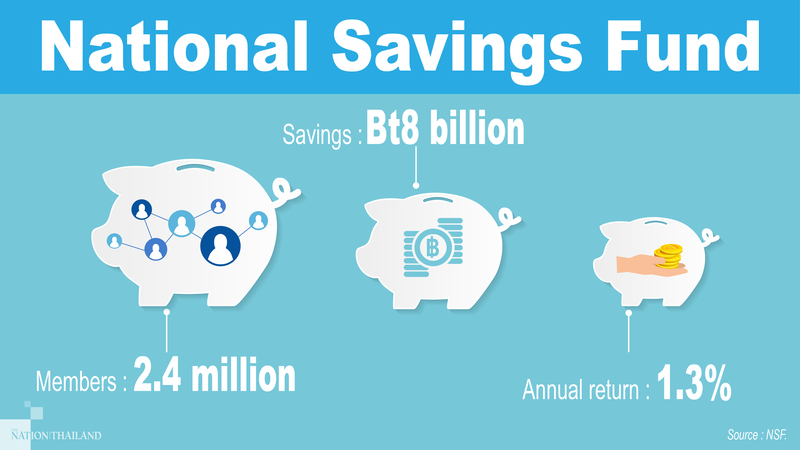
Membership of the National Savings Fund (NSF) has dropped by 500,000 to 2.4 million during the Covid-19 crisis, as people have been unable to maintain their annual contributions, said its secretary-general Jaruluk Ruangsuwan.
.The NSF is designed to take care of workers who are not protected by the Social Security fund.
This year, encouraging workers in the informal sector to join the fund to save for retirement had been extremely difficult, she said.
“On a positive note, about 30 per cent of members increased their contributions out of the targeted 50 per cent, she added.
Combined savings of the 2.4 million current members amount to Bt8 billion. They save a combined Bt100 million per month at an annual rate of 1.3 per cent, compared to the 0.5 per cent on bank savings.
The NSF on Tuesday signed an agreement with the Office of SMEs Promotion (OSMEP) to encourage 79,000 small-business workers not covered by the Social Security fund to join the pension fund.
The first 3,000 new members who contribute the maximum Bt13,200 a year would be handed the chance to win Bt1 million in a lottery, she said.
The NSF’s minimum contribution is Bt50 per year.
For those aged 15-30, the government tops up their contributions by 50 per cent to a maximum Bt600 per year. Those aged over 30-50 receive 80 per cent up to a maximum Bt960, while people aged 50-60 get 100 per cent up to a maximum Bt1,200 a year.
Members of the fund include farmers, taxi drivers, the self-employed, small-shop owners and professionals.
Govt earmarks Bt140bn from 2021 budget for Covid relief
EconSep 09. 2020Budget Bureau director Dechapiwat na Songkhla
By The Nation
The government has earmarked a total of Bt140 billion from the 2021 central budget to combat the impacts of Covid-19, said Budget Bureau director Dechapiwat na Songkhla.
He added that the amount covered both necessary spending and emergency cases.
Of the total, Bt99 billion is allocated for spending under the prime minister’s authority.
The entire Bt140-billion budget allocation will be spent on measures to relieve impacts of the outbreak, in addition to existing stimulus packages funded by the Bt1.1 trillion being borrowed by the government.
He added that the Bt140 billion is considered sufficient to mitigate the impacts of a possible second wave of the outbreak.
By The Washington Post · Abha Bhattarai · BUSINESS
The nation’s bricks-and-mortar retailers were undergoing a reckoning years before the pandemic led to shutdowns and a tanking economy, tipping more than a dozen major retailers into bankruptcy and prompting many others to thin their ranks.
The result: Thousands of liquidation sales, at a time when many Americans are wary of in-store shopping or spending.
Firms that specialize in winding down stores say liquidating now is markedly different from what it was before the pandemic. Companies are offering deeper discounts to win over consumers – with sales starting at 40 percent off instead of the usual 20 percent – as well as other incentives. Even then, results can be spotty: Proceeds from liquidation sales have fallen about 25 percent since the novel coronavirus took hold, according to Jim Schaye, chief executive of retail liquidation firm Eaton Hudson.
“It’s like throwing a party and having nobody come,” he said. “People are just not running out to a J.C. Penney liquidation or a Lord & Taylor liquidation like they would have in the past. Even at 60 percent off, they’re saying: ‘So what? I don’t need it so I’m not going to buy it.'”
The Gap last week announced that it would shut 200 locations, while Ascena Retail Group – the parent company of Ann Taylor, Lane Bryant and Justice – is closing nearly 1,600 stores while in bankruptcy proceedings. Department store chain Lord & Taylor is liquidating all of its stores, as are Pier 1 Imports, Modell’s, Stage Stores and New York & Co. Overall, retailers are expected to close a record 25,000 stores this year, according to Coresight Reserarch.
The typical liquidation sale, which used to last about nine weeks, now takes about 30 percent longer, according to Michael McGrail, chief operating officer of Tiger Group, which is among the firms managing closeout sales for J.C. Penney, New York & Co. and Modell’s. There are some variations, though, based on the type of product being sold: Sporting goods, furniture and housewares tend to sell quickly, though clothing, shoes and jewelry have become more difficult to offload during the pandemic.
“For certain things, the customer does return,” he said. “Do they come back at 100 percent? No. But [the virus] isn’t enough to wipe out consumerism.”
But it has been enough to complicate matters. Millions of Americans remain out of work, and even those with jobs say they’re cutting back on discretionary items. Sales at clothing stores have declined 37 percent from a year ago, while sales of electronics, appliances, furniture and home goods have all dropped by double digits, according to the latest retail sales figures from the Commerce Department.
As a result, liquidation firms say they’ve changed the way deals are structured. Instead of paying retailers for their inventory upfront, as has long been the norm, they have shifted to a fee-based model where the retailer gets a portion of the proceeds after the sale is complete. The pandemic also has forced them to take on new tasks, such as ordering protective equipment for workers, and hiring and training workers to staff stores.
Many workers are hesitant to come back to work temporarily – especially if they’re already furloughed and collecting unemployment benefits – while others are dropping out of the workforce because of health and safety concerns, said Ian Fredericks, executive vice president of the retail group at Hilco Merchant Resources. The company has recruited and trained hundreds of workers to fill in during pandemic liquidations, he said.
“It’s not something we’ve typically done, but we’re doing it more and more now because there just isn’t enough store staff to help customers during the day,” he said. “When one project is over, we can usually send them to another project in the same area.”
Specialty apparel, like men’s suits, has been particularly difficult to sell, even at half price, he said. There have been other challenges, too: “People aren’t necessarily walking around, looking to browse,” Fredericks said. “If they are going to the mall, it’s because they have [a] specific need in mind – and specialty apparel just isn’t it.”
And although Americans are doing more of their shopping online, liquidation sales haven’t quite followed. Many of the retailers shutting down have antiquated websites that can’t handle major sales or buy-online, pick-up-in-store options, McGrail said. Or, if a retailer does have a booming online presence, it often doesn’t want to tarnish its reputation – or a chance at finding a buyer for its e-commerce operations – by offering deep discounts online.
“There is so much uncertainty: You could start a liquidation, and suddenly the mall closes down or there’s another shutdown,” Schaye said. “It’s a constant struggle, so we’re just limping along.”
Employees at a Catherines store in Parkersburg, W.Va., were notified in late July that parent company Ascena had filed for bankruptcy and was shutting down the apparel chain. They immediately began marking down inventory – 40 percent off at first, then as much as 95 percent off. Jeans that originally cost $60 were discounted to $3; pantyhose fell from $17 to 79 cents.
But selling off a store mid-pandemic comes with other considerations: Only five shoppers were allowed in at a time, and employees were required to wipe down registers after each transaction. Fitting rooms were off-limits – which prompted some shoppers to try on tops and pants on the sales floor, according to Lyndsey Fought, 35, who worked part time at the store until it closed in late August.
“To be honest, we just wanted to get it over with,” she said. “We were dealing with the sadness of losing our jobs after having been furloughed 2½ months. And then to be closing down the store? It wasn’t the greatest feeling.”
By Syndication Washington Post, Bloomberg · Alex Longley, Firat Kayakiran · BUSINESS An oil trade that works only when the market is glutted may be about to make a comeback. That’s bad news for producers withholding near-record amounts of crude in a coordinated bid to help prop up prices.
The global Brent crude benchmark is currently trading quite deeply in a bearish pattern known contango, where the most immediate prices are far below those for contracts for supply in later months. The discount has gotten so big that it appears to cover the nominal cost of hiring 1,200-feet long supertankers. In other words: traders can buy cargoes now, stash them on ships, and sell them later at a profit.
Such a development would be viewed with concern by the likes of Saudi Arabia and Russia, the two nations who led the deepest global oil production cuts in history. In recent months, they have been carefully trying to boost supply to bring it slowly back toward normal. The contango implies that the market is so oversupplied that one of the industry’s most expensive forms of storage is becoming a viable way to hoard barrels — on paper at least.
While the oil market has recovered since the depths of the pandemic in April, there has been renewed weakness in recent weeks. With the recovery in global consumption stalling at about 90% of prior year levels and OPEC+ slowly adding supply back to the market, there has been little incentive for refiners to ramp up their consumption of crude, potentially forcing it toward more unconventional storage methods.
To be sure, part of the reason that storage works on paper is because charter rates for tankers have crashed. Several tanker industry officials and shipbrokers said that, in practice, owners are still reluctant to accept multi-month charters at current levels because that locks in low revenue and it’s not ideal to keep the vessels in a single location for long periods of time. They do acknowledge, though, that there have been increased inquiries about storing in recent days.
Nevertheless, the numbers appear to work, according to storage-cost estimates from E.A. Gibson Shipbrokers Ltd. and exchange data compiled by Bloomberg earlier this week.
If floating storage does materialize, it could offer some relief to the tanker owners after rates plunged, according to analysts at Clarksons Securities Ltd. and Pareto Securities AS.
In recent weeks, some tankers that were booked during a super contango earlier this year for storage stopped doing so as those charters expired. The deepening contango may reverse that, or at least encourage some owners to extend existing contracts to store.
“We see some renewed interest in storage work as the contango has widened and spot rates remain low,” said Pareto analysts Eirik Haavaldsen and August Klemp.




 Budget Bureau director Dechapiwat na Songkhla
  File photo
  Oil tank/ File photo
