Stocks rebound from lows on big earnings day #ศาสตร์เกษตรดินปุ๋ย

#ศาสตร์เกษตรดินปุ๋ย : ขอบคุณแหล่งข้อมูล : หนังสือพิมพ์ The Nation.

Stocks rebound from lows on big earnings day

EconJul 31. 2020
By Syndication Washington Post, Bloomberg · Rita Nazareth, Katherine Greifeld, Claire Ballentine · BUSINESS, US-GLOBAL-MARKETS

Stocks pared losses as a rally in big technology companies tempered concern over a slow economic rebound. A third day of falling bond yields sent financial shares slumping.

The S&P 500 came off session lows and the Nasdaq 100 climbed as Qualcomm Inc. soared on a strong sales forecast. After the close of regular trading, Amazon.com Inc., Alphabet Inc. and Facebook Inc. jumped as results topped analyst estimates. Earlier Thursday, equities sank as data showed the U.S. economy had its sharpest contraction on record, while the number of Americans filing for unemployment benefits rose. President Donald Trump raised the notion of delaying the Nov. 3 election until after the coronavirus pandemic eases.

Some corporate highlights:

– United Parcel Service Inc. jumped to a record on results that blew past estimates.

– Procter & Gamble Co. had a surge in sales amid high demand for detergent and continued stockpiling.

– Mastercard Inc. reported a rebound in consumer purchases on its cards in July.

– PayPal Holdings Inc. saw spending on its platform surge as more merchants switched to online sales.

– Johnson & Johnson’s experimental coronavirus vaccine protected a group of monkeys with a single shot, prompting it to start trials in humans this month.

Thanks to solid balance sheets and a suite of products that benefit from social distancing, giant tech companies have fared better during the pandemic-induced recession. The Nasdaq 100 is still poised to beat the S&P 500 for a 10th consecutive month – the longest winning stretch in 20 years. But with much of the good news already priced into markets, traders are looking for catalysts that could sustain further momentum in equities.

“We’re in that uncertain time between the hopeful third quarter rebound and some concern about the reopening process and what the recovery looks like,” said Tom Garretson, senior portfolio strategist for RBC Wealth Management. “We’re kind of in that void right now, waiting for things to play out.”

In a very busy day for earnings, investors also digested economic figures that highlighted the massive devastation caused by the coronavirus pandemic. While some numbers have improved after the reopenings, the recent spike in infections shows that the recovery will most likely take time. Federal Reserve Chairman Jerome Powell said Wednesday that there are signs the increase in cases is starting to weigh on activity, while noting that the path forward for the economy is “extraordinarily uncertain.”

“It’s shocking no matter how you look at it,” said Randy Frederick, vice president of trading and derivatives for Schwab Center for Financial Research. “Are things going to get better from here? I don’t think we know just yet. The virus is getting worse in a lot of areas, and some places have started to shut back down again. If you look at earnings in terms of beat rates, the results have actually been pretty good, granted the expectations bar has been set very low.”

There’s a distinction to be made between the S&P 500’s five biggest companies and all the rest, according to BCA Research.

The firm compared the total market value of the five – Amazon.com, Apple, Facebook, Google owner Alphabet and Microsoft Corp. – with the value of the other 495 companies in a chart last week. The top five’s value increased 266% from the start of 2015 through Tuesday, according to data compiled by Bloomberg. In the same period, the value of the rest rose just 25% – and the entire gain occurred after the S&P 500 set this year’s low in March.

These are some of the main moves in markets:

Stocks

– The S&P 500 decreased 0.4% as of 4 p.m. New York time.

– The Stoxx Europe 600 Index decreased 2.2%.

– The MSCI Asia Pacific Index fell 0.1%.

Currencies

– The Bloomberg Dollar Spot Index decreased 0.2%.

– The euro increased 0.4% to $1.1841.

– The Japanese yen appreciated 0.1% to 104.80 per dollar.

Bonds

– The yield on 10-year Treasurys declined four basis points to 0.54%.

– Germany’s 10-year yield sank four basis points to -0.54%.

– Britain’s 10-year yield fell three basis points to 0.088%.

Commodities

– The Bloomberg Commodity Index dipped 1.1%.

– West Texas Intermediate crude declined 2.8% to $40.13 a barrel.

– Gold weakened 0.8% to $1,954.24 an ounce.

Virus impact easing for business: BOT survey #ศาสตร์เกษตรดินปุ๋ย

#ศาสตร์เกษตรดินปุ๋ย : ขอบคุณแหล่งข้อมูล : หนังสือพิมพ์ The Nation.

Virus impact easing for business: BOT survey

EconJul 31. 2020

By The Nation

Businesses are enjoying some relief from the impact of Covid-19, the Bank of Thailand said on Thursday (July 30), citing progress in economic reopening.

The central bank’s latest survey found businesses reported less impact in July after the fifth phase of lockdown easing.

A total of 297 large and small businesses were surveyed to reveal the pandemic’s affect on three channels – logistics, global supply chain disruption, and consumers’ behaviour shift.

On logistics issues, 21 per cent reported no impact in July, up from 17.2 per cent in June.

On global supply chain disruption, 33.4 per cent reported no impact, up from 25.9 per cent in June.

On consumers’ behaviour shift, businesses unaffected rose to 30.7 per cent, from 22.6 per cent in June.

The decreasing Covid-19 impact has also been positive for employment in many business sectors. However, tourism-related businesses such hotels and restaurants are still cutting working hours as the sector struggles to recover.

Machinery manufacturers and financial services, meanwhile, have been hit hardest by changes in consumer behaviour. Consumers are spending less, leading to low demand for machinery and also affecting loan volumes as well as quality of lending, said the survey.

It was conducted from July 1 to 24.

Investors advised to hold more cash, watch 5 factors #ศาสตร์เกษตรดินปุ๋ย

#ศาสตร์เกษตรดินปุ๋ย : ขอบคุณแหล่งข้อมูล : หนังสือพิมพ์ The Nation.

Investors advised to hold more cash, watch 5 factors

EconJul 31. 2020

By The Nation

An expert at Trinity Securities has advised investors to convert some of their stockholding into cash savings to prepare for the third quarter this year.

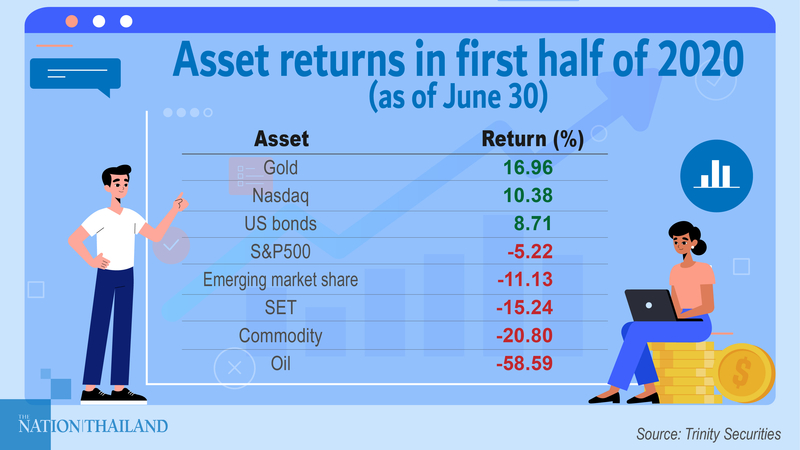
The second quarter saw the Thai stock market recover by 20 per cent, but negative sentiment persists over the Covid-19 pandemic, non-performing loans, the decline in GDP, and changes in asset values – all factors that are prompting investors to revise their investment strategy.

Nuttachart Mekmasin, a research analyst at Trinity Securities, said the Stock Exchange of Thailand (SET) Index rebounded quickly on hopes of economic recovery in the second half of 2020 but had hit a ceiling with no further rise expected soon.

He advised investors to hold 30 per cent in cash and invest 10 per cent in Thai stocks, 20 per cent in foreign stocks, 20 per cent in Thai and foreign bonds, 15 per cent in Real Estate Investment Trusts (REITs), and 5 per cent in gold.

“Regarding foreign stocks, we advise investing 10 per cent in developed markets and another 10 per cent in emerging markets, especially Europe, Japan, and MSCI Emerging Markets,” he said.

“For REITs, we advise investing 10 per cent in foreign REITs because Thai REITs are focused on investment in assets affected by the Covid-19 impact.”

He pinpointed five factors that investors should follow during the second half of 2020:

1. Economic policymakers’ moves: Investors should follow any move to reduce injection of cash into the economic system as this will affect assets’ value.

2. Economic recovery and listed companies’ second-half performance: An absence of signs of recovery will trigger a severe market correction.

3. US-China conflict and US presidential election: These factors will affect the issuing of economic policies.

4. Thailand’s Covid-19 relief measures: Measures such as the Bank of Thailand’s debt payment holiday and the SET’s uptick rule will expire soon; investors will make more short sales if the SET does not extend the uptick rule period.

5. Opec’s agreement to cut oil production: The oil price will drop again if demand increases.

Finance Ministry cuts 2020 GDP forecast to -8.5% #ศาสตร์เกษตรดินปุ๋ย

#ศาสตร์เกษตรดินปุ๋ย : ขอบคุณแหล่งข้อมูล : หนังสือพิมพ์ The Nation.

Finance Ministry cuts 2020 GDP forecast to -8.5% 

EconJul 31. 2020Lavaron Sangsnit, director general at the Fiscal Policy OfficeLavaron Sangsnit, director general at the Fiscal Policy Office

By The Nation

The Finance Ministry has revised down its GDP projection for 2020 to an 8.5-per-cent contraction and will launch additional measures to boost tourism.

Lavaron Sangsnit, director general at the Fiscal Policy Office, said  the ministry revised its forecast downwards from its original projection of 2.8 per cent growth.

“We forecast the economy will contract in a range of 8 to 9 per cent and exports in dollar terms will fall as much as 11 per cent, as Thailand’s trading partners have also been hit hard by Covid-19,” he told a press conference on Thursday (July 30).

Thailand’s 15 trading partners will suffer an average 4.1 per cent economic contraction, according to the Finance Ministry forecast.

Thailand’s economy is expected to plunge more than 10 per cent in the second quarter, figures for which are about to be released.

Despite the economic downturn, the baht is expected to remain strong at around Bt31.7/dollar this year. The Dubai crude oil price is forecast to be at $42 a barrel while the central bank is expected to maintain the policy rate at the current 0.5 per cent for the rest of the year, said Lavaron.

The number of foreign tourists will drop to 6.8 million from about 40 million last year.

The ministry is looking at additional measures to boost domestic tourism on top of the “Travel Together” scheme that subsidises 40 per cent of accommodation and travel costs for Thais holidaying in Thailand. So far, about 6,000 hotels of the total 60,000 nationwide have registered to participate in the scheme, he said.

The Finance Ministry is now working on new incentives for hotels to join. 

“We do not expect [the scheme] to boost economic growth but we want to redistribute income nationwide,” said Lavaron.

He ruled out more relief cash handouts, arguing that the economy has started to recover. 

“Out of our Bt1 trillion borrowing to aid economic recovery, about Bt200 billion is still unused and will be reserved for the future in case of a second wave of coronavirus,” he said.

The government will also accelerate infrastructure spending, which is expected to boost capital spending by 9.7 per cent year on year, he said.

However, private consumption is expected to fall by 2.6 per cent.

Due to the steep fall in exports and weakening consumption , private investment is expected to contract sharply by 12.6 per cent.

The Finance Ministry is more optimistic about next year’s outlook, forecasting GDP growth of between 4 and 5 per cent and export growth at 5 per cent. Foreign tourist arrivals next year are predicted to rise to 15 million-16 million.

The ministry expects that a coronavirus vaccine will be available by the middle of next year, which will boost the tourism industry.

Lavaron assured people that the government still had money to spend to boost the economy should a second wave of the virus occur. The Bank of Thailand recently forecast the Thai economy would shrink 8.1 per cent this year, though some research houses predict a 10-per-cent contraction.

U.S. jobless claims rise a second week in sign of growing risks #ศาสตร์เกษตรดินปุ๋ย

#ศาสตร์เกษตรดินปุ๋ย : ขอบคุณแหล่งข้อมูล : หนังสือพิมพ์ The Nation.

U.S. jobless claims rise a second week in sign of growing risks

EconJul 30. 2020A worker gives a pedicure to a customer outside of a nail salon in Palo Alto, Calif., on July 28, 2020. MUST CREDIT: Bloomberg photo by David Paul Morris.A worker gives a pedicure to a customer outside of a nail salon in Palo Alto, Calif., on July 28, 2020. MUST CREDIT: Bloomberg photo by David Paul Morris.

By Syndication Washingon Post, Bloomberg · Olivia Rockeman · NATIONAL, BUSINESS, US-GLOBAL-MARKETS, CAREER-WORKPLACE 

The number of Americans filing for unemployment benefits increased for a second straight week, a sign the economic rebound is increasingly at risk with Congress poised to potentially let supplemental $600 payments expire.

Initial claims through regular state programs rose to 1.43 million in the week ended July 25, up 12,000 from the prior week, a Labor Department report showed Thursday. There were 17 million Americans filing for ongoing benefits through those programs in the period ended July 18, up 867,000 from the prior week — the largest increase since early May.

U.S. stock futures remained lower after the report, while 10-year Treasury yields extended declines. Economists in a Bloomberg survey had forecast 1.445 million initial claims, with projections as high as 1.6 million.

Almost five months into the pandemic, economic pain remains widespread, with the persistent jump in coronavirus infections and lack of a vaccine preventing a return to normal for the foreseeable future. Further challenges for Americans are in store should lawmakers allow the $600 in extra federal weekly jobless benefits to expire this week; Democrats and Republicans have remained far apart in negotiations over extending the aid that has propped up consumers and businesses.

A separate report Thursday showed the U.S. economy shrank at a record 32.9% annualized rate in the second quarter, pointing to the effects business closures and lost jobs are having on the broader economy.

“Even if the reopening goes well — and many, many people go back to work — it is still going to take a fairly long time for parts of the economy that involve lots of people getting together in close proximity” to recover, Federal Reserve Chairman Jerome Powell said Wednesday, after the central bank kept interest rates near zero. “Those people are going to need support.”

The Labor Department said its seasonal factors had assumed an unadjusted decline of about 181,000 initial claims; the count fell by about 171,000. That resulted in an increase of 12,000 after the department applied its seasonal adjustment.

The data showed initial claims in almost all states fell on an unadjusted basis last week. California — the most populous state and a hotspot for the virus — saw a 40,587 decline on an unadjusted basis, while Florida, Georgia, Louisiana and Texas also reported significant drops.

States with increases included Nevada, New Jersey, Virginia and Kansas.

The jump in continuing claims was concentrated in California and Texas, which reported a combined increase of about 576,000 on an unadjusted basis. Florida showed a decline of about 122,000.

States reported 829,697 people filed for Pandemic Unemployment Assistance, a federal program for those not eligible for regular state programs including independent contractors and self-employed Americans. That figure was down from the prior week.

And the total number of unadjusted continuing claims fell to 30.2 million three weeks ago from 31.8 million. This figure, though, has reflected overcounting of PUA applications as states clear backlogs.

SET down over 1.5% despite positive Fed news #ศาสตร์เกษตรดินปุ๋ย

#ศาสตร์เกษตรดินปุ๋ย : ขอบคุณแหล่งข้อมูล : หนังสือพิมพ์ The Nation.

SET down over 1.5% despite positive Fed news

EconJul 30. 2020

By The Nation

The Stock Exchange of Thailand (SET) Index closed at 1,315.74 today (July 30), down 22.61 points or 1.69 per cent. Total transactions amounted to Bt67.115 billion with an index high of 1,347.45 and a low of 1,313.10.

In the morning session, a stock analyst at Krungsri Securities expected the index to fluctuate between 1,330 and 1,350 points.

“The market gained positive sentiment from the US Federal Reserve’s move to maintain the interest rate at 0-0.25 per cent and a promise that it would issue measures to help economic recovery amid the Covid-19 crisis,” the analyst explained.

“The index was also boosted by mass buy-ups of stocks whose second-quarter performance is expected to improve.”

However, the analyst said the index would be pressured by uncertainty following rising Covid-19 cases in the US and conflict there between lawmakers over $1 trillion in relief measures.

The 10 stocks with the highest trade value today were KCE, AOT, CPALL, HANA, DELTA, PTT, GULF, PTTEP, OSP, and SCC.

As of 4.30pm, the price of crude oil dropped by US$0.72 or 1.74 per cent to $40.55 per barrel, while gold dropped by $12.80 or 0.65 per cent, to $1,963.90 per ounce.

Other Asian indices were mixed:

Japan’s Nikkei Index closed at 22,339.23, down 57.88 points, or 0.26 per cent

China’s Shang Hai SE Composite Index closed at 3,286.82, down 7.73 points, or 0.23 per cent, while the Shenzhen SE Component Index closed at 13,466.85, down 90.59 points, or 0.67 per cent.

Hong Kong’s Hang Seng Index closed at 24,710.59, down 172.55 points, or 0.69 per cent.

South Korea’s KOSPI Index closed at 2,267.01, up 3.85 points, or 0.17 per cent.

Taiwan’s TAIEX Index closed at 12,722.92, up 181.95 points, or 1.45 per cent.

SET rises on Fed’s rate move, vow to introduce more relief measures #ศาสตร์เกษตรดินปุ๋ย

#ศาสตร์เกษตรดินปุ๋ย : ขอบคุณแหล่งข้อมูล : หนังสือพิมพ์ The Nation.

SET rises on Fed’s rate move, vow to introduce more relief measures

EconJul 30. 2020

By The Nation

The Stock Exchange of Thailand (SET) Index rose by 7.18 points, or 0.54 per cent, to 1,345.53 in morning trade today (July 30).

A stock analyst at Krungsri Securities expected the index to fluctuate between 1,330 and 1,350 points.

“The market gained positive sentiment from the US Federal Reserve’s move to maintain the interest rate at 0-0.25 per cent and a promise that it would issue measures to help economic recovery amid the Covid-19 crisis,” he explained.

“Also, mass buy-ups in stocks, whose second-quarter performance is expected to improve, boosted the index.”

However, the analyst said uncertainty following the conflict between US Republicans and Democrats over $1-trillion in Covid-19 relief measures and the rising number of infections in the United States would pressure the index.

He recommended investors buy:

> Food and Electronic stocks that benefit from the weakening baht, such as CPF, GFPT, TU, TFG, Asian, KCE, Delta, Hana, and SVI.

> Stocks whose second-quarter performance is expected to improve, such as Top, PTTGC, SPRC, BGrim, CKP, CPF, TU, Tasco, STA, STGT, SPALI, AP, PRM, PTL, AJ, Stark, CBG, TQM, and JMT.

The SET Index closed at 1,338.35 yesterday (July 29), down 2.57 points, or 0.19 per cent. Total transactions stood at Bt56.11 billion, with an index high of 1,349.91 and a low of 1,337.03 points.

Gold continues rise #ศาสตร์เกษตรดินปุ๋ย

#ศาสตร์เกษตรดินปุ๋ย : ขอบคุณแหล่งข้อมูล : หนังสือพิมพ์ The Nation.

Gold continues rise

EconJul 30. 2020

By The Nation

The price of gold rose by Bt50 per baht weight in morning trade today (July 30), the Gold Traders Association reported.

As of 9.29am, the buying price of a gold bar was Bt29,000 per baht weight and selling price Bt29,100, while gold ornaments cost Bt28,470.48 and Bt29,600, respectively.

At close yesterday, the buying price of a gold bar was Bt28,950 per baht weight and selling price Bt29,050, while gold ornaments cost Bt28,425 and Bt29,550, respectively.

The Comex (Commodity Exchange) gold price to be delivered in August rose by US$8.8, or 0.45 per cent, to $1,953.4 (Bt61,388.72) per ounce at yesterday’s close.

Gold remained in positive territory as investors continued to purchase the metal as a safe-haven asset before the US Federal Open Market Committee began a key meeting.

The Chinese Gold and Silver Exchange Society said the Hong Kong gold price rose by HK$70, opening at $18,170 (US$2,344.52 / Bt73,674.75) per tael this morning.

Fed chief: New surge in cases is beginning to weigh on the economy #ศาสตร์เกษตรดินปุ๋ย

#ศาสตร์เกษตรดินปุ๋ย : ขอบคุณแหล่งข้อมูล : หนังสือพิมพ์ The Nation.

Fed chief: New surge in cases is beginning to weigh on the economy

EconJul 30. 2020Federal Reserve Chair Jerome PowellFederal Reserve Chair Jerome Powell

By The Washington Post · Rachel Siegel · NATIONAL, BUSINESS, HEALTH, POLITICS, HEALTH-NEWS

WASHINGTON – The head of the Federal Reserve said Wednesday that rising numbers of coronavirus cases since mid-June are beginning to weigh on the economy, reinforcing that the fate of the recovery depends on containing the pandemic.

“On balance, it looks like the data are pointing to a slowing in the pace of the recovery,” Federal Reserve Chair Jerome Powell said during a news conference on Wednesday. “I want to stress it’s too early to say both how large that is and how sustained it will be.”

Job gains from May and June came “sooner and stronger” than expected, Powell said. But those encouraging signs were closely followed by a surge in coronavirus cases nationwide. Powell said that at the same time people’s lives depend on containing the public health crisis, it is also important to “deal with the economic ramifications.”

Powell said some measures of consumer spending, based on debit card and credit card use, have moved down since late June. Powell also mentioned recent labor market indicators that are pointing to slower job growth, especially for smaller businesses. Hotel occupancy rates have flattened out, Powell said, while Americans are not going to restaurants, gas stations and beauty salons as much as they had been earlier in the summer.

Powell said the upcoming jobs reports and other surveys will help flesh out the Fed’s economic outlook, cautioning that he did not “want to get ahead of where the data are on this.” But as he has for months, Powell again emphasized that the economy’s recovery depends on the country’s ability to stop the virus from spreading.

“The path of the economy is going to depend, to a very high extent, on the course of the virus and on the measures we take to keep it in check,” Powell said. “The two things are not in conflict. Social distancing measures and a fast reopening of the economy actually go together. They’re not in competition with each other.”

As expected, the Fed’s policymaking board decided to keep interest rates, which are already near zero, unchanged as it concluded two days of policy meetings this week. Markets responded optimistically to the news, with the Dow Jones industrial average ending up 160 points at Wednesday’s close.

The Federal Reserve signaled in its statement on Wednesday that the Fed would continue to use “its full range of tools” to steer the economy out of recession, even as the virus significantly shapes the future of the economy.

“The ongoing public health crisis will weigh heavily on economic activity, employment, and inflation in the near term, and poses considerable risks to the economic outlook over the medium term,” the Fed’s top panel of policymakers said in a statement at the conclusion of two days of meetings.

After sharp declines, economic activity and employment “have picked up somewhat in recent months,” the Fed said. Economists have been closely watching July indicators, which could help explain whether the recovery from earlier this summer is beginning to fizzle as some states and cities reimpose restrictions on businesses to combat rising coronavirus cases.

“Overall financial conditions have improved in recent months, in part reflecting policy measures to support the economy and the flow of credit to U.S. households and businesses,” the Fed statement read.

To support the flow of credit to households and businesses, the Fed said it would increase its holdings of Treasury securities and agency residential and commercial mortgage-backed securities at least at the current pace over the coming months. The Fed has said its support of the markets should remain in place to help safeguard the broader financial system during the pandemic.

At his news conference, Powell said the Fed was committed to keeping its lending facilities and other emergency measures in place not only during the shutdown and reopening, but also through the “long tail where a large number of people are struggling to get back to work.”

“We’re in this until we’re well through it,” Powell said.

Powell’s news conference comes as Congress clashes over another stimulus bill and an extension for enhanced unemployment benefits. On Tuesday, President Donald Trump brushed off the new $1 trillion Senate GOP coronavirus legislation as “sort of semi-irrelevant.”

Powell has repeatedly said that the Fed cannot heal the economy alone and that more help will be needed from Congress to ease the pain for millions of Americans. On Wednesday, Powell said funding from the Cares Act has been key to keeping people in their homes and jobs. He praised the Paycheck Protection Program, for example, for getting money directly to businesses that couldn’t necessarily have been saved through a Fed lending program.

“Lending is a particular tool, and we’re using it very aggressively, but fiscal policy is essential here,” Powell said. “As I’ve said, more will be needed from all of us, and I see Congress is negotiating now over a new package, and I think that’s a good thing.”

Powell has stopped short of telling lawmakers exactly what they should do, or how urgently they should act, saying it isn’t his role to tell other parts of government how to do their jobs. But on Wednesday, Powell pushed the success of Congress’s earlier programs as reason for lawmakers to act again, said Skanda Amarnath, research director of Employ America, a policy group that advocates for full employment and higher wages.

Amarnath said Powell’s framing could give some cover to Republican lawmakers who are less convinced more help is needed, or who dispute the connection between the virus and the recovery.

“[Powell] is trying to reiterate that you can’t think of this as ‘either or,’ ” Amarnath said, adding that when it comes to tackling the pandemic and the economy, “you’re going to have to tackle one to tackle the other.”

For months, Powell has insisted that the virus will dictate an economic turnaround, which he says can’t happen until Americans feel safe going about their daily routines. Since the Fed’s last meeting in June, rising case counts have forced states to reimpose restrictions on business activity. Minutes from the Fed’s June meeting showed officials were worried the United States could enter a much worse recession later this year if the pandemic is not contained.

At this week’s Fed meeting, Fed leaders were expected to discuss other policy tools, such as forward guidance and asset purchases, without necessarily coming away with any firm conclusions. Economists are also awaiting the release of the Fed’s long-term monetary policy review, which could change the way the Fed approaches its inflation target.

Stocks rally, dollar falls on dovish Fed remarks #ศาสตร์เกษตรดินปุ๋ย

#ศาสตร์เกษตรดินปุ๋ย : ขอบคุณแหล่งข้อมูล : หนังสือพิมพ์ The Nation.

Stocks rally, dollar falls on dovish Fed remarks

EconJul 30. 2020

By Syndication Washington Post, Bloomberg · Rita Nazareth · BUSINESS, US-GLOBAL-MARKETS 

U.S. stocks climbed and the dollar fell after the Federal Reserve signaled continued stimulus to prop up the world’s largest economy. Treasurys were little changed.

The S&P 500 extended its July rally as the Fed kept rates near zero in a widely anticipated decision, pledging to use all of its tools to support a recovery from the coronavirus pandemic. Chairman Jerome Powell said there are signs the increase in infections is starting to weigh on activity while noting that the path forward for the economy is “extraordinarily uncertain.” The central bank repeated prior language that the outbreak “poses considerable risks” to the outlook over the medium term.

As the pandemic continues to rage in parts of the U.S., hot spots in Europe and across big emerging economies, governments are having to double down on the $11 trillion dollars worth of stimulus and unprecedented central bank support unleashed since the crisis began. The Fed has kept rates pinned near zero since the outbreak’s onset in March and rolled out several emergency lending programs geared toward fostering liquid trading conditions in financial markets.

“The Fed’s large, looming presence and ability to act more if needed has provided a backstop for risk assets over the near term,” according to Jason Pride, chief investment officer of private wealth at Glenmede. “The focus now shifts to the FOMC’s September meeting, when investors might expect more action,” he said, referring to the Federal Open Market Committee.

Meanwhile, Scott Minerd, chief investment officer at Guggenheim Partners, said a failure in Washington to agree to another covid-19 relief package could push unemployment higher, undermining the stock market and forcing the Fed to expand asset purchases.

“We are in a particularly vulnerable time of the year for risk assets,” Minerd said Wednesday in an interview on Bloomberg Television. “The markets could get easily rattled.”

Some 19% of S&P 500 companies that have posted results so far have reported per-share profits that beat or missed estimates by 50% or more. That’s the highest proportion of companies with surprises of this magnitude since at least 2010, data compiled by Bloomberg Intelligence’s Gina Martin Adams and Wendy Soong show.

Yet earnings may fail to deliver the kind of support needed to sustain the four-month rally in American stocks any time soon, according to Liz Ann Sonders, Charles Schwab Corp.’s chief investment strategist.

She compared the S&P 500 with its forward earnings, based on projected profit during the next 12 months, in a report Monday. While the S&P 500 made up 85% of the gap between this year’s high and low through Tuesday, the profit gauge only rebounded 20%, according to data compiled by Bloomberg. “Earnings will eventually need to do more than just beat an extremely low bar” to justify the surge in share prices, she wrote.

These are some of the main moves in markets:

Stocks

– The S&P 500 climbed 1.3% as of 4 p.m. EDT.

– The Stoxx Europe 600 Index fell 0.1%.

– The MSCI Asia Pacific Index decreased 0.2%.

Currencies

– The Bloomberg Dollar Spot Index dipped 0.3%.

– The euro increased 0.5% to $1.178.

– The Japanese yen was little changed at 105.04 per dollar.

Bonds

– The yield on 10-year Treasurys was unchanged at 0.58%.

– Germany’s 10-year yield increased one basis point to -0.50%.

– Britain’s 10-year yield climbed one basis point to 0.118%.

Commodities

– The Bloomberg Commodity Index rose 0.7%.

– West Texas Intermediate crude climbed 0.5% to $41.26 a barrel.

– Gold strengthened 0.4% to $1,965.93 an ounce.