By Syndication Washington Post, Bloomberg · Eric Lam
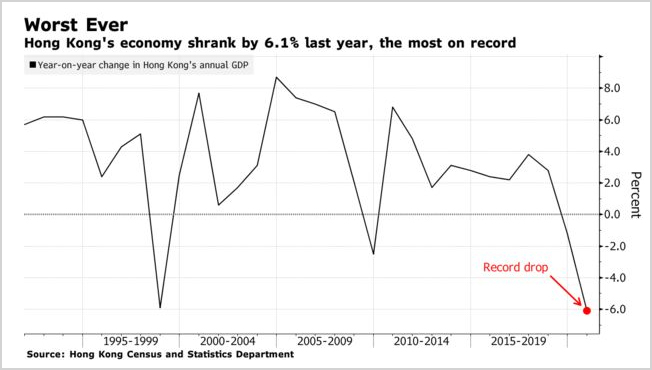
Hong Kong’s economy shrank by a record in 2020, with the global pandemic dragging down output in a city already reeling from massive political upheaval.
Gross domestic product fell 3% in the fourth quarter from a year earlier, resulting in a full-year decline of 6.1%, according to advance estimates from the Hong Kong Census and Statistics Department Friday. The median estimate in a Bloomberg survey of economists was for a 2.1% contraction in the fourth quarter and 6% for the whole of 2020.
Hong Kong hasn’t posted back-to-back annual contractions in data going back to at least 1962. And the biggest contraction in GDP over that period was a 5.9% decline in 1998, when the city’s economy was affected by both the Asian Financial Crisis and the handover to China.
Consumption and tourism-related sectors were particularly hard-hit by the pandemic last year while financial market activity “stayed robust,” the government said in the GDP report.
“The Hong Kong economy is expected to see positive growth for 2021 as a whole, but the economic situation in the first half of the year will remain challenging,” the report said. “Locally, the prospect of domestic economic activities depends critically on how fast the local epidemic situation can be contained.”
Even before the coronavirus hit, the city’s economy was under stress following months of disruptive pro-democracy protests in 2019 that curbed spending and investment. Once the virus began spreading, travel bans brought tourism to a halt and social distancing restrictions put a further dent in spending. By the end of 2020, unemployment had surged to a 16-year high of 6.6%.
Virus outbreaks continue to weigh on the recovery, with the economy losing momentum in the fourth quarter after the government reimposed strict measures to control the spread of infections. GDP growth slowed to 0.2% last quarter compared with the previous three months.
“The next 18 months for me will be full of challenges,” Hong Kong’s Chief Executive Carrie Lam said an interview with Bloomberg Thursday. “I need to deal with this pandemic, and then I need to stimulate the economy to create more jobs for the people of Hong Kong.”
Lam said the economy has a very good chance of achieving positive growth this year, subject to the course of the pandemic. She pointed to an improvement in exports and imports in the latter half of last year as signs of a recovery and said spending at retailers and restaurants will pick up once virus restrictions are lifted.
Revised fourth-quarter and full-year figures as well as growth forecasts for 2021 will be released with the upcoming budget on Feb. 24.
By The Washington Post · Lily Kuo, Shibani Mahtani
TAIPEI, Taiwan – China on Friday accused Britain of turning Hong Kong residents into “second-rate” citizens as the country prepares to welcome tens of thousands of people fleeing Beijing’s crackdown in the Asian financial center.
In a gesture set to inflame tensions between China and the U.K., Beijing said that starting on Sunday it would no longer recognize British National (Overseas), or BN(O) passports – a type of British nationality granted to residents of the former colony born before its 1997 handover to Chinese control.
The U.K. on Sunday begins accepting applications for a program that expands the rights of BN(O) holders, allowing them and their families to live and work in Britain and eventually seek citizenship. Some 5.4 million of Hong Kong’s 7.5 million people are eligible, raising the prospect of a mass exodus.
Britain moved to open its doors after China imposed a sweeping national security law on Hong Kong, sharply curtailing political rights, which London said was a clear breach of the handover agreement. Human rights advocates say authorities are using the new powers to target democracy activists and government critics.
On Friday, British Prime Minister Boris Johnson said he was “immensely proud” of his country’s “commitment to the people of Hong Kong.”
“We have stood up for freedom and autonomy – values both the U.K. and Hong Kong hold dear,” he said.
Chinese Foreign Ministry spokesman Zhao Lijian responded by saying China would no longer recognize the BN(O) as a travel document or proof of identification – a step it has been threatening for months. Criticizing the U.K. for “disregarding the fact that Hong Kong has been returned to China for 24 years,” Zhao said Beijing reserved the right to take further action.
“The U.K. is plotting to turn a large number of Hong Kong people into second-rate U.K. citizens,” he said, accusing Johnson’s government of “violently” interfering in China’s affairs.
While the comments were among China’s harshest against Britain, it was unclear how much effect the change would have or whether it could be used to stop Hong Kong residents from fleeing. Residents can leave Hong Kong with a government-issued identity card or Hong Kong passport and later use the BN(O) document to enter the U.K.
Activists helping Hong Kongers settle in Britain saw Beijing’s move as largely symbolic, noting that it would be difficult for Chinese authorities to know who had settled in the U.K. through the BN(O) program.
“Not recognizing the BN(O) as a valid travel document is the mildest action Beijing can take, so it is well expected and even a relief,” said Simon Cheng, who was granted asylum in the U.K. last year and now helps newly arrived Hong Kongers with immigration advice, legal aid and other assistance. Cheng, a former British consulate worker, was snatched and detained in China during a business trip there in 2019, and said he was tortured.
China promised Hong Kong a high degree of autonomy and pledged to preserve the city’s way of life, including a measure of freedom, for 50 years after the handover. But its tightening control of the city, especially after anti-government protests in 2019, has prompted widespread alarm.
Further measures by Beijing could be a concern. Rights groups say Chinese authorities have previously used travel documents as a way to control or pressure citizens it deems troublesome, by confiscating passports or preventing dissidents, as well as Tibetans, Uighurs and other minorities from obtaining passports.
In the months since Beijing imposed the national security law on Hong Kong, residents have sought ways to escape the city.
Britain’s BN(O) offer has been of particular focus. Since July 15 last year, some 7, 000 Hong Kong people have resettled in the U.K., which granted them special permission to stay even though the BN(O) program doesn’t take effect until this weekend. Others have also arrived in the U.K. hoping to seek residency through asylum.
In October, the British government estimated that between 123,000 and 153,700 BN(O) passport holders and their dependents could arrive in the first year of the migration offer, and up to 320,000 over five years. Civil society groups say that estimate is conservative, and expect up to 600,000 Hong Kongers to relocate to the U.K.
Activists say Hong Kong authorities could impose further controls, such as pressuring airlines not to recognize the special passports or even restricting dual nationality.
“The worst-case scenario would definitely be the Chinese government urging all Hong Kong [people] to renounce the BN(O) otherwise there will be consequences,” said Nathan Law, an activist who left Hong Kong for Britain. “This is something we ultimately worry about.”
HUD nominee Fudge to push for rental assistance, affordable housing amid coronavirus crisis
InternationalJan 29. 2021Rep. Marcia Fudge, D-Ohio, speaks in December after being formally nominated by President-elect Joe Biden to lead the Department of Housing and Urban Development. MUST CREDIT: Washington Post photo by Joshua Lott.
By The Washington Post · Tracy Jan
WASHINGTON – If confirmed as secretary of housing and urban development, Rep. Marcia Fudge, D-Ohio, will confront the immediate challenge of keeping millions of Americans from losing their homes during the coronavirus pandemic while ending discriminatory housing policies as part of President Joe Biden’s push to dismantle systemic racism.
Fudge, 68, appeared remotely before the Senate Committee on Banking, Housing and Urban Affairs for her confirmation hearing Thursday, from Cuyahoga Community College in Cleveland with her family, including her 89-year-old mother, behind her.
During the 75-minute hearing, Republican senators chastised Fudge on what they called her past “intemperate” comments about race and the GOP over policy disagreements, accusing her of dismissing the party’s concern for Black Americans and other communities of color.
Sen. Tom Cotton, R-Ark., mentioned the Biden administration’s focus on examining domestic policy through the lens of racial equity, asking Fudge to define the difference between racial equity and racial equality,
“From my own perspective, the difference is one just means you treat everybody the same. Sometimes the same is not equitable,” Fudge said. “Equity means making the playing field level. . . . The same is not always fair.”
The long history of discriminatory housing policies – such as “redlining,” a policy under which the federal government and banks denied mortgages to people in minority neighborhoods or charged those borrowers more – have directly contributed to the gap between White and Black Americans in wealth, income, homeownership and other economic measures.
The government should directly address the racial wealth gap by offering down payment assistance to residents of previously redlined neighborhoods, given that coming up with cash for down payments is the biggest impediment for Black homeownership, Fudge said. “It’s like us being in a race with people who already have a head start.”
Fudge said she expects to make homeownership – and the wealth creation that comes along with it – a reality for more Americans. Forty-six percent of Black families owned homes, compared with 75% of White families in 2020. That homeownership gap has widened since 1976, according to Pew Research Center.
Boosting Black homeownership, she said, “will require us to end discriminatory practices in the housing market, and ensure that our fair housing rules are doing what they are supposed to do: opening the door for families, especially families of color who have been systematically kept out in the cold across generations, to buy homes and punch their ticket to the middle class.”
Fudge, the former chairwoman of the Congressional Black Caucus who served as Warrensville Heights’s first African American and first female mayor, said that in addition to bolstering fair housing protections and expanding access to affordable housing, her most urgent task is providing rental assistance to households at risk of eviction.
“My first priority as secretary would be to alleviate that crisis and get people the support they need to come back from the edge,” Fudge told committee members.
Tens of millions of Americans are behind on rent, according to Fudge, and almost 3 million homeowners are in forbearance; another 800,000 borrowers are delinquent. Fudge said the $25 billion that Congress has provided in rental assistance and the government’s extension of the eviction moratorium are not enough. Latinos and Black Americans are more likely than White people to have reported job losses during the recession induced by the coronavirus pandemic, and people struggling to pay rent continue to be served with eviction notices despite moratoriums.
Cecilia Rouse, Biden’s nominee to head the Council of Economic Advisers, appeared jointly with Fudge during Thursday’s confirmation hearing,
Sen. Pat Toomey, R-Pa., the acting committee chairman who presided over the hearing, said he hopes Congress will be able to work with Fudge and Rouse to develop appropriate responses to help those suffering the most from the pandemic-induced economic crisis.
“We are in a different place in our economy than we were back in March,” he said, adding that it’s become clear “targeted” groups are being hit much harder by the recession than the “universal catastrophe” in the spring.
Toomey expressed concern about Fudge’s intent to undo HUD regulations put in place by the Trump administration that Republicans said addressed costly and time-consuming Obama-era fair-housing requirements and that Toomey said also discouraged the construction of much-needed affordable housing.
Biden, in executive orders pertaining to racial equity this week, sought to strengthen these anti-discrimination housing policies that the Trump administration had rolled back.
Fudge, as HUD secretary, would be expected to reinstate a 2013 rule aimed at barring the housing industry from enacting policies that, while seemingly race-neutral, have an adverse effect on Black and Latino Americans. The rule had codified a decades-old legal standard known as “disparate impact,” but the Trump administration issued a new rule in September that housing advocates said would make it harder to prove such forms of bias.
Biden is also pushing for the reinstatement of another Obama administration regulation that required communities to identify and address barriers to racial integration and disparities in access to transportation, jobs and good schools – or risk losing federal funds.
Housing advocates say they expect Fudge to do more than reverse the Trump administration’s evisceration of President Barack Obama’s housing policies.
Julián Castro – the housing secretary under Obama who recently helped prepare the “New Deal for Housing Justice,” a playbook for federal policy change focused around racial equity – said in an interview that the new administration should invest in boosting the agency’s fair-housing staff and funding local housing and civil rights nonprofit organizations so reports of housing discrimination can be investigated and fair-housing laws better enforced.
Black homeownership and net wealth were devastated during the Great Recession of 2007-2009, in part because of predatory lending practices, and have yet to recover.
“If we can create greater homeownership for everybody, but particularly for people of color that have lagged behind, then we can close that wealth gap,” Castro said. “I’m confident that it is more realistic today than it was 10 years ago to get big things done on housing, because more people are feeling the pinch right now.”
Other recommendations for the first 200 days of the Biden administration include reinstating protections for transgender homeless people, solidifying the right of families of mixed immigration status to access federally subsidized housing, expanding access to housing vouchers, considering the treatment of people with criminal records who seek federal housing assistance, creating a refundable renter’s tax credit, and establishing a presidential commission on reparations to Black Americans for the legacy of discriminatory federal housing policy.
The spread of covid-19 led to a surge in orders for factory robots
InternationalJan 29. 2021A robot assembles a string trimmer power tool at the Stihl Inc. manufacturing facility in Virginia Beach, Va., on Jan. 11, 2018. MUST CREDIT: Bloomberg photo by Luke Sharrett.
By Syndication Washington Post, Bloomberg · Thomas Black
Orders for robots soared in North America at year-end as manufacturers attempted to grapple with the rising toll of covid-19 and avoid putting employees at risk.
Companies ordered 9,972 robots in the fourth quarter, up 64% from a year earlier. That lifted the annual total to 31,044 units, up 3.5%, the Association for Advancing Automation reported Thursday. And for the first time, automakers didn’t lead demand.
“The pandemic has created a sense of urgency for manufacturing companies to invest in automation like never before,” said Mike Cicco, chief executive officer of the Americas unit of Fanuc Corp., a Japanese robot maker.
The need for automation became apparent outside the auto industry as workforces were hobbled by coronavirus infections, making it difficult to keep up with demand. Sales rose in some industries as household income that would have been spent on restaurants and entertainment went instead to consumer goods. Robot orders in food and consumer goods, life sciences, and plastics and rubber industries all rose more than 50% last year.
Technological advances — such as improved vision, mobility and end-of-arm tools for grabbing objects — have expanded the uses for automation. Machine learning, meanwhile, has made it much easier to program robots for complex tasks that couldn’t be done before, such as preparing food.
It wasn’t long ago that almost all robots were fenced in to keep humans safe. Now, with sensors that stop the machines when people approach, more robots are working alongside employees.
“The automation competence level in general industry has grown, and that matured into greater demand,” said John Bubnikovich, chief regional officer for North America at Germany’s Kuka.
Most of last year’s gain in orders came in the second half. In the first, North American robot orders dropped 18% as companies struggled to understand the impact of the lockdowns. Then demand accelerated, with the final three months of the year registering the second strongest quarter ever, behind the fourth quarter of 2016.
FedEx Corp. in March installed four robots in a pilot program at its Express unit in Memphis, Tennessee, to pick small packages of different sizes and shapes from a bin and put them on a conveyor for sorting.
With the robots handling as many as 1,300 packages an hour, FedEx workers are freed up to do more complex work, such as correcting addresses and dealing with delays, Aaron Prather, senior technical adviser at FedEx Express, said in an October presentation. FedEx plans to add more robots this year, he said.
U.S. new-home sales rose in December for first time since July
InternationalJan 29. 2021New homes under construction by Pardee Construction in the Pacific Highlands Ranch master planned community in San Diego on Aug. 31, 2020. MUST CREDIT: Bloomberg photo by Bing Guan.
By Syndication Washington Post, Bloomberg · Olivia Rockeman
U.S. new-home sales rose in December for the first time in five months, capping the best year since 2006 and signaling that record-low mortgage rates continue to drive demand for a sector that’s been a bright spot in the economy.
Purchases of new single-family houses increased 1.6% to an 842,000 annualized pace in December from a downwardly revised 829,000 rate in the prior month, government data showed Thursday. The median projection in a Bloomberg survey called for 870,000. The median price rose 8% from a year earlier to $355,900.
Housing has helped drive the U.S. economic recovery, fueled by cheap borrowing and buyers looking for more space during the pandemic. While the strength continued in December, a lack of affordable homes and a sluggish job market may be starting to limit the strength in the sector.
For the full year, sales climbed to 811,000, the best level in more than a decade, according to the report, which is released jointly by the Census Bureau and Department of Housing and Urban Development.
Other data in recent weeks show the housing market strengthened in December. Housing starts recently rose to the best pace since late 2006, while existing homes saw unexpected strength.
Federal Reserve Chair Jerome Powell on Wednesday cited real estate as a bright spot in the economy even as other sectors have cooled. “The housing sector has more than fully recovered from the downturn, supported in part by low mortgage interest rates,” he said in a briefing after the latest gathering of policy makers.
The report showed the number of properties sold for which construction hadn’t yet started increased to 277,000 from 256,000 in the prior month, while the number of homes for sale rose to 302,000, the most since May.
At the current sales pace, it would take 4.3 months to exhaust the supply of new homes, up from 4.2 months.
Across regions, sales climbed in the West and Midwest, while the South, the biggest region, fell to the lowest since May.
Samsung net profit misses estimates after 5G iPhone’s debut
InternationalJan 29. 2021Samsung Galaxy S21 smartphones in Phantom Black, Phantom White, Phantom Violet, and Phantom Pink at the Samsung Unpacked product launch event in New York on Wednesday, Jan. 13, 2021. MUST CREDIT: Bloomberg photo by Nina Westervelt
By Syndication Washington Post, Bloomberg · Sohee Kim
Samsung Electronics missed analyst estimates for the fourth quarter and warned profitability will likely decline this quarter, citing weakness in its memory chip business and challenges with currency fluctuations.
South Korea’s biggest company reported net income in the three months ended December of 6.45 trillion won ($5.84 billion), missing the 7.3 trillion won average of estimates compiled by Bloomberg. Shares fell 2.2% in Seoul on Thursday.
Samsung, the world’s largest maker of memory chips and displays, struck a cautious tone that stood in contrast to that of many technology companies benefiting during the coronavirus lockdowns. Just hours earlier, Apple and Facebook reported financial results that handily exceed estimates.
“In the first quarter, we expect overall profitability to decline due to relative weakness in the memory and display businesses,” said Ben Suh, executive vice president of investor relations, during a call with investors. In the memory business, Samsung’s most important profit engine, “results are likely to weaken due to currency effects and continued costs associated with new fab ramp up.”
Operating profit for the semiconductor unit was 3.85 trillion won in the fourth quarter, short of the 4.62 trillion estimate from analysts. The company said it expects a recovery in the business in the first half.
Samsung said it’s tracking whether chip shortages that have hit the global auto industry could spill over to other sectors, including tech products.
“This is a global issue,” said Han Jinman, executive vice president of the memory business. “There is a possibility that the shortage of other semiconductor parts may impact mobile demand and so, we are carefully watching how that plays out.”
In the smartphone business, Samsung struggled in the holiday period as Apple introduced its first 5G-capable iPhones and Chinese rivals put up fierce competition. The Cupertino, Calif.-based company took over the No. 1 position in the fourth quarter, ahead of Samsung and China’s Xiaomi, market research firms said on Thursday.
With a lot of good devices on the market, “there is only so much that Samsung can grab out of it,” said Kiranjeet Kaur, research manager at IDC.
Investors had anticipated Samsung could increase its dividend payout substantially, in part because the founding Lee family faces an enormous inheritance tax bill. Instead, the company said it would continue to return 50% of free cash flow to shareholders between 2021 and 2023, although its annual dividend payout will increase slightly to 9.8 trillion won.
The results come just days after Samsung’s de-facto leader, billionaire heir Jay Y. Lee, was sent back to prison on bribery charges. Although professional managers lead the company’s operating units, Lee has played a central role in major strategic decisions.
The company signaled it will continue to press ahead with critical deals and investments. Samsung will use its capital to expand the capacity of its foundry business, which fabricates chips for clients like Nvidia, to meet demand and overcome current supply shortages. It will also invest in facility expansions and “meaningful” acquisitions, the company said.
“For the last few years, we have been evaluating possible M&A opportunities very carefully and have made significant progress in terms of preparation,” Choi Yoon-ho, chief financial officer of Samsung, said during the earnings call. “Although it is difficult to pinpoint a specific timing due to uncertainties in the internal and external business environment … we are optimistic of carrying out meaningful M&A activities during this term.”
Analysts including Yungsan Choi of Ebest Investment & Securities have been anticipating a long-awaited rebound in memory chip prices due to demand for servers and more powerful 5G smartphones. Component supplier Murata Manufacturing and chipmaker MediaTek both anticipate more than half a billion 5G handsets to be shipped this year.
Chipmakers Intel and Micron Technology gave a bullish forecast for the first quarter of this year on continued demand for computers and phones that enable working and studying from home. Taiwan Semiconductor Manufacturing is planning another record-breaking year of investment with as much as $28 billion set aside to expand and improve its production capacity at a time of silicon supply shortages affecting everyone from global automakers to mobile tech giants like Apple and Qualcomm.
Samsung’s contract chip manufacturing is expected to expand with the addition of Intel as a customer. The two companies have discussed development and production of Intel’s mainboard chipsets over the last two years and Samsung will produce the chipset at its Austin, Texas, plant starting from this quarter, Meritz Securities said in a note.
The existing Austin fab is capable of operating on a 14-nanometer process. With rising expectations of growth in the foundry market, Samsung is considering building a cutting-edge logic chipmaking plant in the region that would be capable of fabricating chips as advanced as 3nm in the future, Bloomberg News reported earlier.
“Regarding investments including building a fab in the U.S., we haven’t made a decision yet,” said Shawn Han, senior vice president. “Due to the nature of foundry business that requires timely and efficient responses to customers’ demand, we routinely review capacity expansions. We continue to study ways to optimize operations at fabs in all regions from Giheung, Hwaseong to Austin.”
Apple CEO slams internet giants ahead of new privacy features
InternationalJan 29. 2021Tim Cook, chief executive officer of Apple Inc., speaks during a Bloomberg Technology television interview in San Jose, Calif., on June 5, 2017. MUST CREDIT: Bloomberg photo by David Paul Morris.
By Syndication Washington Post, Bloomberg · Natalia Drozdiak, Mark Gurman
Apple Chief Executive Officer Tim Cook lambasted tech giants for “data exploitation” and called for reform around the practices of selling user data to target ads.
The iPhone maker is rolling out new privacy features that restrict how mobile apps such as those from Facebook and Google gather data about users to target ads.
“If a business is built on misleading users, on data exploitation, on choices that are not choices at all, then it doesn’t deserve our praise, it deserves reform,” Cook said Thursday at the online Computers, Privacy & Data Protection Conference.
Without naming specific businesses, Cook criticized companies’ algorithms for perpetuating the spread of disinformation and conspiracy theories, saying “we can no longer turn a blind eye to a theory of technology that all engagement is good engagement.”
The Apple CEO also reiterated calls for a U.S. privacy law much like the European Union’s General Data Protection Regulation. He said it’s time for “worldwide laws and new international agreements that enshrine the principle of data minimization, user knowledge and data security around the globe.”
Following an update to Apple’s iPhone and iPad operating system software this spring, users will be prompted to explicitly permit or deny developers the ability to track their data across apps or websites.
It’s expected many consumers will choose not to allow this, making it harder for apps to show users ads based on their past online activity, drawing the ire of Facebook and other advertising companies that rely on such abilities.
In full-page newspaper ads in December, the social network attacked Apple over the plans, saying the features would hurt small businesses and on Wednesday, Facebook told analysts the iOS changes could curb its revenue growth. A group of French online advertisers last fall filed an antitrust complaint against Apple, warning publishers’ ad revenue could plunge by as much as 50% as result of the update.
Apple says the features will give users more transparency about how their data is used, and in a way that still enables advertising.
The remarks come after Apple on Wednesday issued a cautious outlook for its wearables and services sales, despite posting quarterly revenue that topped $100 billion for the first time. The company also published a separate report detailing how companies track user data across websites and apps, alongside quotes from privacy advocates supporting Apple’s new measures.
The Apple CEO last spoke at a Brussels privacy conference in 2018, when he lashed out at Facebook and other Silicon Valley competitors that collect user data, equating their services to “surveillance.”
Since then, the regulatory situation for Apple in Europe has only darkened. Apple faces EU antitrust investigations concerning its app store and payments system and, along with other tech giants, a threat of steep fines and business break-ups loom as part of legislation proposed by the European Commission in December. It’s also facing lawsuits in several European countries over misleading claims about the battery life of older iPhones.
Biden team slams China claims in swift calls to Asia allies
InternationalJan 29. 2021Yoshihide Suga, Japan’s prime minister, wears a protective face mask as he delivers a policy speech in the lower house of parliament in Tokyo on Jan. 18, 2021. MUST CREDIT: Bloomberg photo by Kiyoshi Ota.
By Syndication Washington Post, Bloomberg · Isabel Reynolds
President Joe Biden and his team staked out early opposition to Chinese territorial claims in a series of calls to Asian allies, as Beijing warned that trying to contain the country was “mission impossible.”
Biden reaffirmed in a telephone call with the Japanese prime minister the U.S.’s commitment to defend uninhabited islands controlled by Japan and claimed by China that have been a persistent point of contention between the Asian powerhouses. Meanwhile, newly confirmed U.S. Secretary of State Antony Blinken rejected Chinese territorial claims in a call with his Philippine counterpart and emphasized U.S. alliances in talks with top Australian and Thai officials.
While some observers had anticipated a ratcheting down of U.S.-China tensions under Biden, the series of calls didn’t indicate any softening of security policies in Asia. Chinese President Xi Jinping earlier this week called for the world to abandon “ideological prejudice” and shun an “outdated Cold-War mentality” as he signaled in his first international address since Biden entered the White House that Beijing would continue to forge its own path regardless of criticism.
Over the weekend, China sent an early warning to the new U.S. administration by flying 13 warplanes into the Taiwan Strait. Chinese Defense Ministry spokesman Senior Colonel Wu Qian told a regular news briefing Thursday that trying to contain China was “mission impossible” and urged the U.S. military to use the “new starting point” to bring relations back on track.
Biden’s pledge to Japan, which was made in his first call since taking office with Prime Minister Yoshihide Suga, poses the risk of the U.S. becoming embroiled in any potential conflict arising in the dispute between China and Japan, the U.S.’s biggest ally in Asia. Suga and Biden spoke in the early hours of Thursday Japan time, according to a statement issued by Foreign Ministry.
“President Biden expressed his unwavering commitment to the defense of Japan, including the application of Article 5 of the U.S.-Japan Security Treaty to the Senkaku islands,” the ministry said. Biden also expressed a commitment to “extended deterrence,” both governments said, a term that refers to the potential use of nuclear weapons to defend an ally.
Vessels from Japan and China often come into close contact around the East China Sea islands — called the Senkakus in Japan and the Diaoyus in China — raising concerns of a bigger confrontation. China this month passed a law allowing its coastguard vessels to fire on foreign ships, in a development that could ratchet up tensions with several of its Asian neighbors.
The White House said in its statement that Biden and Suga discussed “the United States’ unwavering commitment to the defense of Japan,” specifying that this covers the Senkaku islands. Japan, whose pacifist constitution limits the activities of its military, seeks regular assurances from the U.S. — its only defense ally. Blinken and Defense Secretary Lloyd Austin have made similar comments on island defense in talks with their Japanese counterparts in recent days.
Earlier this week, White House Press Secretary Jen Psaki said the Biden administration was approaching its relationship with Beijing with “patience” and plans to review hard-line policies that were a hallmark of Donald Trump’s presidency.
Blinken told Philippine Secretary of Foreign Affairs Teodoro Locsin the U.S. rejects China’s maritime claims in the South China Sea if they exceed the maritime zones that China is permitted under international law, and pledged to stand with Southeast Asian claimants in the face of Chinese pressure. Malaysia and Vietnam are among other countries embroiled in similar disputes with China, which claims about 80% of the resource-rich South China Sea.
The Chinese Foreign Ministry reaffirmed its claims to territory in the East and South China seas in response to questions Thursday about the U.S. diplomatic calls. “We hope non-regional countries will fully respect China and regional countries’ efforts to properly handle maritime differences and disputes and safeguard peace and stability,” ministry spokesman Zhao Lijian told a regular briefing in Beijing.
Blinken also discussed with Thai Deputy Prime Minister Don Pramudwinai the importance of working together to “advance our shared prosperity, security, and values across the free and open Indo-Pacific region.”
In a call with Australian Foreign Minister Marise Payne, Blinken reaffirmed his commitment to the so-called Quad. This is a grouping of the U.S., Australia, India and Japan that became elevated under the Trump administration and has been admonished by China as a “clique” that could stoke a new Cold War.
Volkswagen loses title of world’s top-selling carmaker to Toyota
InternationalJan 29. 2021Toyota vehicles bound for shipment at a port at dusk in Yokohama, Japan, on Oct. 31, 2020. MUST CREDIT: Bloomberg photo by Toru Hanai.
By Syndication Washington Post, Bloomberg · River Davis, Tsuyoshi Inajima
Toyota overtook Volkswagen in 2020 to become the world’s top-selling automaker, the first time the Japanese group has clinched the position in five years.
Toyota’s group sales, which include those of its subsidiaries Daihatsu Motor Co. and Hino Motors Ltd., for the year were 9.53 million units, the company said Thursday. That compares with VW’s 9.31 million, announced earlier this month.
The victory for Toyota came despite a painful year for automakers. Although demand for cars recovered marginally toward the end of 2020, industry-wide factory and showroom shutdowns in the spring were enough to drag sales down 14% from 2019, according to an estimate from IHS Markit.
It was also a topsy-turvy year in which the gravity of automakers’ losses was largely determined by their level of exposure to the regions most disrupted by the virus.
VW has a strong footprint in the European Union, where passenger car sales fell an “unprecedented” 24% to fewer than 10 million units in 2020, according to the European Automobile Manufacturers Association. The German carmaker’s sales fell 15%, its worst performance in close to a decade.
VW Chief Executive Officer Herbert Diess initiated a strategic shift after he took over the top job in 2018 to focus on lifting profitability rather than chasing sales growth. VW’s return on sales has been lagging behind Toyota for years and the market slump triggered by the covid-19 pandemic a year ago exposed the German manufacturer’s relatively high costs.
Toyota, on the other hand, has a bigger presence in the U.S., where total car sales in the nation fell 15% in 2020. The Japanese automaker’s global sales were down 11%. Although the U.S. has the most Covid deaths and cases, there haven’t been the same lockdowns as in Europe.
“Naturally the number of units sold was lower than in the previous year because of the spread of coronavirus,” Toyota spokeswoman Chisato Yoshifuji said Thursday. “But because Toyota and its partners were able to thoroughly implement measures to combat the spread of the virus, we were able to continue our corporate activities and keep yearly declines at the level they were,” she said.
Prior to 2020, VW outsold Toyota in every year since 2015. But the two companies’ results last year may be indicative of a longer-term trend, according to analysts.
While VW is expected to temporarily surpass Toyota again in 2021, Toyota is projected to pull ahead each year through 2025, IHS Markit said. VW’s push to produce more electrified vehicles should lead to a sales spike this year, but prolonged lockdowns and shop closures in its domestic market will continue to have an adverse impact, analyst Yoshiaki Kawano said.
Kawano said Toyota will continue to enjoy strong sales in its core markets of Japan and the U.S. In China, the world’s largest car market, it should “put up a good fight” by pushing out more EVs and SUVs in line with local demand, he said.
Although a number of factors such as the continued spread of the virus and a global chip shortage will persist in 2021, IHS Markit estimates auto sales will recover steadily to 84.4 million units from 76.8 million in 2020. Global car sales are expected to touch 94.8 million in 2025.
WHO team investigating coronavirus origins ‘finally free’ from 14-day quarantine in Wuhan
InternationalJan 29. 2021An international team led by the World Health Organization
By The Washington Post · Adam Taylor
An international team led by the World Health Organization to study the origins of the coronavirus in China have completed the first stage of their visit: a mandatory two-week quarantine in Wuhan.
“Graduation, revised,” Marion Koopmans, a virologist at the Erasmus University Medical Center in the Netherlands and one of the members of its 10-person team, tweeted Thursday along with a photograph of medical workers.
“So proud to graduate from our 14 days ‘isolation quarantine’ – no one went stir crazy & we’ve been v productive!” another team member, EcoHealth Alliance President Peter Daszak, added in his own message.
The WHO-led investigation into the virus’s origins in China, mooted since the earliest days of the pandemic, had already been long-delayed amid disagreements over the nature of the investigation.
Geopolitical rivalry complicated the matter further, as U.S. officials in the Trump administration suggested repeatedly that the virus could have leaked from a lab in Wuhan, while Chinese officials claimed that the virus may not have originated in China at all.
In early January, WHO Director General Tedros Adhanom Ghebreyesus made a rare public criticism of China, accusing the country of holding up the process.
“Today, we learned that Chinese officials have not yet finalized the necessary permissions for the team’s arrival in China,” Tedros said during a news conference in Geneva on Jan. 5, adding that he was “very disappointed.”
The WHO team arrived in China less than two weeks later on Jan. 14 but were then immediately restricted to their hotel in Wuhan under China’s mandatory 14-day quarantine required for all arrivals.
Even now, after two weeks in isolation, the team is not fully clear of restrictions: Under Beijing’s recently announced “14+7+7″ policy, team members will be required to continue with health checks and avoid gatherings for another two weeks.
An Associated Press reporter who saw the team leave their hotel Monday noted that though the WHO-backed team just wore masks, the Chinese driver of their bus was in a full-body white protective suit.
The team left their quarantine hotel to move to a different hotel that had a more impressive setting. “Finally free to walk along the lakeside at our hotel on a beautiful sunny day in Wuhan,” Daszak wrote on Twitter.
Some members of the team Thursday said it was a relief to finally escape the quarantine, which had left them confined to their hotel with windows sealed and unable to even meet with each other.
“The only thing I could see for 14 days from the hotel room has been concrete,” Thea Fischer, a Danish member of the team, told Reuters in a phone interview, adding that arriving in the new hotel was like “one has landed from the moon.”
“I lived opposite two of the others in the team, so it was my hope that every time they knocked on the door, that the other two also went out and had their temperature measured, so you could at least exchange a few words and see a human being,” Fischer added.
“But we were always asked kindly but firmly, like some naughty children, to go back to our rooms.”
While the team members were confined to their rooms, they said that they were able to be productive. Peter Ben Embarek, a Danish food safety expert and head of the mission, tweeted that there had been as much as 13 hours of meetings every day and “no time for books, movies or the like. A bit of exercise early morning in the room or during some of the online meetings.”
Daszak tweeted an image of a yoga mat and weights on the floor of his room, noting that his “office” and “gym” had been the same space, but added praise for the hotel.
“Surprisingly easy to do 14 days in quarantine, the high workload meant days have sailed by & this is a v nice hotel,” the British zoologist wrote.
The real work will now begin. Public health experts say that understanding the spread of the virus, which is thought to have originated in bats and likely spread to humans by an unknown animal, is vitally important for preventing the spread of deadly zoonotic diseases in the future.
In an interview with The Washington Post this year, Ben Embarek said that “everything was on the table,” including theories of lab leaks and spread from outside China, but he emphasized that the “least surprising” result would be that the virus had leaped from animals to humans.
One area of early focus is expected to be the Huanan Seafood market in Wuhan, which many of the first cases of the virus were linked to more than a year ago.
Some virologists and public health experts have expressed skepticism that the team will be able to get adequate access for their investigation and suggested that pressure from Beijing could influence the team.
In a briefing Wednesday, White House press secretary Jen Psaki said what she called the “misinformation” coming out of China was of “great concern to us.”
“It’s imperative that we get to the bottom of the early days of the pandemic in China, and we’ve been supportive of an international investigation that we feel should be robust and clear,” she said.
But Tedros, despite his previous criticism of Chinese authorities, suggested there had been progress in discussions with Chinese officials in a message on Twitter on Thursday. “Thanks, Chinese Health Minister Ma Xiaowei, for a frank discussion on the #COVID19 virus origins mission,” the WHO chief tweeted.
“I asked that the international scientists get the support, access & data needed, and the chance to engage fully with their Chinese counterparts.”


 Rep. Marcia Fudge, D-Ohio, speaks in December after being formally nominated by President-elect Joe Biden to lead the Department of Housing and Urban Development. MUST CREDIT: Washington Post photo by Joshua Lott.
 A robot assembles a string trimmer power tool at the Stihl Inc. manufacturing facility in Virginia Beach, Va., on Jan. 11, 2018. MUST CREDIT: Bloomberg photo by Luke Sharrett.
 New homes under construction by Pardee Construction in the Pacific Highlands Ranch master planned community in San Diego on Aug. 31, 2020. MUST CREDIT: Bloomberg photo by Bing Guan.
 Samsung Galaxy S21 smartphones in Phantom Black, Phantom White, Phantom Violet, and Phantom Pink at the Samsung Unpacked product launch event in New York on Wednesday, Jan. 13, 2021. MUST CREDIT: Bloomberg photo by Nina Westervelt
 Tim Cook, chief executive officer of Apple Inc., speaks during a Bloomberg Technology television interview in San Jose, Calif., on June 5, 2017. MUST CREDIT: Bloomberg photo by David Paul Morris.
 Yoshihide Suga, Japan’s prime minister, wears a protective face mask as he delivers a policy speech in the lower house of parliament in Tokyo on Jan. 18, 2021. MUST CREDIT: Bloomberg photo by Kiyoshi Ota.
 Toyota vehicles bound for shipment at a port at dusk in Yokohama, Japan, on Oct. 31, 2020. MUST CREDIT: Bloomberg photo by Toru Hanai.
 An international team led by the World Health Organization
 SootinClaimon.Com