Merkel ties pandemic exit to immunization rates of over 60% #SootinClaimon.Com

#SootinClaimon.Com : ขอบคุณแหล่งข้อมูล : หนังสือพิมพ์ The Nation.

Merkel ties pandemic exit to immunization rates of over 60% (nationthailand.com)

Merkel ties pandemic exit to immunization rates of over 60%

InternationalDec 17. 2020German Chancellor Angela Merkel in the Bundestag in Berlin, on Dec. 16., 2020. MUST CREDIT: Bloomberg photo by Rolf Schulten.German Chancellor Angela Merkel in the Bundestag in Berlin, on Dec. 16., 2020. MUST CREDIT: Bloomberg photo by Rolf Schulten. 

By Syndication Washington Post, Bloomberg · Arne Delfs, Raymond Colitt

Chancellor Angela Merkel tied an exit from the coronavirus pandemic to immunizing more than 60% of the population, indicating a long fight still ahead.

Germany is targeting so-called herd immunity, which means most of the population is resistant to the disease, Merkel said Wednesday in Germany’s lower house of parliament, as a hard shutdown takes effect across Europe’s largest economy.

The German leader has hinted that stringent restrictions, which are set to run until Jan. 10, will remain in force longer. The country’s daily death toll jumped on Wednesday to a record 910 people, the latest reminder of the risks posed by covid-19.

Merkel told her parliamentary caucus that Germany faces a new peak of infections next month and predicted that the first two months of 2021 will be particularly tough, according to a participant in the virtual meeting Tuesday. The nation is heading toward a seven-day incidence rate of 200 cases per 100,000 people, four times the level the government has determined to be manageable, she said.

Europe’s biggest economy began a strict lockdown on Wednesday, with non-essential stores closed, employers urged to shutter workplaces where possible and parents encouraged to keep children away from school. The tougher rules follow weeks of a partial shutdown, delivering a blow to Germany’s recovery and an extension could deepen the impact.

Despite the German government’s aggressive spending to prop up the economy, the fallout from the pandemic will likely depress business activity and lead to company failures, according to the head of the DIW economic institute.

“One of the biggest risks for the German economy is a wave of corporate bankruptcies next year,” Marcel Fratzscher, DIW’s president, said in a Bloomberg TV interview. “It’s not the question of whether it’s going to come. It’s more a question of when exactly companies will fail,” he said, adding that the thinktank is forecasting a contraction in the German economy in the first quarter.

As the restrictions take effect, fatalities surged to more than 900 in the 24 hours through Wednesday morning, well above Friday’s previous record of 604 and taking the total beyond 23,000. The number of new cases rose by 21,456, to 1.38 million, according to data from Johns Hopkins University.

The seven-day incidence rate has risen sharply in the past few weeks and currently is at a peak of 180 per 100,000 inhabitants, according to the RKI public health institute. Officials have said the rate needs to come down to 50 and stay there to allow effective contact tracing.

Germany is in the uncomfortably position of tightening restrictions after some countries such as France and the U.K. imposed stricter curbs earlier and are now gradually easing. Still, there are concerns across the continent that Christmas celebrations could lead to a renewed spike in infections.

Merkel will meet in early January with regional leaders to evaluate the impact of the measures and could move to extend the lockdown then. German law requires the government to reassess a nationwide lockdown every four weeks.

The chancellor told her caucus lawmakers that it’s impossible to develop a long-term strategy to tackle the pandemic because there are still too many unknowns.

She appealed to regional leaders to stick to lockdown rules, warning that failure to do so would risk extending them even longer. She said it’s too early to tell when the pandemic will be over, damping optimism that the expected European approval of a Covid-19 vaccine next week could quickly provide a way out of the crisis.

Trump sits out debut of covid-19 vaccine that he long championed #SootinClaimon.Com

#SootinClaimon.Com : ขอบคุณแหล่งข้อมูล : หนังสือพิมพ์ The Nation.

Trump sits out debut of covid-19 vaccine that he long championed (nationthailand.com)

Trump sits out debut of covid-19 vaccine that he long championed

InternationalDec 17. 2020A health care worker receives the Pfizer-BioNTech Covid-19 vaccine in San Diego on Dec. 15, 2020. MUST CREDIT: Bloomberg photo by Bing Guan.A health care worker receives the Pfizer-BioNTech Covid-19 vaccine in San Diego on Dec. 15, 2020. MUST CREDIT: Bloomberg photo by Bing Guan. 

By Syndication Washington Post, Bloomberg · Josh Wingrove

President Donald Trump pinned all his hopes for ending the pandemic on a vaccine, but as shots started going into American arms this week, he has barely acknowledged the moment and has wavered on when he’ll be inoculated.

The first shipments of a coronavirus vaccine created by Pfizer and German company BioNTech arrived on Monday, with front-line health-care workers receiving injections on live television to mark the occasion. The rollout coincides with the U.S. setting records for daily cases, daily deaths and hospitalizations.

The president has had little to say about any of it, beyond a single congratulatory tweet buried among a stream of false assertions and conspiracy theories about the election he lost. He has not made a public appearance since Saturday, when he attended the Army-Navy football game at the U.S. Military Academy at West Point.

Trump’s administration bet heavily on fast-tracking vaccine development, defying critics who said it would be nearly impossible for a shot to reach consumers less than a year after the coronavirus hit American shores.

The White House is now preparing to publicly inoculate a handful of officials in an event to celebrate the breakthrough and encourage Americans to get vaccinated. Vice President Mike Pence, who is not known to have contracted the virus, said he’ll receive a vaccination within days, but his office declined to say if it would be in front of cameras.

Public vaccination of top government officials, including the president, is regarded as a confidence-booster by health authorities for Americans wary of the shots. The director of the National Institute of Allergy and Infectious Diseases, Anthony Fauci, has said he intends to receive an injection in public as soon as practicable.

But Trump said Sunday he is not “scheduled” to be vaccinated, after Bloomberg News reported that top White House officials including the president had been given priority for shots. His press secretary, Kayleigh McEnany — who has called the shots the “Trump vaccine” — wouldn’t say Monday whether Trump would be vaccinated while he’s still in office.

“He will receive the vaccine as soon as the medical team determines it’s best,” she said. “These are vaccines that he oversaw the development of, he has great confidence in. He wants to see all Americans get this vaccine and he wants to see the most vulnerable among us get it first.”

President-elect Joe Biden said Tuesday that he would get the vaccine in public, but also didn’t say when. “Dr. Fauci recommends I get the vaccine sooner than later. I want to make sure that we do it by the numbers and when I do it you’ll have notice and we’ll do it publicly.”

The course of the pandemic has become intertwined with Trump’s own political fortunes. The U.S. outbreak soared under his watch, with far more publicly reported cases and deaths than anywhere else in the world, even as Trump promised the virus would fade away and downplayed its danger. Most Americans rated his handling of the crisis poorly, opening the door for Biden’s victory.

But now the efficacy of the U.S. vaccination campaign rests in part with Trump. Before he was president, Trump gave credence to the American anti-vaccine movement by publicly questioning the childhood vaccine schedule and suggesting, falsely, that pediatric inoculations may be linked to autism.

Former presidents have already volunteered to publicly take the vaccine as a signal of its efficacy. Recent polls have shown that confidence in the vaccine is increasing but that many Americans still harbor doubts.

Fauci, who has agreed to be the new president’s top medical adviser, said Tuesday that the pandemic will only truly be curbed when 75% or 80% of Americans are vaccinated.

McEnany said Trump was trying to send a “parallel message” by waiting to get it himself: promoting the vaccine as safe but wanting higher-risk groups to receive it first. Trump contracted covid-19 in October, McEnany pointed out, and the president has described himself as “immune,” though the extent and duration of protection from naturally attained antibodies is unknown.

“Even though the president himself was infected, and he has, likely, antibodies that likely would be protective, we’re not sure how long that protection lasts. So, to be doubly sure, I would recommend that he get vaccinated as well as the vice-president,” Fauci said.

Trump has said he’d be criticized for getting a shot too early.

“If I’m the first one, they will say, ‘He’s so selfish, he wanted to get the vaccine first,'” he said in a Fox News interview over the summer, before he was infected. “Either way, I lose on that one, right?”

By many metrics, the pandemic is worse than ever, and continues to worsen. Trump has met the milestones with silence, saying nothing on Friday when daily deaths hit a record of 3,306, or on Monday when there were 264,000 new cases, also a record. He hasn’t asked Americans to do anything to slow transmission of the virus, such as wearing masks.

Pence has found himself filling the vacuum. At a roundtable event on the vaccine rollout Tuesday in his home state of Indiana, he assured Americans the vaccine is safe and pledged to get a shot himself.

“We have come to the beginning of the end of the coronavirus pandemic in America, but as I expect you will hear from our panel and you’ll continue to hear, we have a ways to go,” he said. “Wear a mask and put the health of your family and your neighbors first.”

The Pfizer vaccine’s arrival, with others expected to follow shortly, will focus attention on distribution efforts, the infrastructure developed by the Trump administration and the question of who should receive shots first.

McEnany said Tuesday that two groups of White House officials would get an early vaccine. “Some career staff, national security staff, for the purposes of continuity of government, will have access, in addition to a very small group of senior administration officials for the purpose of instilling public confidence,” she said.

McEnany, like Trump himself and several White House staff, tested positive for the virus earlier this year. She said she “absolutely would be open to taking the vaccine.”

Moncef Slaoui, a leader of the Trump administration’s “Operation Warp Speed” program to accelerate vaccine development, also said Tuesday that both Biden and Trump should be inoculated.

“It is very important that our leaders, departing ones and arriving ones, are protected. And I think both President Trump and President-elect Biden, they are both parts of the higher age group and, therefore, higher risk. So, yes, I think they should be vaccinated,” he told CNN. “That’s an example for the population to follow.”

Trump lashes out at McConnell for recognizing Biden’s victory #SootinClaimon.Com

#SootinClaimon.Com : ขอบคุณแหล่งข้อมูล : หนังสือพิมพ์ The Nation.

Trump lashes out at McConnell for recognizing Biden’s victory (nationthailand.com)

Trump lashes out at McConnell for recognizing Biden’s victory

InternationalDec 17. 2020

By The Washington Post · Timothy Bella

After Senate Majority Leader Mitch McConnell, R-Ky., finally acknowledged on Tuesday that Joe Biden is the president-elect, President Donald Trump publicly pleaded with him to support his continued efforts to upend the election with baseless claims of mass electoral fraud.

“Mitch, 75,000,000 VOTES, a record for a sitting President (by a lot). Too soon to give up,” the president tweeted at nearly 1 a.m. Wednesday. “Republican Party must finally learn to fight. People are angry!”

Trump’s tweet made it clear that McConnell’s decision to recognize Biden as president-elect has opened a rift at the top of the GOP, with the president continuing to falsely claim victory while McConnell works behind the scenes to convince Republican senators not to challenge the electoral college, which cast 306 votes for Biden on Monday, formalizing his victory.

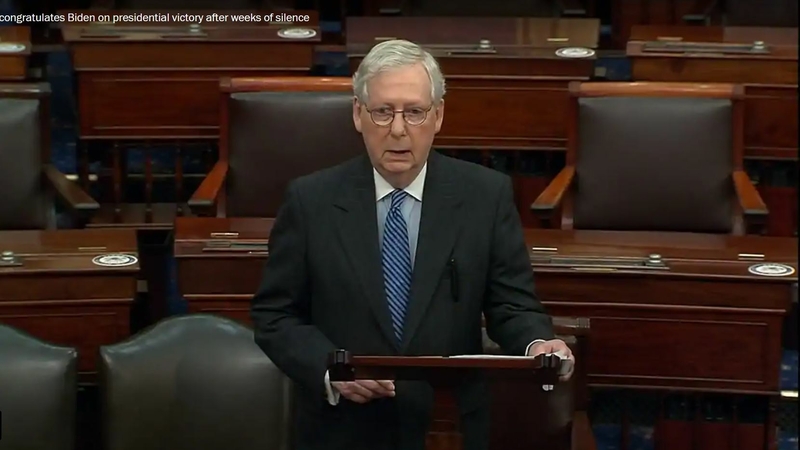
Before Tuesday, McConnell was among a majority of GOP lawmakers in both chambers who had declined to acknowledge Biden as the incoming president for weeks. But in a speech on the Senate floor Tuesday, he said he accepted the electoral college results.

“Many of us hoped that the presidential election would yield a different result, but our system of government has processes to determine who will be sworn in on January 20. The electoral college has spoken,” McConnell said. “So today, I want to congratulate President-elect Joe Biden. The president-elect is no stranger to the Senate. He’s devoted himself to public service for many years.”

The Senate majority leader’s speech sets up a potential fight for control of a Republican Party that’s been reshaped by Trump. The GOP is now faced with its two most influential leaders holding “completely irreconcilable” positions of reality ahead of two critical Senate runoff races in Georgia to decide control of the chamber, The Washington Post’s Aaron Blake wrote in an analysis.

McConnell and other GOP leaders on Tuesday also urged Senate Republicans in a conference call not to join a long-shot effort led by House conservatives to challenge the electoral college results when Congress tabulates the vote on Jan. 6, reported The Post’s Seung Min Kim and Rachael Bade.

Among the Republican lawmakers to join McConnell in accepting the electoral college’s results on Tuesday was Sen. Shelley Moore Capito, R-W.Va. “I think as hard as the losses are to take, at the end of the day, you have to accept what the people’s voices told you,” she said.

On Twitter, Trump pleaded with McConnell and other Republicans to reconsider. Amid another barrage of early-morning tweets promoting the same unfounded claims of election fraud that have been defeated in his campaign’s legal challenges, the president falsely claimed he did better than voting projections in swing states he lost, “but bad things happened.”

Some of the president’s allies also lashed out at the Senate’s top Republican on Tuesday, with Trump-aligned attorney L. Lin Wood calling him “a traitor to American Patriots.”

“His day of judgment is coming,” Wood tweeted.

Fox News host Mark Levin, meanwhile, called for McConnell to retire. While not naming McConnell, Marjorie Taylor Greene, the Georgia representative-elect and QAnon conspiracy theory supporter, said that Republicans who don’t continue contesting the election results are supporting “the Chinese Communist Party takeover of America.”

“You typically don’t use the term ‘congratulations’ when someone just stole a bank,” said Charlie Kirk, founder of the conservative youth organization Turning Point USA.

Trump appeared to note the smattering of support, retweeting early on Wednesday an article titled, “Trump allies slam Mitch McConnell for congratulating Biden.”

Volunteer leads race to rebuilt damaged Beirut church by Christmas Eve #SootinClaimon.Com

#SootinClaimon.Com : ขอบคุณแหล่งข้อมูล : หนังสือพิมพ์ The Nation.

Volunteer leads race to rebuilt damaged Beirut church by Christmas Eve (nationthailand.com)

Volunteer leads race to rebuilt damaged Beirut church by Christmas Eve

InternationalDec 17. 2020Worshipers gather outside a local Maronite church in the Karantina neighborhood in Beirut in August 2020, days after its structure was heavily damaged in a massive port explosion. MUST CREDIT: photo for The Washington Post by Lorenzo Tugnoli.Worshipers gather outside a local Maronite church in the Karantina neighborhood in Beirut in August 2020, days after its structure was heavily damaged in a massive port explosion. MUST CREDIT: photo for The Washington Post by Lorenzo Tugnoli. 

By The Washington Post · Miriam Berger, Nader Durgham

BEIRUT – It is crunchtime for Nicole Sfeir and her team.

In a hard hat and face mask, the 27-year-old architect is among a cadre of hired hands and volunteers who have been left to pick up Beirut’s pieces after the massive port explosion that devastated the city in early August.

Sfeir is responsible for one street in the hard-hit Karantina neighborhood, but she has been fixated on a single particular site: the blasted-out Maronite Christian church. She has been consumed by details of the century-old neighborhood landmark for weeks, from how to best reconstruct its sandstone walls to the ceiling’s intricate wooden arc. She has tried to incorporate more natural light for enhanced spirituality.

Sfeir’s 30-member team has promised to repair the church by Christmas Eve.

With the Lebanese government shirking responsibility for rebuilding the city, there is no grand plan. Instead, lives are being reconstructed brick by building by block. For months, charities have worked around-the-clock and coronavirus curfews to rebuild bits of the broken city, racing to secure walls and return residents home before winter rains cause further damage.

In the immediate aftermath of the Aug. 4 explosion, which killed more than 200 people, Sfeir and others throughout Lebanon descended upon Beirut to clear the rubble, replace windows, offer emergency care, and house, clothe and feed the estimated 300,000 people who had been displaced. These workers rightly feared that the country’s entrenched political elite, dominated by former militia leaders enriched by sectarianism and the spoils of the civil war, would not come to the rescue.

Public faith in the government was running especially low because Beirutis blamed Lebanese authorities for failing to prevent the tragedy, though they had been repeatedly warned over the years that 2,750 tons of ammonium nitrate were improperly stored at the port.

As politicians avoided the streets, the government tasked the more popular army with coordinating reconstruction efforts. But in the four months since the blast, it has been local and international charities, reliant on donations from abroad, that have kept the recovery efforts going.

When the explosion erupted, Sfeir said she felt it in her hometown of Qlayaat, about 16 miles from Beirut. She was unemployed at the time and looking to leave Lebanon. Instead, by chance, she connected with Offre Joie, a Lebanese charity founded during Lebanon’s civil war. She decided to stay in Beirut to volunteer.

“There are people who on their own can’t get back up,” she said, amid the clinking and clanking of construction. “We are helping them stand.”

Worshipers gather outside their Maronite church in Beirut to attend mass in August. MUST CREDIT: photo for The Washington Post by Lorenzo Tugnoli.

Worshipers gather outside their Maronite church in Beirut to attend mass in August. MUST CREDIT: photo for The Washington Post by Lorenzo Tugnoli.

The hardest days, she said, are when construction materials are delayed. Or when it rains, interrupting work and exposing every crack still left to fix. Sometimes, Sfeir needs a day off to stay home and reboot. Then she is back at it.

“People are without windows. People are without doors. People have broken walls. People have water coming from the ceiling,” she said. “So, we have the goal of working faster and faster because the weather isn’t helping.”

Her favorite moments are when residents stop by to ask about the church’s progress, reminding her of the community at the heart of it all. She admires how dedicated people are to the church, inquiring about it before the status of their own homes.

And sometimes she panics: What if there’s another upheaval in the city and they cannot meet the Christmas Eve deadline? “I’m afraid that something will happen outside of my control,” Sfeir said.

Rebuilding Beirut is a daily battle. In the areas most severely affected by the blast, about 2,600 buildings were damaged and one-third of them heavily, according to Jad Tabet, president of the Order of Engineers and Architects of Beirut. These neighborhoods, representing nearly a quarter of the city, included many of Beirut’s famed cafes, bars and clubs. In the four months since, Tabet estimated that at most 20% of the damaged buildings had been fixed.

About $2.5 billion is immediately needed for reconstruction, according to international donors, while so far $5 million is at hand, Tabet said. Adding to the funding shortage is the challenge of accessing money from abroad. This is a logistical minefield because of the country’s banking crisis.

Earlier this month, France and the United Nations announced a new humanitarian aid fund, but they warned that billions of dollars would be held up if Lebanon’s politicians did not break their impasse and form a new government to undertake economic reforms.

So even if windows or walls have been fixed, reconstruction remains far from complete. Few Lebanese can afford to replace everything they lost inside their homes, from ovens to bedroom doors.

“This is a country where the social arm of the state has been delegated to NGOs for quite a while,” said Mona Fawaz, professor of urban studies at the American University of Beirut (AUB). “That’s why it was normal to see some of the big NGOs in Lebanon jump in and do some admirable work.”

Yet, Fawaz warned, this would not be sufficient. “No one can replace the state as a custodian of the common good,” she said. Without proper urban planning, the recovery risks leaving the poor and disenfranchised behind.

Mohamad El Chamaa, 25, volunteered with Offre Joie in Karantina after the blast and now researches the neighborhood for his master’s degree at AUB. In those initial weeks, he recalled, the Karantina church served as a meeting place for volunteers, who congregated there to eat.

But once the initial round of renovations are complete, he said, he worries whether residents will be able to afford to remain in their neighborhood.

The church “is an incentive for them to stay,” he said. “But will they have the power to stay? We are trying to make it so they can.”

For her part, Sfeir said she is ready to take on a new project in Beirut after the work at the church is finished. Then, eventually, she will return to building her own future, she said.

Sfeir holds no illusions about her long-term prospects in Lebanon. Tired of unfulfilled dreams here, she ultimately sees her future outside the country and, like so many Lebanese in her generation, longs to leave. While the Lebanese have long been praised for their resilience, she admits she has grown weary of the soaring poverty, unemployment and inflation, as well as the decades of government corruption and mismanagement. She wants more.

“When I feel that this city is able to return to standing on its legs, I’ll travel to find my future because I won’t have a future in this country,” she said.

As for when that would be, she offered no deadline.

Vaccinating billions means finding ways around a patent impasse #SootinClaimon.Com

#SootinClaimon.Com : ขอบคุณแหล่งข้อมูล : หนังสือพิมพ์ The Nation.

Vaccinating billions means finding ways around a patent impasse (nationthailand.com)

Vaccinating billions means finding ways around a patent impasse

InternationalDec 17. 2020

By Bloomberg
Hugo Miller, Susan Decker

Covid-19 vaccines look set to protect millions of citizens of the world’s richest countries in the coming months. But inoculating the rest of the planet’s population may mean finding a way around an impasse over intellectual property.

Representatives from all 164 member states of the World Trade Organization met last week in Geneva to discuss a proposal from India and South Africa to waive broad sections of the WTO’s intellectual property rules and to try to forge an agreement on how patents developed in the race against covid-19 should be recognized.

The meeting ended without consensus, leaving poorer countries who sponsored the proposal frustrated and legal protections for vaccines intact. That may be a victory for patent protection advocates, but pressure for change will only grow if billions of people in poorer countries go unvaccinated while the rich world starts getting a steady flow of doses from Pfizer Inc. and BioNTech, Moderna and AstraZeneca.

“With the biggest health crisis we’ve experienced, we’re still not able to find alternative ways of dealing with the IP issues when everyone’s lives are at stake,” said Tahir Amin, executive director of the Initiative for Medicines, Access & Knowledge, an organization promoting better access to drugs. “You’ve got the advocates saying ‘Let’s knock the wall down,’ and then you’ve got the investors who say ‘If we open the door it’s like the floodgates.’ We have to be smarter than that.”

A patent gives a drugmaker exclusive rights to manufacture a vaccine it developed, also providing it the power to charge a price that covers the costs of research and development. Their profit margin per dose, however, depends on the urgency of the situation, and amid a pandemic, charging anything more than development costs is bound to be controversial. India’s proposal would require that the waiver remain in place until there’s been widespread vaccination and the majority of the world’s population has developed immunity.

Whether it’s possible to reconcile will only be clear as the pandemic plays out. The European Union and U.S., home to leading drugmakers, are vehemently opposed to the proposition, though pricing may offer some room for negotiation.

Pfizer and its partner BioNTech have said their vaccine will cost $19.50 a dose in the U.S. That’s likely to be too much for many poorer countries, even if discounted, especially given the cost of the vaccine’s deep-freeze storage requirements. But AstraZeneca’s vaccine costs $4 to $5 a dose and is the big hope for the developing world right now.

The Covax alliance, an effort backed by more than 90 rich countries that seeks to boost access to vaccines in about 90 poor ones, has struck a deal with AstraZeneca to buy and distribute vaccines.Last month, Covax said it had raised $2 billion but that may not be enough as it needs another $5 billion next year to procure 2 billion doses. On Tuesday, the EU and European Investment Bank announced 500 million euros ($608 million) in financing to help vaccinate 1 billion people as part of that effort.

“We’re an integrated world,” said Fred Abbott, a professor at Florida State University College of Law. “Everyone understands you can vaccinate everyone in the United States, but if you don’t vaccinate everyone around the world you’re still going to have a problem.”

Pressure from developing countries however is only going to increase next year if they are left in the lurch. UNAIDS, the U.N. agency combating the immunodeficiency virus, calls it a choice between “a peoples’ vaccine or a profit vaccine.”

While the first vaccines have been distributed in recent days in the U.K., nine out of 10 people in poor countries will miss out on a vaccine in 2021, according to Oxfam. That echoes the early days of the AIDS response, said UNAIDS Executive Director Winnie Byanyima, when “treatment was only available to the rich while poorer countries had to wait years.”

The International Federation of Pharmaceutical Manufacturers and Associations argues that suspending patents is fraught with danger. If you waive patents this time round, you risk harming the whole medical infrastructure that allowed Covid vaccines to be developed in record time, said Director General Thomas Cueni.

“Eroding patent protections has far-reaching consequences,” he wrote in a recent New York Times opinion piece, citing the development of messenger RNA, the underlying innovation common to the Pfizer and Moderna vaccines. “Scientists eager to explore future uses of mRNA will struggle to find investment if intellectual property protections are snatched away when others deem it necessary.”Drugmakers like AstraZeneca have pledged not to profit from their vaccine for the length of the pandemic, while Moderna has said it won’t enforce its patents during the pandemic. Even frequent critics of the drugmakers have praised some of these efforts.

There are precedents for countries unilaterally suspending patents but they have been used rarely since 1945. Enforcement would be tough-most patent applications haven’t even been issued yet, and it’s hard to force companies to reveal trade secrets such as manufacturing processes that can have broad uses beyond vaccines.

Back at the WTO, delegates have agreed to keep discussions open and will submit a report to the WTO’s General Council meeting on Dec. 16, highlighting the “current lack of consensus” on the issue, according to a statement from the organization.

James Pooley, former deputy director general of the World Intellectual Property Organization, reckons that even though the proposal is “unlikely to go anywhere,” it may have an impact down the line.

“It’s the battering ram at the door,” he said. “If they keep bashing at it, a hinge may break.”

Biden launches a quiet effort to tame the Senate #SootinClaimon.Com

#SootinClaimon.Com : ขอบคุณแหล่งข้อมูล : หนังสือพิมพ์ The Nation.

Biden launches a quiet effort to tame the Senate (nationthailand.com)

Biden launches a quiet effort to tame the Senate

InternationalDec 16. 2020President-elect Joe Biden acknowledges the crowd Tuesday as he attends a rally with Democratic Senate nominees Raphael Warnock and Jon Ossoff in Atlanta. MUST CREDIT: Washington Post photo by Joshua Lott.President-elect Joe Biden acknowledges the crowd Tuesday as he attends a rally with Democratic Senate nominees Raphael Warnock and Jon Ossoff in Atlanta. MUST CREDIT: Washington Post photo by Joshua Lott. 

By The Washington Post · Annie Linskey

In public, President-elect Joe Biden is spending most of his time announcing Cabinet appointments, meeting with health experts and giving speeches on unity. Behind the scenes, though, he’s grappling with a grittier challenge that could be critical to his presidency – dealing with an unruly Senate.

Biden’s strategy, displayed in private conversations and some public actions, features two goals, both exceedingly difficult: winning the two Senate runoffs in Georgia to seize a razor-thin Democratic majority, while forging alliances with key Republican senators.

Both goals are increasingly evident, as Biden held his first phone call as president-elect this week with Senate Majority Leader Mitch McConnell, R-Ky., and a short time later boarded a plane for Georgia to campaign for the two candidates whose victory would unseat McConnell as majority leader.

Biden’s recent agenda has been driven, to a degree not always obvious, by his desire to take control of the Senate. Last week, he privately urged civil rights leaders to delay pushing for criminal justice reform by a few weeks so their rhetoric would not be used by Georgia Republicans to target Democrats Raphael Warnock and Jon Ossoff.

“We need those two seats,” Biden said, according to tape of the call obtained by the Intercept.

In a meeting on Monday, Biden insisted to supporters that he could work with Republicans, despite the continued refusal of some GOP senators even to acknowledge his victory. “I may eat these words, but I predict to you: As Donald Trump’s shadow fades away, you’re going to see an awful lot change,” Biden said on a call with grass-roots supporters.

Many Democrats are skeptical, saying Senate Republicans’ determination to torpedo Democratic initiatives long predated Trump’s presidency. McConnell, for example, refused to even consider President Barack Obama’s final Supreme Court nominee, Merrick Garland.

But Biden’s agenda, from nominations to spending bills, will depend in no small measure on whether he can manage the Senate. As a 36-year veteran of the chamber, he is invested in the belief that he can succeed where Obama often failed.

“There are a lot of things that would make a huge difference if they can come together in the Senate and make progress,” said Anita Dunn, an adviser to Biden’s transition team. “His belief is that he is going to be able to work with people on both sides to come together around issues where there’s general agreement and make progress that is going to benefit people in this country.”

Biden has acknowledged that might require significant effort as well as time. He mused on Monday that it could take “six to eight months” before his new working relationship with the GOP was established, while also saying that he had already heard from seven “mostly senior” Republican senators.

“You’re going to be surprised,” Biden promised. “We’re going to have a lot of people wanting to work with us.”

Scott Jennings, a longtime political aide to McConnell, said that both Biden and McConnell believe in the institution of the Senate – a notion many Democrats scoff at – and predicted they will find areas to work together. “Nobody’s going to get everything they want,” Jennings added.

He offered some praise for Biden, suggesting he might have success where Obama did not. The former president served only four years in the Senate before rocketing to the presidency, and many Republicans complained that he was aloof and disdainful.

“The key difference is [Biden] is not totally inept when it comes to legislative affairs,” Jennings said, adding that “Biden shouldn’t expect McConnell and the Senate Republicans to roll over on things.”

One likely area of conflict is judicial appointments. McConnell has been singularly focused on confirming scores of conservative federal judges, many of them relatively young and inexperienced, capped by the last-minute installation of Supreme Court Justice Amy Coney Barrett. It is not clear how he will react to Biden’s nominations.

The political environment confronting Biden is also in some ways markedly rougher than that facing Obama, who came into office with sizable majorities in the House and the Senate, and with an opponent who conceded quickly and graciously.

In Biden’s case, just 12 of 52 Republican senators acknowledged his victory, according to a Washington Post survey of GOP members of Congress conducted before Monday, when the electoral college affirmed his win and more Republicans began to accept it.

Biden told supporters Monday that he believed he could find common ground on areas such as an infrastructure program and relations with China, particularly with the senators he has spoken to in recent weeks.

That list includes Sen. Lindsey Graham, R-S.C., one of Trump’s closest allies in the Senate, The Post has learned. Others include Sens. Susan Collins, R-Maine, Pat Toomey, R-Pa., and Sen. Mitt Romney, R-Utah, who was the Republicans’ 2012 presidential standard-bearer.

Romney’s office issued a statement Tuesday confirming that he had “congratulated” Biden on his win and “expressed admiration for his willingness to endure the rigors of a presidential campaign and serve in the nation’s highest office.” The two discussed the country’s deep political divides, the pandemic, the economy and China, the statement said.

After speaking with McConnell on Tuesday, Biden said he hoped for a sit-down soon with the majority leader. “We agreed we’d get together sooner than later,” Biden said. “I’m looking forward to working with him.”

But if winning over Senate Republicans would require a departure from recent history, so would two Democratic Senate victories in Georgia.

A Democrat has not won a Senate seat in the state in two decades. Biden was the first Democratic presidential candidate to capture it since Bill Clinton in 1992.

Even if both Warnock and Ossoff prevail, it would result in a Senate that is split 50 to 50; Democrats would control the chamber only because Vice President-elect Kamala Harris would break ties. And most legislation requires 60 votes in the Senate.

When he visited Georgia this week, Biden’s bipartisan tone was far less evident as he took on Republican Sens. Kelly Loeffler and David Perdue.

“I need two senators from the state who want to get something done, not two senators who are just going to get in the way,” he said at a car rally in Atlanta on Tuesday afternoon. “We can get so much done . . . and we need senators who are willing to do it, for God’s sake.”

And even some on Biden’s staff tend to take a more partisan tone. In an interview with Glamour published Tuesday, Biden campaign manager Jennifer O’Malley Dillon, soon to be his deputy White House chief of staff, referred to Republicans with an expletive and said, “Mitch McConnell is terrible.”

Along with the Democratic National Committee, the Biden operation has spent about $5 million on the Georgia runoffs, according to a Biden campaign official, and is paying for about 50 staff members to continue working in the state. In addition, the campaign has shifted about a dozen staffers who focus on data analytics, and Biden has been raising money directly for Ossoff and Warnock.

Behind the scenes Biden has also made it clear what he believes Democrats should be talking about, and what they should avoid, before the Jan. 5 vote.

In his video call with the leaders of seven civil rights organizations, he argued explicitly that criminal justice reform, an issue of great importance to the groups, was better tabled until after the Georgia vote.

“How much do we push between now and January 5th?” Biden said. “We need those two seats.”

He reiterated this several times. “I also don’t think we should get too far ahead of ourselves on dealing with police reform, because they’ve already labeled us as being ‘defund the police,’ ” Biden told the civil rights leaders. He added, “That’s how they beat the living hell out of us across the country – saying that we’re talking about defunding the police.”

Biden won Georgia by about 12,000 votes, a very narrow margin that relied on several different voting blocs breaking his way, including a strong turnout from African Americans, Latinos and Asian Americans, along with roughly 30 percent of the White vote.

“He was just the right guy, because he was a moderate and people knew him and they thought he was bipartisan,” Biden pollster John Anzalone said. “They didn’t think he was a radical-left guy.”

The moderation has been a hallmark of Biden’s transition. He selected Tom Vilsack to be his agriculture secretary, for example, despite pleas from civil rights leaders who wanted him to name a Black woman and feared Vilsack would lead to a backlash in Georgia.

The Peach State happens to be the home state of Shirley Sherrod, a former official at the Agriculture Department whom Vilsack fired during his previous stint in the job. She was dismissed after a conservative news organization broadcast misleading snippets of a speech that made it appear she was biased against White farmers.

When a full recording emerged and it was clear Sherrod had been misrepresented, Vilsack apologized, and he also reached out to her recently. “I told him, ‘It’s been 10 years ago,’ that ‘I accept your apology,’ ” she told MSNBC’s Joy Reid.

But Sherrod offered some conditions for her grace, saying she would like to see the department make a concerted effort to help groups such as Black farmers who have been disadvantaged, and at times lost their land, because they’ve been unfairly denied loans.

“I meant that, and I was ready to move on,” Sherrod said. “I need to see that they are ready to move on with us.”

Hopes for a ‘normal’ Christmas fade as pandemic rages in Europe and North America #SootinClaimon.Com

#SootinClaimon.Com : ขอบคุณแหล่งข้อมูล : หนังสือพิมพ์ The Nation.

Hopes for a ‘normal’ Christmas fade as pandemic rages in Europe and North America (nationthailand.com)

Hopes for a ‘normal’ Christmas fade as pandemic rages in Europe and North America

InternationalDec 16. 2020

By The Washington Post · Adam Taylor

When governments in Europe announced new shutdowns amid surging coronavirus cases last month, some world leaders floated a tantalizing light at the end of the tunnel.

“I have no doubt that people will be able to have as normal a Christmas as possible,” British Prime Minister Boris Johnson said during a news conference Nov. 5, as he announced a four-week lockdown.

The reassurance, after a tough year when many families had already spent special occasions in isolation, served as motivation to put up with short-term restrictions.

But with coronavirus cases surging again as the holiday season approaches, and vaccine rollouts in stages too early to make a dent, hope for a Christmas miracle has come to look like a mirage.

In Germany, where officials spent weeks deciding whether to offer a Christmas reprieve from restrictions, Chancellor Angela Merkel announced Sunday that the country would return to strict measures like those it had imposed at the start of the pandemic.

The Dutch government announced Monday that it would install its toughest restrictions yet over the holiday season, through Jan 19. “We realize just how far-reaching this decision is,” Prime Minister Mark Rutte said in an evening address to the nation. “This has been a year of sadness and mourning for many.”

The Italian media has speculated that a similar lockdown is impending, while other European countries, including Greece, have imposed measures ahead of Christmas.

Last week in the United States, California announced its restrictions would run through the holiday.

Many global health experts have welcomed the restrictions and shutdowns. “The festive season is a time to relax and celebrate,” World Health Organization head Tedros Adhanom Ghebreyesus said Friday, but it “can very quickly turn to sadness.”

Putting a damper on Christmas can be a tough decision. In Canada, Manitoba Premier Brian Pallister grew emotional when he announced that strict rules for the province would continue over the holiday season. “I’m the guy who is stealing Christmas to keep you safe,” he said, his voice breaking.

Even restrictive measures might not be enough to keep the rate of transmission down over the holidays. On Tuesday, researchers from Imperial College London released a study suggesting that infections increased in London during the final weeks of the nationwide lockdown Johnson announced in November.

Johnson hasn’t entirely reversed his Christmas pledge, but his government on Monday announced large parts of the country, including most of London, would be placed under the highest level of virus restrictions this week.

Britain’s holiday plan – which calls for people to form a “Christmas bubble” of friends and family they wish to socialize with between Dec. 23 and 27 – will remain in place. But some politicians and experts argue it will come at a high cost.

“Letting down our guard for five days over Christmas could be very dangerous indeed,” Tobias Ellwood, a former British defense secretary, said in Parliament on Monday as he asked the government to review the Christmas bubble rules.

Health experts have been concerned for months about Christmas – especially extended, indoor, intergenerational celebrations that often involve travel. Christmas and Hanukkah are widely celebrated in Europe and the Americas, where the virus has hit hard.

Evidence from Thanksgiving celebrations in the United States and Canada show such gatherings can worsen the spread of the virus. Since the U.S. holiday, new daily confirmed cases have skyrocketed and the seven-day average is above 200,000.

Anthony Fauci, director of the National Institute of Allergy and Infectious Diseases, said in a television interview last week that the Christmas season may be worse than Thanksgiving for the spread the virus, as it lasts longer, running through New Year’s.

The middle of January “could be a really dark time for us,” Fauci told CNN last Tuesday.

Germany announced 16,362 new cases on Monday, marking another substantial increase in an outbreak that has led to 21,975 deaths. In the Netherlands, coronavirus cases surged to 9,884 on Sunday – the highest figure seen since late October.

Although daily cases in Britain haven’t reached the level of their November peak, Health Secretary Matt Hancock said Monday that the government had identified a new variant of the virus and that it “may be associated with the faster spread in the south of England.”

Some governments have been able to flatten the curve, allowing a degree of normality over the Christmas period. France announced this weekend that it would relax rules for people in long-term care over the holidays.

But for many, this will be a Christmas like no other. In Belgium, where new cases declined steeply after a strict lockdown last month, residents are still advised to host their Christmas parties outside and allow only one guest to use the bathroom.

The restrictions are not limited to North America and Europe. In Brazil and Russia, two hotbeds of the pandemic with large Christian populations, some regional governments have banned Christmas festivities.

Moscow Mayor Sergei Sobyanin said in early November that Christmas festivities, which usually take place on New Year’s Eve in the Russian Orthodox Church, were canceled, as it was “obvious that mass events will not be held.”

FDA approves first rapid over-the-counter home coronavirus test #SootinClaimon.Com

#SootinClaimon.Com : ขอบคุณแหล่งข้อมูล : หนังสือพิมพ์ The Nation.

FDA approves first rapid over-the-counter home coronavirus test (nationthailand.com)

FDA approves first rapid over-the-counter home coronavirus test

InternationalDec 16. 2020

By The Washington Post · William Wan

WASHINGTON – The Food and Drug Administration on Tuesday authorized the first rapid coronavirus test that can be taken at home without prescription and that yields immediate results.

The test could be a vital tool in the country’s fight against the virus, especially in the months before most Americans are vaccinated. Unlike previous home tests, this version does not require samples to be sent to a lab and can be taken without doctors’ orders by anyone older than 2.

The test, developed by Australian company Ellume, is one of several developments for coronavirus testing.

After months of failures, long lines and continued shortages, the country’s testing capacity is expected to increase rapidly in the coming two to three months, reaching many times its current levels, experts said. That reflects new technologies coming online and long-standing investments to ramp up production that are coming to fruition.

The FDA allowed the test under an emergency use authorization. The newly approved home test will cost about $30, and the first batches will be shipped the first week of January, according to Ellume.

“It’s a big deal, and a huge step for efforts to take back control from the virus,” said Mara Aspinall, a biomedical diagnostics professor at Arizona State University.

But given the pent-up demand for such a test, she said, there remain questions about how much of a difference it would make unless available in large quantities and also how to prevent people and companies from hoarding such a test by buying in bulk.

In an interview, Ellume chief executive Sean Parsons said supply initially will be limited to 100,000, with plans to increase manufacturing to 1 million by mid-2021. Parsons said his company will be announcing a partnership with a major retailer – such as Walgreens, CVS or Walmart – to sell the test and create policies that would prevent hoarding by consumers. He said Ellume is in talks to supply the tests in the future directly to companies and universities.

The test uses a nasal swab to collect a sample and produces results within minutes of using a plastic device similar to a home pregnancy test.

One critical feature of the new home tests: the ability to capture and report test results.

For months, at least two dozen companies have been trying to develop home tests, most of them rapid antigen tests that detect proteins on the surface of the virus. Because labs are not involved in such tests, there was no clear way to report the results. Without that data, experts warned that the country would be flying blind as it navigates the later stages of the pandemic.

Ellume’s test requires users to download an app on their smartphone to see their test result. That app automatically sends data by Zip code to the cloud – ensuring that regional health officials can learn about positive results while keeping the data confidential, the company said.

“Today’s authorization is a major milestone in diagnostic testing for COVID-19,” FDA Commissioner Stephen Hahn said in a statement. “As we continue to authorize additional tests for home use, we are helping expand Americans’ access to testing, reducing the burden on laboratories and test supplies.”

While experts hailed the new test as a long-awaited development, many also worried that people may view the use of such tests as tacit permission to disregard precautions such as wearing masks or maintaining distance. They note that some rapid tests have been 90% to 97% accurate in detecting the virus, and that detection often depends on when people take the test.

Experts also caution that while people can take the test one day and get a negative result, they can acquire the virus the next day.

Last month, the FDA approved another single-use home test kit, but it required a prescription from a doctor. That test, developed by California biotechnology company Lucira Health, was expected to sell for less than $50, company officials said.

In coming weeks, more new tests are expected to be approved. Experts said that with increasing capacity, a growing need exists for state and federal officials to come up with a national strategy for how to deploy the tests more effectively and to provide federal funding for regular, dedicated mass testing in schools, hard-hit nursing homes and among essential workers.

Spending, stimulus talks advance in Congress as Pelosi and McConnell huddle #SootinClaimon.Com

#SootinClaimon.Com : ขอบคุณแหล่งข้อมูล : หนังสือพิมพ์ The Nation.

Spending, stimulus talks advance in Congress as Pelosi and McConnell huddle (nationthailand.com)

Spending, stimulus talks advance in Congress as Pelosi and McConnell huddle

InternationalDec 16. 2020

By The Washington Post · Mike DeBonis, Tony Romm, Seung Min Kim, Jeff Stein

WASHINGTON – Congressional negotiations on spending and economic relief picked up speed on Tuesday as top lawmakers met for an hour in the afternoon and then planned to reconvene in the evening, a sign that negotiations are reaching a critical stage.

House Speaker Nancy Pelosi, D-Calif., hosted the three other most senior congressional leaders – Senate Majority Leader Mitch McConnell, R-Ky.; Senate Minority Leader Chuck Schumer, D-N.Y.; and House Minority Leader Kevin McCarthy, R-Calif. – in her office.

“We’re not leaving here without a covid package. It’s not going to happen,” McConnell said at his news conference Tuesday before the first gathering. “We’re going to stay here, no matter how long it takes.”

The first meeting adjourned about 5 p.m. Eastern time, and the second meeting was set to begin at 7:30 p.m. Lawmakers face a Friday night deadline to pass legislation before a government shutdown, and they are trying to assemble an economic relief package to provide jobless aid and small-business assistance.

The meetings represent the first time in months leaders have met in person to hash out a broad bipartisan deal that could include hundreds of billions in spending in coronavirus relief. Talks remained fluid, and it is unclear whether a second round of $1,200 stimulus checks would be included in the final agreement. Similarly, lawmakers continued to wrangle over whether to include aid for state and local governments in a stimulus deal.

Pelosi and Treasury Secretary Steven Mnuchin also spoke for more than an hour about the spending legislation and a potential pandemic-relief package at about noon Tuesday, according to Drew Hammill, a Pelosi spokesman, illustrating how the Trump administration is involved in this stage of the negotiations.

Previous efforts to reach a compromise have failed since the spring. President-elect Joe Biden has urged lawmakers to reach a deal during the lame duck session of Congress, and Democrats have signaled in recent weeks that they are more open to a smaller-scale package than they were before the election.

Two main items were on the Tuesday afternoon agenda. First, lawmakers are trying to finalize a $1.3 trillion spending accord that will keep the government open past Friday through September 2021. Second, lawmakers are trying to pin down a coronavirus relief deal that would extend numerous expiring aid programs and provide new funding to accelerate and expand distribution of the new coronavirus vaccines.

The renewed momentum behind a deal comes as senior Democratic lawmakers indicate a greater willingness to compromise and a forceful push by a bipartisan group of lawmakers pass a relief bill before Christmas recess.

Lawmakers also face intense pressure to approve new relief with multiple critical emergency programs set to expire by the end of the year, including jobless benefits for 12 million Americans and rental protections for as many 30 million Americans.

On Monday, a bipartisan group spearheaded by Sens. Mitt Romney, R-Utah, and Joe Manchin, D-W.Va., released a $748 billion proposal that would devote hundreds of billions of dollars to unemployed Americans and small business relief, as well as tens of billions of dollars for transportation, education, vaccine distribution, and other needs. The group released a second bill consisting of a liability shield offering businesses immunity from lawsuits and about $160 billion in state and local aid – the two provisions that have most sharply divided lawmakers for months.

The bipartisan group’s proposal would extend the expiring unemployment benefits and eviction moratorium for one month. It would not extend a federal paid sick leave benefit currently being used by tens of millions of Americans.

The legislation also excludes another round of $1,200 stimulus checks although that measure is supported by the White House and numerous congressional Democrats. On an internal Republican call on Monday, Romney said the checks would cost $300 billion to include and that the additional borrowing had already made “people on both sides nervous,” according to two people familiar with the exchange.

Romney had pushed the stimulus checks and more money for vaccines in the bipartisan group’s negotiations in exchange for dropping state aid and the liability shield, but was rebuffed, two people familiar with the internal deliberations said.

White House press secretary Kayleigh McEnany said Tuesday that Trump would support direct payments as part of a package but would not say if they represented a red-line demand for the administration.

“We are hopeful there is a deal there that the president then can look at and support,” she said.

Pelosi and Schumer first backed a $908 billion bill released by the group earlier this month as the starting point for negotiations, although it was significantly smaller than what Democrats had pushed. In recent days, both House Majority Leader Steny Hoyer, D-Md., and Senate Whip Dick Durbin, D-Ill. – the second highest-ranking Democrats in the House and Senate – publicly suggested they would approve a relief package even without the state and local funding component Democrats have demanded for months.

Pelosi continued to advocate for state and local aid during a phone call with Mnuchin on Monday, Hammill said. The White House also included $160 billion in state and local aid in its latest relief proposal. But people close to negotiations believe state and local aid appears likely to fall by the wayside as lawmakers move closer to a final agreement. Although several Senate Republicans support providing state and local aid, McConnell has made clear that he would not back legislation that includes only state and local funding and not the liability shield.

Lawmakers have so far proven unable to reach a compromise on the liability shield, with Manchin representing the only Democrat to back sweeping legal protections from coronavirus-related lawsuits.

On Monday, Durbin backed a $748 billion bipartisan relief package spearheaded by a group of moderate lawmakers that excludes both the state and local aid funding and the liability shield. Hoyer on CNN on Sunday acknowledged Democrats would not “get everything we want” and suggested disbursing emergency aid was more important than holding firm on state and local funding.

“I want to be clear: I’m not giving up on funding for states and localities. This funding is essential in our fight against the pandemic and for our economic recovery,” Durbin said in a statement. “While the fight continues over these issues, we must provide some emergency relief for the American people before we go home for the holidays. I support the $748 billion bipartisan package.”

Lawmakers have little time to act. Trump on Friday signed into law a one-week spending measure that gave lawmakers until this Friday to reach a more comprehensive agreement in order to avoid a government shutdown. If lawmakers have not hammered out all of their issues, they could be forced to seek another short-term spending measure, which could push further negotiations into next week.

How an ‘atmospheric river’ spoiled Monday’s total solar eclipse in Chile #SootinClaimon.Com

#SootinClaimon.Com : ขอบคุณแหล่งข้อมูล : หนังสือพิมพ์ The Nation.

How an ‘atmospheric river’ spoiled Monday’s total solar eclipse in Chile (nationthailand.com)

How an ‘atmospheric river’ spoiled Monday’s total solar eclipse in Chile

InternationalDec 16. 2020A shot of Monday's solar eclipse during partiality, about 12 minutes before totality. Clouds and rain arrived during totality. MUST CREDIT: Washington Post photo by Matthew Cappucci.A shot of Monday’s solar eclipse during partiality, about 12 minutes before totality. Clouds and rain arrived during totality. MUST CREDIT: Washington Post photo by Matthew Cappucci. 

By The Washington Post · Matthew Cappucci

TALCA, Chile – Astronomers and skywatchers alike had looked forward to Monday, Dec. 14, for years – a total solar eclipse would darken a swath of Chile and Argentina, the moon blotting out the sun for just over two minutes as the sun’s breathtaking atmosphere emerged to the naked eye.

Unfortunately for many, myself included, the long-awaited celestial spectacle largely flopped. Chile, one of two countries fortunate enough to be crossed by the narrow swath of totality, was socked in beneath cloud cover thanks to a soggy “atmospheric river.”

While some in Argentina were treated to the indescribable elegance and beauty of the solar corona promenading outward from behind the moon, the only thing visible in Chile was a brief night-like darkening of the ambient overcast.

For those of us who had spent months of planning, forked out thousands of dollars and devised a detailed itinerary in accordance with the latest evolving health guidance from the U.S. and Chilean governments, it marked a hefty letdown that seemed consistent with the running theme of 2020.

Total solar eclipses are arguably the most serene, otherworldly and scientifically spiritual scenes visible on our planet. They happen once every year and a half or so, but the thin sliver of real estate they visit often carves out a track in remote or inaccessible areas. Umbraphiles, or those infatuated with basking in the moon’s shadow, go to great lengths to put themselves in position for each solar eclipse they can.

I caught the eclipse bug in 2017, when my friend and meteorologist colleague, Dan Satterfield, and I drove to the vast emptiness of the Nebraska Sandhills and set up shop, not knowing what to expect. When the sky faded to twilight and the delicate, luminous solar corona, or atmosphere, appeared, we vowed to never miss another one.

On July 2 last year, we traveled to La Serena, Chile, where we rendezvoused with the sun’s corona one again, perched atop a mountain for the 2 minutes 32 seconds of splendor.

Dan and I knew we’d be back in South America for Monday’s total solar eclipse, and we had tossed around the idea of flying to Chile and crossing into Argentina, where the weather prospects were historically favored to be better. Our tickets were booked in early 2020. Then a global pandemic ensued, and we were forced to cancel.

But in late November, the Chilean government announced it would reopen to international travelers, allowing tourists to enter without quarantine after Dec. 7 as long as they presented proof of a negative coronavirus test. Dan and I rebooked our tickets and scrambled to plot an itinerary. Unfortunately, Dan later learned he wouldn’t be able to make the trip, but I decided to still give it a go. I spent weeks crafting a plan and four backup plans, meticulously studying all government health protocols.

Things were looking good until 48 hours before my trip. That’s when evolving health guidance meant that, one by one, the dominoes of my itinerary toppled. After making 19 adjustments and hastily rebooking and revising, I hopped on the one American Airlines flight to Chile and crossed my fingers.

The continued closure of Argentina meant that I would be at the mercy of the weather in Chile. I’d only have 92 miles west to east to position myself, and any errant weather systems could easily sock in that entire region beneath a veil of clouds. By late last week, I was in the path of totality – but Monday’s weather wasn’t looking promising.

Models simulated an atmospheric river – a slender, juicy conveyor belt of deep atmospheric moisture – aimed at the coast. It became apparent that the feature would target the 56-mile-wide path of totality on Monday, aligning perfectly to ruin the show for most. My only hope was that drying in its wake would overspread the extreme southwest extremity of the path of totality in time for the show.

In the end, I awoke at 4:30 a.m., drove an extra four hours and agonized futilely over the forecast – only for sunshine to emerge 10 minutes after totality. The same fate was shared by hundreds of thousands of Chileans who were unable to see beyond thick low clouds that blotted out the show.

During past eclipses, I had spent my time frantically taking photos of the dynamic solar corona. But this time, I knew any efforts would be in vain. Five minutes before totality, I accepted that the weather was hopeless. I tossed aside my camera, stood there with my eyes open, and waited.

Two minutes before totality, animals went silent. I was situated next to a farm, and I watched sheep return from feeding to settle in for the night. The birds, previously chatty, quieted. The brisk wind went nearly calm.

That’s when night descended. At first, it was like a giant thunderstorm had crossed in front of the sun, but the light kept fading. Within 30 seconds, the landscape was thrust into a dusky slumber, the sky overhead transforming beneath an overcast azure. Along the southern horizon, daylight was visible to my south outside the zone of totality.

In the end, the sullied show paled in comparison to what I had witnessed in years prior. As meteorologists, we forecast the weather, but that doesn’t make us immune to its caprice. In this case, the deck was stacked against skywatchers, and those of us in Chile took an inevitable loss.

Across the border in Argentina, most of the path was equally cloudy. A few lucky gaps in the overcast did appear, however, and Argentines in the right place at the right time were treated to the sight of a lifetime.