E.U. proposes sweeping new rules for online business that could force fundamental changes for digital giants #SootinClaimon.Com

#SootinClaimon.Com : ขอบคุณแหล่งข้อมูล : หนังสือพิมพ์ The Nation.

E.U. proposes sweeping new rules for online business that could force fundamental changes for digital giants (nationthailand.com)

E.U. proposes sweeping new rules for online business that could force fundamental changes for digital giants

InternationalDec 16. 2020European Commission Vice President Margrethe VestagerEuropean Commission Vice President Margrethe Vestager 

By The Washington Post · Michael Birnbaum

The European Union on Tuesday unveiled sweeping new rules for online businesses that could potentially force fundamental changes in the business practices of digital giants such as Google, Facebook, Apple and Amazon.

The new rules would overhaul the basic legal framework through which companies conduct their digital business in the vast, wealthy E.U. market, requiring platforms to police content far more aggressively and banning them from using their vast stores of data to unfairly overtake their competitors.

If enacted – a process that could take years – the rules would touch every company that conducts business on the internet within the 27-nation European Union, from the smallest to the gargantuan. But the very biggest companies, almost all of them American, would be subject to particularly aggressive rules.

Violations could be punished with fines of up to 10% of their global business turnover – in the case of Amazon, that would mean up to $28 billion. And repeated violations could be punished with an order to break up businesses.

The E.U.’s Digital Services Act and the Digital Markets Act together construct a European vision for rules of acceptable business behavior in the digital world that is far different from those in place today.

The proposals can be compared to the “first-ever traffic light that brought order in the streets,” said European Commission Vice President Margrethe Vestager, a Danish politician who has pursued aggressive regulation during her six years as the E.U.’s digital enforcer.

“We have such an increase in online traffic that we need to create rules to bring order into chaos,” she said as she announced the draft legislation.

Tuesday’s proposals are part of a trifecta of European initiatives that take aim at digital giants and could pose challenges for President-elect Joe Biden, who has promised a fresh U.S. effort to regulate the digital world but may want to move in a different direction than Europe.

Already, policymakers are trying to sort out the implications of a July ruling by Europe’s highest court that may force U.S. companies to overhaul how they handle the data of E.U. customers. And the E.U. is seeking to impose a new tax on digital businesses that could unsettle Washington, though E.U. policymakers say they hope to do so in cooperation with the White House and not in opposition to it.

Digital issues have “an opportunity to be an irritant. I’ve suggested that we should start off with a truce to give peace a chance,” said Anthony Gardner, a former U.S. ambassador to the European Union who advised the Biden campaign. He said that both taxation and the data privacy issues had the potential to be a “grenade.”

All three E.U. initiatives are the subject of a furious transatlantic lobbying effort, as companies and advocates seek to shape the digital world for years to come.

The proposals unveiled Tuesday would make major online platforms legally responsible for the content users post on their services, requiring companies to police abuse, misinformation and other legal violations far more actively than they do now. The goal is to empower E.U. countries to counter illegal content online. Vestager mentioned “terrorist propaganda” as one example.

Companies that allow other businesses to sell services through their platforms would have to allow equal access to their rivals rather than prioritize their own products. Apple could need to allow other companies to use the payment technology built into its iPhones, instead of locking it to Apple Pay. Amazon would need to give equal treatment to third-party sellers, for example by not defaulting on its product pages to items that it sells itself. Nor would it be allowed to use the data it gathers about popular third-party products to make decisions about which items it sells under its own AmazonBasics label. (Amazon chief executive Jeff Bezos also owns The Washington Post.)

And digital giants would have to make more of their algorithms transparent, to allow independent scrutiny of their business practices.

In all, it’s more proactive than the E.U.’s previous tech regulation, which tended to punish anti-competitive behavior that has already taken place, too late to help smaller companies that have been locked out of markets.

U.S. tech companies had mixed reactions on Tuesday.

“We are concerned that they appear to specifically target a handful of companies and make it harder to develop new products to support small businesses in Europe,” said Karan Bhatia, Google’s vice president of government affairs and public policy, in a statement. “We will continue to advocate for new rules that support innovation, increase responsibility and promote economic recovery to the benefit of European consumers and businesses.”

The proposals are “on the right track to help preserve what is good about the internet,” tweeted Facebook’s head of E.U. affairs, Aura Salla. “We welcome harmonised EU rules on harmful and illegal content online.”

Apple declined to comment. An Amazon spokesman pointed to a recent statement that it was concerned about “ensuring the same rules apply to all companies.”

Although the rules as drafted would have particular impact on the U.S. tech giants, other companies that operate solely within Europe would have to revisit their business practices. Policymakers are also hoping to regulate Chinese businesses as they expand their presence within the E.U.

Vestager said U.S. skepticism toward tech giants had grown in recent years to the point where she no longer worried about a transatlantic clash over regulation.

When she visited Washington not long after she took office six years ago, it was “a completely different world. They were kind of, ‘What are you doing in Europe?” she said.

Now, she said, “the debate will be very different than if we had tabled this five years ago.”

In one sign of that shifting sentiment, the U.S. government and 48 attorneys general filed a landmark antitrust lawsuit against Facebook last week, setting the stage for its possible breakup. Also on Tuesday, Britain unveiled its own proposal for digital regulations, the Online Harms bill.

But conflicts could arise on a range of issues. U.S. companies could be roped into enforcing European laws on free speech that tend to be far narrower than in the United States, for instance. American lawmakers who think digital giants should pay far more taxes still sometimes bristle when other countries try to tax U.S. companies. And the data privacy issues may force costly changes on U.S. companies to overhaul how they handle their European customers’ information.

The confluence of thorny topics could force Biden into a confrontation with Europe, even though both he and European leaders have said they want to reconcile after four years of President Donald Trump.

“Let’s face it. The biggest five companies in the world of tech are American, so if Europe steps in, even with many reasons to do so, that could lead to a deterioration of relations and a tax and trade war,” said Paul Tang, a Dutch member of the European Parliament who works on digital regulation issues and favors tighter rules.

The European Commission this month proposed a transatlantic council to discuss digital trade issues with the new administration.

Because they are moving faster than the United States, some European policymakers hope their standards will become the world’s.

“Since the global market is adopting our standards, if we push forward, we’ll be the first ones crafting the rules,” said Eline Chivot, a senior policy analyst at the Center for Data Innovation, a Brussels think tank, describing some of the European thinking on the area. “Everyone will follow our lead.”

Already, the E.U. has forced significant changes in behavior with a 2018 legal measure on data privacy that gives European users much more control over how their data is used, stored and sold by companies.

“The E.U. at some point has woken up to the fact that all of this digital stuff is of great strategic importance,” said Christopher Kuner, a law professor and director of the Brussels Privacy Hub, a research center at the Free University of Brussels. “The E.U. has no military clout, but where it does have a lot of clout is regulatory areas.”

But skeptics of Europe’s digital efforts say ambitious regulation is sometimes not backed by aggressive enforcement.

Vestager has sought huge fines against some of the biggest tech companies. But her efforts at times have been batted down by courts.

And Tuesday’s proposals were punctuated by an announcement that the very first fine for a violation of the data privacy rules was issued, more than two years after they went into effect. Ireland’s data regulator issued a $550,000 fine against Twitter for breaking data privacy rules – a drop in the bucket for a company that reported $936 million in revenue in the third quarter of 2020 alone.

The new rules “won’t curb the market power of big tech companies,” Tang said. He said he wished the proposals were more stringent.

“It’s absolutely going to be a change in the way we deal with data and in how we find an architecture for the Internet,” he said. “And it’s not going to be the end of the discussion.”


Lockdown winners drive Europe’s IPO market to surpass 2019 #SootinClaimon.Com

#SootinClaimon.Com : ขอบคุณแหล่งข้อมูล : หนังสือพิมพ์ The Nation.

Lockdown winners drive Europe’s IPO market to surpass 2019 (nationthailand.com)

Lockdown winners drive Europe’s IPO market to surpass 2019

InternationalDec 16. 2020

By Syndication Washington Post, Bloomberg · Swetha Gopinath

The European market for initial public offerings raised more money than in 2019, defying the coronavirus crisis and nail-biting Brexit negotiations this year, led by companies that benefited from pandemic-induced lockdowns.

European exchanges hosted 161 IPOs and counting, worth a combined $28.3 billion, surpassing the $26.7 billion raised over 136 listings in 2019, according to data compiled by Bloomberg. This remains only a fraction of global issuance, blown out of the water by the 893 deals worth $134.3 billion in the Asia Pacific region and the record-busting $174.1 billion raised in 483 U.S. deals.

While Norway saw the most deals, London accounted for more than a third of Europe’s proceeds, with 33 deals worth $11.3 billion, up a fifth from last year’s poor showing. This includes international issuers, like Kazakhstan’s digital retail bank Kaspi.kz and two billion-dollar listings by Chinese companies, though the biggest debut came from online shopping emporium THG Holdings Ltd., a rare sizable domestic float.

Next year may bring more home turf listings, as even the possibility of a rocky exit from the European Union isn’t curtailing excitement. “What we are starting to see in 2021 is that the U.K. proportion of the pipeline is looking stronger than usual,” said Charlie Walker, head of equity and fixed income primary markets at the London Stock Exchange.

This, despite the poor relative performance of U.K. stock markets. The FTSE 100 index is down 13% in 2020, more than double the 5.6% dip in the Stoxx Europe 600, while the more domestically oriented FTSE 250 benchmark has slumped 9.8%. And the British economy is facing its worst recession in centuries.

Still, with the Brexit roller-coaster ride started in 2016 getting close to an end, London’s prospects seem brighter. “For next year, there is the expectation that there won’t be those sorts of markers in the calendar that create volatility,” Walker said.

And some big names are already waiting in the wings. U.K. food-delivery startup Deliveroo is said to be exploring a listing in London next year, after stuck-at-home customers turned to its app to order takeout meals, while cybersecurity company Darktrace Ltd. is said to have hired banks for an IPO in the City.

There is no doubt the U.K. could do with more new stocks to beef up its fast-shrinking market. Even the government has taken note, launching a review of listing rules in November, looking for ways to boost London’s appeal to tech and innovative firms and strengthen its standing as a global financial center.

While London has attracted most of the money, it is not the busiest venue, with Oslo clinching that title this year. Norway’s IPO market thundered out of relative obscurity, snagging a record 34 deals, nearly six times as many as in 2019, the data show. And at least three more are set to add to the tally before the year is up.

The surging activity on Oslo’s growth market, digitization of the IPO process during the pandemic and the prevalence of cornerstone investors, previously more common in Swedish deals, all came together to lead to the boom in listings, said Magnus Kvinge, head of equity capital markets for Norway at ABG Sundal Collier.

Sweden came in third after London, winning 29 IPOs worth $2.6 billion. “Since our markets are primarily driven by growth companies and tech, many have benefited from a high interest in investing in these sectors at this stage” given the acceleration of digitization during the pandemic, said Adam Kostyal, head of European listings at Nasdaq Inc.

Other fringe markets stormed up the regional league table, with Warsaw bagging a top five finish thanks to its largest listing on record: Allegro.eu’s October float. Poland’s IPO market has burst to life, with everything from gaming companies, boosted by lockdown-fueled frenzy for digital distraction, to online retailers selling bikes and clothes lining up to list.

Not every country was able to outshine last year’s performance, however. Italy’s fall from grace is particularly acute. Only last year, it was Europe’s most active venue with 35 IPOs worth $2.9 billion. That has since whittled down to a $745 million market.

Traditional behemoth Germany only scraped together $1.3 billion, less than a third of 2019’s proceeds, while France recorded even bigger losses. After previously bringing in deals worth $3.2 billion, Paris has hosted less than $600 million of new floats this year. Half of that came from a blank-check firm listed by French billionaire Xavier Niel and two other partners last week.

Yet, next year is looking better, with some substantial deals in the works. French cloud-computing provider OVH Groupe is said to be preparing a potential IPO for early 2021, while pharmaceuticals giant Sanofi and utility Engie are said to be exploring options for some units, which could result in listings. Meanwhile, private equity backers are said to mull listings for German cybersecurity firm Utimaco and enterprise software developer SUSE.

“We have a really healthy IPO pipeline, probably stronger than we have seen since the disruption caused by Brexit issues several years ago,” said Rob Leach, European head of equity capital markets at Jefferies.

U.K. job cuts hit a record high as aid extension delayed #SootinClaimon.Com

#SootinClaimon.Com : ขอบคุณแหล่งข้อมูล : หนังสือพิมพ์ The Nation.

U.K. job cuts hit a record high as aid extension delayed (nationthailand.com)

U.K. job cuts hit a record high as aid extension delayed

InternationalDec 16. 2020

By Syndication Washington Post, Bloomberg · Brian Swint, David Goodman

U.K. job cuts jumped to the highest on record in the three months through October, raising more questions over Chancellor of the Exchequer Rishi Sunak’s refusal to extend job support programs until hours before they expired.

Redundancies increased by a record 217,000 in the period, the Office for National Statistics said Tuesday. The number of people on payrolls was 819,000 below pre-pandemic levels in November, with over a third of the fall coming from the hospitality sector.

The figures will amplify criticism that Sunak acted too late when he expanded programs to protect jobs and businesses hit by the worst downturn in 300 years. After insisting for months the payouts would be scaled back, the chancellor eventually extended furlough on Oct. 31 — the day the program had been due to expire — as the government announced a second lockdown.

The aid was eventually extended until March, but many firms had already taken the decision to ax jobs. U.K. unemployment increased by 241,000 in the three months through October, taking the jobless rate to 4.9%, the highest since 2016.

It followed an increase of 243,000 in the third quarter, a rise last seen in the financial crisis of 2009.

While the jobless rate in the latest three months was lower than economists predicted, for most of October it was above 5%, the ONS said. The government expects the rate to rise to 7.5%, or around 2.6 million people, and a potential no-deal exit from the European Union’s single market will make it even harder for the economy to bounce back.

A breakdown of payrolls lost during the pandemic shows that hospitality and retail accounted for more than half. Job losses probably continued during the second lockdown in November and restrictions in place across the country in December.

Rolls-Royce Holdings Plc is cutting more than 5,000 jobs this year as reduced air travel hammers its aerospace engine business. Heathrow Airport, Britain’s busiest, says it’s trying to avoid reducing staff by implementing wage cuts, prompting more than 1,000 employees to go on strike earlier this month.

The Bank of England also added stimulus in November, increasing its bond-buying program by $198 billion (150 billion pounds) and predicting contraction in the fourth quarter. Its next policy announcement is due Thursday.

Since October, the emergence of vaccines for the virus have raised hopes that the U.K. economy can start getting back to normal in 2021, albeit with new barriers to trade from Brexit.

Bloomberg Economics now sees unemployment peaking at 7% next year, instead of 7.3%. Nevertheless, the Confederation of British Industry doesn’t see output returning to pre-pandemic levels until the following year.

Russia’s Putin, Mexico’s López Obrador recognize Biden’s win, more than a month after the election #SootinClaimon.Com

#SootinClaimon.Com : ขอบคุณแหล่งข้อมูล : หนังสือพิมพ์ The Nation.

Russia’s Putin, Mexico’s López Obrador recognize Biden’s win, more than a month after the election (nationthailand.com)

Russia’s Putin, Mexico’s López Obrador recognize Biden’s win, more than a month after the election

InternationalDec 16. 2020Russia's President Vladimir Putin and Mexico's President Andrés Manuel López Russia’s President Vladimir Putin and Mexico’s President Andrés Manuel López 

By The Washington Post · Isabelle Khurshudyan, Kevin Sieff

MOSCOW – More than a month later than most world leaders, Russia’s President Vladimir Putin and Mexico’s President Andrés Manuel López Obrador on Tuesday congratulated President-elect Joe Biden on his victory, a delayed recognition that could affect future relations.

“In his message Vladimir Putin wished the president-elect every success and expressed confidence that Russia and the United States, which bear special responsibility for global security and stability, can, despite their differences, effectively contribute to solving many problems and meeting challenges that the world is facing today,” the Kremlin said in a statement.

It went on to say that Putin relayed to Biden that he is “ready for interaction and contact” and suggested cooperation between the two countries based on “equality and mutual respect.”

López Obrador, in a letter to Biden, said he appreciated Biden’s position of “supporting Mexico’s and the world’s migrants” and urged him to “maintain good bilateral relations based on collaboration, friendship and respect for the sovereignty of our respective countries.”

The Russian and Mexican leaders were among the last heads of state to acknowledge Biden’s win; Brazil’s Jair Bolsonaro and North Korea’s Kim Jung Un have yet to extend congratulations to Biden. Biden’s victory advanced another step Monday when 306 electors voted for him.

Other leaders didn’t wait for the electoral college; they reached out to Biden after U.S. television networks called the race for him, as is customary. In 2016, Putin congratulated Donald Trump within hours of his acceptance speech. Kremlin spokesman Dmitry Peskov said this year differed because Trump hasn’t conceded and threatened legal action to contest the count in several swing states. Peskov said the Kremlin would wait until the result became “official,” without specifying what that meant.

In an interview with Russian state television on Nov. 22, more than two weeks after the networks called the race for Biden, Putin referred to him as “the presidential candidate” and said the delay was due to the “internal political standoff” in the United States and “not that we like or dislike someone.”

But analysts viewed Putin’s silence as an attempt to grant legitimacy to Trump’s baseless claims that the election was marred by fraud.

Even before Election Day, officials in Moscow expressed pessimism that either result would improve the countries’ strained relationship. But Biden is expected to take a harder line on Russia, particularly now that Russian government hackers are believed to be behind the recent digital spying operation that hit the Department of Homeland Security, the State, Treasury and Commerce departments and the National Institutes of Health.

In an interview with “60 Minutes” before the election, Biden called Russia “the biggest threat to America right now in terms of breaking up our security and our alliances.”

During the Trump administration, U.S.-Mexico relations were tumultuous, with the White House threatening tariffs on Mexican goods if Mexico didn’t crack down on migration, a protracted renegotiation of NAFTA and, most recently, the U.S. Justice Department’s arrest of a former Mexican defense secretary. Still, relations between Trump and López Obrador were mostly warm – both men fashioning themselves as populists, lambasting the news media and their political predecessors.

López Obrador explained his reluctance to congratulate Biden as an effort to promote a noninterventionist foreign policy while the United States sorted out its domestic political issues. But many Mexican analysts saw an attempt to avoid offending Trump, and upsetting the fragile bilateral relationship.

In doing so, López Obrador appeared willing to risk offending the incoming Biden Administration, which will work closely with Mexico on a range of issues, from migration to trade to security. On migration in particular, the two leaders will consider how to unwind some of the Trump administration’s most controversial policies, including one that has sent tens of thousands of non-Mexican asylum applicants back to Mexico to wait for their U.S. court dates.

Barr’s exit leaves No. 2 Jeffrey Rosen running Trump’s Justice Department #SootinClaimon.Com

#SootinClaimon.Com : ขอบคุณแหล่งข้อมูล : หนังสือพิมพ์ The Nation.

Barr’s exit leaves No. 2 Jeffrey Rosen running Trump’s Justice Department (nationthailand.com)

Barr’s exit leaves No. 2 Jeffrey Rosen running Trump’s Justice Department

InternationalDec 16. 2020When William Barr steps down, Deputy Attorney General Jeffrey Rosen becomes the nation's top law enforcement officer for Donald Trump's final month in office. Rosen is shown on March 29, 2017, as Trump's deputy transportation secretary nominee during a Senate Transportation, Science and Transportation Committee confirmation hearing in Washington, D.C. MUST CREDIT: Bloomberg photo by Andrew HarrerWhen William Barr steps down, Deputy Attorney General Jeffrey Rosen becomes the nation’s top law enforcement officer for Donald Trump’s final month in office. Rosen is shown on March 29, 2017, as Trump’s deputy transportation secretary nominee during a Senate Transportation, Science and Transportation Committee confirmation hearing in Washington, D.C. MUST CREDIT: Bloomberg photo by Andrew Harrer 

By Syndication Washington Post, Bloomberg · Chris Strohm

Attorney General William Barr’s imminent departure will leave the Justice Department in the hands of his handpicked deputy, who could quickly find himself under pressure from Donald Trump to sustain his false claims of election fraud and pursue his political enemies.

When Barr steps down on Dec. 23 after increasingly sharp criticism by the president, Deputy Attorney General Jeffrey Rosen becomes the nation’s top law enforcement officer for Trump’s final month in office. He’s seen in legal circles as a institutionalist, someone who’s managed the department’s internal operations while Barr focused on high-profile issues like the law-and-order response to racial justice protests and a review into the origins of the 2016 Russia probe.

Senate Judiciary Chairman Lindsey Graham, R-S.C., a leading supporter of Trump and Barr, said Monday in a statement that Rosen is “a good man and will be an ethical leader and a steady hand at the Department of Justice.”

That doesn’t mean Rosen will be able to avoid the president’s frustration over losing the 2020 election.

Trump’s closest allies have vowed to press for any possible means to pursue his claims of widespread voter fraud even after the electoral college confirmed Biden’s victory on Monday. In addition, some Republicans have called for a special counsel to be named to ensure a continuing investigation of Hunter Biden, the president-elect’s son, who’s been the subject of federal probes, at least one of which is ongoing.

Barr said in his departure letter on Monday — posted by Trump on Twitter – – that allegations of election fraud “will continue to be pursued.” That could make the next few weeks fraught for Rosen.

Trump praised his new acting attorney general as “an outstanding person” and called the incoming deputy attorney general, Richard Donoghue, “highly respected.” The coming weeks will test Trump’s enthusiasm for the two men, given his long history of demanding “loyalty” from the Justice Department, even when that bucks the institution’s attempts to keep politics at arm’s length.

As acting attorney general, Rosen could appoint a special counsel to investigate Hunter Biden before the Jan. 20 inauguration, although some legal experts have questioned whether an appointment under that circumstance would be legal.

Alternatively, Rosen could simply put a senior Justice Department official in charge of overseeing the Hunter Biden matter, a move that wouldn’t provide as much protection to the official but may be more legally sound.

Trump has largely ignored advice from the Justice Department in making decisions on pardoning or commuting sentences, including for former advisers Roger Stone and Michael Flynn. But Trump may push Rosen to voice support for pardons he may issue in his final days in office — and perhaps press for a finding by the department’s Office of Legal Counsel backing him up if he claims the power to pardon himself.

Before serving as Barr’s deputy, Rosen, 62, held government posts including general counsel and later deputy secretary of the Transportation Department and general counsel of the White House Office of Management and Budget.

From 2009 to 2017, Rosen was a senior partner at Kirkland & Ellis LLP, where Barr also has held a senior position. After Barr became attorney general in February 2019, he successfully lobbied Trump to pick Rosen as his deputy even though he had never been a prosecutor, a more typical background for the post.

To overcome concerns during Rosen’s May 2019 confirmation hearing, Sen. Rob Portman, R-Ohio, cited a letter supporting the nominee from 49 former senior department officials. They said Rosen’s experience made him “highly qualified” for the position.

Trump’s tweets about Barr on Monday — “Our relationship has been a very good one, he has done an outstanding job!” — and the letter he posted from the departing attorney general showed little hint of the breach between them in recent weeks.

The departure of Barr, 70, follows a Dec. 1 interview with the Associated Press in which the attorney general said the Justice Department hadn’t seen “fraud on a scale that could have effected a different outcome in the election.”

A day later, Trump posted a 46-minute taped speech in which he repeated unfounded claims that Democrats had somehow fraudulently engineered his defeat. Then on Dec. 3, the president balked at voicing support for his attorney general.

“Ask me that in a number of weeks from now,” Trump said in response to a question about whether he retained confidence in Barr. “They should be looking at all of this fraud.”

A second blow came when Biden’s transition team announced last week that Hunter Biden was advised that he was under federal criminal investigation. Barr kept information about the probe, which has been going on since 2018, from being announced publicly, the Wall Street Journal reported.

Trump criticized Barr in an interview Saturday with Fox News, saying the attorney general should have disclosed the tax probe into Hunter Biden before the election.

“All he had to do is say an investigation is going on,” Trump said.

Despite those tensions, Barr offered praise for Trump and his accomplishments in his resignation letter.

“Your record is all the more historic because you accomplished it in the face of relentless, implacable resistance,” Barr wrote to the president. “The nadir of this campaign was the effort to cripple, if not oust, your Administration with frenzied and baseless claims of collusion with Russia.”

When Barr took office in February 2019, he moved aggressively, seeking to restore the department’s stance as strong in support of law enforcement and to pursue his longtime belief that the Constitution justifies a dominant role for the executive branch.

But he was criticized for bending to Trump’s political demands, including becoming personally involved in criminal cases against some of the president’s allies, to the point that some career prosecutors resigned in protest.

Trump and his supporters in Congress also wanted Barr to reveal information from an investigation into whether FBI or intelligence officials committed any wrongdoing in the early stages of their probe into Russia’s interference in the 2016 election and whether anyone associated with Trump conspired in the operation. Barr even echoed Trump’s claim that his campaign had been the victim of “spying.”

But weeks before the election, Barr signaled that the FBI-Russia probe, led by U.S. Attorney John Durham of Connecticut, wouldn’t release preliminary findings ahead of the vote.

“To be honest, Bill Barr is going to go down as either the greatest attorney general in the history of the country or he’s going to go down as a very sad situation,” Trump said in an interview in October on Fox Business Network.

Yet in what many Republicans will see as a parting gift, Barr revealed that he’s named Durham to serve as special counsel in the continuing FBI-Russia probe, meaning his work is likely to continue into the Biden administration.

Starting next week, Rosen will have oversight of that probe, and the responsibility for dealing with Trump if he demands more.

Biden will arrive in office amid a pandemic. It will be his biggest challenge – but also an opportunity. #SootinClaimon.Com

#SootinClaimon.Com : ขอบคุณแหล่งข้อมูล : หนังสือพิมพ์ The Nation.

Biden will arrive in office amid a pandemic. It will be his biggest challenge – but also an opportunity. (nationthailand.com)

Biden will arrive in office amid a pandemic. It will be his biggest challenge – but also an opportunity.

InternationalDec 16. 2020Jamie Roderick, 35, a volunteer for MoveOn, helps place 1,000 signs featuring the faces of nurses and other front-line health-care workers, as well as signs calling for more personal protective equipment (PPE), on the lawn in front of the Capitol on April, 17. MUST CREDIT: photo for The Washington Post by Evelyn Hockstein.Jamie Roderick, 35, a volunteer for MoveOn, helps place 1,000 signs featuring the faces of nurses and other front-line health-care workers, as well as signs calling for more personal protective equipment (PPE), on the lawn in front of the Capitol on April, 17. MUST CREDIT: photo for The Washington Post by Evelyn Hockstein. 

By The Washington Post · Amy Goldstein

As President-elect Joe Biden and his team devise a governing strategy to defeat the coronavirus pandemic – the incoming administration’s most urgent priority – they have become centrally focused on instilling broad, bipartisan faith in vaccines.

With the first vaccine against the virus, developed by Pfizer and a German biotech firm, now allowed for public use, the president-elect regards it as imperative to “deweaponize” attitudes toward immunization among his political adversaries, as one member of his coronavirus advisory board put it, speaking on the condition of anonymity about internal matters without permission to discuss them openly.

“We can’t have a repeat of masks,” the member said, referring to the intense partisan polarization over wearing face coverings that President Donald Trump fostered and that public health experts bemoan as one reason the United States leads the world in coronavirus cases and deaths.

Biden has not spoken publicly about behind-the-scenes concern that leading Republicans might foment opposition to the shots, which are expected to slow the virus’s spread significantly if enough people receive them.

Yet he has talked with increasing frequency about vaccines’ capacity to tamp down the virus’s transmission only “if they’re injected into an arm of people, especially those most at risk,” as he said last week at an event in his hometown of Wilmington, Del. And the idea of conquering Republicans’ reluctance about vaccination is one way to understand his oft-stated desire to be “a president for all the people.”

Health-care workers administer coronavirus tests outside a high school in Eau Claire, Wis., on Nov. 21, 2020. MUST CREDIT: Washington Post photo by Michael S. Williamson.

Health-care workers administer coronavirus tests outside a high school in Eau Claire, Wis., on Nov. 21, 2020. MUST CREDIT: Washington Post photo by Michael S. Williamson.

Health policy experts say Biden’s capacity to mold bipartisan receptivity to being vaccinated has implications for his broader agenda to expand health coverage and access to affordable care. “If you can’t do this one, you are not going to be able to get buy-in on universal coverage,” said Robert J. Blendon, a professor of health policy and political analysis at Harvard University who studies public opinion about health care.

Blendon said GOP candidates this year and officeholders have not indicated they will take a wholesale stand against coronavirus vaccines – but will emulate Trump in rejecting a strong federal role in setting pandemic policy in favor of state and local decisions. Republicans “are going to fight [the government deciding] who gets the vaccine, who distributes it and if there’s any need for [vaccination] requirements before you can go to work, school, get on a plane,” Blendon said.

The political stakes and the consequences for public health are considerable, said Larry Levitt, executive vice president of the Kaiser Family Foundation, a health policy group.

“The success of Biden’s presidency likely rests in large part on tamping down the pandemic and having a successful vaccine rollout,” Levitt said. “The Biden administration is going to need to bring red America and blue America together. If the vaccine is a repeat of masks, our efforts to end the pandemic will be stymied.”

The transition’s unspoken concern about which Americans will be willing to get vaccinated – and the dangerously uneven embrace of masks – runs through the three parts of a plan Biden introduced this month for starting to control the pandemic during his first 100 days in office.

Biden has said that on the day he is sworn in, Jan. 20, he intends to sign an executive order requiring masks to be worn everywhere the federal government has jurisdiction, including on buses and trains that cross state lines. He also has promised to enable “the majority of our schools” to reopen and stay open, and to distribute “at least 100 million covid vaccine shots” during the 100 days.

Already, the president-elect and his top pandemic advisers are showing wariness about the adequacy of distribution procedures. David Kessler, a co-chairman of the advisory board and a former Food and Drug Administration commissioner, said that, based on reviews underway of what the Trump administration has set up, “there are elements of a plan that exist to get it shipped to certain locations.”

“But there is a world of difference between a vaccine and a vaccination,” Kessler said in an interview. “Once a vaccine arrives in a state or a city, what happens?”

Paige Thompson, a nurse, checks in on patient Rodney Hopp in the covid-19 ward at Tampa General Hospital in Tampa, Fla., on Aug. 19., 2020. MUST CREDIT: Washington Post photo by Michael S. Williamson.

Paige Thompson, a nurse, checks in on patient Rodney Hopp in the covid-19 ward at Tampa General Hospital in Tampa, Fla., on Aug. 19., 2020. MUST CREDIT: Washington Post photo by Michael S. Williamson.

Biden has indicated that he thinks the government is not fully prepared. He said last week that “without urgent action by this Congress this month to put sufficient resources into vaccine distribution and manufacturing . . . there’s a real chance that, after an early round of vaccination, the effort will slow and stall.”

His emphasis on bipartisanship and on enhancing equity – he is forming a coronavirus equity task force – is a departure from the Trump administration’s approach to contending with covid-19, the disease caused by the virus that has infected more than 16.5 million people in the United States and killed more than 300,000. It comes on top of his basic view that the federal role should be more assertive. The extent to which these values will infuse his broader health-care agenda remains to be seen, with many policies being discussed within the transition but not yet decided.

Still, much of Biden’s broader goal of expanding health coverage will depend on his ability to persuade congressional Republicans to go along, especially if the Senate remains in GOP control after a pair of runoff elections in Georgia next month.

The pandemic’s primacy among the issues Biden is inheriting was evident in his decision to create the 13-member coronavirus advisory board less than 48 hours after he clinched the election, his first act as president-elect.

According to people familiar with the board’s activities who spoke on the condition of anonymity to describe internal workings, its three co-chairs have informally divided responsibilities, with small working groups under them. Surgeon General-designee Vivek Murthy is focusing mainly on improving coronavirus testing and the supplies of personal protective equipment. Marcella Nunez-Smith, named to lead the new equity task force, has been focused on global equity issues. And Kessler, one of the people under consideration to lead the FDA again, is working primarily on vaccines.

In tandem with that board, the transition has a health-care policy team, which has been combing through Biden’s campaign promises on the pandemic and other health-care goals, figuring out how to adapt them into policies for governing – which ones still are pertinent, what the sequence should be and whether ideas should be added.

The coronavirus-fighting ideas being evaluated are drawn largely from plans that Biden began to issue in late winter, not long after the crisis started and five months before he became the Democratic presidential nominee.

A March 12 document listed actions Biden vowed to take “on Day One as president,” if Trump hadn’t done them first. The list included restoring a unit within the White House’s National Security Council for global health security and biodefense, an office that President Barack Obama created and that Trump dismantled two years ago.

Mayo Clinic paramedic Adam Glass, a paramedic with the Mayo Clinic, helps load covid-19 patient Rita Huebner into an ambulance in Eau Claire, Wis., on Nov. 18, 2020. MUST CREDIT: Washington Post photo by Michael S. Williamson.

Mayo Clinic paramedic Adam Glass, a paramedic with the Mayo Clinic, helps load covid-19 patient Rita Huebner into an ambulance in Eau Claire, Wis., on Nov. 18, 2020. MUST CREDIT: Washington Post photo by Michael S. Williamson.

On the list, too, is a commitment to “ensure that every person who needs a test can get one” free, including by establishing at least 10 mobile testing sites and drive-through facilities in each state. Biden promised to issue a daily White House report about the number of tests performed and to provide enough protective gear for health-care workers, emergency personnel and others at heightened risk of infection because of their jobs.

And he called for 14 days of paid leave for workers who are sick with the coronavirus or who are caring for ill relatives or other loved ones.

In an update of his plan in late June, Biden said he would form a Pandemic Testing Board, double the number of drive-through testing sites and “increase the numbers until there are no more lines.” He pledged to hire at least 100,000 people nationwide to help build a “contact-tracing workforce.” And he said he would invoke the full powers of the Defense Production Act, a law that gives a president authority to take steps to increase manufacturing for national defense purposes.

According to people inside and outside the incoming administration who are familiar with this process, most of these and other ideas remain works in progress, in part because transition members have gotten a late start in delving into the inner workings of what the Trump administration has and has not accomplished. The president delayed allowing Biden representatives inside federal agencies, as Trump attempts to cling to the presidency for another term despite the election results.

“We need to know more about the Trump plan to get Americans vaccinated,” Kessler said in the interview. “I am in dozens of meetings on vaccine distribution issues” to learn from the current administration exactly what has been set up.

Kessler reflected the concern about whether Republicans will buy into the mass vaccination campaign. “We need everyone across the political spectrum pulling together to get the job done and Americans safely vaccinated,” he said.

Although there is no precise goal for the vaccination effort, Anthony Fauci, the longtime director of the National Institute of Allergy and Infectious Diseases, whom Biden has appointed his chief medical adviser on the coronavirus, recently estimated that vaccinating 75% to 85% of the population would “crush” the outbreak by the end of next year. The White House coronavirus task force said recently that 100 million well-targeted vaccinations could slow the virus’s spread by late spring.

Evidence exists of a partisan divide in attitudes toward getting the Pfizer vaccine or others that could be coming soon, according to public opinion surveys. A Quinnipiac University poll, conducted last week among registered voters just before federal regulators authorized the Pfizer vaccine, found that, overall, about 6 in 10 of those surveyed said they would be willing to receive a coronavirus vaccine if government health officials approved it.

Half of the Republicans surveyed said they would be willing, compared with 8 in 10 Democrats and nearly 6 in 10 independents.

An ABC News/Ipsis poll, conducted after the first coronavirus vaccine was allowed, found a sharper split, with 26% of Republicans surveyed saying they will never receive a vaccine, compared with 6% of Democrats.

In general, polls in past weeks have shown that Americans’ willingness to receive a coronavirus vaccine has risen since early fall but is lower than it was over the summer. And recent surveys by both the Pew Research Center and the Kaiser Family Foundation have found considerable division on how soon people want to get vaccinated, with more preferring to wait than wanting to receive a shot as soon as possible.

“It is absolutely critical for the transition and the new administration to be reaching out to Republicans on this issue of vaccine,” said Dan Mendelson, a Clinton administration budget official who founded Avalere, a health-care consulting firm.

Attitudes about important public health issues, research has shown, can be influenced by high-profile messengers with credibility among groups that identify with them. For that reason, Mendelson said, “you want prominent Republicans endorsing the vaccine and the president-elect’s plans.”

“The complication is Trump is preventing this by continuing this charade that he is going to overturn the election,” Mendelson said. “So you have Republicans from [Senate Majority Leader Mitch] McConnell on down [who] you can’t put on a covid transition assignment, because they haven’t even acknowledged that the new government is forming.”

Kessler said: “We understand there are people who have concerns about the vaccine. We will address those concerns in a scientific, evidence-driven manner.” To start, he said, the public must be allowed to see all the effectiveness and safety data that federal regulators and advisers review for each vaccine candidate they are asked to allow.

The Biden coronavirus advisory board member who spoke on the condition of anonymity said the country lost the battle over wearing masks because Trump and other senior Republicans have displayed skepticism about their value.

If that partisan schism can be closed for the herculean effort of immunizing a nation against a lethal virus, the member said, “everything else is logistics and tactics.”

Biden speaks on power of democracy in counter to Trump’s attempts to overturn results #SootinClaimon.Com

#SootinClaimon.Com : ขอบคุณแหล่งข้อมูล : หนังสือพิมพ์ The Nation.

Biden speaks on power of democracy in counter to Trump’s attempts to overturn results (nationthailand.com)

Biden speaks on power of democracy in counter to Trump’s attempts to overturn results

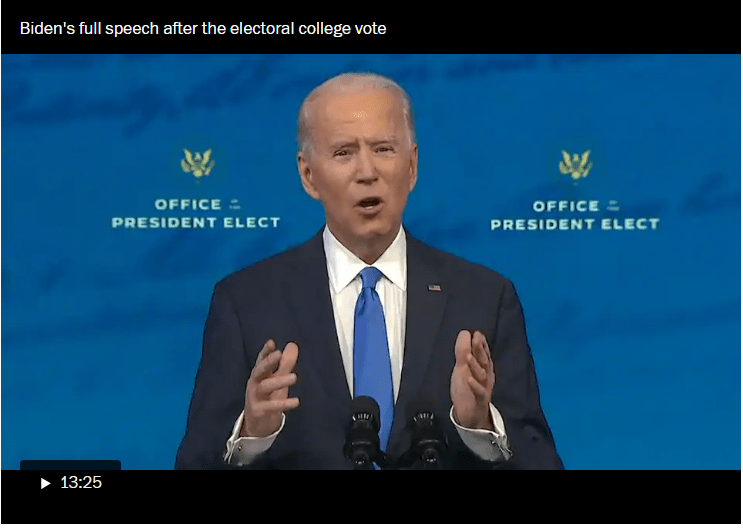
InternationalDec 15. 2020President-elect Joe Biden speaks after winning the electoral college vote Monday, Dec. 14, 2020. MUST CREDIT: Washington Post photo by Joshua LottPresident-elect Joe Biden speaks after winning the electoral college vote Monday, Dec. 14, 2020. MUST CREDIT: Washington Post photo by Joshua Lott 
By The Washington Post · Matt Viser

WASHINGTON – President-elect Joe Biden reaffirmed his faith in American democracy and the integrity of its elections in an address Monday after the electoral college formalized his victory over President Donald Trump despite the incumbent’s false claims that the election results are somehow in doubt.

In some of his most sweeping comments since he was projected as the winner 37 days earlier, Biden attempted to unify a polarized and skittish country with direct appeals to the more than 74 million Americans who voted for Trump.

“In this battle for the soul of America, democracy prevailed,” Biden said. “We the people voted. Faith in our institutions held. The integrity of our elections remains intact. And now it is time to turn the page, as we’ve done throughout our history. To unite. To heal.”

The speech represented Biden’s most forceful defense of the election – and his own legitimacy as president – as well as his most complete denunciation of Trump’s fraudulent claims. Biden noted that he received 7 million more popular votes, and the same number of electoral votes, 306, as Trump did in 2016 when he claimed “a landslide.”

Biden ridiculed Trump – and the scores of Republican elected officials who supported him – for still claiming victory despite losing repeated legal challenges, and he praised judges and election workers, both Democrats and Republicans, who withstood Trump’s criticism and defended the integrity of the election.

“They knew this election was overseen, overseen by them – it was honest, it was free, and it was fair,” Biden said. “They saw it with their own eyes, and they wouldn’t be bullied into saying anything different. It was truly remarkable.”

“It is my sincere hope we never again see anyone subjected to the kind of threats and abuse we saw in this election,” he added. “It’s simply unconscionable. We owe these public servants a debt of gratitude . . . our democracy survived because of them.”

It was, in essence, Biden’s second acceptance speech – the first came after numerous news organizations projected him the winner on Nov. 7 – with Monday’s speech placing more emphasis on the bedrock principles of democracy as a way to counter all that has transpired in recent weeks as Trump has attempted to usurp the will of the people.

From its inception, Biden’s presidential candidacy was meant as a rebuke to Trump and his attempts to bend to his will American norms and institutions, from the country’s legal system to its intelligence agencies to the decorum exhibited in political debate. Biden’s speech on Monday night was designed to once again counter Trump’s assault – and to solidify his assertions that the country’s founding democratic principles would remain intact.

“If anyone didn’t know it before, we know it now,” Biden said. “What beats deep in the hearts of the American people is this: democracy. The right to be heard. To have your vote counted. To choose the leaders of this nation. To govern ourselves.”

Biden’s remarks followed an exceptionally volatile five-week period in which Trump has repeatedly claimed that he, not Biden, won the election. Trump has filed lawsuits in state and federal courts, called for protests in the streets by his backers and demanded, with significant success, that Republicans join him or face electoral consequences. He has castigated many of Biden’s 81 million votes as fraudulent and initially refused to allow Biden’s transition team to continue working with his administration to begin the transfer of power, eventually relenting more than two weeks after Biden was projected as the winner.

Just minutes after Biden on Monday evening crossed the threshold of 270 electoral votes needed to formally win the presidency, Trump changed the subject, announcing in a tweet that Attorney General William Barr will resign in coming days. Trump has frequently clashed with Barr, most recently over Barr’s statement that there is no evidence of the widespread voter fraud that the president continues to allege occurred.

Biden’s aides viewed the speech as another major marker in their attempts to not only publicly rebut Trump’s false claims but to counter any notion that Biden is an illegitimate president. They have accelerated the timetables for announcing prominent Cabinet positions as one way to forecast that he is moving ahead to build his administration. His aides have built a transition headquarters of sorts in downtown Wilmington, Del. – with a blue backdrop, presidential seals, American flags, and “office of the president elect” written all around – as a way to evoke an image of formality and the traditional trappings of presidential power.

Trump, who had no public events on his schedule Monday, tweeted a series of grievances throughout the day, claiming voter fraud despite his legal team’s repeated inability to prove such claims in court.

Biden, in remarks that appeared clearly aimed at Trump, implicitly rejected those attempts to challenge the results of the election.

“In America, politicians don’t take power – people grant it to them,” Biden said. “The flame of democracy was lit in this nation a long time ago. And we now know that nothing – not even a pandemic or an abuse of power – can extinguish that flame.”

Even as Trump has refused to concede and pledged to continue fighting the results despite few, if any, avenues left to him, Biden also called on the country to move on. He and his advisers have been planning an inauguration, even though they do not expect Trump to attend.

Biden has spent the past several weeks forming his Cabinet, in a dicey dance that is aimed at both appeasing a vocal liberal faction in his party as well as beginning to reach out to moderates and Republicans he will need to confirm his nominees and approve his legislative proposals.

His attempts to fill key roles in the administration have been the primary focus for his transition, which has gotten off to a brisker pace than those of many of his recent predecessors, according to the nonpartisan Center for Presidential Transition. Biden is expected to name additional senior nominees this week, perhaps including his pick for attorney general, the highest-profile role left.

Pressure has built around the importance of that role, particularly after Biden’s son Hunter disclosed last week that he was under federal investigation for tax issues, which could include whether he did not report income from Chinese-related business deals. Biden has accused Trump of using the Justice Department to carry out his own bidding, making his decision on its leader an important one even as he has pledged not to tell the department whom to investigate or not.

Restoring faith in the department became even more challenging on Monday night when Trump announced that Barr would resign by Dec. 23.

Since unofficially claiming his victory more than a month ago, Biden has been most focused on the economy and the coronavirus, the two crises that will immediately confront him. He has talked recently about receiving the vaccine in public, as a way to encourage other Americans to do the same, and he has repeatedly acknowledged the pain felt by the families of the more than 300,000 Americans who have died, as well as the challenges faced by first responders.

“There is urgent work in front of all of us,” Biden said. “Getting this pandemic under control to getting the nation vaccinated against this virus. Delivering immediate economic help so badly needed by so many Americans who are hurting today – and then building our economy back better than it ever was.”

Biden has privately spoken with Senate Republicans but has so far been reluctant to engage with them given that many have not been willing to publicly state that Biden won the election.

“I think he’s president-elect subject to whatever additional litigation is ongoing,” Sen. John Cornyn, R-Texas, one of the top Senate Republicans, told reporters on Monday.

“I believe that we’ll see the page turned on Jan the 20th,” he added in a reference to Inauguration Day. “We’ll have a peaceful transition.”

Sen. Mike Braun, R-Ind., a staunch Trump defender who previously refused to acknowledge Biden’s win, shifted on Monday.

“Today, the Electoral College has cast their votes and selected Joe Biden as the President-elect,” he said in a statement. “I, like many Hoosiers, am disappointed by the results of the Electoral College vote, but today marks a watershed moment where we must put aside politics and respect the constitutional process that determines the winner of our Presidential election.”

Biden’s long-held belief that Republicans would alter their behavior once Trump is out of office will soon face a test as he puts forth his nominees for hearings and votes and prepares an opening batch of legislation he will ask them to consider.

The meeting of the electoral college has been, in recent history, a formality often unnoticed by the public, rather than an event carried live on cable television and prompting a major address by a president-elect. It was Trump’s defiance that prompted Biden to give another victory speech.

Just as he did in his speech more than five weeks ago, the incoming president made a promise to Trump’s tens of millions of supporters, many of whom currently view Biden as an illegitimate president-elect.

“I will work just as hard for those of you who didn’t vote for me,” he said, “as I will for those who did.”

US to open consulate after recognising Morocco’s claim to Western Sahara #SootinClaimon.Com

#SootinClaimon.Com : ขอบคุณแหล่งข้อมูล : หนังสือพิมพ์ The Nation.

US to open consulate after recognising Morocco’s claim to Western Sahara (nationthailand.com)

US to open consulate after recognising Morocco’s claim to Western Sahara

InternationalDec 15. 2020

By The Nation

The Moroccan Foreign Ministry has revealed details of the historic December 10 phone call between US President Donald Trump and Morocco’s King Mohammed VI to announce US recognition of the kingdom’s sovereignty over the Western Sahara.

The US had decided to open a consulate in the Western Sahara city of Dakhla, to encourage US investments and contribution to economic and social development in Morocco’s southern provinces, said the ministry.

During their discussion, the monarch and President Trump exchanged views on the current situation in the Middle East.

The king referred to the “consistent and balanced” positions of Morocco on the Palestinian question, stressing that Morocco supports a solution of two states living side-by-side in peace and security and that negotiations between the Palestinian and Israeli sides remain the only way to achieve a final, lasting and comprehensive settlement of this conflict, said the ministry.

In his capacity as chairman of the Al-Quds Committee of the Organisation of Islamic Cooperation, Mohammed VI also underlined the need to preserve the special status of Al-Quds (Jerusalem). The monarch also insisted that the followers of the three monotheistic religions be allowed freedom to practice their rites, and that the Islamic character of Al-Quds Asharif and Al-Aqsa Mosque be respected, in accordance with the Al-Quds/Jerusalem Call signed by himself and Pope Francis, during his visit to Rabat on March 30, 2019.

The ministry added that the king had informed President Trump that Morocco plans to grant authorisation for direct flights to transport members of the Moroccan Jewish community and Israeli tourists to and from Morocco.

The kingdom would also resume official contacts with Israeli counterparts and diplomatic relations as soon as possible, as well as promoting innovative relations in the economic and technological fields, including working to reopen liaison offices in both countries, as was the case previously and for several years until 2002.

The monarch stressed that these measures would not affect Morocco’s permanent and sustained commitment to the Palestinian cause and its determination to continue to contribute effectively and constructively to a just and lasting peace in the Middle East.

The king also discussed efforts by the Gulf Cooperation Council to resolve the crisis, expressing to President Trump his hope that positive developments recorded so far would lead to reconciliation. This would consolidate security and stability in the Gulf region leading to economic and social development for the benefit of the peoples of the region.

He also expressed his gratitude for the “important role and decisive steps” taken by the US, reiterating his support for the Kuwaiti mediation to end this dispute.

Biden secures win over Trump in electoral college #SootinClaimon.Com

#SootinClaimon.Com : ขอบคุณแหล่งข้อมูล : หนังสือพิมพ์ The Nation.

Biden secures win over Trump in electoral college (nationthailand.com)

Biden secures win over Trump in electoral college

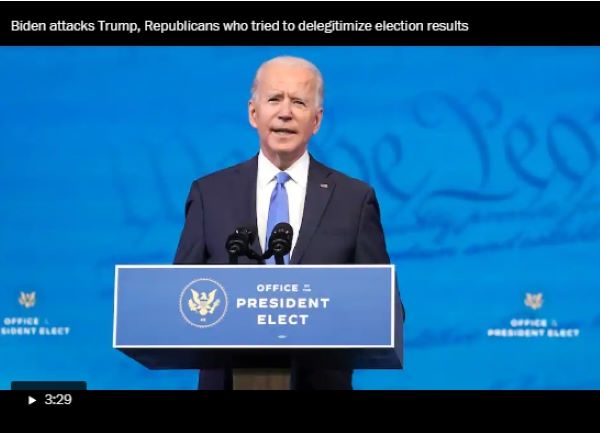
InternationalDec 15. 2020President-elect Joe Biden announces Cabinet nominees on Friday, Dec. 11, 2020. MUST CREDIT: Washington Post photo by Joshua LottPresident-elect Joe Biden announces Cabinet nominees on Friday, Dec. 11, 2020. MUST CREDIT: Washington Post photo by Joshua Lott 
By The Washington Post · John Wagner, Felicia Sonmez, Matt Viser

WASHINGTON – Joe Biden has amassed the electoral votes to secure his White House win. California and its 55 electoral votes put the president-elect over the top, despite President Donald Trump’s efforts to subvert the Nov. 3 election results.

Members of the electoral college convened in state capitals throughout the country Monday to formally vote for Biden. After the gatherings, Biden plans to address the nation and say, “The flame of democracy was lit in this nation a long time ago. And we now know that nothing – not even a pandemic – or an abuse of power – can extinguish that flame,” according to excerpts of his speech.

Trump has planned no public events but continues to tweet grievances about the election, which he claimed Sunday is “under protest.”

Based on the results of the Nov. 3 general election, Biden is set to have 306 electoral votes to Trump’s 232 by the end of the day. To win the White House, a candidate needs 270 of the 538 total electoral votes.

The votes are cast by individual electors, who are typically leaders and loyalists of the political party that won the state’s popular vote. Their ballots will be formally counted during a joint session of Congress on Jan. 6.

A top Senate Republican on Monday warned members of his party not to challenge the electoral college results when both chambers of Congress meet next month to officially tally them.

“I think that would be a bad mistake,” Sen. John Cornyn, R-Texas, told reporters at the Capitol on Monday afternoon when asked about a possible GOP effort to object to the results.

“I think there comes a time when you have to realize that despite your best efforts, you’ve been unsuccessful. That’s sort of the nature of these elections,” Cornyn said. He added: “I just hope they realize that it would be futile and it’s unnecessary.”

At least one Trump ally, Rep. Mo Brooks, R-Ala., has suggested that he will try to use an 1880s law that allows members of Congress to challenge a state’s results during the Jan. 6 tally and make the whole Congress vote on whether to accept the results.

To do so, however, one senator would have to join in Brooks’s effort. No senator has publicly declared that they would, though Sens. Rand Paul, R-Ky., and Ron Johnson, R-Wis., have reportedly declined to rule it out.

Cornyn also on Monday inched closer to calling Biden “president-elect,” telling reporters that the title is warranted “subject to whatever additional litigation is ongoing.” But he declined to call on other Republicans to use the term, saying, “I’ll leave that up to each individual.”

One such lawmaker left his party on Monday.

Rep. Paul Mitchell, a second-term Michigan Republican who is retiring from Congress, announced Monday that he is leaving the Republican Party and will become an independent in protest of the GOP’s embrace of Trump’s efforts to overturn the results of the 2020 election.

In a letter to Republican National Committee Chairwoman Ronna McDaniel and House Minority Leader Kevin McCarthy, R-Calif., Mitchell delivered a rebuke of Trump’s actions, declaring that it is “unacceptable for political candidates to treat our election system as though we are a third-world nation and incite distrust of something so basic as the sanctity of our vote.”

He also criticized his party’s leaders for supporting efforts to overturn the vote and promoting the baseless claim that the election was rife with fraud.

“If Republican leaders collectively sit back and tolerate unfounded conspiracy theories and ‘stop the steal’ rallies without speaking out for our electoral process . . . our nation will be damaged,” Mitchell said in the letter, which was first reported by CNN.

Mitchell, the sophomore representative to the GOP House leadership, announced last year that he would not run for reelection in 2020, voicing frustration that “rhetoric overwhelms policy” in Washington. He was among the first Republican lawmakers to criticize Trump for his racist tweets aimed at four liberal minority congresswomen known as “the squad.”

In his letter, Mitchell said Republican leaders’ actions risk causing “long-term harm to our democracy.”

“As elected members of Congress, we take an oath to ‘support and defend the Constitution of the United States,’ not to preserve and protect the political interests of any individual, be it the president or anyone else, to the detriment of our cherished nation,” he said. “As a result, I am writing to advise you both that I am withdrawing from my engagement and association with the Republican Party at both the national and state level.”

He added: “I am also requesting that the Clerk of the U.S. House of Representatives change my party affiliation to Independent for the remainder of my term in office. While admittedly symbolic, we all know that symbols matter.”

Meanwhile, in a prime-time address Monday night, Biden is planning to deliver another victory speech, speaking to the nation after the electoral college has reaffirmed his presidential victory, while Trump continues to falsely claim the results are in doubt.

Biden’s remarks are intended to unify, with direct appeals to Trump supporters, while also proclaiming that American democracy has worked despite repeated attempts to subvert it.

“If anyone didn’t know it before, we know it now,” Biden plans to say, according to early excerpts of the speech. “What beats deep in the hearts of the American people is this: Democracy. The right to be heard. To have your vote counted. To choose the leaders of this nation. To govern ourselves.”

In remarks that appear clearly aimed at Trump, the president-elect also implicitly rejects Trump’s attempts to challenge the results of the election.

“In America, politicians don’t take power – the people grant it to them,” Biden plans to say. “The flame of democracy was lit in this nation a long time ago. And we now know that nothing – not even a pandemic or an abuse of power – can extinguish that flame.”

Even as Trump has refused to concede and pledged to continue fighting the election results despite few avenues left to him, Biden plans to call for the country to move on.

“In this battle for the soul of America, democracy prevailed,” he plans to say. “We the people voted. Faith in our institutions held. The integrity of our elections remains intact. And so, now it is time to turn the page. To unite. To heal.”

Biden has spent the past several weeks forming his Cabinet and preparing to take the oath of office on Jan. 20. Just as he did in his election victory speech more than five weeks ago, the incoming president plans to speak to Trump’s large number of supporters, many of whom view Biden as an illegitimate president-elect.

“I will work just as hard for those of you who didn’t vote for me as I will for those who did,” Biden plans to say, before turning toward the coronavirus pandemic and the plan to vaccinate millions of Americans.

“There is urgent work in front of all of us,” his remarks continue. “Getting the pandemic under control to getting the nation vaccinated against this virus: delivering immediate economic help so badly needed by so many Americans who are hurting today and then building our economy back better than ever.”

Former Minneapolis police officers seek delay in George Floyd murder trial #SootinClaimon.Com

#SootinClaimon.Com : ขอบคุณแหล่งข้อมูล : หนังสือพิมพ์ The Nation.

Former Minneapolis police officers seek delay in George Floyd murder trial (nationthailand.com)

Former Minneapolis police officers seek delay in George Floyd murder trial

InternationalDec 15. 2020People gather to memorialize George Floyd in Minneapolis on Oct. 14, 2020. MUST CREDIT: Washington Post photo by Joshua LottPeople gather to memorialize George Floyd in Minneapolis on Oct. 14, 2020. MUST CREDIT: Washington Post photo by Joshua Lott 

By The Washington Post · Holly Bailey

MINNEAPOLIS – Two of the former Minneapolis police officers charged in George Floyd’s killing have asked a judge to delay the trial, accusing prosecutors of slow-rolling the handoff of key evidence and of turning over material that they say appears disorganized and riddled with technical problems.

In separate court filings, attorneys for Derek Chauvin and Tou Thao argued that the delays, and their concerns with the trial materials, have harmed their ability to prepare an adequate defense for their clients. The trial is scheduled to begin March 8.

Robert Paule, an attorney for Thao, asked Hennepin County District Judge Peter Cahill to delay the trial by four months – to July 5. Eric Nelson, an attorney for Chauvin, did not cite a specific date in his request for a delay but pressed for “relief the court deems just.”

Chauvin’s attorney also asked Cahill for an extension to a Dec. 15 deadline for the defense to disclose planned expert witnesses, partly blaming prosecution delays but acknowledging other issues in what has become a notorious case that spawned widespread protests and calls for police policy changes: “It also should be noted that the global profile of this case has also contributed to the delay in retaining experts willing or able to participate,” Nelson wrote.

Floyd died May 25 while handcuffed and restrained facedown on a South Minneapolis street as police investigated a 911 call about a counterfeit $20 bill that had been passed at a local convenience store. During a struggle, Chauvin pressed his knee into Floyd’s neck for more than nine minutes, as the 46-year-old Black man repeatedly complained he couldn’t breathe. Floyd ultimately lost consciousness and a pulse and was later pronounced dead at a hospital.

Chauvin, a 19-year-veteran of the Minneapolis force, was charged with second-degree murder and manslaughter, while the other officers at the scene – Thao, J. Alexander Kueng and Thomas K. Lane – were charged with aiding and abetting murder. The Minneapolis Police Department fired all four of the men.

In June, Cahill set an Aug. 14 deadline for disclosure of evidence in the case. But defense attorneys have repeatedly complained about the prosecution’s slow pace of disclosure and the nature of it, claiming the evidence has been disorganized.

Defense attorneys estimated they have so far received tens of thousands of pages of police documents and more than 300 gigabytes of video, including surveillance footage that captured the moments before Floyd’s death.

In a court filling Monday, Nelson said “every single round of discovery” had been riddled with problems, including corrupted files, videos that would not open and electronic documents that were arranged “in absolutely no discernible order.”

He estimated that prosecutors had disclosed “approximately 17,000 items of substantive value” after the judge’s August deadline and that key items appeared to be deliberately buried or “hay stacked” within material that seems irrelevant to the case, including documents related to the city’s mounted police patrol and planning reports for the 2008 Republican National Convention.

“It appears as if the state has printed the reports, shuffled them like a deck of cards and scanned them back into the computer to be disclosed,” Nelson wrote.

Minnesota Attorney General Keith Ellison, whose office is leading the case, said in a statement Monday that prosecutors “disagree with the characterizations” detailed by defense attorneys and would respond in detail in a future court filing.

Among the documents of contention is an FBI summary report of a July 8 interview between the agency and Hennepin County Medical Examiner Andrew Baker, who conducted Floyd’s autopsy and probably will be a key figure in the trial. The former officers have indicated that they will argue that Floyd died as a result of poor health and drug use, not because of any actions the officers took.

According to the FBI summary of the interview, which was not recorded, agents said Baker told them Floyd’s heart and lungs had stopped “due to the combined effects of his health problems as well as the exertion and restraint involved in Floyd’s interaction with police prior to being on the ground.”

The summary, filed into evidence as part of Thao’s motion, says Baker told the FBI other factors had contributed to Floyd’s cardiopulmonary arrest, including existing heart disease and the presence of fentanyl and other intoxicants. “Baker did not know if Floyd would have lived but for the officer’s actions,” the FBI summary reads. But the medical examiner told agents that “the stress from the events that occurred with Minneapolis police officers was more than Floyd could tolerate.”

Paule, Thao’s attorney, told the judge that prosecutors had been aware of the FBI interview at least as of Aug. 7, pointing to a letter prosecutors sent to the U.S. attorney’s office as FBI agents were working to summarize the interview. According to Paule and Nelson, the FBI report, dated Sept. 1, was given to defense attorneys on Oct. 28 – more than two months after the discovery deadline.

“The state had knowledge of this interview and its importance yet failed to timely and properly fully disclose the materials,” Paule wrote in a motion on Friday. He accused prosecutors of “knowingly” withholding evidence that Baker had “opined that the police restraint of George Floyd on the ground did not cause his death” and that their delayed disclosure “appears to have been done so in a manner designed to handicap” his client.

In addition to delaying the trial, Paule asked for the judge to sanction prosecutors by ordering them to pay defense attorney fees and costs related to the evidence disclosure delays.

In an unrelated case, Hennepin County prosecutors said Monday that they would not bring homicide charged against a White pawnshop owner who allegedly fatally shot a Black man in South Minneapolis during the civil unrest that followed Floyd’s death.

Calvin Horton, 43, was shot May 27 outside Cadillac Pawn along Lake Street during the second night of protests over Floyd’s death. John Rieple, the store’s owner, was arrested but was never formally charged.

County attorney Mike Freeman said Monday that prosecutors did not have enough evidence to counter Rieple’s claim of self-defense, pointing to a lack of cooperation from witnesses. Authorities also were hampered because they could not recover key evidence, Freeman said: Faced with a hostile crowd, police abandoned the scene before finding a weapon, and “looters destroyed all the video” from store security cameras.