Joe Biden socks and Kamala Harris scrunchies: Washington’s gift shops prepare for a new administration
InternationalNov 14. 2020White House Gifts, where manager Mirian Aquino was setting up a display Friday, is among the Washington, D.C.-area souvenir vendors overhauling their inventory in advance of Joe Biden’s inauguration and move to the White House. MUST CREDIT: Washington Post photo by Michael Robinson Chavez
By The Washington Post · Abha Bhattarai · NATIONAL, BUSINESS, FEATURES, POLITICS, US-GLOBAL-MARKETS, RETAIL, TRAVEL
WASHINGTON – There are socks emblazoned with Joe Biden’s face and wine glasses honoring Kamala Harris.
Though President Donald Trump has yet to concede the presidential race, the wheels of commerce roll on. White House Gifts is lining its shelves with Joe Biden and Kamala Harris merchandise in advance of the inauguration, which in a typical year can generate as much as 20% of its sales. MUST CREDIT: Washington Post photo by Michael Robinson ChavezAlso on sale at White House Gifts in downtown Washington: Biden-Harris candy jars, celebratory hair scrunchies, and plush German shepherds with “First Pet” bandannas honoring Major and Champ. The Donald Trump merchandise, meanwhile, has been moved to the back of the store, marked down 75%.
Every four to eight years, Washington’s gift shops and souvenir stands undergo an overnight transformation. Barack Obama action figures made way for “Make America Great Again” gear in 2016, and now Biden-Harris face masks and T-shirts are pushing MAGA hats to the clearance racks. Sales are typically steady regardless of who’s in the White House, thanks to a dependable stream of political supporters and tourists who want keepsakes from the nation’s capital.
“Whenever you have a change in administration, no matter who it is, there are new customers and all new energy,” said Alesia Jones, vice president of the longtime Washington store. “It’s like you flip a switch and have a completely new store.”
But this year is different. Sales at White House Gifts have fallen 80% since the pandemic took hold in March, and tourism – especially lucrative international travel – ground to a halt. Most of the people who wander in are regional, traveling from Maryland or Virginia. The store, which once had 32 workers, now employs seven.
Still, souvenir sellers around the city say they are hopeful the Biden-Harris win will create enthusiasm for their products. Harris – the country’s first female, Black and Asian vice president – holds a special appeal to girls and women that they’re hoping to capitalize on. White House Gifts is already selling girls’ T-shirts that say “Kamala is my VP” and “That little girl was me,” a reference to Harris’ viral exchange with Biden during a Democratic presidential debate last year. Other shop owners say they’re hoping to replicate the kind of success they’ve had with products commemorating former first lady Michelle Obama and late Supreme Court Justice Ruth Bader Ginsburg.
After a costly mistake in 2016 – in which owner Jim Warlick bought $100,000 worth of Hillary Clinton T-shirts, mugs and wine glasses before the election – executives this time waited until Sunday, one day after Biden was named the winner of the presidential race, to place their orders. Jones says she’s still parsing speeches and appearances by Biden and Harris to pick up on quotes and ideas for new merchandise.
“Each president has their own theme,” said Jones, who said designers typically start creating products six months before an election. “For Trump, it was ‘Make America Great Again’ and ‘Keep America Great’ that kind of took over. This time around, we’re picking up on cues such as Joe Biden’s aviator glasses and, of course, the fact that Kamala Harris is breaking a huge glass ceiling for women.”
The official White House Gift Shop is offering preorders on an official Biden-Harris inauguration coin for $100. Elsewhere on the internet, businesses are selling Biden-scented candles (“a captivating blend of musk and honey” for $25), Harris-themed coloring books ($17) and life-size cardboard cutouts of both ($40). For those on the other side of the political spectrum, there are “Impeach Biden” bumper stickers ($5) and bath mats ($20).
The change in administration, shop owners say, often also means a change in tone. At Chocolate Moose, a novelty gift shop where Trump toilet paper has been the top-seller for four years, owner Michele Crosby said she’s preparing for more earnest products this time around.
“We carry merchandise for every administration but obviously some administrations offer more material than others,” she said. “Trump has definitely been our biggest-selling administration.”
In addition to $8 rolls of toilet paper bearing Trump’s face, other popular items include a squeaky Trump dog toy for $22 and a $15 talking pen with eight catchphrases, including “I don’t wear a toupee” and “Look, I’m really rich.”
Crosby said she isn’t sure what types of Biden-Harris merchandise she’ll stock because vendors have been slow to design, manufacture and ship products during the pandemic. The 42-year-old shop in downtown D.C., has been closed during the pandemic, so the business has shifted to online. Still, Crosby said, about 85 percent of the orders are locals who tend to lean Democratic.
“Covid has put a halt to so much production,” she said. “We’ll try to get what we can.”
Also in question is the upcoming presidential inauguration, which typically generates more than $1 billion for local shops, restaurants and hotels. It’s unclear how many people will show up for the Jan. 20 event during a pandemic and whether there will be the usual gaggle of inaugural balls and receptions that bring thousands of tourists to the area.
“The inauguration is like a Super Bowl for us,” Jones said, making up as much as 20 percent of White House Gifts’ annual sales. “This year we don’t really know how to plan. How many people will come? What will the events look like? Will there be a parade? We just don’t know.”
Some tourism experts, though, say there is reason for optimism. Despite the ongoing pandemic, Maggie Daniels, a professor of tourism at George Mason University, said the Biden-Harris inauguration “will mark the beginning of a significant and lasting boost” to Washington businesses.
“This is perhaps the first time in the history of the United States that the excitement associated with our incoming vice president is as palpable as that of our incoming president,” she said.
Executives at America! sprang into action within minutes of the Biden-Harris win. Managers at the national gift shop chain kicked off a group text to figure out logistics. By Saturday evening, commemorative T-shirts bearing the faces of Biden and Harris were on display at the company’s Baltimore and D.C.-area stores, including the Reagan National Airport and Baltimore-Washington International Marshall Airport and in National Harbor and Alexandria, Va.
As of Tuesday morning, all 13 of the company’s stores were stocked with inauguration T-shirts, coffee mugs, buttons and magnets. Trump merchandise had been relocated to the back.
“Trump was a very successful brand for our stores these past years, and we’re excited to move forward now that we have a new president-elect,” said Tara Towers, vice president of merchandising for the company’s parent company, Marshall Retail Group. “Sales of inauguration T’s have already been really promising, and that momentum will continue until the inauguration.”
“Make America Great Again” baseball caps were the best-selling product during the Trump years. This time around, Towers said the company has two areas of focus: uniting Americans with a new line of red-white-and-blue merchandise and creating Harris-related products geared toward women and girls.
“We want to bring a sense of empowerment to our stores, the idea that the world is full of endless possibility,” she said.
Biden will need to talk tech and tax to fix ties with Europe
InternationalNov 14. 2020President-elect Joe Biden speaks while delivering an address to the nation during an election event in Wilmington, Del., on Nov. 7, 2020. MUST CREDIT: Bloomberg photo by Sarah Silbiger.
By Syndication Washington Post, Bloomberg · Marc Champion · NATIONAL, BUSINESS, WORLD, TECHNOLOGY, POLITICS, NATIONAL-SECURITY, WHITEHOUSE, US-GLOBAL-MARKETS, EUROPE
From NATO to climate change, the relationship between the U.S. and Europe is in dire need of a reboot after four years of President Donald Trump’s abrasive “America First” policies.
Technology-covering 5G networks, digital taxation, privacy rules, cross border data flows and more-may not be the most obvious place to start fixing a transatlantic security alliance formed before the dawn of the Internet. But as Joe Biden heads to the White House, it’s arguably the most urgent, if difficult.
The spread of covid-19 has underscored as never before the dominant role tech companies will play in driving future economic growth, determining the balance of power with China and filling the gaping holes that the pandemic has torn in government budgets either side of the Atlantic.
The U.S. struggle to persuade European governments to follow its lead with blanket bans on Huawei Technologies from 5G networks drew headlines, yet other tech disputes-over how to regulate intercontinental data transfers, or who gets to tax the overseas profits of U.S. tech giants-are just as consequential. Amazon.com Inc. became the latest target this week of European Union competition regulators.
If they’re to meet a rising challenge from China, the Americans and Europeans need to cooperate, set common standards and resolve their tax and other differences, according to Bruce Stokes, director of a transatlantic task force set up by the German Marshall Fund, a think tank based in Washington and Brussels.
“This is the next big crisis in transatlantic relations,” Stokes said. “To be successful in this future technological environment you need brains, money and market, and alone neither the U.S. nor Europe has enough brains, money and market to compete with the Chinese going forward.”
Take the distribution of tech company users, the source of big-data streams so valuable that some have called them the crude oil of the future. Only 235 million, or fewer than 10% of Facebook’s approximately 2.74 billion monthly active users are in the U.S., making international markets essential to the company’s data pool. By contrast, well over 90% of WeChat’s roughly 1.2 billion users live in China.
“If the Teslas of the world are not working with Europe they will have a big market that will disappear,” said Lise Fuhr, director general of the European Telecommunications Network Operators’ Association. “It is still a big, well-educated and diverse market that’s hard to ignore.”
Even so, tech has become a major point of transatlantic division. The Trump administration twice walked away from talks aimed at creating new international rules for setting taxes on trade in digital services, while at the same time threatening a trade war if France, the U.K. or others followed through with plans to set their own.
Finding a new legal framework for transatlantic data transfers is even more urgent, according to Jean-Marc Leclerc, vice-chair of the American Chamber of Commerce in the EU’s Digital Economy Committee.
The European Court of Justice in July struck down the 2015 U.S.-EU Privacy Shield framework for data transfers, in a case that turned on whether the agreement protected the privacy rights of Facebook’s 400 million-plus European users when the company moved their data to servers in the U.S., where protections are weaker. The answer was no.
“It’s extremely important for us,” said Leclerc. “Most of the economy relies on data flows these days, so we are trying to help both sets of governments to find a long-term solution.”
Hitting a transatlantic reset can’t happen until at least January, when Biden is sworn in, and then it won’t be easy. For one thing, there’s no snapback to a time before Trump, especially amid growing calls for so-called “digital sovereignty” in Europe that would reduce dependence on the U.S.
With the exception of 5G and digital tax, the Trump administration didn’t pay much attention to tech in its dealings with the EU for the last four years, but Europe did. The EU prepared new regulations including a Digital Services Act that could impact U.S. companies and further complicate the relationship, according to Fran Burwell, a fellow at the Atlantic Council, a Washington think tank.
Biden will take time to get a team and strategy in place and is likely to be more attentive to the concerns of America’s big tech companies than was Trump. His ability to cut international deals also could be limited by a Senate that’s expected to remain in Republican control. All of which could create the temptation to focus on more traditional transatlantic areas for cooperation.
“They need to be talking right away, because the European train is moving,” Burwell said of leaders in Brussels and Washington. “These digital issues are not a technical backwater anymore. We are talking about the resilience of our systems.”
Biden has made it clear that he sees restoring alliances as a priority. Meanwhile, “companies on both sides are already working together and governments at a less senior level are already working together,” said James Lewis, a former U.S. official at the departments of State and Commerce who now runs the Strategic Technologies Program at the Center for Strategic and International Studies, in Washington.
One example, according to Lewis, is OpenRAN, a telecoms project to broaden access to the Internet being led by U.S., Japanese and European companies. “It’s the reaction to China that will drive them together,” he said.
Still, the U.S. penchant for imposing sanctions even on allies began before Trump and is seen in Europe as a long-term threat to its sovereignty over banking, trade and foreign policy. The dominance of American tech companies like Facebook and Amazon has added to this sense of over-dependence.
In response, the EU started a European Cloud Initiative designed to “secure Europe’s place in the global data-driven economy.” A report by the Brussels-based European Council of Foreign Relations proposed the creation of 11 new tools to strengthen Europe’s economic sovereignty, including a digital currency to obscure the visibility of European financial transactions to the U.S., and an export bank to help European companies trade without fear of U.S. sanctions.
“These are not instruments that you would like to use,” but they’ve become necessary, Carl Bildt, Sweden’s former prime minister, said at the report’s publication in October. “I would declare a digital emergency for Europe if I see how we are lagging behind the Americans and the Chinese.”
Minneapolis violence surges as police officers leave department in droves
InternationalNov 14. 2020A protester screams at a Minnesota State Patrol officer on May 29 in Minneapolis. MUST CREDIT: Washington Post photo by Salwan Georges
By The Washington Post · Holly Bailey · NATIONAL, COURTSLAW, RACE
MINNEAPOLIS – The sound of gunfire has become so familiar across North Minneapolis that Cathy Spann worries she has grown numb to it.
Minneapolis Police Chief Medaria Arradondo, right, kneels as the hearse carrying George Floyd’s body arrives at North Central University for a June 4 funeral. MUST CREDIT: Washington Post photo by Salwan Georges
Day and night the bullets zip through this predominantly Black neighborhood, hitting cars and homes and people. The scores of victims have included a 7-year-old boy, wounded in a drive-by shooting; a woman who took a bullet that came through her living room wall while she was watching television with her family; and a 17-year-old girl shot in the head and killed.
Spann, a longtime community activist who works for the Jordan Area Community Council, cannot recall another time when things were this bad – not even when the city was branded “Murderapolis,” during a spike in violence in the mid-1990s.
The police are not as much a presence as they used to be, Spann said, noting that sometimes when neighbors call 911, officers are delayed in responding or don’t come at all.
“If you want to talk about pandemics, we’re dealing with a pandemic of violence,” Spann said on a recent afternoon, just as word came of two more nearby shootings. “We’re under siege. You wake up and go to bed in fear, because you don’t know what’s going to happen next. . . . And our city has failed to protect us.”
Nearly six months after George Floyd’s death here sparked massive protests and left a wide swath of the city burned and destroyed, Minneapolis is grappling with dueling crises: an unprecedented wave of violence and droves of officer departures that the Minneapolis Police Department warns could soon leave the force unable to respond to emergencies.
Homicides in Minneapolis are up 50%, with nearly 75 people killed across the city so far this year. More than 500 people have been shot, the highest number in more than a decade and twice as many as in 2019. And there have been more than 4,600 violent crimes – including hundreds of carjackings and robberies – a five-year high.
Most of the violence has happened since Floyd’s death on Memorial Day, which some experts attribute in part to the lingering anger over the slaying and the effects of the coronavirus, including job losses and the closure of community centers and other public spaces.
Minneapolis police say they have struggled to respond. They have faced a surge of officer departures in the wake of Floyd’s death and the outcry against police. In June, a city council majority vowed to defund and dismantle the department and replace it with a new agency focused on a mix of public safety and violence prevention – a move that could go before voters in 2021.
Police Chief Medaria Arradondo said more than 100 officers have left the force – more than double the number in a typical year – including retirements and officers who have filed disability claims, some citing symptoms of post-traumatic stress disorder linked to the protests over Floyd’s death.
In a recent meeting with the Minneapolis Charter Commission, which is studying police staffing as part of the city council’s efforts to remake policing, Arradondo told members he had been forced to deactivate several divisions inside the department and put those officers back on patrol because of staffing shortages.
He told the commission the department has about 735 sworn officers – down from the city’s budgeted 888 positions – of which about 500 were on patrol, he said. He warned that dropping below 500 officers on the streets would jeopardize the city’s crime response and that he and Mayor Jacob Frey had started to develop “contingency plans” that would include “triaging calls” for help, something he said he believes will erode public trust further.
“It’s creating a police department that I did not want to have, and that’s one-dimensional,” Arradondo said. “Our core focus is patrols and investigations.”
On Friday, the city council voted to allocate nearly $500,000 for the police department to temporarily hire officers from neighboring law enforcement agencies to help patrol city streets from Nov. 15 until the end of the year.
“Our city is bleeding,” the chief told members of the council on Tuesday. “At this moment, I’m trying to do all I can to stop that bleeding.”
But the plan to hire temporary officers does not address the department’s uncertain future, with even more officers considering departing.
Ron Meuser Jr., a Twin Cities personal injury attorney, said he represents 175 Minneapolis police officers who have left the force or are in the process of filing disability claims that would allow them to leave their jobs permanently, many citing PTSD from recent civil unrest.
One officer said he is in the process of leaving the force after he suffered physical injuries, including cuts and burns, during the days of unrest after Floyd’s death. While inside the city’s 3rd Precinct building as it was overtaken by protesters and subsequently burned, he recorded video messages to his wife and children because he thought he might not make it out alive.
“After that, I wasn’t me anymore,” said the officer, who spoke on the condition of anonymity for fear of retribution. He said he had nightmares. He couldn’t sleep. He had panic attacks.
In training, he had been taught to listen to his body when arriving on a scene, to pay attention when the hairs stood on the back of his neck. Sitting in his squad car, he constantly felt physically sick and found himself unable to focus, second-guessing every decision. He later was diagnosed with PTSD and is receiving treatment.
“I was paranoid. I was anxious. I was depressed,” he said. “This made me into a person who wasn’t good to be a cop.”
Meuser said his firm recently met with another 100 officers who are considering leaving the force, some citing mental exhaustion and fears of further civil unrest, including protests linked to the trial of the four former police officers charged in Floyd’s killing, which is scheduled for March. The officers have expressed a fear that the city will suffer “Portland-style riots during the entire trial,” he said, referring to extended unrest in the Oregon city.
Low morale is rampant, Meuser said, and he expects the exodus could extend to hundreds more officers by summer, perhaps as many as a third of the department’s positions.
“You have a lot of officers come in and say, ‘Why am I doing this?’ They sit there with their spouses and say, ‘Is this worth it?’ “
The absence of officers on the streets has been noticeable, especially in South Minneapolis near where Floyd was killed. Dozens of Minneapolis residents spoke before the city council last month, many complaining of trauma from the constant gunfire and violence and robberies.
“Since the unjustified and unfortunate death of George Floyd, the city council has engaged in rhetoric that has emboldened criminals, the proof of which is in the unprecedented spike in crime,” said George Saad of southwest Minneapolis, describing himself as an immigrant and a “child of war” who came to the city because of its rich diversity. But now Saad says he feels terrorized in his own community, afraid to walk down the street.
“You guys have had years to address any culture problems within the Minneapolis Police Department,” he said. “You have failed to do so. Instead, you embark on a campaign against your own police department, fighting and demonizing an entire internal city organization instead of making it better.”
Karen Forbes, of South Minneapolis, told council members how bullets burst through her living room wall on a recent night, narrowly missing her head. “I have relived that night many times, hearing the sounds of the bullets hitting my radiator and drywall spraying everywhere,” Forbes said.
Like many during the hearing, Forbes questioned the lack of police officers on the street and blamed the city council for pursuing what she described as a “sociology experiment that obviously doesn’t work.” She and others called for a surge of law enforcement into the city.
But it’s not clear that the city can do that: Facing an economic fallout from the coronavirus, Mayor Frey recently unveiled a budget proposal that includes a $179 million budget for police, a nearly $14 million cut from the department’s approved 2020 budget. But Frey has asked the city council to fund three new cadet classes in 2021 – about 104 officers – including one to replace a 2020 class scheduled for this fall that was canceled.
Frey said in a statement to The Washington Post that he remains concerned about “capacity challenges” facing the police department. But he said the new cadet classes would allow the city to “bring in new officers who ascribe to our vision for the department.”
Yet because of the city’s police training policies, members of those cadet classes, if approved by the city council, would not become full-time officers for more than a year.
Lt. Bob Kroll, head of the city’s police union, has said officers face a new level of danger and “intense scrutiny” since Floyd’s death, something that is driving potential recruits away from the profession. Kroll did not respond to requests from The Post for comment.
Arradondo has taken to comparing what is happening now to “the Murderapolis years” in the 1990s as he agonizes over the city’s homicide rate.
“We’re at a critical juncture right now,” the police chief recently told one neighborhood group. “I will move heaven and earth to make sure all of our communities are safe, but I’m going to need resources for that.”
The mayor’s proposed budget boosts funding for the Office of Violence Prevention, a city effort that has put groups of activists on the streets to de-escalate tensions between gang members and other groups that many blame for the escalation in violence. But some residents question whether that’s enough.
In August, community activist Spann and seven other residents from North Minneapolis sued the city, arguing that the declining number of police officers is in violation of the city charter, which requires a minimum number of officers based on population – what they estimate to be a sworn force of at least 743. The city says the case does not have merit because there are enough officers based on the city’s last official census results – in 2010, when Minneapolis was substantially smaller.
The city also downplayed police officer departures, presenting staffing numbers that include more than 90 officers who have been on long-term leave and remain on the payroll. Those officers, a recent court filing from the city pointed out, could still return to full-time status.
“This is fundamentally a political dispute between parties who disagree about policing now in Minneapolis and its future,” assistant city attorney Gregory Sautter wrote in court filings. “Resolution of this dispute would best be served through the political process.”
Arradondo has asked for about $500,000 to hire temporary officers for the rest of the year, and he said he probably will ask for similar funding for temporary officers in 2021 – leading to an angry exchange with city council members questioning why the police department needs more funding while criticizing the department’s overall strategy in dealing with the crime surge.
“With over 70 homicides in our city, what is going to work?” said Jeremiah Ellison, a council member who represents northern Minneapolis. “All I’m hearing is, ‘We don’t need a strategy, we don’t need a plan, shut up and pay us.’ I’m sick of it.”
Steve Fletcher, who represents an area that includes downtown Minneapolis, asked why the department needs money to hire temporary officers “given how much less policing” the city had seen under a department with “the highest funding it has ever had.” Fletcher questioned Arradondo’s spending, prompting an angry response from the normally staid police chief.
“I have 74 people who are no longer alive in this city because they’ve been killed. I’ve got almost 500 people who have been shot and wounded in the city,” Arradondo said, noting that budget debates won’t stop “the bloodshed” in Minneapolis. “It’s not like I’m sitting on a treasure chest of an exuberant amount of money that’s not being utilized.”
Council member Lisa Goodman, who also represents part of downtown, described the contentious back and forth between her colleagues and the police chief as “embarrassing.”
“It’s pretty simple,” Goodman said. “This is an effort just to get a few more feet on the street, and those feet on the street, to a lot of victims, really, really matter.”
The city council voted 7-6 to fund temporary officers in Friday’s city council meeting.
Amid concerns about civil unrest, the city has pointed to its existing mutual-aid agreements with several regional law enforcement agencies. Three times in the past two months, Gov. Tim Walz, D, has deployed members of the Minnesota National Guard and the Minnesota State Patrol to help guard the city, including last month when a judge threw out one of the murder charges against Derek Chauvin, the former Minneapolis police officer who held his knee to Floyd’s neck and is now charged in his killing.
State officials have been wary of commenting on Minneapolis’s dwindling police staff and whether that raises larger public safety issues for the region. But the state has sent in reinforcements before. In 1996, Gov. Arne Carlson, R, angered Minneapolis officials when he ordered dozens of state police officers and other law enforcement officials to the city for two months to help reduce the crime rate, even though the police force at the time was fully staffed.
Last month, several law enforcement agencies, including Minneapolis police, the state patrol and other departments in Hennepin County, began a coordinated effort to stop drag-racing in downtown Minneapolis. More than two dozen people were cited or arrested. The announcement was met with mixed feelings as residents in neighborhoods hard hit by violence wondered why a similar plan of action couldn’t be deployed to stop shootings and carjackings.
“You can put together that team to go address drag racing, but you can’t put that team together to address the fact that young Black and Brown lives are being lost and killed and murdered and maimed over here in north Minneapolis?” Spann asked. “Why do those people matter and we don’t?”
Spann has tried hard to stay strong for her community, a low-income neighborhood of mostly Black residents who are among the poorest in the city. Of the more than 500 people shot in Minneapolis, more than half of the cases happened on the city’s north side.
Spann used to walk around the neighborhood for exercise and to stay in touch with people. But in recent weeks she has been too scared to go to the park, where gun battles are frequent. Inside her house, she tries to keep up, phoning neighbors and residents to make sure they are OK. Sometimes it’s so relentless, so overwhelming, that she just has to sit for a minute in silence and try to calm her nerves.
“This isn’t just my work,” she said. “This is my life.”
She worries about the lasting trauma on the community – how it might manifest in children who have been shot and survived and what effect gunfire and the fear of getting struck by bullets is having. “What is this doing to us as a community, as human beings?” Spann said. “We are all secondary victims.”
Among some Black residents, she said, there have been conflicted feelings about the push to abolish the police. Many have been harassed by officers, but they also live in a neighborhood that on some nights feels like a war zone.
“Why can’t I have police reform? Why can’t I have law and order? Why do I have to pick and choose? I should be able to have both,” Spann said.
In addition to the small boost in temporary outside officers, city council members are considering a public safety pilot program that would partner police with community groups in an attempt to stop the violence on the city’s north side. But Spann has lost confidence in city officials who she said haven’t acted quickly enough to stop the shootings that have terrorized her community.
Neighbors have started talking about patrolling the streets on their own – as they did in May when arsonists set fire to multiple buildings in the area and police and firefighters never came. Spann has reached out to state officials and federal prosecutors to ask what law enforcement agencies can do for them, since she doesn’t believe the city will ask.
By The Washington Post · Hannah Knowles, David A. Fahrenthold, Rosalind S. Helderman · NATIONAL, POLITICS, COURTSLAW President Donald Trump’s faltering legal efforts to challenge the results of the election hit additional hurdles Friday as Republicans contended with setbacks in courtrooms in Michigan and Arizona and another major law firm withdrew from a case.
A state judge in Michigan rejected a request by two Republican poll watchers to delay the certification of the vote count in Detroit, saying he saw no convincing evidence of election fraud at the center where election workers tallied absentee ballots.
Judge Timothy Kenny said the allegations of misconduct, made by the GOP poll watchers and one Detroit election official, were “not credible.” He said the plaintiffs’ demand for an outside audit of the election in Michigan could delay the process so long that the state’s electors might not be selected in time to vote in the electoral college in mid-December, when the president is formally elected. President-elect Joe Biden now leads in Michigan by about 148,000 votes.
To grant the plaintiffs’ request, Kenny said, “would undermine faith in the Electoral System.”
The ruling is the latest in a string of defeats for Trump and his allies, who have sought to undo – or at least delay – Biden’s electoral victory with long-shot lawsuits claiming election irregularities. In Michigan alone, state judges have rejected several efforts to delay certification of the vote count.
A similar suit filed by the Trump campaign in federal court Tuesday is still pending.
State Republicans have also continued to press efforts to question the vote-counting process in Michigan. Two Republican state senators wrote a letter to the state’s secretary of state late Thursday requesting that the results be audited before they are certified.
And Trump remained defiant about his unfounded claims that results around the country were tainted by massive ballot fraud, even after federal and state government officials issued a joint statement Thursday saying this year’s election “was the most secure in American history.”
The president countered in a tweet Friday: “This Election was Rigged.”
Hours later, Edison Research projected that Biden won in Georgia and Trump was victorious in North Carolina, the last states to be called in the race. Biden is now projected to have won 306 electoral votes, matching Trump’s 2016 electoral college victory.
Election officials in Georgia began Friday the laborious process of recounting by hand every one of the nearly 5 million ballots cast in the state’s presidential election. Secretary of State Brad Raffensperger, a Republican, has said that the election was fair and transparent and that he expects the recount to confirm the results, which have Biden ahead by more than 14,000 votes.
Meanwhile, in Arizona, the Trump campaign acknowledged to a judge in a court filing Friday that its lawsuit there would make no difference to the result of the presidential election.
The campaign maintained that two down-ballot races “remain at issue”: a Board of Supervisors seat and a state Senate seat. But attorneys for the Arizona secretary of state, a defendant in the case, said that all claims were almost certainly moot, pending 3 p.m. local time Friday, when Maricopa County expected to finish counting all its ballots.
The suit by the Trump campaign, the Republican National Committee and the state Republican Party had said that “up to thousands” of allegedly mishandled ballots in the state’s most populous county, Maricopa, would “prove determinative” in the presidential election, and sought to delay certification of Arizona’s results until there could be a hand recount of affected votes.
But the scope of the campaign’s legal action was steadily whittled down this week in court, particularly after county officials said fewer than 200 votes for president were at stake. Biden leads by 11,000 votes in Arizona.
In its latest filing Friday, Trump’s team acknowledged that its suit would have no bearing on the outcome of the presidential election in the state, writing that “the tabulation of votes statewide has rendered unnecessary a judicial ruling as to the presidential electors.”
The new filing came a day after a Maricopa County Superior Court judge held a day-long hearing in the matter, in which the judge refused to admit some of the evidence gathered by the campaign, indicating that he found it untrustworthy.
During the hearing, an attorney for the president’s campaign, Kory Langhofer, emphasized that the campaign was not alleging that any fraud took place in the state,a sharp contrast with the “stop the steal” protests that outraged Trump supporters have held in Arizona.
“We’re not alleging that anyone was stealing the election,” Langhofer said, adding later, “The allegation here is that, in what appears to be a limited number of cases, there were good-faith errors in operating machines that should result in further review of certain ballots.”
The Trump campaign’s lawsuit had alleged that poll workers pressed or told voters to press a button on a tabulating machine to cast their ballots, even after those tabulators flagged an apparent “overvote,” in which the machine believed a voter marked two candidates in the same race. If the machine reads two votes in the same race, it will not count a vote for any candidate in that contest.
Tim Murtaugh, a spokesman for the Trump campaign, said in a statement, “We continue to explore President Trump’s options in Arizona.”
“Every state has different laws and therefore different legal approaches,” he added regarding the campaign’s broader legal setbacks. “We are still determined to ensure that every legal vote is counted and every illegal vote is not.”
The courtroom losses came as some prominent law firms have backed away from Trump’s legal efforts.
Porter Wright Morris & Arthur – a large firm headquartered in Columbus, Ohio – had been leading the Trump campaign’s efforts in the key battleground state of Pennsylvania. But two lawyers from the firm filed a motion late Thursday to withdraw from a federal suit challenging the results, just days after the action was initiated.
“Plaintiffs and Porter Wright have reached a mutual agreement that Plaintiffs will be best served if Porter Wright withdraws,” attorneys Ronald Hicks and Carolyn McGee said in their motion.
The firm said Trump’s campaign was “in the process of retaining” other attorneys to represent it. Linda Kerns, a Philadelphia lawyer who is representing Trump in a flurry of lawsuits in Pennsylvania courts, will remain on the case.
Trump’s federal lawsuit in Pennsylvania seeks an emergency injunction preventing state authorities from certifying the election results. It alleges that hundreds of thousands of votes cast in Philadelphia and Pittsburgh are invalid because Trump’s campaign was unable to observe them being counted, which election officials deny.
Secretary of State Kathy Boockvar on Thursday asked the court to dismiss the case, describing it as a “desperate and unfounded attempt to interfere” with the election process.
This week, the Phoenix-based law firm Snell & Wilmer withdrew from representing the Republican National Committee in Arizona. With more than 450 lawyers in 15 cities, the firm is one of the largest in the western United States.
And Jones Day, a prominent Washington-based firm that has represented the Trump campaign since the 2016 election, put out a statement this week emphasizing that it is not representing the campaign in its election challenges.
Instead, the firm has been acting on behalf of the Pennsylvania Republican Party in a case that began before Nov. 3 dealing with the narrow issue of ballots that were postmarked by Election Day but received during a two-day window after the election, as allowed by a state court ruling.
Boockvar has said about 10,000 such ballots were received – too few to affect the outcome of the election in the state, where Biden leads by more than 59,500 votes.
Murtaugh, of the Trump campaign, said in a statement, “Cancel culture has finally reached the courtroom.”
“Leftist mobs descended upon some of the lawyers representing the President’s campaign and they buckled,” he said, adding, “The President’s team is undeterred and will move forward with rock-solid attorneys to ensure free and fair elections for all Americans.”
Trump supporters, counterdemonstrators face off near White House ahead of Saturday rallies in D.C.
InternationalNov 14. 2020Anti-Trump and pro-Trump demonstrators square off at Black Lives Matter Plaza on Friday. MUST CREDIT: Washington Post photo by Ricky Carioti
By The Washington Post · Emily Davies, Marissa J. Lang · NATIONAL, POLITICS, WHITEHOUSE
WASHINGTON — Conservative protesters drawn to Washington D.C. by the planned rallies in support of President Donald Trump’s refusal to accept the results of the presidential election were confronted by D.C. activists and surrounded by police Friday as the nation’s capital prepares for a possibly tense weekend of protest.
Police break up a scuffle between anti-Trump and pro-Trump demonstrators at Black Lives Matter Plaza on Friday. MUST CREDIT: Washington Post photo by Ricky Carioti
Dozens of Trump supporters in red Make America Great Again hats and no masks squared off with masked D.C. activists who arrived to defend art and protest signs on the fence surrounding Lafayette Square – the center of months of racial justice protests. They shouted, holding up their phones to record the interaction for their respective audiences on social media, then eventually dispersed as police officers on bicycles circled the plaza.
Activist Medea Benjamin writes slogans Friday on the plywood covering the front of an office building at 17th Street and Pennsylvania Avenue, home to King & Spalding law firm, protesting its involvement with Trump’s election lawsuits. MUST CREDIT: Washington Post photo by Bill O’Leary
“As I look at this scene right now, I can’t help but to think how much this is truly the personification of two Americas,” a Black Lives Matter D.C. activist observed as she filmed the scene.
Small confrontations were ongoing through the late afternoon near the White House.
The president called Saturday’s rallies – which have been promoted by far-right media personalities, white nationalists and conspiracy theorists – “heartwarming” in a tweet Friday afternoon.
“I may even try to stop by and say hello,” Trump wrote.
The rallies, including a Women for America First event that received a permit Friday from the National Park Service, are expected to kick off about noon at Freedom Plaza. A “Million MAGA March,” “March for Trump” and a “Stop the Steal” demonstration are also planned.
A pro-Trump demonstrator kneels to pray above his Bible as he and other supporters square off with anti-Trump demonstrators at Black Lives Matter Plaza on Friday. MUST CREDIT: Washington Post photo by Ricky Carioti
Counterdemonstrations organized by D.C. anti-fascist and anti-racist groups will gather nearby.
According to the lone permit the Park Service issued, pro-Trump demonstrators will march from Freedom Plaza to the Supreme Court on Saturday afternoon. Rallygoers will also hear from a roster of speakers that includes several lawmakers; former White House aide Sebastian Gorka; Trump ally Matt Schlapp, who is head of the American Conservative Union; and incoming Rep. Marjorie Taylor Greene, R-Ga., who has openly backed QAnon, a baseless conspiracy theory that Trump is leading the fight against a cabal of Satan-worshiping saboteurs who traffic children.
Friday’s confrontations at Black Lives Matter Plaza were the second time in as many months that self-identified Trump supporters had torn down photographs from a memorial honoring Black men and women killed by police.
“It’s horrible because it’s a memorial to the people who died and who didn’t get justice and so to see them stepping on it and being careless about it, it’s just frustrating,” said Nadine Seiler, 55, who has spent weeks tending to the fence and the artwork placed there.
In anticipation of the rallies Saturday, Seiler said she has spent the past few days “quadruple zip-tying” the most meaningful artwork to the fence to prevent it from being removed. Some activists had supported the idea of temporarily removing pieces from the fence to protect them.
Although none of the rallies organizers have announced plans to gather at Black Lives Matter Plaza on Saturday, the square has become a flash point for those who oppose Trump and those seeking to make a stand against D.C.’s liberal activists.
D.C. Mayor Muriel E. Bowser, D, has said city officials are monitoring social media chatter around the planned events and will support “peaceful First Amendment demonstrations.” The mayor also warned out-of-town visitors against bringing firearms to the city, noting D.C. has stricter firearm laws than other parts of the country – and no firearms, with or without a permit, can be brought within 1,000 feet of a protest, according to D.C. law. The Park Service also bans guns at demonstrations.
Videos of a caravan of gun-toting demonstrators led by Infowars founder and conspiracy theorist Alex Jones began to circulate on social media late Thursday as the group made its way through Richmond.
Christoper R. Barron, a spokesman for the Women for America First march, said the group will “welcome all peaceful protesters in support of President Trump” but does not condone violence. Barron declined to comment on the simultaneous pro-Trump rallies planned for Saturday because, he said, organizers were not involved in planning those.
The rallies have garnered support from Fox News host Sean Hannity as well as more fringe figures, including Enrique Tarrio, chairman of the Proud Boys; white nationalist Nicholas Fuentes, who marched in Charlottesville; Jack Posobiec, who promoted the “Pizzagate” conspiracy that led to a 2016 shooting at D.C. pizzeria Comet Ping Pong; Scott Presler, a pro-Trump activist who works with anti-Muslim hate group ACT for America; as well as Jones.
Beginning 6 a.m. Saturday, Constitution Avenue will be closed between 18th Street NW and Pennsylvania Avenue NW. On the other side of the Mall, Independence Avenue will be closed from 14th Street to Ohio Avenue SW. Several main thoroughfares, including New York Avenue and G, H, I and K streets, will be shut down from 9th Street NW to 18th Street NW.
By The Washington Post · Eugene Scott · NATIONAL, POLITICS
ARIZONA-ANALYSIS: President-elect Joe Biden officially won Arizona on Friday, an event that may have been a surprise to some Americans who associate the state with immigration hard-liner Sheriff Joe Arpaio and right-leaning voting blocs such as seniors and Mormons.
The Grand Canyon state turning blue for the first time since 1996 was years in the making. And here are some of the groups that played roles in expanding the former vice president’s lead over President Donald Trump, who most Arizona voters supported in 2016.
– Latino activists
The state’s Latino political community has been working for years to increase turnout among its members – especially after the recent elections of hard-liners on immigration, including former governor Jan Brewer, a vocal supporter of Trump. State laws such as the infamous S.B. 1070 drew national attention to Arizona as a place that would be tough on undocumented immigrants. But Latino activists who viewed their contributions to the state’s economy and culture as fundamental to what made Arizona – and America – great began to register younger voters at higher rates than normal, with the goal of sending more liberal politicians to the state legislature, Congress and ultimately the White House.
Ian Danley, executive director of Arizona Wins, an advocacy organization that coordinates with various political groups, told The Washington Post’s Jose Del Real and Hannah Knowles:
“I think the Republican rule over the last decade in Arizona has done deep damage with them among Latino voters. It has undoubtedly politicized the Arizona Latino community in a way that I don’t think you’ve seen anywhere else in the country. That piece of this is hard to overstate. It was such an important part of our political reality, narrative and culture over the last decade. The movement they have led over a decade is real.”
– White college-grad women
The late senator John McCain, R-Ariz., spent his final days in office being one of the few Republican lawmakers willing to hold the president accountable. Having little to no tolerance for pushback, Trump mocked McCain’s status as a former prisoner of war and chose not to attend the former GOP presidential nominee’s funeral, allegedly calling him a “loser.” So when the lawmaker’s grieving widow, Cindy McCain, a business executive and a former educator, endorsed Biden, she did so with the goal of hoping to connect with Arizona’s women voters.
“I decided to take a stand, and hopefully other people will see the same thing,” Cindy McCain said in September of her endorsement of Biden. “Other women particularly.”
“You may have to step out of your comfort zone a little bit, but Biden is by far the best candidate in the race,” McCain added.
The state’s college-educated white women appeared to have heeded McCain’s challenge. In 2016, most of Arizona’s white women with college degrees gave their support to Trump over Hillary Clinton, the first woman to be a major party nominee. But that was not the case in 2020. Nearly six in 10 – 57 percent – of white women with college degrees in Arizona supported Biden. And the percentage who backed Trump also decreased.
– Independent voters
Arizona has always had a large percentage of independent voters who are not deeply partisan and therefore can swing elections either way based on their support or their sitting out a contest. Nearly a third – 31 percent – of Arizona’s registered voters are independent. And while these voters are not allowed to cast ballots in the primary elections, they made a big dent in the general. Independent voters showed up for Trump in the state in 2016, but more than half swung to Biden this year, reminding Americans that not all former Trump voters are Trump loyalists.
– Changing demographics
Arizona’s popularity as a destination for retirees gives it relatively high number of senior citizens compared with other states. Seniors are one of the most consistent voting blocs and largely lean right, making it easier for GOP candidates to win elections. But the state’s growing Latino population is younger on average, as are the young adults and families moving to Arizona from other states. And these demographics – millennials and Generation Z – overwhelmingly lean left. With millennials being the largest age voting bloc this year – and largely disapproving of Trump – Biden had quite the advantage.
InternationalNov 13. 2020A television is seen through a window near the entrance to the West Wing of the White House on Tuesday night. President Trump’s sole public event this week was a wreath-laying at a Veterans Day ceremony. Washington Post photo by Jabin Botsford
By The Washington Post David Nakamura
WASHINGTON – On Thursday, six American service members were killed in a helicopter crash during a peacekeeping mission in Egypt. Tropical Storm Eta made landfall in North Florida, contributing to severe flooding. The number of Americans infected with the novel coronavirus continued at a record-setting pace, sending the stock market tumbling.
At the White House, President Donald Trump spent the day as he has most others this week – sequestered from public view, tweeting grievances, falsehoods and misinformation about the election results and about Fox News’s coverage of him.
Neither he nor his aides briefed reporters on the news of the day or reacted to Democratic leaders who accused Republicans of imperiling the pandemic response by “refusing to accept reality” over the election results.
The contrast between the nation grappling with an ongoing global crisis and a president consumed with his own political problems highlighted a fundamental contradiction at the heart of Trump’s assault on the integrity of the U.S. election system: He is leveraging the power of his office in a long-shot bid to stay in the job while ignoring many of the public duties that come with it.
“It seems clear Trump has checked out,” said Norman Ornstein, a political scientist at the conservative American Enterprise Institute who has criticized Trump. “It’s not like this guy has shown a great interest in governing for four years, so to expect he will now accelerate the pace is a little fanciful. It’s pretty clear he feels wounded. Under those circumstances, the idea he’s going to pay more attention to the details of governance is ridiculous.”
White House aides disputed the notion that Trump was reneging on his responsibilities as president, releasing a list of executive actions he has taken since the election. The list included an order Thursday banning U.S. investment in Chinese military companies, an emergency declaration for Florida over the storm damage and several presidential proclamations, including celebrating the 245th anniversary of the U.S. Marine Corps.
“Any suggestion that the President has given up on governing is false,” White House spokesman Judd Deere said in a statement. “Just as he promised, President Trump is fighting hard for a free and fair election while at the same time carrying out all of his duties to put America First.”
Deere added that Trump is continuing to work on a “meaningful economic stimulus” to deal with the pandemic, but such legislation appears all but dead on Capitol Hill. The president met privately with Vice President Pence for lunch and with Secretary of State Mike Pompeo and Treasury Secretary Steven Mnuchin in the afternoon, according to his public schedule.
At a news conference, House Speaker Nancy Pelosi, D-Calif., accused Trump and his GOP allies of engaging “in an absurd circus right now” over the election results.
Republicans are “shamefully pretending” that Trump can overturn the outcome, “making it even harder to address the massive health and economic crisis that we’re facing,” Pelosi said.
Since the Nov. 3 election, Trump has addressed reporters twice – both times baselessly alleging widespread fraud in the ballot counting and promising to pursue legal challenges in swing states. His sole public event this week was to spend seven minutes at a wreath-laying event at a Veterans Day ceremony on Wednesday.
Over the weekend, he spent two days at his private golf club in Sterling, Va. But his public schedule has not included the daily presidential security briefing since early October, even as his administration has refused to launch the formal transition, depriving President-elect Joe Biden’s team of access to national security information.
National Security Council aides have grown agitated and uncertain about the stalled transfer of power, according to a former Trump administration official who remains in touch with colleagues. The staffers recognize that Biden will be the next president, but they are “not allowed to act like that will happen,” said the former official, who spoke on the condition of anonymity because his current job did not permit him to speak publicly.
Meantime, national security actions and requests for briefings from the president are drying up, the person said, and the team preparing updates for Biden and Vice President-elect Kamala Harris is “very frustrated.”
It was Biden who offered the first public condolences to the families of the service members who died in Egypt. “I join all Americans in honoring their sacrifice, as I keep their loved ones in my prayers,” he wrote on Twitter in the early afternoon Thursday.
By that time, Trump had issued nearly four dozen critical tweets and retweets about the election results and Fox News, including a baseless conspiracy theory from a far-right television network that alleged votes had been improperly tallied in Pennsylvania. He also found time to thank actor Scott Baio for posting a photo of a craft store’s candle display, which had been arranged to spell out, “Trump is still your president.”
“Thank you Scott, and stay tuned. You are terrific!” Trump wrote.
His tweets impugning Fox News drew sarcastic responses from Democrats.
“Thanks for working so hard for us!” Rep. Eric Swalwell, D-Calif., wrote. Michael McFaul, who served as U.S. ambassador to Russia in the Obama administration, tweeted: “Sir, COVID19 cases in the US are exploding. Please refocus your attention. After January 20th, you will have all the time in the world to rant about Fox ratings.”
Trump associates have said privately that the president has no grand strategy to overturn his loss to Biden and that he has begun to talk about running again in 2024. His focus on his administration since Election Day has centered on ousting top aides at the Pentagon – including Defense Secretary Mark Esper, who was fired on Monday – and other agencies who were viewed as insufficiently loyal to the president.
On Thursday, the White House forced the removal of three high-ranking officials at the Department of Homeland Security.
Critics have speculated that Trump is laying the groundwork for major policy actions in his final days, such as bringing home more U.S. troops from Afghanistan. Others interpreted his housecleaning as an effort to install loyalists who could hamper a smooth transition for Biden, making it more difficult for him to govern.
Answers were not forthcoming from the White House, however. In an interview with the Trump-friendly “Fox & Friends” show, host Brian Kilmeade asked White House press secretary Kayleigh McEnany whether Trump was receptive to granting Biden access to national security briefings.
“I haven’t spoken to the president about that. That would be a question more for the White House,” replied McEnany, who was appearing as a campaign surrogate, a role that has sparked criticism that she is violating Hatch Act regulations that bar federal officials from campaign activities.
By late afternoon, the White House announced that Trump had signed the executive order that banned U.S. investment in Chinese military companies that the administration has accused of perpetrating cyberespionage against American companies. But there was no public signing ceremony, and it was White House national security adviser Robert O’Brien, not Trump, who issued a statement on the order.
A former Obama administration official recalled that in 2016, after Trump’s election victory over Hillary Clinton, then-President Barack Obama traveled to the Asia-Pacific Economic Cooperation forum in Peru, where he met with several foreign leaders, including Chinese President Xi Jinping.
“It was all business. They talked about what they needed to manage for the remainder of his term,” said the former Obama aide, who spoke on the condition of anonymity to discuss the private meeting. “At the end of it, Obama closed his notebook and said, basically, ‘I’m sure you are aware of the news of our election outcome. I hope you treat Trump fairly and continue to work with him to develop the relationship.’ “
On Thursday, Trump aides did not respond to a question about whether the president would participate in the virtual APEC summit next week.
Covid’s long, dark winter has already arrived in the upper Midwest, as cases and deaths surge, snatching lives, overwhelming hospitals, exhausting health-care providers and raising fears that the region’s medical system will be completely overwhelmed in the coming days.
As coronavirus cases grow exponentially across the United States – up 70% on average in the past two weeks, with an average of 130,000 cases per day nationally – the situation is particularly acute now in the upper Midwest and Plains states, with North and South Dakota leading the nation in new cases and deaths per capita over the past week, according to Washington Post data.
Experts say that cases are surging in the region as the weather has turned colder and more people are forced inside – into more poorly ventilated indoor spaces where transmission thrives – with the virus arriving even in remote areas in largely conservative states where Republican leaders have resisted mask mandates or business closures, asking their residents to rely instead on personal responsibility.
The region’s surge is a preview of what the rest of the United States can expect in the coming weeks as winter approaches, experts say.
The situation has become so acute that even some leaders who previously resisted restrictions have moved toward new strictures. Republican Gov. Kim Reynolds in Iowa, long an opponent of closures and mask-wearing as “feel-good” options, this week moved to prohibit maskless indoor gatherings of 25 or more and require those attending larger outdoor events to wear a mask.
In Minnesota, Gov. Tim Walz, a Democrat, has warned of more “nightmare” numbers to come, even as the state has instituted new restrictions on bars, restaurants and social gatherings in an attempt to stop the spread. On Friday, Minnesota will begin limiting social gatherings to 10 people or less and tightening restrictions on larger social receptions as the country heads into a holiday season when doctors fear multigenerational family gatherings could become superspreader events.
In North Dakota, where cases have increased 60% in the past month, Republican Gov. Doug Burgum said this week that the state’s hospitals are at capacity and are so strained that the state will allow its doctors and nurses to continue working after they test positive for the coronavirus. His spokesman later qualified this is a potential short-term tool.
Even though he has continued to resist a statewide mask mandate, Burgum urged his fellow residents to take precautions as hospitals brimmed with patients.
“You don’t have to believe in covid, you don’t have to believe in a certain political party or not, you don’t have to believe whether masks work or not. You can just do it because you know that one thing is very real. And that’s that 100 percent of our capacity is now being used,” Burgum said.
Doctors and health-care providers across the upper Midwest grappling with rising caseloads and staff shortages continue to urge leaders in their states to do more to stem the tide of the virus, as many in these hardy, wind-swept states where independence is prized still refuse to wear masks.
“We had months to prepare for this, we saw it happen in other states that were hit earlier. Why weren’t we prepared for what was coming?” said Sarah Newton, chief medical officer of the hospital in tiny Linton, N.D., population 997.
She said she saw coronavirus cases begin surging in late September and October, and on some days ill patients filled the hospital, a low-slung brick critical-access facility with 14 beds.
“I felt so emotionally overwhelmed by what I was seeing. I felt like I was screaming into a void. I was drowning in my own hospital,” Newton said.
The disconnect with what was going on inside the hospital and her community was extreme, Newton said. She would go outside and see no one wearing a mask or social distancing, “having giant weddings and going about their lives.”
This week, the unthinkable happened. She called several hospitals in the region and was unable to find an intensive-care bed in a bigger hospital to transfer a rapidly declining coronavirus patient who needed more help than her small facility could provide.
“We have people we are not able to get to a higher level of care, and honestly, it’s a horrible feeling,” Newton said. “We have failed to do the things that prevented us from being here.”
Andrew Pavia, chief of pediatric infectious diseases at the University of Utah School of Medicine, said on a press call organized by the Infectious Diseases Society of America on Wednesday that the “enormous surge” in the upper Midwest and mountain states is concerning because health-care access in some rural areas is already limited and staff and facilities taxed.
“The situation really has to be described as dire,” Pavia said, saying that the “political climate” and “general distrust of the government” in these areas resulted in a reluctance of public officials to take more stringent measures to stop the spread of the novel coronavirus, which causes the disease covid-19. Mass gatherings such as the motorcycle rally in Sturgis, S.D., also contributed, Pavia said, as well as university students attending classes that were largely in person.
More than 330 coronavirus cases and one death were directly linked to the Sturgis bike rally as of mid-September, according to a Washington Post survey of health departments in 23 states.
“There’s an awful lot of preventable deaths happening right now,” Pavia said.
Doctors at one of the region’s largest health-care systems, Avera Health in Sioux Falls, S.D., with facilities in South Dakota, Minnesota, Iowa, Nebraska and North Dakota, said that its modeling showed the virus surge was only going to get worse in the coming weeks. Already, some of its facilities are nearing capacity and between 200 and 400 of its staffers are either out sick or in quarantine, officials said.
In Minnesota, state officials presented grim new infection numbers Thursday – with 7,228 people testing positive – and warned that the state is on pace to see at least 100,000 new cases by Thanksgiving.
The state reported 39 deaths Thursday. It set a record the day before, reporting that 59 people had died of covid.
In stressing the urgency of the situation, state health officials have pointed to a dramatic uptick in the positivity rate in diagnostic testing in recent weeks – rising from just 5% a month ago to 15% on Thursday.
Overall, nearly 202,000 people have tested positive in the state since the pandemic began and nearly 2,800 people have died.
“This is going to be a long dark winter,” Walz told reporters Tuesday. “[You] can’t wish it away, can’t hope it, can’t think it’s not real. This is killing large numbers of people.”
What has worried state officials is that there is no hotspot in Minnesota – the entire state is described as a “red zone.” All regions have seen a dramatic rise in cases and hospitalizations, including rural areas that had been largely spared by the disease until recent weeks.
In Itasca County, a rural area of 45,000 residents northwest of Duluth, county health officials said there were 200 coronavirus cases and 13 deaths through September. Numbers have skyrocketed in the past few weeks – averaging about 200 to 300 new cases a week – with a positivity rate so high that the beleaguered county health department announced it would no longer do contact tracing and focus its efforts on protecting “high-risk settings” including schools and long-term-care facilities.
An underlying concern for state officials is the pressure on Minnesota hospitals.
State health officials have warned of dire capacity levels statewide in terms of the number of available intensive-care beds, saying this week that they were at 90 to 95 percent capacity. In the Twin Cities, just 22 ICU beds were available – statistics that Walz described as “catastrophic.” Hospitals and the state are trading information hour by hour on capacity restraints and how to move patients. Officials are beginning to enlist retired health-care workers to help in what could be a nightmarish scenario in coming weeks.
Case counts are skyrocketing throughout the Midwest, with Illinois reporting 12,702 cases Thursday, a record, and Kansas reporting two record-high case counts this week.
“Now even in rural America people are thinking maybe I should pay attention to this,” said Liz Stedry, 44, a property manager and mother of a blended family of eight in Prairie Village, Kan., including 16-year-old twins with cystic fibrosis.
Stedry’s mother is a county commissioner in Jefferson County, Kan., which approved a mask ordinance Monday; the county commissioner pushed for one for weeks.
Stedry and her family have been in quarantine since Wednesday, after her husband and two of the children came down with mild cases of the coronavirus.
“The numbers are crazy scary. You want them to be kids but you worry about it. I’m actually happy it’s a forced quarantine,” she said. “Now the others have to be at home, too, until the time is up.”
Last week, South Dakota’s new daily reported cases rose by roughly 9%; the state also reported an 18.2% increase in daily deaths and a 26.5% uptick in hospitalizations, according to Washington Post data. The South Dakota Department of Health reported 2,020 new coronavirus infections Thursday, a record for positive results in a 24-hour period.
Despite this, its largest city, Sioux Falls, rejected a mask mandate Tuesday, and many in the state just don’t seem to think masks are necessary. Gov. Kristi Noem, a Republican, has taken a laissez-faire attitude toward the virus and has refused to issue a statewide mask mandate or other controls.
Masks are one of the most effective tools at fighting the coronavirus, public health officials say, and help protect the wearer and others.
Noem’s spokesman, Ian Fury, said that Noem had no intention of changing her approach, noting that although the hospitalization rate has increased, 34 percent of the state’s hospital and ICU beds remain open.
But doctors have countered that just because a bed is open doesn’t mean there will be enough staff. Monument Health, a hospital system in South Dakota, issued a statement this week that it is experiencing “stressed capacity” across the state.
“Our limiting factor isn’t beds, it’s staff,” said John Pierce, president of Rapid City Hospital, noting that the facility has a “record high” number of coronavirus patients and is having to shift non-coronavirus patients to other hospitals and hiring contract caregivers.
Chris Bjorkman, of De Smet, S.D., lost her husband, John, 66, a retired schools superintendent, after both were sickened by the coronavirus in September. Bjorkman had to be flown to a hospital in Marshall, Minn., when his condition worsened and there was no room for him in South Dakota, she said.
He eventually ended up back in a hospital and died Oct. 20. The last time she was able to speak to him, she said, he told her the hospital food was awful, so she had a meat-lovers pizza delivered to his room.
Bjorkman said that since her husband’s death she has been disheartened that so few of her neighbors have been wearing masks. Even the clerks in her local supermarket didn’t wear them until one of her family members called them out on it last week.
“People are not taking it serious,” she said. “Some just don’t care.”
– – –
The Washington Post’s Jacqueline Dupree and Emily Wax contributed to this report.
By The Washington Post Seung Min Kim, Josh Dawsey, Matt Viser, Jon Swaine
WILMINGTON, Del. – President-elect Joe Biden began seeing more support, if indirectly, from Republicans on Thursday as senior GOP lawmakers called for him to receive classified briefings even as the Trump administration continued to bar a formal transition.
Trump officials prolonged that blockade even though in private top campaign aides were candidly telling President Donald Trump that his prospects of winning reelection were an uphill battle, according to sources close to the discussions who spoke on the condition of anonymity to reflect private conversations. His campaign, meantime, was scrambling to form a coherent legal strategy.
Taken together, those elements underscored a reality that Biden has accepted but one that Trump and key Republican officials haven’t: The current president is unlikely to overturn enough ballots in key states to undermine Biden’s presidential win.
Sen. Susan Collins of Maine, a moderate Republican who won a tough reelection bid last week, said Biden needs to be briefed on classified intelligence – calling that process the “most important part of the transition” and one that can take place even as Trump contests the results in court.
“Like any apparent winner, he should have access to office space, federal employees, materials, supplies, whatever, but the standard assistance that the apparent winner receives,” Collins told reporters on Thursday. “That doesn’t in any way preclude President Trump from pursuing his legal remedies if he believes there are irregularities, but it should not delay the transition, because we want the president-elect – assuming he prevails – to be ready on day one.”
The acknowledgments came as Biden and his team continued to map out his transition, despite the lack of official certification from the General Services Administration that would unlock the resources and access to the federal government that Biden and his team will need to fully prepare for taking office on Jan. 20.
Biden also spoke with House Speaker Nancy Pelosi, D-Calif., and Senate Minority Leader Charles Schumer, D-N.Y., in their first substantive conversation since Biden was declared president-elect, with the trio stressing the need to have a coronavirus relief package signed into law by the end of the year.
The conversation effectively inserted Biden as a central figure in the talks, while Trump continued to stay out of sight and away from governing. The three Democrats coalesced behind a unified position, in particular advocating for state and local aid – a main sticking point between Democrats and Republicans.
Biden held another notable conversation on Thursday with Pope Francis, according to the transition team. Biden, who will become only the second Catholic to assume the U.S. presidency, expressed a desire to work together on issues including poverty, climate change and immigration.
The president-elect on Thursday also traveled to Rehoboth Beach, Del., where he has a vacation home and where he is expected to stay through part of the weekend. Biden, who on Wednesday named Washington veteran Ronald Klain as his incoming White House chief of staff, is not expected to formally announce other administration personnel this week.
But behind-the-scenes conversations between Capitol Hill and the transition team continued to occur, and Biden’s team has also tapped a coterie of senior House and Senate Democratic officials to serve as liaisons to Hill offices until Biden officially assumes the presidency, according to congressional aides.
An informal sketch of Biden’s orbit continued to take shape, with Steve Ricchetti, who served as chief of staff for Biden during his vice presidency, expected to assume a senior adviser role and Ted Kaufman, who temporarily succeeded Biden in the Senate when he was elevated to the vice presidency, becoming the head of a kitchen cabinet of sorts on which Biden will rely, according to a person familiar with the structure. Tom Donilon, another veteran Biden hand, is also expected to be a senior adviser to the president-elect.
One intriguing name being discussed privately is former Democratic presidential nominee Hillary Clinton as the U.S. ambassador to the United Nations, according to the person familiar with the chatter who spoke on the condition of anonymity. The thinking behind the move was that it would be a way for Biden to highlight the importance of that position in his administration and that placing her there would raise the prestige of the U.N. itself at a time when global cooperation, and the U.S. role on the world stage, has ebbed.
Another name emerging as a potential Cabinet pick is Rep. Cheri Bustos, D-Ill., the chairwoman of the House Democrats’ campaign arm who oversaw the party’s loss of House seats in the 2020 elections. She has signaled interest in leading the Agriculture Department. A spokeswoman for Bustos said, “With votes still being counted across America, Congresswoman Bustos remains focused on the task at hand and making sure front-line members in uncalled races have the support they need.”
Meanwhile, the outlook at the White House continued to remain tense.
Some aides were looking for jobs, and many were quarantining or even sickened by the fresh coronavirus outbreak within the White House. Few were continuing to fight for Trump’s reelection.
“A lot of people aren’t here,” one administration official in the West Wing said on Thursday. Trump remained sequestered Thursday, marking a week since he has spoken in public view.
At his campaign headquarters, many staffers were expected to be laid off in the coming days, two officials said, with some aides being notified on Thursday. Officials were also supposed to brief surrogates on legal strategy Thursday afternoon but postponed the call twice, a person familiar with the planning said.
Later, in a 12-minute call, campaign officials said they believed Trump could still win the race. Tim Murtaugh, the campaign spokesman, asked donors and surrogates “for patience” and said it would take some time.
“There is not going to be a silver bullet,” he said. Murtaugh spent much of his time criticizing the news media, according to an audio recording of the call.
“The campaign continues to firmly believe that this election is not over,” Murtaugh said.
Justin Clark, the deputy campaign manager overseeing the legal efforts, told listeners that “you’re going to see a lot of things happen,” without offering much in the way of specifics. Clark asked for people to send to the campaign for investigation things they see on Twitter or on other websites.
Privately, White House senior adviser Jared Kushner, the president’s son-in-law, continued to tell allies that Trump is “realistic” about his chances but wants to continue the fight, a person who has spoken to him said. Campaign manager Bill Stepien and other top campaign aides have also briefed Trump on his chances, casting them as uphill and telling Trump it is unlikely he will win.
But Trump does not want to pull out of the fight until the votes are certified in key states, which won’t be until late November or early December. His campaign filed five new lawsuits in Pennsylvania in an attempt to block 8,349 ballots in Philadelphia from being counted – complaints that centered on mail-in ballots that city officials decided to accept despite administrative errors made by voters.
Biden has been declared the winner of Pennsylvania by multiple media outlets, and he leads Trump in the state by more than 53,000 votes. Kevin Feeley, a spokesman for the Philadelphia city commissioners, said on Thursday that the disputed ballots had not yet been added to the public vote totals.
The Trump campaign ran into resistance elsewhere in the courts in Pennsylvania, as three former Republican members of Congress and several veterans of GOP administrations joined the opposition to an effort by Trump to use the federal courts to block certification of the state’s election results.
Trump alleged in a lawsuit that hundreds of thousands of votes in Democratic Philadelphia and Pittsburgh are invalid because his campaign was not able to watch them being counted, which election officials deny.
A group including former congressmen Charlie Dent and Jim Greenwood, R-Pa., and former congresswoman Connie Morella, R-Md., along with former New Jersey governor Christine Todd Whitman and former deputy attorney general Donald Ayer, filed a brief on Thursday asking Judge Matthew Brann to leave the dispute to the Pennsylvania state courts, which are considering a lawsuit from Trump on the same issue.
Another onetime Republican leader, former senator Saxby Chambliss, R-Ga., whose state has also become a battleground over ballots that Republicans have contested, told The Washington Post in an interview that “there was no wholesale fraudulent scheme.”
Of Georgia, where Biden leads by roughly 14,000 votes and where a hand recount is underway, Chambliss, who retired at the end of 2014, said: “I am on the ground and I heard nothing about any kind of harvesting of ballots or fraudulent transactions. Sure, there are going to be isolated situations but not on a wholesale basis.”
Chambliss stopped short of saying Trump should concede or allow the transition process and security briefings for Biden to begin. He said he supported Trump’s right to pursue all legal options to contest the election. But he emphasized that the process must play out in court, and only if new evidence surfaces.
Other GOP figures went further in actively identifying Biden as the rightful winner. Republican Gov. Mike DeWine of Ohio, whose state Trump won by eight points, said on CNN on Thursday that he sees Biden as the president-elect even as Trump has “every right” to legally contest the results.
“Our courts are the best place, frankly, to adjudicate facts,” DeWine said.
But because of Trump and his team’s public defiance, many elected Republican officials have declined to even call Biden the president-elect. Even some GOP lawmakers who said Biden should be briefed were careful to distinguish between the type of intelligence Biden received as the Democratic nominee and the full-blown presidential daily briefing, which Biden would usually have access to as the president-elect.
“We should be in the same posture that we ran throughout the whole campaign, both of them receiving briefings, as they’re both trying to be able to prepare and then allow the process to be able to go through right now,” said Sen. James Lankford, R-Okla., a member of the Intelligence Committee.
Still, the consensus among Senate Republicans on Thursday was that Biden should be privy to the nation’s classified secrets.
“I see no problem” with Biden getting briefings, said Sen. Charles Grassley of Iowa, the most senior Republican in the Senate.
“I think so, yes,” Sen. Lindsey Graham, R-S.C., an ardent Trump ally, responded when asked whether Biden should be receiving classified briefings.
“Whether he actually gets the product itself, I think the information needs to be communicated in some way,” said Sen. John Cornyn, R-Texas, another member of the Intelligence Committee. “If in fact he does win in the end, I think they need to be able to hit the ground running.”
– – –
The Washington Post’s Amy Gardner, John Wagner, Mike DeBonis and Felicia Sonmez contributed to this report.
Jerry Rawlings, who as a young military officer orchestrated two coups to seize control of the government in Ghana, then led the African country for 20 years, guiding it through a period of relative stability with an idiosyncratic blend of autocratic rule and democratic reform, died Nov. 12 at a hospital in the capital city of Accra. He was 73.
The death was announced in a statement by the country’s president, Nana Akufo-Addo, citing an undisclosed illness.
Rawlings was a 32-year-old Ghanaian air force officer when he first attempted to overthrow what he considered a corrupt national government in May 1979. He was jailed but soon became a hero to the country’s poor people and military.
With the help of disaffected soldiers and non-commissioned officers, he escaped from jail on June 4, 1979, then proceeded to a radio station to urge his followers to seize power. By the end of the day, the country’s military leader, Frederick Akuffo, had been toppled.
Rawlings, who was often known as “Flight Lt. Rawlings” for his military rank, charged Akuffo’s regime with corruption and profiteering.
“The rich became richer, including the high military officers, and most of us were starving,” he said at the time. “I’ve always wanted to do something to correct injustice.”
A presidential election was already scheduled, and Rawlings vowed to step aside in favor of the new democratically elected leader. But during his 112 days in power, he oversaw the hasty creation of military tribunals that put Akuffo and two other former heads of state on trial. They were executed, along with numerous high-ranking officials.
True to his word, Rawlings and other coup leaders returned to their military positions when Ghana’s new president, Hilla Limann, was sworn into office. In a speech before the country’s parliament, Rawlings looked directly at Limann and issued an unmistakable warning.
“If people in power use their offices to pursue self-interest, they will be resisted and unseated,” he said, before ominously adding, “We have every confidence that we shall never regret our decision to go back to the barracks.”
In 1957, Ghana became Africa’s first sub-Saharan country to declare independence from a colonial power, in its case Great Britain. After Ghana’s first president, Kwame Nkrumah, was overthrown in a military coup in 1966, the country faced increasing poverty and unrest under a series of military and civilian leaders.
That trend continued during Limann’s first two years in office, as Rawlings traveled throughout the country, giving speeches to large crowds and denouncing what he called the “rottenness” of a system that “would permit those same corrupt forces to retain their hold on Ghanaian life.”
Limann maligned Rawlings as “that boy,” and some of his associates mocked his mixed-race ancestry, calling him “half African.”
On Dec. 31, 1981, Rawlings led a second coup, calling Limann and his supporters “a pack of criminals who bled Ghana to the bone.”
This time, Rawlings had no intention of relinquishing authority. He dissolved the country’s parliament, abolished the constitution and banned all political parties except his own. He aimed to establish a socialist state in Ghana, espousing admiration for Libya and its dictator, Moammar Gaddafi.
“I am prepared at this moment to face a firing squad if what I try to do for the second time in my life does not meet the approval of Ghanaians,” Rawlings announced at the time.
He was, without question, an authoritarian ruler who fired judges and shut down opposition newspapers. His regime drove out many of the country’s business elite, particularly those of Lebanese descent, and publicly flogged people accused of charging too much money for commercial goods. Rawlings withstood several attempted coups, with political dissenters arrested and, in some cases, sentenced to death.
Yet, by the standards of other dictators, Rawlings demonstrated a certain measure of enlightenment and restraint. Instead of imposing Soviet-style economic programs, he took the advice of the International Monetary Fund and World Bank and launched free-market reforms that led to a decade of growth.
He resisted the establishment of a cult of personality around himself and seldom used the title “president.” No pictures of him were allowed in public places, and he was never implicated in scandals involving financial corruption or personal behavior.
He also pledged to restore democratic elections to Ghana and to allow opposition political parties, provided that they not have names that had been used before. In 1992, after more than 10 years of one-man rule, Rawlings ran for election and won the presidency with 58 percent of the vote.
Despite economic setbacks over the next few years, he was reelected in 1996 in an election that local and international observers agreed was free and fair. Under Ghana’s new constitution, which he helped produce, Rawlings could not seek a third term as president.
When the candidate from his party lost the presidential election in 2000, the peaceful transfer of power was considered a rarity in African politics.
Rawlings was born Jerry Rawlings John on June 22, 1947, in Accra. His father was a Scottish businessman, and his mother was from Ghana’s Ewe ethnic group. His parents were not married, and Rawlings was raised by his mother.
When he entered Ghana’s training academy for air cadets, his last name, John, was omitted from his official form, and he became known as Jerry Rawlings, or sometimes Jerry John Rawlings. (Ghanaians often called him “J.J.,” which some critics said stood for “Junior Jesus.”)
Rawlings excelled as a pilot and, after his first coup in 1979, reportedly celebrated by going for a joyride in a jet fighter, flying low over Accra and the countryside.
Survivors include his wife of 43 years, Nana Konadu Agyeman, who ran unsuccessfully for Ghana’s presidency in 2016; and four children.
In later years, Rawlings remained a powerful voice in Ghana’s public life. Despite his rise to power on the strength of a military coup, he came to be seen as a pan-African statesman and as a primary architect of his country’s emerging social and political stability. He lectured around the world and participated in peacekeeping and diplomatic efforts for the United Nations and African Union.
In a 1979 interview with The Washington Post, Rawlings cited the influence of Frantz Fanon, a Black psychiatrist and writer from Martinique whose books delineated the dehumanizing effect of colonialism and economic inequality.
“Well, that is what we are all about,” Rawlings said. “It’s not a Black-White thing here but the rich suppressing the poor, exploiting us, oppressing us.”

 White House Gifts, where manager Mirian Aquino was setting up a display Friday, is among the Washington, D.C.-area souvenir vendors overhauling their inventory in advance of Joe Biden’s inauguration and move to the White House. MUST CREDIT: Washington Post photo by Michael Robinson Chavez
 President-elect Joe Biden speaks while delivering an address to the nation during an election event in Wilmington, Del., on Nov. 7, 2020. MUST CREDIT: Bloomberg photo by Sarah Silbiger.
  A protester screams at a Minnesota State Patrol officer on May 29 in Minneapolis. MUST CREDIT: Washington Post photo by Salwan Georges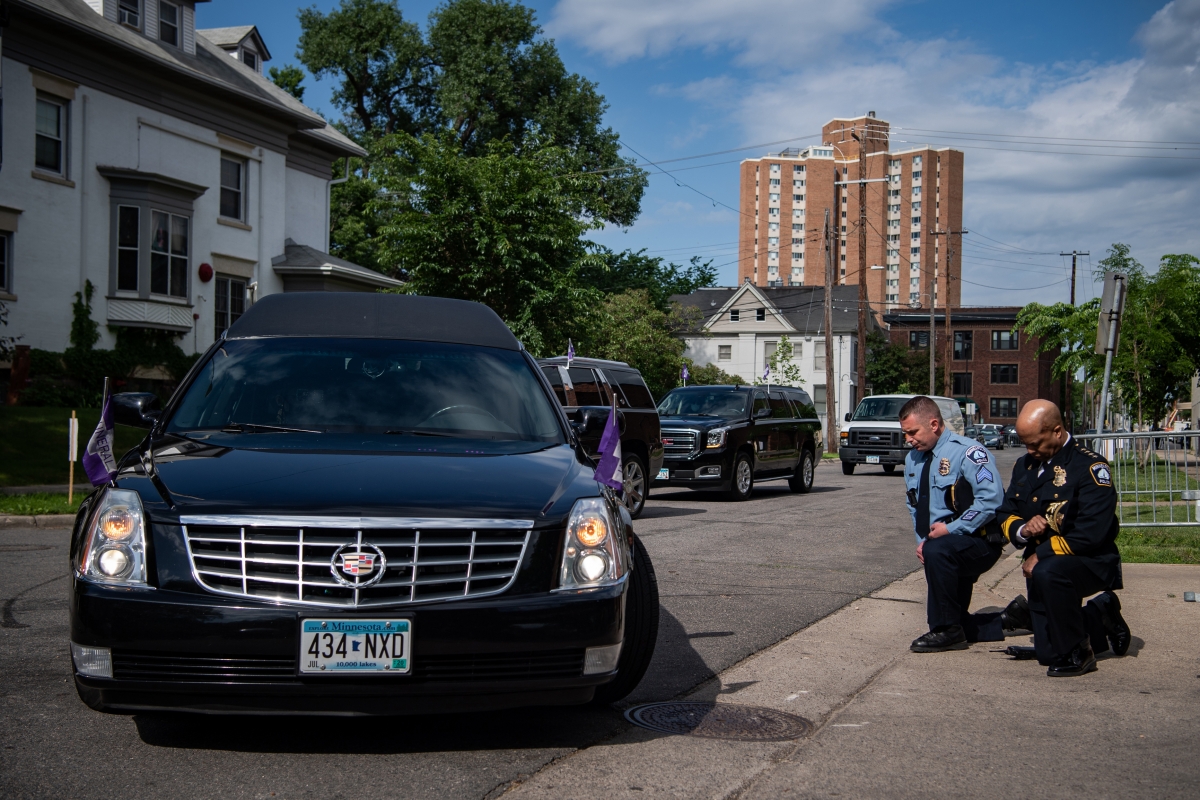
 President Trump
  Anti-Trump and pro-Trump demonstrators square off at Black Lives Matter Plaza on Friday. MUST CREDIT: Washington Post photo by Ricky Carioti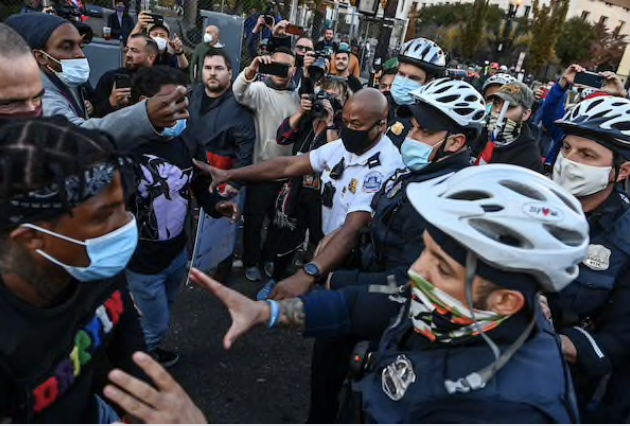
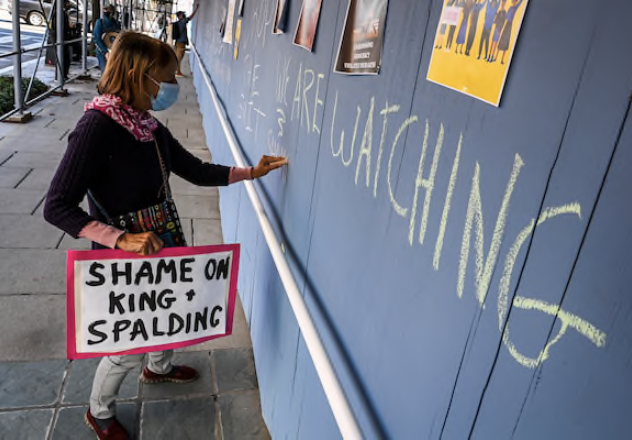
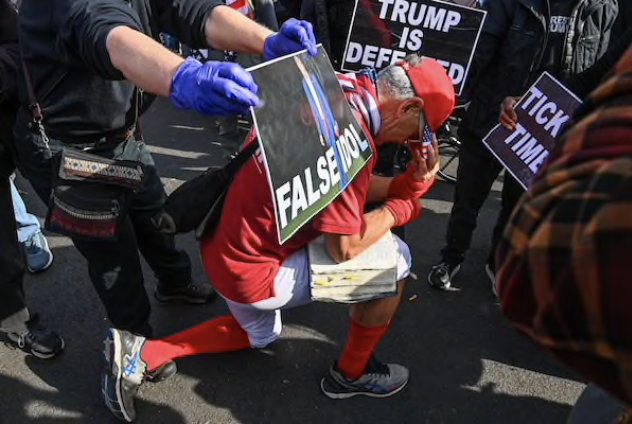
 President-elect Joe Biden
  A television is seen through a window near the entrance to the West Wing of the White House on Tuesday night. President Trump’s sole public event this week was a wreath-laying at a Veterans Day ceremony. Washington Post photo by Jabin Botsford
 Joe Biden
  Jerry Rawlings
  SootinClaimon.Com