Head of House Democratic campaign committee to step down after election losses
InternationalNov 10. 2020Rep. Cheri Bustos, D-Ill., speaks to her constituents from Illinois’ 17th District at the International Brotherhood of Boilermakers Reception in D.C. in 2018. MUST CREDIT: Washington Post photo by Melina Mara.
By The Washington Post · Mike DeBonis · NATIONAL, POLITICS, CONGRESS
WASHINGTON – The chairwoman of the Democratic Congressional Campaign Committee said Monday that she will not seek a second term in that post, moving to leave the House leadership days after her party sharply underperformed expectations in last week’s general election.
Rep. Cheri Bustos, D-Ill., campaigned for House Democrats’ top political job on the premise that she was best equipped to help win races in swing districts, including those President Donald Trump had won in 2016.
Bustos, representing a swath of rural northwest Illinois, had easily outperformed Trump in 2016. Following Democrats’ historic 2018 gains, she pledged to hold on to those Trump-friendly seats and push Democratic gains farther into the suburbs – adding to the Democrats’ 15-seat majority.
But last week’s results instead appear to have cut deeply into that majority, with a net loss of four seats to Republicans so far and with more races yet to be called. Bustos herself was nearly a victim of the GOP surge, eking out a four-point victory after winning by more than 20 percentage points in 2016 and 2018.
Bustos has faced angry recriminations from fellow Democrats who were blindsided by the losses, and the underwhelming results have turbocharged long-simmering infighting between moderate Democrats and liberal members who have been critical of the DCCC’s centrist messaging and recruiting practices.
The latter faction had previously battled with Bustos over her decision to blacklist campaign vendors who work to unseat Democratic incumbents in primaries as well as a lack of diversity in her initial staff hires – an effort that prompted the replacement of several committee officials, including Bustos’s handpicked executive director.
On a conference call with Democratic lawmakers last week, Bustos blamed bad polling that underestimated GOP turnout for the misguided 2020 expectations and promised to launch a thorough postmortem review to identify missteps. But it now appears that Bustos will not see that review to its conclusion.
In a statement, she said she will “instead focus my work on exciting legislative possibilities in the years to come” rather than seek another term leading the campaign committee.
“Now, for the first time in a decade, our caucus will serve in a House majority with a Democratic president. After four years of this administration’s chaos and broken promises, there is now no limit to what we can achieve as we work to Build Back Better for the communities we serve,” said Bustos, a member of the Appropriations and Agriculture committees.
Bustos will remain as DCCC chair until a new chairman is chosen by the Democratic caucus later this year, said a Democratic aide, who spoke on the condition of anonymity to discuss internal planning.
Significant Democratic gains were expected to propel Bustos further up the party leadership ladder, perhaps into the assistant speaker post vacated by Sen.-elect Ben Ray Luján, D-N.M. Now Bustos appears to be out of the competitive Democratic leadership derby for the time being.
Hours after Bustos made her decision public, Rep. Sean Patrick Maloney, D-N.Y., announced that he would run to succeed her, touting his own experience winning in a swing district and his fundraising prowess.
Maloney led a postmortem review of the DCCC’s similarly underwhelming performance in 2016, when party leaders thought they would be in contention for the majority but instead only made modest inroads. That familiarity with the organization, Maloney said in his letter Monday, “will shorten the learning curve and allow me to hit the ground running immediately.”
Another potential successor is Rep. Tony Cárdenas, D-Calif., who pushed for the shake-up inside the DCCC ranks last year and leads BOLD PAC, the political arm of the Congressional Hispanic Caucus. Cardenas has announced his intentions to run for the assistant leader post but could change course and instead pursue the campaign post.
Leadership of the party campaign committee stands to be a crucial job ahead of the 2022 elections. Democrats are likely to have the narrowest House majority in 20 years in the 117th Congress, and they will be facing the political head winds that have typically hampered the president’s party in congressional midterms.
“We must defend vulnerable front-line members while working to expand our majority in what will almost assuredly be a difficult environment,” Maloney said in his letter.
House Speaker Nancy Pelosi, D-Calif., paid tribute to Bustos in a statement Monday, calling her “a leader of great integrity and inspiration.”
“Chairwoman Bustos brought strategic thinking, political astuteness and boundless stamina to Hold The House, with the added challenge of the coronavirus,” Pelosi said.
By The Washington Post · Felicia Sonmez · NATIONAL, POLITICS Senate Majority Leader Mitch McConnell, R-Ky., on Monday threw his support behind President Donald Trump’s legal challenges in the wake of his loss to Democrat Joe Biden, saying that the president is “100% within his rights” to pursue recounts and litigation, though Trump has produced no evidence of widespread voting fraud.
“This process will reach its resolution. Our system will resolve any recounts or litigation. In January, the winner of this election will place his hand on a Bible, just like it’s happened every four years since 1793,” McConnell said in remarks on the Senate floor.
Trump and his campaign have offered no evidence to back up their baseless claims, and state and local officials from both parties have rejected the accusations made by the president and his supporters. McConnell, later pressed by reporters, declined to answer when asked to produce evidence of fraud that would overturn the election results.
McConnell heralded Republican wins in Senate and House races, results that have been called by media organizations but have not been certified by state election officials. Among those results was McConnell winning a seventh term.
But the GOP leader dismissed concerns about the president’s actions as Trump has refused to concede while making unfounded claims. McConnell argued that “a few legal inquiries” from Trump “do not exactly spell the end of the republic” and that the president should not “immediately, cheerfully accept preliminary election results.”
McConnell, speaking for the first time since Biden was projected as the winner Saturday, did not congratulate the president-elect, though four members of the Senate Republican conference have done so in recent days.
McConnell’s remarks came shortly after he met with Attorney General William Barr on Monday afternoon. A Justice Department spokeswoman declined to comment on the meeting.
“Our institutions are built for this,” McConnell said. “We have the system in place to consider concerns. And President Trump is 100% within his rights to look into allegations of irregularities and weigh his legal options.”
Senate Minority Leader Chuck Schumer, D-N.Y., took to the floor shortly after McConnell spoke. He pushed back against the Kentucky Republican’s remarks and called for GOP lawmakers to follow the lead of former president George W. Bush, who congratulated Biden in a statement Sunday.
Schumer called the unsubstantiated claims of voter fraud “extremely dangerous” and “extremely poisonous to our democracy.”
“As in any campaign, the president has a right to bring legal challenges or request recounts where state law allows,” Schumer said. “However, there is no legal right to file frivolous claims. Lawsuits must have basis in facts and evidence. And make no mistake: There has been no evidence of any significant or widespread voter fraud. Joe Biden won this election fair and square.”
InternationalNov 10. 2020Defense Secretary Mark T. Esper meets with crew members of the USS Bonhomme Richard on September visit to Naval Base San Diego. MUST CREDIT: Lisa Ferdinando/Defense Department.
By The Washington Post · Missy Ryan, Dan Lamothe, Paul Sonne, Josh Dawsey · NATIONAL, NATIONAL-SECURITY WASHINGTON – President Donald Trump fired Defense Secretary Mark Esper on Monday, ousting his fourth Pentagon chief and stoking uncertainty as the nation navigates a chaotic transition marked by an incumbent who is refusing to concede.
“Mark Esper has been terminated. I would like to thank him for his service,” the president said on Twitter, making a sudden but widely anticipated move that underscored his insistence on absolute loyalty from top advisers even as he contests the outcome of the Nov. 3 election.
Trump said that Christopher Miller, who was recently named director of the National Counterterrorism Center, would immediately become acting defense secretary. “Chris will do a GREAT job!” Trump wrote.
Esper’s firing plunges the Pentagon into a new period of leadership upheaval as it tries to manage an unusual transition period fraught with political tensions and potential security risks. Democrats and independents criticized the decision, saying the abrupt change could endanger American security at an already vulnerable moment.
The move comes as the Trump administration refuses to allow President-elect Joe Biden’s team to launch its work, increasing the likelihood of a disorderly transition as the country hurtles toward the Jan. 20 inauguration and grapples with a sharp worsening of the coronavirus crisis.
In a letter to Trump on Monday, which was obtained by The Washington Post, Esper said he accepted the president’s decision to replace him.
“I have served these last few years . . . in full faith to my sworn oath to support and defend the constitution, and to safeguard the country and its interests, while keeping the department out of politics and abiding by the values Americans hold dear,” he said.
An Army veteran and former weapons lobbyist who was confirmed as defense secretary in July 2019, Esper was mostly aligned with his commander in chief on major foreign policy issues had clashes with Trump over his steps to draw the military into partisan politics.
Chief among those occurred in June, when Trump demanded that thousands of troops be dispatched on the streets of Washington amid protests over the police killing of George Floyd. Trump threatened to invoke the Insurrection Act to use active-duty service members against demonstrators, but Esper and Gen. Mark Milley, chairman of the Joint Chiefs of Staff, pushed back, concerned it would look like martial law.
Two officials, who spoke on the condition of anonymity because they were not authorized to comment to the news media, said Esper’s public opposition to using troops in June drew the most fierce response from the president that they had ever seen.
While aides talked Trump out of firing Esper that week, the president regularly raised the issue throughout the campaign season, believing the defense chief was trying to embarrass him and damage his reelection prospects, the officials said. In recent months, Esper has rarely seen the president.
One former senior administration official said that Esper often asked for advice on how to deal with the president and “knew he was going to be fired for many months.” The former official said Esper frequently complained that Trump was not listening to him and was agitated when he was around.
In recent months, Esper has kept a low profile and distanced himself from the presidential campaign, steering clear of the campaign activity embraced by other Cabinet members, including Secretary of State Mike Pompeo.
Two officials said White House chief of staff Mark Meadows called Esper about five minutes before Trump posted his Twitter message to inform him of the president’s decision.
John Kelly, the former chief of staff, said Esper had “made the decision to stay loyal to the law and constitution and paid the price.”
“The irony is that the president derided him as ‘Mark Yesper’ and the reason that he got fired is that he wasn’t,” said Eric Edelman, a former top Pentagon official under President George W. Bush. “It’s mean-spirited vengeance and vindictiveness, and he’s doing it because he can.”
Esper’s departure may be the first in what some officials say could be a series of senior-level ousters, possibly including FBI Director Christopher Wray, in a presidential score-settling now that the election is over.
In recent days, the Trump administration has also fired the head of the Federal Energy Regulatory Commission and forced out the No. 2 official at the U.S. Agency for International Development, a move apparently aimed at keeping the agency’s head, a Trump appointee, in place.
Esper took over amid earlier upheaval in 2019, after then-acting Defense Secretary Patrick Shanahan abruptly resigned in the midst of preparations for his confirmation hearing. Shanahan served in an acting capacity for six months after his predecessor, retired Gen. Jim Mattis, resigned over disputes with Trump about military alliances and other matters. Richard Spencer, the then-Navy secretary, served as acting defense secretary for a week while Esper underwent Senate confirmation.
Since his clash with Trump in June, Esper presided over the military’s response to the coronavirus pandemic, sought to take steps to address racial and gender discrimination, and announced troop cuts in line with Trump’s foreign policy goals. But he also continued to subtly defy the president on matters that Pentagon officials see as a threat to the military’s status as a nonpartisan institution.
In July, Esper issued a de facto ban on the display of the Confederate battle flag on military bases and stated openness to renaming Army posts that recognize Confederate officers who fought to preserve slavery. Trump angrily tweeted that he would not allow bases to be renamed but did not overturn the ban.
But Esper also struggled at times to achieve his stated goal of protecting the military from politicization.
In the same June week that he broke with Trump over the use of active duty troops to restore order, he referred to U.S. cities as a “battlespace,” a remark for which he apologized. He also drew criticism for appearing alongside Trump for a photo at St. John’s Church near the White House shortly after uniformed personnel cleared protesters from the area.
It was not immediately clear whether the Trump administration would seek Senate confirmation for Miller, an Army Special Forces veteran with more than 30 years of government service, before Biden takes office in January.
Miller previously oversaw Special Operations policy at the Pentagon and served as a top counterterrorism official at the White House National Security Council, where he focused on pressuring the Islamic State, hostage recovery and hunting down the remnants of al-Qaida’s leadership. On his watch, the U.S. military killed Islamic State leader Abu Bakr al-Baghdadi.
While in uniform, Miller was part of the first deployment of American Special Operations troops to Afghanistan in 2001 and to Iraq in 2003.
Arnold Punaro, a retired Marine Corps general with extensive experience preparing nominees for Senate confirmation, said he did not expect the appointment to present any legal issues, because Miller was already confirmed by the Senate before being sworn for his previous job in August.
But some analysts and politicians warned that the shuffle at the top of the Pentagon was ill-timed and dangerous, citing geopolitical crises that have required the engagement of national security officials during past presidential transitions.
The Iranian hostage crisis continued to play out during the transition from President Jimmy Carter to President Ronald Reagan in 1980. The bombing of Pan Am Flight 103 over Lockerbie, Scotland, occurred during the transition from Reagan to President George H.W. Bush in 1988. Four years later, Bush ordered U.S. troops into Somalia as part of a United Nations mission during the transition from Bush to Bill Clinton in 1992.
Rep. Adam Smith, D-Wash., chairman of the House Armed Services Committee, called the firing a destabilizing move that will embolden adversaries and puts the United States at greater risk.
“Until President-elect Biden is sworn into office next January, it is imperative that the Pentagon remain under stable, experienced leadership,” Smith said. “It has long been clear that President Trump cares about loyalty above all else, often at the expense of competence, and during a period of presidential transition competence in government is of the utmost importance.”
One Republican official who works in national security, speaking on the condition of anonymity because of the sensitivity of the issue, called Trump’s decision “irresponsible and petty.”
Mark Cancian, a former Marine officer and White House budget official, said a possible confirmation effort could prove an uphill battle for Miller, who only several months ago was assigned to a mid-level Pentagon role.
“He doesn’t have that national reputation,” Cancian said.
Funding for Pfizer vaccine came from Berlin, not Washington
InternationalNov 10. 2020A pedestrian wearing a protective mask passing in front of Pfizer signage is reflected outside headquarters in New York on July 22, 2020. MUST CREDIT: Bloomberg photo by Jeenah Moon
By Syndication Washington Post, Bloomberg · Riley Griffin, Drew Armstrong · NATIONAL, BUSINESS, HEALTH, WHITEHOUSE, HEALTH-NEWS The encouraging data from Pfizer’s experimental covid-19 vaccine had plenty of people in Washington lining up to take credit.
A logo sits on a sign outside the headquarters of BioNTech in Mainz, Germany, on July 17, 2020. MUST CREDIT: Bloomberg photo by Alex Kraus
Vice President Mike Pence was among Trump administration officials saying support from the government’s Operation Warp Speed program helped accelerate the development of the vaccine, which was found to be more than 90% effective in preventing symptomatic Covid-19 infections in an interim analysis.
Pfizer received no funding from Operation Warp Speed for the development, clinical trial or manufacture of the vaccine. Its partner, BioNTech, did receive government money — from Germany.
BioNTech is credited for contributing the messenger RNA technology, which prompts the body to make a key protein from the virus, creating an immune response. The biotechnology company already had a history of working with Pfizer on influenza vaccines, and in March they clinched a deal to co-develop a shot to prevent against covid-19 at research sites both in the U.S. and Germany. The two companies began human testing of the vaccine in April, before the existence of Operation Warp Speed was revealed publicly.
Berlin gave $445 million to the German company in a September agreement to help accelerate the vaccine by building out manufacturing and development capacity in its home market.
What the U.S. did, meanwhile, was commit to buying hundreds of millions of vaccines in advance to ensure Americans were among the first in line if it clinches an emergency-use authorization or approval from the FDA. The Trump administration agreed in July to pay almost $2 billion for 100 million doses, with an option to acquire as many as 500 million more, once that clearance comes.
As part of that agreement, the U.S. gets to decide who gets the vaccine first, and will work with the company on logistical support. While most vaccine front-runners that have been tapped by Warp Speed will distribute their doses through a government partnership with McKesson Corp., Pfizer is handling its own delivery of its products. The company has designed reusable containers that can keep the doses at ultracold temperatures, and is organizing trucks and flights to move them.
Operation Warp Speed is credited with speeding along several other vaccine programs, including one from Moderna Inc.that uses similar technology to Pfizer’s and could produce trial data later this month. The Trump administration’s rapid-vaccine operation, led by the Health and Human Services Department, the Defense Department, and other agencies, could well prove to be the reason many Americans get a vaccine in 2021, even if it’s not made by Pfizer.
Some Republicans, including Donald Trump Jr. and Sen. Ted Cruz, R-Texas, questioned the timing of Pfizer’s release of its positive data on Monday, almost a week after the presidential election — with the implication that the information could’ve changed the outcome and tipped the scales toward President Donald Trump, who lost to former Vice President Joe Biden.
Pfizer said on Oct. 27, a week before Election Day, that it hadn’t met the threshold for positive cases that would’ve allowed it to report the data. After that, it revised its trial protocols to raise that threshold higher, after consulting with the U.S. Food and Drug Administration on what would be acceptable to gain approval. The FDA has been under pressure from scientists to set tough standards for a vaccine so that Americans will feel it has been rigorously vetted and is safe to use.
If Pfizer hadn’t raised its threshold in response to the FDA’s recommendations, it’s possible it could have hit the lower bar of 32 positive cases before the Nov. 3 election. But it’s unclear when the trial hit that number. The company didn’t find out it had surpassed the new, revised threshold of 62 positive cases until Sunday.
All along, Pfizer’s top executives have attempted to quell notions that it has been influenced by political players.
Chief Executive Officer Albert Bourla has said repeatedly that the drug giant has avoided taking taxpayer dollars for research and development purposes.
“I wanted to liberate our scientists from any bureaucracy,” Bourla said in a Sept. 16 interview on CBS’s “Face the Nation.” “When you get money from someone, that always comes with strings. They want to see how we are growing to progress, what types of moves you are going to do. They want reports. I didn’t want to have any of that.
“Basically I gave them an open checkbook so that they can worry only about scientific challenges, not anything else. And also, I wanted to keep Pfizer out of politics, by the way,” Bourla said.
Trump supporters launch disparate efforts to fight results as no GOP or Trump allegations of irregularities have been proved
InternationalNov 09. 2020Joe Mullica, 56, along with a select few supporters of President Trump, maintain their protest of the vote count outside the Pennsylvania Convention Center in Philadelphia on Nov. 8. MUST CREDIT: Photo for The Washington Post by Amanda Voisard
By The Washington Post · Robert Klemko, Annie Gowen, Holly Bailey, Scott Wilson · NATIONAL PHILADELPHIA – President Donald Trump’s refusal to accept the presidential election results is being reinforced in pockets of denial nationwide, but the anger continues to fall short of a coherent resistance movement that would threaten to overturn the vote.
In states where Trump won and here in one where he lost a close race, elected Republicans and GOP voters called for the continuation of efforts to challenge the results, which in Pennsylvania give President-elect Joe Biden a roughly 45,000-vote margin of victory.
Small clusters of Trump supporters gathered on several Philadelphia street corners Sunday to condemn a vote-counting process in which the president lost an early lead to Biden over several agonizing days. No evidence of improper counting procedures or any type of voter fraud has been presented.
“If he won and you want to go communist, knock yourself out,” said Joe Mullica, 56, a truck driver who grew up in south Philadelphia and demonstrated with a handful of others. “But when you consider Trump increased the Black vote, the Hispanic vote and yet you’re gonna tell me Biden won more than Obama? Hello? That don’t send up red flags?”
The flashes of defiance on the streets reflected the larger one at 1600 Pennsylvania Avenue, where Trump continued to insist, without evidence, that Biden and the Democratic Party stole the election.
At five days, the lag between Election Day, on Nov. 3, and a result was not close to the longest in U.S. history. But the delay did represent perhaps the most perplexing one, based less on proof than petulance.
By the end of Sunday, all but four states had been called, leaving Biden and his running mate, Sen. Kamala Harris of California, with nine more than the 270 electoral votes needed to secure the presidency. But Trump allies have kept up questions primarily about the counts in Arizona and Georgia, both uncalled, and here in Pennsylvania.
There appeared this weekend to be no centralized effort – at the White House or elsewhere – to bring together scattered Republican protests in an effort to reverse the results in Trump’s favor. On a conference call with allies Saturday, Trump campaign manager Bill Stepien said the campaign may be “propping up” rallies, protests and other events in upcoming weeks.
Bill Whalen, a political analyst at Stanford University’s conservative Hoover Institution, compared a legal challenge based on what he has seen and heard so far to the band-already-on-the-field kickoff return that won the game for the University of California at Berkeley over Stanford in 1982.
“It would be a once-in-a-lifetime coincidence of events – in other words, Trump is going to lose,” Whalen said. “The president will run out of legal options and the election will go to Joe Biden. Eventually, there will be a Barry Goldwater moment.”
Whalen was referring to a meeting in 1974 when President Richard Nixon was trying to stave off impeachment over the fallout from the Watergate break-in. Goldwater, a leading Republican senator from Arizona, told him he did not have support in the chamber to save his presidency.
Whalen said Trump will probably receive the same message regarding support within his party.
“Until then, Biden will begin making daily policy announcements and appointments,” Whalen said, “and we will forget all about this.”
“The 2000 election stretched into mid-December before it was conceded,” Whalen continued. “And today, the republic still stands. The only damage done by these kinds of challenges is in the short term, not the long term.”
But some Republicans said Sunday that the president has a case to make in some close-run states and showcase an issue – voter fraud – that the party has attempted to elevate into a national issue for several election cycles. There has been little proof of its existence.
Sen. Lindsey Graham, R-S.C., urged Trump to refuse to concede the election, calling it “contested” on Fox News Sunday.
Kris Kobach, a former Kansas secretary of state who lost two statewide races on the issue, said: “There’s very much a live legal controversy in multiple states.”
He pointed to Pennsylvania, Georgia, Wisconsin and Nevada, where Republicans have alleged that more than 3,000 voters who do not live in the state cast their ballots there.
“If anything, this latest election has once again raised the profile of the issue,” Kobach said. “It’s a perennial problem.”
Most of the Republican legal efforts have been small-scale and thrown out by judges. In Nevada, a federal judge rejected Republicans’ request to intervene in ballot counting in Clark County, which includes Las Vegas. Judges in Georgia and Michigan quickly dismissed Trump campaign lawsuits last week. Supreme Court Justice Samuel A. Alito Jr. ordered Pennsylvania counties to comply with state guidance to keep late-arriving ballots separate, but did not direct officials to stop counting ballots as Republicans requested.
The GOP defiance and frustration about the still-emerging results faded in some parts of the country Sunday, as arguments against accepting the vote moved from the streets to social media.
Hundreds of Trump supporters had descended upon the steps of the Minnesota Capitol in St. Paul and later in front of the governor’s mansion last week, waving Trump flags and bearing signs alleging widespread voter fraud, despite there being evidence of none. On Sunday, the scene was silent.
In nearby Anoka County, a conservative-leaning suburb about 20 minutes north of Minneapolis where neighborhood streets had been dotted with Trump campaign signs as late as Saturday morning, many of those signs had been removed.
Most of the criticism came from prominent Republicans in a state the president believed he could win but did not.
On Thursday night, Jennifer Carnahan, the chairman of the Minnesota GOP, held a private Zoom call with party activists where she said Republican National Committee Chairman Ronna McDaniel had asked her to rally other Republicans to back the president’s claims of voter fraud.
She cited “the looseness of the election laws,” among other issues.
“In regards to the fraud and the concern that the president’s campaign is feeling around the country, another thing that Ronna had said on the call today is she asked us as chairs: ‘Can you get your other leaders in the state to start coming out and speaking about this?’ ” Carnahan said, according to audio posted by the Minnesota Reformer, which had a reporter on the call.
“Because it can’t just be the state party chair, right? It can’t just be me saying, ‘Hey, we have concern of the validity of some of this stuff.’ . . . So I’m gonna be making calls tomorrow to all of our leaders asking us to be a voice,” she said.
An RNC spokesman did not return a request for comment.
After Carnahan’s call, several other Minnesota Republicans spoke out about the election, including her husband, Rep. Jim Hagedorn, who represents the state’s 1st Congressional District. In a Facebook post, he described an “eerily exact emerging pattern” in how votes were being handled and processed in “Democrat-run battleground states” that he described as “suspicious.”
“What makes this all the more suspicious is that in each case the tabulation process has taken an extremely long period of time and the new votes have always helped Joe Biden close the gap or move ahead,” Hagedorn wrote. “And so far, once Biden has finally pulled ahead, the voting is miraculously complete. Biden never comes up short! What are the odds of that?”
On Friday, Rep. Tom Emmer, who represents the state’s 6th Congressional District and is also chairman of the National Republican Congressional Committee, called for a “thorough investigation” of Trump’s claims.
“All Americans can agree that only legal ballots should be counted,” Emmer said in the statement. “Allegations of fraud deserve a complete and thorough investigation. Our nation is stronger when we work together to root out fraud and protect our Democratic process and the right of every American to have their vote counted.”
In Michigan, which Trump won in 2016 and lost this year, a spokesman for the Michigan Republican Party said Sunday that an effort was underway to identify witnesses to voter fraud and affidavits attesting to them. Biden won the state by a little more than two percentage points.
National and state Republican leaders have claimed that there were multiple problems in the state, including in Antrim County, which was initially awarded to Biden but was reversed after what officials called a software updating glitch. Over the weekend, Republican leaders of the state’s House and Senate oversight committees subpoenaed voting-related documents from the Michigan Department of State.
“President Trump won more than 70 million votes and we owe it to those voters to make sure it was a fair election,” Tony Zammit, the Michigan Republican Party’s communications director, said in an interview Sunday.
Republican officials, including McDaniel, made unsubstantiated allegations that ballots were missing in Rochester Hills, Mich – something the City Clerk Tina Barton said was a egregious misrepresentation of a technical error that was quickly fixed.
“As a Republican, I am disturbed that this is intentionally being mischaracterized to undermine the election process,” Barton said in a statement.
In Georgia, which has yet to be called for either candidate, Democrats have greeted Republican claims that they would be filing lawsuits in a dozen counties with skepticism, even as a recount is expected to proceed.
On Thursday, a judge in Chatham County dismissed a lawsuit filed by the Trump campaign and the Georgia Republican Party claiming that Republican observers had seen a woman mix 50 ballots into a stack of uncounted absentee ballots.
In Pennsylvania, state Senate Majority Leader Jake Corman, R, who has been critical of election officials and the state’s Democratic governor, described a variety of concerns. No evidence of voter fraud has surfaced.
Corman pointed to issues regarding discrepancies in poll watching at early voting sites, signature verification for absentee ballots and the availability of provisional ballots – all of which, he alleged, may have helped swing the vote in favor of Democrats.
“We’ll have to find out if there was actual fraud. It’s all anecdotal, but it gives the appearance there’s a problem.”
“The last thing we want is to not have a clear winner,” he continued, “and now you’re going to have three million-plus people in Pennsylvania not accept the vote because they believe there was some underhanded activity.”
Virus-ravaged India bets on poor farmers to rescue economy
InternationalNov 09. 2020Boys carry fodder past cattle at a village in Gaya district, Bihar, India, on Oct. 23, 2020. MUST CREDIT: Bloomberg photo by Prashanth Vishwanathan.
By Syndication Washington Post, Bloomberg · Anurag Kotoky, Swansy Afonso · BUSINESS, WORLD, US-GLOBAL-MARKETS, ASIA-PACIFIC India’s economy left cratered by the pandemic is drawing energy from one of its invisible and often-neglected engines: farmers.
Business leaders, policy makers and politicians alike are pinning hopes on the rural sector as bountiful rains have set the stage for another year of record crops. Higher disposable incomes with farmers are expected to boost demand from automobile to cement to gold jewelry.
That contrasts with the urban areas, where companies are still struggling to boost their sales following the pandemic that has hit business activities, hurt demand and caused labor shortage. The adverse impact of the world’s strictest lockdown in March continues to haunt, but the hinterland is holding out hope.
Maruti Suzuki India and the local unit of South Korea’s Hyundai, the two main players in India’s car market, said October sales were the best-ever for any month. Hero MotoCorp, the world’s largest maker of motorcycles and scooters, as well as smaller rival Bajaj Auto, reported record sales, as rural markets provided a cushion against a downturn in cities.
“We have seen a stronger demand from rural areas across categories for our products as compared to last year,” Srinivasu Allaphan, director of sales and marketing at JK Tyre & Industries said in an email response. “We expect it to sustain for the next three quarters. Higher sales in rural markets will compensate for the losses in urban and semi-urban towns.”
Rural incomes have stayed strong as production of monsoon-sown food grains is estimated to hit record 144.5 million tons. The government’s move to raise support prices for some crops and boost spending on rural employment programs have also supported incomes of farmers and laborers.
“Despite Covid-19 and the related lockdown, the agricultural activities across the country have almost remained unaffected. This has raised the hope that rural demand could drive the economic recovery,” according to India Ratings and Research, a unit of Fitch Ratings.
Some companies reported strong demand for their products and services, such as automobile, cement, steel, tires and jewelry, in rural areas.
Hindustan Unilever, Asia’s biggest maker of personal care products by market value, said its sales jumped the most since 2011. “We are seeing rural markets as well as smaller towns perform relatively better,” Sanjiv Mehta, chairman and managing director of the company, which sells its products through 8 million outlets in the nation, said on a conference call.
Tractors, passenger cars and light commercial vehicles are seeing a healthy demand as rural buying continues to be strong, according to Mahindra & Mahindra Financial Services. Farm equipment makers echoed the sentiment. “We continue to witness unprecedented retail demand,” said Hemant Sikka, president at Mahindra & Mahindra, which also makes tractors.
Even construction activities gathered pace. JSW Steel’s retail sales volume more than doubled from a quarter earlier in the July-September period, the company said, while Ajoy Chawla, CEO of the jewelry division of Titan, said demand in tier 2 and 3 markets was fueled by weddings that were postponed earlier.
Some farmers preferred to invest in gold. “The post-Covid economic uncertainties will further strengthen demand, as gold has emerged as the safest investment option,” said Ahammed MP, Chairman of Kerala-based Malabar Gold & Diamonds. Tanya Rastogi, director of Lala Jugal Kishore Jewellers, said the rural sector is an “untapped treasure for the jewelry industry.”
Bharat Petroleum, the nation’s second-biggest fuel retailer, said its sales in urban pockets had almost halved, prompting it to quickly focus on the rural and highways segments to contain the market share loss. “We want to capture the rural presence and the Indian rural growth,” said N. Vijayagopal, the company’s finance director.
Demand for everything from tractors to jewelry notwithstanding, rural India alone may not be able to underpin a recovery in the economy that’s headed for its worst annual contraction on record, according to top company officials and analysts. With more than eight million reported infections, the South Asian nation is the second-worst-hit by the pandemic after the U.S. and risks remain.
While demand is “good,” and is likely to remain so for the rest of the year due to a good monsoon, it’s difficult to predict sales beyond that, R.C. Bhargava, chairman of automaker Maruti, told reporters. A rush to own private vehicles as people move away from mass transport will be over by January, he said.
Automobile inventories had piled up in anticipation of strong sales during the October-November festive season. Sales were already going through their worst slump even before the virus, and pent up demand during the nationwide lockdown led to increased sales on a lower base.
As demand may be subdued after the festival season, automobile makers and dealers should be cautious about building inventories, the Federation of Automobile Dealers Associations said Monday. Stockpiles at the moment are at the highest level for the financial year, which may later hurt dealers, leading to showroom closures and job losses, it said in a statement.
“I would not really bet on the mass consumer coming back in a hurry because so far I am not seeing any evidence of it,” Rajiv Bajaj, managing director at Bajaj Auto, told CNBC TV-18. “I’m extremely concerned, I’m very anxious.”
Rural demand will perk up somewhat, but will not be able to offset the shortfall in urban demand because the share of agriculture in gross value added of the Indian economy ranged between 14.6% and 17.8% during 2012-13 to 2019-20, according to India Ratings and Research.
Some experts highlighted that India is witnessing an uneven recovery, where upper-income groups are seeing a rapid and strong improvement in their economic conditions, while those with lower incomes are losing ground.
“I must say that while parts of the marketplace are coming back to normal, it still is a reasonable K-shaped recovery,” said Dipak Gupta, joint managing director at Kotak Mahindra Bank. “Unfortunately, the upper part of the K-curve is still small as compared to the lower part.”
President-elect Biden announces coronavirus task force made up of physicians and health experts
InternationalNov 09. 2020Former vice president Joe Biden stops by a restaurant in Philadelphia on Tuesday, Nov., 3, 2020. MUST CREDIT: Washington Post photo by Demetrius Freeman /Photo by: Demetrius Freeman — The Washington Post
By The Washington Post · Yasmeen Abutaleb
WASHINGTON – President-elect Joe Biden on Monday announced the members of his coronavirus task force, a group made up entirely of doctors and health experts, signaling his intent to seek a science-based approach to bring the raging pandemic under control.
Biden’s task force will have three co-chairs: Vivek H. Murthy, surgeon general during the Obama administration; David Kessler, Food and Drug Administration commissioner under Presidents George H.W. Bush and Bill Clinton; and Marcella Nunez-Smith, associate dean for health equity research at the Yale School of Medicine. Murthy and Kessler have briefed Biden for months on the pandemic.
Biden will inherit the worst crisis since the Great Depression, made more difficult by President Trump’s refusal to concede the election and commit to a peaceful transition of power. The Trump administration has not put forward national plans for testing, contact tracing and resolving shortages in personal protective equipment that hospitals and health-care facilities are experiencing again as the nation enters its third surge of the virus.
“Dealing with the coronavirus pandemic is one of the most important battles our administration will face, and I will be informed by science and by experts,” Biden said in a statement. “The advisory board will help shape my approach to managing the surge in reported infections; ensuring vaccines are safe, effective, and distributed efficiently, equitably, and free; and protecting at-risk populations.”
The United States is recording more than 100,000 new coronavirus cases a day and, on many days, more than 1,000 deaths, a toll expected to worsen during the crucial 10-week stretch of the transition. It remains unclear whether Trump or his top aides will oversee and lead a robust response to the pandemic during the transition, which could further exacerbate the crisis Biden and Vice President-elect Kamala D. Harris inherit.
The 13-member task force also includes former Trump administration officials, including Rick Bright, former head of the Biomedical Advanced Research and Development Authority, who, after being demoted, spoke out against the administration’s approach to the pandemic. Luciana Borio, director for medical and biodefense preparedness on Trump’s National Security Council until 2019, is also on the panel.
The group includes several other prominent doctors:
· Zeke Emanuel, chair of the Department of Medical Ethics and Health Policy at the University of Pennsylvania.
· Atul Gawande, a surgeon at Brigham and Women’s Hospital and a professor at Harvard Medical School who is a prolific author.
· Michael T. Osterholm, director of the Center for Infectious Disease Research and Policy at the University of Minnesota.
· Eric Goosby, global AIDS coordinator under President Barack Obama and professor of medicine at the University of California at San Francisco School of Medicine.
· Celine R. Gounder, clinical assistant professor of medicine and infectious diseases at New York University’s Grossman School of Medicine.
· Julie Morita, executive vice president of the Robert Wood Johnson Foundation, a philanthropy focused on health issues.
· Loyce Pace, president and executive director of the Global Health Council, a U.S.-based nonprofit organization dedicated to global health issues.
· Robert Rodriguez, professor of emergency medicine at the UCSF School of Medicine.
Rebecca Katz, director of the Center for Global Health Science and Security at Georgetown University Medical Center, and Beth Cameron, director for global health security and biodefense on the White House National Security Council during the Obama administration, are serving as advisers to the transition task force.
Task force members will work with state and local officials to craft public health and economic policies to address the virus and racial and ethnic disparities, while also working to reopen schools and businesses, the transition team said in a news release.
Public health experts said Biden should use the transition to provide leadership as the pandemic continues through a deadly stretch and begin communicating a strong national message.
“Clearly from the election outcomes, half the country doesn’t believe we’re in a crisis,” said Kavita Patel, a fellow at the Brookings Institution who worked on health policy in the Obama administration. Biden and Harris “have an incredible platform that can be used for communication. The country needs clear daily briefings that we thought we’d get from the White House coronavirus task force. They have an incredible platform, if not an official platform.”
Biden plans to call Republican and Democratic governors to ask for their help in developing a consistent message from federal and state leaders, according to three Biden advisers who spoke on the condition of anonymity because they were not authorized to speak publicly about these matters. He will urge governors to adopt statewide mask mandates and to provide clear public health guidance to their constituents, including about social distancing and limiting large gatherings.
The task force will have subgroups that focus on issues related to the response, including testing, vaccine distribution and personal protective equipment, according to two people familiar with the plans who spoke on the condition of anonymity to reveal plans that were not yet public.
In his victory speech Saturday, Biden addressed challenges in bringing the pandemic under control.
“We cannot repair the economy, restore our vitality or relish life’s most precious moments – hugging a grandchild, birthdays, weddings, graduations, all the moments that matter most to us – until we get this virus under control,” Biden said. “That plan will be built on a bedrock of science. It will be constructed out of compassion, empathy and concern. I will spare no effort – or commitment – to turn this pandemic around.”
Yet the ambitious plans Biden laid out on the campaign trail are set to collide with political realities. That includes a deeply divided nation in which more than 71 million people voted for Trump and the possibility of having to navigate a Republican-controlled Senate disinclined to support a greater federal role in testing and contact tracing, among other responsibilities now left mostly to the states.
Biden’s most ambitious plans will require significant congressional funding. Senate Majority Leader Mitch McConnell (R-Ky.) has said he would like to pass new coronavirus relief measures during Congress’s lame-duck session, and Congress faces a Dec. 11 government funding deadline. Biden and his team are poised to begin engaging with congressional Democrats on their priorities.
Biden’s most ambitious plans include dramatically expanding testing and building a U.S. public health jobs corps to have 100,000 Americans conduct contact tracing. They also include ramping up production of personal protective equipment and implementing a vaccine distribution plan.
Murthy, who served as the 19th U.S. surgeon general, is a physician whose nomination was stalled in the Senate for more than a year because of his view that gun violence is a public health issue. Three months into the Trump administration, he was replaced as “the nation’s doctor” with more than two years left on his four-year term.
In 2016, he wrote a landmark report on drug and alcohol addiction, which put that condition alongside smoking, AIDS and other public health crises that previous surgeons general addressed. The report called the addiction epidemic “a moral test for America.” Murthy’s office sent millions of letters to doctors asking for their help to combat the opioid crisis.
The son of immigrants from India, he earned medical and MBA degrees at Yale before joining the faculty at Harvard Medical School, where his research focused on vaccine development and the participation of women and minorities in clinical trials.
After leaving his post as surgeon general, he wrote a book on loneliness and social isolation, including their implications for health, that grew out of his conversations with people in clinical practice and as surgeon general.
Several public health officials celebrated Nunez-Smith’s leadership role on the task force. Her research focuses on promoting health and health-care equity in marginalized populations, according to her Yale biography. She has also studied discrimination that patients endure in the health-care system – expertise that many said was welcome in an epidemic that is disproportionately affecting people of color.
Kessler was FDA commissioner from 1990 to 1997, during the George H.W Bush and Clinton administrations. He is well-known for his attempts to regulate cigarettes – an effort that resulted in a loss in the Supreme Court, which ruled that the agency did not have the authority. That prompted Congress to pass a law, enacted in 2009, that explicitly gave the agency that power.
Kessler, a pediatrician and lawyer, worked at the FDA to accelerate AIDS treatments and on food and nutrition issues. He oversaw the FDA’s development of standardized nutrition labels and notably ordered the seizure of orange juice labeled “fresh” because it was made from concentrate. He has written several books on diet, mental illness and other topics, and has served as dean of the medical schools at Yale and UCSF.
– – –
The Washington Post’s Lenny Bernstein and Laurie McGinley contributed to this report.
President-elect Joe Biden faces a crucial decision in the coming weeks that could dictate how he plans to run his administration and shepherd the nation’s economy: whom to nominate as treasury secretary.
A leading candidate for the post is Federal Reserve governor Lael Brainard, who served as a senior Treasury Department official in the Obama administration. Brainard has broad policymaking experience, particularly during economic crises, as well as wide respect among international foreign ministries and central banks from her time as the department’s top diplomat.
At the same time, Biden could face pressure from the Democratic Party’s left wing to pick a more liberal figure, someone who could push for aggressive financial overhauls and prove more adversarial to supporters of free trade. Such a nominee, however, could face difficulty winning Senate confirmation if Republicans retain control after two January runoffs in Georgia.
During the campaign, Biden was able to bring together two wings of his party as voters unified to defeat President Donald Trump. But picking Cabinet officials who satisfy both groups will be complicated, especially for a role as crucial to Biden’s economic agenda as treasury chief. Come January, the Biden administration is expected to prioritize a massive stimulus package to shore up the economy’s shaky recovery. Biden also campaigned on tax increases for businesses and some of the wealthiest Americans – issues that the next secretary will have to pursue.
If nominated and confirmed by the Senate, Brainard would be the first female treasury secretary. She would also have the distinction of having served in government during multiple tumultuous economic crises. She was at the department during and in the wake of the global financial crisis, and she has played a major role at the Fed during the coronavirus pandemic. As the coronavirus recession looms large and the pandemic escalates heading into winter, Brainard’s supporters say her career and past work as a financial diplomat make her uniquely qualified to steer a new administration’s economic plan for the country.
“We have been in a regime where there is a sense that cooperating with other countries weakens the U.S. She felt and acted completely differently,” said Eswar Prasad, a professor of trade policy at Cornell University who worked with Brainard at the Brookings Institution. “She’s a master in the art of gentle persuasion rather than using sticks to get people to do the right thing.”
Brainard’s potential nomination, though, would face the Democratic Party’s crosscurrents of economic populism, which Sens. Bernie Sanders, I-Vt., and Elizabeth Warren, D-Mass., tapped into during their primary runs. Some liberal groups have voiced concerns about Brainard’s promotion of free-trade pacts during the Obama administration. But they have not mounted a vigorous effort to undermine her candidacy for the Treasury Department post.
“If she becomes treasury secretary, her policy is going to be Obama 2.0 on trade,” said Peter Gowan, an economic expert at the Democracy Collaborative, a left-leaning think tank.
Brainard declined to comment.
Brainard joined the Fed board in 2014 and, most recently, has played a central role in implementing the Fed’s vast economic response since the coronavirus crisis began. She is the lone Democrat on the Fed board and has bucked her colleagues by consistently dissenting on policies that relax rules on the banking system.
Before joining the Fed, Brainard served as undersecretary for international affairs at the Treasury Department and a top deputy to then-Treasury Secretary Timothy F. Geithner. Brainard led coordination of the Obama administration’s global economic and financial policy, including during Europe’s sovereign-debt crisis.
The new administration will come to office at an extremely fraught time for the nation’s economy. A surge in coronavirus cases has economists and public health officials bracing for a devastating winter. Economists warn that strong gains made in the third quarter could be thwarted by the end of 2020 as the pandemic rages on. It is also unclear whether Congress or the Trump administration will agree on a stimulus deal in the lame-duck session, despite the fact that scores of households and businesses will be strapped to make it until January.
No matter whom Biden chooses, the treasury secretary will be one of his top economic advisers and play an instrumental role in another stimulus deal. The secretary will also work closely with Fed Chair Jerome Powell, especially concerning the Fed’s pandemic lending programs. Those close to Brainard say she has a strong working relationship with Powell. This year, Powell brought Brainard into the Fed’s close inner circle – a group traditionally confined to the Fed chair, vice chair and New York Fed president – that shapes the monetary policy agenda.
Earlier in Brainard’s career, she served as deputy national economic adviser in the Clinton White House during the Asian financial crisis. Between 2001 and 2008, Brainard was vice president and the founding director of the Global Economy and Development program at the Brookings Institution. She received a PhD in economics from Harvard University and taught at the Massachusetts Institute of Technology. Brainard also worked in management consulting at McKinsey & Co.
Brainard, the Fed’s only remaining Obama-appointed governor, has garnered particular praise from the left for her consistent objections to rollbacks of Dodd-Frank banking regulations. Brainard has long maintained that weakening rules for the nation’s banking system, even when the economy is healthy, puts the country’s broader financial system at risk. While votes by the Fed board are typically unanimous, Brainard has issued roughly 20 dissents since 2018 on issues including from capital requirements and bank acquisitions.
Brainard doubled down when the pandemic thrust the economy into a sudden recession this year.
In June, the Fed put new restrictions on how the country’s biggest banks spend capital, ordering them to suspend their stock buyback programs and limit dividend payments to shareholders. Brainard urged for more, calling on her colleagues to block dividend payouts to shareholders, not just limit them.
“I do not support giving the green light for large banks to deplete capital, which raises the risk they will need to tighten credit or rebuild capital during the recovery,” Brainard wrote in her dissent. “This policy fails to learn a key lesson of the financial crisis, and I cannot support it.”
Despite Brainard’s firm stance on regulatory issues, the banking industry is likely to be more comfortable with Brainard as the leader at the Treasury Department. That is especially the case in contrast with a candidate such as Warren.
“There’s a level of familiarity there, even if you disagree with somebody on their policies or their policy proposals,” said Brian Gardner, chief Washington policy strategist at Stifel Financial Corp. “I think there is a general level of comfort that they know her. She’s more of a mainstream type of candidate or nominee. I think the industry by and large is okay with her.”
That could change if Brainard is instead promoted to Fed chair when Powell’s term expires in 2022, giving Brainard a much more focused role overseeing the country’s banking system. After being nominated by Trump, Powell became Fed chair in 2018 and has sided with the Fed’s other Republicans on banking deregulation.
Economists and Fed watchers say Biden is unlikely to replace Powell, who has been the face of the Fed’s pandemic response and who has strong relationships with Republicans and Democrats on Capitol Hill. Biden might also be encouraged to keep Powell at the Fed for the sake of continuity, especially given the economic uncertainty still ahead. At the same time, Powell’s critics on the left say that he has gone too far to ease banking regulations and that Biden should put a Democrat in his place.
Brainard has led the Fed’s attempts to modernize the Community Reinvestment Act, or CRA, which was crafted to encourage banks to lend in low-income neighborhoods. Those efforts have put Brainard and the Fed in conflict with other banking regulators, whose proposals to revamp the historic anti-redlining law have not gotten the central bank’s support.
Sam Bell, founder of Employ America, a left-leaning group that advocates on monetary policy, pointed to Brainard’s work on the CRA as one example of her ability to persuade Powell on certain banking issues, despite her long history of regulatory dissents. Bell said it would be a “total asset” to have a treasury secretary in place who could work effectively with Powell.
“Clearly they have a good relationship, and he has moved to her lane,” Bell said. “She’s someone who’s been able to dissent but still has internal pull on a major policy fight.”
Brainard also cautioned against the Fed hiking interest rates starting in 2015, years into a slow but steady expansion that had Fed leaders speculating on the right time to slow the economy and, as was thought at the time, stave off a rise in inflation despite potential effects on unemployment. The Fed’s gradual rate hikes in subsequent years have since been criticized as undercutting full employment.
The Fed’s approach to inflation and unemployment changed this year through a new framework that signaled the Fed would not raise interest rates to respond to low unemployment. In a speech a few days later, Brainard suggested the old approach risked “an unwarranted loss of opportunity for many Americans.”
Had the Fed’s new framework been in place years ago, Brainard said, “it is likely that accommodation would have been withdrawn later and the gains would have been greater.”
As undersecretary for international affairs in the Obama Treasury Department, Brainard was a crucial negotiator during Europe’s debt crisis, often exerting her influence behind closed doors. The daughter of a Foreign Service officer, Brainard was raised in Poland and Germany during the Cold War and is fluent in German.
Soon, the question may become how Brainard would apply her record to the top post at the Treasury Department. Bank regulation falls largely outside the department’s purview, but its secretary also chairs the Financial Stability Oversight Council, whose mandate is to identify and respond to emerging risks in the country’s financial system. The council could be one avenue through which Brainard could push an agenda intent on rooting out financial hazards.
Brainard has been among the most outspoken Fed leaders urging Congress for more fiscal aid, especially when it comes to narrowing the economy’s racial and gender gaps. Brainard has also emphasized the risks of withdrawing fiscal support too soon and, in turn, laying the foundation for a deeper crisis.
“While the strong bounce-back in activity from the initial devastation of covid-19 was heartening, the recovery thus far has been highly uneven and the path ahead is highly uncertain,” Brainard said last month. “Strong support from monetary policy – if combined with additional targeted fiscal support – can turn a K-shaped recovery into a broad-based and inclusive recovery that delivers better outcomes overall.”
– – –
The Washington Post’s Jeff Stein contributed to this report.
InternationalNov 09. 2020President-elect Joe Biden visits his family graves at St. Joseph On the Brandywine in Wilmington, Del. on Oct. 18, 2020. MUST CREDIT: Washington Post photo by Demetrius Freeman /Photo by: Demetrius Freeman — The Washington Post Location: Washington, United States
By The Washington Post · Matt Viser
WASHINGTON – President-elect Joe Biden and his advisers plan this week to demonstrate a far more assertive strategy against the coronavirus than President Donald Trump’s, and Biden may take a more proactive role in coming weeks in congressional negotiations over an economic stimulus package.
Biden’s proposals, some of which were posted on his new transition website, include aiming to secure funds for ramping up coronavirus testing, acquiring additional protective equipment such as masks and gowns, and investing $25 billion in vaccine manufacturing and distribution.
Biden’s aides, saying they recognize that the United States has one president at a time, nonetheless hope to seize on the momentum from his victory to signal decisive action on the major crises engulfing the nation. That could be complicated, however, by Trump’s refusal to concede and the fact that some states are still finalizing their vote counts.
Biden’s preparations come as some Republicans said they will continue challenging the results showing that Biden has captured the White House. GOP leaders such as Senate Majority Leader Mitch McConnell, R-Ky., have yet to publicly acknowledge Biden’s victory.
In a move that appeared designed to encourage more Republicans to accept the election’s outcome, former president George W. Bush on Sunday announced that he had called Biden, as well as Vice President-elect Kamala Harris, to congratulate them on their win.
“Though we have political differences, I know Joe Biden to be a good man, who has won his opportunity to lead and unify our country,” Bush said in a statement. “I offered him the same thing I offered Presidents Trump and Obama: my prayers for his success, and my pledge to help in any way I can.”
While he said that Trump has a right to pursue any legal challenges, Bush made clear that in his view, “the American people can have confidence that this election was fundamentally fair, its integrity will be upheld, and its outcome is clear.”
Biden made a handful of calls Sunday, according to advisers, but he spent much of the day relaxing with his family. He attended a church service at his local parish, walking through the cemetery where his son Beau, who died in 2015 of brain cancer, is buried, but made no public appearances.
At the same time, his team’s plans for a new administration were moving ahead aggressively. For months, a group of advisers has been running a nascent transition effort, meeting with Trump administration officials and preparing lists of potential staffers. Biden himself, however, has in general not been engaged directly in that process.
“He’s been focused like a laser on the campaign,” said one adviser involved in the transition, speaking on the condition of anonymity to discuss planning efforts. “But it’s going to be a very difficult transition, and we’ll be ready for it.”
The adviser also said that the Biden team is still savoring their candidate becoming president after decades of trying. “We’re enjoying the moment. It’s been years and years and years,” the adviser added. “Next week, and the week after, we’ll be focused on what’s next.”
Still, Biden’s aides said the president-elect recognizes the need to signal to the public that he plans fast action to help a country staggering under a pandemic and an economic free-fall.
Biden is planning to announce a task force on the coronavirus on Monday, led by two advisers who have been consulting with him for months and have helped devise the science-based approach he highlighted during his campaign. His transition team, which unveiled a website and social media accounts Sunday, plans to begin making personnel decisions this week.
Aides do not expect to announce any Cabinet nominations for several weeks, according to an aide familiar with the planning who spoke on the condition of anonymity because they were not authorized to share internal deliberations. Top White House positions, which don’t require confirmation, are typically announced first and Biden’s team expects to follow that model, the aide said.
Some top jobs – including Biden’s pick for White House chief of staff – will probably be made public this week, potentially providing insight into how Biden intends to govern.
Many inside the campaign believe Ronald Klain, a longtime Biden aide who served as chief of staff in the early years of his vice presidency, is a likely choice for White House chief of staff. Other prospects include top adviser Steve Ricchetti, who served as Biden’s chief of staff during President Barack Obama’s second term, and Rep. Cedric Richmond, D-La., a co-chairman of the Biden campaign.
The jockeying for influence and top positions has been underway for weeks, with widespread speculation over various roles and positions. Since Biden was declared the winner Saturday morning, the work has mingled with celebration.
Top aides celebrated at the Wilmington Westin’s restaurant, the River Rock Kitchen, until late Saturday evening. Many wore new black face masks with “46” written on the side, in homage to Biden soon becoming the 46th president.
Friends of Biden’s from across the political spectrum said they expected a more traditional government than the chaos-favoring Trump had assembled.
“I think first of all, his Cabinet will be damn competent. Joe understands the issues, he understands government,” former defense secretary Chuck Hagel said Sunday.
“Will we see some bipartisanship in the Cabinet? Maybe if he can make some of the right fits,” Hagel added. “You will see some bipartisanship in the administration.” Hagel, a Republican from Nebraska, served in the Senate alongside Biden and later joined Obama’s Cabinet.
It’s still unclear whether and when Biden’s transition team will gain access to federal agencies. That process can begin only after the head of the General Services Administration rules that the election results are final, enabling Biden’s transition team to expand its work and gain access to government funds.
Biden officials are prepared for legal action if that administrator – Emily Murphy, a Trump political appointee – delays that decision, according to officials familiar with the matter.
Trump has so far not conceded defeat, continuing to falsely claim that he won the election, and as of Sunday afternoon the GSA had not yet signed the letter needed to start that process, the Biden transition aide said.
Biden allies are hoping the election sets the stage for the president-elect to take on more of a public role, starting this week, in educating Americans about the severity of the virus, after many months of Trump playing down the dangers.
“I think you’ll see a different tone now. I think you’ll even see some governors start to take a different tone now that Mr. Trump is out of office,” Gov. Andrew Cuomo, D-N.Y., said on ABC’s “This Week.” “The political pressure of denying covid is gone. I think you’ll see scientists speak with unmuzzled voices now.”
While Biden’s transition will focus heavily on the coronavirus response, it is also aimed at launching some of his other priorities. The Washington Post reported Saturday night that he was planning a series of executive orders, but his team is also aiming to line up some legislative efforts.
Sen. Mitt Romney, R-Utah, the 2012 Republican presidential nominee, said he had not yet spoken with Biden. But he was one of the only elected Republicans to say that he looks forward to trying to work with the incoming Democratic president.
“Can we find common ground? Yes,” Romney told CNN. “And if Joe Biden works with Republicans in the Senate, he’s going to find that we will be able to find common ground. After all, he’s been there a long time himself. He knows what it takes to get things done in that chamber.”
Beyond resistant Republicans, Biden is likely to face challenges from a fractious Democratic Party. While he was able to unite the party behind the goal of defeating Trump, Democrats are frustrated, and in some cases angry, that their House majority was reduced and that they have not secured a Senate majority.
Control of the Senate is likely to come down to two runoff elections in Georgia that will be decided Jan. 5. Democrats would need to win both races to effectively have control of the Senate, with Harris serving as the tie-breaking vote.
On Sunday, Sen. Elizabeth Warren, D-Mass., a former presidential candidate who drew the support of many liberal voters, suggested it would be a mistake for Biden and other Democrats to reach out to Republicans as they shape their agenda.
“What happens next matters. In the past, efforts to build ‘unity’ and ‘consensus’ in Washington have too often meant turning over the keys to giant corporations and their lobbyists,” Warren tweeted Sunday afternoon. “We can’t let that happen again.”
A leader of the Black Lives Matter movement sent a letter to Biden and Harris urging them to pursue a “well-thought out, community-driven, fully resourced agenda that addresses the particular challenges faced by Black people.”
In the letter, Black Lives Matter co-founder Patrisse Cullors requested a meeting with the president-elect and vice president-elect to “discuss the expectations that we have for your administration and the commitments that must be made to Black people.” She added, “We want something for our vote. We want to be heard and our agenda to be prioritized.”
But several Republicans on Sunday said that the race still needs to go through any recounts and legal challenges before Biden is declared the winner.
“Every legal challenge should be heard,” House Minority Leader Kevin McCarthy, R-Calif., said on Fox News’s “Sunday Morning Futures.” “Then, and only then, [will] America decide who won the race.”
Former governor Chris Christie of New Jersey, a top Trump ally, had a blunt warning for his fellow Republicans, however. “If your basis for not conceding is that there was voter fraud, then show us. Show us,” he said on ABC’s “This Week.” “Because if you can’t show us, we can’t do this. We can’t back you blindly without evidence.”
Sen. Roy Blunt, R-Mo., said on the same program that it “seems unlikely” that vote projections showing Biden as the winner would change, but that it was understandable for Republicans to wait a little longer for state election officials to certify the outcome.
“It’s time for the president’s lawyers to present the facts,” Blunt said.
Blunt, who chairs a bipartisan congressional committee that plans the presidential inaugurations, said some decisions have yet to be made, but at the moment he expects a traditional ceremony.
“We’re moving forward, anticipating an outside, full-scale inauguration that’s easier to scale back than to scale up,” he said. “We’re going to be talking to people this week about that very topic.”
“We’re going to project to the world that democracy works,” Blunt added. “I expect to see both vice president Biden and President Trump on the stage on Inaugural Day. And that will be a powerful message, no matter which one of them is sworn in that day.”
– – –
The Washington Post’s Amy B Wang, Annie Linskey, Sean Sullivan, Felicia Sonmez and Robert Samuels contributed to this report.
By The Washington Post · Anthony Faiola, Terrence McCoy, Loveday Morris · WORLD, POLITICS, THE-AMERICAS, ASIA-PACIFIC, EUROPE He was their lodestar, the man who brought fringe populists from Hungary to Brazil in from the diplomatic cold, elevating their science-dismissing, migrant-scapegoating, nationalistic message from the balcony of its greatest perch: the White House.
But with President Donald Trump’s narrow election defeat, the globe’s right-wing autocrats and nationalistic movements face a new challenge: how to navigate a world where the most powerful man on Earth is no longer in their corner.
Few are predicting an end to Global Trumpism, the nation-first, people-dividing style of governance with a hint of authoritarianism that began to gain traction in Europe and Asia well before Trump’s 2016 election. President-elect Joe Biden’s tight victory, in fact, could embolden Trump’s global allies to portray his unexpectedly strong showing as anything but a repudiation of their arch-conservative populist ideals.
Trump’s false, democracy-damaging claims of widespread fraud, meanwhile, could serve as a model for how to handle their own political challenges at home. The precedent of a sitting U.S. president refusing to honor a free and fair vote could embolden more hard-right nationalists, aggrieved by political defeats, to mount similar attempts to cling to power. Or, at the very least, they could mimic the doubt Trump has thrown on the legitimacy of his opponent’s win, inciting their fervent supporters to the streets and compromising the ability of political rivals to effectively lead.
Some of Trump’s global backers initially rallied to his defense as the U.S. election unfolded. But following his claims on Thursday of a U.S. election being stolen, even some of his most ardent backers appeared to hedge their bets.
“I am not the most important person in Brazil, just as Trump is not the most important person in the world, as he himself says,” Brazil’s far-right President Jair Bolsonaro – a close Trump ally – said during a Friday event. “The most important person is God. Humility must be present among us.”
Biden’s victory nevertheless presents practical challenges to policies that went unchecked during Trump’s presidency, ranging from destruction in Brazil of the Amazon rainforest under Bolsonaro to democratic backsliding in Hungary and Poland to heavy-handed law enforcement under Philippine President Rodrigo Duterte.
“Trump gave these populists tremendous respectability, the ability to say they were not extremist outsiders, but people who could be invited to and welcomed by the White House,” said Yascha Mounk, a political scientist at Johns Hopkins University who has studied the erosion of liberal democracy worldwide. “But a Trump loss raises the prospect that they will be seen as being on the wrong side of history after all.”
Trump’s four years saw victories and defeats for right-wing nationalists overseas, some of whom embraced his populist former political strategist Stephen Bannon as an adviser and ally. They lost power in Italy and Slovakia and slumped in the polls in Germany. But they secured key victories in Brazil and Poland, with the overt backing of the Trump White House.
“Trump’s defeat can be the beginning of the end of the triumph of far-right populism also in Europe. Thank you, Joe,” tweeted Donald Tusk, former President of the European Council, who has railed against populism in his native Poland.
Nationalists remain in control of Hungary, where the anti-immigrant Prime Minister Viktor Orban shut down the Budapest campus of an American university over its links to billionaire financier and liberal donor George Soros. But instead of criticizing Orban, Trump’s ambassador, David B. Cornstein, blamed Soros for not establishing better ties with Orban’s right-wing government.
Orban openly supported Trump in a September op-ed. The Democrats’ foreign policy, he said in the pro-government Magyar Nemzet, was built on “moral imperialism.”
“We were forced to taste it,” he wrote. “It didn’t taste good.”
Biden has described Hungary and Poland as rising “totalitarian regimes” and implied that its leaders were “thugs.” Hungarian lawmaker Gergely Gulyás, the head of Orban’s prime ministerial office, said he was “pessimistic” as votes were coming in Tuesday. He hoped the foreign policy of a new Democratic administration would be “better than the last one.” But he noted that Biden had received donations from Soros. “The starting point is not good,” he said.
Peter Kreko, director of the Budapest-based Political Capital Institute, sees change ahead for Hungary.
“Trump’s presidency meant unconditional support from Washington,” he said. “I think a Joe Biden administration would be much tougher on Hungary, on democratic backsliding and corruption related to Chinese and Russian investments, where Trump just looked away.”
No global leader has barnacled himself more tightly to Trump than Bolsonaro, the formerly fringe politician who won the Brazilian presidency in 2018 by mimicking many of Trump’s campaign tactics. Bolsonaro has made closer relations with the U.S. president the keystone of his foreign policy. He has met with Bannon; he cheered on Trump during his impeachment and, as the election neared, left no doubt where he stood.
“I hope, God willing, to soon appear at the inauguration of President (Trump) in the United States,” Bolsonaro said late last month. “I don’t need to hide this. It’s from my heart.”
The defeat of Trump, who shares Bolsonaro’s laissez-faire approach to the environment, will make life more difficult for Brazil’s president. Much of the international community has condemned his stewardship of the Amazon rainforest, devastated on his watch by fire and deforestation. The arrival of Biden, who has threatened economic consequences for continued deforestation, brings more pressure.
“If he loses his main partner, his role model – because that’s what Donald Trump is – then he will be all alone,” said Dawisson Belém Lopes, a political scientist at the Federal University of Minas Gerais. “Brazil has become an environmental villain. … It will be a nightmare for Bolsonaro.”
Yet few expect Bolsonaro or other nationalists to abandon their populist politics. If anything, the narrow margin of the U.S. vote showed the brand’s enduring appeal. Analysts expected the results to provide Bolsonaro with a road map for his own campaign for reelection in 2022.
“All of the social and economic problems that led to the rise of Trump and Bolsonaro, these problems are still here,” said Maurício Santoro, a political scientist at the State University of Rio de Janeiro. “The political system hasn’t reformed itself. We’re talking about a long-form battle over the reform of political systems.”
Some like-minded leaders have jumped to Trump’s aid. The hard-right Slovenian Prime Minister Janez Jansa tweeted: “It’s pretty clear that American people have elected @realDonaldTrump and @Mike_Pence for #4moreyears. More delays and facts denying from (the mainstream media), bigger the final triumph for #POTUS.”
Bolsonaro’s influential son, Congressman Eduardo Bolsonaro, tweeted Friday that the decision by the “fake news” to take Trump’s Thursday night claims off the air amounted to a left-wing conspiracy against “freedom of expression.”
It’s easy to understand their defense. Populist leaders were able to count on Trump to provide what would once have been unthinkable U.S. support. At times, the stamp of his approval appeared to help them at home.
Poland’s Law and Justice party has stacked the courts with supporters and punished judges who spoke out about changes. It has chipped away at the independence of the media, using state-run channels to churn out pro-government propaganda and attack opponents. Politicians from the ruling party have frequently made discriminatory statements targeting minorities. President Andrzej Duda has described LGBT “ideology” as more destructive than communism in his recent reelection campaign.
Nevertheless, Trump welcomed Duda in July as the first world leader to visit the White House following the initial wave of the coronavirus pandemic, giving his re-election campaign a boost just days before the squeaker of a vote. Months earlier, the Trump administration had granted him another gift: visa-free travel to the United States for Polish citizens.
Daniel Fried, a former U.S. ambassador to Poland, said veterans of Poland’s Solidarity movement told him Tuesday, “we’re counting on you” to restore democratic values.
“They’re not suggesting that the U.S. needs to fix Polish politics,” Fried said. “But they want to believe that the U.S., the country that in some way saved them, is willing to stand up again for democracy.”
Trump has had his ups and downs with authoritarian Turkish President Recep Tayyip Erdogan, who stands accused of his own shenanigans to remain in power. The American leader at one point threatened to “totally destroy and obliterate” Turkey’s economy over its involvement in Syria, though their mutual search for global allies ultimately led them to a pragmatic embrace. Trump has refrained from sanctioning Turkey over the purchase of a Russian missile system – something Biden might be less shy about.
Trump’s friendly ties with Indian Prime Minister Narendra Modi culminated with an extraordinary 50,000-person rally in Houston last year, and a February jaunt to India by Trump, a time when his host was under fire over violence tied to a law that critics say discriminates against Muslims. Trump praised the Hindu nationalist nonetheless, saying, “He wants people to have religious freedom and very strongly.”
Despite Vice President-elect Kamala Harris’s Indian roots, the new administration may prove less forgiving over Modi’s Hindu nationalist agenda, even as it cultivates the relationship on most other fronts.
In Britain, where the Brexiteers became synonymous with the global wave of isolationism that brought Trump to power, there are some jitters over whether and how Biden will pursue the U.S.-British special relationship with the Trump-friendly Prime Minister Boris Johnson. Some fret that Biden, eager to curry favor with more like-minded leaders on the European continent, might prove tougher to woo into the lucrative trade deal that London needs after it bids farewell to the European Union.
“But I think, on balance, it would actually be easier for Boris Johnson to deal with Biden,” said the London-based analyst Tony Travers. “The comparisons between Johnson and Trump were always quite off. He is much more of a mainstream European politician than he is like Donald Trump.”
Trump’s early claim of victory amid unfounded accusations of fraud might have done more harm than good to nationalist movements that are seeking to portray themselves as legitimate parties. Jörg Meuthen, leader of the far-right Alternative for Germany, called the move “unnecessary.”
“It doesn’t matter who wins,” he said Wednesday on German television. “We have to work with the U.S. cooperatively.”
 Rep. Cheri Bustos, D-Ill., speaks to her constituents from Illinois’ 17th District at the International Brotherhood of Boilermakers Reception in D.C. in 2018. MUST CREDIT: Washington Post photo by Melina Mara.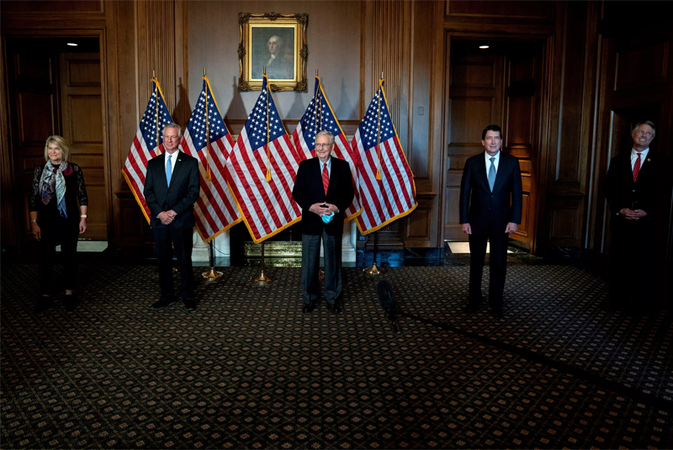
 Defense Secretary Mark T. Esper meets with crew members of the USS Bonhomme Richard on September visit to Naval Base San Diego. MUST CREDIT: Lisa Ferdinando/Defense Department.
  A pedestrian wearing a protective mask passing in front of Pfizer signage is reflected outside headquarters in New York on July 22, 2020. MUST CREDIT: Bloomberg photo by Jeenah Moon
 Joe Mullica, 56, along with a select few supporters of President Trump, maintain their protest of the vote count outside the Pennsylvania Convention Center in Philadelphia on Nov. 8. MUST CREDIT: Photo for The Washington Post by Amanda Voisard
  Boys carry fodder past cattle at a village in Gaya district, Bihar, India, on Oct. 23, 2020. MUST CREDIT: Bloomberg photo by Prashanth Vishwanathan.
  Former vice president Joe Biden stops by a restaurant in Philadelphia on Tuesday, Nov., 3, 2020. MUST CREDIT: Washington Post photo by Demetrius Freeman /Photo by: Demetrius Freeman — The Washington Post
  Lael Brainard
  President-elect Joe Biden visits his family graves at St. Joseph On the Brandywine in Wilmington, Del. on Oct. 18, 2020. MUST CREDIT: Washington Post photo by Demetrius Freeman /Photo by: Demetrius Freeman — The Washington Post Location: Washington, United States
  President Trump
  SootinClaimon.Com