By The Washington Post · Marissa J. Lang · WORLD, THE-AMERICAS MEXICO CITY – It’s the moment for which advocates of legal marijuana here have been waiting: Mexican lawmakers, working under a court order, have until mid-December to finalize rules that will make the country the world’s largest market for legal pot.
Advocates have long argued that legalization would put a dent in the black market, allow for safe, regulated consumption, create jobs and cut down on crime.
But rather than counting down the days with glee, they’re waging an 11th-hour campaign to change legislation that they say would favor large corporations over small businesses and family-owned farms, while doing little to address the issues at the root of the country’s illegal drug trade.
“The truth is we’re just a few weeks away from the vote and we don’t know what’s going to happen,” said Julio Salazar, a senior lawyer and legalization advocate with the nonprofit group Mexico United Against Crime. “I’m not sure if the initiative being pushed by Congress actually makes things better. It makes a cannabis market for the rich and continues to use criminal law to perpetuate a drug war that has damaged the poorest people with the least opportunities.”
The proposal would allow private companies to cultivate and sell marijuana to the public. But it would limit the number of plants an individual could own to six, and require consumers to register for a government license – a step that advocates say could discourage legal use and leave customers likelier to stay in the illegal market.
It would also require commercial sellers to provide seed-to-sale product tracing, akin to the system used in California, but likely to be far more difficult in rural Mexico.
Ricardo Monreal, the Senate leader of President Andrés Manuel López Obrador’s ruling Morena party, has said lawmakers considered a number of international models for legalization. The current proposal borrows elements from Uruguay, Canada and some U.S. states.
Advocates fear the legislation, if approved as written, will cut Mexican-owned businesses out of a lucrative new market while doing little to loosen the grip of organized crime on the drug trade.
“We want a legal framework that can bring some of these players in from the illegal market into a legal one,” said Zara Snapp, co-founder of the RIA Institute, a Mexico City-based drug policy research and advocacy group. “The purchase price needs to be low enough to undercut the illegal market for consumers. … You also have to make sure there are enough entry points for (growers) to move over.”
If 30 percent of growers can be drawn into the legal market, she said, “that’s 30 percent that are paying taxes and out of the shadows, when before it was zero percent.”
Neither Monreal nor the Senate commission that is overseeing the legislation responded to requests for comment. Monreal has told reporters that no bill would perfectly address advocates’ demands, but ending prohibition is expected to buoy Mexico’s economy and allow small farmers a path out from under the cartels.
“The most important thing for Mexico and its legislators is that they dare to knock down this decades-old taboo,” Monreal told Reuters this year. The deadline for a vote is Dec. 15.
Marijuana in Mexico has long been the butt of jokes and stereotypes. Snapp hopes the country can overcome that stigma.
“The first time I went to a cannabis expo, there was this Dutch company selling Mexico sativa seeds, and it was crazy to me that there was no way for that to be our intellectual property,” she said. “I hope we can start to see a shift where Mexico can take pride in this.”
Hemp was brought to the country by Spanish colonists in the 16th century for use as a building material. By the 20th century, marijuana was banned throughout Mexico and the lucrative product moved underground. Marijuana cultivation, much of it for export to the United States, bankrolled the organized crime that continues today in the form of the diversified drug cartels now fueling historically high homicide rates.
But a decade ago, prohibition began to soften. Lawmakers decriminalized possession of small amounts of the drug in 2009; then-president Felipe Calderon, who militarized the fight against the cartels, said the measure would allow law enforcement to shift focus from individual users to large-scale drug dealers and smugglers.
Court rulings loosened regulations still further, leading to the Supreme Court ruling in 2018 that found that banning cannabis violated Mexicans’ constitutional rights.
As specialty strains and gourmet cannabis products began to emerge in U.S. states where they were legal, the flow of trafficking flipped: Marijuana grown in the western United States was being smuggled south across the border to consumers willing to pay a premium, according to the U.S. Drug Enforcement Administration.
Today, a lush marijuana field containing hundreds of plants grows in the shadow of the Mexican Senate. Cultivated and tended to by cannabis activists, the protest garden reeks of reefer. It gives advocates a place to light up just steps from where lawmakers will decide how freely they should be allowed to do so.
Despite the steady march toward legalization, attitudes in Mexico around the drug remain fairly conservative. Polls indicate that as many as 60 percent of Mexicans believe marijuana should remain illegal, a finding that lawmakers are expected to take into account.
“Public opinion is important right now because it impacts how politicians think,” Snapp said. “But what the politicians need to remember is that we are not at this point because of public opinion – we are here because the Supreme Court ruled on multiple occasions that any and all Mexicans have the right to the free consumption of cannabis, and inhibiting personal use infringes that right.”
Salazar said advocates want a Mexican solution.
“The legislation being pushed took the worst parts of all the different models,” Salazar said. “They took the consumer registry from Uruguay that is excessive. They included the traceability requirement from the United States, which makes sense over there because regulation is local, but not in Mexico where it would be federal. And we also copied the lack of reparations to help indigenous communities or those most affected by the war on drugs.”
Many of Mexico’s farmers, advocates point out, live in rural areas without reliable access to the internet and other technologies that would be required to adhere to some of the proposed regulations, such as tracking the plant from seed to sale.
“The devil is really in the details of these laws,” said John Walsh, director of drug policy for the Washington Office on Latin America. “There is no one-size-fits-all legalizing solution.
“With Mexico, is this actually going to be an inclusive market shaped to the country’s realities? Or will it be a market controlled by well-heeled, well-financed, well-connected corporations?”
By The Washington Post · Louisa Loveluck · NATIONAL, WORLD, MIDDLE-EAST
LONDON – Iran reacted cautiously as former U.S. vice president Joe Biden was named America’s president elect, urging the new administration to overturn Trump-era policies that have left Iran isolated on the world stage as its economy crumbles.
President Donald Trump’s push to neuter Iran internationally became a defining focus of his foreign policy. Since withdrawing from a landmark nuclear agreement two years ago, a U.S. campaign of “maximum pressure” has seen the administration impose crippling sanctions on Iran and order the killing of its most renowned military strategist.
On Saturday, President Hassan Rouhani said that approach had been “wrong” and would not succeed. “We hope today’s conditions have shown the sanctioners that their policies have failed in the past three years,” he said, in comments carried by the semiofficial Tasnim news agency.
“God-willing, the next American president will submit to laws and regulations and will return to their commitments,” he said, in a reference to the nuclear deal signed between the two nations in July 2015.
Hours later, as media outlets announced that Biden had taken a definitive lead, Rouhani’s deputy, Eshagh Jahangiri, said that he hoped for a change in “destructive U.S. policies.”
“I hope we will see a change in the destructive policies of the United States, a return to the rule of law and international obligations and respect for nations,” he said, according to Iranian state media.
Biden, who was vice president when the deal was struck, has cast the Trump administration’s Iran policies as reckless, and argued that they have emboldened Tehran instead of weakening it. In promises made ahead of the election, he said that he would offer Iran a “credible path back to diplomacy,” with a potential return to the nuclear deal if it returns to compliance with its original terms.
But the path ahead may be politically difficult. As president, Biden may have to deal with a Republican-majority Senate, where policy toward Iran has often become a divisive and partisan issue.
“In Tehran there is going to be a big question mark over whether Biden can re-engage with Iran on a diplomatic track,” said Ellie Geranmayeh, a senior policy fellow at the European Council on Foreign Relations.
“Legally he will be able to do that, but politically? Given the optics in Congress, there will be question marks over whether Biden has the stomach to take on the Republican Party on an issue as toxic as Iran.”
This election has been closely watched across Iran, with senior officials depicting the race as revealing deep flaws in American democracy and social media users poking fun at both Washington’s political optics and their own.
In an interview with Iran’s INSA news agency, Ali Karimi Firuzjayi, a senior parliamentary official, said that America’s ballot had revealed “the disgrace of Western liberal democracy.”
“What a spectacle,” Iran’s supreme leader, Ayatollah Ali Khamenei, tweeted.
And across social media and WhatsApp chat groups, the memes went into overdrive, often with a satirical twist.
Echoing the blue and red electoral maps splashed across American news sites, one picture showed a former Iranian president Mahmoud Ahmadinejad – whose disputed re-election in 2009 set off huge protests – beside a completely brown U.S. map, showing that he had won all states.
One video showed Trump swinging his hips at election rallies in time, but to Iranian music. Another showed Americans lining up to vote, with their vox-pops dubbed with clips from the Iranian media’s coverage of its own elections. In Fairfax County, Va., a young blonde woman in a purple fleece is heard explaining in Farsi that her vote will “cut the invasive hands of the foreigners and colonizers.”
As American voters turned out in what appeared to be record numbers Tuesday, senior figures from across Iran’s political and religious establishment insisted that the outcome would not alter the country’s path.
“Whoever becomes the president of the United States does not affect our policies,” said Khamenei, the supreme leader, in an address marking the 41st anniversary of the seizure of the U.S. Embassy in Tehran that led to a protracted hostage crisis.
In a radio interview Saturday, Iran’s deputy foreign minister, Abbas Araqchi, insisted that even if the U.S. president changed, its “domineering and bullying policies” would not.
But many across the country were still glued to the results, reflecting just how deeply Washington’s maximum pressure campaign has affected the lives of many ordinary citizens.
Punishing rafts of U.S. sanctions have created severe medical shortages in Iran as restrictions on the banking sector have made it tough to pay for imports. Food prices have also skyrocketed as goods have disappeared from the shelves.
Trump’s sweeping immigration restrictions have also divided Iranian families, and dashed the hopes of others who had hoped to study, work or travel in the United States.
On Monday, the Trump administration announced a new round of sanctions, this time targeting the country’s oil sector.
In Tehran, a 45-year-old mathematician, Sohrab, said that he hoped a Biden presidency would involve a less “chaotic” approach to the region “so they are more capable of making permanent changes toward stability.”
Ahead of Iranian presidential elections last year, experts said, the Biden administration will have a narrow window of opportunity to try to re-engage the same administration, led by Rouhani, that agreed the nuclear deal in the first place.
“I think there is cautious interest across the board in Iran to have some sort of sanctions relief from a Biden administration in return for rolling back some of its nuclear activities,” said Geranmayeh.
In comments published Saturday, Iran’s foreign minister, and a key proponent of the 2015 nuclear deal, Mohamed Javad Zarif appeared to indicate that a shift in approach from the Biden administration might allow for a return to diplomacy.
“There are clear differences between the two campaigns,” he said of the Biden and Trump efforts “During Trump, we witnessed numerous threats from him and his foreign affairs ministry. But what matters to us is not the tone or terms, but the actions.”
As Trump approaches his final months in office, the question now, said Dalia Dassy Kaye, a political scientist at the RAND Corporation, is what moves Trump and Iran now make in the final months of the administration. “There is a very real sense that this has been a very tough time for Iran under this administration,” she said.
“Now what happens between November and January? What does the Biden team inherit?”
By The Washington Post · Steve Hendrix · NATIONAL, WORLD, MIDDLE-EAST JERUSALEM – Israelis began coming to grips Saturday with the defeat of President Donald Trump, who enjoys widespread support here and whose presidency is seen by many as the friendliest to Israel in history.
President-elect Joe Biden will inherit a Middle East policy that has tilted dramatically toward Israel in the past four years, with the United States moving its embassy to Jerusalem, suspending aid to Palestinians, declaring legal support for Jewish settlements in the West Bank and backing out of the Iran nuclear deal.
Biden could bring U.S. policy back in line with Democratic orthodoxy, for instance by championing a two-state solution to the Israeli-Palestinian conflict and opposing the expansion of West Bank settlements. But analysts say he is unlikely to insist on undoing all of Trump’s initiatives.
Biden has criticized moving the embassy to Jerusalem but said he would not pull it back to Tel Aviv. Instead, many here expect him to rebuild diplomatic relations with the Palestinian Authority by reopening a consulate in East Jerusalem and a Palestinian mission in Washington, D.C. Biden is also likely to resume humanitarian aid to the Palestinians.
“It’s not at all black and white with Biden,” said Michael Oren, a former Israeli ambassador to the United States who has known the incoming president for decades.
Prime Minister Benjamin Netanyahu did not join the cascade of world leaders offering best wishes to Biden on Saturday. But early Sunday he tweeted congratulations to both Biden and Vice President-elect Kamala Harris.
“Joe, we’ve had a long & warm personal relationship for nearly 40 years, and I know you as a great friend of Israel. I look forward to working with both of you to further strengthen the special alliance between the U.S. and Israel.”
The prime minister immediately followed that with a tweet thanking Trump for his policy gifts to Israel. “Thank you @realDonaldTrump for the friendship you have shown the state of Israel and me personally,” he wrote.
Biden is no stranger to Israelis. He was known as a staunch supporter of Israel through his 36 years in the Senate. He calls Netanyahu “my friend” and cites his 1973 encounter with then-Prime Minister Golda Meir as “one of the most consequential meetings” of his life.
As vice president, however, he was a loyal wingman to President Barack Obama, remembered here as a critic. And Biden will take office as the standard-bearer of a Democratic Party viewed as increasingly at odds with Israeli policy.
“Biden is the generation that remembers; he remembers the Six-Day War; he was close enough to feel the history of the Holocaust,” Oren said. “Obama was of a different generation; it was more ideological with him. Biden is not ideological.”
Israelis are perhaps most wary of shifts in Washington’s stance on Iran. Biden was part of the Obama team that reached the Iran nuclear agreement, which lifted sanctions on Tehran in return for restrictions on its nuclear program. Trump’s unilateral withdrawal from it is viewed by security experts here as the greatest of his gifts to Israel. Biden’s promise to offer Iran a “path back to diplomacy” makes many in Israel nervous.
Tzachi Hanegbi, a minister from Netanyahu’s Likud party, warned on Israeli television that Biden’s return to the nuclear accord could lead to war. “If Biden stays with that policy, there will, in the end, be a violent confrontation between Israel and Iran,” Hanegbi said.
Trump’s departure could be keenly felt by Netanyahu on a personal level. The prime minister has touted his close relationship with Trump as a chief political asset, and some of Trump’s actions, such as endorsing Israel’s annexation of the Golan Heights, which was captured from Syria in 1967, were timed to boost Netanyahu’s election prospects.
Some members of Netanyahu’s fractious coalition government have said that Trump’s exit from the White House will devalue Netanyahu’s status as a Trump-whisperer and increase the chances of a no-confidence vote and early elections. Netanyahu’s popularity has plummeted in recent months over his handling of a resurgent coronavirus and a collapsing economy.
In the West Bank, Palestinian leaders hailed Biden’s triumph over Trump, whom they have accused of putting U.S. policy at the service of Israel’s right wing.
“There was nothing worse than the Trump era,” former Palestinian Authority minister Nabil Shaath said in an interview with Turkish media. “Good riddance.”
Trump’s supporters in Israel, however, say his hard-line tactics have taught Palestinians that their history of rejecting peace offers has led them to a diplomatic dead end. Biden, they fear, will take a softer line.
Israeli settlers, who held rallies before the election to pray for Trump’s success, recognize that Biden’s diplomats will be nothing like the current U.S. ambassador from Washington, David Friedman, a longtime champion of the settlement movement.
But settlers like David Elhayani, head of the Yesha Council, an umbrella for Jewish settlements in the West Bank, said the party of the U.S. president doesn’t always matter. It was under Republican George W. Bush that Jewish settlements in the Gaza Strip were abandoned, Elhayani said.
“Under Obama, we built more [settlement] houses than we have under Trump,” he added. “I think Biden is a friend of Israel.”
Some Israelis are hoping that a Biden presidency could help ease the turmoil of recent Israeli politics. Netanyahu is often accused of mimicking Trump’s divisive rhetoric, which has helped stoke divisions in Israeli society. Netanyahu’s son Yair, who has cited Trump as a “rock star” role model, has regularly tweeted vitriolic insults at his father’s critics, including prosecutors pressing corruption charges against the prime minister and protesters clamoring for his ouster.
“Israel is part of the democratic world,” said Mordechai Kremnitzer, senior fellow at the Israel Democracy Institute. “And the way that President Trump has been conducting himself has not exactly been a great example to that world.”
By The Washington Post · Toluse Olorunnipa, Annie Linskey, Philip Rucker · NATIONAL, POLITICS Joseph Robinette Biden Jr. was elected the nation’s 46th president Saturday in a repudiation of President Donald Trump powered by legions of women and minority voters who rejected his handling of the coronavirus pandemic and his divisive, bullying conduct in office.
Biden’s victory was the culmination of four years of struggle for Democrats and others who have resisted Trump. It was celebrated by an emotional outpouring in cities coast to coast that ended with a tailgate-style victory party in Biden’s hometown of Wilmington, Del. The election took four days to be resolved after the former vice president was projected to win a series of battleground states, and was clinched by the state where he was born, Pennsylvania.
Voters also made history in electing as vice president Kamala Devi Harris, 56, a senator from California and daughter of Jamaican and Indian immigrants who will become the country’s first woman, first Black person and first Asian American to hold the No. 2 job.
Trump, who was at his Virginia golf course when Biden was declared the winner, did not concede.
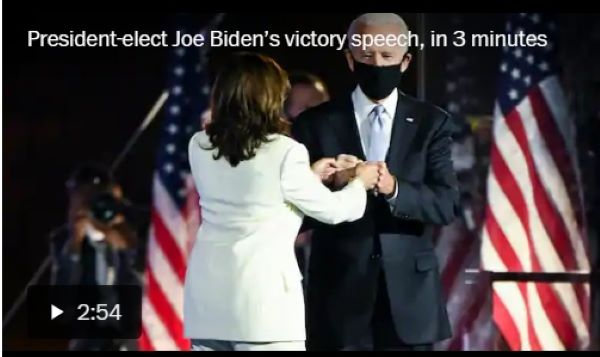
In a prime-time speech to flag-waiving supporters outside the Chase Center in Wilmington, Biden made no mention of Trump’s intransigence, instead offering an olive branch to the president’s supporters and imploring all Americans to “put away the harsh rhetoric,” and end “this grim era of demonization.”
“To make progress, we must stop treating our opponents as our enemy,” Biden said, before referring to the Book of Ecclesiastes. “The Bible tells us that to everything there is a season – a time to build, a time to reap, a time to sow. And a time to heal. This is the time to heal in America.”
Before introducing Biden, Harris acknowledged the history-making reality of her election, saying she stood on the shoulders of trailblazing women and would do her best to join their ranks.
“While I may be the first woman in this office, I will not be the last,” Harris, wearing all white, said to raucous applause. “Because every little girl watching tonight sees that this is a country of possibilities.”
She described Biden as a “healer” and a “tested and steady hand” ready to help shepherd the country through multiple crises.
News of Biden’s victory – and Trump’s defeat – sent thousands of people into the streets for impromptu celebrations in cities including Philadelphia, Atlanta, New York and Washington. The events mirrored some of the mass demonstrations that have taken place across America in the past four years, as diverse groups have protested gun violence, sexual assault, systemic racism, police brutality and Trump’s presidency.
But the joyous outbursts came against a dark backdrop: a bitter and closer-than-expected election that revealed the nation’s deep fissures, and the precedent-shattering attempts by an incumbent president to defy its results.
Trump on Saturday continued to make baseless claims that the election was rigged, assertions that have been echoed by his loyal supporters.
“I WON THE ELECTION, GOT 71,000,000 LEGAL VOTES,” Trump tweeted Saturday afternoon, despite the reality that he was losing the popular vote for a second time and at risk of facing a 306-to-232 electoral college drubbing.
Trump’s allies encouraged his supporters to prepare to protest in the streets, and most Republican leaders remained silent rather than publicly acknowledging the outcome of a free and fair election resulting in their standard-bearer’s defeat.
In a statement shortly after the race was called, Trump defiantly claimed that “this race is far from over” and pledged to challenge the result in the courts until “the rightful winner is seated.”
Biden won three swing states that Trump had claimed in 2016 – Michigan, Wisconsin and Pennsylvania – reconstituting the “blue wall” that had protected previous Democratic nominees. He was projected the winner in Nevada on Saturday, completing his successful defense of all states won by Hillary Clinton in 2016. He also was leading in the formerly Republican terrain of Arizona and Georgia as he boosted Democratic votes across the Sun Belt. By early Saturday, Biden had amassed a record 74.6 million votes, beating Trump by more than 4 million, a margin that was expected to increase once all ballots were certified.
By denying Trump a second term, a country convulsed by health, economic and social crises brought to an end a tumultuous presidency that polarized the nation and was characterized by attacks on undocumented immigrants, political adversaries and, at times, the rule of law.
On Saturday, Biden presented a starkly different vision for governing and vowed to be a president for all Americans, not just those who elected him.
“For all those of you who voted for President Trump, I understand the disappointment tonight,” he said in his only mention of the incumbent. “I’ve lost a couple times, myself. But now, let’s give each other a chance.”
Trump, meanwhile, continued to vent his frustration on Twitter and in a defiant speech from the White House on Thursday night. He and his aides alternately demanded that vote-counting end or continue as they searched for dwindling opportunities for a path to 270 electoral votes. They filed multiple legal challenges over the election in several states.
Voters punctuated the extraordinarily ugly and disruptive campaign season by choosing as Trump’s successor his antithesis – a career Democratic politician who offered himself as a healer with the compassion and empathy he said was needed to usher in an era of civility and restore the soul of America. He won the presidency on the 48th anniversary of his first election to the Senate, on Nov. 7, 1972.
Biden, who will be 78 when he is sworn in Jan. 20, will become the nation’s oldest president and will arrive with nearly a half-century in elected office, including eight years as vice president and 36 years representing Delaware in the Senate. He is also the second Catholic and first Delawarean to be elected president.
He used his remarks Saturday to cite a popular Catholic hymn, “On Eagles’ Wings,” offering it as a source of solace to those who have lost loved ones to the coronavirus crisis.
Biden said controlling the pandemic would be his first order of business, and announced plans to name a group of scientists and experts to create a plan of action for implementation beginning Jan. 20.
“I will spare no effort – none, or any commitment – to turn around this pandemic,” he said.
Harris’s ascent to one of the nation’s two highest offices marked a particularly momentous occasion in the history of women’s rights and came a century after the 19th Amendment guaranteed all women the right to vote. It also occurred four years after Clinton, the first female presidential nominee of a major political party, lost unexpectedly to Trump.
Since then, a record number of women have been elected to offices across the country, amid the tenure of a president who has insulted women, demeaned their looks and belittled the #MeToo movement against sexual assault.
Biden’s win was powered by a record number of votes by women, with Black women providing an especially large boost, according to preliminary exit polls. More than 90 percent of Black women supported the Biden-Harris ticket, making for the widest margin in any voting bloc in the country.
Harris, who attended Howard University in Washington, is also the first graduate of a historically Black university to be elected to serve in the White House.
While Biden’s path to victory became clearer Wednesday after he secured wins in key battleground states, the apparently narrow margins in several states left the outcome in doubt for days. During that period, Trump sought to shift the race to the courts by alleging fraud but providing no evidence.
Trump has previously declined multiple opportunities to commit to a peaceful transition of power, saying he reserved the right to object to what he has defined as fraud despite the lack of evidence.
Despite Trump’s unprecedented effort to use the vast platform of the presidency to cast doubt on the legitimacy of an American election, the traditional markers of a coming transfer of power began to emerge shortly after Biden was declared the winner.
Former presidents and presidential candidates released statements congratulating the new president-elect; world leaders reached out to express optimism about developing a working relationship; Democratic congressional leaders expressed their support; and, despite pressure from some of Trump’s allies not to legitimize the results, some Republicans also publicly sent their well wishes to the soon-to-be Biden-Harris administration.
“Our democracy needs all of us more than ever,” former president Barack Obama said in a statement offering well wishes on behalf of himself and his wife, Michelle Obama. “Michelle and I look forward to supporting our next President and First Lady however we can.”
Among the Republicans sending statements of support were former Florida governor Jeb Bush, Maryland Gov. Larry Hogan and Sen. Mitt Romney of Utah, the 2012 GOP presidential nominee.
Among the world leaders who swiftly and publicly congratulated Biden on Saturday were British Prime Minister Boris Johnson, Ukrainian President Volodymyr Zelensky and Canadian Prime Minister Justin Trudeau.
“The US is our most important ally and I look forward to working closely together on our shared priorities, from climate change to trade and security,” Johnson said in a statement released on Twitter.
Indian Prime Minister Narendra Modi offered “heartiest congratulations” to Harris, whose mother immigrated to the United States from India, for inspiring “immense pride” for Indian Americans.
Throughout the campaign, Biden pitched himself to voters as a uniter who would restore the nation’s governing norms, respect long-standing institutions and reconnect relationships with international allies that have frayed as Trump embraced autocrats and brushed aside leaders of other democracies.
Unlike in his two other attempts at the White House, in the 1988 and 2008 contests, Biden entered the race at the top of the polls. He crafted a decidedly centrist pitch as many other candidates vied for attention from the energized liberal wing of the Democratic Party.
But his candidacy struggled in the early contests. He placed a dismal fourth in Iowa, then sank to fifth in New Hampshire.
Biden’s chances brightened in Nevada, where he was powered by a more diverse electorate. And then the race moved onto turf far more agreeable to a man who had long worked with Black elected officials and served the first African American president – South Carolina, and its predominantly Black Democratic electorate.
Boosted by support from Rep. James Clyburn, an influential Black Democrat in the state, he rallied to an easy victory, and he replicated it in a host of states over the next few weeks to effectively clinch the nomination just as the nation closed down under the explosion of the coronavirus.
Even in the general election, the campaign tried to maintain a low profile, with Biden avoiding showmanship and making a point to elevate others in the party.
He focused insistently on the coronavirus, keeping a card with an updated death count with him at all times and deploying his own personal story of loss to convey a sense of empathy that he said the president lacked. He hoped that his experience with the death of his first wife and their daughter in a 1972 car accident and the 2015 death from cancer of his son Beau would help him connect with a country in mourning.
Biden’s campaign also reflected his desire to model the guidance of public health officials in minimizing the spread of a virus that has killed more than 237,000 Americans. He wore a mask at all public appearances, at times for entire speeches, unless he was yards from anyone else, and urged Americans to follow suit. Even as the president resurrected mass gatherings, filled with maskless supporters who refused to socially distance, Biden held no large rallies, instead speaking before parking lots full of cars as supporters honked in agreement.
Clinching the nomination early offered advantages, affording Biden time to unite the Democratic Party. He rolled out back-to-back-to-back virtual endorsements by former rivals in which they would appear together on video, events that fostered a sense of Democratic bonhomie after a bruising primary.He worked with Sen. Bernie Sanders (I-Vt.) and his supporters to develop policies, effectively muting the criticism from the left that had hounded Clinton.
Trump used the cooperation as an attack line, saying the “manifesto” that the two wings of the party developed showed that Biden was controlled by the left. To respond, Biden would point to his long record as a moderate. “The party is me. Right now, I am the Democratic Party,” Biden snapped to Trump as the president made a case that the Democratic Party is controlled by its liberal base.
The GOP also tried to weaponize Biden’s authorship of the 1994 crime bill, which critics say led to mass incarceration. Biden never apologized for his role in shepherding the legislation, which also included a 10-year ban on assault weapons. Although the Republican effort appeared to have nominally boosted Trump’s support among Black men, Biden retained the overwhelming backing of non-White voting groups.
Biden’s ascent to the White House reflects a decades-long quest for the presidency and a remarkable rise from his roots in Scranton, Pa., a childhood he often references in his speeches.
His family moved to Delaware when he was a boy, but Biden maintained his ties to his native town. On Election Day, he made a campaign stop at his former home and wrote a note on the living room wall. “From this house to the White House with the grace of God,” Biden wrote.
His first White House campaign ended in 1987 when he bowed out after being accused of plagiarizing. His second, in 2008, ended after a bad showing in Iowa but put him on the path to becoming vice president.
But Biden situated himself as an institutionalist and creature of the Senate, where he served for six terms. He chaired the Senate Foreign Relations and Judiciary committees, overseeing the hot-button Supreme Court confirmation hearings of Robert Bork and Clarence Thomas. His regrets over how Anita Hill was treated as a witness during the latter hearings led him to push to add women to the Judiciary Committee and ultimately to elevate Harris as his vice-presidential pick.
Trump, the third president in American history to be impeached, is set to leave office with a tenuous legacy and a long string of unfulfilled promises. His final months in office aren’t likely to change that, with the country beset by a surging public health crisis.
His loss all but ensures that he will be the first president since Herbert Hoover to leave office with fewer Americans employed than when he was sworn in. The 6.9 percent unemployment rate in October, while down from the pandemic high of more than 14 percent, is still significantly above the 4.7 percent rate when he took over in January 2017.
The national debt has soared, thousands of troops remain in overseas war zones and the kind of Washington influence-peddling Trump calls “the swamp” has only increased under his watch. Trade deficits persist, and the fence project on the border with Mexico has been neither completed nor, as Trump promised, financed by the Mexican government.
The president’s decision to sign hundreds of executive orders and bypass Congress rather than securing policy changes via legislation means that much of his legacy can easily be overturned. Yet while Biden campaigned on a promise to roll back Trump’s signature legislative victory – a tax cut passed in 2017 – he may not be able to do so if Republicans maintain their Senate majority.
Still, Trump’s term in office will be recorded in history books as turbulent, norm-shattering and consequential on numerous fronts. He was impeached by the House last year for alleged abuse of power and obstruction of Congress after he encouraged Ukraine’s president to investigate Biden and his son Hunter. He was ultimately acquitted by the Senate.
He has cemented his impact on the federal judiciary, appointing more than 200 judges and three Supreme Court justices. Their impact on American life will extend long past Trump’s term.
When Biden is sworn in, he will have an opportunity to leave his own stamp on a country he has served in public office for the vast majority of his adult life.
“I’ve long talked about the battle for the soul of America. We must restore the soul of America,” he said Saturday. “Our nation is shaped by the constant battle between our better angels and our darkest impulses. And what presidents say in this battle matters. It is time for our better angels to prevail.”
Notwithstanding the second wave of Covid-19 infections, Myanmar is going ahead with its General Election on November 8.
This will be the second election in the post-military era, and it will mark a significant historical event in the country’s recent democratic transformation. While the incumbent National League for Democracy (NLD) is expected to win most of the 424 elected seats, ethnic parties in the states—the provinces of ethnic nationalities—may see better results than in 2015. Unlike 2015, there are some new political parties, which are less aligned with either the military-backed Union Solidary and Development Party (USDP) or the NLD.
Although the electoral outcome is unpredictable, the result is not likely to make a significant difference to current democratisation challenges, which require strengthening civil society to improve institutional and governance systems. The current restricted environment for civil society organisations, especially those advocating for the expansion of human rights and accountability, is almost certain to continue in post-2020 Myanmar. There is a lot of stake for the democratisation of Myanmar and its fragile reform for a more inclusive society.
There are three possible electoral outcomes, and each will shape Myanmar’s legislative agenda differently. Most importantly, the outcome will decide who will be the next president and who will control the administration until February 2026.
In the first possible outcome, the incumbent NLD administration will return with a reduced majority, riding on the national popularity of its leader Aung San Suu Kyi and its dominant online presence to overcome Covid-related campaign restrictions.
The second possible outcome would see the military-backed USDP win by gaining at least 25 percent of elected seats and combining this with the 220 military-reserved seats to control the Union legislature.
In the third possible outcome, the minority nationalities will hold the balance of power in the national legislatures to assert influence over the election of the future president. However, with the recent cancellation of the elections in constituencies from mostly nationality-dominated areas, this outcome seems unlikely.
The unique nature of Myanmar’s political system under the 2008 Constitution means the parliamentary election results have limited influence on future political constellations. Apart from their legislative functions, members of parliament have limited scrutiny on the executive government. While the parliament will elect the president and the vice presidents and confirm the president-nominated judicial and ministerial positions, Myanmar’s parliament operates as a check and balance to the executive. Partly due to its restricted powers within the scope of the 2008 Constitution, but mostly due to party discipline of restraint in making critical comments against their leaders, the current, NLD-dominated parliament has been criticised for not fulfilling its potential to be a public forum to check the NLD-led government’s decisions, especially in protecting the broader rights of the people and ensuring democratic spaces.
In addition to the NLD’s inability to progress key national reform agenda such as peace and constitutional reforms, the erosion of freedom of expression and the failure of local administration changes generated a range of tensions and fragmentation within the civil society over the last five years. In addition, both print media and social media in Myanmar have come under increasing scrutiny that has contributed to self-censorship and silences. Unlike in 2015, there is little expectation that the outcome of this election will offer significant structural changes to address these concerns.
There has been a lot of expectation that civil society organisations (CSOs) could play a positive role in monitoring Myanmar’s elections to ensure the effectiveness and integrity of the democratic process in Myanmar. The local CSOs are also expected to play a significant role in the forthcoming election by conducting observation and public education. There was a highly-celebrated, active and widespread engagement of both local and international CSOs supporting the 2015 election. However, recent political developments indicate their engagement in the 2020 election is likely to be quite restricted. Moreover, space for the CSOs to contribute to political and policy reforms after the election is unlikely to be significantly reduced.
The recent example of the People’s Alliance for Credible Elections (PACE) and the controversial decisions of the Union Election Commission (UEC) demonstrate the current predicament faced by CSOs that are focused on policy or political reforms. PACE is a prominent local group almost exclusively focused on electoral issues. It provided the largest numbers of electoral observers in the 2015 General Election, and both by-elections in 2017 and 2018. Despite its prominent previous involvements in ensuring the integrity of the electoral process, in July 2020, the UEC decided not to give accreditation to PACE for the 2020 Election, citing the lack of association registration and foreign funding. It is worth noting that neither conditions are illegal under the current Association Law. The UEC reversed its decision in a few weeks later, caving to intense public pressure, to allow PACE as one of the local organisations accredited as election observers.
The strange case of the PACE Accreditation echoes the difficulties faced by Myanmar’s CSOs in their endeavours to promote public policies under the NLD-led administration. A general view on this restricted political landscape is that the current government is unnecessarily bureaucratic and only follows the letter of the law in public policy processes. A more pessimistic view, as expressed privately among some local leaders, suggests two key elements of the NLD’s failure of leadership.
The first element entails the government’s desire to reign in the myriad of CSOs, especially those attracting lucrative international funding. It is probably understandable for a legitimate government to establish a justifiable framework to strengthen accountability, sustainability and probity within the sector. The 2014 Association Law stipulates only a voluntary registration and there is no overarching framework concerning CSOs to guide such a systematic CSO reform. Without a comprehensive approach to strengthening the CSO sector, the NLD-led or NLD-appointed authorities have used a seemingly overzealous legalistic style to deter broader democratic reforms.
The second element of this failure relates to the NLD’s perspective on CSOs’ policy criticisms as the political opposition to the government. With an almost dogmatic conviction on the infallibility of its leader, many in the NLD are intolerant to any critical comments. Despite many CSO leaders being former allies in the struggle against the military rule, there is little or no space for policy dialogues or engagement with them. In contrast to the last quasi-military government, which openly accommodated their inputs in policy workshops and reform dialogues, the CSOs have become frustrated with the NLD members with the lack of engagement in policy discussions. This antagonism has led to some student unionists agitating for an election boycott in 2020, partly as an objection to the popularly elected government.
There is no sign of an improved relationship between the broader CSO community and the NLD-led administration in the near future. More importantly, it is unlikely that a returned NLD administration will change its approach to the CSOs. Taking a cue from the current CSO-NLD relationship, it is also unlikely that, in the event of the second possible election outcome, a USDP-Military administration would consider the CSOs as friends, especially concerning human rights-related issues.
In the third possible outcome, in which ethnic nationalities hold the balance of power in the legislature, heated contestations between the military, administrative and legislative institutions could take place. Such an unstable environment might result in politicisation among CSOs, rather than strengthening the sector.
The 2020 General Election should be a critical time to consolidate democratisation, especially in relation to resetting the relationship between CSOs and the political authorities. However, their recent experience in advocacy for political and policy reform under the NLD government and the potential election outcomes indicates such collaboration is not likely to occur or even guarantee the current level of freedom enjoyed by the service-oriented CSOs. There is a need to find another opportunity in the post-2020 elections to re-establish democratic alliance between political forces and CSOs.
Japan has agreed to offer financial assistance to two of its companies to diversify their manufacturing base to India as part of its recent initiative to provide subsidies to companies relocating from China.
They are: Toyota-Tsusho and Sumida. The move was announced following Indian Prime Minister Narendra Modi’s meeting with global investors on Thursday. Modi is to follow up Thursday’s round table discussions with one-on-one meetings with the investors, including some marquee Japanese players.
Toyota-Tsusho is looking to set up a rare earth metal facility, and Sumida is for automotive parts.”Work had been going on to seek to get these companies to India, but the Japanese side decided to provide assistance to make the process more attractive for the two companies,” said a government source.India and Japan have been seeking to build a coalition to counter China’s growing dominance and the ties have been strengthened following the outbreak of the Covid-19 pandemic.
Along with Australia, India and Japan had launched supply chain resilience initiative for Indo-Pacific, where the government had also urged Tokyo to expand the coverage of the financial assistance to India.
Japan had announced a $2-billion initiative, unofficially aimed at re-shoring some of its companies as well as diversifying into other markets. While a bulk of the funding is aimed at those entities that shift from China back to Japan, India and Bangladesh are among countries where assistance will be provided.
There are an estimated 30,000 Japanese companies that have production bases in China, which had emerged as the factory to the world, compared with 5,100 in India.
Recently, Japan External Trade Organisation (JETRO) had announced that it would help 10 Japanese companies to get into high-tech projects with Indian companies. The list included the likes of Suzuki and Olympus.
While Suzuki is working on IT infrastructure to develop a transit bus traffic control system in rural areas, Olympus and HCL Technologies are working on technologies to aid doctors.
InternationalNov 08. 2020Chief Executive of the Hong Kong Special Administrative Region Carrie Lam Cheng Yuet-ngor (left) meets with Secretary of the CPC Guangdong Provincial Committee Li Xi in Guangzhou, Nov 7, 2020. (PHOTO/HKSAR GOVERNMENT)
By China Daily
HONG KONG – Chief Executive of the Hong Kong Special Administrative Region Carrie Lam Cheng Yuet-ngor met with leaders of Guangdong province and Shenzhen on Saturday to discuss ways to jointly take forward the Guangdong-Hong Kong-Macao Greater Bay Area development and further cooperation between Hong Kong and Shenzhen.
During the meeting with Secretary of the Guangdong Provincial Committee of the Communist Party of China Li Xi and Governor of Guangdong province Ma Xingrui, Lam expressed gratitude to the province for the long-standing support for Hong Kong during the COVID-19 epidemic.
Carrie Lam expressed the hope that cross-boundary travel could resume gradually and orderly for the people of Guangdong and Hong Kong when the SAR further brings the epidemic under control
The Guangdong authorities have helped the city implement anti-epidemic measures at border control points. Majority of the members of the support teams who came to Hong Kong to help with testing in the Universal Community Testing Programme in September were also from Guangdong.
Lam expressed the hope that cross-boundary travel with exemption of quarantine could resume gradually and orderly for the people of Guangdong and Hong Kong when the SAR further brings the epidemic under control.
Lam said that she is confident of the prospects of Guangdong-Hong Kong cooperation down the road, in particular the Bay Area development, given the unique advantages of Hong Kong and the cooperation foundation built over the years between the two places. She expressed the hope that the two governments will work together to contribute to the development of the nation and the Bay Area.
Lam met with the Secretary of the CPC Shenzhen Municipal Committee Wang Weizhong and Shenzhen Mayor Chen Rugui in the afternoon.
Pointing out that Hong Kong made contributions in the course of developments of Shenzhen in the past and was also the beneficiary, Lam said she believes that the close and mutually beneficial relationship can be further strengthened in the future.
Secretary of the CPC Shenzhen Municipal Committee Wang Weizhong pledged to offer full support for Hong Kong to integrate into the nation’s development
She said the HKSAR government is studying policy initiatives recently promulgated by the country on the development of Shenzhen in order to explore further room for collaboration in such areas as promoting innovation and technology, attracting talent and improving people’s livelihoods.
Pointing out that the Ministry of Science and Technology has expressed staunch support for Hong Kong-Shenzhen cooperation on innovation and technology, Lam expressed the hope that while taking forward the development of the Hong Kong/Shenzhen Innovation and Technology Park in the Loop, both places can implement enhanced collaborative measures in the Shenzhen-Hong Kong Innovation and Technology Cooperation Zone in Shenzhen as soon as possible to contribute to the development of an international I&T hub in the Bay Area.
She also expressed her gratitude to the Shenzhen municipal government for its support for Hong Kong amid the epidemic, including helping with the construction of community treatment facilities and a temporary hospital as commissioned by the central government.
For his part, Wang pledged to offer full support for Hong Kong to integrate into the nation’s development, according to reports of the Shenzhen branch of People’s Daily.
He expressed the hope that closer cross-boundary cooperation can be conducted in checkpoint construction, technological innovation, modern service industry, education and healthcare, social livelihood and joint prevention and control of pandemic, according to the reports.
India’s economy expected to bounce back from next fiscal, says SBI chairman Khara
InternationalNov 08. 2020State Bank of India chairman Dinesh Kumar Khara
By The Statesman
The corporate sector will become “very careful about borrowings” and use their internal resources initially.
The Indian economy, which has shown resilience to come out from a downturn caused by the pandemic, is expected to bounce back from the next fiscal, State Bank of India chairman Dinesh Kumar Khara said on Saturday.
The SBI chief made the statement while addressing the virtual annual general meeting of Bengal Chamber of Commerce and Industry. He said that there will be a “paradigm shift” which will lead to a more matured economy” with economic players learning to contain costs.
“The economy is expected to bounce back from the next fiscal starting from April 2021. The next normal will see a paradigm shift and some of them will be permanent.”
He added that the economy had shown “resilience to come out from the downturn” and some positive traction was witnessed towards the end of the first quarter of the current fiscal.”
According to him, investment demand from corporate will take some time to pick up.
“Average capacity utilisation among the corporations is around 69 per cent. Investment demand from corporate will take some time to pick up. The cash-rich PSUs will initially embark upon capital expenditure plan which will generate investment demand,” he said.
The corporate sector will become “very careful about borrowings” and use their internal resources initially.
He further pointed out the industries such as steel and cement are doing well since the beginning of April 2020 and now they are at a position from where they can tap the export markets.
President Joko “Jokowi” Widodo is set to award the title of national hero posthumously to six Indonesian figures on Heroes Day, which falls on Nov. 10, Social Affairs Minister Juliari Batubara has said.
“There are six national hero awardees this year,” Juliari said on Friday, as quoted by Antara.
Two of the awardees are from the country’s easternmost provinces, namely Sultan Baabullah from North Maluku and Machmud Singgirei Rumagesan from West Papua. The two figures will be the first national heroes from both provinces.
Sultan Baabullah was the seventh sultan of the Ternate Sultanate from 1570 to 1583. His influence reached as far as 72 islands including Mindanao Island in the Philippines and the Papuan Islands.
Baabullah defeated the Portuguese colonizers and led Maluku to its peak of glory at the end of the 16th century through free trade in spices and forest products.
Machmud Singgirei Rumagesan was the king of Sekar region, now Fakfak regency, who fought against the Dutch colonial government and later established the Tjendrawasih Revolutionary Movement of West Irian (GTRIB).
The GTRIB called on the Indonesian government to form a local government in Papua, led by native Papuans, as a part of Indonesia to rival the Dutch that still occupied the land after Indonesian independence in 1945.
The other four awardees are first National Police chief Gen. (ret) Raden Said Soekanto Tjokrodiatmodjo from Jakarta, former information minister Arnold Mononutu from North Sulawesi, Youth Congress figure Sutan Mohammad Amin Nasution from North Sumatra and warlord Raden Mattaher from Jambi.
Juliari said the nomination of the six historical figures had gone through a selection process in the Social Affairs Ministry and the Title, Order of Merit and Honors Council.
Soekanto Tjokrodiatmodjo led the National Police from 1945 to 1959. He was mandated by first President Soekarno to build a police institution with nationalism in mind. He was awarded the Bintang Mahaputra medal by President Soeharto in 1968 as a recognition of his professional accomplishments during his service.
Arnold Mononutu was a nationalist involved in the country’s struggle for independence, including supporting the notion of unifying the Dutch-established State of East Indonesia (NIT) with the Republic of Indonesia. Afterward, Arnold was appointed as the information minister. In 1953, he became the first Ambassador of Indonesia to China.
Sutan Mohammad Amin Nasution was an Acehnese-Mandailing lawyer who was also involved in the independence movement. He served as the governor of North Sumatra and later became the first governor of Riau. He was also one of the founders of the Young Indonesians organization, which later held the Second Youth Congress in Oct. 1928.
Raden Mattaher was a warlord of the Jambi Sultanate in the 19th century who also fought against Dutch colonial rule. In 1885, Mattaher and his great uncle Thaha Syaifuddin, the sultan of Jambi who was named a national hero in 1977, sunk a Dutch warship in the Kumpeh Muaro Jambi River. (aly)
Such figures have been unseen since August, and raise concerns of a third wave of infections amid the onset of cooler temperatures.
More than 100 new clusters were discovered over the past week.
“We have to watch the situation with a stronger sense of caution than before,” Prime Minister Yoshihide Suga said on Friday.
Top government spokesman Katsunobu Kato added that the government was “sparing no effort” to curb the outbreak, though a suspension of the multi-billion dollar Go To Travel campaign to resuscitate the ailing hospitality industry does not appear to be on the cards.
While Japan has avoided the explosive growth in cases elsewhere, it has been one of the hardest-hit in East Asia. It has also, comparatively, been one of the more laissez-faire in its response.
China, where the coronavirus was first detected, reported no local transmissions on the mainland on Friday, with all 33 new cases imported. The tally stands at 86,184.
Outpacing both countries is Japan, with 107,554 cases as of Saturday night. Tokyo, which accounts for nearly one in three cases, reported 294 new cases on Saturday, with several traced to Halloween parties.




 Chief Executive of the Hong Kong Special Administrative Region Carrie Lam Cheng Yuet-ngor (left) meets with Secretary of the CPC Guangdong Provincial Committee Li Xi in Guangzhou, Nov 7, 2020. (PHOTO/HKSAR GOVERNMENT)
  State Bank of India chairman Dinesh Kumar Khara
  President Jokowi Widodo
 SootinClaimon.Com