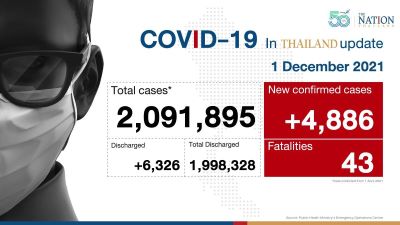
Ministry of Public Health reported on Wednesday (December 1) morning that in the past 24 hours there are 4,886 new patients who tested positive for Covid-19, 165 of whom have been found in prisons.
Death toll increased by 43, while 6,326 patients were cured and allowed to leave hospitals.
The country’s total caseload from Covid-19 stands at 2,120,758 – 2,025,754 of whom have recovered, 74,190 are still in hospitals and 20,814 have died.
Separately, another 233,654 people were given their first Covid-19 shot in the last 24 hours, 274,665 their second shot and 64,754 a booster, bringing the total number of Covid-19 vaccine doses administered nationwide to 93,231,463.
According to Worldometer, confirmed cases globally had risen to 263.06 million on Wednesday, 237.54 million of whom have recovered, 20.29 million are active cases (84,759 in severe condition) and 5.23 million have died (up by 7,617).
Thailand ranks 24th in the global list of most cases, which is topped by the US with 49.43 million, followed by India with 34.6 million, Brazil with 22.1 million, the UK with 10.23 million and Russia with 9.64 million.
The Thailand Meteorological Department said on Wednesday (December 1) that the rather strong high-pressure system covers upper Thailand while another rather strong high-pressure system from China extends to cover the upper Laos and Northeast of Thailand. Cool to cold weather in the morning and strong winds are forecast in the areas, with a drop in temperature by 1-3 degrees Celsius.
Meanwhile, the rather strong northeast monsoon prevails over the Gulf and the South. Heavy rains are likely over the middle and the lower parts of the South. People should beware of the severe condition and rain accumulation that may cause overflows and flash floods.
Waves in the Gulf of Thailand are 2-3 meters high and more than 3 meters high during thundershowers. All ships should proceed with caution and keep off thundershowers, while and small boats should keep ashore until December 2.
The weather forecast for the next 24 hours is as follows:
North: Cool to cold weather in the morning; temperature lows of 14-19 degrees and highs of 27-31 degrees Celsius. Temperature on hilltops is likely to drop to 6-12 degrees Celsius with frost in some areas.
Northeast: Cool to cold weather with strong winds; temperature lows of 14-18 degrees and highs of 27-29 degrees Celsius. Temperature on hilltops is likely to drop to 9-14 degrees Celsius.
Central: Cool weather in the morning with strong winds; temperature lows of 21-22 degrees, highs of 28-31 degrees Celsius.
East: Cool weather in the morning with strong winds; temperature lows of 21-24 degrees, highs of 29-32 degrees Celsius; waves 2 meters high and over 2 meters offshore.
South (east coast): Thundershowers in 70 per cent of the areas with isolated heavy rains; temperature lows of 22-24 degrees, highs of 28-31 degrees Celsius; waves 2-3 meters high and over 3 meters during thundershowers.
South (west coast): Thundershowers in 70 per cent of the areas with isolated heavy rains; temperature lows of 22-24 degrees, highs of 26-32 degrees Celsius; waves 2 meters high and over 2 meters offshore.
Bangkok and surrounding areas: Cool weather in the morning with strong winds; temperature lows of 22-24 degrees, highs of 29-31 degrees Celsius.
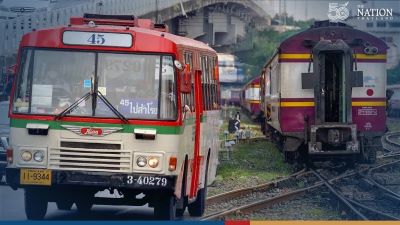
The Cabinet on Tuesday agreed to provide subsidies of 2.28 billion baht to the Bangkok Mass Transit Organisation (BMTA) and 3.38 billion baht to the State Railway of Thailand (SRT).
These funds are being allocated to compensate for losses incurred by BMTA and SRT as well as to boost their liquidity.
The Cabinet has also instructed the two organisations to seek ways of reducing their reliance on subsidies, boosting revenue and reducing costs.
BMTA said it will expedite the preparation of a business rehabilitation plan that is in line with plans to reform the public bus system in Greater Bangkok. The SRT, meanwhile, has been instructed to come up with a business recovery plan, especially to earn additional income from the transfer of assets.
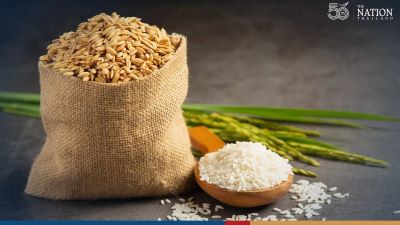
The Cabinet on Tuesday set aside more than 140 billion baht for rice price guarantee in the 2021-2022 fiscal year.
Commerce Minister Jurin Laksanavisit said the price guarantee scheme should also be implemented in the following fiscal year but will depend on the price of rice in the world market.
This year Thailand is expected to export about 6 million tonnes of rice as targeted because exporters have received many orders.
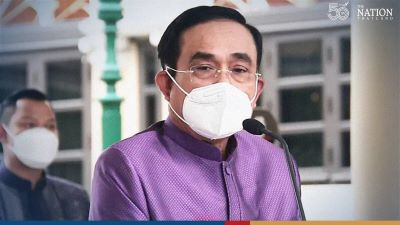
Thailand will continue conducting RT-PCR tests on travellers arriving under the Test & Go scheme, Prime Minister Prayut Chan-o-cha said after wrapping up the weekly Cabinet meeting on Tuesday.
This means tourists will still need to book their first night in a SHA Plus+ hotel as they wait for their test results.
Prayut said the plan to conduct rapid antigen tests (ATK) has been shelved given the new variant Omicron being found in many parts of Europe.
Thailand has also banned flights from eight countries in southern Africa, namely Botswana, Eswatini, Lesotho, Malawi, Mozambique, Namibia, Zimbabwe and South Africa.
Omicron, marked as a “variant of concern” by the World Health Organisation, was reported on November 24 and found in a sample collected in South Africa on November 9.
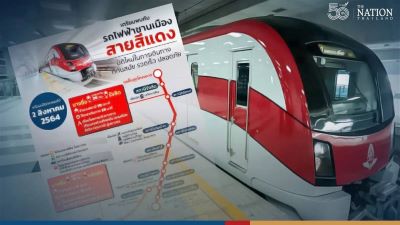
The State Railway of Thailand’s Red Line went commercial on Monday after providing free runs for four months.
The fares range from 12 to 42 baht, and the first day saw a total of 11,401 commuters, with most of them ending or starting their journey at Bang Sue Grand Station.
At Bang Sue, the line branches into two – Bang Sue-Rangsit to the north and Bang Sue-Taling Chan to the west.
The services have been extended to midnight every day.
Trains on the Bang Sue-Rangsit line run every 12 minutes during rush hour – 7am to 9.30am and 5pm to 7.30pm – and 20 minutes outside of rush hour. Trains on Bang Sue-Taling Chan line run every 20 minutes during service hours
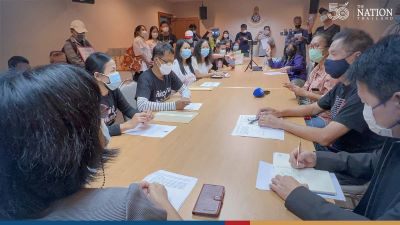
The Triumph International Worker’s Union led employees from Brilliant Alliance Thai Global to file a complaint with the National Human Rights Commission at the Government Complex in Bangkok on Tuesday.
This move came after Loeng Police Station charged six labour activists on November 16 for allegedly holding an illegal protest outside the Government House in Dusit district on October 19.
Garment workers fight for their right to survival, as police slap them with charges
The protesters were demanding that the government and Labour Ministry secure a 242-million baht compensation for the 1,388 employees that had been laid off with little or no severance pay by Brilliant Alliance Thai Global, a lingerie manufacturing company in Samut Prakan.
Garment workers fight for their right to survival, as police slap them with charges
The Textile Industrial Labour Union said the police charges violated the workers’ rights, especially since they were suffering from a loss of income and had nothing to fall back on.
The apparel industry is known for its chronically low wages and most workers have little or no savings.
Garment workers fight for their right to survival, as police slap them with charges
The union said they had submitted a letter to the government many times, but no progress has been made.
Garment workers fight for their right to survival, as police slap them with charges
Brilliant Alliance Thai Global, formerly called Body Fashion and owned by Triumph International, is now part of the Hong Kong-based Clover Group International.
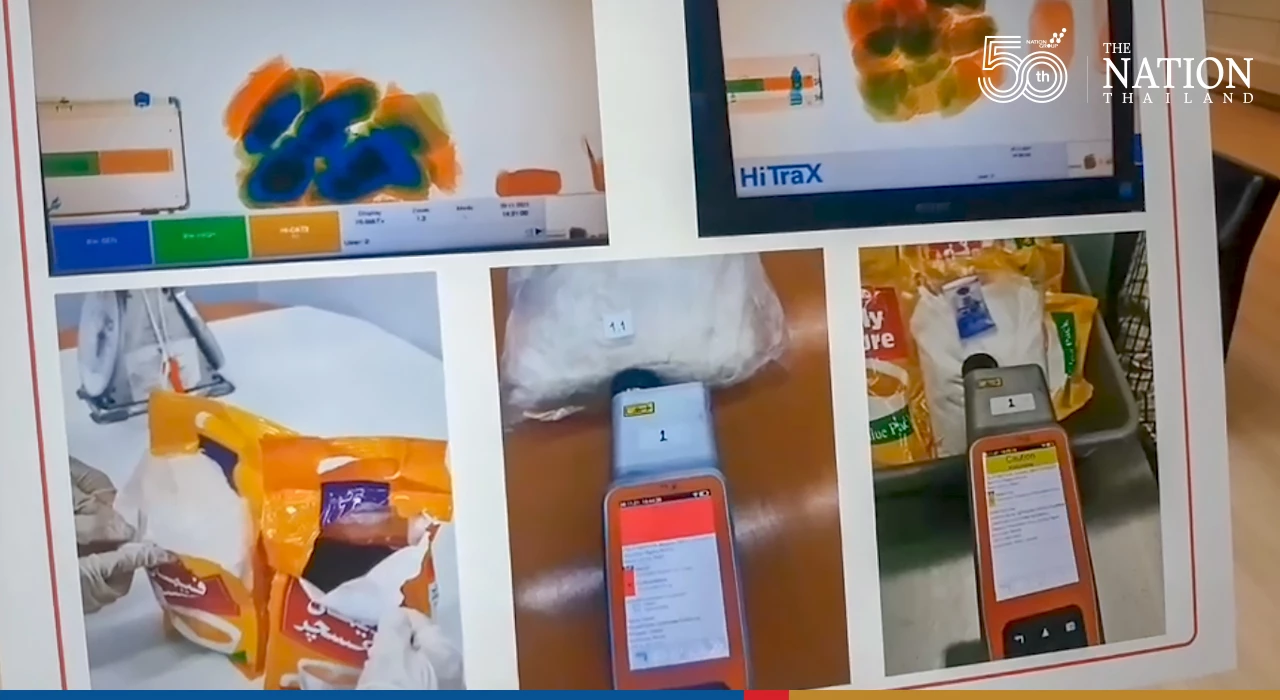
Two Pakistani nationals were caught at Suvarnabhumi Airport on Monday trying to smuggle in 30.6 kilograms of ketamine and 1.1kg of heroin. The total street value of the seized drugs came in at 95 million baht.
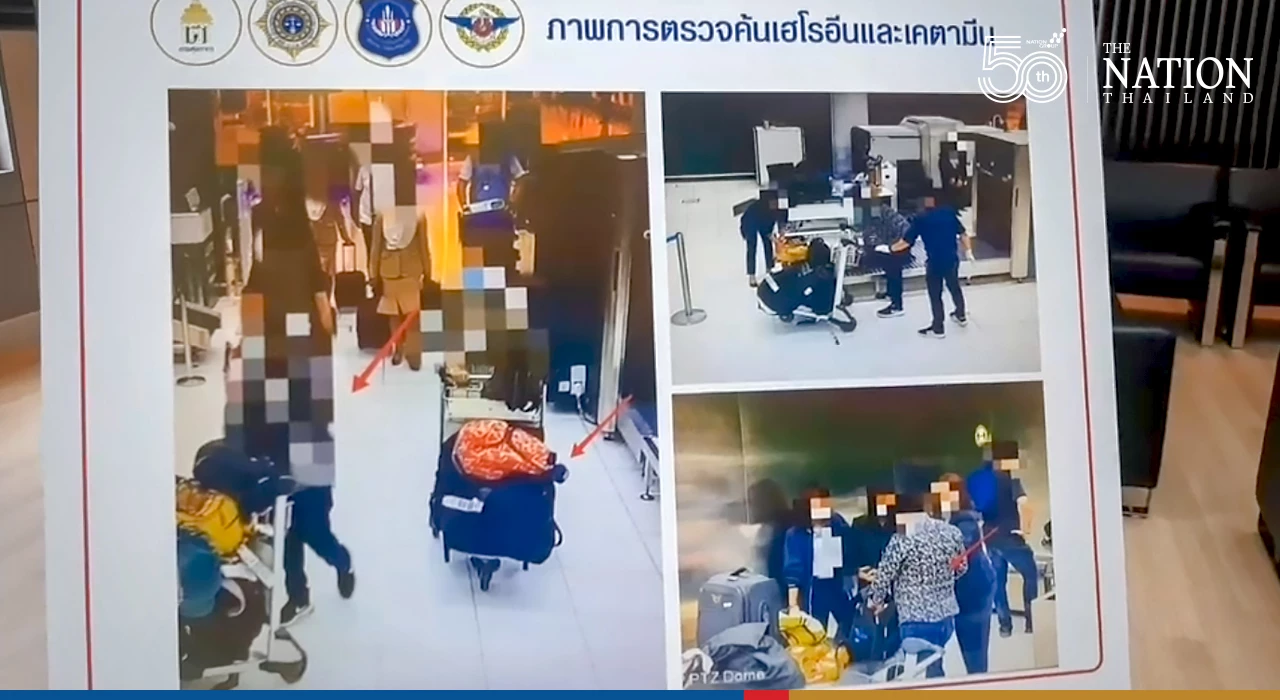
Customs Department director-general Pachara Anantasilp told the press on Tuesday that the two men were nabbed as they tried to walk through the “nothing to declare” green channel.
They had travelled from Karachi to the United Arab Emirates, before landing in Thailand on an Emirates flight. The drugs had been hidden inside instant tea packages in their luggage.
Pachara said the drugs were not detected in either Karachi or Dubai airports until they arrived in Thailand. He said the other airports may have missed the haul because they focused more on weapons and other dangerous items. The two suspects are currently being interrogated.
Though the smuggling of drugs via air travel tapered off during the Covid-19 pandemic, it has started picking up again now that Thailand is slowly reopening. The Customs Department has been randomly checking the luggage of arriving and departing passengers.
Since October 2020, 202 suspects have been caught trying to smuggle drugs worth about 8.5 billion baht.
2 Pakistani men caught in Suvarnabhumi with haul of ketamine, heroin
2 Pakistani men caught in Suvarnabhumi with haul of ketamine, heroin2 Pakistani men caught in Suvarnabhumi with haul of ketamine, heroin2 Pakistani men caught in Suvarnabhumi with haul of ketamine, heroin
As the China-Thailand bilateral railway talent development cooperation continued apace, more vocational institutions in Thailand have joined the training program, importing technologies and curriculum development schemes from China to help Thailand foster railway talents.
“Iwant to bring what I have learned in China about railways back to serve Thailand,” said Kantithat Danaut, expecting the construction of the China-Thailand railway to pick up speed.
The Nakhon Ratchasima province in northeastern Thailand, where the 23-year-old boy was born, is expected to be linked with the capital Bangkok by the China-Thailand railway that has started construction in 2017.
Encouraged by his mother, Kantithat took part in a Chinese high-speed railway training program in 2017, which is the beginning of his high-speed railway dream.
Students of the Banphai Industrial and Community Education College practice train simulation driving in Khon Kaen province, Thailand, Nov. 17, 2021. (Xinhua/Lin Hao)
Under the joint training program for high-speed railway talent development between China and Thailand, Kantithat and 39 other Thai students first received one-month language training at the Confucius Institute at Khon Kaen University, and then went to the Wuhan Railway Vocational College of Technology (WRC) in central China’s Hubei Province for an eight-month training to learn to be a high-speed railway technician.
Recalling his stay in Wuhan, Kantithat said it is the help of his teachers and senior schoolmates that made him be able to improve his Chinese and learn about high-speed trains.
Students of the Banphai Industrial and Community Education College practice train simulation driving in Khon Kaen province, Thailand, Nov. 17, 2021. (Xinhua/Lin Hao)
So excited when first taking China’s high-speed railway train, Kantithat said it was comfortable, safe and fast, “you can feel how fast it is when there is the other high-speed train running from the opposite direction.”
Back to Thailand from China, Kantithat then went to Japan as a technician intern, while he wanted to go to China to continue learning about high-speed railway next year.
As the bilateral railway talent development cooperation continued apace, more vocational institutions in Thailand have joined the training program, importing technologies and curriculum development schemes from China, to help Thailand foster railway talents, and bringing Thai youths like Kantithat closer to their dream of a railway driver or technician.
Sitting at the controls of a state-of-the-art simulator, Preeyaporn Kaenavong and her classmates were trying to accelerate a train out of a station.
A student of the Banphai Industrial and Community Education College practices at a track switch in Khon Kaen province, Thailand, Nov. 17, 2021. (Xinhua/Lin Hao)
The “virtual train” gathers pace as they guard against unknown hazards ahead — from adverse weather conditions to dangers such as obstacles on the track.
Preeyaporn and her classmates are operating a train driver simulator, the centerpiece of the Lu Ban High-Speed Railway Institute, which was established in Banphai Industrial and Community Education College in Thailand’s northeastern province of Khon Kaen, in a collaborative effort with the WRC in China.
The simulation driving training base was a gift from WRC’s partner Zhengzhou J&T Hi-Tech Co., a company headquartered in central China’s Henan Province.
The Lu Ban High-Speed Railway Institute is teaching prospective drivers and engineers how to operate Thailand’s under-construction high-speed railway.
“I want to go to China to continue my study and board a high-speed train to experience the speed,” said Preeyaporn.
Junyar Pabu, former head and now adviser of the Banphai Industrial and Community Education College, said in recent years, Thailand’s Ministry of Education has been enhancing cooperation with its Chinese counterpart and encouraging closer cooperation between Thai and Chinese vocational colleges to cultivate railway talents. “This is how the Lu Ban High-Speed Railway Institute was established.”
Besides the WRC, the Banphai college is also cooperating with China’s vocational colleges in southwestern provinces of Guizhou and Yunnan as well as Chongqing Municipality, Junyar said.
Under the support of Chinese partner colleges, Thailand’s vocational colleges have made great progress in railway talent development, especially in curriculum development, teacher training, teaching hardware and joint training programs, he said.
“The China-Thailand railway talent development cooperation fully demonstrates that the Belt and Road Initiative has promoted the common development and prosperity along the routes,” Junyar said.
Both Thailand and China will benefit from the China-Thailand railway, he said, hoping the construction work can accelerate.
“I’m waiting for the China-Thailand railway, hoping it can be completed as soon as possible so that I can contribute to its development,” Kantithat said.
Junyar Pabu, former head and now adviser of the Banphai Industrial and Community Education College, speaks during an interview with Xinhua in Khon Kaen province, Thailand, Nov. 17, 2021. (Xinhua/Lin Hao)
The daily consumption of fuel in Thailand fell 5.1 per cent in the first 10 months of this year compared to the same period last year. However, the Department of Energy Business said fuel usage picked up in October once pandemic restrictions were lifted.
Nantika Thangsupanich, the department’s director-general, said on Monday that the daily consumption of Jet A1, diesel, benzene, kerosene and natural gas vehicle (NGV) fuels had dropped by 42.9 per cent, 5.9 per cent, 9.3 per cent, 5.7 per cent and 19.6 per cent year on year, respectively.
“The average daily consumption of benzene from January to October stood at 28.40 litres per day, down by 9.3 per cent compared to the same period in 2020. However, consumption in October rose to 28.56 litres per day once lockdown measures were relaxed,” she said.
She added that the average diesel and NGV consumption from January to October stood at 60.85 and 3.09 litres per day, down by 5.9 and 19.6 per cent respectively, due to the Covid-19 fallout.
Meanwhile, the average consumption of liquefied petroleum gas (LPG) rose by 8 per cent to 16.51 litres daily due to increased use in petrochemical and industrial sectors.
Though the daily consumption of Jet A1 dropped by 42.9 per cent from the same period in 2020, Nantika said it surged by 16.9 per cent in October compared to the previous month as flights resumed in response to the gradual reopening of the country.
“Meanwhile, export of fuel in the first 10 months stood at 199,457 barrels per day. The export value accounted for 14.28 billion baht per month, up 71.9 per cent,” she added.
Thailand’s fuel consumption slowly picks up as more doors open


 Garment workers fight for their right to survival, as police slap them with charges
 Garment workers fight for their right to survival, as police slap them with charges
 Garment workers fight for their right to survival, as police slap them with charges
 Garment workers fight for their right to survival, as police slap them with charges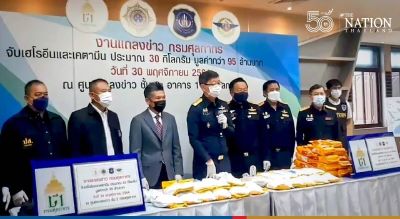
 2 Pakistani men caught in Suvarnabhumi with haul of ketamine, heroin
 2 Pakistani men caught in Suvarnabhumi with haul of ketamine, heroin
 2 Pakistani men caught in Suvarnabhumi with haul of ketamine, heroin
 2 Pakistani men caught in Suvarnabhumi with haul of ketamine, heroin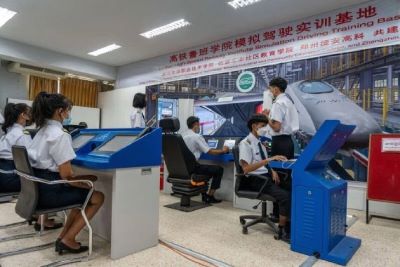
 Students of the Banphai Industrial and Community Education College practice train simulation driving in Khon Kaen province, Thailand, Nov. 17, 2021. (Xinhua/Lin Hao)
 Students of the Banphai Industrial and Community Education College practice train simulation driving in Khon Kaen province, Thailand, Nov. 17, 2021. (Xinhua/Lin Hao)
 A student of the Banphai Industrial and Community Education College practices at a track switch in Khon Kaen province, Thailand, Nov. 17, 2021. (Xinhua/Lin Hao)
 Junyar Pabu, former head and now adviser of the Banphai Industrial and Community Education College, speaks during an interview with Xinhua in Khon Kaen province, Thailand, Nov. 17, 2021. (Xinhua/Lin Hao)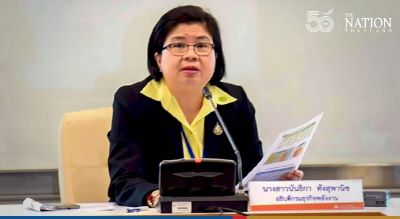
 Thailand’s fuel consumption slowly picks up as more doors open
