By Syndication Washington Post, Bloomberg · Katia Dmitrieva · BUSINESS
U.S. retail sales rose in October at the slowest pace in six months, suggesting consumers are becoming more hesitant amid a surging pandemic and lack of fresh federal stimulus.
The value of total sales increased 0.3% from the prior month, when there was a downwardly revised 1.6% gain, Commerce Department figures showed Tuesday. The median estimate in a Bloomberg survey of economists called for a 0.5% increase. Excluding autos and gasoline, sales rose 0.2%, compared with estimates for a 0.6% gain.
Weaker momentum in consumer spending — which accounts for two-thirds of the economy — indicates growth could slow more sharply following the third quarter’s record jump in gross domestic product. November and December could prove tougher with states and cities reimposing restrictions on indoor dining and nonessential business to contain a rampant coronavirus, while hopes for additional fiscal stimulus this year keep fading and political uncertainty hangs over government policy.
U.S. stock futures and 10-year Treasury yields extended declines after the data. Other data Tuesday morning are due to deliver additional readings on the U.S. economy, including industrial production for October and home builder sentiment for November.
The subdued government figures follow strong quarterly results earlier Tuesday from two large retailers — Home Depot Inc. and Walmart Inc. Home Depot’s comparable sales jumped 24.1% in the latest quarter from a year ago as the home-improvement retailer benefited from a surge in renovation activity, while Walmart’s sales also climbed more than projected as online demand soared at the world’s largest retailer.
The retail report provides a snapshot of activity in October: eight of the 13 major retail categories decreased, led by clothing and sporting goods and hobby stores. Nonstore retailers — which include online vendors like Amazon.com Inc. — recorded the biggest increase, at 3.1%.
Restaurants and bars recorded the first decline since the initial depths of the pandemic in April, a sign that colder weather is discouraging the outdoor dining that kept many businesses afloat during the summer.
So-called control group sales — often a more reliable gauge of underlying demand — increased 0.1% from the prior month, missing forecasts. That figure excludes food services, car dealers, building-materials stores and gasoline stations.
While overall retail sales rose 5.7% from a year earlier, several categories remain well below pre-pandemic levels, including gasoline stations, clothing stores and restaurants.
The data point to spending that’s moderating at the start of the fourth quarter as coronavirus cases rise in every U.S. state, prompting some, including California and New Jersey, to issue new restrictions. Other regions have paused full reopenings.
Early trials from companies including Moderna Inc. have proven effective, though a vaccine must be developed and deployed in scale before consumers feel comfortable enough to regain regular activity. In the meantime, an elevated savings rate is likely to continue supporting some spending.
Amazon expands push into health care with online pharmacy
InternationalNov 18. 2020An Amazon.com delivery truck sits in Richmond, California, on Oct. 13, 2020. MUST CREDIT: Bloomberg photo by David Paul Morris.
By Syndication Washington Post, Bloomberg · Angelica LaVito, Matt Day · BUSINESS, HEALTH, US-GLOBAL-MARKETS, HEALTH-NEWS
Amazon.com unveiled its biggest push into selling prescription drugs with the launch of a digital pharmacy and discounts for paying U.S. Prime members that sent shock waves through shares of drugstore chains and distributors.
The e-commerce giant on Tuesday unveiled Amazon Pharmacy, a section of its retail website and mobile application that lets people order medication. Shoppers can pay using their health insurance. Prime members who don’t use their insurance are eligible for discounts on generic and brand-name drugs on Amazon’s site or at about 50,000 participating pharmacies.
Amazon’s new offering comes more than two years after its $753 million acquisition of PillPack, an online pharmacy known for organizing prescriptions into packets. This expansion puts the Seattle-based e-commerce company into more direct competition with pharmacy giants CVS and Walgreens, the two largest chains in the U.S.
The move also helps Amazon compete with Walmart and other big-box stores that already sell prescription drugs.
Analysts have long expected Amazon to dive deeper into health care in a bet the company can bring its digital real estate and logistical prowess to bear on a roughly $4 trillion industry in the U.S. with a reputation for inefficiency. The company rattled drug retailers with its PillPack acquisition, but Amazon has been slow to integrate the online pharmacy startup into its offerings.
The announcement Tuesday marks the first time that shoppers can order prescription drugs directly on Amazon. Previously, they were redirected to PillPack’s website. An integrated pharmacy removes one of the few gaps in Amazon’s offerings compared with major big box and grocery rivals, some of whom have long filled shoppers’ prescriptions in the same stores where they sold flat-screen televisions or cans of soup.
The discounts are a clear play for people who pay for their medications with cash, whether they are uninsured or are looking to save money. Strong demand for transparency and better deals have helped fuel the rise of discount card programs like GoodRx. Amazon will display both the price when using insurance and the price without. Infusing transparency into a system that has been frustratingly opaque for consumers could alter the supply chain.
“We designed Amazon Pharmacy to put customers first — bringing Amazon’s customer obsession to an industry that can be inconvenient and confusing,” said TJ Parker, vice president of Amazon Pharmacy and co-founder of PillPack.
Amazon’s push comes as consumers are shunning stores and ordering more items online, a trend the coronavirus pandemic has accelerated. With consumer behavior shifting, chain drugstores have already started rethinking their strategies. CVS acquired health insurer Aetna for $68 billion in 2018 and is adding more health services to its stores. Walgreens is dabbling with numerous partnerships to add items like groceries and mobile phones to its stores.
Amazon could find it difficult to quickly pry away customers from pharmacy chains. For many consumers, asking doctors to steer recurring prescriptions elsewhere is cumbersome, especially for those who rely on insurance to pay for their medication.
In some cases, such a switch might also require an office visit — at a time when Americans have been steering clear of the doctor’s office out of concerns about the pandemic. And the ubiquity of the biggest pharmacy chains means most consumers have one nearby, and shopping at them is an ingrained habit.
Amazon’s entry into a market doesn’t guarantee its dominance. Drugstores have long insisted that patients prefer to talk to their pharmacist at the counter, an experience Amazon will try to recreate digitally.
Amazon CEO Jeff Bezos has positioned Prime, Amazon’s paid membership program, at the center of the company’s efforts to create loyal customers. What was originally an unlimited shipping program has grown in recent years to include video streaming, games and digital storage, and discounts at Amazon-owned Whole Foods Market.
Trump administration announces troop cuts in Afghanistan, Iraq amid concerns
InternationalNov 18. 2020Forward Operating Base Lightning, a U.S. Army base in eastern Afghanistan, has been abandoned. MUST CREDIT: Photo by Lorenzo Tugnoli for The Washington Post.
By The Washington Post · Dan Lamothe · NATIONAL, WORLD, POLITICS, NATIONAL-SECURITY, MIDDLE-EAST
The U.S. military will halve the number of troops it has in Afghanistan within the next two months and cut a smaller number in Iraq, Pentagon officials said Tuesday, as President Donald Trump seeks to move closer to keeping a four-year-old campaign promise despite concerns that the decision in Afghanistan could undermine negotiations with the Taliban.
Acting defense secretary Christopher Miller announced the plan in a speech at the Pentagon, eight days after he took over for fired Defense Secretary Mark Esper, who submitted a classified memo to the White House recommending that the conditions on the ground in Afghanistan did not warrant such reductions.
Miller said the U.S. military will carry out Trump’s orders in both countries by Jan. 15, with the numbers reduced from about 5,000 to 2,500 in Afghanistan and from about 3,000 to 2,500 in Iraq. He took no questions from reporters but said he was celebrating the decision.
“We owe this moment to the many patriots who made the ultimate sacrifice and our comrades who carry forward their legacy,” Miller said. “Together, we have mourned the loss of more than 6,900 American troops who gave their lives in Afghanistan and Iraq, and we will never forget the more than 52,000 who bear the wounds of war, and all those who still carry its scars – visible and invisible.”
The decision in Afghanistan comes about nine months after the Trump administration and the Taliban reached a deal that will remove all U.S. troops there by next May if certain conditions are met.
Senior U.S. military officials have raised concerns about the Taliban’s commitment to meeting the terms of the deal, citing a spike in violence against Afghans since the agreement was signed and ongoing questions about whether the militant group will break with al-Qaida.
Miller said the troops cuts are consistent with the administration’s established plans and strategic objectives, and based on continuous conversations with national security advisers in his Cabinet.
During his remarks, Miller did not mention Esper’s dissent but said he had spoken with military commanders in recent days, “and we will all execute this repositioning in a way that protects our fighting men and women, our partners in the intelligence community, our diplomatic corps, and our superb allies.”
Deadlocked board in key Michigan county fails to certify vote totals by deadline
InternationalNov 18. 2020Supporters of President Trump protest the vote count outside of TFC Center where absentee ballots were counted in Detroit following Election Day. MUST CREDIT: Washington Post photo by Salwan Georges
By The Washington Post · Kayla Ruble, Tom Hamburger · NATIONAL, POLITICS
DETROIT – In a party line vote, the Wayne County Board of Canvassers failed on Tuesday to certify its ballot count, punting the question of who won the state’s most densely populated region to a state regulatory board that meets Nov. 23.
The four-member board’s two Republicans voted against certification, while its two Democrats voted to certify the results. Joe Biden holds a lead of nearly 148,000 votes in Michigan, and Democrats here believe the partisan split of the board in Wayne County – home to heavily Democratic Detroit – simply delays an inevitable official victory for Biden in the state.
But in the short term the standoff provides a public relations advantage to the Trump campaign and a group of Republican lawyers and activists who have questioned the legitimacy of the count in Detroit, which went overwhelmingly for Biden.
The head of the Michigan GOP congratulated the board in a statement.
“I am proud that, due to the efforts of the Michigan Republican Party, the Republican National Committee and the Trump Campaign, enough evidence of irregularities and potential voter fraud was uncovered resulting in the Wayne County Board of Canvassers refusing to certify their election results. This action will allow more time for us to get to the bottom of these deeply troubling irregularities,” said Laura Cox, the state party chair. “The people of Michigan deserve fair, open and transparent elections, and we will continue to fight for just that.”
The state board – also made up of two Republicans and two Democrats – has until Dec. 13 to reach a final decision certifying the winner of the election statewide.
Mark Brewer, a leading Democratic election lawyer in Michigan, called the vote “outrageous, unprecedented, and racist.”
He said the two white Republicans on the Wayne County board “have essentially disenfranchised black voters.”
He said the Republicans on the board failed the county, state and their legal obligation. “They had a legal duty to certify,” a vote that was fair he said.
The head of the Michigan GOP congratulated the board in a statement.
“I am proud that, due to the efforts of the Michigan Republican Party, the Republican National Committee and the Trump Campaign, enough evidence of irregularities and potential voter fraud was uncovered resulting in the Wayne County Board of Canvassers refusing to certify their election results. This action will allow more time for us to get to the bottom of these deeply troubling irregularities.” Said Laura Cox, the state party chair. “The people of Michigan deserve fair, open and transparent elections, and we will continue to fight for just that.”
Democrats expressed anxiety in recent weeks that Republican legislators will seek to use a quirk in state law to appoint their own electors.
“By indulging partisan conspiracy theories and debunked claims of fraud, legislative Republicans are eroding our citizens’ faith in our democratic institutions,” Christine Greig, the Michigan House Democratic leader, said in an interview Monday. “Stubborn refusal to acknowledge the election result flies in the face of the oath that each of us swore when we assumed our offices in the Michigan Legislature. It all needs to stop.”
Because electors must be chosen by Dec. 8 under federal law, some supporters of President Donald Trump have argued that if there is no winner by that date, the legislature should try to name its own representatives to the electoral college.
At a rally outside state Capitol in Lansing on Saturday, pro-Trump activists urged the legislature to take control of the situation and select Michigan electors committed to the president.
“You’d better, and I mean better, send electors for Donald Trump,” organizer Kevin Skinner shouted. “We’re not going to take a stolen election.”
Whether the legislature could pick its own electors is the subject of an ongoing debate among legal experts of both parties.
Last week, Republican legislative leaders in Lansing issued carefully worded statements saying that the legislature should honor the will of the voters and not play a role in selecting electors.
Key GOP leaders also backed away from a call to audit the results before certifying.
“I don’t believe that enough votes are in question in Michigan to change the outcome, so I think we need to move forward” with county and state canvassing board certification, Michigan’s Republican former secretary of state, Ruth Johnson, told The Washington Post in an interview.
Johnson, now a member of the state Senate and chair of its Elections Committee, said she still thought an audit was necessary – but that it did not need to be conducted until after the votes were certified.
But the Trump campaign is continuing to press its case to try to block certification of the vote, despite multiple legal setbacks. On Monday, Michigan’s Court of Appeals ruled against two Republican poll watchers, days after a lower court judge had rejected their request to halt certification, saying he saw no convincing evidence of election fraud at the center where workers tallied absentee ballots.
A similar suit filed by the Trump campaign in federal court Tuesday is still pending. As part of it, the campaign filed 238 pages of affidavits from Republican poll watchers across Michigan. They contained no evidence of significant fraud, but included complaints about rude behavior or unpleasant looks from poll workers or Democratic poll watchers.
Retired Democratic U.S. senator Carl Levin said the Republican complaints about the vote process recalled an ugly history of racist and anti-immigrant attitudes.
“The Republican complaints smacked, as they so often do, of an anti-big-city bias,” he said.
The NAACP went to court Friday to intervene in the Trump lawsuit, calling the legal complaint “an all-out attack on votes cast by Black voters.”
Trump’s campaign has said that their lawsuits in Michigan are aimed at ensuring equal protection under the law, alleging Republicans were denied their rights.
“In this country, voting is a fundamental right and that means that there has to be uniform standards,” said White House press secretary Kayleigh McEnany, speaking in a personal capacity at a briefing earlier this month about the legal challenge.
The focus on Wayne County’s vote – which effectively put Biden over the top in Michigan – has put a spotlight on the usually anonymous officials in charge of certifying votes.
The 83 county canvassing boards in the state are required by law to report certified numbers to the state canvassing board, which will meet Monday to begin its process.
Each county board is composed of two Democrats and two Republicans, appointed by their parties for staggered four-year terms. Before they certify the results, the boards spend two weeks reviewing poll books and vote totals and resolving any discrepancies that need to be corrected. The main task: to check whether the number of votes reported by the voting machines in each precinct match the number of voters recorded in poll books.
“We’re not here to talk about the van full of ballots that showed up at 3 a.m. or whatever people are alleging happened. That’s not why we’re here. We’re here to look at those poll books,” Voorheis said.
On Friday, inside a building near the riverfront on Detroit’s east side, a handful of sheriff’s deputies were posted at the entryway screening guests for coronavirus symptoms while guarding the Wayne County Board of Canvassers office, where about a dozen workers have been stationed nearly every day since Nov. 3 working to complete the certification process.
At least a half dozen observers from both political parties, as well as independent groups such as the League of Women Voters, sat quietly at their own tables on the edge of the room with a view of the process.
At one point in the evening, sheriff’s deputies had to mediate when a brief dispute broke out after two observers tied to conservative groups, who had been taking photos of the canvassing process, lodged a complaint about a Democratic observer taking a selfie with them in the background.
The flare-up was a sign of the unusual tension that has marked this year’s canvassing process.
“I’ve been doing voter protection since 2008. I’ve never, ever seen any of this. Ever,” said Alec Gibbs, a Flint attorney who does voter protection work for the Genesee County Democratic Party. “We had no reason to believe that county canvassing boards would become flash points.”
Former Minneapolis police officer charged in George Floyd’s death seeks to bar evidence of past neck and body restraints
InternationalNov 18. 2020Flameless candles are illuminated after being placed at the memorial for George Floyd outside Cup Foods to celebrate what would have been Floyd’s 47th birthday on Oct. 14 in Minneapolis. MUST CREDIT: Washington Post photo by Joshua Lott.
By The Washington Post · Holly Bailey · NATIONAL, COURTSLAW, RACE
MINNEAPOLIS – Derek Chauvin, the former Minneapolis police officer who held his knee at George Floyd’s neck for more than nine minutes and is now charged with his murder, has asked the judge in his case to block prosecutors from introducing evidence of his allegedly having used similar neck and body restraints on other suspects. Chauvin’s lawyer argues in new court documents that his “use of force” in those cases was legal and cleared by police supervisors.
Prosecutors have said they want to cite eight incidents from Chauvin’s 19-year career as a Minneapolis police officer to show a pattern of excessive force and behavior similar to the Memorial Day encounter that left Floyd dead. Prosecutors want to include four cases from 2014 to 2019 in which they claim Chauvin restrained suspects “beyond the point when such force was needed.”
In a court filing Monday, Eric Nelson, Chauvin’s attorney, asked Hennepin County District Judge Peter A. Cahill, who is overseeing the case, to block that proposed evidence, arguing that his client had used approved force and, after routine investigations, had been essentially “acquitted by MPD supervisors of applying force in a manner that was either unreasonable or unauthorized.”
“The state attempts to characterize Mr. Chauvin’s use of force as ‘unreasonable’ or ‘beyond what was needed,'” Nelson wrote, noting that Chauvin had reported his use of force in each of the incidents. “And in every single one, it was determined by a supervisor that Mr. Chauvin’s use of force was reasonable in the circumstances and authorized by law and MPD policy.”
Prosecutors have argued that Chauvin’s behavior while on the force is relevant because they could use it to rebut defense claims that he used “reasonable force” in restraining Floyd, who died May 25 while officers pinned him, face down and handcuffed, on a South Minneapolis street. Officers had been investigating a 911 call about a counterfeit $20 bill that had been passed at a local convenience store, and they were trying to interview Floyd and put him into a police vehicle, which Floyd resisted, saying he was afraid of being in a confined space.
During an ensuing struggle with police, Floyd was placed on the ground, where Chauvin pressed his knee into the man’s neck for more than nine minutes as Floyd repeatedly complained of struggling to breathe. Floyd ultimately lost consciousness and a pulse while restrained. He was later pronounced dead at a hospital.
One of the cases prosecutors have sought to mention at Chauvin’s trial is a July 2019 domestic disturbance incident in which a caller reported that a man had poured gasoline throughout a house and was armed with a knife. In seeking to subdue the suspect and keep him from reaching for scissors on a nearby table, Chauvin allegedly “delivered a single kick” to the man’s midsection and then applied a neck restraint, causing the man to lose consciousness.
Chauvin later told a supervisor that he realized the man had passed out and placed him in a “recovery position” until he “came to,” prosecutors said, something they say the officer did not do when Floyd complained of struggling to breathe.
In his motion to block the incident from being cited at trial, Nelson argued the case is not relevant or similar to Chauvin’s encounter with Floyd and should not be allowed as evidence.
In what appears to be a new defense argument, Nelson repeatedly claimed Chauvin did not use a neck restraint on Floyd but rather what he called “body weight control techniques.”
That is a shift from previous defense motions, in which Nelson defended how Chauvin handled Floyd by arguing that he used an approved neck restraint. In an August motion to dismiss charges, Nelson filed exhibits that included past department training materials with photos demonstrating the knee-on-neck hold similar to the one Chauvin used on Floyd and argued that his client “did exactly as he was trained to do.”
Prosecutors said in a filing Monday that they want to show the jury body-camera video of one of the incidents: a September 2017 encounter where Chauvin allegedly hit a 14-year-old boy in the head with a flashlight during a domestic assault investigation and then restrained him with a knee to the back for 17 minutes even though the child was handcuffed and complained of struggling to breathe. According to prosecutors, the boy’s mother, who had called police, repeatedly asked Chauvin to get off her son, who was bleeding from the ear and later received stitches. Prosecutors described Chauvin’s behavior as “far more violent and forceful” than his police report had implied.
Three of the incidents that prosecutors have sought to use as evidence include encounters in which Chauvin was working as an off-duty police security guard, including in February 2015, when he allegedly pushed a man against a wall and used a neck restraint before placing him in a prone position on the ground.
Prosecutors have said they want to cite that case, in part, because it “demonstrates the common method Chauvin employs when dealing with individuals larger than himself – Chauvin allegedly described the man in police records as “a large individual (with a) muscular type build.” They also said it shows Chauvin regularly used such techniques with “suspected intoxicated people who Chauvin believes are not perfectly complying with his demands.”
They wrote that the evidence shows “a repeating pattern of very similar conduct . . . and demonstrates that his use of force was not reasonable.”
Nelson defended his client’s behavior, arguing that Chauvin “was the only officer on the scene” in an incident that happened late at night and that he behaved “as his MPD training had taught him.” On this instance and the others, Nelson said prosecutors had offered no evidence that Chauvin’s actions violated department policy or the law.
Chauvin’s “modus operandi was simply that of a Minneapolis Police officer performing his duties and reacting to the circumstances,” Nelson wrote. “The state’s attempt to characterize these incidents as evidence of some kind of ill will intent or common scheme of violence that is somehow unique to Chauvin is specious, at best.”
He argued that allowing the incidents to be cited as evidence before a jury would violate Minnesota legal precedents on how past acts can and cannot be used in current cases. Nelson wrote that he believes prosecutors want to use past incidents to “illegally prove propensity,” which he argued is not allowed under state law and would be “unfairly prejudicial.”
Chauvin is facing second-degree unintentional murder and manslaughter charges, while three other officers at the scene – J. Alexander Kueng, Thomas K. Lane and Tou Thao – are charged with aiding and abetting. All four are set to be tried together in March.
In a separate motion, prosecutors asked Cahill to reconsider his recent decision to allow audio and visual coverage of the upcoming trial, which the judge said was necessary because of the anticipated need to accommodate social distancing requirements due to the ongoing covid-19 pandemic. Monday’s request did not specify a reason, but prosecutors have argued against such coverage in the past, citing concerns that it might impact court proceedings.
By The Washington Post · Adam Taylor, Michael Birnbaum · NATIONAL, WORLD, NATIONAL-SECURITY, WHITEHOUSE, ASIA-PACIFIC, EUROPE
Afghanistan could once again become a haven for international terrorist organizations that seek to harm Western countries if foreign forces leave too abruptly, the head of NATO said Tuesday in a rare rebuke of U.S. policy, following reports that the Trump administration would withdraw thousands of troops from the country.
“We now face a difficult decision. We have been in Afghanistan for almost 20 years, and no NATO ally wants to stay any longer than necessary,” NATO Secretary General Jens Stoltenberg said in a statement. “But at the same time, the price for leaving too soon or in an uncoordinated way could be very high.”
“Afghanistan risks becoming once again a platform for international terrorists to plan and organize attacks on our homelands,” he said. “And ISIS could rebuild in Afghanistan the terror caliphate it lost in Syria and Iraq,” Stoltenberg added, referring to the Islamic State militant group.
The warning, though couched in diplomatic language, marked the sharpest tone that Stoltenberg has taken toward President Donald Trump. The United States is by far the most powerful member of NATO, and Trump has repeatedly clashed with the other partners and privately threatened to quit the military alliance altogether.
U.S. officials said the White House is planning to roughly halve the number of U.S. troops in Afghanistan, from around 5,000 to 2,500, by the time President-elect Joe Biden assumes office on Jan. 20. The officials have said that the announcement could be made as early as this week.
A U.S. drawdown in Afghanistan would gut NATO operations in the country. Although the military alliance has roughly 12,000 troops from 38 countries in Afghanistan, it is reliant on U.S. personnel and infrastructure. The expectation at NATO is that if the United States pulls out, everyone else will also, given the importance of U.S. logistical capabilities in Afghanistan.
Under the leadership of the fundamentalist Taliban group, Afghanistan became a safe haven for Islamist extremists in the 1990s. After the al-Qaida terrorist attacks on Sept. 11, 2001, U.S. airstrikes and Afghan resistance forces ousted the Taliban from power for hosting Osama bin Laden.
NATO forces poured in after the Taliban fell, and in 2003 a U.S.-led NATO mission took control of international security efforts in the country. In his statement Tuesday, Stoltenberg emphasized the high cost that NATO allies have paid. “Hundreds of thousands of troops from Europe and beyond have stood shoulder to shoulder with American troops in Afghanistan, and over one thousand of them have paid the ultimate price,” he said.
The U.S. election results were greeted with relief inside NATO’s glassy new headquarters in Brussels this month. Many diplomats feared that Trump, given a second term, would make good on private threats to pull the United States out of the alliance.
Stoltenberg – a former Norwegian prime minister who is light-years away from Trump in temperament – has made it his mission to be a Trump whisperer since 2017. Keep Trump happy, Stoltenberg’s advisers sometimes said, and keep NATO going.
Even in private conversation, Stoltenberg has refused to criticize the man who shoved aside Montenegro’s prime minister at a summit, routinely misrepresents the NATO’s spending pledges and has appeared more eager to befriend the alliance’s main foe, Russian President Vladimir Putin, than his fellow democratically elected leaders.
Days before the 2016 election, Stoltenberg told a reporter with exasperation that Trump had exerted no influence on European defense spending, which was already rising following Russia’s 2014 annexation of Crimea.
After the election, however, NATO started boasting about increased defense spending since 2016, which was a way to write Obama out of the history and give Trump an easy public relations victory. When Stoltenberg was asked about the tactic, he would simply smile.
Tuesday’s statement appeared to be the sharpest attempt yet to push back at Trump’s go-it-alone impulses on defense issues that affect many NATO militaries. It also reflects concerns that despite Trump’s push for a peace deal with the Taliban, Afghanistan is still a risk to international security.
Trump has repeatedly threatened to pull troops out of Afghanistan, part of a broader promise to roll back open-ended U.S. involvement in foreign conflicts. His proposals have won cautious praise from critics on the left who accuse the U.S. military of ongoing overreach abroad. But foreign policy elites generally oppose rapid withdrawal from Afghanistan, fearing for the future of the country the departing troops would leave behind.
Edmund Fitton-Brown, coordinator of the United Nations’ Islamic State, al-Qaeda and Taliban Monitoring Team, told the BBC in October that al-Qaeda and the Islamic State could seek to exploit a weak Afghan state. “Both of those groups have an avowed aspiration to pose an international threat,” he said.
In a report submitted to the U.N. Security Council in May, he warned that al-Qaeda maintains a presence in the country and a relationship with the Taliban, and that peace would rely on commitments by the Taliban to oppose international terrorism.
“The challenge will be to secure the counterterrorism gains to which the Taliban have committed, which will require them to suppress any international threat emanating from al-Qaida in Afghanistan,” he wrote.
How a Biden presidency could advance transgender rights – and lead to backlash
InternationalNov 18. 2020With her win in 2017 for a Virginia House of Delegates seat, Danica Roem, D-Prince William, became the first transgender legislator elected in the United States. MUST CREDIT: Washington Post photo by Jahi Chikwendiu.
By The Washington Post · Samantha Schmidt, Emily Wax-Thibodeaux · NATIONAL, POLITICSIn the weeks leading up to the election, the calls to Julian Harris’s office kept coming in, and the waitlist kept growing.
There was an urgency to the phone calls. Harris, a licensed independent clinical social worker in Silver Spring, Md., who caters to the LGBTQ community, said many of the callers were transgender people seeking counseling services, fearing another four years of a Trump administration that has repeatedly attacked the rights of their community. Other clients were rushing to get legal name changes or surgeries scheduled before the election, worrying it could become more difficult in a second Trump term. At Whitman-Walker, an LGBTQ-focused community health center in D.C., the director of gender-affirming services estimated a 75% increase in the number of requests from transgender people seeking referrals for surgery in the weeks before the election.
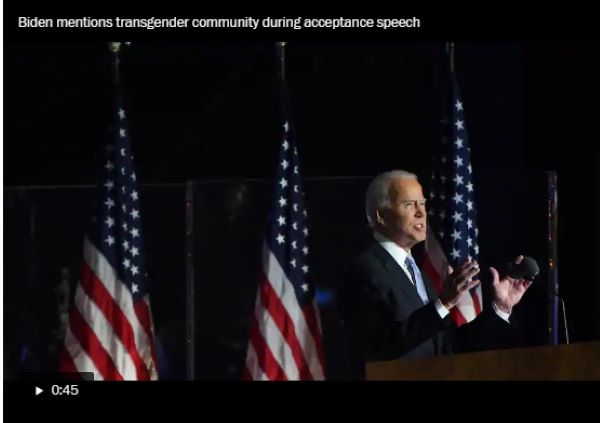
But on Nov. 7, when major news outlets called the election for Joe Biden, the transgender community watched as the president-elect specifically mentioned them in his victory speech, the first U.S. president-elect in history to do so.
“All of a sudden, they slept well that night,” Harris, who is a transgender man, said his clients told him. “A weight had been lifted that they didn’t even realize was so heavy.”
It was only one word, but the mention of the transgender community in Biden’s acceptance speech was a symbolic shift from a presidential administration that has spent the past four years repeatedly erasing protections for transgender people – in health care, federal employment, federal prisons, homeless shelters and other housing services receiving federal funds.
The Trump administration has banned transgender members of the military and rescinded Obama-era guidance that offered protections for transgender students. It has declared that the federal Title IX rules require schools to ban transgender students from participating in school sports corresponding to their gender identity.
“Over the course of these four years I think a lot of trans people have looked on in horror,” said Gillian Branstetter, a transgender advocate and media manager at the National Women’s Law Center. “It looked to many that we were a bigger priority to our enemies than we were for our friends.”
The incoming Biden administration has already committed to reversing all of those actions and has released a lengthy platform touching on issues that were until recently rarely mentioned by national politicians. Biden has pledged to work to end what he calls an “epidemic” of violence against transgender people, particularly transgender women of color. He has committed to expanding access to health care for the LGBTQ community and ensuring their fair treatment in the criminal justice system. He plans to prioritize enacting the Equality Act, guaranteeing LGBTQ protections under civil rights laws, and to collect data on a community that advocates say has long existed in a vacuum of information.
“I think Joe Biden knows the trans community in a way that maybe previous presidents have not,” said Ruben Gonzales, vice president of the LGBTQ Victory Institute, which works to advance LGBTQ public leaders.
Beyond his policy plans, Biden has touted his relationships with the transgender community. Years ago, he wrote the foreword to a memoir by Sarah McBride, who this month was elected the country’s first transgender state senator, in Delaware. In 2017, the former vice president called Virginia Del. Danica Roem to congratulate her on the night that she became the first openly transgender elected official.
But not all transgender advocates are convinced by Biden’s symbolic gestures and campaign promises. Many feel his policies won’t go far enough to address the systemic problems facing transgender people – especially transgender women of color – in housing, employment and the criminal justice system.
Others fear the conservative resistance to the transgender community will continue long after President Donald Trump leaves office, in state houses and in the courts.
“As far as political problems go, they are far bigger than Trump,” Branstetter said. “Trump’s exit won’t erode them for us.”
– – –
While the Trump administration froze or reversed many of the rights and protections the transgender community gained under President Barack Obama, it also galvanized a swell of transgender activism, including transgender young people and their parents testifying in legislatures across the country, and a growth in transgender visibility and acceptance.
More than 6 in 10 Americans said they have become more supportive toward transgender rights compared with five years ago, according to one 2019 survey from the Public Religion Research Institute. More than 8 in 10 Americans favor protections for LGBTQ people in jobs, public accommodations and housing, and more than two-thirds of Americans favor allowing transgender people to serve in the U.S. military, support that has slightly increased since 2017, according to the PRRI.
In June, the Supreme Court ruled that the federal law barring employment discrimination on the basis of sex also applies to gay and transgender people, a landmark victory that could ripple across many realms of American life. That same month, an estimated 15,000 people marched in a striking show of support for Black transgender lives in New York City. And in this year’s election, a record number of LGBTQ candidates ran for office, including several transgender people elected to state legislatures.
Now, advocates are calling on Biden to appoint LGBTQ people – including transgender people – to positions in the White House.
Raffi Freedman-Gurspan, the first openly transgender appointee in the Obama White House, served as the primary liaison to the LGBTQ community and as an outreach and recruitment director in the Presidential Personnel Office. She said the Obama administration appointed six transgender people to roles in the White House over the years, and she hopes Biden will go further. “I’m not going to be surprised when we hear about our first nonbinary appointee,” she said. “I would expect it.”
Biden has named to his transition team Shawn Skelly, former special assistant to the undersecretary of defense for acquisition, technology and logistics, and coordinator of the Defense Department Warfighter Senior Integration Group. Skelly was the first transgender veteran to be appointed by a U.S. president. The Victory Institute plans to provide the Biden transition team with a list of suggested LGBTQ leaders, in the hopes of seeing the first LGBTQ person in a Cabinet-level position. Among them is Pennsylvania Health Secretary Rachel Levine, a transgender woman who has been leading the state’s response to the coronavirus pandemic.
Transgender advocates in the nation’s capital, long a leading hub of LGBTQ resources, say they hope the Biden administration helps support local centers that cater to homeless and vulnerable transgender people. “We appreciate the solidarity, we appreciate all those things, but at the end of the day the only thing that makes a difference is the resources we need to survive every day,” said Ruby Corado, founder of Casa Ruby, a center in D.C. for LGBT youth.
Tamika Spellman, a longtime advocate for transgender sex workers in the District, said she sees Biden as a “cop lover” who supports more policing, instead of less. “If they think that’s what is going to be the answer to the issue, that is not it,” Spellman said. “The answer to the issue is housing, resources, job opportunities.”
– – –
Beyond Washington, advocates are already seeing echoes of the Trump administration in Republican-led state houses and in conservative courts. Sarah Warbelow, head of the Human Rights Campaign’s team of lawyers and fellows focused on federal, state and municipal policy, said anti-LGBTQ bills are already being filed for the coming year. “What we have seen historically is that when a conservative state house does not like a federal policy,” she said, “they will then try at the state level to discriminate.”
She’s also keeping a close eye on judges confirmed under the Trump administration who “have extreme views that are outside the mainstream and the understanding of constitutional law.”
In Texas, state Rep. Steve Toth, R-Spring, has filed a draft of a bill to classify gender-affirming hormones and surgeries as child abuse when performed on minors. It follows a wave of similar proposals in state legislatures across the country earlier this year.
“A doctor’s first covenant is do no harm,” Toth said in an interview. “These children are too young to be taking hormones when the vast majority are confused and end up going back. These are 7-year-old and 11-year-old kids, picking up ideas from social media and being confused.”
The House Bill (HB) 68 would amend the definition of child abuse in the Texas Family Code to include the removal of healthy tissue, the prescription of puberty-blocking hormones and sterilization surgeries if the procedures aim to “change or affirm a child’s perception of the child’s sex.” The act also targets mental health professionals “attempting to change or affirm a child’s sex, if that perception is inconsistent with the child’s biological sex.”
Susan Williams, an activist in South Dakota and parent of a transgender child, said she hopes state lawmakers do not direct anger over election results against the community. “Transgender South Dakotans have been under attack in our state house since 2014, if not earlier,” Williams said. “This deeply harmful trend has continued regardless of the national political landscape or which party the president belongs to.”
Legislation at the state level can also have unanticipated effects, experts say. Public opinion research shows those debates can actually lead to greater acceptance, said Andrew Flores, an assistant professor of government at American University whose research focuses in part on attitudes of the LGBTQ community. He cited research showing that in states where people were asked to vote in ballot measures banning same-sex marriage, attitudes shifted in favor of same-sex marriage at a stronger pace over time. Even anti-LGBTQ backlash can ultimately be “a source of potential change,” he said.
From LGBTQ issues to immigration to racial justice, the Trump administration galvanized liberal activism across the country, in marches and protests and get-out-the-vote efforts. The question for some transgender advocates is whether that level of energy will continue after Trump leaves the White House.
“When there’s not this big personality attracting attention, when there’s not this chaotic circus at the top,” Branstetter said, “are people going to be paying as much attention?”
InternationalNov 18. 2020Judy Shelton, President Donald Trump’s nominee for governor of the Federal Reserve, speaks during a Senate Banking Committee confirmation hearing in Washington, D.C., on Feb. 13, 2020. MUST CREDIT: Bloomberg photo by Andrew Harrer
By Syndication Washington Post, Bloomberg · Laura Litvan, Erik Wasson · NATIONAL, BUSINESS, POLITICS, CONGRESS
Judy Shelton’s nomination to the Federal Reserve Board was blocked in the Senate Tuesday, a stunning defeat for Senate Majority Leader Mitch McConnell, R-Ky., and a blow to President Donald Trump’s drive to reshape the U.S. central bank before he leaves office.
After covid-19 exposure forced two Republican senators into quarantine, the GOP was left short of enough votes needed to overcome united Democratic opposition.
Republican Sens. Mitt Romney of Utah and Susan Collins of Maine joined with 47 Democrats and two independents in a 50-47 vote against advancing Shelton’s nomination. Once the outcome was clear, McConnell switched his vote to no, a tactical move that would allow him to bring the nomination up for reconsideration later.
McConnell’s plans to confirm Shelton were blown up Tuesday morning when Sen. Chuck Grassley, R-Iowa, announced he would be in quarantine after exposure to someone who tested positive for the coronavirus. Sen. Rick Scott, R-Fla., also is in quarantine. Both were expected to back Shelton.
Shelton, 66, a former informal adviser to Trump, was long known for her advocacy of a return to the gold standard, ultra-hawkish views on inflation and opposition to federal deposit insurance. She provoked further controversy and opposition by abandoning those views and calling for interest-rate cuts to align herself with Trump as she emerged as a candidate for a Fed post.


 An Amazon.com delivery truck sits in Richmond, California, on Oct. 13, 2020. MUST CREDIT: Bloomberg photo by David Paul Morris.
 Forward Operating Base Lightning, a U.S. Army base in eastern Afghanistan, has been abandoned. MUST CREDIT: Photo by Lorenzo Tugnoli for The Washington Post.
 Supporters of President Trump protest the vote count outside of TFC Center where absentee ballots were counted in Detroit following Election Day. MUST CREDIT: Washington Post photo by Salwan Georges
 Flameless candles are illuminated after being placed at the memorial for George Floyd outside Cup Foods to celebrate what would have been Floyd’s 47th birthday on Oct. 14 in Minneapolis. MUST CREDIT: Washington Post photo by Joshua Lott.


 With her win in 2017 for a Virginia House of Delegates seat, Danica Roem, D-Prince William, became the first transgender legislator elected in the United States. MUST CREDIT: Washington Post photo by Jahi Chikwendiu.
 Judy Shelton, President Donald Trump’s nominee for governor of the Federal Reserve, speaks during a Senate Banking Committee confirmation hearing in Washington, D.C., on Feb. 13, 2020. MUST CREDIT: Bloomberg photo by Andrew Harrer
 สายการบิน AirAsia Japan ในเครือแอร์เอเชียยื่นล้มละลายหลังปิดกิจการไปเมื่อเดือนที่แล้ว
 สงครามกลางเมืองเอธิโอเปีย ความขัดแย้งระหว่างรัฐบาลเอธิโอเปียและกลุ่มชาติพันธุ์

