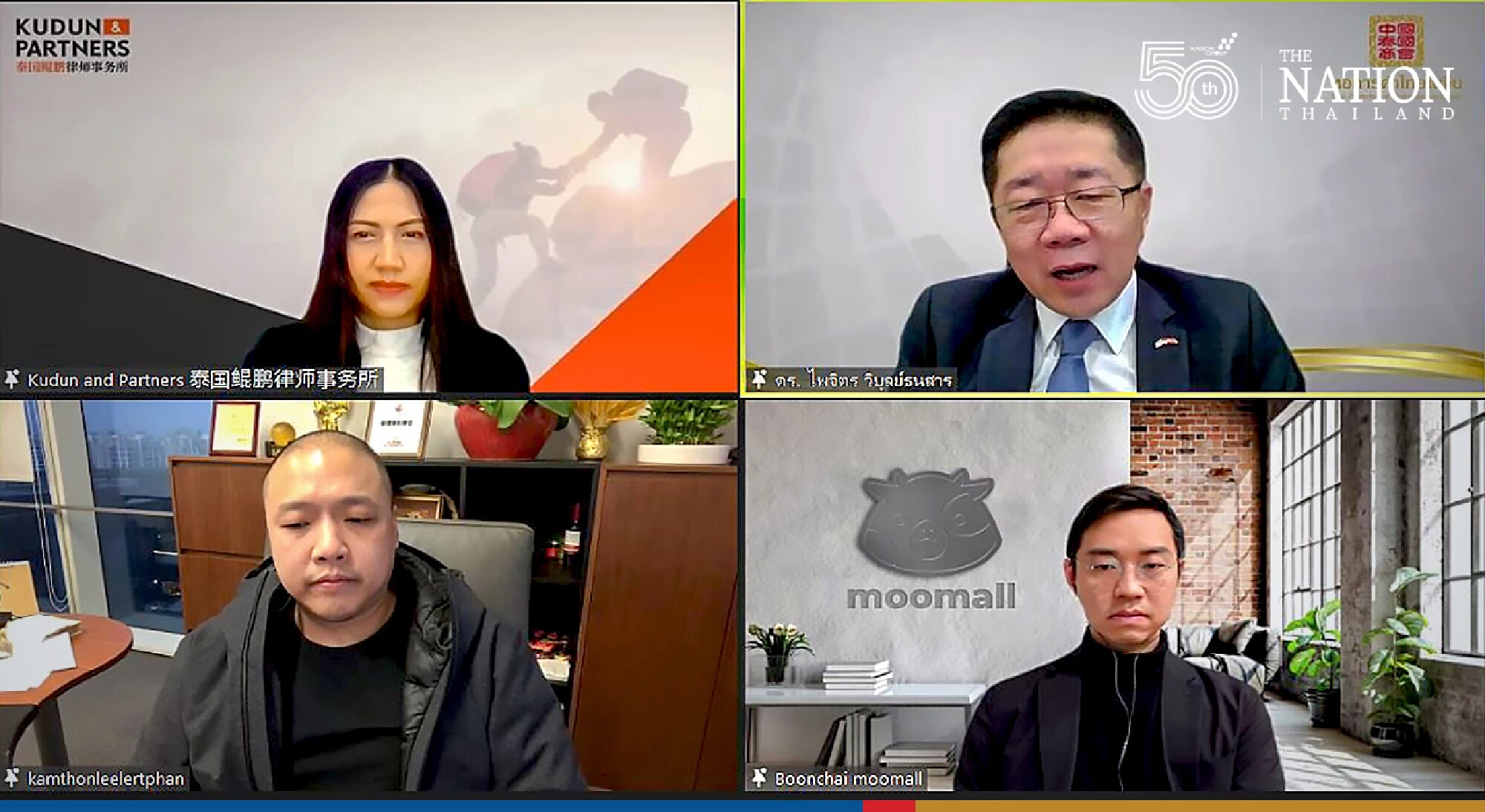
The Thai Chamber of Commerce held an online seminar on Wednesday to enlighten Thai businesses and entrepreneurs about investing in China this year in the current Covid-19 situation.
The seminar discussed the Chinese economy, investment and expected trade between the Asian giant and Thailand in 2022.
Chairman Soopakij Chearavanont said Covid-19 has not stopped the Chinese economy from growing. All the virus has done is to pose a challenge.
Thai Ambassador to China Atthayut Srisamut said Chinese customer demands have changed due to the coronavirus. They need better and healthier products, he said, adding that the percentage of trade between Thailand and China increased by 3-4 per cent, while trade with other countries also saw an increase.
Chinese Ambassador to Thailand Han Zhiqiang noted that trade between Thailand and China has been on the increase for eight years, with the first ten months of 2021 alone seeing trade worth US$100 billion (Bt3.32 trillion).
The founder of Namu Life (Beijing) Trading and Thira Venture Boonchai Limatibul said the products that Thailand exports to China must be unique because Chinese people cannot travel to other countries right now. The Chinese, he added, can produce ordinary products themselves at low cost, so Thai products cannot compete against them.
Dok Bua Ku director Kamthon Leelertphan said China’s lower class is seeing increasing revenue and consuming products like people in the city. However, they might not like these products so Thai businesses must create a variety of special items to attract these people.
Trends develop quickly in China, while the government there is also easing a lot of restrictions. So Thai business operators must adapt and follow the trends, he said.
Kudun and Partners lawyer Mayuree Sapsuttiporn said Chinese laws are easing and the investment process has been reduced so Thai businesses can benefit from this. Meanwhile, Thai law also grants privileges for Chinese investors, which includes allowing them to purchase real estate at prices lower than the market.
The baht opened at 33.26 to the US dollar on Thursday, strengthening from Wednesday’s closing rate of 33.37.
The Thai currency is likely to move between 33.20 and 33.40 to the greenback during the day, Krungthai Bank market strategist Poon Panichpibool predicted.
Poon said that the baht might strengthen slightly. He said the baht was supported by the dollar and the gold-selling but the Omicron situation pressured the baht. Foreign investors must heavily invest in the baht for it to strengthen past level 33 to the dollar.
He said that foreign investors were buying short term bonds less in the past two days as they speculated the baht might not strengthen or they are waiting for the baht to weaken.
Poon said that the baht might not strengthen much because importers might buy the dollar when the baht reaches between 33.10 to 33.20 to the dollar.
He added that investors are in a risk-on state after the US inflation rate jumped up to 7 per cent which support the US Federal Reserve to increase the interest rate.
Finance Minister Arkhom Termpittayapaisith made it clear on Wednesday that the government will proceed with the plan to impose capital gains taxes on profits from crypto and share trading despite opposition from many parties.
“The collection of crypto and share trading taxes will help maintain fairness in the taxation system and expand Thailand’s tax collection base to bring in capital required for the country’s development,” he argued.
“Our tax collection base has remained the same for a long time despite a growing economy. This is because we have several tax exemptions designed to help certain sectors. Once those sectors are able to get back on their feet, it will be time to reduce the exemptions.”
Arkhom said Thailand had issued a tax on cryptocurrency in 2018 but this had received an exemption due to being a new sector, while the financial transaction tax collected from profits earned by share trading had also been exempted by the Revenue Department for 30 years in a bid to reduce the cost of share trading and promote investment.
“The government has no plan to control the growth of digital currency as many have feared,” Arkhom assured. “The Revenue Department is working with the Thai Digital Asset Association in setting criteria for calculating taxes on crypto trading profits and expect clear regulations to be finalised by this month.”
As for the share trading tax, the Revenue Department is considering one of two calculation methods: per time trading or capital gains. The latter could affect bigger investors who go in for high trading volumes.
Krungsri Securities forecast the Stock Exchange of Thailand (SET) Index on Thursday (January 13) would rise to between 1,685-1,690 points before falling.
It said the index still gained positive sentiment from rising oil prices of above US$82 per barrel, as well as foreign fund inflow on hopes over Thailand economic recovery.
“However, investors should beware of shares mass sell-offs amid uncertainty over the US Federal Reserve’s move to raise the interest rate after Washington’s Consumer Price Index in December has risen by 7 per cent year on year,” Krungsri Securities said.
It also recommended buying of the following companies’ shares as an investment strategy:
PTTEP, TOP, PTTGC, IVL and SPRC, which benefit from rising oil price and gross refining margin.
BBL, TTB, KBANK and BLA, which benefit from news of interest rate hike.
RCL, LEO, III, WICE, SONIC and JWD, which benefit from rising freight rate.
The SET Index closed at 1,678.50 on Wednesday, up 11.38 points or 0.68 per cent. Transactions were totalled 87.94 billion baht with an index high of 1,680.85 and a low of 1,673.00.
When Ekaterina “Barbie” Vandaryeva faces 18-year-old Thai striking sensation Supergirl in a strawweight Muay Thai matchup, she believes her age and experience against better competition will be the deciding factor in this foray.
The 30-year-old will attempt to use her experience when they enter the Circle at ONE: HEAVY HITTERS on Friday, 14 January, inside the Singapore Indoor Stadium.
However, the Belarusian knows she can’t count out the rising Thai star just because of her youth. In fact, the Kick Fighter Gym representative believes being younger has its advantages.
“At [Supergirl’s] age, you don’t analyze much – don’t think much. You just come out and keep hitting,” the fighting pride of Minsk said.
“You go and strike until you’re dead [tired]. This is an advantage of being young.”
She further broke down her philosophy on age and fighting.
“When you grow up, you start analyzing, thinking what’s working, what to do next,” she added. “And sometimes it doesn’t work in your favor, especially in sports.”
Considering that, when Vandaryeva steps into the Circle and the door closes behind her, she will benefit from standing somewhere in the middle of not overthinking her strategy but not letting her game plan sail with the wind either.
She must remain focused because no matter how young Supergirl may appear, the teenager known for her ab-spearing knees is a legitimate threat. She’s been practicing the combat sport since she was three years old and has competed in over 40 professional Muay Thai fights.
The Thai’s repertoire isn’t lost on “Barbie.”
“She is, of course, an interesting fighter – not a bad one,” she said.
“She is somewhat unusual because Thai athletes don’t like using their arms very much. They do it rarely, mostly to distract and get into clinch and so on.
“But she keeps rushing with her arms endlessly, so I need to contain her advances.”
By doing so, Ekatarina hopes to emerge victorious over the younger of the Jaroonsak siblings and make a case for a rematch with former foe Jackie Buntan, who defeated her once.
Speaking of former opponents, the three-time Muay Thai World Champion believes she’s faced much tougher competition.
“You need to understand that her opponents in the bouts we have seen are not of a very high level,” Vandaryeva expressed.
“But at the same time, I’m an experienced fighter in terms of the scale of competitions and the opponents I’ve had.”
Although Vandaryeva is confident going into her bout with Supergirl, she’s not predicting an outcome. Instead, she’d let her experience do the talking.
“Only the ring will show. Let’s see in the fight.”
Watch the full event live on AIS Play beginning with the lead card at 6:30 p.m. Indochina Time (ICT) on Friday, 14 January. Also, Thairath TV32 will cut into the main card at 9:30 p.m. ICT on Friday, 14 January.
Mission Blue, one of the pillars of Rolex’s Perpetual Planet initiative, ignited action to protect ocean ecosystems more than a decade ago.
Mission Blue, one of the pillars of Rolex’s Perpetual Planet initiative, ignited action to protect ocean ecosystems more than a decade ago.
As part of the initiative, it established more than 130 “Hope Spots” that are considered vital to preserving species or places where communities rely on the marine environment to survive, such as the Azores archipelago in Portugal.
Oceanographer Sylvia Earle, a co-founder of Mission Blue, says: “The Azores archipelago is a magnet for life. It really is a magical place. Launching the Azores as a Hope Spot is so logical – just ask the whales.
“Like Rolex, I feel that we have to continue our efforts towards a Perpetual Planet so the marvels of the ocean in all its teeming diversity are not lost to future generations,” Earle, who has been a “Rolex Testimonee” since 1982, says. “Together we can make a difference.”
Protecting a deep-sea ecosystem
The Azores islands harbour an important ecosystem that attracts 25 species of cetaceans. Hundreds of species also thrive in the warmer waters delivered via a branch of the Gulf Stream. However, this ecosystem is under pressure from human activities.
The Azoreans are well aware of the importance of a marine environment and many are involved in ecotourism.
The authorities established several small Marine Protected Areas (MPAs) in the 1980s and announced the Blue Azores programme in 2019. The programme aims to create a network of fully protected MPAs covering 15 per cent of the Azorean side of the North Atlantic Ocean.
They are also developing innovative studies and approaches which contribute to the sustainable management of fisheries, supporting scientific processes and implementing a “blue literacy” programme for schools.
Mission Blue’s Hope Spot council reviewed these efforts, as well as the scientific research of Hope Spot Champions, and concluded that the policy momentum is strong and the time appropriate to designate the Azores as a Hope Spot.
“The Azores Archipelago was named a Hope Spot in recognition of the collaborative efforts of the government, University of the Azores, organisations and community members. Together, they are working to achieve increased marine protection and a growing comprehensive network of protected areas that extend from the surface of the sea all the way down to the deep seafloor,” Earle said.
The aim is to contribute to Portugal’s and Mission Blue’s efforts to reach the international goal of protecting 30 per cent of oceans by 2030. Mission Blue’s work is long-term and is achieved through policy advocacy, communications campaigns and regular oceanic expeditions that build support for the protection of ecosystems.
Each Hope Spot has a “champion” who is involved in conservation and coordinates action in the area by meeting government and business leaders, running advocacy events and working with young people.
“The inclusion of the Azores as a Hope Spot is a significant step in our mission to promote the protection of this unique place,” Azores Hope Spot champion Christopher Pham says.
The Azores and its Champions will now have higher visibility on the global ocean conservation stage, allowing them to renew the call for enhanced marine conservation ahead of the 2030 deadline.
In support of ocean conservation
Rolex is also helping to protect oceans through a variety of partnerships and grants including individuals such as Rolex Awards Laureates Barbara Block, Vreni Häussermann and Brad Norman, as well as Rolex Awards Associate Laureate Emma Camp and global networks of marine scientists.
The company is also partnering with the Monaco Blue Initiative that brings together experts, policymakers and business entrepreneurs along with local and international NGOs, to discuss and highlight solutions to challenges of ocean management and conservation.
Moreover, it has supported individual expeditions such as “Under The Pole III”. The team has been exploring the oceans since 2017 to study the mesophotic coral ecosystems that exist between 30 and 150 metres and advance underwater exploration techniques.
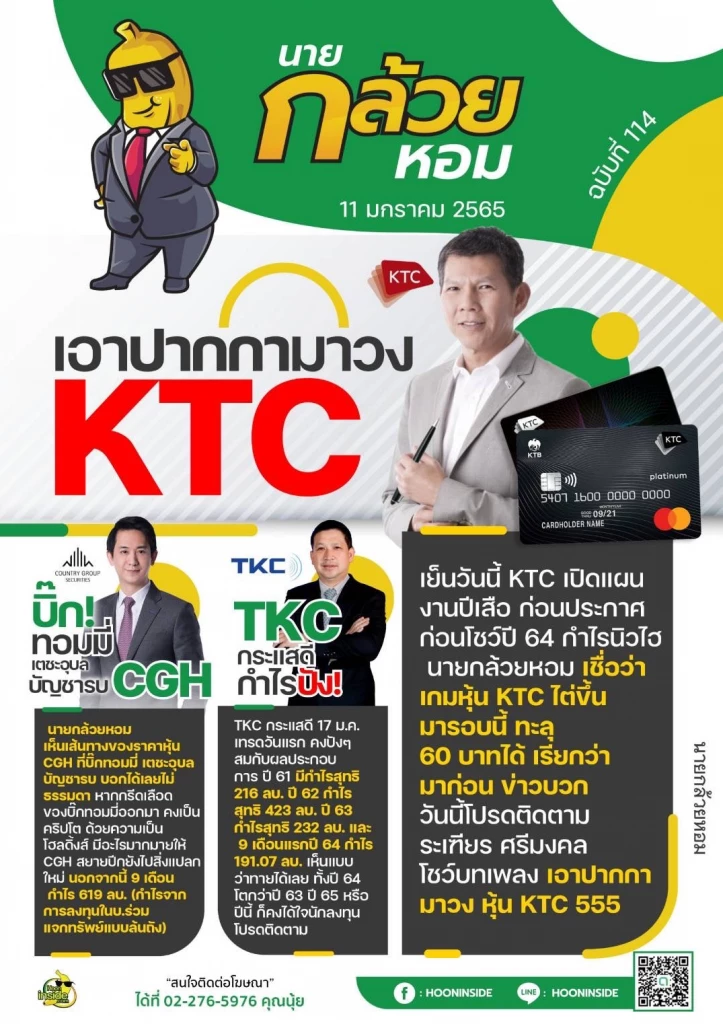
KTC is all geared up with goals to push its port to over a hundred billion baht and achieve new high profits post the COVID-19 crisis. The Company embarks on a new journey after confirming two new s-curve business models to drive the future.
KTC is all geared up with goals to push its port to over a hundred billion baht and achieve new high profits post the COVID-19 crisis. The Company embarks on a new journey after confirming two new s-curve business models to drive the future: 1. “MAAI By KTC” a brand new full-service loyalty platform for business partners in the form of a mobile application, and 2. “KTC P BERM” boosts its secured loans target to 11,500 million baht by the end of 2022. KTC joins forces with “Krungthai Bank” and KTB Leasing networks nationwide to advance into the secured loans business in full force, expand the credit cardmember and personal loan membership base, create marketing privileges, and launch new products in collaboration with a variety of business alliances. KTC’s vision is to achieve the reaping of benefits between members-alliances-KTC, establish a merchant network to reach more premium and lifestyle target groups covering all cardmember needs, and drive the business towards sustainability and corporate responsibility.
Mr. Rathian Srimongkol, President & Chief Executive Officer, “KTC” or Krungthai Card Public Company Limited, reveals, “After the COVID-19 situation has unravelled in a better direction along with the reopening of the country from November 2021 onwards, the economy and consumer spending demonstrated better growth respectively. This is a good indicator of the consumer credit market and poses an opportunity to push the KTC business to grow. Achieving a new record of over 6,000 million baht in profit and over one hundred billion baht for the port of receivables remains within the realms of possibility. For this new journey, we have dedicated our time to building two fresh business models that we’ll implement to send happiness as a gift to members to uplift their mood after the COVID-19 crisis. KTC will also advance its credit card and personal loan businesses to expand its new member base and upkeep the quality of the port of receivables, as well as select valuable privileges to meet all the needs of over 3.3 million members.”
“The first of the two business models that will be the vehicles that drive the KTC business to create a new s-curve and generate sustainable revenue growth is the ‘MAAI By KTC’ platform. The platform is an extension of KTC’s strengths, namely the execution of its reward point system and expertise in marketing and managing KTC FOREVER points that meet and cover every lifestyle.”
‘MAAI By KTC’ is, therefore, a new state-of-the-art that provides services to business partners that desire the use of a comprehensive loyalty platform. The platform will offer 3 solutions: 1. Membership Management; 2. Point System Management and 3. e-Coupon Management. Moreover, the MAAI Platform also features the MAAI Wallet Application, a one-stop source that accumulates points from various affiliate alliances all in one place for ease of use and maximum benefit. There are many redemption options, including e-Coupons or products at general partner stores covering all transaction categories such as merchants, movie theaters, restaurants, and delivery services. The official launch is in the first quarter of 2022. In January 2022, it will be available to KTC employees to test at an early stage with 16 merchant alliances and will continue to expand extensively beyond that. The origin of the word MAAI (pronounced as “my”) comes from the word MAK MAAI meaning numerous benefits from many partner stores and the convenience that abounds. The name is also synonymous with the word Mine with the intention to denote benefits that belong not only to but also for the user. The app will be available for download on the Apple Store, Play Store, and Huawei Store.”
“The second business model is ‘KTC P BERM’ secured loans. Starting from today, consumers will get to know and become more familiar with the P BERM business. KTC will continuously expand its member base to drive portfolio growth by leaps and bounds and achieve a loan target of 11,500 million baht in 2022. KTC has set its eyes on proactively reaching target groups in each area through the P BERM Delivery service. This will be achieved by using KTC’s sales team across the country to provide loan services directly to the customer’s house or at a location convenient for the customer in a timely manner. KTC P BERM is connected to the Krungthai Bank network with more than 900 branches nationwide and 11 KTB Leasing (KTBL) branches, which is the main strategy. KTC P BERM’s core communication will be through online channels mainly targeting its receptive customers and creating a variety of products that meet the needs of the market, whether it is the ‘P BERM’ cash card, the first for Vehicle Title loans in the form of a cash card that allows customers to instantly Swipe-Transfer-Withdraw-Pay in installments all-in-one. This new direction covers the hire purchase business under the license of KTBL, of which KTC holds a 75.05 percent stake. Moreover, KTC will develop work processes based on the Digital Twin principles and continuously apply technology with the loan registration and approval processes to make the service more convenient, fast, and safe. On this note, KTC aims to fill gaps in the market by differentiating its strengths from other operators with a large credit limit of 1 million baht and a 2 hour approval time with immediate access to cash. This service is accessible to people of all occupations with easy document requirements with zero hassle, to reinforce the intention of conducting business that opens opportunities and options for people who do not give up to make a living and have easy access to ‘KTC P BERM’ loans.’”
“KTC’s credit card and personal loan business in 2022 will focus on the growth of the quality port of receivables, expand new target audience, and maintain the current member base by creating great experiences through marketing promotion activities that satisfy consumers. The credit card business strategy will center around expanding the card base with major partners by means of new product launches and co-branded credit card relaunches with the right benefits to establish connections between the members and the card in the long term. Customers will enjoy maximum benefits from the synergies of KTC and upcoming alliances. KTC is renowned for its wide selection of promotions from popular merchants favored amongst cardmembers. In terms of card transaction promotion strategies, the Company will continue to promote KTC FOREVER points and monthly installments as driving forces for marketing activities. In 2022, KTC will use the strength of its partner network to expand to more premium and lifestyle merchants to meet the needs of the existing top-level members and attract new target groups. To add, KTC will develop various services so that cardmembers can enjoy happiness from using the KTC Mobile app or KTC Phone, including travel services with ‘KTC World Travel Service’, and shopping on the ‘KTC UShop’ e-marketplace. It is expected that the credit card spending in 2022 will grow by 10 percent from 2021 or about 220,000 million baht.”
“Meanwhile, the personal loans business strategy will focus on expanding new member base in potential groups by offering the ‘KTC PROUD’ cash card to customers who have regular income and have a higher income base. KTC is rolling out a campaign to lighten cardmembers’ loads, reduce interest to only 0.93 percent per month, and increase the number of installments up to as high as 60. In addition, in 2022, Thai people will enjoy next-level convenience with the option to self-apply for loans online through an electronic application via a mobile app with the digital identity verification system feature (Electronic Know Your Customer or E-KYC), corresponding to the needs of today’s society that require services to be convenient, fast, time-saving, and travel-free. Regarding the current personal loan member base of over 700,000 accounts, KTC is striving for long-term commitment through ongoing campaigns to ease the burden of members. This includes the Debt-Clearing campaign that has increased rewards to 600 to give customers the opportunity to win 100 percent and 10 percent debt clearance throughout the year, as well as develop online money transfers via PromptPay accounts for added convenience. Additionally, cardmembers enjoy transferring money through the KTC Mobile app to 13 banks in real time, 24 hours a day. Besides, KTC is launching special privilege campaigns with leading merchants for customers to get value for money when using the cash card to swipe to purchase products. Cardmembers also enjoy the option to pay in 0 percent installments at participating merchants, thereby reinforcing the worthiness of using the cash card credit lines with 4 functions
‘Swipe-Transfer-Withdraw-Pay in installments.’ It is estimated that the debtor balance in 2022 will grow 7 percent from the year 2021.”
“In terms of member base expansion strategies, the distribution channel this year has to work hard and proactively to win customers of every product into the port. Using Krungthai Bank as a communication channel, KTC will play to the strengths of each product as a selling point combined with the strong points of the distribution channel. It is expected that the demand for personal loans this year will be high as the Thai economy has just begun to recover, and traders or entrepreneurs still seek working capital to maintain operation or expand their business. However, screening the credit risk to gain mutual benefit from all parties remains a challenge amidst fragile economic conditions. By 2022, the goal is to land a minimum of 250,000 new credit card members and a minimum of 100,000 new KTC PROUD members.”
“Efficient financial management is another key to success. KTC will manage financial costs at an appropriate level under acceptable risk as priority. KTC will increase the proportion of short-term loans; it is expected that by the end of 2022, the ratio of short-term to long-term borrowing (original term) will be at 20:80 and the financial cost will be close to what it was in 2021 at 2.6 percent per year. The Company will raise long-term loans in the amount of not more than 12,000 million baht to support debentures due in 2022 of 9,500 million baht and support the growth of KTC’s loan portfolio. Despite this, the economic situation is still an important factor affecting the direction of interest rates. Whether it is a new virus strain mutation, the announcement of the QE limit reduction, the Federal Reserve interest rate hike forecast, and the economy’s ability to recover as a result of COVID-19 impact.”
“Lastly, KTC also emphasises on the integration of sustainability or ESG in economic, social, and environmental dimensions to responsible business practices under the concept of ‘Sustainable Development by Spirit’. This is to be in harmony with the needs of stakeholders and support the Sustainable Development Goals of the United Nations. As part of the 5-year sustainability strategy, KTC will utilise digital technology and innovation to generate key results. We will develop products and services that create better experiences for customers and stakeholders with a secure operating system, and create opportunities for people in society to thoroughly access financial services. We will also take into account the reduction of the natural resource consumption and hence reduce the environmental impact in accountable ways. KTC has been included in THSI (Thailand Sustainability Investment) list for the third year, has been on the ESG 100 list since 2016. In 2021, KTC received a rating of AA in the MSCI ESG Rating assessment and was selected as a constituent company in the ‘FTSE4Good Index series’, the Global Sustainability Index.”
Kla Party leader Korn Chatikavanij urged the Revenue Department on Wednesday to delay taxing cryptocurrency trading until it has listened to opinions from experts.
Korn, a former finance minister, said the department should allow stakeholders to propose ideas and it should take more time to study the best way to collect taxes on cryptocurrency before it issues new regulations.
The department last week announced its plan to collect 15 per cent withholding taxes on transactions involving cryptocurrencies. The department said the loss from previous and future trading could not be cited for tax deduction. Profit from the trades throughout the year would also be added as income for paying yearly income tax, the department said.
Revenue Department director-general Ekniti Nitithanprapas said on Monday that his agency was discussing cryptocurrency tax guidelines with the Bank of Thailand, the Securities and Exchange Commission and other bodies and it was likely to issue tax rules on the crypto trade by the end of this month.
Korn said the department should also study taxing methods of other countries before making a final decision.
Apart from the capital gains tax (CGT), Korn said, traders and crypto exchange operators would also ask the department to clarify its plan to collect VAT when cryptocurrencies are used to buy goods.
Korn said the department should go in for VAT exemption when vendors accept cryptocurrencies for their goods or services because there will be double VAT charges – on goods or services as well as on the exchange of crypto into baht.
Korn cited three main issues for the department to study:
1) VAT and Goods and Services Tax: He said Singapore, Australia and some EU nations exempt VAT on the use of cryptocurrencies to buy goods and services.
2) Capital Gains Tax: Korn said several Asian countries, including Singapore, Malaysia and Hong Kong, do not collect CGT from cryptocurrency trading. He said these countries allow traders to calculate their profits or losses before paying annual personal income taxes.
3) Tax exemption: Korn noted that South Korea initially planned to collect 20 per cent tax on trading of cryptocurrencies with exemption for the first 2.5 million won earned. The rule was delayed to 2023 following strong opposition. Korn said the Revenue Department should also consider an amount that would be exempted from tax, such as the first Bt100,000 earned from trading in cryptocurrency.
“I don’t agree with the plan to collect this tax until the Revenue Department can clear all the doubts as mentioned,” Korn argued.
“It must also make clear how it will manage a fair tax collection from all people involved,” he added.
Thai President Foods has informed the Commerce Ministry that it will not increase the price of its popular instant noodles under the “Mama” brand despite an increase in manufacturing costs.
“The manufacturer has insisted that the price of Mama instant noodles in bag form will remain the same as the company is committed to helping alleviate people’s financial burden,” Manlika Boonmeetrakul-Mahasuk, adviser to the Commerce minister, said on Wednesday.
“The company said it would employ a cost management strategy to deal with the increasing costs of wheat flour and palm oil, the two key ingredients in instant noodles.”
Apart from the highly popular Mama instant noodles, which retail starting at 5-6 baht per bag, Thai President Foods also manufactures instant rice porridge and a variety of biscuits.
Commerce Minister Jurin Laksanawisit has urged manufacturers of necessary consumer goods to fix prices as long as they can so people are not burdened further at a time when prices of several farm products are skyrocketing, Manlika added.
The Bank of Thailand (BOT) is preparing for four types of economic and financial risks that could occur in 2022 as the economy is still recovering from the impact of Covd-19, leaving many sectors vulnerable.
Speaking at BOT’s Meet the Press event on Tuesday, central bank governor Setthaput Suthiwart-Narueput said that this year economic recovery is seen to be in a K shape, where only certain sectors, industries or areas of the economy recover while others persistently lag behind.
“The Thai economy should bounce back to before Covid levels not sooner than the first quarter of 2023,” he predicted. “This is because our economy relies heavily on exports and tourism, while employment in related sectors will not bounce back anytime soon,” he believed.
“This year we are prepared for four challenges that can potentially occur – namely the Omicron outbreak, inflation, an NPL cliff, and an increase in policy rates by global central banks,” Setthaput said.
“As for the first risk, the Omicron outbreak, BOT estimates the new variant’s spread would stop within the first half of the year,” he said. “Although Omicron can spread faster than the Delta variant, it will not cause the economy to ‘halt’ for a long time. The banking system will continue to roll out more loans while the central bank will issue financial measures to make sure different sectors can maintain solvency during the outbreak,” he said.
“BOT estimates that Thai inflation in 2022 will be in an acceptable range of 1.4 to 1.7 per cent, but it could rise next year, though it won’t reach 2.0 per cent,” Setthaput said.
“Our latest survey found that the hike in product and service prices has yet to be distributed across all sectors, which means there is a small chance that inflation will cause the overall economic recovery to stumble. The central bank will however use appropriate measures to prevent inflation from growing more than the estimation,” he said.
The central bank also estimated that next year there is a small chance of an NPL cliff, or a situation where a lot of debt defaults occur in a very short time, forming a cliff of non-performing loans, or NPLs.
“As the economy still faces many uncertainties, the number of NPLs will gradually rise, but will probably not form an NPL cliff this year,” Setthaput hoped.
“To prevent an unexpected rise in NPLs, BOT will promote joint ventures between banks and asset management companies so they can help borrowers who fall behind, while making sure commercial banks have enough reserves to cover increasing defaults,” he said.
“The last risk that we might face in 2022 is a hike in policy rates by global central banks, especially the Untied States [Federal Reserve]. Such a hike would affect the economic recovery of many developing countries. However, we estimate that the effect on Thailand, should there be any, will be minimal as we still have a strong international financial status and do not suffer from structural vulnerability as during the 1997 financial crisis.”
Before closing the event, Setthaput said BOT would issue Thailand’s Financial Landscape Consultation Paper on February 2, which will include new issues such as digital assets and a green economy.
After issuing the paper, BOT will accept opinions from different groups and industries for a month before using them to draft out the country’s financial policy.