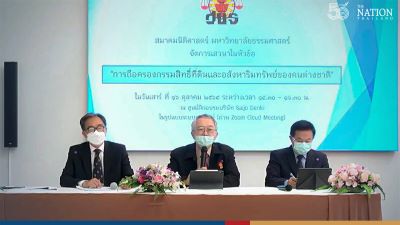
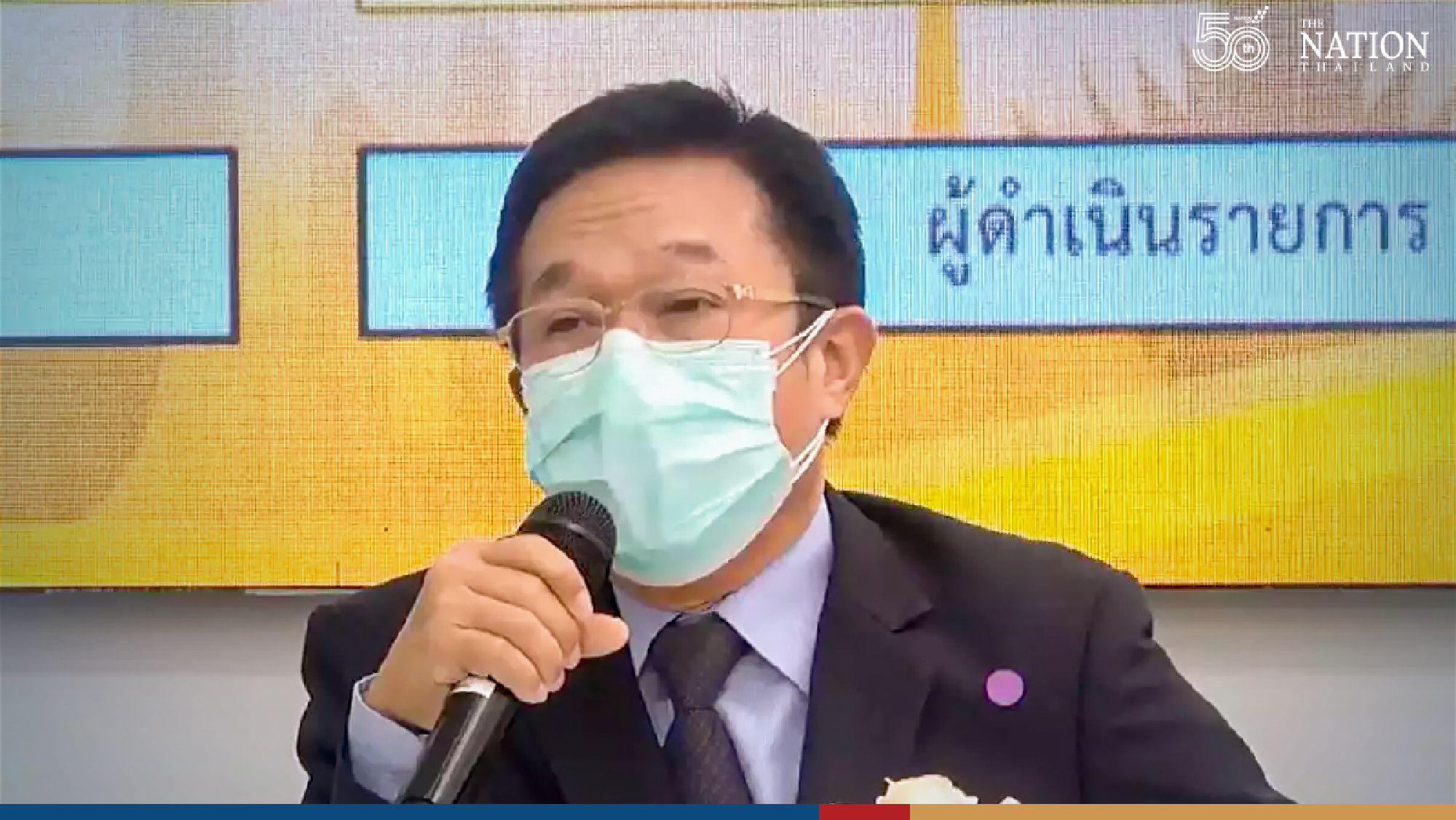
The pros and cons of allowing foreigners to own land in Thailand were discussed at the “Foreign Ownership of Land and Real Estate” forum held on Saturday by Thammasat University’s law association.
Participating were Senator Dr Sathit Limpongpan and president of the Thai Chamber of Commerce’s Housing Business Association Issara Boonyang.
On September 14, the Cabinet mulled ideas to attract high-potential foreigners to Thailand in a bid to boost the economy, and the option of letting non-Thais own land was brought up.
Many people have voiced concern that letting foreigners own land may leave little for Thai nationals. Others, however, point out that attracting high-potential foreigners by allowing them to own land will bring more foreign currency into the country. For instance, to be eligible foreigners must invest between US$250,000 and $500,000 in government bonds or have a minimum monthly income of $80,000.
Thammasat forum ponders idea of letting foreigners own land in Thailand
Dr Sathit said that he agreed with the idea of letting foreigners own land in Thailand but added that this may bring the prices up drastically and make owning land impossible for future generations.
However, Issara pointed out that many foreigners already own land in Thailand illegally through Thai nominees.
Thammasat forum ponders idea of letting foreigners own land in Thailand
He also pointed out that many big economies like Germany, UK and Switzerland are letting foreigners buy land and cashing in on tax and foreign investment.
Currently, foreigners can buy condominium units in Thailand under the condition that 51 per cent of the total units in the development are held by Thais. Though foreigners can own horizontal properties, they can only take the land on a maximum of a 99-year lease. This law has been applied by many companies in the Eastern Economic Corridor.
Thailand is planning to kick off free-trade negotiations with China and India in a bid to attract high-worth investors, the Thai Chamber of Commerce (TCC) said.
Sanan Angubolkul, chair of TCC and the Board of Trade, said Thailand has lost many economic opportunities due to the Covid-19 pandemic. In comparison, he said, other countries in the region like Singapore, Indonesia and especially Vietnam have adapted quickly and caught the attention of investors.
He said Thailand should target high-potential investors from China and India as both countries are huge markets. He said TCC has been discussing the potential of attracting investment from China under a coordination scheme called “Team Thailand Plus China”.
As for India, Sanan said TCC has discussed the subject with the Indian ambassador. Saudi Arabia is another country the TCC is eyeing to boost business.
“A framework for cooperation with other countries will make Thailand more interesting to foreign investors. The more trade partners we have, the more advantage we gain,” the TCC chairman said.
Sanan also urged the government to expedite action on joining the Comprehensive and Progressive Agreement for Trans-Pacific Partnership (CPTPP). He said that if the country continues delaying the signing of the pact, it will lose trade opportunities to Vietnam, Malaysia and Singapore. (Related report: Thailand urged to join CPTPP trade pact soon)
When a fashion industry sustainability group called out China over its treatment of Uyghur Muslims, the idea was to nudge Beijing toward human-rights reforms while cleaning up a troubled corner of the $60 billion global cotton business. Western brands have learned the hard way that things dont work that way in China.
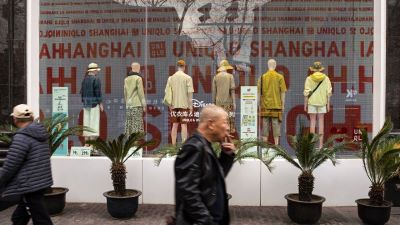
In the 12 months since the Better Cotton Initiative, whose members range from Uniqlo owner Fast Retailing Co. to Nike Inc. to Walmart Inc., published a statement on allegations of forced labor in the cotton-growing Xinjiang region, several brands have suffered major setbacks in China, one of the world’s biggest producers and consumers of the fabric.
The organization missed production targets last year and companies including Levi Strauss & Co. and Chinese sneaker maker Anta Sports Products Ltd. have scaled back their involvement. Others have gone quiet, pulling statements of concern about the situation in Xinjiang from their websites. Hennes & Mauritz AB’s revenue in China, once its fourth-largest market, fell 40% in the most recent quarter.
Although the BCI statement has long vanished from the group’s website, there’s little sign of a truce. Instead, China, which says claims of human-rights violations are unfounded, is escalating its response. In late September it launched a recruitment drive for a sustainability certification program that would undercut the BCI, with the first applications to join due by Friday.
The escalating conflict shows how difficult it can be for brands to satisfy demands from western consumers and human-rights groups for greater sustainability without risking open war with China, which has become more willing to wield its clout to defend its policies. It’s also a potential setback for the broader ESG movement that’s rallying institutional investors around the banner of improved environmental, social and governance targets.
“It’s really terrible if companies start feeling they can’t speak out against atrocities because of a fear of backlash,” said Therese Kieve, stewardship analyst at Sarasin & Partners, which holds shares of Asos Plc and Associated British Foods Plc, owner of the Primark chain. “Then nothing’s going to change.”
The Geneva-based BCI declined to comment on China for this article.
Comfort, convenience and relatively low cost have made cotton the world’s most widely used textile fiber. More than 26 million tons is plucked from shrubs annually and spun into yarn. That’s enough to provide at least two dozen T-shirts for everyone on the planet. Prices of the commodity have been rising sharply, hovering near the highest levels in a decade this month, amid surging demand from China and poor prospects for the U.S. harvest now underway.
But there’s an ugly side to that success. Growing cotton can often require vast amounts of water and pesticides. Labor practices are hard to police in the remote fields where much of it is grown.
The Better Cotton Initiative was created in 2009, pooling industry efforts to clean up the supply chain. The group tries to help farmers transition to greener methods, while making sure cotton remains affordably priced. The organization also says it refuses to operate in regions where forced labor is “orchestrated by the government.”
The confrontation that erupted last October followed the U.S. government’s decision to ban some imports from Xinjiang, where it says Chinese authorities are detaining more than 1 million Uyghurs and other ethnic and religious minorities in “re-education” camps in what constitutes an ongoing genocide. China has repeatedly denied these claims.
While the BCI didn’t withdraw altogether from China, it said it would focus on other regions of the country. Beijing responded with fierce criticism of western fashion brands, prompting calls for boycotts. Landlords closed some H&M stores in retaliation for an undated statement on its website that expressed concern about reports of forced labor in Xinjiang.
Dozens of Chinese celebrities ended their contracts with BCI member firms including H&M, Adidas and Nike, with former Burberry Group brand ambassador and actress Zhou Dongyu saying the trenchcoat maker had not “clearly and publicly” stated its stance on cotton from Xinjiang.
The flap highlighted a quandary for the foreign labels, said Veronica Bates Kassatly, independent analyst of sustainability claims in the global apparel sector and a former World Bank economist.
“They cannot afford to upset Chinese consumers and they cannot afford to upset Chinese manufacturers, either,” she said.
The BCI has expanded so quickly – it now has more than 2,100 members – and become so prevalent that its production represents almost a quarter of global cotton output. 2.4 million farmers are licensed to sell cotton certified by the organization, which is funded through membership dues and a levy on sales.
There’s also an incentive to becoming a member, as BCI-certified cotton helps fashion giants burnish their sustainability credentials. New members continue to join — nearly 190 in the first half. Among them is Boohoo Group, the British online fast-fashion retailer seeking to clean up its own supply chain.
Few big brands will talk openly about their discussions with the BCI on how to police Xinjiang cotton. Burberry, for example, scrubbed references to the group in its annual report published in June, after citing the organization a year earlier. BCI lists Burberry as a member on its website. The company declined to comment for this story.
“Companies are doing everything they can to avoid these types of public conversations,” Bertille Knuckey, co-head of ESG Research at Sycomore Asset Management. “Now they are just avoiding really engaging on the topic.”
Once the BCI published the statement on alleged human-rights violations, some members expressed frustration that it had gone beyond its primary mission of environmental sustainability and strayed into areas where it did not have adequate knowledge or expertise, people familiar with the situation said.
Levi Strauss’s new chief sustainability officer, Jeff Hogue, who joined last year, decided not to take up a seat on the BCI council even though the retailer, which backed the formation of the program, was due to hold that position until 2022. Levi’s, which remains a member of the BCI, said Hogue is currently focused on the upcoming release of the company’s first sustainability report and ESG disclosure.
At the height of the boycott crisis, BCI said the decision to suspend licensing would prevent almost 500,000 tons of Xinjiang cotton from entering the global supply chain.
The provenance of cotton is hard to trace because of the many stages in the production process. It starts with raw cotton produced in remote villages in countries such as China, India or Mozambique. Seeds are extracted, bolls are removed and the fiber is spun into yards. They’re transported to mills that produce and dye the fabric – often with toxic products and little environmental oversight. The textiles are sold to clothing manufacturers, which ship finished products to stores worldwide.
The fashion and apparel industry was shaken to its core in 2013 when a garment factory collapsed in Bangladesh. The tragedy resulted in more than 1,000 deaths, putting the spotlight on an industry that long pushed profit at the expense of the wellbeing of those at the bottom of the production chain.
Following the incident, brands vowed to improve labor standards, including an increase in the number of labels and certifications meant to show that the industry is tackling abusive working practices.
Authorities from France to the U.S. are carrying out investigations that may shed more light on what is happening in Xinjiang.
Several French campaign groups lodged a legal complaint in April against two BCI members: Japan’s Uniqlo and Spain’s Inditex, the parent of Zara. Also named were French fashion group SMCP, which owns brands like Maje and Sandro, as well as Skechers USA Inc. The complaint accused the four companies of profiting from forced labor of China’s Uyghur minority as well as crimes against humanity. French prosecutors started an investigation in June.
SMCP and Inditex both strongly denied the accusations and said they will fully cooperate with the probe. Inditex said traceability controls are carried out “rigorously” on its clothing. Fast Retailing said there’s no forced labor in its supply chain and it intends to cooperate with authorities if contacted. Skechers declined to comment on pending litigation, but said previous supplier audits found no use of forced labor.
A criminal complaint was filed last month against the C&A fashion chain and other retailers by the European Center for Constitutional and Human Rights, accusing them of “directly or indirectly abetting and profiting from alleged forced labor of the Uyghurs in Xinjiang,” and being “involved in crimes against humanity.” C&A, a BCI member, says it doesn’t have supplier contracts in the region and doesn’t tolerate forced labor or unauthorized subcontracting in its supply chain.
The association uses so-called “mass balance,” a widely employed volume tracking system, that allows farmers and manufacturers to mix Better Cotton with conventionally grown fabric while benefiting from the label. The system has allowed the BCI to dramatically increase the volume of Better Cotton sold worldwide. But the lack of transparency and full traceability has raised concerns.
“Due to the mass balance approach, there is a potential risk that cotton from the Xinjiang region may be included within BCI cotton,” a spokesperson for British apparel chain Next Plc said. To try to avoid that, the company has explicitly banned the use of cotton from the area.
The BCI has said it’s moving toward a better traceability program in the coming months. C&A is calling for changes in the program.
“It is also time to open up the debate about what are the steps needed to increase the traceability of cotton and what are the opportunities that will arise from it,” said Betty Kiess, a spokeswoman. C&A will continue to collaborate with the organization, she said.
Incremental progress on environmental goals is better than nothing, some brand owners say. Tendam, the Spanish owner of the Women’secret lingerie label, joined the BCI this summer. The initiative is encouraging growers to adopt “better behaviors,” including reduced water usage, said Ignacio Sierra, corporate general manager at Tendam.
Whether global brands embrace China’s own sustainable cotton certification program is an open question. They may need to if they wish to keep selling in that market, and some clothes could even be manufactured solely for the Chinese market based on this label, according to a person familiar with the BCI’s work.
“The standards of BCI are too general and may not be suitable for cotton grown in China,” Wang Wenkui, an executive at the China Cotton Industry Alliance, told the Global Times. The Chinese guidelines will set out specific growing practices, including temperature and regulation of pesticides.
“I’m quite confident that our cotton growing standards will replace the BCI standards in the future,” Wang said.
Representatives from public and private sectors related to digital media got together to share their ideas on the virtual forum “Thailand Platform – A Pipe Dream or Reality” hosted by Spring News on Friday.
The event was organised in collaboration with the Digital Economy and Society (DES) Ministry’s Electronic Transactions Development Agency (ETDA) and the Digital Government Development Agency (DGA).
‘Thailand Platform’ necessary to woo Thais back from foreign digital offerings
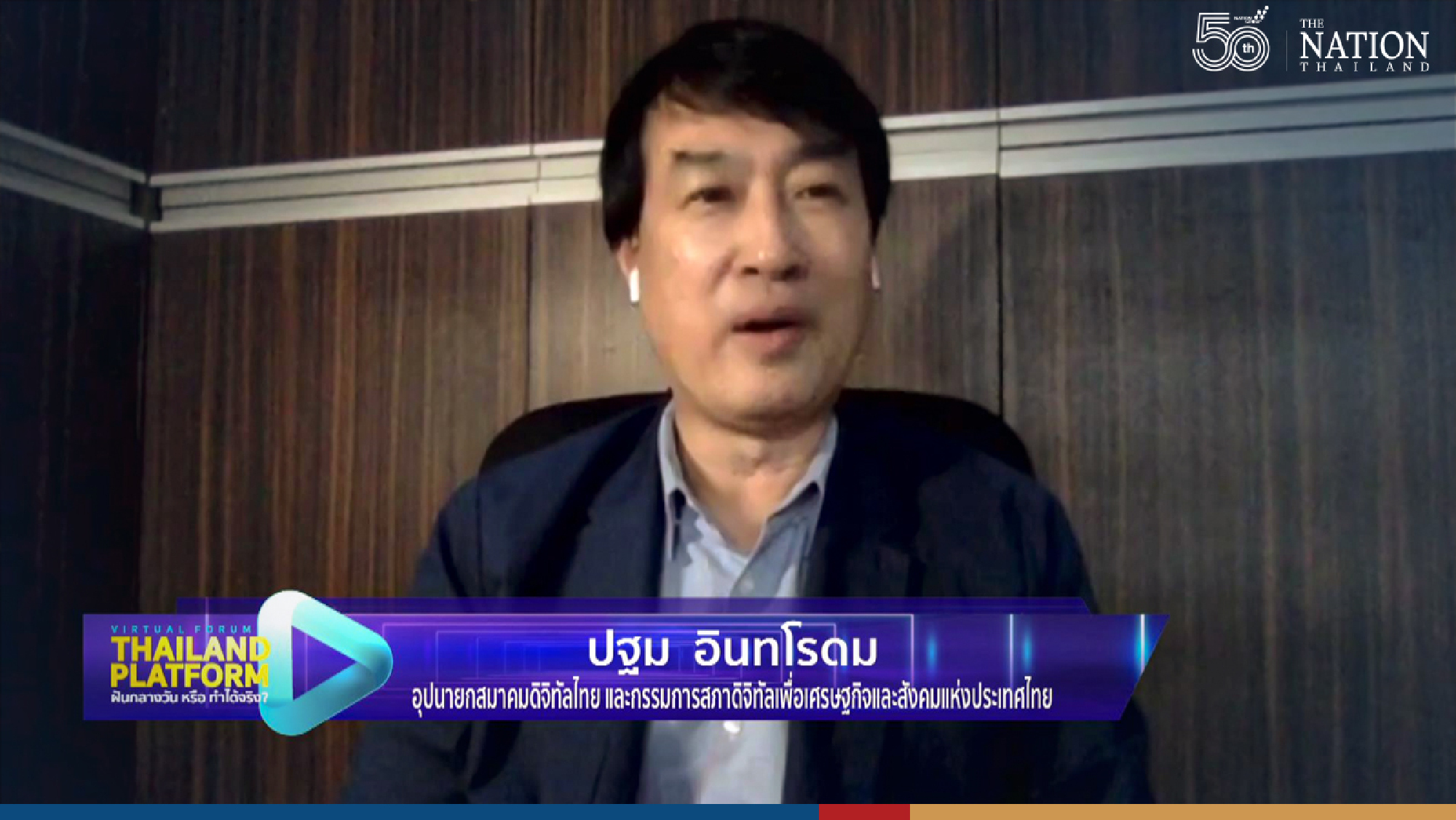
Pathom Intharodom, president of the Thai Digital Trade Association (TDTA) and director of Thailand’s Digital Council, said the Covid-19 outbreak has changed consumer behaviour and now Thais are spending more time on international digital platforms like Netflix and Spotify.
“Establishing the ‘Thailand Platform’ will promote the creation of local digital content that can compete with foreign alternatives,” he said. “The government should play the role of facilitator or regulator to ensure the private sector has what it needs and can compete fairly.”
‘Thailand Platform’ necessary to woo Thais back from foreign digital offerings
Pawin Phurijitpanya, a film director with the GDH studio, added that promoting locally made films will not only add more content to the Thailand Platform but can also be distributed via big streaming services like Netflix or Disney Plus. He said this will help expose Thai films to global audiences.
‘Thailand Platform’ necessary to woo Thais back from foreign digital offerings
“Content is key to attracting customers to a platform, not the subscription rate,” he said. “We must ensure that the content on Thailand Platform is of high quality that is constantly updated to keep audiences interested.”
Tharaphut Jaruwatthana, president of Media Agency Association, added that most OTT (over-the-top) platforms in Thailand have generated about 2 billion baht in advertising revenue scattered across several services.
“If we can combine these media into one centralised platform, then they can potentially generate up to 100 billion baht in advertising revenue yearly,” he said.
‘Thailand Platform’ necessary to woo Thais back from foreign digital offerings
Meanwhile, Chaichana Mittraphan, president of ETDA, said that Thailand having its own digital platform will make the handling of regulations and complaints easier.
‘Thailand Platform’ necessary to woo Thais back from foreign digital offerings
“More than 40,000 complaints are filed every year concerning digital platforms, but the ETDA cannot tackle all of them because most of these platforms do not have an office in Thailand and hence do not fall under Thai law,” he said. “ETDA is drafting a law to regulate all digital platforms available in Thailand, regardless of their country of origin, to ensure a fair competition between service providers.”
‘Thailand Platform’ necessary to woo Thais back from foreign digital offerings
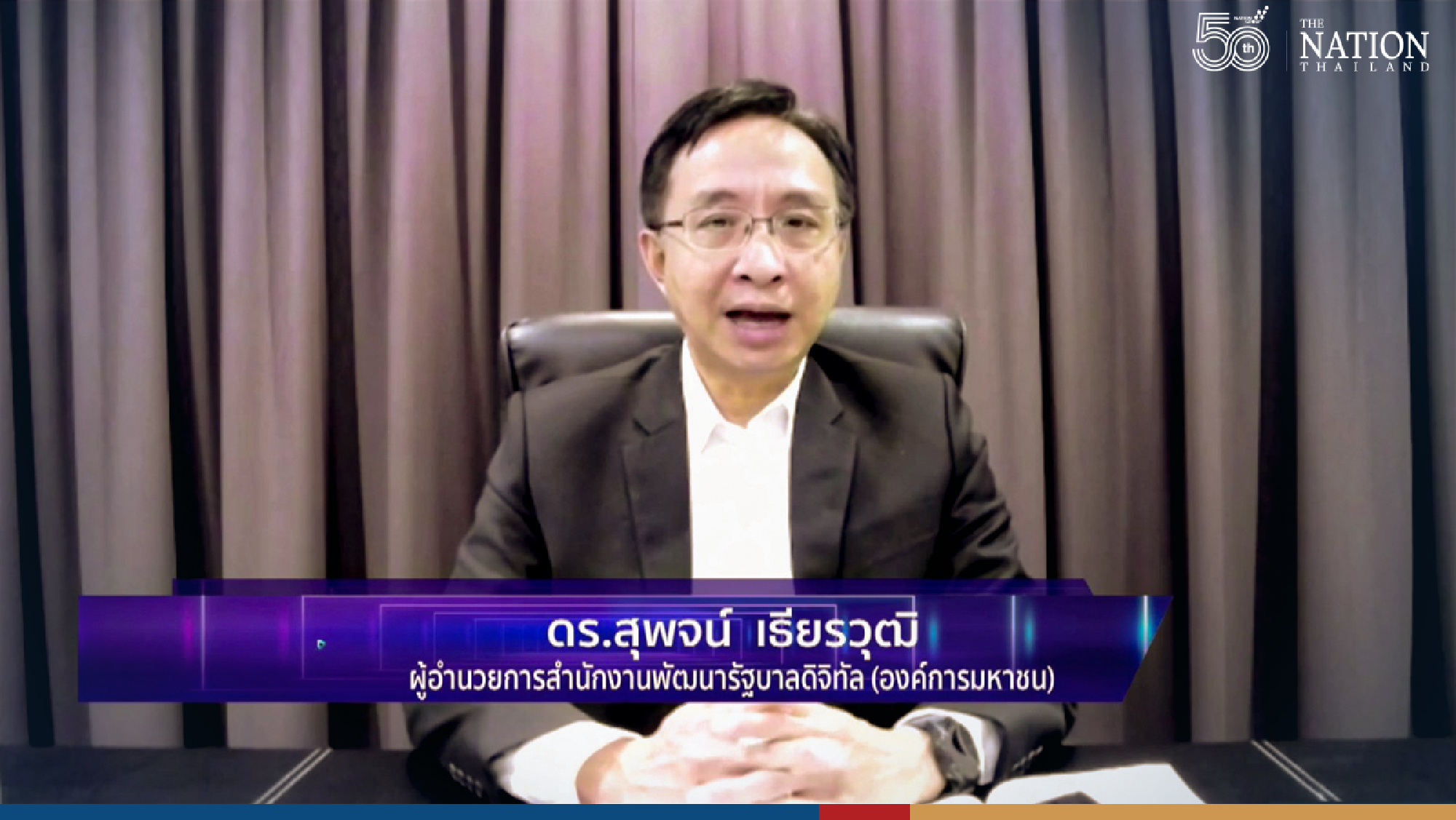
Lastly, DGA director Suphoj Thianwut said the agency has launched a mobile application “Tang Rat” (The State’s Path) as a portal for all government digital services to serve people’s needs in the new normal.
“Private entrepreneurs are welcome to join Tang Rat to integrate their services with those of government,” he said. “The DGA supports the idea of building a ‘Thailand Platform’ and believes the government must remove regulations that obstruct the private sector from joining the platform.
“The ‘Thailand Platform’ cannot be built alone by a single agency. It will require cooperation from all related public and private organisations who can pool their resources and expertise in respective fields to make the platform a reality,” he added.
Being awarded the Green Loan Certificate under the Climate Bonds Initiative (CBI) on 1 October 2021 connotes the eco-friendly nature of the 240-megawatt solar energy scheme.
The US$160.5 million financing of B.Grimm Power PCL (BGRIM)’s Dau Tieng solar farm project in Vietnam has been certified as a “green” borrowing by an independent international environmental agency.
Being awarded the Green Loan Certificate under the Climate Bonds Initiative (CBI) on 1 October 2021 connotes the eco-friendly nature of the 240-megawatt solar energy scheme.
The certificate was given to Dau Tieng Tay Ninh Energy Joint Stock Company, a BGRIM subsidiary, after a syndicated loan for the amount was finalised on 31 August 2021.
The financing comprises a $32.5 million loan directly funded by ADB and the Leading Asia’s Private Infrastructure Fund (LEAP), a $128 million syndicated loan (B loan) funded by commercial banks, including Bangkok Bank, Kasikorn Bank, Kiatnakin Phatra Bank, ICBC (Thai) and Standard Chartered Bank (Thai).
Dau Tieng is BGRIM’s second green loan of large-scale solar farm in Vietnam, after the 257-MW Phu Yen TTP facility in Phu Yen province, that gained the green loan recognition.
The Phu Yen TTP solar farm, which is operated by Phu Yen TTP Joint Stock Company that is owned 80% by BGRIM, is funded by a $183 million loan that received the CBI credential at the end of 2020, becoming the first green lending extended to Vietnam.
BGRIMs VN solar venture financing gets green certification
These certificates underpin BGRIM’s potential in developing projects that contribute to environmental and climate protection, said Dr Harald Link, Chairman and President of BGRIM.
“BGRIM is committed to expanding its business with sustainability under the principles of good governance and responsible value chain management. We pursue our business by taking into account the impacts in various dimensions including economy, society and environment through the clean energy development,” said Dr. Link.
“BGRIM’s investment in renewable energy ventures in Thailand, Vietnam, Cambodia, Lao PDR and many other countries are testimonial to its contribution in reducing global warming and taking care of the environment in a sustainable way according to the company’s long-standing philosophy of ‘Doing business with compassion for the development of civilization in harmony with Nature” that spans over 143 years in B.Grimm’s history,” Dr Link concluded.
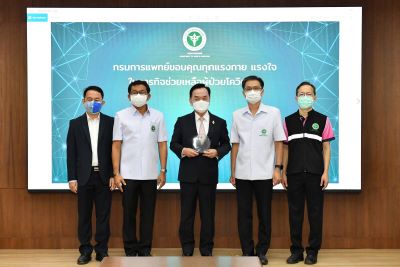
Department of Medical Services gives Appreciation Plaque to CP Foods and the Charoen Pokphand Foundation
Somsak Akksilp, 2nd from right, director-general of the Department of Medical Services (DMS), presented CP Foods and the Charoen Pokphand Foundation with Appreciation Plaque for supporting the work of COVID-19 pre-admission centre at Nimibutr Sport Building. Voravit Janthanakul, Center, Executive Vice President for corporate administrative and the foundation’s secretary, was the company’s representative. Deputy director-generals of DMS, Pairoj Surattanawanich, Left , Weerawut Imsamran, 2nd from left) and Nutthapong Wongwiwat, right, also participated in the recognition ceremony at the Department of Medical Services, Ministry of Public Health.
Microsoft said it will shut down its LinkedIn site inside of China, days after facing public criticism for censoring the posts of several U.S. journalists.
In announcing the decision Thursday, LinkedIn said it was facing “a significantly more challenging operating environment and greater compliance requirements in China.”
The news brings to an end the last major Western social-media site operating inside China, where the authorities have long blocked Facebook, WhatsApp, Twitter and other apps.
“Increased repression inside China, and greater criticism from Congress of going along with Chinese regulations, have made it unsustainable” for U.S. social-media companies, said Adam Segal, an expert on China and technology at the Council on Foreign Relations.
LinkedIn said it will “sunset” its current site later this year, but will launch a new site called InJobs that will not include a social-media feed or the ability to share posts or articles.
“Our new strategy for China is to put our focus on helping China-based professionals find jobs in China and Chinese companies find quality candidates,” LinkedIn said. It didn’t provide further details.
Chinese-owned social-media apps, such as WeChat and Weibo, are heavily censored to delete content that the authorities deem sensitive. And U.S. users of LinkedIn in recent weeks said they have faced similar censorship on their profiles inside China.
Those reports prompted Sen. Rick Scott, R-Fla., to write a letter to the chief executives of Microsoft and LinkedIn expressing concern that an “American company is actively censoring American journalists on behalf of the Chinese Communist Party.”
One of the journalists, Bethany Allen-Ebrahimian, an Axios reporter who focuses on China from Washington, D.C., reported on Sept. 30 that LinkedIn had blocked her own profile and those of other U.S. journalists in China.
In an interview Thursday, Allen-Ebrahimian said LinkedIn several weeks ago sent her a message informing her that her profile would no longer be viewable in China because it contained “prohibited” content.
Allen-Ebrahimian asked the company several times for more specifics but “they never told me what the prohibited content was,” she said. LinkedIn didn’t respond to questions about that on Thursday.
Even if LinkedIn’s new site lacks social-media features, the company will still be subjected to potentially invasive information requests from the Chinese authorities, Allen-Ebrahimian said.
“If the Chinese authorities want to know, has this person messaged with anybody, have they applied for any jobs? InJobs will have to provide that. If it’s a criminal matter, okay, but what if they’re doing it for political reasons?” she asked.
Melissa Chan, an American journalist who has reported for Vice and The Atlantic, also disclosed that LinkedIn had blocked her profile in China over “prohibited” content.
“There remains a lot more questions than answers,” Chan said by email on Thursday. “Did some Chinese authority reach out to LinkedIn with a list of people and posts they had a problem with? Or did LinkedIn take the initiative and do it themselves? Knowing what happened matters.”
Greg Bruno, a freelance journalist and author who focuses on Tibetan issues, said in an interview Thursday that LinkedIn told him he was blocked inside China due to “prohibited” content in the publications section of his profile. The only information in this section was about his three-year-old book, which he said details “China’s effort to marginalize and de-ligitimize Tibetan exiles.”
“I was pretty angry,” he said. “The biggest thing that bothered me about LinkedIn’s message was it was putting the onus on me to self-censor.”
Despite his troubles with LinkedIn, Bruno lamented the end of the last U.S. social-media holdout in China. “This is just going to continue to insulate us in our information bubbles and cut us off as people,” he said.
Three months after Richard Branson reached the edge of space, Virgin Galactic, his space tourism company, is postponing its next test flight to make what it calls enhancements to its space plane that would make it safer over the long-term, the company announced Thursday.
The decision means that a test flight scheduled for this month, which was to have flown members of the Italian Air Force and National Research Council, will be delayed until the second half of next year, and commercial service wouldn’t begin until the fourth quarter of that year, the company said.
The stand down is yet another sign of the complexities of human space flight and comes as a number of companies have been working on flying paying customers to either the edge of space or to orbit. Virgin Galactic has repeatedly delayed flying its paying customers, some of whom have waited years. After suspending ticket sales, which had been priced at $250,000 each, the company announced this year it was reopening tickets sales at $450,000 each.
In a statement, Virgin Galactic CEO Michael Colglazier said the company’s spacecraft “are designed with significant margins for safety, providing layers of protection that far exceed loads experienced and expected to occur on our flights.” The enhancement to the spacecraft “underscores our safety-first procedures, provides the most efficient path to commercial service and is the right approach for our business and our customers.”
Earlier this year, Branson, who had been itching to get to space for years, moved up his flight and was able to beat rival Jeff Bezos to space by less than two weeks. But Bezos’ Blue Origin just completed its second successful human spaceflight on Wednesday, carrying William Shatner and three others on a quick suborbital flight to an altitude of more than 66 miles.
It is planning one more flight by the end of the year and a half dozen or more next year.
A Virgin Galactic spokesperson said that there were no issues with the vehicle currently and that it would be cleared to fly in the next month or two. But as the company tested materials in the laboratory to determine how often parts and materials would need to be inspected and maintained, the data projected lower safety margins over the long-term.
The company had been planning to stand down for some time at the end of the year to perform maintenance on its mother ship, which hoists the spaceplane aloft so that it can be “air launched” from about 45,000 feet. It will now perform that work immediately and include the additional spacecraft materials in the review as well.
While the delay for the Italian Air Force mission is several months, the delay of commercial service from when it was originally foreseen should be only about a month or so, the person said.
The Italian Air Force flight had been delayed previously after the company noticed a potential defect in a component supplied by an outside contractor. The current delay is unrelated to that, the company said. The earlier issue has been resolved.
Virgin Galactic was also grounded by the Federal Aviation Administration this year after Branson’s flight went off course during its descent and controllers failed to inform the FAA it was flying outside of its restricted airspace. The FAA announced last month it was allowing the company to return to flight operations after the company made changes on how it would communicate with the FAA during flights.
The Stock Exchange of Thailand (SET) Index closed at 1,638.34 on Friday, down 2.63 points or 0.16 per cent. Transactions totalled 84.75 billion baht with an index high of 1,651.41 and a low of 1,635.14.
The index fell for the second day running after dropping by 2.67 points or 0.16 per cent on Thursday.
In the morning session, Krungsri Securities expected the Stock Exchange of Thailand (SET) Index on Friday would rise to between 1,645 and 1,650 points before falling.
It said the index gained positive sentiment from rising oil price in line with tight oil supplies, as well as mass buy-ups of stocks that benefit from the country reopening after the government planned to ease lockdown measures and allow foreign travellers to enter the country on November 1.
“However, the index would be under pressure as some investors would sell their stocks to cope with risk of US Federal Reserve signalling it would taper its quantitative easing programme this year,” Krungsri Securities said.
The 10 stocks with the highest trade value today were KBANK, BANPU, U, PTT, IRPC, AOT, SCB, CPALL, 7UP and GULF.
Other Asian indices were up:
Japan’s Nikkei Index closed at 29,068.63, up 517.70 points or 1.81 per cent.
China’s Shanghai SE Composite closed at 3,572.37, up 14.09 points or 0.40 per cent, while the Shenzhen SE Component closed at 14,415.99, up 74.62 points or 0.52 per cent.
Hong Kong’s Hang Seng Index closed at 25,330.96, up 368.37 points or 1.48 per cent.
South Korea’s KOSPI Index closed at 3,015.06, up 26.42 points or 0.88 per cent.
Taiwan’s TAIEX Index closed at 16,781.19, up 393.91 points or 2.40 per cent.
The baht opened at 33.18 to the US dollar on Friday, unchanged from Thursday’s closing rate.
The Thai currency is likely to move between 33.10 and 33.30 during the day, Krungthai Bank market strategist Poon Panichpibool predicted.
Poon said that the baht is strengthening because foreign investors are investing in Thai stocks especially stocks relating to country opening.
Meanwhile, investors sold gold after the price increased caused the baht to strengthen in the short term. However, Poon said that the baht will not strengthen much soon as the Covid-19 situation is still worrying and the basic factor was not fully recovered.
The key resistance level for the baht would be from 33.35 to 33.50, which is the level at which exporters might sell the US currency. The baht’s key support level would be at 33.
Poon said that the baht is highly volatile and could suddenly change direction. He recommended that investors use various hedging tools such as options or Foreign Currency Deposit (FCD) accounts with a currency forward.

 Thammasat forum ponders idea of letting foreigners own land in Thailand
 Thammasat forum ponders idea of letting foreigners own land in Thailand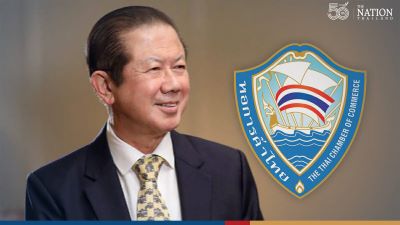

 ‘Thailand Platform’ necessary to woo Thais back from foreign digital offerings
 ‘Thailand Platform’ necessary to woo Thais back from foreign digital offerings
 ‘Thailand Platform’ necessary to woo Thais back from foreign digital offerings
 ‘Thailand Platform’ necessary to woo Thais back from foreign digital offerings
 ‘Thailand Platform’ necessary to woo Thais back from foreign digital offerings
 ‘Thailand Platform’ necessary to woo Thais back from foreign digital offerings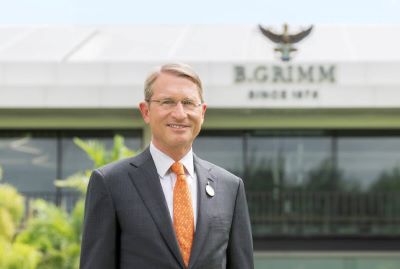
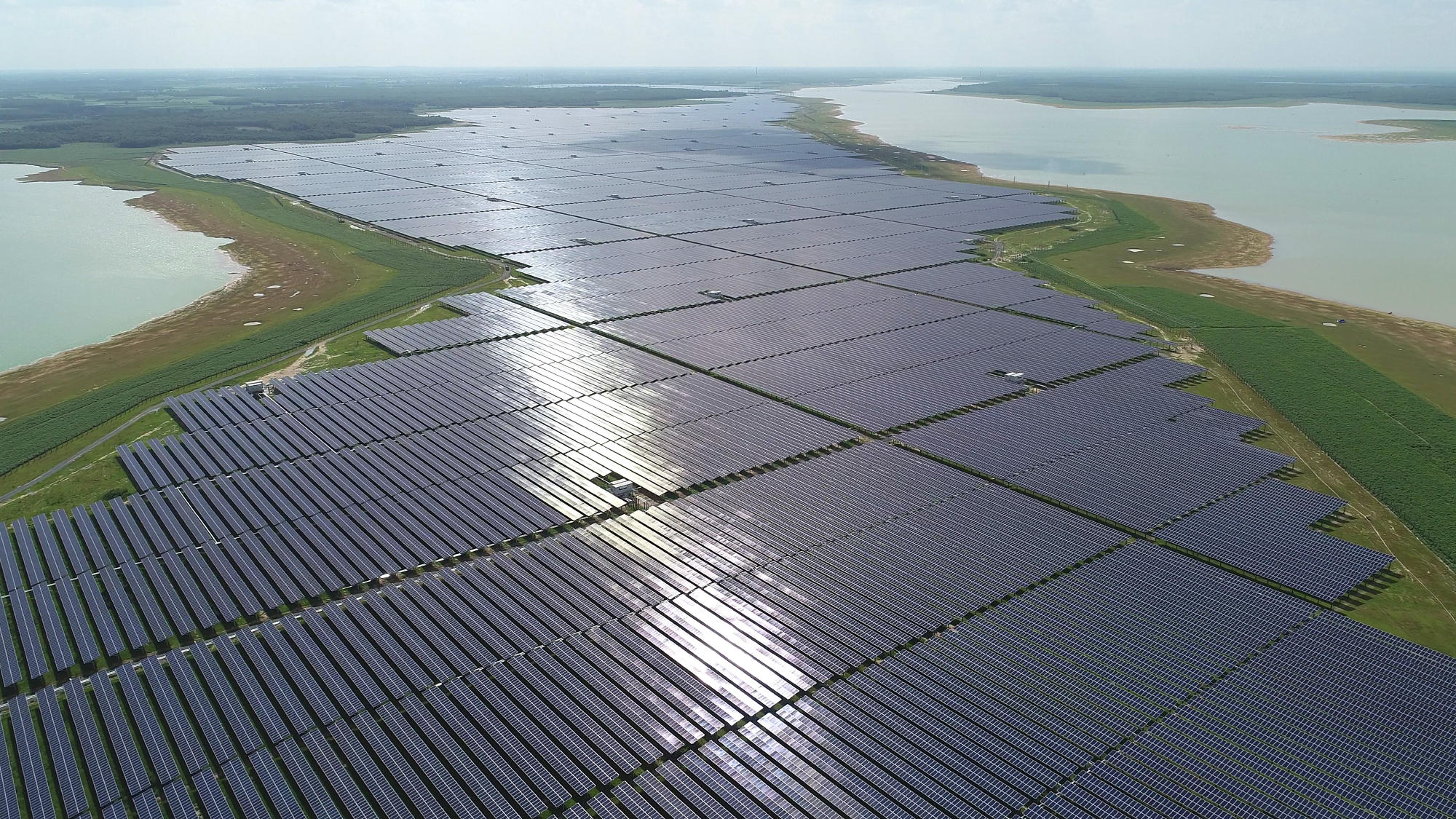 BGRIMs VN solar venture financing gets green certification