Almost 9M cryptominers prevented in SEA SMBs in 2020 #SootinClaimon.Com

#SootinClaimon.Com : ขอบคุณแหล่งข้อมูล : หนังสือพิมพ์ The Nation.

https://www.nationthailand.com/business/40002589

Almost 9M cryptominers prevented in SEA SMBs in 2020


more than phishing, ransomware combined, Unusually high office electricity bill despite remote work? Maybe there’s a miner

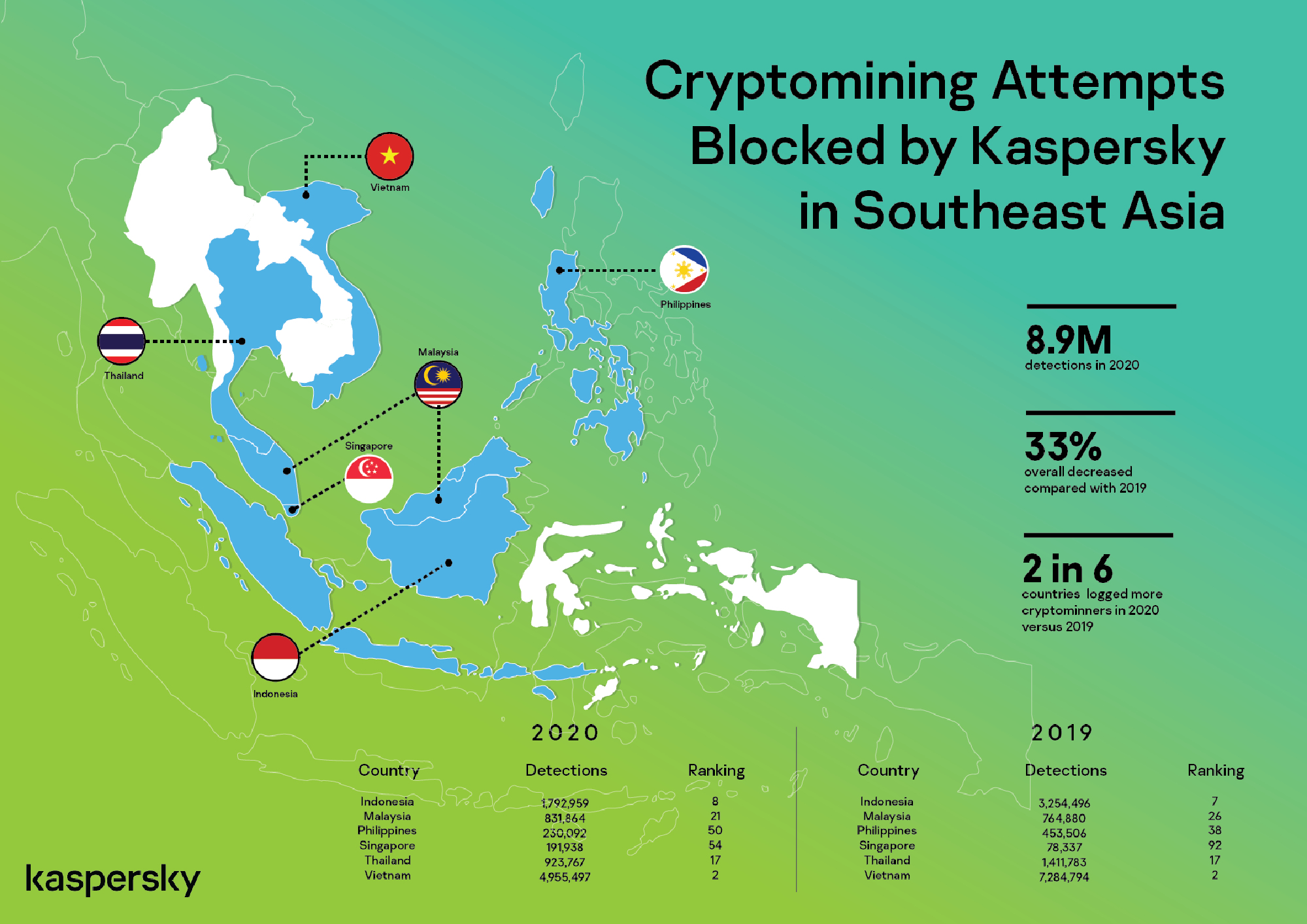
In Southeast Asia, cryptomining is the highest in terms of attempted attacks blocked by Kaspersky at 8,926,117 in 2020. Detected phishing attempts were at 2,890,825 while ransomware attempts were at 804,513 last year.

Malicious cryptocurrency malware used in cryptomining is being used by cybercriminals to use hardware they don’t own such as smartphones, computers, tablets, and servers. They then harness the processing power of these devices to mine for cryptocurrencies such as Bitcoin, the prices of which have been skyrocketing.

So if you’re a business owner and your staff are working remotely because of the pandemic yet you find your office power bill unusually high, check your IT backend. There may be cryptominers using your business resources, at your expense.

In Kaspersky’s recent 2020 SMB Threat Report, cryptomining attempts were monitored to have been reduced to 8,926,117 in 2020 from a massive 13, 247,796 detections in 2019.

“We have seen a decrease in miner attacks around the world and the same trend applies to SEA, too. The main factor behind the decreasing number of attacks is the cost of cryptocurrencies which has been declining over the past three years and only recently began to rise sharply in price again,” says Evgeny Lopatin, Malware Analyst Team Lead at Kaspersky.

Kaspersky is advising business owners not to keep their guards down.

“SMBs normally have a relaxed attitude towards information security and so the main damage from cryptomining is expected to be felt by this sector. Cryptocurrencies continue to attract investor and user attention due to the continued spike in its prices so we really caution SMBs not to underestimate the possibility that cryptomining will remain to be a serious cyberthreat. After all, cybercriminals have long realized that infecting servers is more profitable than mining on home users’ computers so SMBs should take this silent threat seriously,” says Yeo Siang Tiong, General Manager for Southeast Asia at Kaspersky.

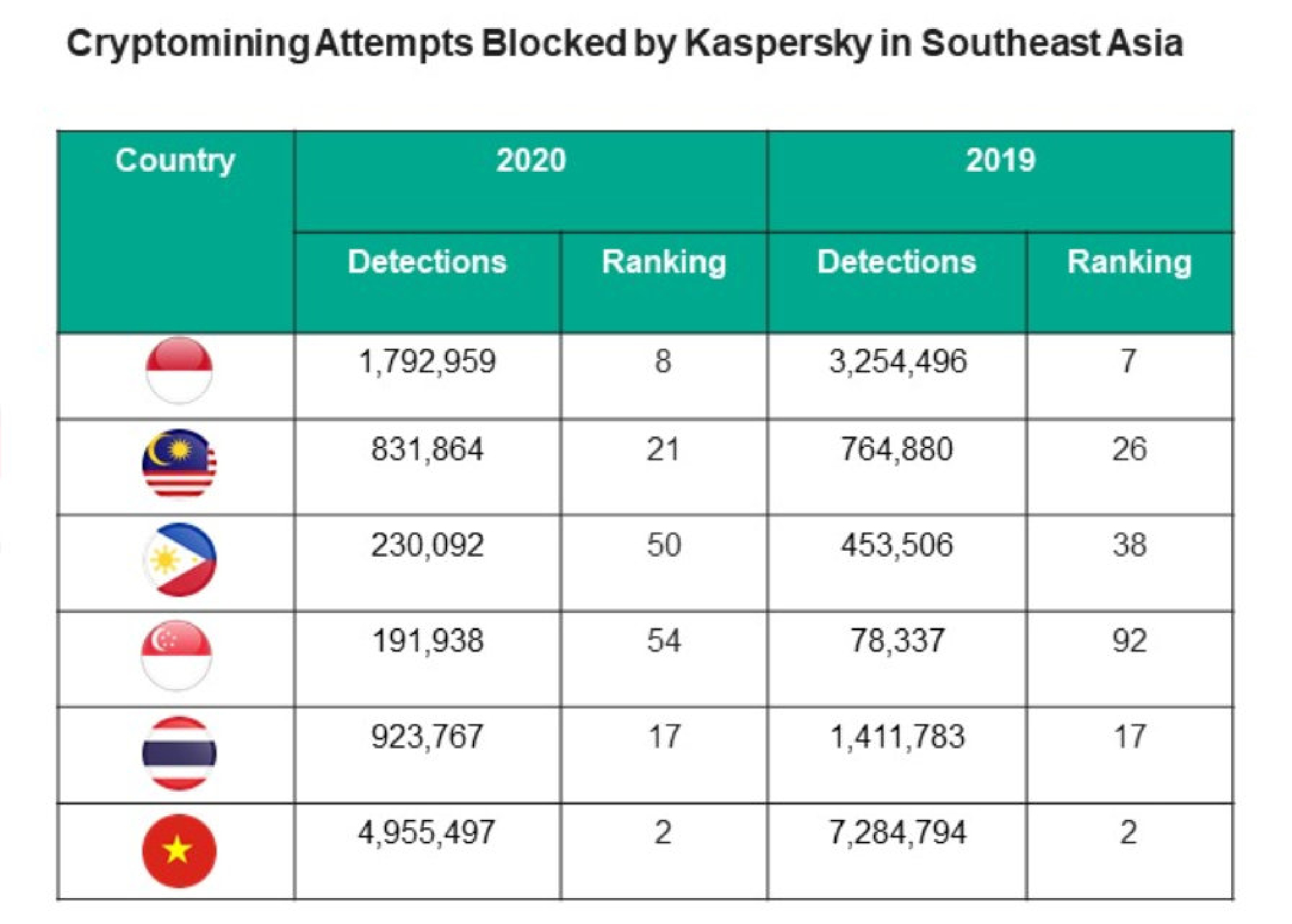
In the region, most of the monitored cryptomining attempts prevented by Kaspersky were observed in Indonesia and Vietnam for two consecutive years, accounting for almost 71% in 2020 and 80% in 2019 of all attempted incidents in SEA.
Almost 9M cryptominers prevented in SEA SMBs in 2020Almost 9M cryptominers prevented in SEA SMBs in 2020

Unlike ransomware attacks which tend to be more frightening and require to be dealt with quickly, cryptominers flourish the longer they are hidden and use this stealth in the long-term to profit from the exploit.

Some tell-tale signs that personal devices are being used illegally by cryptominers include system response slowing down due to the workload strain, increase in power consumption that result in batteries depleting at a faster pace or electricity bills skyrocketing, and a more significant data usage.
Almost 9M cryptominers prevented in SEA SMBs in 2020Almost 9M cryptominers prevented in SEA SMBs in 2020

ADVERTISEMENT

If businesses suspect their systems being accessed by cryptominers, Kaspersky has a few tips to ensure the safety of their assets and devices:

● Keep operating systems and software fresh and regularly updated.

● Avoid clicking email links and attachments from unverified and untrusted sources.

● Practice caution when installing software from the web since cryptominers are known to embed malware in them.

● Take advantage of a strong security solution that businesses with limited cybersecurity expertise and resources could use like Kaspersky Endpoint Detection and Response Optimum (KEDRO). KEDRO is actually an efficient way for SMEs to reduce costs while saving on protection as it complements protection for endpoints such as mobile phones, tablets, and laptops connected to the company network.

● Carry out regular security audits of your corporate network. And you should not forget about less-obvious targets, such as queue-management systems, POS terminals, and vending machines. Once infected, an army of those devices can bring much profit to criminals.

Learn more about current deals of up to 40% in savings on the KEDRO security solution by visiting https://go.kaspersky.com/SEA_SMB_Promo_KERO.html?utm_campaign=SEA21Q2KERO.

Published : June 29, 2021
Twitter Reveals 4 Key Conversation Themes in Thailand #SootinClaimon.Com

#SootinClaimon.Com : ขอบคุณแหล่งข้อมูล : หนังสือพิมพ์ The Nation.

https://www.nationthailand.com/business/40002586

Twitter Reveals 4 Key Conversation Themes in Thailand


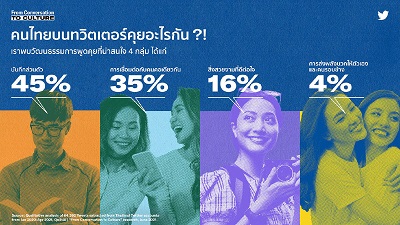
Twitter research found four unique cultural themes on Twitter in Thailand and uncovered 10 conversational topics that shape them

Twitter is where people connect and converse. It’s where communities are formed and people engage in conversations. Thais come to Twitter to find out #WhatsHappening, connect with others, and join in conversations on a diverse range of topics. From entertainment to sports, TV to movies, beauty to current affairs; people are finding out and sharing the latest updates about these topics, and much more, on Twitter.

Conversations are at the heart of Twitter and a single Tweet can have a wide-ranging impact. Twitter took a deep dive into over 64,000 Tweets in Thailand to find out more about the power of Tweets and how Thais shape their own unique culture through conversations and communities.

Speaking of this recent research, Martyn U’ren, Head of Research APAC & Global Export – Twitter, said, “From the outset, our aim was to get an accurate view of conversations on Thai Twitter. While some conversations are louder than others, what we found was that Thai conversations are diverse and vibrant. The research has shown an interesting layering of conversational topics that form four key cultural themes. What does this mean? Our findings will help Thais to better understand the diverse communities on Twitter while providing Thai and international brands with unique insights into conversational themes and topics on Twitter in Thailand.”

This research found four unique cultural themes on Twitter in Thailand and uncovered 10 clear conversational topics that shape them. It uncovered that Thais on Twitter are a manifestation of Thai culture and that people showed a huge span of affinities in conversations, and that diversity is the norm.

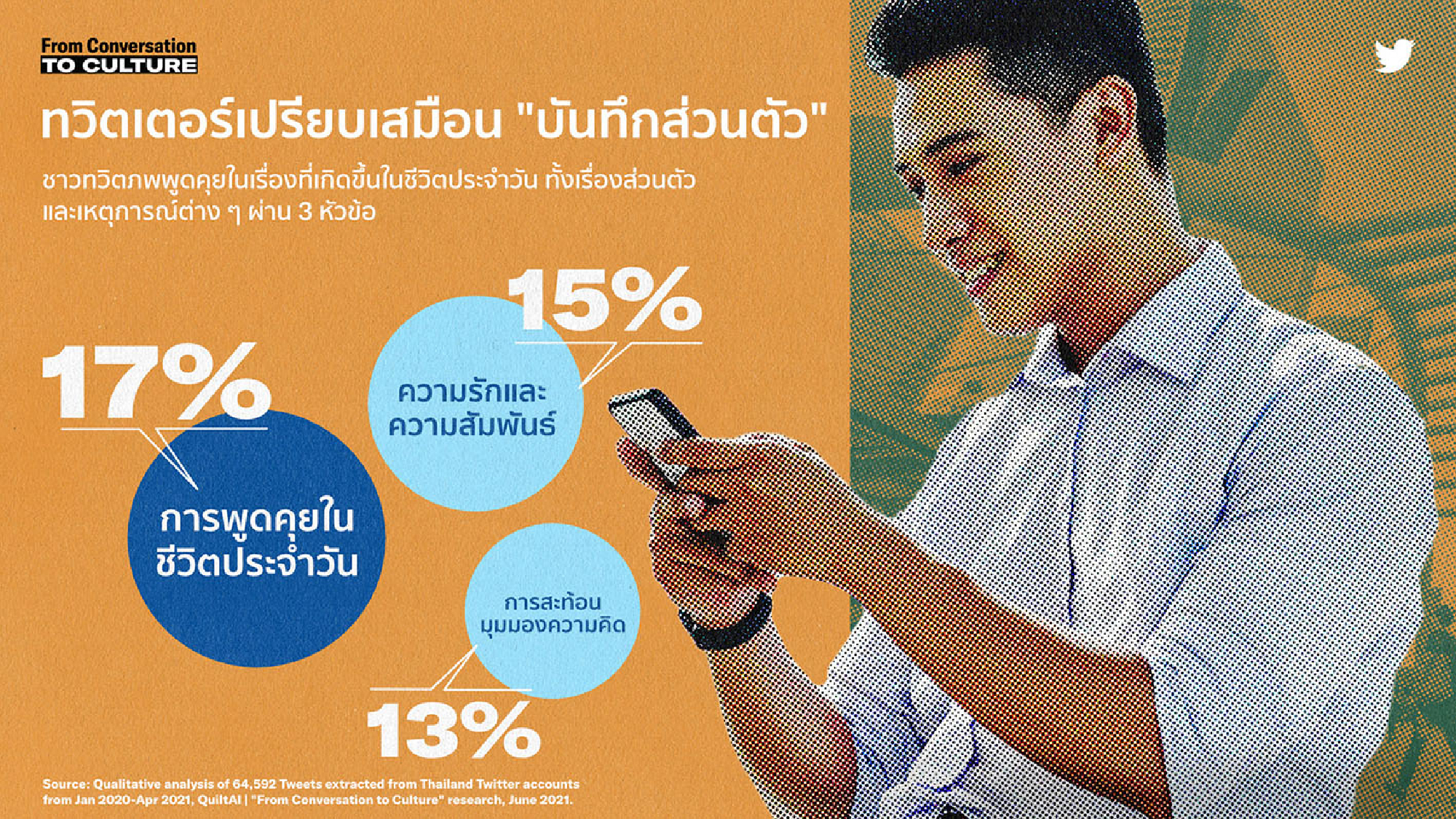
1. Personal Musings – Everyday Chatter, Love and Relationships, Self-Reflection

This is the largest space comprising 45% of the total conversation volume on Twitter in Thailand and it’s where people engage in everyday chatter – sharing their daily routine, commute and the mundane in their lives. It’s also a safe space for people to pour out their hearts and Tweet about love and relationships – their lack of, desire for, and moments with their significant others.

Thais tend to also share their daily pain points in moments of self-reflection. This might literally be small physical aches and pains like a minor headache or fatigue, though Thais also like to comment on the weather – the unbearable heat during the hot season and their desire for the rainy season to arrive.

Twitter Reveals 4 Key Conversation Themes in ThailandTwitter Reveals 4 Key Conversation Themes in Thailand


2. Community and Connection – Current Affairs, Passions, Local Marketplace

Twitter is an essential part of Thais’ lives and research found that the community and connection space accounted for 35% of total conversational volume. Actively using Twitter to stay connected with their communities as well as keep themselves updated with #WhatsHappening around them, Thais Tweet regularly about current affairs; from COVID updates to cryptocurrency to local or regional politics.

Whether it’s music, sports, food or shopping; Thais also like to share their passions on Twitter. From beauty to food to restaurants and the latest fashion, Thais actively review products they’ve bought and places they’ve been. For entrepreneurs, Twitter is the place to sell their wares. From home cooked food and confectionery to clothing, fan merchandise and crafts; Thais have made Twitter their local marketplace where they showcase their creativity and products they’ve made for sale.

Twitter Reveals 4 Key Conversation Themes in ThailandTwitter Reveals 4 Key Conversation Themes in Thailand

ADVERTISEMENT

3. Beauty and Wonder – Curated Aesthetics, Celebrity and Fandom, Hopes and Dreams

Accounting for 16% of conversational volume, this space sees Thais on Twitter sharing Tweets about common interests that people can marvel at. Using curated aesthetics like a photo album or digital scrapbook, people like to share places or items of beauty. Visual Tweets of everyday scenes such as cafes, beautiful homes, nature, beaches and more are common. Celebrity and fandom is another popular conversation in this space and comes alive on Twitter. From K-Pop, in particular Thai stars such as BamBam (@BamBam1A) from GOT7 (@GOT7Official) and #Lisa from BLACKPINKOFFICIAL (@BLACKPINK), to local artists such as Peck Palit (@peckpalit) and 4EVE (@4eveOfficial), and celebrities, Thais are avid fans of everything celebrity.

While the pandemic brought struggles for some, Twitter also saw hopes and dreams emerge as a key theme with people Tweeting their travel nostalgia and engaging with others by asking “Where would you travel after COVID?”

Twitter Reveals 4 Key Conversation Themes in ThailandTwitter Reveals 4 Key Conversation Themes in Thailand

4. Betterment and Aspiration – Podium for Celebration, Inspirational and Uplifting

With 4% of the total conversational volume; conversations here are centered around motivations and inspiration, with people expressing their best selves. As a podium for celebration, Thais on Twitter proudly share their joy and celebrations – from graduation, good grades, birthdays, to anniversaries and more.

Thais are also generous with uplifting each other and Tweets in this space are inspirational and uplifting. Twitter is like a support network where people encourage each other through tough times – Tweets are often general, not aimed at any specific person, but for the community at large, in the event somebody needs the support.

Twitter Reveals 4 Key Conversation Themes in ThailandTwitter Reveals 4 Key Conversation Themes in Thailand

Keep up-to-date with the latest happenings on Thai Twitter by following @TwitterThailand.

Published : June 29, 2021

Facebook wins dismissal of U.S., states monopoly lawsuits #SootinClaimon.Com

#SootinClaimon.Com : ขอบคุณแหล่งข้อมูล : หนังสือพิมพ์ The Nation.

https://www.nationthailand.com/business/40002569

Facebook wins dismissal of U.S., states monopoly lawsuits


Facebook Inc. won the dismissal of two antitrust cases filed by the federal government and a coalition of states when a judge threw out the lawsuits. The social media platform shares rose.

U.S. District Judge James Boasberg in Washington on Monday granted Facebook’s request to dismiss the complaints, filed last year by the U.S. Federal Trade Commission and state attorneys general led by New York’s Letitia James.

The judge said in the opinion that the FTC failed to meet the burden for establishing that Facebook has a monopoly in social networking. He said the agency could refile the complaint within 30 days.

“Although the court does not agree with all of Facebook’s contentions here, it ultimately concurs that the agency’s complaint is legally insufficient and must therefore be dismissed,” Boasberg wrote.

With the ruling, Facebook has escaped — at least for now — the most significant regulatory threat to its business to emerge out of the wider crackdown on U.S. technology giants.

The decision delivers a blow to the FTC and the states, which claimed Facebook violated antitrust laws by buying photo-sharing app Instagram and messaging service WhatsApp to cut off emerging competitive threats and protect its monopoly.

It puts new emphasis on antitrust legislation advanced by the Judiciary Committee last week that would make it easier for enforcers to challenge anticompetitive conduct by the biggest tech platforms.

Boasberg’s decision to toss the Facebook complaints shows the hurdles U.S. antitrust enforcers face in trying to take on the internet giants. Officials on their own can’t break up companies or impose other remedies, but instead must persuade judges to take action. The process can take years.

The Facebook lawsuits were filed in December as part of a widening crackdown on America’s tech giants. The cases followed a Justice Department complaint against Alphabet Inc. for allegedly monopolizing internet search, and the findings of a House investigation that accused tech companies of abusing their dominance. Lawmakers have since proposed a pile of bills that would cast a broad regulatory net over the companies.

The Facebook lawsuits centered on the 2012 acquisition of Instagram and the 2014 takeover of WhatsApp. Officials say Facebook made the deals because it saw both companies as threats to its business. Rather than compete with its own products, Facebook followed Chief Executive Officer Mark Zuckerberg’s mantra: “it is better to buy than compete,” according to the FTC complaint.

Facebook offered $1 billion for Instagram when it had only 25 million users and no revenue, but had already started to capture the market for mobile photo-sharing. Zuckerberg said the threat from Instagram was “really scary,” according to the FTC complaint. The company paid $19 billion for WhatsApp because it saw messaging apps as another danger to its business. A Facebook executive said the apps “might be the biggest threat we’ve ever faced as a company,” the FTC complaint said.

Facebook attacked the complaints on several grounds. One of its key arguments was that the FTC investigated both acquisitions when they were announced and allowed both deals to proceed. While antitrust enforcers can challenge completed mergers, Facebook argued the FTC’s case was unprecedented and the agency never explained why its prior decisions approving the purchases were mistaken. The government simply wants a “do-over,” Facebook said.

The company also had argued that a U.S. Supreme Court ruling in April that curtailed the FTC’s authority to recover money for defrauded consumers required that the complaint be dismissed.

Published : June 29, 2021

By : Syndication Washington Post, Bloomberg · David McLaughlin

To disclose or not to disclose? #SootinClaimon.Com

#SootinClaimon.Com : ขอบคุณแหล่งข้อมูล : หนังสือพิมพ์ The Nation.

https://www.nationthailand.com/business/40002559

To disclose or not to disclose?


Nu To Van Partner, Tax & Legal – Global Trade Advisory Deloitte Thailand Tom Cachet Manager, Tax & Legal – Global Trade Advisory Deloitte Thailand

After a year completely disrupted by the Covid 19 pandemic, there were some indications by the beginning of 2021 that Thai Customs had picked up their audit activities on importers, most likely to make up for the limited controls on imports that preceded and in search of foregone duty and tax revenue.

Companies, which are audited by Customs, are at risk of having to pay back duties and VAT together with fines, penalties surcharges in case of non-compliance issues.

However, by April of 2021, a third Covid-wave hit Thailand and Customs decided to scale back their enforcement activities in an effort not to place an undue burden on companies already suffering from the pandemic.

To disclose or not to disclose?To disclose or not to disclose?

Temporary incentives for self-disclosure of non-compliance to Customs

Instead, incentives are being made available to companies to self-disclose non-compliance issues with duty and tax exposures. The One-Stop-Service for Additional Duty Payment (One-Stop-Service Program) already allows importers to disclose self-identified import duty/VAT shortfalls centrally to Customs Headquarter. As long as the importer can prove that there was no intention to evade duties, Customs would waive the customs fines. This program still runs until 30 September 2021.

In addition, a new Ministerial Regulation was released on 28 May 2021 to reduce monthly duty surcharges to 0.25% of any outstanding duty payable for those companies making a self-disclosure to Customs. Duty surcharges are calculated monthly on top of the duty shortfall amount, which is either detected by Customs or self-disclosed by the importer, from the date of import/export until the date of payment (but capped at the total amount of duty shortfall). Normally, duty surcharges range from 0.25% to 1%, depending on when payment is made. However, under the new Ministerial Regulation the percentage is fixed at 0.25% regardless how far back the import/export is dated.

The duty surcharge reduction is a temporary relief measure in response to the lingering Covid situation in Thailand, and applies from 1 June until 30 September 2021.

By promoting both a waiver on customs fines and a reduction of duty surcharges in case of a self-disclosure, Customs is making an attempt to convince companies to independently come forward with any self-assessed non-compliance findings. This will still allow them to secure some duty revenue despite not being able to conduct their usual audit activities. Now may be the time for companies to seriously consider taking them up on their offer. After the relief measures expire on 30 September 2021, and if the situation allows it, Customs is expected to increase their audits once again.

What to look out for?

ADVERTISEMENT

Some of the typical non-compliance issues that Customs assessed companies for before restricting their audit activities were related to the use of Free Trade Agreements (FTAs), payments of royalties and declaration of tariff code (HS codes).

Importers who make use of FTAs to obtain import duty privileges must present to Customs a Certificate of Origin (CO) issued in the exporting country. Thai Customs is known to rigorously verify whether COs have been completed in accordance with FTA guidelines and are consistent with other submitted customs documentation such as the import declaration, invoice and bill of lading. If any errors or inconsistencies are detected, the duty privileges are usually denied. One area that has caught Customs’ recent attention was related to FTA imports that involved multiple party sales transactions and “breakbulk” transactions in an intermediary country where a regional distribution center is located.

Currently, these kind of transactions are only allowed under the ASEAN FTA. Using the same kind of transactions under different FTAs are currently not allowed in Thailand and can lead to claw back of duties and taxes together with fines and penalties for historic shipments.

Another area is related to the declared value of imported goods. During audits, Customs normally reviews whether any additional payments (e.g. for royalties or license fees) were made on top of the price of the imported goods. In case Customs views that these payments should be dutiable, Customs will reassess the original declared value and claw back duties with fines and penalties.

Finally, tariff codes (HS codes) have traditionally been a hot target area for Customs challenges given the ambiguity of the classification system and the possibility for Customs to opt for codes which would normally attract higher duty rates. Companies must review whether they have been declaring tariff codes that can be defended in accordance with the customs classification rules and if not, consider whether to make a change and disclose past mistakes.

What’s next?

Given that Customs has temporarily decided to scale back their enforcement activities, companies are encouraged to conduct an internal review of their company’s import/export activities to determine whether they have complied with customs rules and regulations or not and identify potential risks and exposures. If any significant non-compliance is identified, it may be worthwhile to make the self-disclosure to Customs before 30 September 2021 to mitigate the potential financial exposure in the future and close the issue.

On the other hand, companies must keep in mind the possibility that following a self-disclosure Customs could expand investigations into other customs issues. Therefore, companies must have a clear picture of their customs risk areas and exposures before deciding to proceed with the self-disclosure.

With only limited time before the self-disclosure incentive programs close, now may be a good time for companies in Thailand to start reviewing their import and export activities.

Published : June 28, 2021

SET expected to shed points amid Covid uncertainty, volatile funds flow #SootinClaimon.Com

#SootinClaimon.Com : ขอบคุณแหล่งข้อมูล : หนังสือพิมพ์ The Nation.

https://www.nationthailand.com/business/40002588

SET expected to shed points amid Covid uncertainty, volatile funds flow


The Stock Exchange of Thailand (SET) Index rose by 6.30 points, or 0.40 per cent, to 1,585.47 on Tuesday morning.

The SET Index closed at 1,579.17 on Monday, down 3.50 points or 0.22 per cent. Transactions totalled THB68.83 billion with an index high of 1,581.34 and a low of 1,565.31.

Krungsri Securities predicted the SET Index would fall to 1,565 and 1,570 points due to uncertainty over the Covid-19 outbreak, especially in Asia and Britain.

It added that this negative sentiment had led to a fall in oil price.

“In addition, volatility in funds flow and Thailand Futures Exchange’s move to roll over its future contracts would pressure the index,” Krungsri Securities said.

It recommended that investors buy:

▪︎ HANA, KCE, TU, CPF, ASIAN and EPG, which benefit from the weakening baht.

▪︎ BCH, CHG, BDMS, HMPRO, BEM and CKP, whose second-quarter business turnover is expected to improve.

▪︎ KCE, IRPC, STA and STGT, which will be listed on the SET50 Index on Wednesday.

▪︎ AAV, ICHI, NRF, PSL, PTL, SINGER, STGT, SYNEX and TKN, which will be listed on the SET100 Index on Wednesday.

Published : June 29, 2021

By : The Nation

Importers buy dollars as baht slides towards 32 to the greenback #SootinClaimon.Com

#SootinClaimon.Com : ขอบคุณแหล่งข้อมูล : หนังสือพิมพ์ The Nation.

https://www.nationthailand.com/business/40002584

Importers buy dollars as baht slides towards 32 to the greenback


The baht opened at 31.93 to the US dollar on Tuesday, unchanged from Monday’s closing rate.

The Thai currency is likely to move between 31.85 and 32.00 during the day, Krungthai Bank market strategist Poon Panichpibool said.

He said the most important factor influencing the baht was the Covid-19 crisis in Thailand, and the vaccine distribution in the country.

Poon predicted that importers would buy dollars at this time as the baht has weakening.

He suggested that investors monitor if the baht weakens to 32 per US dollar. If the baht reaches that point, technically the currency will move further to 32.25 to 32.50, he added.

Published : June 29, 2021

By : The Nation

Gold market awaits US non-farm payroll for June #SootinClaimon.Com

#SootinClaimon.Com : ขอบคุณแหล่งข้อมูล : หนังสือพิมพ์ The Nation.

https://www.nationthailand.com/business/40002583

Gold market awaits US non-farm payroll for June


The price of gold in Thailand rose by THB50 per baht weight in morning trade on Tuesday.

The Gold Traders Association report at 9.26am showed buying price of a gold bar at THB26,850 per baht weight and selling price of THB26,950, while gold ornaments were priced at THB26,363.24 and THB27,450, respectively.

At close on Monday, the buying price of a gold bar was THB26,800 per baht weight and selling price THB26,900, while gold ornaments were priced at THB26,317.76 and THB27,400, respectively.

Spot gold price on Tuesday was US$1,775 (THB56,870) per ounce after Comex gold on Monday rose by $2.9 to $1,780.8 per ounce.

The gold market is keeping an eye on the US non-farm payroll in June in a bid to predict the Federal Reserve’s monetary policy.

Hong Kong gold price, meanwhile, dropped by HK$60 to $16,450 (THB67,899) per tael, the Chinese Gold and Silver Exchange Society reported.

ADVERTISEMENT

Published : June 29, 2021

By : The Nation

U.K. regulator cracks down on Binance, the worlds biggest cryptocurrency exchange #SootinClaimon.Com

#SootinClaimon.Com : ขอบคุณแหล่งข้อมูล : หนังสือพิมพ์ The Nation.

https://www.nationthailand.com/business/40002573

U.K. regulator cracks down on Binance, the worlds biggest cryptocurrency exchange


A top financial regulator in Britain has ordered Binance, the worlds biggest cryptocurrency exchange, to cease regulated activity in the country, the latest effort by a world government to limit crypto-related businesses.

The Financial Conduct Authority followed its prohibitions on Binance Markets Limited with a warning to consumers to be wary of advertisements “promising high returns on investments in cryptoasset or cryptoasset-related products.” The move mirrors that of Japan, where finance regulators last week notified Binance that it is not authorized to do business in the country.

The regulatory warning shots highlights the inherent tension surrounding digital currency, which is finding cachet with a growing number of new investors and even has it encounters skepticism from governments and legacy financial institutions due to its volatility and its use by malicious actors to facilitate crime.

The crypto market’s extreme volatility was on display last week, as hundreds of billions of dollars in value evaporated on news of China’s crackdown on bitcoin mining. But as of Monday afternoon, bitcoin was trading up 5%, around $34,0000, and the total cryptocurrency market stood at $1.4 trillion, according to CoinMarketCap.

Consumers in the U.K. will still be able to use Binance for activities the FCA doesn’t regulate, such as buying and selling bitcoin. In an email to The Post, Binance said the FCA notice has “no direct impact” on the services provided on Binance.com

“We are aware of recent reports about an FCA UK notice in relation to Binance Markets Limited (BML). BML is a separate legal entity and does not offer any products or services via the Binance.com website,” Binance said in an email to The Post. “Binance acquired BML May 2020 and has not yet launched its UK business or used its FCA regulatory permissions. Our relationship with our users has not changed.”

The FCA has previously cautioned that scores of crypto companies that were seeking its approval could not meet requirements for preventing money laundering. The British financial watchdog named price volatility, consumer protection among its chief concerns about the cryptocurrency landscape, as well as charges and fees and misleading marketing materials.

“Investing in cryptoassets, or investments and lending linked to them, generally involves taking very high risks with investors’ money,” the FCA said in January. “If consumers invest in these types of product, they should be prepared to lose all their money.”

Binance, which according to its website hosts 2 billion trades a day, applied to register with the FCA but withdrew its application on May 17, the Wall Street Journal reported.

Just five crypto companies are currently registered with the FCA, including Gemini and Ziglu Limited, a British digital wallet company. The FCA recommends consumer withdraw their investments in unregistered assets or firms, as they are “operating illegally.”

Global adoption and investment in cryptocurrency isare rising just as some regulators are setting limitations and cracking down on crypto-related businesses. Others are grappling with how to design new rules to protect investors without stifling the potential for financial innovation.

In the U.S., the chair of the Securities and Exchange Commission has called for a federal watchdog to oversee crypto exchanges – the platforms where people can buy and sell tokens – since no single market regulator has clear jurisdiction over them. “Right now the exchanges trading in these crypto assets do not have a regulatory framework, either at the SEC or our sister agency, the Commodity Futures Trading Commission,” SEC Chair Gary Gensler told Congress last month.

ADVERTISEMENT

More recently, Biden administration officials have embarked on a review of potential oversight measures tied to the speculative trading of the crypto market and cryptocurrency’s potential uses to facilitate crime. Tax avoidance is another key issue that policymakers are focused on. The White House and the Treasury Department are backing a new plan to target cryptocurrency as part of a broader effort to ensure tax compliance.

While cryptocurrency investors in the U.S. can trade tokens and exchange them for cash, achieving some degree of mainstream adoption, investment vehicles offered through other types of assets are not yet widely available for digital currency. Some investment managers are seeking regulatory approval for bitcoin exchange traded funds, in an attempt to pull in additional investors similar to the way ETFs have broadened the appeal of investing in the stock market. Other financial services companies are seeking to place crypto alongside the basket of investments that comprise retirement plans.

Published : June 29, 2021

By : The Washington Post · Taylor Telford

Big tech lifts stocks as reflation trade wanes #SootinClaimon.Com

#SootinClaimon.Com : ขอบคุณแหล่งข้อมูล : หนังสือพิมพ์ The Nation.

https://www.nationthailand.com/business/40002568

Big tech lifts stocks as reflation trade wanes


Some of the worlds largest technology companies led stocks to a fresh record on Monday, extending a rally thats already added $6 trillion in value to the equity market this year.

After swinging between gains and losses throughout most of the session, the S&P 500 moved higher on news that Facebook Inc. won dismissal of two monopoly lawsuits. Some of the stay-at-home darlings like Apple Inc., Amazon.com Inc. and Zoom Video Communications Inc. climbed as last week’s reflation trade waned. Cruise operators and airlines sank as governments from Europe to Asia imposed new limits on travel from Britain — which is seeing a spike in coronavirus cases.

With stocks on track for one of their best first halves in history, the debate over elevated valuations is coming back to the forefront. The S&P 500 is trading above the average of the past decade and this quarter potentially marking the peak of a profit recovery from the depths of the pandemic. Meantime, demand for protection against losses in coming months has risen in the options market.

“Investors should not be looking for stocks to move higher in a straight line, but rather prepare for the economic recovery taking shape,” John Stoltzfus, chief investment strategist at Oppenheimer, wrote to clients. “We look for progress, not perfection in the economic data this week, with the potential for any disappointments to give rise to volatility, and with results that are better than expected likely to provide positive offsets.”

Traders awaited a batch of economic reports due this week, with one of the highlights being the jobs reading on Friday, which is forecast to show an acceleration in payrolls growth in June.

These are some of the main moves in markets:

Stocks

– The S&P 500 rose 0.2% as of 4 p.m. EDT

– The Nasdaq 100 rose 1.3%

– The Dow Jones industrial average fell 0.4%

– The MSCI World index was little changed

Currencies

– The Bloomberg Dollar Spot Index rose 0.1%

– The euro was little changed at $1.1925

– The British pound was little changed at $1.3874

– The Japanese yen rose 0.1% to 110.61 per dollar

Bonds

– The yield on 10-year Treasuries declined four basis points to 1.48%

– Germany’s 10-year yield declined four basis points to -0.19%

– Britain’s 10-year yield declined six basis points to 0.72%

Commodities

– West Texas Intermediate crude fell 1.6% to $72.88 a barrel

– Gold futures were little changed

Published : June 29, 2021

By : Syndication Washington Post, Bloomberg · Rita Nazareth, Vildana Hajric

Thai economy slowed in May as resurgent virus sapped recovery #SootinClaimon.Com

#SootinClaimon.Com : ขอบคุณแหล่งข้อมูล : หนังสือพิมพ์ The Nation.

https://www.nationthailand.com/business/40002563

Thai economy slowed in May as resurgent virus sapped recovery


Economic indicators showed the Thai economy slowed in May from the previous month, after the third wave of Covid-19 emerged in April.

However, the economy continued to grow from the same period last year, driven by exports, the Finance Ministry’s Fiscal Policy Office (FPO) reported.

Private consumption in May expanded from the same period last year but slowed compared to the previous month. May’s Consumer Confidence Index also dropped to 44.7 from 46.0 in April, as worry over the resurgent virus trumped fresh government aid measures. However, private consumption was supported by real farm income that continued to expand at 12.5 per cent per year.

Exports also expanded by an 11-year high of 41.6 per cent from the same period last year.

Figures for tourism in May showed 6,052 arrivals on Special Tourist Visas (STVs), including businesspeople and Thailand Privilege Cardholders. Most were from the United States, United Kingdom, Germany and Asean, while domestic tourism grew by 140.2 per cent from last year’s low base.

The FPO said economic stability remained sound in May, although prices rose. This was reflected by the headline inflation rate of 2.4 per cent and the core inflation of 0.5 per cent.

Meanwhile, the public debt/GDP ratio at the end of April stood at 54.9 per cent, which is still within the statutory 60 per cent limit.

Thailand’s external stability remains stable, said the FPO, and can withstand risks from global economic volatility since international reserves were high at $251.8 billion at the end of May.

Published : June 29, 2021

By : The Nation