Pet-food boom drives crop giant ADM’s push in $91 billion market

#ศาสตร์เกษตรดินปุ๋ย : ขอบคุณแหล่งข้อมูล : หนังสือพิมพ์ The Nation

https://www.nationthailand.com/business/30379216?utm_source=category&utm_medium=internal_referral

Pet-food boom drives crop giant ADM’s push in $91 billion market

Dec 09. 2019
Pet dogs stand in a shopping cart inside a Lowe's Cos. Home Improvement Warehouse store in Burbank, Calif., on May 19, 2017. MUST CREDIT: Bloomberg photo by Patrick T. Fallon.

Pet dogs stand in a shopping cart inside a Lowe’s Cos. Home Improvement Warehouse store in Burbank, Calif., on May 19, 2017. MUST CREDIT: Bloomberg photo by Patrick T. Fallon.
By Syndication Washington Post, Bloomberg · Isis Almeida

1,045 Viewed

At Archer-Daniels-Midland Co.’s new animal-nutrition lab in Decatur, Illinois, food scientists aren’t coming up with the next generation of rations for the world’s pigs, cows or chickens. They’re making dog cookies.

Just-baked bone-shaped treats containing ancient grains including quinoa, buckwheat and chia sit on a lab counter that looks more like a large kitchen island. The smell is so good they could be mistaken for real cookies. And that’s the objective, as animal lovers across America increasingly project their personal tastes on their cats and dogs.

Dog treats may seem like a strange bet for one of the world’s largest traders of crops such as corn, wheat and soybeans. But the $91 billion pet-food market is growing so rapidly it will be almost as big as the chocolate confectionery market by 2024, according to data from Euromonitor International Ltd.

“What we are seeing is a trend toward humanization of pets, so pet food solutions and labels are starting to mirror more and more what the pet owners are thinking and eating,” Ian Pinner, vice president of growth and strategy at ADM, said in an interview. “Think about gluten-free pet food. It’s a very small category, but it’s a category that’s growing very quickly at the moment.”

The newly-opened research center is part of ADM’s push to transform itself into an ingredients and animal-nutrition business, a drive largely responsible for billions in acquisitions in recent years. This year’s $1.8 billion buyout of Neovia, ADM’s second-biggest deal ever, expanded the pet-food business from just supplying ingredients, premixes and treats to manufacturing and owning consumer brands.

ADM is already seeing strong results. In the third quarter, the nutrition unit — which also contains Wild Flavors, a maker of flavors, colors and food ingredients — accounted for 17% of earnings before interest, taxes, and amortization, up from 9.5% a year earlier.

Dogs and cats have become so popular that American households now have more pets than children. As a result, the pet-food market is expected to have grown at an average annual rate of 5.5% to $91 billion in the 10 years through 2019, according to Euromonitor data. By 2024, the researcher found, pet food sales may hit $115 billion, just $1.1 billion less than the chocolate market.

Pet food usually contains a blend of meat and grains, including corn, wheat, rice and soy products. But just like in human food, the gluten-free craze is spreading with pet owners increasingly seeking grain-free options. Many brands and treats have replaced traditional recipes with ingredients that include pea protein, sweet potatoes and even tapioca starch.

“As we humanize pets, there are more and more ingredients being introduced,” Ryan Lane, president of ADM’s North American animal-nutrition business, said in an interview in Decatur. There’s now a value proposition with things like food without wheat, or corn or soy, he said.

“That has been the biggest change over the last five years,” Lane said. “And our specialty ingredients business can supply those.”

As consumers become more demanding, so do ADM’s customers.

The 117-year-old agriculture giant is working harder to cater to customer needs as it develops new products. To prototype treats for clients, for instance, ADM’s lab has a 3-D printer that can make “on the spot concepts and designs for what might be a new dog treat,” Pinner said. The research center is also focusing on aquaculture, another growing area for ADM, and should have salmon and shrimp tanks in operation by 2021.

Just like for humans, taste is crucial. The pet treats ADM develops are tested in partnership with the University of Illinois. Dogs will get two bowls of dog food and scientists will note their preferences. Studies also take into account if a dog has a right or left paw preference, meaning they have a tendency to turn one way or the other when deciding which bowl to focus on. And surprisingly, taste is also important for fish.

“Salmons are carnivores and they will spit it right out if it doesn’t taste right,” Lane said.

Overall, Americans last year spent around $72.6 billion on everything from pet food to veterinary care, a figure that’s expected to rise by 3.9% this year, the American Pet Products Association estimates.

“If you think about labels, wanting to be more nutritious and less processed, healthier and more traceable, I think those are trends you’ll see coming through companion animals as well,” ADM’s Pinner said.

The death of the English High Street hits women workers hardest

#ศาสตร์เกษตรดินปุ๋ย : ขอบคุณแหล่งข้อมูล : หนังสือพิมพ์ The Nation

https://www.nationthailand.com/business/30379208?utm_source=category&utm_medium=internal_referral

The death of the English High Street hits women workers hardest

Dec 08. 2019
Pedestrians walk along the high street with a view towards Canterbury Cathedral in Canterbury, England, on Feb. 22, 2018. MUST CREDIT: Bloomberg photo by Luke MacGregor.

Pedestrians walk along the high street with a view towards Canterbury Cathedral in Canterbury, England, on Feb. 22, 2018. MUST CREDIT: Bloomberg photo by Luke MacGregor.
By Syndication Washington Post, Bloomberg · Lucy Meakin

1,643 Viewed

When the northern city of Leeds began setting up its retail skills training center, manager Dianne Wainwright knew that one of her biggest problems was simply getting people in the door.

She knew there was an audience, but she had to find a way to fit into the schedule of workers — often women — trying to juggle family life and caring commitments around long hours on the shop floor.

Getting workers up to speed on everything from digital skills and visual merchandising to functional math is becoming more pressing as major chains such House of Fraser, Mothercare and ToysRUs shutter stores and shift online. The employees being left behind are predominantly female, often facing high barriers to securing new positions in a changing workplace, even when initiatives like Wainwright’s Ambition Leeds are stepping in.

It’s a particular problem for Britain, which really is a nation of shopkeepers. Retail is the largest private sector employer with 2.9 million people. Of the sales assistants and cashiers on the front line of stores, around seven in 10 are female, according to the Annual Population Survey.

But while you’re still likely to hear a female voice at the grocery store checkout, it’s increasingly likely to be a machine. Self-service checkouts and home delivery are now ubiquitous. J Sainsbury, the second largest supermarket chain, is even trialing an entirely till-free store in central London, meaning the kinds of jobs available are shifting away from the female dominated end to those more usually held by men.

“Work is gendered,” said Vivian Hunt, managing partner for the U.K. and Ireland at McKinsey. “The further you go back in the supply chain, in manufacturing and warehousing, there are fewer women but those jobs are a little slower to be automated. It’s the customer facing, customer service roles, it’s the call support centers, the back office jobs with low physicality. These roles are more vulnerable.”

The Office for National Statistics estimates that about two-thirds of cashier, sales and retail assistant jobs are at high risk of being replaced by technology. Of the 108,000 job losses in sales and customer service occupations between 2011 and 2018, almost three quarters were women, according to analysis by the Royal Society for the Encouragement of Arts, Manufactures and Commerce.

At department store Debenhams, many workers face an uncertain future. It may close as many as 22 locations next year as part of an agreement with creditors to save the company.

Ex-retail workers are staying unemployed for longer. About 40% have been unemployed for six months or more, the second-highest of all sectors and a stark turnaround from before the global financial crisis, when they had among the shortest periods of unemployment, according to the Resolution Foundation.

Overall, 70% of roles at high risk of automation are currently held by women, according to the ONS. McKinsey estimates that one-in-four working women will need to substantially re-skill — and probably more in retail.

Many of the industry’s new jobs, Wainwright says, aren’t on the shop floor. They’re more like social media specialists, visual merchandisers, data analysts and multimedia designers. Even those in more traditional customer service roles face new challenges, from event planning to drive store footfall to the IT skills needed to handle online order collections.

For bosses, a tight labor market and lack of qualified candidates means redeploying existing workers is increasingly attractive. Employment is near record highs and the jobless rate is below 4%. McKinsey estimates the cost of retraining an employee is around 10% of their annual salary, while replacing them can cost as much as 30%.

Retraining isn’t always that simple, though. Despite huge changes in attitude over the past century, women in still spend an average 23 hours per week caring for family members, more than double the time spent by men. As a result they may not be able to commit additional — and usually unpaid — time to learning outside working hours.

Mobility is also an issue for women who are likely to earn less than their partner. Wider caring responsibilities may also mean they need to remain close to elder family members, or near to childcare for their own kids.

For Wainwright and the team at Ambition, the answer was to fit around the lives of those it hopes to reach. That means opening early, for pre-work sessions, and late, with at a location right in the center of the retail district.

“When we’re running a breakfast session, people know that they can leave here and be at work literally within five minutes,” Wainwright said. “The money could be invested in retraining them. It makes far more sense than getting rid of people.”

Paris billionaires’ rivalry fuels pursuit of Tiffany, Moncler

#ศาสตร์เกษตรดินปุ๋ย : ขอบคุณแหล่งข้อมูล : หนังสือพิมพ์ The Nation

https://www.nationthailand.com/business/30379205?utm_source=category&utm_medium=internal_referral

Paris billionaires’ rivalry fuels pursuit of Tiffany, Moncler

Dec 08. 2019
Jewerly, boxes and decorations sparkle in Tiffanys Holiday window display at the flagship store in New York on Nov. 17, 2019. MUST CREDIT: Bloomberg photo by Christopher Goodney.

Jewerly, boxes and decorations sparkle in Tiffanys Holiday window display at the flagship store in New York on Nov. 17, 2019. MUST CREDIT: Bloomberg photo by Christopher Goodney.
By Syndication Washington Post, Bloomberg · Eric Pfanner, Albertina Torsoli

1,421 Viewed

The first families of French luxury are at it again, firing up a race to gather the world’s brightest baubles and fanciest fashions under their rival houses.

Only days after the Arnaults’ LVMH snapped up jeweler Tiffany & Co. for $16.2 billion, word surfaced of a possible riposte from the Paris giant’s crosstown rival, the Pinaults’ Kering. The Gucci owner has held exploratory talks with Italian skiwear maker Moncler SpA about a potential acquisition, according to people with knowledge of the matter.

“We had expected the LVMH-Tiffany news to catalyze a round of industry consolidation — which Kering-Moncler would be a part of — but the race seems to have gotten underway even more swiftly than imagined,” said Swetha Ramachandran, investment manager of the GAM Global Luxury Brands Fund.

The rivalry, more than two decades in the making, has defined the modern luxury industry and shows no signs of ending. Since 2001, when Kering founder Francois Pinault beat out LVMH Chief Executive Officer Bernard Arnault for control of Gucci, the companies have increased their hold over the sector through dozens of deals.

Kering has announced at least $14.7 billion of acquisitions since 1995, according to data compiled by Bloomberg, compared with at least $45.5 billion for LVMH. Each family’s wealth has increased vastly as the companies integrated their purchases and rode a wave of demand in China.

As their dominance over the business has grown, the two families have broadened the playing fields on which they compete. The Pinaults and Arnaults have bought up neighboring vineyards in Burgundy, set up separate art museums in Paris and even one-upped each other with contributions to the rebuilding of Paris’s fire-ravaged Notre Dame Cathedral.

On one scorecard, Arnault has a clear lead. He’s the richest person in Europe with a $101.8 billion fortune, after adding $33 billion this year alone, according to the Bloomberg Billionaires Index. Pinault, whose son Francois-Henri now runs Kering, has a net worth of $38.7 billion, up $9 billion in 2019.

Sprawling structures like those of Kering and LVMH — which owns brands ranging from Louis Vuitton to Christian Dior to Dom Perignon — have gone out of style in other industries. But there’s no conglomerate discount for these giants.

Combining many different brands under one umbrella lets LVMH and Kering pool functions like purchasing and information systems, while feeding investment to those that need it most, as individual labels ride the ups and downs of consumers’ changing tastes.

With a market value of more than 200 billion euros, LVMH is one of the biggest companies in Europe. Its rival, which owns Saint Laurent, Boucheron jewelry and Brioni suits, trails at 68 billion euros, but Gucci has been the fastest-growing major luxury brand over the past few years.

As the bigger player, LVMH has led the way in turning new acquisitions into drivers of growth. While Arnault has had a few missteps, including purchases of Donna Karan and Marc Jacobs and unsuccessful runs at Hermes International and Gucci, deals for the likes of Bulgari jewelry, Givenchy and Christian Dior have paid off handsomely. LVMH has pushed newly acquired brands upmarket with a sharper focus on marketing and store presentation, boosting profits.

Kering’s offerings include Ulysse Nardin watches, fashion labels such as Alexander McQueen and Bottega Veneta, but it’s less diversified than LVMH. The company has become increasingly dependent on Gucci, which provided more than three-quarters of its operating profit in the first half of the year. That’s putting pressure on Kering to hedge against the risk that demand for the Italian brand’s new looks could fade. Hence the possible interest in Moncler, which has a market value of about $12 billion.

To secure the maker of puffy down jackets worn on the ski slopes of St. Moritz and at the World Economic Forum in Davos, the Pinaults will need the backing of another luxury billionaire. Moncler Chairman Remo Ruffini’s holding company owns a 22.5% stake in the company, valued at about $2.5 billion.

Moncler confirmed that it’s had contacts with Kering, saying there are no concrete proposals. A representative for the French company declined to comment.

So successful have the Pinaults and the Arnaults been that others elsewhere have sought to emulate the conglomerate approach, but so far their acquisitions have been limited to second-tier brands. Capri Holdings Ltd., the U.S. parent of Michael Kors, has added Italian label Versace and Jimmy Choo. Tapestry Inc. owns Coach, Kate Spade and Stuart Weitzman. China’s Shandong Ruyi has talked of turning itself into an Asian LVMH.

With many Italian luxury labels already acquired and others struggling, that means the global luxury business is increasingly controlled from Paris.

“Competition is the mother of invention,” Luca Solca, an analyst at Sanford C. Bernstein in Geneva, said. “The rivalry between LVMH and Kering – or between Arnault and Pinault, if you really want to personalize it – has brought the creation of two incredible companies that sit at the top of the modern luxury goods industry.”

Corporate bonds reach record high

#ศาสตร์เกษตรดินปุ๋ย : ขอบคุณแหล่งข้อมูล : หนังสือพิมพ์ The Nation

https://www.nationthailand.com/business/30379149?utm_source=category&utm_medium=internal_referral

Corporate bonds reach record high

Dec 09. 2019
By THE NATION

953 Viewed

The issuance of corporate bonds with maturity of over one year from early this year through mid-November has already hit a record high of Bt1 trillion, according to The Thai Bond Market Association (ThaiBMA).

TBMA senior executive vice-president Ariya Tiranaprakij said that the value was well over the association’s expectations.

One reason is that companies rushed to take advantage of the low interest to issue bonds to refinance the short term loans that they had taken out to finance their business takeovers.

The top five industries issuing the bonds during this period were real estate developers with an issuance worth Bt144 billion, followed by finance companies at Bt133 billion, banks Bt124 billion, ICT Bt115 billion, and food Bt89 billion.

Most of the issuances were made in the second half of this year, especially in perpetual bonds.

The association expects to see a lower value of Bt800 million in corporate bond issuance in 2020, due partially to the new stricter rules of the Securities and Exchange Commission on corporate bond trading.

The value of the bonds due next year is worth Bt622 billion.

California’s fintech startups are invading New York

#ศาสตร์เกษตรดินปุ๋ย : ขอบคุณแหล่งข้อมูล : หนังสือพิมพ์ The Nation

https://www.nationthailand.com/business/30379203?utm_source=category&utm_medium=internal_referral

California’s fintech startups are invading New York

Dec 08. 2019
A view from 68th floor of 3 World Trade Center building in New York on May. 22, 2018. MUST CREDIT: Bloomberg photo by Jeenah Moon.

A view from 68th floor of 3 World Trade Center building in New York on May. 22, 2018. MUST CREDIT: Bloomberg photo by Jeenah Moon.
By Syndication Washington Post, Bloomberg · Julie Verhage

1,470 Viewed

When two Irish brothers started Stripe Inc. together in 2010, there was little question about where they should put their headquarters. It had to be California.

Now, though, Stripe is leaving the metropolitan tech mecca, awash in tech talent and investor cash, and is in the process of moving its main office about 10 miles to neighboring South San Francisco. What’s more, the company-whose $35 billion valuation makes it one of the world’s most valuable startups-is currently building up its staff in another state altogether: New York.

In September, Stripe opened an office near Wall Street the company told Bloomberg, and plans to add several hundred employees there in the coming years. The startup’s planned New York growth is on track to outpace its headquarters’.

The city has long been a hub for finance, and more recently for tech. “New York is a global leader,” said David Singleton, Stripe’s chief technology officer. “It’s just an important market for entrepreneurialism and startups.”

Stripe is one of many Bay Area-based fintech companies now building up a New York presence. Plaid Technologies Inc., which connects various apps to customers’ bank accounts, has relocated or hired more than 100 people in the city over the last year, or about a quarter of its staff. Affirm Inc., the lending startup founded by former PayPal Holdings Inc. co-founder Max Levchin, also recently opened up a Manhattan office that has about 50 employees, the company said. And Brex Inc., the business credit card startup most recently valued at $2.6 billion, has permanently relocated its chief financial officer to Midtown, according to a person familiar with the matter who asked not to be identified discussing information that’s not yet public.

In some ways, the moves are natural for tech startups with financial ambitions. Despite the growing success of fintech upstarts hailing from San Francisco, Wall Street institutions remain on top of the financial world, and New York offers an appealing pool of potential hires. Uber Technologies Inc., for example, announced the creation of a new unit called Uber Money in October, and will be shopping for fintech talent in and around Manhattan, according to a CNBC report. At Affirm, the company’s New York employees’ resumes are littered with names like Morgan Stanley and Goldman Sachs.

Often, financial technology companies that are just getting started set up shop in San Francisco to be close to tech workers with experience designing products at big companies, said Mark Goldberg, a partner at Index Ventures. San Francisco’s resident tech giant include Uber, Lyft, Twitter and Airbnb. But “what they don’t understand is the industry,” he said, adding that eventually, many fintech companies look eastward for hiring. “What I think happens is that companies that start on the West Coast end up recognizing that they want to compliment that DNA with capital market expertise, and with people that have been in and around banks.”

Meanwhile, tech epicenter San Francisco has become less hospitable for some companies. Last year, voters passed a new tax on businesses that will go to fund homelessness relief efforts, and taxes financial services companies at a higher rate than other types of businesses. Stripe’s decision to leave the city was widely regarded by local officials as related to the passage of the new tax. The company, which strongly opposed the measure, denied that taxes were a major factor in the decision to move.

Stripe instead pointed to the limited office space in San Francisco. The city’s asking prices for commercial rent, which are the highest in the nation, climbed 7% over the last year to record levels in the third quarter, according to real estate firm Cushman & Wakefield. And adding to the region’s woes: In recent months fires caused widespread power outages in homes around the Bay Area.

Still, none of fintech unicorns Bloomberg spoke to have plans to move their headquarters away from the West Coast. Stripe, while hiring a few hundred people in New York, currently has more than 1,000 employees in Silicon Valley. Affirm’s San Francisco office is many times larger than its Manhattan outpost. And New York-based financial services startups tend to have stubbornly lower valuations than their high-flying West Coast counterparts.

For Plaid, New York is a homecoming of sorts. The startup left the city in 2013 after winning TechCrunch’s Disrupt New York Hackathon, and, seeking proximity to engineers and investors, moved its headquarters to San Francisco. “Us coming back and building a really big presence is a strong signal for NYC tech, which has made huge strides in terms of client base, talent, and funding,” said Charley Ma, Plaid’s New York City growth manager, who moved from the West Coast for the job last fall. Plaid’s chief executive officer, however, will remain in San Francisco.

Prominent social critic offers moral support to leaders of Future Forward Party

#ศาสตร์เกษตรดินปุ๋ย : ขอบคุณแหล่งข้อมูล : หนังสือพิมพ์ The Nation

https://www.nationthailand.com/news/30379213?utm_source=category&utm_medium=internal_referral

Prominent social critic offers moral support to leaders of Future Forward Party

Dec 08. 2019
The three men had dinner together on December 2 and Sulak,centre, had posted on his Facebook page on December 3 a picture of the three sitting together in a restaurant.

The three men had dinner together on December 2 and Sulak,centre, had posted on his Facebook page on December 3 a picture of the three sitting together in a restaurant.
By The Nation

2,022 Viewed

Outspoken social critic Sulak Sivaraksa has clarified in a Facebook post that there were no motives behind his meeting with Thanathorn Juangroongruangkit, leader of the Future Forward Party, and Piyabutr Saengkanokkul, the party’s secretary-general, on December 2.

+++

The three men had dinner together on December 2 and Sulak had posted on his Facebook page on December 3 a picture of the three sitting together in a restaurant.

Sulak’s move comes after the Constitutional Court disqualified Thanathorn as a member of the House of Representatives on the grounds of holding a stake in a media company.

Sulak said that there was nothing special about the meeting and that he just wanted to offer moral support to the two men.

He also said that Thailand was still under the control of the military despite the country holding a general election in March.

“Thai political form is democracy but the essence is dictatorship,” he wrote.

He suggested that Thanathorn and Piyabutr remain patient and use peaceful means to fight the military’s meddling in politics.

Another prominent political figure of the past also came into the limelight: former prime minister Anand Panyarachun came to listen to Thanathorn give a talk on Thai politics at the Foreign Correspondents’ Club of Thailand on December 2.

Sulak’s and Anand’s moves have been interpreted by many as an important political signal.

Anand had long distanced himself from politics, while Sulak has often come out to voice his support for Thanathorn, Piyabutr and pro-democracy activists at crucial events.

The Election Commission will meet on Wednesday to look into whether Thanathorn had violated the law by lending Bt191 million to his party. Some have speculated that the latest case could lead to the banning of his party and its executives being banned from politics for 10 years.

Texans on southern border vow to fight Trump’s efforts to take their homes for border wall

#ศาสตร์เกษตรดินปุ๋ย : ขอบคุณแหล่งข้อมูล : หนังสือพิมพ์ The Nation

https://www.nationthailand.com/news/30379217?utm_source=category&utm_medium=internal_referral

Texans on southern border vow to fight Trump’s efforts to take their homes for border wall

Dec 09. 2019
Yvette Arroyo watches her children play in her backyard. MUST CREDIT: Photo by Brenda Bazán for The Washington Post

Yvette Arroyo watches her children play in her backyard. MUST CREDIT: Photo by Brenda Bazán for The Washington Post
By The Washington Post

628 Viewed

BROWNSVILLE, Texas – Salvador Castillo was yearning for tranquility when he became enchanted by a one-acre homestead close – but not too close – to the city, a place where cows graze beneath whispering mesquite trees on the property’s edge.

This was Texas living, the Afghanistan war veteran thought, not the thin-walled apartment and constant din that aggravated the emotional scars of his work providing security for Air Force operations. Castillo and his wife bought the home using military benefits and grew their family into their new neighborhood – about half a mile from a bend in the Rio Grande, near where it ends its journey through mountains and deserts and the valley, spilling into a sandy delta at the sea.

The levee along the Rio Grande, where the Trump administration wants to build a section of border wall, as seen from a residential property in Brownsville, Texas. MUST CREDIT: Photo by Brenda Bazán for The Washington Post

The levee along the Rio Grande, where the Trump administration wants to build a section of border wall, as seen from a residential property in Brownsville, Texas. MUST CREDIT: Photo by Brenda Bazán for The Washington Post

They never imagined a border wall could dissect their property someday. But the first letter, stamped with an official government seal, arrived about a year ago. Their neighbors, the Carrascos and Trevinos, got them too.

The United States wanted permission to enter and survey their land – three homes targeted in two neighboring U-shaped Texas subdivisions – in preparation for construction of the Trump administration’s new border wall system.

“We were astonished,” Castillo said, noting that the government letter basically sought unlimited access to his family land with no preclusions. His wife, Yvette Arroyo, threw the first letter away, but the lawsuit that came next was a bit more intimidating. “We were like, ‘Hell no!’ We don’t like this. It’s very intrusive.”
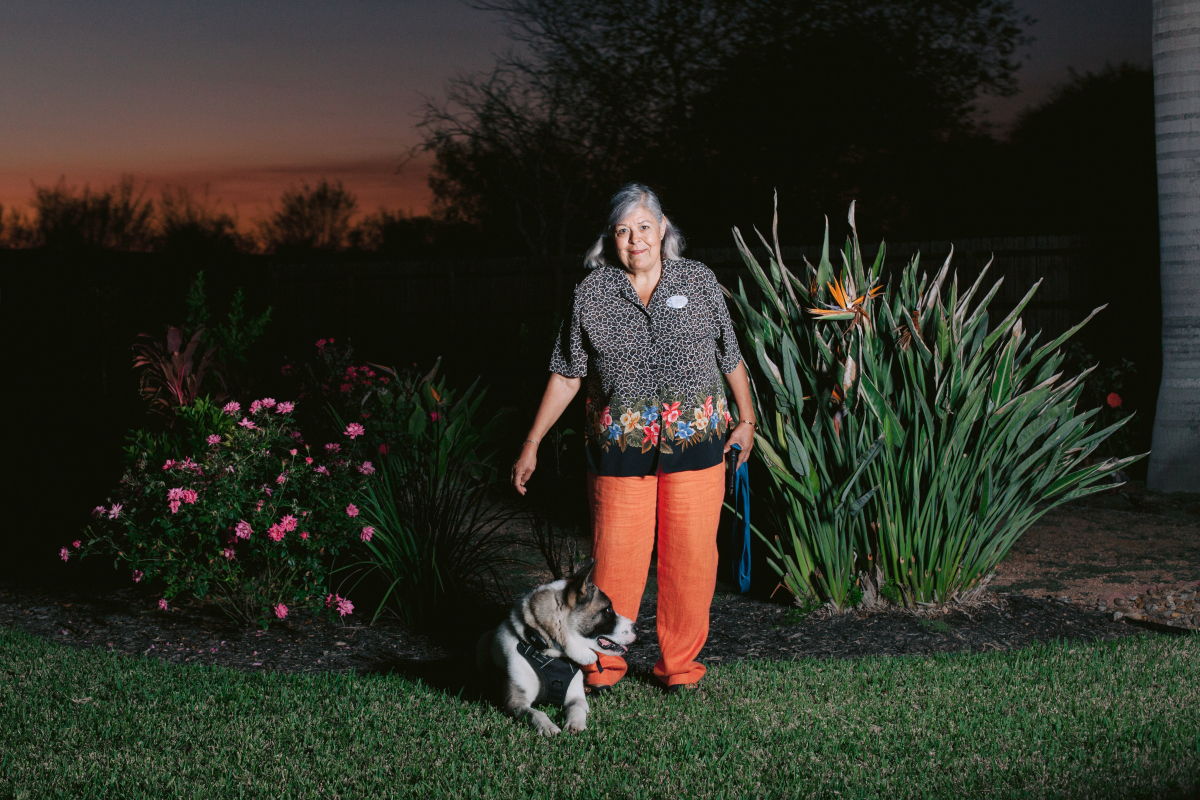
Elvia Carrasco and her dog, Guardian, next to her backyard garden in Brownsville, Texas. MUST CREDIT: Photo by Brenda Bazán for The Washington Post

Elvia Carrasco and her dog, Guardian, next to her backyard garden in Brownsville, Texas. MUST CREDIT: Photo by Brenda Bazán for The Washington Post

President Donald Trump aims to build 166 miles of border barrier in Texas, almost all of it slated to go on private land that the government has yet to acquire – thousands of parcels along the river, an unknown number of them occupied by their owners, including churches and single-family homes. No new border wall has been built on private land in Texas since the president took office, but land acquisition in the Rio Grande Valley is about to enter a new phase this week, as U.S. attorneys began filing initial petitions in court while making cash offers to property owners, according to Justice Department officials with knowledge of the process.

On Friday, the federal government filed its first land acquisition case to condemn nearly 13 acres of private property in the Rio Grande Valley, a parcel near the river levee in Hidalgo County. The owner was offered $93,449 in compensation for the land.

As the government pushes to accelerate construction of what Trump has promised will be a total of 500 miles of new barrier by the end of 2020, it is families like the Castillos, Trevinos and Carrascos that are in the way. Building a wall means more than cutting through desolate desert, grassy ranchlands, shrubby wildlife preserves or old vacant lots – it also means seizing land from working families.

The fight that likely will ensue pits Texans against Trump, who has long said he wants to take whatever land he needs to build his signature promise to America. Landowners, including some who support Trump, are preparing a legal fight that could stall the wall-building effort and lead to years-long court battles over private land rights, family homes and what the Trump administration deems a critical national security issue.

So far, the Trump administration has built about 85 miles of fencing, nearly all of it replacing older structures built before the president took office in 2017. The government broke ground on new border wall in the Rio Grande Valley on Nov. 1, but it was on land the government already controls.

The president has placed his son-in-law, Jared Kushner, in charge of the wall project, including the acquisition of private land. Kushner has urged the Army Corps and the Justice Department to expedite the process, and more recently has directed staff to begin building a centralized database of all the privately owned parcels along the border, according to two senior administration officials familiar with the effort.

The letters landowners have been receiving are the first step in what can be a contentious process, with the government seeking “right of entry” to conduct surveys on the properties and unfettered access for 12 to 18 months. Most landowners consent at first contact and eventually sell, according to attorneys familiar with the eminent domain process.

A growing number of South Texans have not signed those letters and are facing federal lawsuits seeking access to their land. Some said in interviews they have refused to sign because they have concerns about the process or oppose the border wall project.

The Brownsville neighbors, who are no fans of the wall, ignored the letters. One family threw it away. Then came the calls, the text messages and the visits from U.S. attorneys to their work and home.

“I stopped answering the door,” said Arroyo, a teacher, of the multiple visits from lawyers, U.S. Border Patrol agents and Army personnel. “Going to battle against the federal government is not something we will win. But we are not going to take this lying down.”

Assistant Attorney General Jeffrey Bossert Clark, of the Justice Department’s Environmental and Natural Resources Division, said Congress authorized the Department of Homeland Security to acquire land, including by condemnation, “for the public purpose of protecting our nation’s international borders from such threats as terrorism, human trafficking, drug trafficking and illegal immigration.”

“When such takings become necessary, the government provides just compensation that is fair to both landowners and taxpayers,” he said. “When landowners disagree with the government over valuation, there is a transparent, court supervised process for determining just compensation. The vast majority of these matters are resolved without litigation.”

U.S. authorities have filed more than twice as many land-taking lawsuits in 2019 as they did in 2018, indicating that more people are objecting to the government’s use of their land. The Texas Civil Rights Project, which is representing six border property owners pro bono, said the lawsuits signal that landowners are resisting. The nonprofit organization worked closely with activists to teach landowners that they are not obligated to sign their rights away, but many of the property owners cannot afford legal representation.

“These cases are just the tip of the iceberg,” said Ricky Garza, an attorney with the civil rights organization. “We don’t know how many others are prepared to fight back.”

If a court grants the government access, surveyors enter the properties to test the soil, run hydrology studies and determine how much land they need to take for the project. Federal officials sometimes don’t return, deciding a barrier cannot be built and instead work toward installing technology such as fiber optic cables, cameras or listening devices as part of what officials call the “border wall system.”

Rocio Trevino, who owns a home in the subdivision adjacent to the Castillos and Carrascos, denied the government access to survey until they could answer basic questions about what would happen next. The Trevinos signed over rights to a vacant lot they own that also lies in the wall’s path. But the idea of giving the government access to their family home was different.

Trevino voted for Trump and agrees that the nation needs to secure the border – the family has hurricane shutters over every window and door for security – but she is exasperated by the uncertainty and unresponsiveness of the process involving her property.

“What bothered me most is every time I asked a question, the government responded with, ‘We don’t know. We don’t know,’ ” she said.

With five children and a pet horse, the family was not comfortable with strangers entering the property at any hour. The only information they have seen is a map of their tract with a red box superimposed on the slice of the backyard the Trevinos presume could be taken from them. It is adjacent to the holding pen where they keep their quarter horse, Chief, and feet from a fenced-in swimming pool.

People who support the idea of a wall “might feel like it’s good and it’ll stop illegals, but when the wall gets into your space, well, nobody wants that,” said Trevino, 39, who owns a business consulting firm. “I am well aware that things are happening around us, but this is our space and we should have a say-so in whether we want it or not.”

The ordeal has shaken Trevino’s faith in the president, and she would not say if she would vote for him again next year.

Once past the surveying stage, the government will decide how much private land to take and what to pay for it; the government is obligated to offer fair market value as it takes title to the land. Even as negotiations begin, the federal government could own the land in as little as 90 days, attorneys said.

The problem for these three middle-class American families is that despite being relatively far from the waters of the Rio Grande, their property lines are within 50 feet of an earthen levee that marks the edge of the ever-changing waterway’s flood plain.

Wall construction elsewhere in the region involved cutting into the levee to build the concrete base that anchors tall steel bollards. The design includes “enforcement zones” or roads that hug the wall and are wide enough for agents to patrol in vehicles.

Elvia Carrasco has no idea if the metal markers seven feet inside her backyard fence line means that is all contractors will need, or if the construction will run right through the middle of her home.

After years of working and living in Minnesota, Carrasco and her husband moved south, living in a recreational vehicle in Brownsville for a few years before buying a home in 2015 large enough to fit her entire family for holiday reunions.

“Imagine fitting six adults and grandchildren into an RV for Christmas,” said Carrasco, 62, laughing as she tended to the young guava, plum and lemon trees in the backyard botanical garden she has cultivated. The survey marks cuts into her garden.

The couple poured their savings and the money they earned from the sale of their other home into the down payment on their border home, and then spent tens of thousands of dollars on outdoor electricity and an aluminum shed Carrasco’s husband built as a “man cave.” Their border home is an oasis.

“Nothing happens out here,” Carrasco said. “Sometimes I spend all day outside pruning and talking to God and my flowers and plants about all this. I’m not going to let them take what we worked so hard to earn.”

Castillo and Arroyo expect their property value will drop when the barrier is built, and they have suspended all home improvement projects, trying to ignore the cracked blacktop driveway and the failing brick exterior and waiting to repair the master bathroom.

Skinny PVC pipes poke out from the ground where the couple started and stopped installing a sprinkler system. The frame of an unfinished treehouse sits hollow in the middle of the backyard. Instead, the family is saving money in case they have to move.

“We’re kind of trapped,” Castillo said, his youngest son giggling in a tree swing and his daughters feeding grass to a passing horse they dubbed Philippe after the horse in the Disney film “Beauty and the Beast.” “Why am I going to invest in my property if I’m going to have to stare out at a wall or lose it entirely? I’m leaving. I can’t stay here.”

Castillo’s ancestors settled in the Rio Grande Valley in the late 18th century as ranch hands and saddle makers. They are naturally “border people,” and more Texan than American, he said. When he moved into the home, he brought his great-grandfather’s gravestone along and placed it in the southeast corner of his yard – inches from a spray-painted wooden stake the government placed there in September. It is labeled RGV-HRL-7528-2.

He sees the effort to take his land as a betrayal of his service to the country, but he says he is trying to be realistic.

“This is what a certain majority of Americans wanted,” he said. “So because of their desire, I have to swallow it, accept it and take the hit. I guess this is service of a different kind to that America. It’s easy for them to judge; it’s not their backyard.”

Half a year on, Hong Kong’s pro-democracy movement shows it’s still strong

#ศาสตร์เกษตรดินปุ๋ย : ขอบคุณแหล่งข้อมูล : หนังสือพิมพ์ The Nation

https://www.nationthailand.com/news/30379215?utm_source=category&utm_medium=internal_referral

Half a year on, Hong Kong’s pro-democracy movement shows it’s still strong

Dec 08. 2019
Anti-Government Protests in Hong Kong

HONG KONG, CHINA - DECEMBER 8: Protesters form a frontline during a standoff with police at a demonstration on December 8, 2019 in Hong Kong, China. Demonstrations in Hong Kong stretched into its sixth month as pro-democracy groups won the recent District Council elections, continuing demands for an independent inquiry into police brutality, the retraction of the word

Anti-Government Protests in Hong Kong HONG KONG, CHINA – DECEMBER 8: Protesters form a frontline during a standoff with police at a demonstration on December 8, 2019 in Hong Kong, China. Demonstrations in Hong Kong stretched into its sixth month as pro-democracy groups won the recent District Council elections, continuing demands for an independent inquiry into police brutality, the retraction of the word “riot” to describe the rallies, and genuine universal suffrage. (Photo by Anthony Kwan/Getty Images)
By The Washington Post · Shibani Mahtani ·

594 Viewed

HONG KONG – Six months ago over a million people in Hong Kong marched through the city in what became the start of a sustained pro-democracy movement against Beijing’s tightening grip. On Sunday, they did it again.

At least 800,000 people, according to organizers, showed up in the same park, waving signs calling for the end of Chinese Communist Party rule and for the Hong Kong government to meet protesters’ four existing demands. The march, which was approved by authorities, was one of the biggest peaceful protests seen in the city for months and underscores the strong support that still exists for greater democratic freedoms in Hong Kong, despite a crackdown that has seen police fire over 10,000 tear gas canisters, rubber bullets and arrest some 6,000 people.

It was also an indication that increased violence by protesters that reached a peak in November has not deterred the “wo, lei, fei” – the peaceful, reasonable and nonviolent protesters – who continue to demonstrate in solidarity with the more radical front-liners.

“We want to show that the spirit of Hong Kong people is the same, that it won’t change despite all the actions done by the police and the government to stop us and suppress us,” said Mike Cheung, a 25-year old protester standing in Victoria Park waiting for the growing crowd to begin their march. “We still have hope, no matter what.”

The first weeks of November saw the protest movement reach a dangerous new level as protesters tried to hold two university campuses against police incursions, leading to a siege with huge amounts of force used by both sides. Protesters rained down petrol bombs on police, who in turn fired tear gas for hours and threatened to use live rounds against protesters.

But the movement in recent weeks scored two key victories: a resounding vote of confidence at the ballot box with pro-democracy parties winning a huge majority of seats in local elections, and the passage of a U.S. bill that would open those who restrict Hong Kong’s freedoms to sanctions.

The Hong Kong government formally withdrew in October the legislation that would allow extraditions to mainland China, a proposal which kicked off the protests back in June. But it has made no indication that it will meet any of the other demands of protesters, which include an independent investigation into police conduct and the long-held goal of direct elections for Hong Kong leaders.

A 23-year old protester, who wanted to only be referred to by her first name Violet for fear of repercussions from her employer, said she has often been discouraged by the futility of mass demonstrations like Sunday’s.

“Sometimes it almost feels like we are Sisyphus trying to push the rock up the mountain, even though it keeps rolling back on us,” Violet said. But, she added, “being here is the right thing to do.”

In contrast to the tensions that have marked protests for months, the crowd gathered in Victoria Park was almost festive, showing off artistically-designed posters portraying the flash-points over the past six months. Several groups gave out Christmas cards to attendees, asking them to write a message of support to the dozens of detained protesters who have been denied bail and are held in detention centers.

“Even though it is the festive season, we have to remember our brothers and sisters still in jail and tell them that we remember their sacrifices,” said Christine Chan, 23, as she handed out the cards and colored pens.

But by night, small groups of protesters had set up barricades in front of lines of riot police. Graffiti marked almost the entire route of the march. A few businesses perceived to be pro-Beijing and Chinese banks were vandalized, as was the territory’s High Court.

The rally was organized by the Civil Human Rights Front, the same group that organized the earlier marches that drew millions of people. Ahead of the protest, CHRF urged demonstrators to remain peaceful, a hallmark of their rallies. The group said it had timed their march for international Human Rights Day on Dec. 10.

“The human rights violations and humanitarian crisis in Hong Kong and China are reaching a tipping point now,” the group said, expressing solidarity with the Muslim Uighur minority who have been placed in mass detention camps in western China. “Our rally today is to gather everyone in Hong Kong to defend our city, as well as [to advance] the international human rights movement.”

American support for the protest movement has been viewed by Beijing as a deliberate provocation, and Chinese authorities have accused “foreign actors” of stoking the flames of unrest in Hong Kong to destabilize China. On Monday, China said it would sanction U.S.-based nonprofits including the National Endowment for Democracy and Human Rights Watch in retaliation for the pro-Hong Kong legislation.

“They bear great responsibility for the current chaos in Hong Kong,” said Foreign Ministry spokeswoman Hua Chunying. “These organizations deserve to be sanctioned, and they must pay the price for it.”

Those statements appeared to have little connection with the scenes on Sunday, however.

By nightfall, Hong Kong people of all ages continued to make their way from the park – more than three hours after the march began – filling the streets with chants of “Five Demands, Not One Less!”

“We know that achieving democracy takes a very long time, especially since we are against the biggest dictator in the world right now,” added Violet. “But most of us have made ourselves ready for a long fight.”

Deadly fire consumes factory in New Delhi residential area, killing 43

#ศาสตร์เกษตรดินปุ๋ย : ขอบคุณแหล่งข้อมูล : หนังสือพิมพ์ The Nation

https://www.nationthailand.com/news/30379214?utm_source=category&utm_medium=internal_referral

Deadly fire consumes factory in New Delhi residential area, killing 43

Dec 08. 2019
By The Washington Post · Niha Masih, Tania Dutta543 Viewed

NEW DELHI – At least 43 people have died and a dozen others injured in a fire that swept through a small factory early Sunday morning in India’s capital, according to police, making it the second most deadly fire in Delhi history.

The fire rescue operation took nearly four hours involving 30 fire engines and 150 personnel. The fire broke out on the second floor of the five-story building. Atul Garg, the chief of Delhi Fire Services said that cause of the fire – reported at 5:20 a.m. – was not immediately clear as the focus was on the rescue.

Images shared by local media from the accident site showed narrow corridors blackened with soot and charred remains of materials. Police officials said that most of the deceased were workers who lived in the factory, which manufactured school bags and purses. Majority of them were poor migrants from the state of Bihar.

“I saw bodies being taken in sacks,” said Sarfaraz Nabi, who runs an electrical shop nearby describing the mayhem following the fire. Police and rescue teams also carried some on their shoulders. It was a painful sight.”

Another resident, Babur Ali said locals rushed in to save people on hearing of the fire. “I went to the third floor to knock on doors but the rooms were locked from inside and people were fast asleep. We ran out of the building for our lives.”

Garg said the factory was operating in a residential area in central Delhi near Rani Jhansi Road and there were no fire safety provisions. Congested lanes and dilapidated buildings with illegal manufacturing workshops dot the area where the accident took place.

Most of the deaths were due to smoke inhalation, according to Sunil Choudhary, deputy chief fire officer. “The iron gate of the building was locked from outside. The whole building became a gas chamber,” he said.Choudhary said they were looking into the possibility of a short circuit having caused the fire.

There was chaos at the Lok Nayak Jai Prakash hospital where majority of those rescued were shifted as people ran between the emergency ward and the mortuary to locate their relations. Abdul Kareem, 35, rang his relative Mohammad Shakir, a worker at the unit, multiple times after hearing of the fire before he was directed to the hospital. “We have been waiting to hear from the doctors or anyone who could at least tell us if he is alive or dead.”

Mehboob Alam, 60, was also waiting at the mortuary for news of his two nephews who worked in the factory. “My elder brother called me in the morning crying. Imran (his nephew) had called his father scared that he would not survive.” By early evening, Imran’s body was found but Alam was still searching “hopelessly,” for his other nephew.

Deadly fires are common in India, as fire safety regulations are poorly enforced and illegal construction rampant. Small factories, like the one gutted today, often operate illegally in cramped residential buildings without any safety measures in place. Earlier this year a fire at a hotel killed 17 people, prompting an outcry over fire safety measures in buildings in the capital.

Calling it a “tragic incident,” Imran Hussain, a minister in the Delhi state government, said an investigation will be conducted and action taken against those responsible. Delhi’s chief minister, Arvind Kejriwal, visited the spot and announced compensation to the families of the victims.

Delhi witnessed its worst fire tragedy over two decades ago when a fire blazed through a movie theater during a screening, killing 59 people and injuring more than 100 others.

Hong Kong braces itself for big march after days of relative calm

#ศาสตร์เกษตรดินปุ๋ย : ขอบคุณแหล่งข้อมูล : หนังสือพิมพ์ The Nation

https://www.nationthailand.com/news/30379211?utm_source=category&utm_medium=internal_referral

Hong Kong braces itself for big march after days of relative calm

Dec 08. 2019
By The Straits Times
Asia News Network
Hong Kong
800 Viewed

Hong Kong is bracing for renewed tensions on Sunday (December 8) with a march approved by the authorities expected to draw a huge turnout.

Over the past few days while attention has been focused on Hong Kong’s economic outlook, netizens have been drumming up support for the march which is being seen as a litmus test of the support for the anti-government movement amid a weakening economy.

The Civil Human Rights Front, the group behind some of the city’s biggest protests, is expecting a massive turnout for the procession to protect human rights. The first organised by the Front to be approved in months, the march is due to begin at 3pm at Victoria Park in Causeway Bay and will proceed to Chater Garden in Central.

Responding to the planned Human Rights Day event, the government defended the city’s human rights track record, saying the public have had “unquestionable freedom of peaceful assembly, of procession and of demonstration”.

Over the past five years, Hong Kong has held about 44,000 public assemblies and 6,000 public processions – an average of about 27 such events a day, it pointed out in a statement.

Since June, there had been over 900 public demonstrations, processions and public meetings, of which many ended in violent and illegal confrontations including arson and vandalism, the government added. It said it hoped that when people expressed their views and opinions, they would do so without infringing on others’ rights and freedom.

Hong Kong police commissioner Chris Tang told the media in Beijing that police would take a “humanistic” approach to minor incidents but warned of resolute measures against violence. But he added that he hoped the march would be peaceful.

The rally will be taking place amid growing concerns about the state of the Hong Kong economy but two top city officials have offered contrasting views for the future, one more positive than the other.

Commerce and Economic Development Secretary Edward Yau said on Saturday the economy would soldier on and may pick up in 2020.

His prognosis, delivered on a local radio programme, followed Financial Secretary Paul Chan’s warning that months of protests cost the economy two percentage points last quarter.

Yau offered listeners a more upbeat view, saying the pick up in Hong Kong’s economy would ride on the back of progress in trade talks between the United States and China, and as the anti-government unrest, which has gripped the city for almost seven months, fades away.

“On the US-China trade war, I hope that we are seeing some light at the end of the tunnel, with the sitting down of the two leaders and the teams, hopefully we will be having some easing of that tension, which will create a better environment for us hopefully in the new year,” said Yau.

He also said dialogue between the government and society was necessary to resolve the current political crisis, adding that while the retail and tourism sectors had been badly hit, professional and financial services remained “very much intact”.

“If Hong Kong can maintain its ease of doing business, a place where we lay out a level playing field for all, a place where law and order can be maintained, I think confidence will be able to come back.

“So, we are struggling, but I think we will soldier on and we will bounce back,” Yau said.

In contrast, Chan on Monday painted a grim outlook, saying the ongoing unrest has shaved two percentage points from the economy which is already in a precarious position.

The economy has suffered a technical recession for the first time in a decade after growth contracted for two consecutive quarters, shrinking by 3.2 per cent in the third quarter from a year ago.

The slump was driven by a plunge in imports and exports, retail sales, and tourism figures as the months-long protests compounded damage from the drawn-out trade war between the US and China.

While speaking on a separate radio programme on Saturday, Chan said he would consider giving cash handouts when drawing up the 2020-2021 Budget. But he cautioned that the government would be in deficit in the coming years and had to consider fiscal policy over the long-term as the downturn could be “protracted”.

On Saturday afternoon, hundreds of pro-government supporters assembled in Wan Chai, protesting against the pan-democrats’ use of “unscrupulous means to become district councillors” and blaming the media for spreading “fake news”.

Anti-government protesters for their part gathered in Edinburgh Place in Central to show support for Indonesian domestic helper Yuli Riswati, who is also an award-winning writer. On Monday the authorities deported her for failing to extend her visa, a move her supporters alleged was politically motivated.