Sam Rap Thai to promote local delicacies on the global stage

#ศาสตร์เกษตรดินปุ๋ย : ขอบคุณแหล่งข้อมูล : หนังสือพิมพ์ The Nation

https://www.nationthailand.com/food/30378983?utm_source=category&utm_medium=internal_referral

Sam Rap Thai to promote local delicacies on the global stage

Dec 02. 2019
By The Nation

752 Viewed

Sam Rap Thai Institute, an international institute dedicated to promoting Thai food culture, was set up by Thai Fight Company and the Thai Studies Institute of Chulalongkorn University on October 1 this year with the aim of making Thai food, and not just Pad Thai and somtam, known all over the world.

Loved for its rich and bold taste, Thai food might be a favourite but but “local food wisdom” is not developed as it should be. The main purpose of the Sam Rap Thai Institute is to build up a collection of local materials and recipes and publicizing dishes through various activities including television cooking contests and local food festivals, which will be held both domestically and internationally throughout the year.

Sam Rap Thai Institute will also give out the “Siam Jarat” award to guarantee local food and restaurants using authentic recipes.

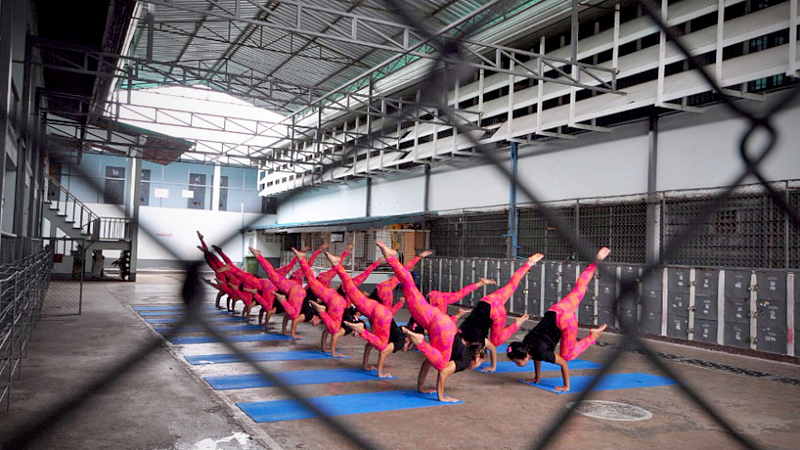
Yoga in prison: another life choice for inmates

#ศาสตร์เกษตรดินปุ๋ย : ขอบคุณแหล่งข้อมูล : หนังสือพิมพ์ The Nation

https://www.nationthailand.com/lifestyle/30378981?utm_source=category&utm_medium=internal_referral

Yoga in prison: another life choice for inmates

Dec 02. 2019
By The Nation

2,261 Viewed

Stretching and bending on the mat, one female prisoner says it is the only time she feels free and no in pain.

Prison life in by its definition limiting and yes, painful, too as the minutes tick by slowly with little to occupy the mind or body. For the fortunate few, there are a number of volunteers doing projects in prisons including art activities, knitting, making furniture, making Buddha statues, all activities that could lead to income-earning work once they are released. There’s yoga too though that appears to be less-accepted on the outside

The Prison Yoga Project is being run by Thirawan Watthanothai, former dean of the Faculty of Architecture, Rajamangala University of Technology Thanyaburi (RMUTT) and introduced in 2011 at Ratchaburi Central Prison before expanding to other prisons. She also plans to initiate a yoga practice project for men in prisons.

After more than 8 years of running her yoga programme in prisons, Thirawan is determined to continue and expand, noting that it has been shown to be useful to the inmates.

“Ninety per cent of the inmates who come to practise yoga have their own unique abilities and what we need to do is encourage society to accept them once they are released. Most yoga studios refuse to give them work even if they pass the test. I want society to give people an opportunity. There was a case of a female inmate in Udon Thani, whose foreign boyfriend helped her move to Switzerland an even opened a yoga studio for her. She was proud that she learned yoga at the prison, “said Thirawan who started to learn yoga with an Indian instructor after overworking, feeling stressed and unable to sleep.

The idea to launch yoga in prison came about after she helped a fellow teacher prepare a report on life in prison and discovered the levels of stress from which female inmates suffer. She felt yoga could be the answer and set off on a journey to get her idea accepted. It took a while but Thirawan was determined.

“We ask the officers to select young people serving long sentences for yoga practice. If we want to mould them into yoga teachers, they must study from 9am to 2pm every day for several months. We saw how it improved not just their state of mind but also helped with lowering blood sugar. After three weeks, the body adapts and the students want to continue. We selected 25 people to teach yoga, most of them with 20 years to run on their jail terms. Prison administrators and staff cooperate to organize morning yoga classes for female inmates. ”

India, America, England, Australia and Scandinavia have also expressed interest in using yoga as part of their jail rehabilitation programmes and studies have shown that prisoners who have been practising yoga enjoy positive physical and mental or even spiritual health. Research in US prisons has found that yoga helps with concentration, makes the body and mind relax and reduces stress and anxiety.

Patcharee Mungmai, 30, a former inmate was given the opportunity to teach yoga to other inmates. She said that yoga is very helpful to her because while she was in prison, she almost lost her mind.

“In prison, the scariest thing is not being beaten but the possibility of going insane. Yoga really made us more conscious. I was sentenced to 16 years and 8 months, but only served 8 years and 1 day. I was arrested during my 4th year in university as part of a drug round up,” she says. Today she is a speaker on drug prevention at the probation office in Ubon Ratchathani Province.

Steady wind, close finishes start Phuket King’s Cup Regatta of ten races

#ศาสตร์เกษตรดินปุ๋ย : ขอบคุณแหล่งข้อมูล : หนังสือพิมพ์ The Nation

https://www.nationthailand.com/sport/30379003?utm_source=category&utm_medium=internal_referral

Steady wind, close finishes start Phuket King’s Cup Regatta of ten races

Dec 03. 2019
Windsikher/Photo by Guy Nowell

Windsikher/Photo by Guy Nowell
By THE NATION

725 Viewed

Phuket – Good, steady wind and some very close racing helped get the 33rd edition of the annual Phuket King’s Cup Regatta off to an exciting start today (December 2).

A total of 75 boats are contesting 10 classes in this year’s regatta, as well as a large fleet taking part in the International Dinghy fleet for young sailors.Two races were held on the first day with Hong Kong’s Nick Burns on WindSikher finishing first in the top flight IRC Zero class.

Thailand’s Kevin Whitcraft finished second overall on THA 72, with defending champion Ray Roberts from Australia third on Team Hollywood.“There was reasonably good wind today, between six and eight knots,” said Race Director Simon James.

“The wind direction changed all the time and the tide was very strong today. By the time we had the second race, the wind became a bit lighter and the tide was getting even stronger.

”Russia’s Alexey Mashkin led an international field in the IRC 1 class aboard his boat MegaZip, followed by Japan’s Nanamori Yasuo on Karasu (Emagine) and Estonia’s Mati Sepp on Loco.Chinese sailors shone in the IRC2 class, taking first and third places. Finishing first was Shen Sheng at the helm of BigBoys Sailing Team (Madame Butterfly), with Thai-based sailor Morten Jakobsen second on Over Here and China’s Minzhi Feng third on Highlead Encoragers (JUDY).

Hong Kong-based sailors finished first and second in the Premier Class, with Peter Cremers steering Shahtoosh into the lead, with Geoff Hill on Antipodes coming second. Local sailor Ithinai Yingsiri kept the Thai flag flying with a third place overall after the first two races.The Multihull Racing Class honours went to Australian Dan Fidock on Fugazi, followed by Germany’s Gaetan Verhegge on Team Red Blood and Hong Kong’s Mark Thornburrow on Bonza.

The hotly contested locally-built multihull Firefly 850 Sport Class saw John Newnham on Twin Sharks win both races today for the overall lead, followed by Hans Rahmann on Voodoo and Peter Taylor on Ballerina.

Closer to Kata Beach, more than 100 young sailors practiced for the International Dinghy fleet, with racing divided into Optimist Boys and Girls, Laser 4.7 (Mixed), Laser Standard, Laser Radial and 420 classes. Racing for the young sailors starts on December 4.Kevin Whitcraft, President of the Organising Committee, said: “For 2019 and in past years, we have had a special focus on growing the dinghy components of our overall regatta, as we in the sailing community in Thailand can feel the positive effect this is having over the years as the sport of sailing continues to grow in popularity here.”

The Phuket King’s Cup Regatta is organised by the Phuket King’s Cup Regatta Organizing Committee under the auspices of the Royal Varuna Yacht Club, in conjunction with the Yacht Racing Association of Thailand, the Royal Thai Navy and the Province of Phuket.There will be five days of racing for the keelboats and multihulls, with a reserve day on Thursday, December 5. For the International Dinghy Classes, four consecutive days of racing will start from Wednesday, 4th December.

Sponsors of the Phuket King’s Cup Regatta include Principal Host Sponsor Kata Group, and Strategic Partners: RMA Group and Belt and Road International Regatta. Co-Sponsors: Haadthip PCL. and Ford. Equipment Sponsor includes B&G Electrical Marine.

China’s Li ready to rise to the occasion in Presidents Cup

#ศาสตร์เกษตรดินปุ๋ย : ขอบคุณแหล่งข้อมูล : หนังสือพิมพ์ The Nation

https://www.nationthailand.com/sport/30379008?utm_source=category&utm_medium=internal_referral

China’s Li ready to rise to the occasion in Presidents Cup

Dec 03. 2019
By THE NATION

246 Viewed

International Team member Haotong Li is planning to showcase the growing strength of Chinese golf to the world by producing a winning display against a Tiger Woods-led United States Team in the Presidents Cup at The Royal Melbourne Golf Club, Australia next week.


The 24-year-old Li will become the first golfer from mainland China to feature in the biennial team competition from December 9-15, an accomplishment he hopes will add further spark for the game to reach greater heights in his home nation.

A two-time European Tour winner, Li qualified automatically as one of the top eight golfers for the Ernie Els’ International Team and he is determined to ensure a memorable debut by helping the team lift the Presidents Cup. Since 1994, the International Team has won the Cup only once previously in 1998 when it was played at Royal Melbourne.

“Everyone in the team must play as best as we can. Then we may have a chance to win. It definitely means a lot to me to be on this team,” said Li. “I was quite close to be in the team in the last edition. I feel I put a lot of effort to get into this team. I just want to go there (Royal Melbourne) and show my golf to the world.”

After launching his career by winning the inaugural PGA TOUR Series-China Order of Merit in 2014 following a three-win season, Li has blossomed into a leading international star. One of his triumphs on the European Tour came at the 2018 Omega Dubai Desert Classic where he defeated reigning FedExCup champion Rory McIlroy with a final-hole birdie after battling head-to-head in the final round.

Earlier this year, the tenacious Chinese showed his match play prowess by progressing into the knock-out phase at the World Golf Championships-Dell Technologies Match Play after defeating Ryder Cup star Alex Noren and World No. 1 Brooks Koepka in the group stage. When he represented Asia in the 2018 EurAsia Cup in Malaysia, he was unbeaten in three matches, owning a 2-0-1 record.

He knows all eyes will  be on him in Australia.

“As Chinese golfers, it is our responsibility and obligation to promote Chinese golf to the world and I’m proud to be one of them. I think we should try hard with better performances to show Chinese golf,” he said.

Li has forged a close friendship with South African legend Els, whom he played with during the final round at the 2017 Open Championship and shot a closing 63 to finish third for his best result in a major.


“Ernie is a very special person to me personally. He has a lot of experience and I can learn a lot of great things from him. It’s my honour to be part of his team,” said Li. “Hopefully I can get some points, especially against Tiger and the best golfers in the world. I’m very excited to get there. To be fair, our team is not as strong as the U.S. Team. So we just want to play our best and hopefully beat them.”

With C.T. Pan of Chinese Taipei also making his debut for the International Team, there is every likelihood that Li and Pan will be paired by Els in either the Four-ball or Foursomes sessions at Royal Melbourne. Li is looking forward to returning to Melbourne where he received plenty of local support when China finished joint second in the ISPS HANDA World Cup of Golf in 2016.

“I have talked a lot with C.T. during tournaments. It would be great (to play together),” he said. “I’ve been there to Melbourne a couple of times and I just want to be back again. It will be incredible for sure and the people will support us.”

Li is looking forward to the day when China has the opportunity to host the Presidents Cup. Since the event’s inauguration, South Korea remains as the only Asian nation to have hosted the prestigious team event in 2015.


“I think such events will help promote Chinese golf a lot. I’m looking forward to having the Presidents Cup in China one day. Chinese golf should be impacted positively,” he said.

PMI rebound a good sign, analysts say

#ศาสตร์เกษตรดินปุ๋ย : ขอบคุณแหล่งข้อมูล : หนังสือพิมพ์ The Nation

https://www.nationthailand.com/ann/30378977?utm_source=category&utm_medium=internal_referral

PMI rebound a good sign, analysts say

Dec 02. 2019
An engineer checks machines in Weifang of Shandong province, China, August 31, 2019. [Photo/VCG]

An engineer checks machines in Weifang of Shandong province, China, August 31, 2019. [Photo/VCG]
By China Daily/ANN

775 Viewed

China’s manufacturing activity rebounded to expansionary territory in November after a six-month streak of contraction. This indicates that growth is stabilizing and business confidence is improving in light of supportive government policies, analysts said on Sunday.

The purchasing managers index for the manufacturing sector bounced back to 50.2 in November from October’s 49.3, according to the National Bureau of Statistics. The growth beat many analysts’ expectation for a below-50 reading.

A reading above 50 indicates expansion, while a reading below reflects contraction.

Analysts said the official factory gauge’s return to the expansion zone indicated that the decelerating economic growth has shown sign of stabilizing and that the business outlook is brightening.

But they warned that the government needs to step up supportive policies to stimulate demand and shore up growth, as the manufacturing sector still faces downward pressure amid uncertainties surrounding the trade talks between Beijing and Washington.

The subindex for production gained 1.8 points to 52.6 in November, while the subindex for new orders rebounded by 1.7 points to 51.3, both of which were in the expansion zone, the NBS reported.

NBS senior statistician Zhao Qinghe said the data showed that both production and demand in the manufacturing sector had improved in November. The two indexes stood at their highest level since the start of the second half of the year.

High-tech manufacturing and the manufacturing of equipment and consumer goods also saw expansion over two consecutive months, showing that the economy is on a transformative track toward high-quality growth and a consumption-driven model, Zhao said.

Meanwhile, China’s nonmanufacturing sector registered faster expansion in November. Its PMI stood at 54.4, up from 52.8 in October, the NBS reported.

“The rebound of both manufacturing and nonmanufacturing PMI showed that downward pressure has been released to some extent in the fourth quarter. But it remains to be seen whether the trend will be sustainable, as the risk of weakening demand still exists,” said Liu Xuezhi, a senior researcher at the Bank of Communications’ Financial Research Center.

Top policymakers in Beijing will gather at the Central Economic Work Conference later this month. The meeting is expected to lay out the country’s growth targets and set the tone for the coming year.

The country’s monetary policy has become more accommodative to prevent a broader economic slowdown, with a focus on guiding more bank lending to smaller and private businesses.

In terms of fiscal policy, the Ministry of Finance has announced a new quota of 1 trillion yuan ($142 billion) of local government special bonds for 2020 and urged that the bonds be issued and used “as early as possible” to boost infrastructure investment.

Looking into 2020, economists predict that Chinese policymakers will maintain stable credit growth and a supportive fiscal policy to stabilize growth. The probability of Beijing and Washington reaching their phase-one trade deal could help reduce external uncertainties.

“The reduced external uncertainty and accommodative policy should lend some support to exports and corporate confidence, which in turn stimulate inventory restocking, manufacturing capital expenditures and private consumption,” Robin Xing, chief China economist at Morgan Stanley, wrote in a research note.

Hu Yifan, chief China economist of UBS Global Wealth Management, said that the country’s consumption remains resilient, and the government is likely to announce more tax and fee cuts to boost consumption in the coming year.

Inclusion of 3500MHz sought in spectra auction

#ศาสตร์เกษตรดินปุ๋ย : ขอบคุณแหล่งข้อมูล : หนังสือพิมพ์ The Nation

https://www.nationthailand.com/business/30379000?utm_source=category&utm_medium=internal_referral

Inclusion of 3500MHz sought in spectra auction

Dec 02. 2019
Marcus Adaktusson, dtac's Chief Corporate Affairs Officer

Marcus Adaktusson, dtac’s Chief Corporate Affairs Officer
By Sirivish Toomgum
The Nation

1,401 Viewed

Total Access Communication (dtac) will propose to the National Broadcasting and Telecommunications Commission (NBTC) tomorrow (December 3) a postponement of the auction of four spectra to allow for the inclusion of 3500MHz.

The NBTC will tomorrow hold a public hearing on the plan toauction 700 MHz, 1800 MHz, 2600 MHz, and 26GHz together on February 16 next year.

Dtac will make a number of recommendations to NBTC regarding the multi-band spectrum auction, Marcus Adaktusson, dtac’s Chief Corporate Affairs Officer, said today (December 2).

“A well-designed and well-timed spectrum auction is critical to 5G deployment in Thailand. While we welcome the proposed multi-band auction model, we propose adjusting the timing of the auction to allow for inclusion of the 3500MHz band. This will allow bidders to acquire the most efficient spectrum portfolios for 5G deployment,”he said.


Source: dtac

Source: dtac

While the NBTC reportedly plans to auction 3500MHz in advance next year, he said dtac has yet to see a firm commitment as to when that auction will happen as well as details of the 3500MHz auction plan.

The 3500MHz band is currently being used by satellite operator Thaicom.

Technically, the 2600MHz and the 3500MHz bands could be substituted for each other for 5G since they have similar properties.

He noted that the 3500MHz spectrum is becoming the most-used band for 5G service across the world, which means more device and equipment will be available on a cost-effective basis.

Source: dtac

Source: dtac

Narupon Rattanasamaharn, dtac’s senior vice president, added that if NBTC could not auction 3500MHz in the upcoming auction on February, it should at least quickly provide full auction details of the band.

Given the 190MHz bandwidth of the 2600MHz spectrum will be allocated at the auction, dtac will suggest to NBTC that it impose spectrum caps in the 2600MHz spectrum band to avoid potential market distortion and allow sufficient number of operators to contribute to 5G development in Thailand.

The NBTC may want to make some caps flexible, based on the number of bidders, Adaktusson added.

Dtac will also ask the NBTC to provide clarifications on potential interference, usage restrictions and roll-out obligations of some spectra.

The company cited the NBTC draft term of licensing rules that 20MHz of the 2600MHz is currently being used and as such NBTC should provide relevant clarifications in terms of interference and usage restriction risks to enable proper valuation of the auctioned spectrum.

The NBTC should also set reserve prices at a level which support infrastructure investments.

The proposed reserve price for the 10MHz of spectrum in the 2600MHz band (Bt1.862 billion per licence) is at the higher end of international benchmark and there is a clear risk that much needed investments in network infrastructure will be impeded by the high spectrum prices.

The 1800MHz spectrum band (Bt12.486 billion per licence) is priced many times higher than the international benchmark and will definitely increase the risk of a failed auction.

Moreover, the NBTC should set significant financial guarantees to prevent unserious bidders from entering the race.

Deloitte Thailand launches new advisory service for family-run businesses

#ศาสตร์เกษตรดินปุ๋ย : ขอบคุณแหล่งข้อมูล : หนังสือพิมพ์ The Nation

https://www.nationthailand.com/business/30378994?utm_source=category&utm_medium=internal_referral

Deloitte Thailand launches new advisory service for family-run businesses

Dec 02. 2019
Deloitte Thailand  launches Deloitte Private, a dedicated practice that provides integrated advisory and assurance services to private entities.

Deloitte Thailand launches Deloitte Private, a dedicated practice that provides integrated advisory and assurance services to private entities.
By THE NATION

1,060 Viewed

Deloitte Thailand on Monday (December 2) announced the launch of Deloitte Private, a dedicated practice that provides integrated advisory and assurance services to private entities.

In Thailand, family businesses are growing stronger, as out of a total net worth of Bt42 trillion from all Thai businesses, approximately Bt30 trillion is family-run businesses, or 72 per cent of the total business value, and more than 50 per cent of listed companies are family owned, according to Deloitte.

Professionalising the business remains a key concern among family business owners.

Deloitte Private’s subject-matter experts and industry specialists within the Deloitte global network advise family and privately owned businesses, family offices and high net worth individuals, and private equity firms, helping them to grow in an increasingly complex, global and digital business world, the firm said.

“We see an increasing demand from privately owned businesses for professional advice to tackle their most complex challenges: from investing in emerging technologies, expanding in global markets, to navigating tax reforms, restyling the workforce and countering omnipresent risks such as cyberattacks,” said Richard Loi, Deloitte Private leader for Southeast Asia. “We have been advising privately owned organisations, and with Deloitte Private formally launched in Thailand, we aim to expand our network to reach more clients,” he added.

“Our in-depth knowledge, coupled with access to our Asia Pacific and global resources, gives us a unique value proposition to best serve the private market in the region,” said Philip Yuen, chief executive officer for Deloitte Southeast Asia. “Deloitte Private offers a single point of access that the decision-makers of family businesses and privately owned companies strive for.”

One of the service offerings in Deloitte Private is Family Enterprise Consulting, a highly customised service for business and wealth-owning families.

“The economic environment requires businesses to adapt quickly,” said Subhasakdi Krishnamra, country managing partner, Deloitte Thailand. “Family businesses are facing distinct challenges affecting their future success. Being agile and staying in the game will offer businesses growth opportunities and the ability to compete in today’s dynamic markets amid uncertainties.”

“One of the perennial challenges faced by almost every family is balancing the desire to preserve wealth through the generations with the income needs and ambitions of the current generation,” added Phansak Sethsathira, partner and leader of Deloitte Private Thailand. “Our suite of offerings has been designed specifically for this unique group of clients, and our aim is to address some of the fundamental questions and achieve clarity around priorities, wants and needs in order to help define and execute an effective strategy that preserves the family’s wealth and legacy for the future.”

The first Deloitte Private practice in Southeast Asia was launched in Singapore. Besides Indonesia, Deloitte Private will be launching in several other markets in Southeast Asia soon.

Deloitte Private will also launch Best Managed Companies in Indonesia – an awards programme recognising privately held companies for their organisation’s success and achievements.

Best Managed Companies Indonesia joins a global awards programme currently active in the Americas, Europe, Australia, China and now Southeast Asia. The designation is a well-regarded international stamp of quality for best managed private companies.

U.S. stocks sink on worrisome factory data and Trump’s renewed tariffs on steel, aluminum

#ศาสตร์เกษตรดินปุ๋ย : ขอบคุณแหล่งข้อมูล : หนังสือพิมพ์ The Nation

https://www.nationthailand.com/business/30379013?utm_source=category&utm_medium=internal_referral

U.S. stocks sink on worrisome factory data and Trump’s renewed tariffs on steel, aluminum

Dec 03. 2019
File Photo:U.S. Stocks Tumble As China Trade Talks Stall

NEW YORK, NEW YORK - NOVEMBER 20: Traders work on the floor of the New York Stock Exchange (NYSE) on November 20, 2019 in New York City. As trade talks with China continue to lack resolution, frustrating investors, the Dow Jones Industrial Average ended the day down over 100 points. (Photo by Spencer Platt/Getty Images)

File Photo:U.S. Stocks Tumble As China Trade Talks Stall NEW YORK, NEW YORK – NOVEMBER 20: Traders work on the floor of the New York Stock Exchange (NYSE) on November 20, 2019 in New York City. As trade talks with China continue to lack resolution, frustrating investors, the Dow Jones Industrial Average ended the day down over 100 points. (Photo by Spencer Platt/Getty Images)
By The Washington Post · Taylor Telford, Thomas Heath

337 Viewed

Stocks got off to a rocky December start on Monday amid disappointing manufacturing and construction data and renewed global trade tensions.

The record bull run of the past month flamed out, with the Dow Jones industrial average declining 268 points, or .95%, to close at 27,783. The Standard & Poor’s 500 index dropped 27 points, or .86%, to close at 3113. The tech-laden Nasdaq composite was hit particularly hard, finishing at 8,567, a 97-point drop of 1.1%.

“All this trade friction is weighing on the manufacturing sector, reminding us that protectionism is not a victimless crime,” said Kristina Hooper, chief global market strategist at Invesco.

Nine of 11 stock market sectors declined on Monday, with industrials, information technology and real estate leading the slide. All but seven of the Dow 30 blue chips finished in negative territory, with Boeing, American Express and United Technologies the biggest drags.

President Trump threw another curve ball into the trade picture Monday when he announced on Twitter that he would reinstate steel and aluminum tariffs on Brazil and Argentina. He accused the two nations of weakening their currencies to gain competitive advantage against the U.S., an oft-repeated rebuke that he’s cited in his ongoing push for lower or even negative interest rates from the Federal Reserve.

“Brazil and Argentina have been presiding over a massive devaluation of their currencies. which is not good for our farmers,” Trump said in Monday morning tweet. He then pivoted to the Federal Reserve, saying the central bank should “act so that countries, of which there are many, no longer take advantage of our strong dollar by further devaluing their currencies. This makes it very hard for our [manufacturers] & farmers to fairly export their goods. Lower Rates & Loosen – Fed!”

Stock futures had been trending up early Monday. Two surveys over the weekend showed that China’s manufacturing sector rallied to an eight-month high in November, and European manufacturing data showed a better-than-expected easing in the sector’s contraction. The strong data suggested that China’s economy could be stabilizing after months of a brutal slowdown, quieting some fears about the trade war’s toll on one of the world’s most powerful economic engines.

But Trump’s early morning announcement quickly cooled markets. By midday, all three market measures were in the red.

“The stock market’s early gains in the futures markets melted away after the President’s early morning tweet,” said Chris Rupkey, chief financial economist of MUFG Union Bank, in a note.

Then came Monday’s U.S. manufacturing report about a half-hour after trading began.

U.S. manufacturing disappointed in November, according to the Institute for Supply Management. Its manufacturing index dropped to 48.1% in November from 48.3% in October, coming in well below analyst expectations. Readings below 50% indicate business conditions are getting worse. Global trade “remains the most significant cross-industry issue,” Timothy Fiore, chair of the ISM’s manufacturing business survey committee, said in the report.

“With manufacturing being in deep trouble globally, today’s PMI reading of 48.1 could mean that the sector won’t avoid a recession, so the consumer economy would have to remain robust to sustain growth in the U.S.,” Ken Berman, a strategist with Gorilla Trades, wrote in commentary Monday.

Also on Monday, the Commerce Department reported a downward revision in September construction spending that showed a 0.3% decline instead of the 0.5% surge as originally reported.

November was a blockbuster month for Wall Street, as strong earnings and trade hopes yielded 10 record-breaking closes for U.S. indexes. The Standard & Poor’s 500 is still up nearly 25% for the year heading into a period that’s typically high-performing for stocks.

December could also bring progress on the trade front, as the terms of an agreement by the United States, Mexico and Canada could be finalized, while resolution on the first phase of a trade deal with China continues to flit in and out of reach.

Last week, Trump said that negotiators were in “the final throes” of sorting out a trade deal with China that would bring the first phase of resolution in the 16-month conflict. But over the weekend, China’s state-run newspaper, the Global Times, reported that negotiators are optimistic about a deal before the Lunar New Year in January, but that rollbacks of tariffs are essential if a deal is to be reached.


In an interview with Fox Business on Monday, Commerce Secretary Wilbur Ross said progress with China has been “one step forward, one step backward” and made it clear Trump was not looking to compromise on tariffs. Ross said Trump to move forward with the tariff increases slated for Dec. 15 if a phase one deal wasn’t inked by then.

“That won’t interfere with this year’s Christmas. Nobody’s reordering stuff after the 15th of December,” Ross said. “Retailers have stocked up. So, it’s a very good time, if we have to put more tariffs on.”

When Trump announced the reinstated the steel and aluminum tariffs, he pointed to the strength of the markets as evidence that his hard-line trade policies weren’t hurting the U.S. economy.

“U.S. markets are up as much as 21% since the announcement of Tariffs on 3/1/2018,” Trump tweeted Monday. “And the U.S. is taking in massive amounts of money (and giving some to our farmers, who have been targeted by China)!”

On Friday, a top Mexican trade negotiator said that terms of a replacement for the North American Free Trade Agreement – one of the Trump administration’s key goals – could be cemented early this week, fueling hopes that Congress could approve it before the end of 2019. The Trump administration reached an agreement with the governments in Canada and Mexico last year, but it must be approved by the House and the Senate before the changes can become official.

Trump’s renewed tariffs on steel and aluminum dealt a surprise blow to one of Brazil’s most crucial industries in a vulnerable moment for the economy, as unemployment hovers above 10% and growth continues to slow. Brazilian steel exports to the U.S. accounted for roughly $2.6 billion last year – making the U.S. one of Brazil’s biggest markets for steel – and analysts expected the tariffs to be painful.

In Argentina, where steel and aluminum exports represent roughly $700 million, the unexpected news comes as the nation is undergoing a transition of power. If the tariffs persist, they will be one of the earliest diplomatic tests to face the incoming presidency of Alberto Fernández, a leftist politician who will take office within a week.

Before leaving the White House for a trip to a NATO gathering in London, Trump told reporters he had given Brazil and Argentina “a big break on tariffs, but now I’m taking that break off.”

“It’s very unfair to our manufacturers and very unfair to our farmers,” Trump said. “Our steel companies will be very happy, and our farmers will be very happy.”

The flurry of potential trade activity is coalescing during what is typically a period of low volatility and high advances for stocks, said Sam Stovall, president of CFRA Research.

“Seasonal optimism typically gathers additional steam in the final month of the year as investors look to earnings projections for the coming year. Indeed, since 1945, the S&P 500 posted its best average return in December, along with the highest frequency of advance and lowest level of volatility,” Stovall wrote in a note to investors Monday. “Trade relations, earnings estimates and valuations will likely influence trading this month, while the angle of ascent for U.S. economic growth, along with the presidential primaries, will garner additional attention as the new year progresses.”

U.S. factories extend contraction as index misses forecasts

#ศาสตร์เกษตรดินปุ๋ย : ขอบคุณแหล่งข้อมูล : หนังสือพิมพ์ The Nation

https://www.nationthailand.com/business/30379007?utm_source=category&utm_medium=internal_referral

U.S. factories extend contraction as index misses forecasts

Dec 03. 2019
File Photo

File Photo
By Syndication Washington Post, Bloomberg · Vince Golle

910 Viewed

America’s industrial heartbeat remained faint in November as a measure of manufacturing contracted for a fourth straight month against a backdrop of weaker orders and subdued production. Stocks and the dollar fell, while Treasuries rallied.

The Institute for Supply Management data on Monday showed the factory purchasing managers’ index unexpectedly declined to 48.1, near the expansion’s low point, from 48.3. The median forecast in a Bloomberg survey of economists called for an improvement to 49.2. Readings below 50 indicate activity is shrinking.

The figures show the manufacturing sector, while no longer in freefall, lacks upward momentum in an environment of corporate investment cutbacks, subdued global demand and a still-simmering U.S.-China trade war. At the same time, factory gauges in China and Germany suggested the worst may be over for the sector.

Consumer spending continues to keep the U.S. expansion going, and other reports indicate American factory activity is gradually firming. A similar PMI issued Monday by IHS Markit rose to a seven-month high of 52.6 in November, after the government reported last week that business-equipment demand climbed in October by the most in nine months.

Still, the ISM’s measure of factory orders declined in November after consecutive gains and, at 47.2, matches the lowest readings of the expansion. While 20.5% of respondents — the same as in October — reported higher orders, the share indicating lower bookings increased by 2.7 points to 31.2%. These figures signal that the surprise jump in the government’s October reading for capital goods orders and shipments may not be sustained.

Thirteen industries, including wood products, furniture, textiles and fabricated metals, reported that business shrank in November.

The ISM’s survey indicated a deeper decline in factory employment, while the gauge of order backlogs dropped to its lowest level since January 2016. That helps explain why factories can operate with leaner staffing. The group’s gauge of production, while rising for the first time since June, contracted for a fourth month.

An ISM measure of exports, after expanding in October for the first time in four months, fell back into contraction. The imports gauge also signaled a contraction, albeit a milder one than a month earlier.

The gauge of supplier deliveries was the only component above 50, indicating shipments of inputs are slowing.

An index of prices paid contracted for a sixth straight month, a sign that weak demand is holding down inflation.

Confidence in manufacturing, employment drops

#ศาสตร์เกษตรดินปุ๋ย : ขอบคุณแหล่งข้อมูล : หนังสือพิมพ์ The Nation

https://www.nationthailand.com/business/30379005?utm_source=category&utm_medium=internal_referral

Confidence in manufacturing, employment drops

Dec 03. 2019
The Business Sentiment Index (BSI) dropped to 47.4 in November 2019, which was below the 50 threshold for eight consecutive months.

The Business Sentiment Index (BSI) dropped to 47.4 in November 2019, which was below the 50 threshold for eight consecutive months.
By The Nation

1,010 Viewed

The Business Sentiment Index (BSI) dropped to 47.4 in November 2019, which was below the 50 threshold for eight consecutive months due largely to weaker confidence in the manufacturing sector, according to a central bank report on Monday (December 2).

However, the confidence of respondents in the non-manufacturing sector held steady this month, the report said. Their order books and investment sentiment improved slightly, while the positive performance outlook edged down.

The three-month BSI fell to 52.7 due to a softened positive outlook in almost all sub-indices, especially in production and performance.

In November 2019, the BSI decreased from the previous month to 47.4, mainly driven by a pessimistic view of respondents in the manufacturing sector.

Automotive and petroleum-related sectors showed reductions in production, performance and orders because of a sluggish demand both domestic and external, as well as inconclusive trade negotiations between the US and China.

There was also a broad-based decrease in sub-indices, especially for production and performance.

In particular, respondents in the construction and machinery manufacturing sectors were less optimistic on future production and performance, in line with their investment conditions that have not recovered yet.

However, the expected BSI and almost all sub-indices remained above the 50 threshold, indicating that most respondents still expected an economic expansion in the future, the report said.

Weak domestic demand remained the most important constraint in doing business this month, consistent with the persistent deterioration of sentiment in domestic order books for six consecutive months.

Furthermore, more respondents expressed concern over economic uncertainty, which was also partly reflected by the downtrend of the performance sentiment index as well as the worsened business sentiment in employment over the last three months particularly in the manufacturing sector.

However, expected inflation in the next 12 months remained unchanged at 1.7 per cent, the report added.