Moon begins week of ASEAN diplomacy with Brunei, Singapore summits

ศาสตร์เกษตรดินปุ๋ย : ขอบคุณแหล่งข้อมูล : หนังสือพิมพ์ The Nation

https://www.nationthailand.com/ann/30378694?utm_source=category&utm_medium=internal_referral

Moon begins week of ASEAN diplomacy with Brunei, Singapore summits

Nov 24. 2019
President Moon Jae-in and Sultan Hassanal Bolkiah shake hands at the presidential office on Sunday. Yonhap

President Moon Jae-in and Sultan Hassanal Bolkiah shake hands at the presidential office on Sunday. Yonhap
By The Korea herald

718 Viewed

President Moon Jae-in held summit meetings with the leaders of Brunei and Singapore over the weekend, kicking off a flurry of bilateral and multilateral summits held on the occasion of the ASEAN-ROK Commemorative Summit and the first Mekong-Korea summit. On Sunday, Moon met with Brunei’s Sultan Hassanal Bolkiah, who is visiting Korea on a state visit, in Seoul.

“The potential for cooperation between the two countries is limitless, from ICT, smart city, electronic government and other high-tech industries to defense and defense industry,” Moon said at the meeting, saying that the two countries’ cooperation should expand beyond energy and infrastructure.

“If (Brunei’s) Vision 2035 and our New Southern Policy are carried out in harmony, (the two countries) could expand the scope of cooperation to new industries of the future and achieve shared prosperity.”

Vision 2035 is Brunei’s economic growth strategy, and the New Southern Policy is one of Moon’s main foreign policies that aims to significantly boost Seoul’s economic and political cooperation with ASEAN.

The Bruneian leader echoed Moon, saying that Korea is an important partner of ASEAN and that Brunei will seek ways to expand Seoul’s cooperation with ASEAN and his country.

Following the summit, the two leaders attended the signing ceremony for three memorandums of understanding on Korea-Brunei cooperation.

The two sides agreed to seek closer cooperation on Sunday in the areas of information and communication technology, electronic government systems and fields related to building smart cities.

The Moon administration’s New Southern Policy — whose scope includes India — is central to the ASEAN-Korea summit.

According to Joo Hyung-chul, Moon’s chief economic adviser and head of the New Southern Policy committee, the leaders attending the summit conference will adopt a joint Korea-ASEAN vision that will lay the foundation for future cooperation among the countries.

A day ahead of the Brunei summit, Moon kicked off the series of summits with Singapore’s Prime Minister Lee Hsien Loong.

The Korea-Singapore summit was also followed by a signing of memorandums on smart city cooperation and pharmaceuticals production and quality control standards. The two sides also signed revised memorandums on cooperating in the fields of cybersecurity and standardization.

In addition to the leaders of Brunei and Singapore, Moon is set to hold bilateral meetings with seven other heads of states attending the ASEAN-Korea and Mekong-Korea summits.

On the sidelines of the ASEAN-Korea summit on Monday and Tuesday, Moon will meet with the leaders of Indonesia, Laos, Myanmar, Thailand and the Philippines, in Busan.

On Wednesday, Moon and Vietnamese Prime Minister Nguyen Xuan Phuc will hold a summit in Seoul after wrapping up the Mekong-Korea summit in Busan earlier in the day.

The week of ASEAN diplomacy will end Thursday with Moon meeting Malaysian Prime Minister Mahathir Mohamad in Seoul.

A summit meeting between Moon and Cambodian Prime Minister Hun Sen was canceled and replaced with a foreign ministers’ meeting between Seoul’s Kang Kyung-wha and her counterpart, Prak Sokhonn. According to Cheong Wa Dae, the Cambodian prime minister is unable to attend the summit, as his mother-in-law is in a critical condition.

Envoy: China nationals will be taught how to behave in M’sia

ศาสตร์เกษตรดินปุ๋ย : ขอบคุณแหล่งข้อมูล : หนังสือพิมพ์ The Nation

https://www.nationthailand.com/ann/30378689?utm_source=category&utm_medium=internal_referral

Envoy: China nationals will be taught how to behave in M’sia

Nov 24. 2019
Ambassador Peoples Republic of China to Malaysia Bai Tian at Malaysia - China Enterprises Business Matching Conference 2019 at Shangri La hotel. AZMAN GHANI / The Star

Read more at https://www.thestar.com.my/news/nation/2019/11/24/envoy-china-nationals-will-be-taught-how-to-behave-in-msia#BghwZVckDmUHF5Uq.99

Ambassador Peoples Republic of China to Malaysia Bai Tian at Malaysia – China Enterprises Business Matching Conference 2019 at Shangri La hotel. AZMAN GHANI / The Star Read more at https://www.thestar.com.my/news/nation/2019/11/24/envoy-china-nationals-will-be-taught-how-to-behave-in-msia#BghwZVckDmUHF5Uq.99
By The Star/ANN

771 Viewed

KUALA LUMPUR: China will not tolerate misbehaviour involving its nationals in Malaysia, says its chief diplomat here.

China’s Ambassador to Malaysia Bai Tian (pic) said the embassy received several reports on tourists who did not respect the sensitivities of Malaysians.

Saying this caused much embarrassment to the Chinese government, he remarked: “The Chinese have a civilisation dating back 5,000 years and we know how to behave properly and not offend others.”

Bai Tian said Chinese tourists spent RM12.3bil over the past year in Malaysia, and so the embassy was extra concerned about such misdemeanours.

He cited an incident in Sabah where tourists from China acted insensitively in front of a mosque, which led to them being ticked off by local tourism officials.

“What the Malaysian authorities did was right. On our part, we will educate our tourists to behave properly in Malaysia, ” said the envoy at a forum on China’s Belt Road Initiative (BRI) organised by the Malaysian Youth Council and Dewan Bahasa dan Pustaka here yesterday.

Bai Tian spoke on the many job opportunities under the BRI cooperation with Malaysia and how it would be the catalyst for further trade growth between both countries and the world.

On the chaos in Hong Kong, he said the rule of law had been set aside with the so-called pro-democracy protesters turning Hong Kong into an “abyss of chaos”.

On the Muslim Uighur issue, he said one should consider China’s policy of allowing them to have more children and the 15 years of free education which was not offered to others.

China has been under international fire for its alleged persecution of Muslim Uighurs, a predominantly Turkic-speaking ethnic group primarily from China’s northwestern region of Xinjiang.

“There are 14 million Muslims in Xinjiang, with 40,000 mosques and 26,000 imams.

“Our Constitution allows for all religions, and freedom not to have a religion.

“Who was heading the 23 countries to criticise us over the Uighurs? The US and its allies.

“Sixty-six countries, including Muslim countries, stood up and refuted the Western accusations, ” said Bai Tian.

The envoy also lambasted the “debt trap” theory against China which gave loans to Asian countries.

“This is all a Western fabrication for their own economic and political agenda, ” he said.

The forum was held in conjunction with the 45th anniversary of diplomatic relations between Malaysia and China.


Read more at https://www.thestar.com.my/news/nation/2019/11/24/envoy-china-nationals-will-be-taught-how-to-behave-in-msia#BghwZVckDmUHF5Uq.99

Musk touts 187,000 Cybertruck orders two days after reveal

ศาสตร์เกษตรดินปุ๋ย : ขอบคุณแหล่งข้อมูล : หนังสือพิมพ์ The Nation

https://www.nationthailand.com/business/30378709?utm_source=category&utm_medium=internal_referral

Musk touts 187,000 Cybertruck orders two days after reveal

Nov 25. 2019
Tesla Chief Executive Officer Elon Musk said orders for the Cybertruck have climbed to 187,000 even after two windows unexpectedly shattered in Thursday's big reveal.
Photo credit: Tesla

Tesla Chief Executive Officer Elon Musk said orders for the Cybertruck have climbed to 187,000 even after two windows unexpectedly shattered in Thursday’s big reveal. Photo credit: Tesla
By Syndication Washington Post/Bloomberg · Dana Hull · BUSINESS

392 Viewed

Tesla Chief Executive Officer Elon Musk said orders for the Cybertruck have climbed to 187,000 even after two windows unexpectedly shattered in Thursday’s big reveal.

File Photo:Tesla Debuts Its New Crossover SUV Model, Tesla X  FREMONT, CA - SEPTEMBER 29: Tesla CEO Elon Musk steps out of the new Tesla Model X during an event to launch the company's new crossover SUV on September 29, 2015 in Fremont, California. After several production delays, Elon Mush officially launched the much anticipated Tesla Model X Crossover SUV. The (Photo by Justin Sullivan/Getty Images)

File Photo:Tesla Debuts Its New Crossover SUV Model, Tesla X FREMONT, CA – SEPTEMBER 29: Tesla CEO Elon Musk steps out of the new Tesla Model X during an event to launch the company’s new crossover SUV on September 29, 2015 in Fremont, California. After several production delays, Elon Mush officially launched the much anticipated Tesla Model X Crossover SUV. The (Photo by Justin Sullivan/Getty Images)

The electric-car maker has a history of unveiling future products to throngs of excited customers, taking deposits, and then delivering years later. Two years ago, Tesla showed off a Semi truck and a next generation Roadster sports car, but neither vehicle is in production yet. This spring, Musk unveiled the Model Y crossover; that vehicle is slated to begin production next summer.

The orders, an increase from a 146,000 figure that Musk announced in a Tweet on Saturday, underscores the hard-to-resist nature of announcing deposits, even when they are fully refundable and may never be converted into actual sales.

Tesla’s reservation list has long been a source of intrigue for investors, analysts, journalists, fans and skeptics of the company, as it’s often used as a proxy for demand. Musk’s tweet breaks with the recent practice at Tesla, which has stopped giving reservation figures on its quarterly earnings calls, saying the metric wasn’t relevant.

“We don’t want to comment on the granularity of deposits – again, people just read too much into those,” Musk said on Tesla’s first-quarter earnings call in April, when asked about the Model Y.

Tesla’s website allows customers to order the truck for a fully refundable $100, and says they can complete their configuration “as production nears in late 2021.” Musk said in a tweet Saturday that 42% had ordered the dual-motor option, which starts at $49,900, while 41% have ordered the $69,900 triple-motor option, production of which is expected to begin in late 2022. Just 17% ordered the single-motor version, which begins at $39,900.

The $100 deposit for the Cybertruck is far cheaper than the $1,000 that was required to reserve a Model 3 sedan.

“Reservations are not relevant for us,” former Chief Financial Officer Deepak Ahuja said in January, during the company’s 2018 fourth-quarter earnings call. “Now we do have a large reservations backlog still, which tells us that a lot of customers are still waiting for those cars. But I don’t think it’s appropriate to share the reservations number.”

Tesla never released an order or reservation figure for the Model Y. The company had $665 million in customer deposits as of Sept. 30, according to a regulatory filing.

In a demonstration of the truck’s toughness, long-time Tesla lead designer Franz von Holzhausen whacked the Cybertruck’s stainless steel door with a mallet, showing that it couldn’t be dented. But when he threw a metallic ball at the driver side front window, it shattered.

The crowd gasped. “Oh my f—ing god,” said Musk. “Maybe that was a little too hard.”

So von Holzhausen tried a second, softer throw – this time targeting the truck’s rear window – only to see that shatter as well.

It wasn’t immediately clear who supplied the glass or if Tesla made what it called “Armor Glass” completely in-house. Tesla entered the glass technology business back in 2016, and has an internal group known as Tesla Glass.

Musk said his team threw the same steel ball at the window several times before the event and didn’t even scratch the glass. Late Friday, he tweeted out a short video of von Holzhausen that has been viewed more than 6 million times.

The angular, futuristic design and the shattering glass generated enormous publicity for Tesla and its truck, but shares tumbled 6.1% to $333.04 Friday, the sharpest decline in almost two months.

Finance Ministry mulls tax incentives for longer-term investment: source

ศาสตร์เกษตรดินปุ๋ย : ขอบคุณแหล่งข้อมูล : หนังสือพิมพ์ The Nation

https://www.nationthailand.com/business/30378704?utm_source=category&utm_medium=internal_referral

Finance Ministry mulls tax incentives for longer-term investment: source

Nov 25. 2019
By Wichit Chaitrong
The Nation

1,302 Viewed

The Finance Ministry will decide on Monday (November 25) on tax incentives for long-term equity investment.

Ministry officials will meet with representatives of the Revenue Department and Securities and Exchange Commission (SEC) to resolve whether to renew incentives for investors in long-term equity funds (LTFs), given than tax deductions under the scheme will cease at the end of the year.

“The Revenue Department and SEC have different ideas about how to promote long-term investment,” an informed source said on condition of anonymity.

The SEC wants to promote more investment in the Stock Exchange of Thailand, while the Revenue Department wants to promote investments extending least 10 years, the source said.

Investors in LTFs are currently required to stay in for at least five years, but the department regards the term as too brief.

Finance Minister Uttama Savanayana has asked the Fiscal Policy Office to present options, said the source, and it “is likely to agree with the Revenue Department”.

Tax deductions under LTF conditions amount to as much as 15 per cent of income, but are limited to Bt500,000 per individual taxpayer.

Officials will also discuss whether to maintain that limit or halve it.

Critics say the incentives benefit only high-income people, who can afford to invest more.

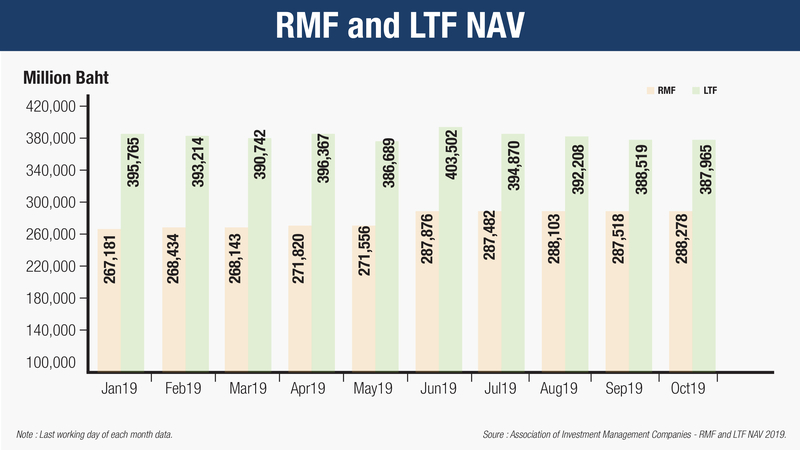
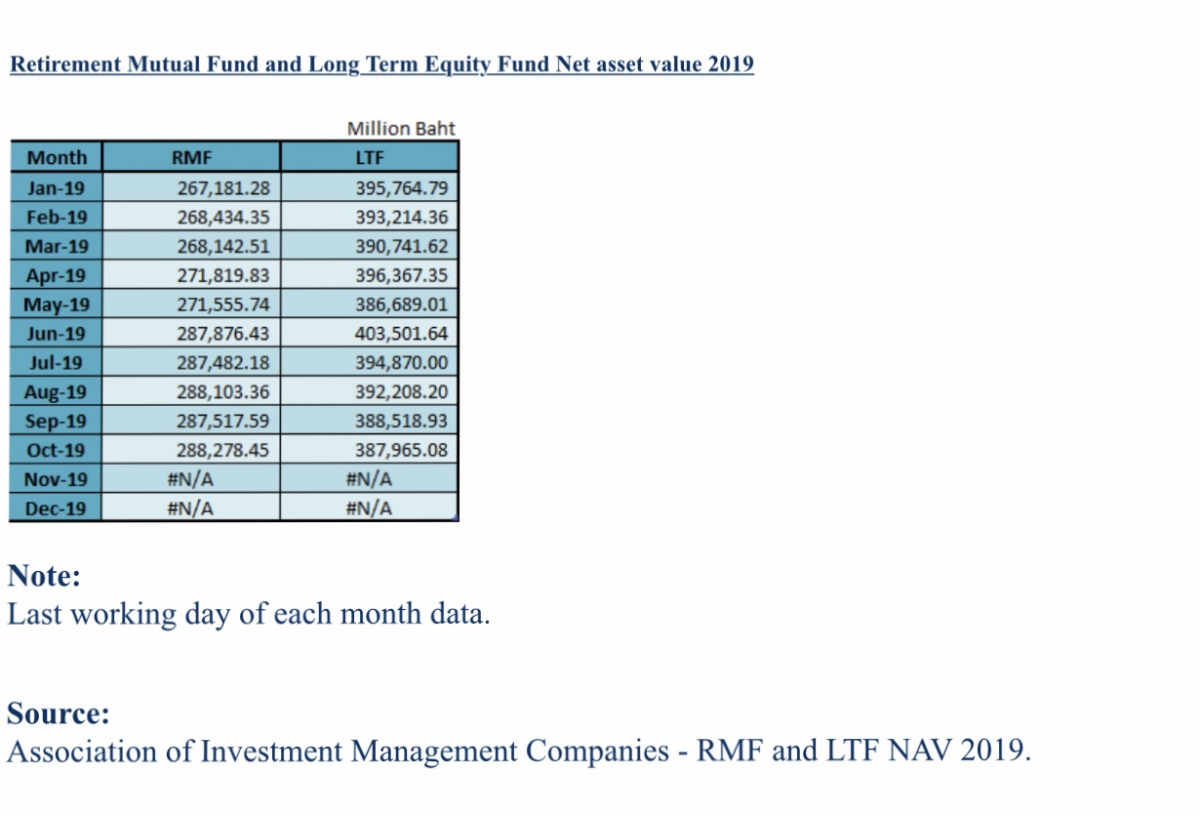
The net asset value of LTFs was Bt387.9 billion as of October 19, compared to Bt395.7 billion January.

Vorapol Socatiyanurak, former secretary-general of the SEC, has meanwhile said he agrees that the term of investment should be as much as 10 years, believing it would encourage long-term investment.

The longer period would also encourage people to save for their retirement, something most workers do not do, even as the average age of the population is rapidly rising, Vorapol noted.

A survey by the SET found that 62 per cent of workers age 40-60 established savings plan too late in life to assure them of basic necessities in old age.

Bloomberg News will avoid investigating Mike Bloomberg during his presidential campaign

ศาสตร์เกษตรดินปุ๋ย : ขอบคุณแหล่งข้อมูล : หนังสือพิมพ์ The Nation

https://www.nationthailand.com/news/30378717?utm_source=category&utm_medium=internal_referral

Bloomberg News will avoid investigating Mike Bloomberg during his presidential campaign

Nov 25. 2019
File Photo:Michael Bloomberg Speaks At Predominantly Black Church In Brooklyn, New York

NEW YORK, NY - NOVEMBER 17: Michael Bloomberg prepares to speak at the Christian Cultural Center on November 17, 2019 in the Brooklyn borough of New York City. Reports indicate Bloomberg, the former New York mayor, is considering entering the crowded Democratic presidential primary race. (Photo by Yana Paskova/Getty Images)

File Photo:Michael Bloomberg Speaks At Predominantly Black Church In Brooklyn, New York NEW YORK, NY – NOVEMBER 17: Michael Bloomberg prepares to speak at the Christian Cultural Center on November 17, 2019 in the Brooklyn borough of New York City. Reports indicate Bloomberg, the former New York mayor, is considering entering the crowded Democratic presidential primary race. (Photo by Yana Paskova/Getty Images)
By The Washington Post · Paul Farhi

55 Viewed

Bloomberg News will stop writing editorials about the presidential campaign and its reporters will avoid investigating the personal life and finances of its owner, Mike Bloomberg, as the news organization seeks to avoid conflicts of interest in covering Bloomberg’s newly announced candidacy for president.

In an extraordinary memo to his newsroom on Sunday, Bloomberg News Editor in Chief John Micklethwait outlined steps designed to steer his reporters through a potential journalistic minefield: how to cover the campaign of the man who owns the news organization that is covering him.

Bloomberg, the billionaire former mayor of New York City, made his campaign for the Democratic nomination official on Sunday after last week buying $30 million in TV ads to tout his background.

The ad blitz places Bloomberg’s sprawling media empire in the uncomfortable, and perhaps unprecedented, position of having to cover the campaign of the man who founded and still heads their company. Bloomberg operates one of the world’s largest media operations, with about 2,700 journalists in TV, radio, magazine and digital operations.

For weeks, Bloomberg News’ top editors have wrestled with how they could fairly report on their boss if he decided to run while being fair to his political rivals, including President Donald Trump, who is seeking a second term.

Micklethwait’s memo Sunday laid out what he called “basic principles” in covering Bloomberg’s political aspirations.

Most notably, he said his newsroom would continue “our tradition” of not investigating Bloomberg, his family and his wealth, “and we will extend the same policy to his rivals in the Democratic primaries.” A Bloomberg News spokeswoman, Kerri Chyka, also said the company won’t initiate stories about Bloomberg L.P., following a long-standing policy.

The hands-off policy puts Bloomberg News in the awkward position of passing on such critical stories as Trump’s unfounded allegations of corruption against former vice president Joe Biden and his son Hunter. At the same time, Micklethwait said Bloomberg News would continue to investigate the Trump administration.

The decision not to initiate stories about Democrats’ wealth and family is itself a potential conflict, as it may leave readers and viewers in the dark about important developments involving Bloomberg’s rivals. It would also unfairly give greater weight to stories involving potential corruption by Trump, his family or his administration.

However, Micklethwait said Bloomberg would publish investigative articles or summaries of articles about these topics involving Democrats from “credible journalistic institutions.” He did not spell out which sources he deemed “credible.”

Taken broadly, the guidelines are similar to Bloomberg News’ policies in covering Mike Bloomberg during his three terms as New York mayor. In that instance, Bloomberg News had a city hall reporter who regularly reported on the then-mayor’s policies and initiatives (the company currently has a full-time reporter assigned to Bloomberg’s presidential campaign).

But the size, scope and complexity of covering a national political campaign are far greater than covering city hall.

Micklethwait also said Bloomberg News would suspend publishing unsigned editorials on Bloomberg Opinion and will temporarily shut down the board that produces them. These editorials reflect Bloomberg News’ institutional view, and Mike Bloomberg’s own positions on issues, according to Micklethwait.

In an unusual move, the two top editors of the opinion section, David Shipley and Timothy O’Brien, will take a leave of absence and join Bloomberg’s campaign, according to the memo. Five other members of the opinion team will join them on the campaign, the company said.

Shipley is a former speechwriter for President Bill Clinton; O’Brien is a veteran journalist and the author of a book about Trump, “TrumpNation,” for which he and his publisher were unsuccessfully sued by Trump over O’Brien’s claims that Trump’s net worth was considerably less than what Trump had claimed.

Micklethwait said Bloomberg will continue to publish bylined opinion columns, including those from outside contributors, although it won’t publish any op-eds on the election. It’s unclear how this policy would work, given that almost every issue of national and international importance is affected by the presidential race.

Bloomberg News has aggressively covered the campaign so far, including reporting on Mike Bloomberg’s run.

“I think this is a structure that can cope with many eventualities,” Micklethwait wrote. “No doubt many of you are already thinking of possible complexities that may arise. My response is: let’s get back to work. We can spend a long time debating ‘what ifs.’ I would rather that we got on with the journalism and let that speak for itself. So write, blog, broadcast – and the rest will take care of itself.”

Trump, prove to China that you’ll stand up for democracy and human rights

ศาสตร์เกษตรดินปุ๋ย : ขอบคุณแหล่งข้อมูล : หนังสือพิมพ์ The Nation

https://www.nationthailand.com/news/30378714?utm_source=category&utm_medium=internal_referral

Trump, prove to China that you’ll stand up for democracy and human rights

Nov 25. 2019
Hong Kong District Council Election

HONG KONG, CHINA - NOVEMBER 25: Local residents celebrate as Junius Ho Kwan-yiu lose in District Council Elections, outside a polling station on November 25, 2019 in Hong Kong, China. Hong Kong held its district council election on Sunday as anti-government protests continue into its sixth month with demands for an independent inquiry into police brutality, the retraction of the word

Hong Kong District Council Election HONG KONG, CHINA – NOVEMBER 25: Local residents celebrate as Junius Ho Kwan-yiu lose in District Council Elections, outside a polling station on November 25, 2019 in Hong Kong, China. Hong Kong held its district council election on Sunday as anti-government protests continue into its sixth month with demands for an independent inquiry into police brutality, the retraction of the word “riot” to describe the rallies, and genuine universal suffrage. (Photo by Billy H.C. Kwok/Getty Images)
By The Washington Post · No Author · OPINION, EDITORIALS

152 Viewed

This editorial appears in The Washington Post. President Donald Trump displayed a noticeable weakness in the knees Friday when speaking about legislation that Congress has overwhelmingly passed to impose sanctions on China for the crackdown against pro-democracy demonstrators in Hong Kong.

File Photo: President Trump

File Photo: President Trump

Although the House passed the Hong Kong Human Rights and Democracy Act by a vote of 417 to 1 and the Senate by unanimous consent, Trump seemed to waver and hinted that he might veto it. On Thursday, a veto is exactly what China requested.

A veto would be a gift to China’s President Xi Jinping and have lasting deleterious consequences. Congress hopefully would override. But a veto would show China that Trump lacked the spine to stand up for freedom and human rights, just as Hong Kong citizens were again showing their commitment to democracy with a record turnout for local elections Sunday. No future protests about silencing dissent, muffling the Internet, mass incarceration or intrusive surveillance will have the same punch if Trump goes limp on Hong Kong.

Trump’s comments Friday were a porridge of muddled thinking. “Well I’ll tell you, we have to stand with Hong Kong but I’m also standing with President Xi,” he said. “He is a friend of mine. He is an incredible guy.”

Mr. Xi is not a “friend.” Just take a minute to read the Trump administration’s own National Security Strategy document,which describes this as an era of great-power rivalry. “China and Russia want to shape a world antithetical to U.S. values and interests,” it says. With China, the competition is not only over the South China Sea or trade. It is also a competition of profound consequence between China’s illiberal, authoritarian system and the values of democracy and a rules-based international order for which the United States must be the leading exponent and guardian.

Trump’s hesitancy may stem from his desire to reach a trade deal with China. Negotiations appear to have reached a standstill despite his earlier claims of a first-phase agreement. Perhaps Trump thinks vetoing the Hong Kong democracy bill would lure Xi to a compromise. This is hardly logical. In the end, Xi will make decisions about trade based on China’s economic interests. Trade and democracy are not a zero-sum game in this complex relationship.

A U.S. president should defend the right of people to live in dignity and choose their rulers because these are universal values inscribed in America’s history and role in the world. They are not bargaining chips. Likewise, a trade deal that’s worth anything must be sturdy enough to survive amid all the other pressures and crosscurrents in the relationship with China. No one should want trade terms that are won by sacrificing freedoms and rights in Hong Kong or anywhere else.

Việt Nam a new star in Southeast Asia region: Horasis forum

ศาสตร์เกษตรดินปุ๋ย : ขอบคุณแหล่งข้อมูล : หนังสือพิมพ์ The Nation

https://www.nationthailand.com/news/30378712?utm_source=category&utm_medium=internal_referral

Việt Nam a new star in Southeast Asia region: Horasis forum

Nov 25. 2019
Delegates pose for photos during a break at the opening plenary session held yesterday as part of the 2019 Asia Horasis Meeting that officially begins today. VNS Photo Bồ Xuân Hiệp

Delegates pose for photos during a break at the opening plenary session held yesterday as part of the 2019 Asia Horasis Meeting that officially begins today. VNS Photo Bồ Xuân Hiệp
By Bồ Xuân Hiệp
Viet Nam News/Asia News Network

165 Viewed

BÌNH DƯƠNG — Việt Nam has emerged as a new economic star in the Southeast Asia region, with its southern province of Bình Dương poised to become a new centre for global dialogue in the near future, the chairman and founder of Horasis said yesterday at one of Asia’s largest economic forums.

More than 400 top leaders from across Asia and 500 government officials and top executives from businesses in Việt Nam are participating in the 2019 Horasis Asia Meeting that officially opens today in Bình Dương Province.

Speaking on the sidelines of the opening plenary session yesterday, Dr. Frank-Jürgen Richter, said: “We’re very impressed with the potential of the Vietnamese economy and Bình Dương Province, which is one of the country’s major economic hubs with strong industrial development. That’s why we chose Bình Dương to host the Horasis Asia Meeting again this year.”

“The province has all the conditions to become one of Asia’s most attractive investment destinations and a new financial hub in the region,” he told Việt Nam News.

“Bình Dương boasts good infrastructure with a state-of-the-art conference centre, and we have had great support from the local government as the host of our meeting,” he noted.

“The province has attracted attention from investors from all parts of Asia such as Japan, China, Indonesia, South Korea and the rest of Southeast Asia,” he said.

To lure even more foreign investment, the province should diversify its portfolio, and not only focus on manufacturing but also raise the profile of knowledge-based industries such as blockchain, AI and, IoT, Richter said.


Asia in transition

The world is at a crossroads, and Asia with its exposure to a highly volatile geo-political and geo-economic context, is no exception, according to speakers at the meeting.

Asian economies should grasp opportunities emerging from rampant change in an era of disruption to achieve inclusive growth.

With uncertainty stemming from the US-China trade war, many businesses are looking at other production locations in the wider Asia Pacific region. Việt Nam is set to benefit the most from the trade war, according to Richter.

“I very much believe that Việt Nam, with strong economic fundamentals coupled with firm government commitment to more open trade and investment, will soon achieve a double-digit growth rate of 10-12 per cent in the near future,” he said.

According to the World Bank in Việt Nam, in the short and medium term, Việt Nam’s economic outlook is expected to be positive despite signs of cyclical moderation in growth.

After peaking at 7.1 per cent last year, real GDP growth is projected to slightly decelerate at 6.6 per cent this year, led by weaker external demand and continued tightening of credit and fiscal policies.

Annual headline inflation has been stable for seven consecutive years (at single digits), trending towards 4 per cent and below in recent years, according to the World Bank.

Strong FDI inflows, which reached almost $18 billion last year, account for almost 24 per cent of total investment in Việt Nam, it said.

Speaking at a National Assembly meeting last month, PM Nguyễn Xuân Phúc said Việt Nam’s open economy was exposed to external risks.

The country’s gross domestic product (GDP) growth, however, was expected to exceed 6.8 per cent this year, backed by robust exports and foreign investment, he said, adding that the country aims to keep inflation below 4 per cent next year.

Việt Nam’s foreign exchange reserves had reached a record high of US$73 billion.

However, the country’s pace of privatisation of state-owned enterprises and pace of budget spending on infrastructure had been slower than expected, according to Phúc.

Trần Văn Nam, Party Secretary of Bình Dương Province, said the Horasis event would help promote the image of Việt Nam, especially Bình Dương Province, with international partners, and improve management capacity as well as the science and technology level of Việt Nam.

“CEOs and investors from Southeast Asia, Japan, South Korea, India and the rest of the world have already come to seek investment opportunities in the province today,” he said.

During the two-day event, entrepreneurs from around the world will discuss Asian enterprises’ rise to global eminence.

Participants will also examine the state of the global economy and Asia’s role in shaping it.

The 2019 Horasis includes four plenary and dialogue sessions related to key issues in the current globalisation era such as new trends in economic and trade development and achievements in science and technology.

Delegates will also attend the 15th Asia International Science Conference on Urbanisation, which is expected to launch various IT projects.

The two-day event is co-hosted by Bình Dương Province Becamex IDC Corp and VSIP Group.

Horasis is a global visions community committed to providing a platform for companies from emerging and developed markets to seek global partners.

In addition to the Horasis Asia Meeting, Horasis hosts the annual Horasis Global Meeting, Horasis China Meeting, Horasis India Meeting, and others. — VNS

[ASEAN-Korea summit] S. Korea-ASEAN summit to open in Busan, prologue to ‘New Southern Policy 2.0’

ศาสตร์เกษตรดินปุ๋ย : ขอบคุณแหล่งข้อมูล : หนังสือพิมพ์ The Nation

https://www.nationthailand.com/news/30378711?utm_source=category&utm_medium=internal_referral

[ASEAN-Korea summit] S. Korea-ASEAN summit to open in Busan, prologue to ‘New Southern Policy 2.0’

Nov 25. 2019
Photo: Yonhab

Photo: Yonhab
By Yonhab, The Korea Herald/Asia News Network

179 Viewed

BUSAN — A special group summit between South Korea and the 10 Southeast Asian nations will get under way in Busan on Monday, which Seoul views as another milestone in bilateral partnerships amid its signature New Southern Policy.

President Moon Jae-in has invited the leaders of the ASEAN member states to the two-day event in Busan, his hometown, meant to celebrate the 30th anniversary of their dialogue relationship.

Cambodian Prime Minister Hun Sen has canceled his plan to attend it, saying his mother-in-law is in critical condition. Instead, Foreign Minister Prak Sokhonn is joining it.

Moon is seeking fresh momentum from the ASEAN-Republic of Korea Commemorative Summit for the “New Southern Policy 2.0” in the latter half of his presidency. In November 2017, he announced the major diplomatic initiative aimed at lifting Seoul’s strategic ties with ASEAN to the level of those with four regional powers: the United States, China, Japan and Russia. He has kept his word to visit all the ASEAN countries during his tenure.

“The 30-year-old South Korea-ASEAN relationship is at another point of a grand transition following the declaration of the New Southern Policy. This summit will be an occasion on which their relations can be upgraded to another level, by looking ahead into the next 30 years,” South Korean Foreign Minister Kang Kyung-wha said at a press briefing in Busan.

On Monday, Moon is scheduled to hold a string of bilateral summits with Thai Prime Minister Prayut Chan-o-cha, Indonesian President Joko Widodo and Philippine President Rodrigo Duterte at the BEXCO convention center in this southern port city.

High on the agenda are ways to promote cooperation in various fields, including ICT and smart cities, and joint efforts for the complete denuclearization of the Korean Peninsula and establishment of lasting peace.

Business is also a key topic. Moon and ASEAN leaders will participate in the CEO Summit that is bringing together more than 500 businesspeople, including Jim Rogers, a well-known investor.

Moon already met bilaterally with Singaporean Prime Minister Lee Hsien Loong and Brunei’s Sultan Hassanal Bolkiah at Cheong Wa Dae in Seoul over the weekend. They are on an official and state visit, respectively, to South Korea.

In his first official activity in Busan as part of this week’s ASEAN diplomacy, Moon attended the groundbreaking ceremony for the Busan Eco Delta Smart City, together with the leaders of Thailand, Vietnam and Laos.

Moon is to host a welcome dinner for all the participating ASEAN leaders ahead of formal group talks, with two sub-sessions Tuesday.

On Tuesday, Moon and the ASEAN leaders plan to adopt a statement on a vision for future partnerships.

A number of additional events are to take place in Busan this week, such as the ASEAN-Republic of Korea Business and Startup Expo, the Culture Innovation Summit, the Smart City Fair and the Special Exhibition on Biodiversity Cooperation between Mekong nations and the Republic of Korea. (Yonhap)

Hong Kong’s pro-democracy parties sweeping pro-Beijing establishment aside in local elections

ศาสตร์เกษตรดินปุ๋ย : ขอบคุณแหล่งข้อมูล : หนังสือพิมพ์ The Nation

https://www.nationthailand.com/news/30378708?utm_source=category&utm_medium=internal_referral

Hong Kong’s pro-democracy parties sweeping pro-Beijing establishment aside in local elections

Nov 25. 2019
Hong Kong District Council Election

HONG KONG, CHINA - NOVEMBER 25: Local residents celebrate as Junius Ho Kwan-yiu loses in District Council Elections, outside a polling station on November 25, 2019 in Hong Kong, China. Hong Kong held its district council election on Sunday as anti-government protests continue into its sixth month with demands for an independent inquiry into police brutality, the retraction of the word

Hong Kong District Council Election HONG KONG, CHINA – NOVEMBER 25: Local residents celebrate as Junius Ho Kwan-yiu loses in District Council Elections, outside a polling station on November 25, 2019 in Hong Kong, China. Hong Kong held its district council election on Sunday as anti-government protests continue into its sixth month with demands for an independent inquiry into police brutality, the retraction of the word “riot” to describe the rallies, and genuine universal suffrage. (Photo by Billy H.C. Kwok/Getty Images)
By The Washington Post · Shibani Mahtani, Tiffany Liang, Anna Kam, Simon Denyer

352 Viewed

HONG KONG – Voters took to the polls in record numbers to cast ballots in the only fully democratic election in the Chinese territory, an early sign that they wanted to send a strong message to their government and to the Communist Party in Beijing.

Early results compiled by the South China Morning Post showed pro-democracy parties winning 278 of the first 344 seats to be declared, pro-Beijing parties taking 42, and independents 24. Many prominent figures in the protest movement won; many leading pro-establishment figures were unseated. Pro-democrats look to be able to secure 12 of 18 district councils available in Hong Kong – before this vote, they did not have a majority in any.

Hong Kong District Council Election  HONG KONG, CHINA - NOVEMBER 25: Local residents celebrate outside a polling station as Junius Ho Kwan-yiu loses in District Council Elections on November 25, 2019 in Hong Kong, China. Hong Kong held its district council elections on Sunday as anti-government protests continue into its sixth month with demands for an independent inquiry into police brutality, the retraction of the word "riot" to describe the rallies, and genuine universal suffrage. (Photo by Billy H.C. Kwok/Getty Images)

Hong Kong District Council Election HONG KONG, CHINA – NOVEMBER 25: Local residents celebrate outside a polling station as Junius Ho Kwan-yiu loses in District Council Elections on November 25, 2019 in Hong Kong, China. Hong Kong held its district council elections on Sunday as anti-government protests continue into its sixth month with demands for an independent inquiry into police brutality, the retraction of the word “riot” to describe the rallies, and genuine universal suffrage. (Photo by Billy H.C. Kwok/Getty Images)

With nearly half of the 452 seats still to be declared, pro-democracy parties had comfortably surpassed the number of seats they won in 2015 and were on course for their strongest ever showing in district council elections.

The pro-Beijing Democratic Alliance for the Betterment and Progress of Hong Kong (DAB), the largest party in the district councils, had won just 26 races and lost 156. The pro-democracy Democratic Party, in contrast, had won 54 and lost only two.

The turnout – 2.94 million, or more than 71% of the 4.13 million eligible voters – was more than double the 1.4 million who voted in local elections in 2015. Voter registration was also a record high, driven in part by 390,000 first-time voters.

“Hong Kongers regard the election as a referendum and have clearly spoken that they are unhappy with how Hong Kong and Beijing have dealt with the ongoing protests in the last six months,” said Kelvin Lam, who won the South Horizons West seat, according to the South China Morning Post.

Lam was drafted to contest the seat for the pro-democracy camp after prominent activist Joshua Wong was barred from standing.

In 2015, pro-Beijing parties won just over 54% of the vote and 298 of the 452 seats to take control of all 18 district councils. They tend to be better funded and organized than pro-democracy groups, with solid links with the business elite and political establishment that allow them to argue that they are in the best position to get things done for their constituents.

Pro-democracy groups won 40% of the vote and 126 seats in 2015. Independents took the remainder.

But this time around, elections that have typically been fought on issues such as traffic, trash collection and the nuisance of pests such as wild boars became a referendum on the most fundamental issue in the territory: Whether one stands with the movement fighting for democratic freedoms, or with the pro-Beijing establishment that has had a grip on the former colony since Britain handed it back to China in 1997.

The protests were sparked in June by a proposal to allow criminal suspects to be extradited to China. The government eventually withdrew the proposal, but not before demonstrators added more demands: full democracy, retracting the official description of the protests as riots, amnesty for arrested protesters and an inquiry into alleged police brutality.

“The voice of the public is loud and clear: five demands, not one less,” said Roy Kwong Chun-Yu, who won in the Pek Long constituency. If Hong Kong Chief Executive Carrie Lam “doesn’t listen to our voice,” he said, “she must still not be awake.”

Even in pro-Beijing strongholds such as North Point, fresh-faced candidates running on an explicitly pro-democracy platform unseated longtime incumbents. Among them was 23-year old Karrine Fu, who beat 45-year old Hung Lin-Cham, the DAB incumbent who had won the past three elections.

DAB, which had been the largest party in the district councils, threw its weight behind the unpopular extradition bill. Its vice chairman, Holden Chow, lost his seat to a 25-year-old pro-democracy activist in one of several upsets for the party.

Lo Kin-Hei, vice-chairman of the pro-democracy Democratic Party, called the result was a “clear win” for his camp. “Really wonder what Carrie Lam & [Chinese President] Xi Jinping thought when they see the record-breaking turnout & result today,” he tweeted.

Voters waited for hours in lines that snaked around city blocks, an unusual experience for Hong Kong residents. Almost every neighborhood in the city has seen violent unrest at some point over the six-month long protest movement, with police firing tear gas and rubber bullets and protesters countering with molotov cocktails and projectiles.

District councilors’ responsibilities are largely local, but they are given 117 seats on the 1,200-member election committee, dominated by pro-Beijing groups and business interests, that selects Hong Kong’s chief executive.

“Everyone just asks what side you are on, pro-democracy, or pro-establishment,” said Sabrina Koo, a pro-democracy candidate. “Only after that do they ask us what our plans are for the community and about local issues.”

Voters, relishing the opportunity to express their democratic rights, were unperturbed by the lines. Gloria Lai, 40, took her two children to a polling station close to a major protest flash point in Wan Chai: A road that in the past months has seen tear gas, water cannons and massive fires. They waited an hour to vote.

“I want my children to always remember that it is their right to vote, it is their right to voice out their opinion, and this is something to be treasured,” she said. “We don’t have the right to vote for our chief executive, but we have this.”

The contest for district council is the only fully democratic election in Hong Kong. The city’s leader is not directly elected. Only half of the Legislative Council, the lawmaking body, is chosen by the people.

Another voter in Wan Chai, which is currently represented by pro-Beijing politicians, said he flew back to Hong Kong from Britain, where he has lived for the past decade, to cast his ballot. The 39-year-old man, who asked to be identified only by his last name, Chan, said he has never seen such lines in an election, including in Britain.

“This is the best way to express our views, it is the right way,” he said. “We don’t want violence on the streets, but if we don’t have a way to express our political views in any other way, that will happen.”

Francis Lee, who researches public opinion and the media at the Chinese University of Hong Kong, said the high turnout, while “expected because of the heated political and social atmosphere” of recent months, was still impressive for Hong Kong.

“A combination of police tactics and the (subway and rail network’s) tendency to close numerous stations during protest events has made it extremely difficult to hold any large-scale peaceful protests,” he said. “Many moderate supporters of the movement were frustrated by the lack of opportunities to express themselves,” he said, and see the election as a way to re-enter the fold.

The well-funded establishment camp was hoping for support from a “silent majority” that has grown uncomfortable with protest violence in Hong Kong.

Some voters expressed a desire for a return of peace to the city streets, and said they would vote for experienced candidates.

“Nothing is more important than bettering the lives of ordinary people,” said a 74-year old pro-Beijing supporter who gave his last name as Chow. “The responsibility of our youth is to study hard, not to make society a mess.”

Others said the protest movement had changed their views. Two voters in Sai Wan Ho, where a young protester was shot at close range this month, said they were deeply influenced by what they had seen.

“I couldn’t sleep well last night, I’ve been anticipating this election for so long,” said a 52-year-old man who gave his last name as Wong. “I really hope these elections can change the situation and change the political development of Hong Kong.”

The election was overwhelmingly peaceful and orderly, making a rare weekend without violence or police action in Hong Kong. Riot officers in green fatigues, some wearing masks, were seen at some polling stations, but the atmosphere was generally calm.

Otherwise, it felt like a typical weekend in the city before the protests began in June: Families out shopping and eating and people running errands. The weeks leading up to the vote saw the biggest escalation in violence since the protests began more than five months ago, with hundreds of demonstrators arrested after police seized a university campus that had become a fortified base for the movement.

Two protesters still holed up in the Polytechnic University held a news conference urging people to vote.

Hundreds of candidates chose to run in response to the events of the past months. These include Cathy Yau, a police officer who left the force over concerns that they were abusing their authority and is now running on a pro-democracy platform; Jimmy Sham, a leader of the Civil Human Rights Front, the group behind the largest peaceful rallies in the movement, and Tommy Cheung, who decided to contest elections in Yuen Long after mobs attacked protesters at a subway station there.

Sham appeared at his constituency in Sha Tin, walking with the help of cane, a reminder of the political violence against candidates ahead of the vote. Sham was attacked in October by a group of men wielding hammers, one of several cases of violence against candidates on both sides. A candidate was stabbed, one had part of his ear bitten off, and two others were assaulted.

Ivan Choy, who studies Hong Kong electoral politics at the Chinese University of Hong Kong, said a high voter turnout is usually to the advantage of pro-democracy candidates. But more voters on the “other side” who are desperate for an end to months-long conflicts could also be coming out to vote.

“After a number of seriously violent confrontations, the election will show whether mainstream public opinion is still supporting the movement, or whether protesters have lost the support of society,” he said.

Cooperative Promotion Department draws up plans to help rice farmers

ศาสตร์เกษตรดินปุ๋ย : ขอบคุณแหล่งข้อมูล : หนังสือพิมพ์ The Nation

https://www.nationthailand.com/news/30378713?utm_source=category&utm_medium=internal_referral

Cooperative Promotion Department draws up plans to help rice farmers

Nov 25. 2019
Phichead Wiriyaphaha

Phichead Wiriyaphaha
By THE NATION

258 Viewed

Phichead Wiriyaphaha, director-general of Cooperative Promotion Department, has announced that his department is readying agricultural cooperatives nationwide to join the government’s unmilled rice scheme to help rice farmers after several private millers and agricultural cooperatives were forced to shut their rice buying stations due to a lack of revolving funds.

“After discussing with other partners in the scheme including the Department of Internal Trade, the Bank for Agriculture and Agricultural Cooperatives (BAAC) and the Public Warehouse Organisation, we came up with three measures to help rice farmers and regulate the price of unmilled rice,” said Phechead.

“The first measure is to stock unmilled rice in silos of farmers or partner organisations and pay a storage fee of Bt1,000-Bt1,500 per tonne to slow the release of rice on the market and prevent oversupply,” he said. “The second measure is to provide loans to farmers to enable them to process their rice into different value-added products. The total budget for this measure is set at Bt15 billion while the interest will be set at the MLR-1 of 4 per cent per year, with the government responsible for 3 per cent and farmers paying 1 per cent interest.”

For the last measure, the Cooperative Promotion Department will join the government in paying rice traders an additional 3 per cent in storage fees if they buy and store more unmilled rice in their stock for another 2-6 months. The total budget for this measure is set at Bt510 million and target of stocked rice is at 4 million tonnes.

“We will present the 3 measures to the Cabinet for approval on December 3,” said Phichead.