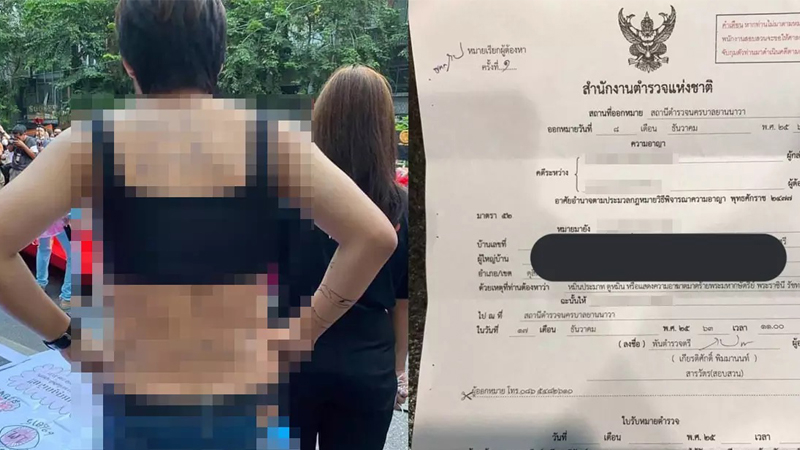
A 16-year-old male teenager has reportedly become the latest to be accused of committing lese majeste offences.
A Twitter user shared a photo of the teenager and an image of the summons issued by Yannawa Police Station in Bangkok, asking him to report to the investigation officer on December 17 at 11am.
The tweet added that an administrator of a famous Facebook page had filed a complaint with police against the boy.
A senior reporter of Khaosod English, Pravit Rojanaphruk, posted on his Facebook on Friday that the teen was
“likely the youngest-ever,” to be accused of the crime. “At least 24 people are now accused of defaming the Thai King,” he added.
Section 112 of the Criminal Code states that “Whoever defames, insults or threatens the King, the Queen, the Heir-apparent or the Regent, shall be punished with imprisonment of three to 15 years.”
Organisers of the pro-democracy movement have announced they will replace volunteer guards with trained security professionals at future protests.On Friday, protest leader Parit “Penguin” Chiwarak said that peaceful protest was an important “weapon” for the demonstrators and also acted as a shield to protect them from the regime’s powers.Posting on Facebook, Parit said that to preserve peace at protests, the pro-democracy Ratsadon group would stop using volunteer guards and employ professionals from now on. He did not say where the professional guards would come from.Parit added that the decision was made in the belief that protesters could protect themselves and the rally venues. “This duty should not be the sole responsibility of guards, as was the case before,” he said.
By The Washington Post · Josh Dawsey, Laurie McGinley
WASHINGTON – White House Chief of Staff Mark Meadows on Friday told Stephen Hahn, the commissioner of the Food and Drug Administration, to submit his resignation if the agency does not clear the nation’s first coronavirus vaccine by day’s end, according to people familiar with the situation who spoke on the condition of anonymity because they were not authorized to discuss what happened.
The threat came on the same day that President Donald Trump tweeted that the FDA is “a big, old, slow turtle” in its handling of vaccines, while exhorting Commissioner Stephen Hahn to “get the dam vaccines out NOW.” He added: “Stop playing games and start saving lives!!!”
It also led the FDA to accelerate its timetable for clearing America’s first vaccine from Saturday morning to later Friday, according to two people familiar with the process who spoke on the condition of anonymity to discuss internal matters.
The White House actions once again inject politics into the vaccine race, potentially undermining public trust in one of the most crucial tools to end the pandemic that has killed more than 290,000 Americans. It comes in the midst of a process that had been designed to show no shortcuts were taken in reviewing the safety and effectiveness of a vaccine as surveys show many people remain unsure whether they will get the shots.
A White House official declined to comment, saying “we don’t comment on private conversations, but the Chief regularly requests updates on progress toward a vaccine.”
“This is an untrue representation of the phone call with the Chief of Staff,” Hahn said in a statement. “The FDA was encouraged to continue working expeditiously on Pfizer-BioNTech’s EUA request. FDA is committed to issuing this authorization quickly, as we noted in our statement this morning.”
The two-shot vaccine, which has been shown to be 95% effective in randomized trials involving tens of thousands of people, has already been cleared by Britain, Canada, Bahrain and Saudi Arabia. U.S. officials have engaged in a more rigorous review process that they believe will boost public confidence.
Meadows’ threat and the president’s tweets constituted the latest attack by Trump, who has complained vociferously that the vaccine wasn’t authorized before Election Day, blaming it on the ‘Deep State’ inside the agency that he accused of working against his reelection. Trump was also said to be upset that Britain cleared the vaccine before the United States, although the Pfizer-BioNTech vaccine has been developed and reviewed in record time.
With the timetable apparently accelerated from Saturday morning, the FDA and Pfizer were rushing to complete the paperwork needed for the authorization, according to another individual who spoke on the condition of anonymity because he didn’t have authority to discuss the plans.
Pushing up authorization is not expected to change the timing of delivery of doses to vaccination sites or their readiness to give people shots, according to a person familiar with the distribution plans, not authorized to speak.
An FDA statement issued early Friday morning said the FDA had informed Pfizer that it would “rapidly work toward finalization and issuance of an emergency use authorization” following Thursday’s endorsement of the Pfizer-BioNTech vaccine by an agency advisory committee.
The statement was signed by Hahn and Peter Marks, director of the Center for Biologics Evaluation and Research, which reviews vaccines. The officials said the FDA has also notified the Centers for Disease Control and Prevention and Operation Warp Speed, “so they can execute their plans for timely vaccine distribution.”
An FDA advisory committee reviewed the vaccine for more than eight hours Thursday and voted overwhelmingly in favor of using it in people age 16 and older. It is unclear whether a decision on the vaccine on a Friday night would do anything to speed up the delivery of the first vaccine doses.
Property boom drives pandemic surge in Canada household wealth
InternationalDec 12. 2020A “For Sale” sign is displayed outside a home in Vancouver, B.C., on April 16, 2020. MUST CREDIT: Bloomberg photo by Jennifer Gauthier.
By Syndication Washington Post, Bloomberg · Theophilos Argitis
In the midst of a deep economic crisis, Canadians are becoming a whole lot richer.
The nation’s households have seen their net worth jump by more than C$600 billion ($469 billion) since the end of last year, according to third-quarter data released Friday by Statistics Canada. That’s despite a downturn that saw 3 million people lose jobs and the unemployment rate surge to historic highs.
The numbers show the extent to which efforts by the Bank of Canada and the federal government to flood the economy with cash have shored up household balance sheets, providing a cushion to the economy. The interest rate cuts by the central bank have stoked the housing market, while government support more than offsets falling incomes.
On a per capita basis, household net worth reached a record C$320,441 in the third quarter, up about C$12,000 since the end of last year.
The value of land and residential structures held by households, which grew by about C$440 billion this year, was the main contributor to the wealth boost.
While mortgage debt is also increasing to finance some of those home purchases, the increase in leverage is nowhere near the gain in asset values. The ratio of debt to assets fell to near the lowest in 15 years.
Sharply higher household net worth was offset by a deterioration in government finances, with state borrowing surging to records this year.
The cost of failure: What’s at stake if Brexit talks founder
InternationalDec 12. 2020Haulage trucks near the Port of Dover in Dover, England, on Dec. 11, 2020. MUST CREDIT: Bloomberg photo by Chris Ratcliffe.
By Syndication Washington Post, Bloomberg · Joe Mayes
Negotiations between the U.K. and European Union over a post-Brexit trade deal are reaching a tense climax ahead of Sunday’s deadline. As a deal hangs in the balance, here’s a summary of what’s at stake if the talks fail.
Decades of free movement of goods, services, people and capital will come to an abrupt end when Britain leaves the EU’s single market and customs union on Dec. 31.
If no trade agreement is reached, businesses and consumers on both sides would face a hammer blow. Companies would have to grapple with tariffs, quotas and potential chaos as they move goods across the border. London financial firms’ efforts to secure EU approval to go on serving clients across the bloc would be dealt a setback; and consumers would see their rights to live and stay on the other side of the English Channel curtailed. Even taking a pet dog to the continent could become more difficult.
_ The Economic Hit
Without a trade deal, the U.K. economy would suffer a near-term shock of around 1.5% of GDP, according to Bloomberg Economics. The Office for Budget Responsibility, Britain’s independent spending watchdog, forecasts a 2% GDP decline.
An economic forecast by the International Monetary Fund estimates a no-deal Brexit would reduce the EU’s long-term potential output by almost 0.5%, but it would knock almost 3% off the U.K.’s.
_ Tariffs
Instead of frictionless trade with a market of more than 400 million consumers, British firms would revert to trading with the EU under rules established by the World Trade Organization in 1995. That means imports and exports to the EU would be subject to WTO-negotiated tariffs – essentially a tax on goods.
The EU’s average tariff rate is 3%, but some products would attract much higher levies: British automakers would face a 10% tariff on all auto exports to the EU, while farmers exporting dairy products would see a 35.4% charge.
The car industry alone would face a 55 billion-pound hit due to a collapse in demand and local production due to tariffs, according to the Society of Motor Manufacturers and Traders.
Tariffs could also lead to increased prices for companies and consumers. For supermarkets, the cost would be 3.1 billion pounds ($4 billion) a year, according to the British Retail Consortium. Some 85% of foods imported from the EU would attract tariffs of 5% or more.
About 43% of the U.K.’s exports, valued at about 300 billion pounds, go to the EU each year, and the bloc is the source of 51% of its imports.
_ Customs
Businesses exporting to the EU will have to file customs declarations with or without a trade deal. To move goods from Dover to Calais – the U.K.’s busiest crossing point with the EU – trucks will need a government-issued permit indicating they have the correct paperwork and won’t be held up by French officials.
Delays at the border would threaten to throw manufacturers relying on parts arriving just-in-time into chaos, including companies in car-making and aerospace, while fresh food produce might rot in queuing trucks.
Animal products will need to move through designated border inspection posts accompanied by export health certificates issued by a veterinary professional.
While goods moving out of the U.K. will face checks from the year-end, Britain is deferring full import controls on those arriving from the EU until July 2021. However, companies will still need to keep records of their transactions and file the customs declarations in July.
_ Standards
Companies may have to comply with two separate regimes for product standards and regulations, needing approvals from U.K. and EU bodies to have the right to sell in both markets. For example, some goods will need to bear a new U.K. Conformity Assessed (UKCA) mark from Jan. 1, instead of the EU’s CE mark, in order to be sold in Britain.
_ City of London
Finance firms will lose their passport to offer services across the EU, whether there’s a trade deal or not, and have already been forced to shift staff and beef-up their operations in the bloc. Their access to customers would depend on the EU judging U.K. rules to be equivalent to its own in 40 areas. Failure to reach a trade accord would set back that process. Even if permission is granted, the EU would still be able to withdraw it with little notice.
_Services
The services sector – which make up 80% of Britain’s economy – would face new restrictions. British architects and consultants would be among professionals who would lose their automatic right to offer their services across Europe. Firms may need to establish an office in the EU to continue trading, and may have to seek local approval for their professional qualifications.
_ Northern Ireland
Goods crossing from the rest of the U.K. into Northern Ireland that are deemed at risk of moving into the Republic of Ireland – nd therefore the EU – would have to pay tariffs when crossing the Irish Sea, the solution that was included in the Brexit divorce agreement to avoid a hard border on the island of Ireland.
The U.K. government had previously said it planned to renege on this part of the agreement and break international law, but it has since backed down. EU officials will be present in Northern Ireland to monitor whether those rules are respected.
– Fishing
EU boats would lose the automatic right to fish in U.K. waters, and vice versa, risking the prospect of maritime clashes between fishermen. Seafood exports would be particularly vulnerable to border delays, meaning fish could rot at ports.
_ Passports
Even with a trade deal, British visitors to the EU will need more than six months left on their passport in order to travel. Those staying in the EU for longer than 90 days may require a visa.
Motorists may need an international driving permit. Traveling with pets to the EU will become more difficult, too. Animal owners will face a four-month process involving blood tests, vaccinations and health certificates.
_ Immigration
The free movement of people between Britain and the EU will end. The U.K. is planning to use a so-called points-based immigration system, where overseas workers must prove they meet certain criteria before being allowed to come to Britain for a job. The criteria include speaking English, having an existing employment offer and earning more than 20,480 pounds a year.
_ Wine and Cigarettes
British travelers to the EU will be able to benefit from duty-free shopping in ports and airports. However, it will no longer be possible to return with unlimited quantities of products such as alcohol and tobacco from the bloc without paying the appropriate taxes. Instead, shoppers will have more limited, tax-free allowances – 200 cigarettes, 18 liters of wine, and four liters of spirits.
Here’s why the stimulus deal is such a big deal for Europe
InternationalDec 12. 2020European Union flags fly in Brussels on April 10, 2019. MUST CREDIT: Bloomberg photo by Jasper Juinen.
By Syndication Washington Post, Bloomberg · John Ainger, Alexander Weber, Viktoria Dendrinou
After a hard-fought battle, the European Union’s landmark 1.8 trillion-euro ($2.2 trillion) budget and stimulus package has finally got over the line.
It’s quite the achievement. Not only will the funds help the region overcome the economic damage the coronavirus left in its wake, but they pave the way for much deeper integration in the bloc and set the stage for the continent’s transition to a low-carbon economy. Europe’s leaders will also be hoping that the agreement puts talk of an EU breakup firmly in the past.
For the European Central Bank, which on Thursday extended its huge emergency bond-buying program, the funds help address its repeated call for fiscal policy to move to the forefront of economic support. In addition to being a broad complement to monetary policy, the deal also has a technical benefit. Part of the package is financed by jointly backed bonds, which should provide the ECB with another asset to buy.
The region’s markets have received a major boost. The euro is at its highest level since mid-2018 versus the dollar and the borrowing costs of heavily indebted nations like Italy and Spain have fallen dramatically — despite unprecedented government spending.
Here’s a look at why the EU’s recovery deal is quite so important.
– Hamiltonian moment: Riffing off what happened in the U.S. in 1790, a so-called Hamilton moment would be the mutualizing of obligations across all 27 member countries. That would require treaty changes adopted by national parliaments and in some cases referendums.
The new package doesn’t go that far, but it’s a step in that direction, with the promise that the debt to fund grants and loans to member will be issued jointly, rather than taken on national balance sheets.
Along with ECB’s bond buying, that’s helped to rein in borrowing costs even for euro-area countries with huge debt burdens and perilous fiscal situations.
Spanish 10-year bond yields dipped below 0% Friday, following their Portuguese peers earlier this week, and it’s looking increasingly likely that those of other peripheral nations, like Italy and Greece, will soon follow suit.
– Economic impact: The European Commission has estimated that the plan could add around 2% to the bloc’s economic output by 2024 and create 2 million additional jobs by 2022.
Some economists have said it could end up being less than that if the EU funds replace money that would have come out of national coffers. It’s also not yet clear to what extent countries will draw on the loans that are on offer.
A major benefit is that the recovery funds will help soften the blow for countries that are harder hit by the crisis, for example because their economies rely to a greater extent on tourism. The EU has been particularly alarmed by the uneven shock of the virus and the widening of the region’s north-south divide.
– Helping the central bank: ECB officials have lauded the agreement as a “game changer,” mostly because it displays solidarity between richer and poorer member states. Even before the pandemic struck, the institution had called on members of the 19 nation euro area to invest in their economies and lift growth.
If the plan is successful, it could help the ECB get inflation closer to its target of just under 2%.
President Christine Lagarde said Thursday that the recovery fund should become “operational without delay.” She’s also stressed that the EU aid money should be spent in a way that increases longer-term growth and shouldn’t get lost in national budgets.
Lagarde has even suggested making the recovery fund a permanent tool for similar crises in the future, and that it could “enrich” the long-standing debate over a common euro-area budget.
The EU bonds backing the program are also another asset for the ECB’s quantitative-easing programs. That reduces the risk it’ll eat up so much national debt that it crushes markets and faces accusations of monetary financing.
– A new safe asset: German bonds have been seen as Europe’s benchmark, but they fall short of being a rival to Treasuries given there’s not enough of them to go round and they don’t adequately represent risk for the wider region.
ointly issued debt will go some way to raising the profile of a European “safe asset,” though, and will finally give investors a security for the whole of the bloc.
It could also elevate the status of the euro versus the dollar. Progress on the fund has helped push the currency above $1.20, to a two-and-a-half-year high.
– Social and green leader: The EU is set to become the world’s biggest issuer of green debt, with a third of the bonds being issued to come under the environmentally-friendly tag.
The bloc will publish an accompanying green taxonomy and green bond standard next year, and it’s widely expected to become a blueprint for the rapidly growing market
Demand from investors for EU social-debt, which is going toward a regional job-support program, already smashed records this year, drumming up billions of euros of orders.
– Another defeat of populists: The agreement means future EU funds will be tied to the rule of law, a link Hungary and Poland have been opposing. While the two countries won a possible delay to the establishment of such a mechanism, the bloc ultimately took a step toward adopting a tougher tool to sanction governments that erode democratic standards.
This comes on the heels of the U.S. election, which may have taken some of the wind out of the populists’ sails. The EU’s illiberal members had been emboldened by President Donald Trump’s ascent and rule over the past four years.
– A stronger economic toolbox: The recovery fund joins a series of other tools adopted this year to strengthen the EU’s economic arsenal, including measures to help businesses and workers.
It also comes just a week after the euro area finally agreed on a long-awaited reform of its bailout fund, a deal that could pave the way for more ambitious work on strengthening the euro’s architecture
Russia roils agricultural markets on Putin’s push to curb food prices
InternationalDec 12. 2020Customers choose fresh bread at the Neglinnaya Plaza shopping center in Moscow on Feb. 19, 2015. MUST CREDIT: Bloomberg photo by Andrey Rudakov.
By Syndication Washington Post, Bloomberg · Anatoly Medetsky, Megan Durisin
Russia is rattling agriculture markets once again with the threat of government intervention as President Vladimir Putin and his prime minister rail about food-price inflation in one of the world’s biggest exporters of wheat and sunflower oil.
This week, Putin expressed surprise at sharp price increases for staples like bread and sunflower oil, and told the government to develop a plan for curbing them. Prime Minister Mikhail Mishustin jumped in Thursday, saying food producers, exporters and retailers should stop taking advantage of consumers. Officials are already considering a wheat export tax in addition to the earlier proposal to set a grain shipment quota for a few months next year, according to an export lobby group.
“Don’t profit off of the people,” Mishustin said during televised comments at a cabinet meeting. “It’s unacceptable in this difficult situation. It’s necessary to take drastic measures and set straight the way prices are formed.”
He didn’t elaborate, but Russia has a history of disrupting the wheat market by implementing restrictions or duties. The country imposed an export tax in 2007 to combat rising food costs — helping push global wheat prices to a record — and a ban in 2010 after a poor crop, curbing supplies and helping propel prices to two-year highs.
It wasn’t clear immediately how the wheat export tax would affect shipments. The earlier proposal for a grain quota this season was loose enough for normal trade. Russia already is stepping in on oilseed markets, with the prime minister setting export taxes from January on commodities including sunflower seeds, used to make sunflower oil. Draft regulations to contain food prices are due for submission Monday.
Food inflation in Russia accelerated to 5.8% in November, the highest year-over-year gain since mid-2019. A United Nations global price gauge is at a six-year high as robust grain demand in China and tightening supply stoke prices. The U.S. Department of Agriculture cut its outlook for global wheat stockpiles on Thursday.
Benchmark futures for wheat — where Russia leads global exports — rallied in the wake of Putin’s comments, although the government hasn’t indicated any sales limits. Domestic prices are near a record high, and local bakers and meat producers asked the government for an export tax last month.
The agriculture ministry has proposed a quota from mid-February, with volumes high enough to keep trade flowing. A weak ruble helped accelerate wheat exports this year, making Russian supplies more competitive.
“The comments from Putin create a bit of uncertainty around the subject,” Matt Ammermann, a commodity risk manager at StoneX, said by email. “The market is sensitive to the potential ‘what ifs’ right now.”
Russia reaped a near-record wheat harvest, and the proposed quota is relatively relaxed, giving little immediate concern for supply, said Carlos Mera, a senior analyst at Rabobank International. Still, the fact that Putin and Mishustin are talking about this means the potential for intervention can’t be discounted.
“The situation seems quite fluid,” he said. “It’s all speculation at the moment.”
Supreme Court dismisses bid to overturn the presidential election results, blocking Trump’s legal path
InternationalDec 12. 2020Justices Neil Gorsuch and John Roberts are pictured at the top steps of the Supreme Court in June 2017. MUST CREDIT: Washington Post photo by Ricky Carioti
By The Washington Post · Robert Barnes
WASHINGTON – The Supreme Court on Friday dismissed a long-shot bid by President Donald Trump and the state of Texas to overturn the results in four states won by Democrat Joe Biden, blocking the president’s legal path to reverse his reelection loss.
The court’s unsigned order was short: “Texas has not demonstrated a judicially cognizable interest in the manner in which another state conducts its elections. All other pending motions are dismissed as moot.”
Justices Samuel Alito Jr. and Clarence Thomas said they did not believe the court had the authority to simply reject a state’s filing, a position they have taken in the past. But they said they would not have allowed Texas more than that.
“I would . . . grant the motion to file the bill of complaint but would not grant other relief, and I express no view on any other issue,” Alito wrote in a statement joined by Thomas.
Taking into account an earlier case from Pennsylvania, it means that in two cases to reach the court – where conservatives hold a 6 to 3 majority – no justice has expressed support for the drastic idea of throwing out election results.
Trump, who has appointed three of the court’s nine members, has long viewed the Supreme Court as something of an ace-in-the-hole, and Friday called for the justices to display “courage” and rescue him in post-election litigation.
After Justice Ruth Bader Ginsburg died in September, Trump said filling the seat was essential because of the possibility of litigation that might otherwise end in a tie. Justice Amy Coney Barrett was confirmed in a party-line vote by the Republican-controlled Senate to replace Ginsburg.
In a case earlier this week, the court turned down a request from Republican congressional candidates to overturn the results in Pennsylvania in a one-sentence order. Barrett took part in the case, but neither she nor fellow Trump appointees Neil Gorsuch or Brett Kavanaugh noted their objection.
Trump has refused to acknowledge defeat, instead embarking on a noisy campaign to discredit the election. He has made unproven charges of corruption and a rigged election in states he lost and unsubstantiated claims of illegal voting, votes switched by computer software and rampant fraud.
None have come close to being proven, and Attorney General William Barr said U.S. attorneys and FBI agents running down specific complaints and information “have not seen fraud on a scale that could have effected a different outcome in the election.”
Legal efforts by Trump and his allies filed in states he lost have been stunningly unsuccessful – one minor win compared to more than 50 losses in state and federal courts at both the trial and appellate level.
In one case that reached the U.S. Court of Appeals for the 3rd Circuit, the comeuppance was delivered by a judge Trump had nominated.
“Free, fair elections are the lifeblood of our democracy. Charges of unfairness are serious,” wrote Judge Stephanos Bibas. “But calling an election unfair does not make it so. Charges require specific allegations and then proof.”
Lawsuits continue around the country, but the Texas case was the one Trump and his allies had pinned their hopes upon.
The election results have been certified in each state, and the Electoral College is scheduled to meet Monday. Biden has 306 electoral votes, exactly the number Trump had when he was elected in 2016. But while Trump lost the popular vote then, Biden has a margin of more than 7 million votes.
Texas, led by Trump partisan Attorney General Ken Paxton, a Republican, tried to maneuver around the lower court losses by filing directly with the Supreme Court. States suing other states are allowed to ask the court to take up the case, although the court sometimes does not grant permission.
Trump tweeted that it was the “big one” that “everyone has been waiting for.”
Texas charged that actions by state officials in Pennsylvania, Georgia, Michigan and Wisconsin violated the Constitution, and diluted the impact of Texas voters.
Its major complaint was that state officials and courts in those states had changed election procedures to make it easier to vote by mail or other methods. It said that violated the Constitution’s direction that “the legislature” of each state set voting procedures.
It asked the justices to block those states from casting their combined 62 electoral votes for Biden and order the state legislatures, all Republican-controlled, to appoint either new electors or none at all. That would require the court to set aside the results in those states, which Biden won by a combined 300,000 votes.
Trump asked to intervene in the suit and 17 attorneys general from states where Trump won joined in – even when their own states had voting procedures altered by state officials or courts. A majority of House Republicans urged the Supreme Court to take the case.
The targeted states responded in blistering briefs, with Pennsylvania Attorney General Josh Shapiro calling the Texas suit a “seditious abuse of the judicial process.”
Wisconsin Attorney General Joshua Kaul, a Democrat, said agreeing to the Texas request would thrust the court into the political sphere in a way never imagined.
“If Texas’s theory of injury were accepted , it would be too easy to reframe virtually any election or voting rights dispute as implicating injuries to a state and thereby invoke this court’s original jurisdiction,” he wrote.
“New York or California could sue Texas or Alabama in this court over their felon-disenfranchisement policies. Garden-variety election disputes would soon come to the court in droves.”
The states said Texas’s claims were hypocritical and cynical. Although Texas said in a filing that it “does not ask this court to reelect President Trump,” the suit does not ask the court to discount the votes in any state Trump won where state officials and courts altered voting procedures because of the coronavirus pandemic.
Among those states are Texas itself, where the governor made changes.
Amid protests, D.C. police face perception they’ve chosen sides
InternationalDec 12. 2020A MAGA hat burns outside of BLM Plaza in Washington D.C. on Nov. 14. MUST CREDIT: Photo for The Washington Post by Evelyn Hockstein
By The Washington Post · Marissa J. Lang, Peter Hermann
WASHINGTON — The tension and violence at last month’s “Million MAGA March” has cast a long shadow, with ideologically opposed groups facing off again Saturday in the nation’s capital as police try to walk a line somewhere in between.
Washington D.C. protesters who have spent months calling for criminal justice reform say they were outnumbered and violently attacked by Proud Boys and other far-right agitators while police stood by on Nov. 14. At least three suffered knife wounds.
Republican members of Congress, meanwhile, accused the District’s liberal leadership of allowing D.C. protesters to harass and set fire to the property of supporters of President Donald Trump.
As these two dissonant sides meet again, police in the role of peacekeepers will be forced to contend with the growing perception that officers have chosen sides.
District officials say police did their best to minimize harm in a delicate and difficult situation. But officers’ behavior at the November rally – posing for photos with Trump supporters, standing back as demonstrators in Make America Great Again garb vandalized Black Lives Matter signs, standing back as arguments escalated to physical conflict – has prompted many to question the role personal politics play in policing.
When Trump’s most fervent supporters gather Saturday, urging him to continue his fight to overturn the results of the election he lost, D.C. activists will not be waiting along Pennsylvania Avenue to meet them.
Instead, protesters will gather in Black Lives Matter Plaza, ready to defend what they see as theirs: the fence on which signs and memorials have been hung, the pavement that bears the slogan “Black lives matter,” the very city itself and the people who live there.
Officials expect a smaller crowd than the thousands who converged days after Democrat Joe Biden was declared the victor of a bitterly fought presidential race. But the threat of an unpredictable and potentially violent day looms.
Police have said they stood back as Trump’s supporters destroyed signs because authorities do not believe it is illegal to tear them down and officers thought stepping in might exacerbate tensions. Roger Mitchell Jr., the city’s interim deputy mayor for public safety and justice, conceded in an interview that the optics were poor.
“I can absolutely see how people would see it as taking sides,” he said. “I’m not supportive of any law enforcement officer taking sides. . . . Their job is to be neutral and be there to protect whoever is there, whatever their political affiliation is.”
Pro-Trump rallies this weekend are expected to draw thousands of his most ardent supporters to the nation’s capital.
Events are scheduled to begin about 9 a.m. Saturday with a prayer rally at the Capitol. Other pro-Trump demonstrations will convene about noon near the Washington Monument and in Freedom Plaza. Demonstrators are again planning to march to the Supreme Court, where speakers will address the crowd from the marble steps. Among those invited to speak is Trump’s recently pardoned former national security adviser, Michael Flynn, who twice pleaded guilty to lying about his contacts with Russia’s ambassador during special counsel Robert Mueller III’s probe of 2016 election interference.
A Trump supporter is forced out of Black Lives Matter Plaza by demonstrators on Nov. 14 in Washington D.C. MUST CREDIT: Photo for The Washington Post by Evelyn Hockstein
A National Park Service permit issued Friday indicates organizers of the March for Trump, likely the largest of the rallies, expect about 15,000 attendees. Another “Million MAGA March” rally will convene at the National Sylvan Theater on the Mall, with about 500 people expected, according to a separate Park Service permit.
The Proud Boys – a male-chauvinist organization the FBI has deemed an extremist group with ties to white nationalism – plans to return to D.C. this weekend. Counterprotesters say at least three D.C. activists were stabbed in violent clashes with men wearing the Proud Boys’ signature gold-and-black uniform last month.
These incidents, along with more than six months of tense encounters with police, have convinced many D.C. protesters that police will not protect them, so they have been preparing to protect themselves.
Rotating shifts of anti-Trump demonstrators plan to patrol Black Lives Matter Plaza through the weekend, looking for attempts to tear down signs or vandalize protest murals. Dance protests and live music are scheduled alongside anti-Trump and anti-fascism rallies.
But D.C. police shut down the plaza early Friday, effectively evicting anti-Trump demonstrators and uprooting an ongoing peace vigil. D.C. activists noted on social media that the street slated to host their protest was closed on the same day the Park Service issued permits allowing Trump supporters to gather.
Dustin Sternbeck, a police spokesman, said police closed streets in the area of Black Lives Matter Plaza “to ensure public safety is maintained.” The police department did not respond to concerns from activists about their demonstration space being blocked.
Activists have warned about anti-Trump protesters being a possible target of violence Saturday and offered alternatives to showing up in person, including donating cash and supplies to protesters and lobbying the city to enforce its mask mandate. Street medics, who volunteer at rallies to care for injured demonstrators, have for weeks been recruiting reinforcements.
Congressional Republicans, meanwhile, have accused the District’s Democratic leadership of allowing Trump’s supporters to be bloodied in scuffles last month with counterprotesters over Trump flags and MAGA hats, which anti-Trump protesters later burned.
The group behind the March for Trump has deemed Black Lives Matter Plaza a “no-go zone” and discouraged supporters from venturing far from its rally point along Pennsylvania Avenue.
At a briefing with D.C. Council members this week, interim city administrator Kevin Donahue said he hopes protesters “get out of town as fast as possible.”
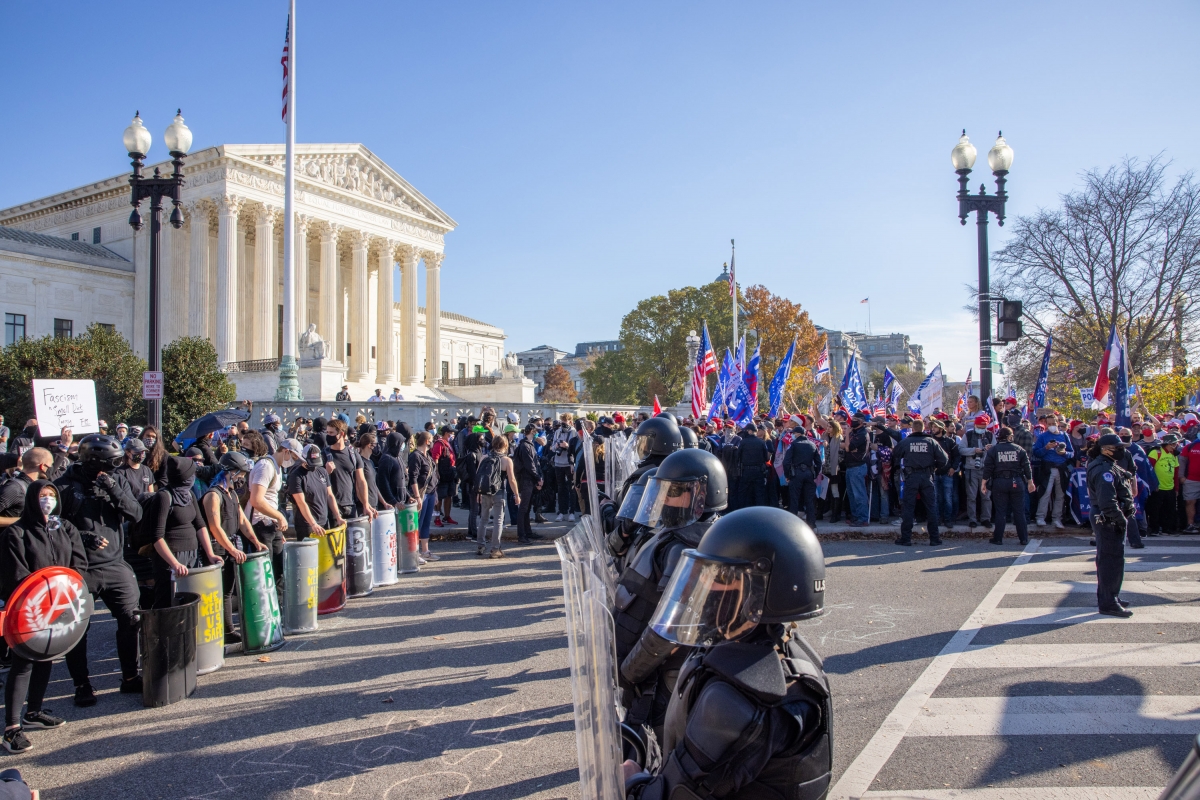
Last month’s rally brought two discordant views of America onto a crash course in the nation’s capital, with Trump supporters insisting without evidence the election had been stolen. They waved flags and chanted profanity-laden slogans from Freedom Plaza to the steps of the Supreme Court, where a small crowd of counterprotesters waited, wearing all black and using bicycles and homemade shields to create a barricade.
Violence between the two groups later broke out five blocks east of the White House. The groups charged each other as they approached the same intersection, brawling for several minutes before police cleared the area.
In the melee, a D.C. fire official said, a man in his 20s was stabbed in the back and taken to a hospital with serious injuries. Street fights continued into the night.
“Anytime there is violence in this city, that’s not a win,” Mitchell said.
Nearly two dozen people were arrested during the November rally, including several on gun charges, according to D.C. police, who said four officers also were injured.
D.C. activists said at least two additional counterprotesters were assaulted, including one who was wearing body armor and said his vest stopped a blade from penetrating his skin. Another received four stitches to close a knife wound in the arm, protesters said.
The demonstrators did not file police reports, and officers did not make arrests.
Dub, a 25-year-old street medic who declined to give a full name, out of fear of being targeted by the Proud Boys, said a woman came to medics seeking treatment for a cut on her neck after she said she was caught in a Proud Boys attack.
“I’m worried about the next one,” Dub said of Saturday’s protests. “I don’t want to see my people get harmed again.”
D.C. Police Chief Peter Newsham said last month that officers followed every big group of roving demonstrators and tried to intercede before factions collided. He said there were people on both sides determined to fight.
Washington D.C. police face counterprotesters as Trump supporters amass outside the Supreme Court on Nov. 14. MUST CREDIT: Photo for The Washington Post by Evelyn Hockstein
“The police department was put directly into the middle of it,” Newsham said, adding that the main goal of police is “to prevent violence . . . without choosing sides.”
But police actions during the demonstrations led many protesters to assume officers had done just that.
Trump supporters waving flags bearing a thin blue line, a pro-police symbol that critics have long claimed also stands for white supremacy and opposition to the Black Lives Matter movement, cheered officers as they passed. Several lined up for photos with officers, who smiled and flashed thumbs-up gestures for the camera.
“This is a volatile time,” Mitchell said. “I’m hearing more and more politicalization of policing, and our law enforcement is in the middle. We want them to act accordingly to maintain the civil rights of our community, and when they don’t, they need to be held accountable. When there is a perception that there is a side being taken, then our job is to mitigate that perception.”
Outside the Supreme Court, where thousands of Trump supporters faced off last month with a small crowd of black-clad counterprotesters, Proud Boys members tried to leap over metal barricades assembled to separate the groups. They were pushed back by police as the crowd chanted an expletive at counterprotesters. Moments later, officers in riot gear arrived and stood with shields up, facing the anti-Trump demonstrators.
– – –
As more officers with crowd-control munitions converged, counterprotesters glanced up from peeling clementines and drinking water on the curb of Maryland Avenue.
“This is disgusting,” said Jen Nick, 28, a Navy veteran who stood on the front line with a contingent of veterans donning “Vets for BLM” T-shirts. Looking at the row of officers, she said it seemed police were doing little to protect D.C. counterprotesters from the largely out-of-town crowd.
The administration of D.C. Mayor Muriel Bowser, D, declined to allow Newsham or other police officials to be interviewed for this report. Newsham is soon leaving the department to become police chief in Prince William County, Va.
Chuck Wexler, executive director of the Police Executive Research Forum, which advises law enforcement agencies on best practices, said it is not enough for officers at protests to have good intentions – they also need to be aware of the optics of their actions.
“We are living in an age where reality matters, but so does appearance,” Wexler said. “It’s hard when some group is trying to react favorably to the police. But I think police chiefs are aware that the appearance of fairness is as important as the reality.”
While many of the confrontations that happened last month did not culminate in violence, activists said being confronted by dozens of barefaced Trump supporters in the midst of a national surge of coronavirus cases made them feel unsafe.
Dozens of D.C. police officers have tested positive for the coronavirus in the weeks since the November rally. As of Thursday, 74 remained in quarantine. Police have declined to draw a direct link between demonstrations and the spike in infections among officers.
– – –
Harry’s Bar, a pub in the Hotel Harrington that has become known as a meeting point for Trump supporters and Proud Boys, was slapped with a fine for violating the mayor’s order mandating mask use and banning large crowds – the bar’s second offense since October.
D.C. police said officers will not be enforcing mask rules this weekend or issuing fines to those who flout the mandate or social distancing guidelines.
D.C. Council members and their staffs have received hundreds of messages from constituents ahead of Saturday’s rallies, urging the city to do more to enforce coronavirus restrictions. Chairman Phil Mendelson, D, encouraged residents concerned about the spread of germs at the demonstrations to “protect themselves from the dangers of this potential superspreader event by staying away from it.”
“Regardless of one’s views about the ideology of the rally, we have to be careful to respect the First Amendment right to demonstrate,” Mendelson said in an emailed statement.
Organizers with Women for America First, the pro-Trump group behind the rally at Freedom Plaza that also led the only permitted march on Nov. 14, sought to distance themselves from the violence that erupted.
“We hope everyone is peaceful and respects the right of all Americans to peacefully protest and have their voices heard,” said group spokesman Chris Barron.
InternationalDec 12. 2020Sen. Doug Jones is pictured at a news conference in August 2019. MUST CREDIT: Photo by Elijah Nouvelage for The Washington Post
By The Washington Post · Devlin Barrett, Matt Zapotosky, Matt Viser
WASHINGTON – President-elect Joe Biden’s search for the next attorney general is increasingly focused on Sen. Doug Jones, D-Ala., and former deputy attorney general Sally Yates, according to people familiar with the discussions, who said that appeals court Judge Merrick Garland remains a serious contender.
Jones, who lost his reelection bid in November, is the favorite at this stage, but Biden and his inner circle continue to debate the nomination, these people said, speaking on the condition of anonymity to describe internal discussions.
It is increasingly unlikely, these people said, that former Massachusetts governor Deval Patrick will be selected to become the nation’s top law enforcement official. People familiar with the discussions said in recent days that the discussions of the three other candidates has increasingly shifted toward the likelihood of confirmation in the Senate, which is currently controlled by Republicans. On that question, Jones is viewed as having an edge over Yates, according to the people familiar with the discussions.
With Jones’s stock on the rise, some civil rights leaders have privately expressed some reservations to members of Biden’s inner circle in recent days about whether his record on criminal justice reform and civil rights is sufficient. As a U.S. attorney in Alabama in the Clinton administration, Jones famously prosecuted members of the Ku Klux Klan who bombed a black church in Birmingham in 1963, killing four girls. The case had been stymied by then-FBI Director J. Edgar Hoover, but was resuscitated in 1971 and then again in 1993 at the urging of civil rights leaders.
House Majority Whip James Clyburn, D-S.C., recently cited that case in praising Jones to the website Cheddar.
“Decades they walked around free after bombing that church and killing those four Black girls. [Jones] prosecuted them and got them convicted,” Clyburn said. “You don’t have to be Black to do right by Black people.”
But – publicly and privately in conversations with those close to Biden – some civil rights leaders have suggested the case does not, by itself, demonstrate the kind of proven track record on civil rights and criminal justice reform they would like to see in an attorney general.
“I would never look at one case for anyone to determine the full measure of their record on civil rights or criminal justice reform,” said Sherrilyn Ifill, president and director-counsel of the NAACP Legal Defense and Educational Fund. “I think if you’re looking at the full measure of their record, it’s legitimate to ask how broad that record is in the matters that are of most interest to activists and communities of color around the country.”
As a senator, Jones sponsored voting rights legislation and co-sponsored the bipartisan criminal justice reform First Step Act. He also successfully passed legislation calling for the release of records about unsolved criminal civil rights cases, and he struck a deal to permanently renew annual federal funding for historically Black colleges and universities.
Some civil rights leaders have privately expressed concern that Jones voted to proceed on a Republican police reform bill, led by Sen. Tim Scott, R-S.C., that Democrats and the civil rights community saw as too weak. Jones was only one of two Senate Democrats to break with his party, along with Joe Manchin III, W. Va. Jones’s vote, though, was only procedural. He told WBUR at the time he would not vote to pass it “as is” but wanted to bring the bill to the floor for debate, where “the American people would have seen the flaws” in it.
Asked about the possibility of a Jones nomination, one civil rights leader speaking on condition of anonymity said: “Nobody’s going to be jumping up and down with enthusiasm,” but added, “I don’t know if people would be jumping up and down with opposition either.”
A spokeswoman for Jones declined to comment.
Several civil rights leaders have publicly expressed a preference for a Black attorney general. Marc Morial, president and CEO of the National Urban League, said that – in addition to scrutinizing the attorney general pick – he was focused on the entire slate of senior officials that Biden will pick to run the Justice Department.
“I’ve made that point privately, repeatedly, that the attorney general is crucial, but the team is crucial,” he said.
To that end, people familiar with the discussions said the incoming administration has increasingly focused in recent days on finding Black candidates to nominate for other Justice Department jobs, as it appears likely that Biden’s attorney general pick will be White.
Ifill has publicly expressed support for Yates, and other civil rights leaders have seemed to give her a tacit endorsement – noting that familiarity with the inner workings of the Justice Department were important criteria to them. That would not seem to apply to Jones or the other person still under consideration, Garland, as both of their experience in the Justice Department was from long ago.
Yates has more recent and extensive history on civil rights and criminal justice reform. As the Justice Department’s No. 2 official at the end of the Obama administration, she ordered the shutdown of private prisons under the Justice Department’s control, pushed for ending the use of solitary confinement and helped implement sentencing reform. She was also generally viewed inside the building as an advocate for prosecuting police officers who committed misconduct.
According to people familiar with the matter, when a dispute erupted among the department’s Civil Rights Division and federal prosecutors in New York about whether to bring charges against the officer involved in the death of Eric Garner, Yates sided with the Civil Rights Division, which wanted to proceed with a case. Ultimately, though, Attorney General Loretta Lynch gave the green light to proceed so late in her tenure that the case fell to the next administration, and officials under Attorney General William P. Barr closed it without bringing any charges.
Yates, though, also has detractors, and her confirmation could be a bruising fight. Senate Republicans have scrutinized Yates and others’ supervision of the FBI’s probe of President Trump’s 2016 campaign – recently calling her to testify publicly about the matter – and Trump has attacked her as having “zero credibility.”
A new issue emerged this week that could complicate the confirmation process for whichever candidate Biden chooses – the disclosure of a two-year investigation of the incoming president’s son, Hunter Biden, into whether he paid taxes on China-related business dealings. Already, some Republicans are calling for a special prosecutor to be appointed to handle the investigation.
Robert Mintz, a former federal prosecutor now in private practice, called the Hunter Biden case “the first big test” of President-elect Biden’s pledge to reestablish the independence of the Department of Justice.” Mintz said the next attorney general will face “the daunting task of how to manage a highly politically charged investigation of an immediate member of the president’s family while attempting to maintain the appearance of autonomy and lack of political influence in the decision-making.”

 Parit Chiwarak
 A “For Sale” sign is displayed outside a home in Vancouver, B.C., on April 16, 2020. MUST CREDIT: Bloomberg photo by Jennifer Gauthier.
  Haulage trucks near the Port of Dover in Dover, England, on Dec. 11, 2020. MUST CREDIT: Bloomberg photo by Chris Ratcliffe.
  European Union flags fly in Brussels on April 10, 2019. MUST CREDIT: Bloomberg photo by Jasper Juinen.
  Customers choose fresh bread at the Neglinnaya Plaza shopping center in Moscow on Feb. 19, 2015. MUST CREDIT: Bloomberg photo by Andrey Rudakov.
  Justices Neil Gorsuch and John Roberts are pictured at the top steps of the Supreme Court in June 2017. MUST CREDIT: Washington Post photo by Ricky Carioti
  A MAGA hat burns outside of BLM Plaza in Washington D.C. on Nov. 14. MUST CREDIT: Photo for The Washington Post by Evelyn Hockstein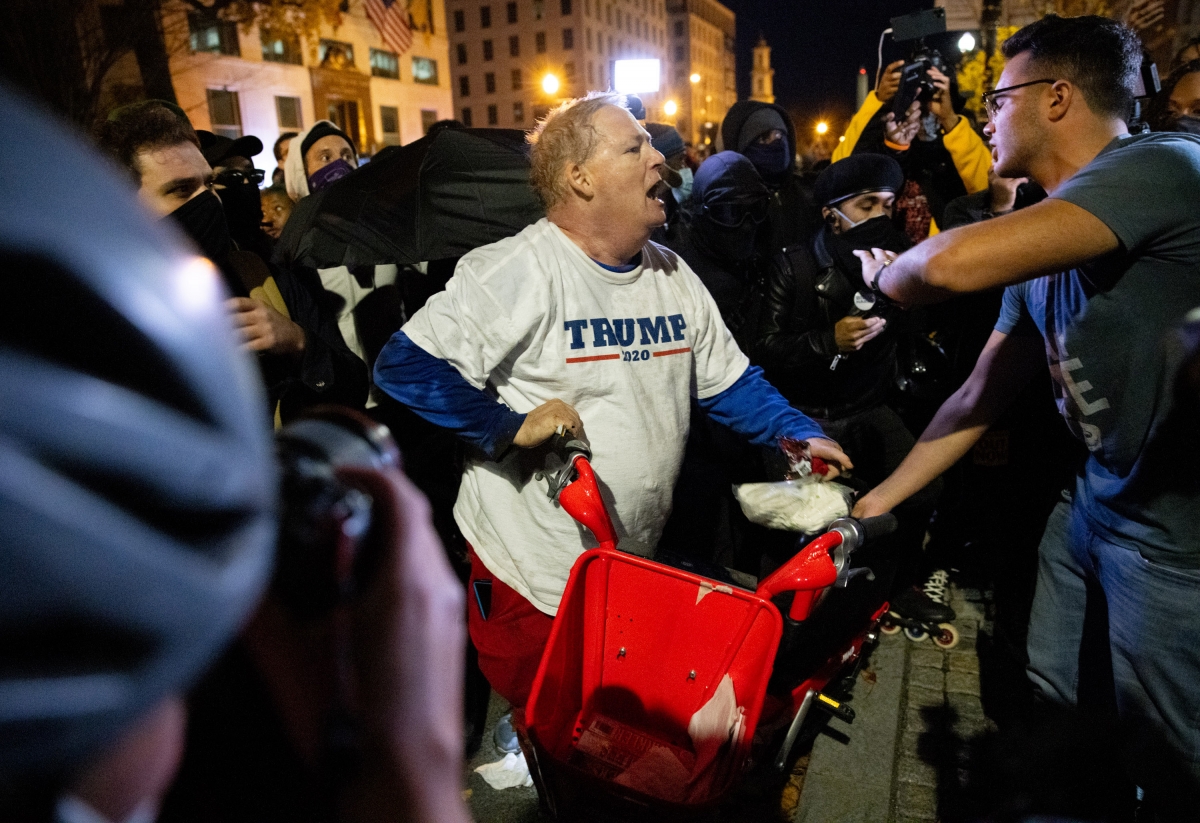
 Sen. Doug Jones is pictured at a news conference in August 2019. MUST CREDIT: Photo by Elijah Nouvelage for The Washington Post
  SootinClaimon.Com