Many fled Washington during pandemic, halting citys population boom

#SootinClaimon.Com : ขอบคุณแหล่งข้อมูล : หนังสือพิมพ์ The Nation.

https://www.nationthailand.com/international/40010438


WASHINGTON – The pandemic helped suppress U.S. population growth across the country, new data released this past week showed – but in the District of Columbia, the decrease was particularly sharp: After steadily growing for a decade and a half, the city shrank this year by around 20,000 residents, or 2.9%.
Many fled Washington during pandemic, halting citys population boom

Most of the loss was due to domestic migration (more people moving out than in), raising questions about whether the exodus is a blip or heralds a flattening out or even a reversal of the city’s long growth spurt.

About 23,000 more people moved out of the city than moved into it between July 1, 2020, and July 1, 2021, according to Census Bureau estimates, a decrease that was offset by a gain of about 2,100 people from natural increase (births over deaths) and about 1,100 from international migration.

In 2020, by comparison, Washington lost just 658 people through domestic migration. Before 2018, the domestic migration numbers had been positive going back to 2008. The city’s population had been growing since 2006.

The pandemic is a large driver of the change, analysts say. A report this summer using U.S. Postal Service data found that the District lost at least 17,000 more people during 2020 than the previous year, with at least 9,000 of the loss appearing to be permanent.

The report, by Ginger Moored, a financial analyst at the city’s Office of Revenue Analysis, showed 29,362 more people moved out of the city than into it during 2020, with moves accelerating after March. The net loss was much higher that year than in 2019, which saw 11,480 net moves out, the report said.

The analysis, which studied change of address forms filed with the USPS by individuals and families, found that while there was some decline in the number of moves into the District in 2020, about 90% of the increase in net moves out were due to additional people leaving the city.

Helen and Josh Folk didn’t expect to be among them last year. They had lived in a Capitol Hill rowhouse for a decade and had planned to stay there with their two small children for a few more years. Then the pandemic hit.

Helen, 34, a customer-facing manager for a national bank, was suddenly using the kitchen table as her office space – right across from her husband, Josh, 39, an executive at IdeaScale, a cloud-based software company. Conference calls and Zoom meetings became an elaborate dance as the couple ducked in and out of bedrooms or out the front door.

The Folks had planned to move to Northern Virginia by the time their girls started elementary school, but the pandemic pushed them to make the move earlier.

“All of the things we loved about living in the city – being able to walk around and go to restaurants, hanging out with friends, the social aspect – none of that was happening,” Helen Folk said. “It made us start to reevaluate what we wanted.”

A year ago, they moved to a house in Great Falls, Va., where each adult has a separate office space and the yard is big enough for the kids to play in and for friends to safely visit. “There are things we miss about D.C., but with the pandemic and having two little kids, we wouldn’t exactly have been able to enjoy those things anyway,” she said.

It’s not clear whether all of those who moved are gone for good.

When filling out the USPS forms, people mark their moves as permanent or temporary; the report estimated that of the increase of 17,882 net moves out, 9,335 were permanent and 8,547 were temporary.

The wave of departures comes even as decennial census data show the city grew by a robust 14.6% between 2010 and 2020. That growth came largely in the first part of the decade, peaking in 2013 before slowing down. Last year was the first time in a decade and a half that the city registered a net population loss. A shrinking population translates to less revenue for the city from income tax, real estate tax and sales tax.

The decline was confirmed by apartment vacancy rates, which shot up from 2.6% in the third quarter of 2019 to 7.7% in the first quarter of 2021, said the city’s interim chief financial officer, Fitzroy Lee.

The sharp drop in the District’s population was no surprise to local real estate professionals, who have for months been seeing residents ditch high-density parts of town in search of more space.

Harrison Beacher, the 2022 president of the Greater Capital Area Association of Realtors (GCAAR), said condominium sales have limped along through much of the pandemic, prompting some sellers to take their apartments off the market until spring 2022 in hopes of securing a better offer.

Neighborhoods full of high-density buildings and shared living options have cooled off as buyers looked to parts of the District with detached single-family homes, backyards, and access to nature and walking paths, setting records for sales in neighborhoods that had previously been considered less desirable, Beacher said.

“In moderate and higher income households, you don’t really see as many people leaving the area as you see them looking at slightly different neighborhoods,” Beacher said. “People were unwilling to pay as much for a tiny box.”

There are signs that the past year was an anomaly. As of May 2021, the USPS data show net moves out of the city have returned to 2019 levels. “But for the city to regain the population it lost, we would need to see an influx of residents into the city at levels we have not seen in several years,” it said.

The vacancy rate has recently returned to below the pre-pandemic level, registering at 1.8% in the third quarter of this year, Lee said, adding that this offered hope that the slowdown would be temporary.

“Frankly, I was worried until I started seeing the later data from USPS and the vacancy rate,” he said. “There is evidence that people are coming back.”

The Zip codes registering the largest declines in 2020 were areas with relatively high numbers of multifamily buildings, including Dupont and Logan circles, Adams Morgan, Columbia Heights, 14th and U Street NW, and Southwest Waterfront.

Zip codes with the fewest losses tended to be toward the edges of the city and have more single-family homes such as Shepherd Park, Takoma, Chevy Chase, Friendship Heights and Barnaby Woods. At least 31% of people leaving D.C. are believed to have moved to places in the Washington metro area, with Bethesda and Arlington gaining some of the highest percentages of people moving from the District, according to the report.

Zip code 20003, which includes Navy Yard, a neighborhood with many multifamily buildings, had the largest influx from other parts of the city. “New apartments coming online and offering incentives for moving in may be why Navy Yard and adjacent areas were able to attract so many residents from other parts of the city,” the report said.

William Frey, a senior demographer at the Brookings Institution, said the patterns suggest the city’s population may bounce back after the pandemic.

“I think it says that D.C., with its exceptionally large young population of students, interns and others who moved from out of state – many of them renters – who are more primed to make a covid-related move, will have lost a higher share of residents than many other cities,” he said. “The fact that a good portion of the D.C. out movers were labeled temporary, or destined to D.C. suburbs, suggests that there is a good chance the District can see a population rebound once the pandemic has subsided.”

Even before the pandemic, the city’s meteoric growth had slowed considerably, which Lee attributed to rising housing prices and scarce availability.

The prices of homes in the District have remained high through the pandemic. Even with a population drop, a housing shortage – and limited supply of single-family homes – has continued an imbalance of supply and demand that favors sellers and pushes home prices up and up, Beacher said.

In D.C., the median sale price for homes in November was $725,000 – a nearly 3% increase from the previous month and a more than 6.5% increase from the same time period in 2020, according to the GCAAR.

For this reason, several real estate agents said, some families have opted to leave the District, looking at homes in the suburbs and exurbs of Maryland and Virginia. In Montgomery County, just over the D.C. border, the median sale price for homes was $525,000, up more than 7% from November 2020, according to GCAAR data.

“When people were in their house in 2020 and realized they needed more space to do more things inside, they realized there are limited options to do that in the city unless you have a million dollar budget,” Beacher said.

Bic DeCaro, a real estate agent in Northern Virginia, said the transition to remote work pushed many to begin looking beyond D.C. borders.

Prince William County, Loudoun County and even parts of Warren County have become pandemic destinations, DeCaro said.

“When people feel they can leave and work remotely from anywhere, permanently, they start thinking about quality of life,” DeCaro said. “If they can get paid the same amount they’re getting paid to live in a city, but live in a cheaper area, then all of a sudden they can save more money, they can move to a better school district, they can get a head start on living in the place they want to retire to.”

But Steven Martin, a senior demographer at the Urban Institute, said the latest numbers don’t necessarily signify a radical shift, saying in a city where upward of 100,000 people move in and out each year, the current numbers are not out of line.

“Movement in is happening, just at a lower rate than before, so people are still being attracted into the area,” he said. “I’m not ready to decree that a new age has dawned in D.C.”

The D.C. government has cast doubt on the accuracy of the 2020 Census count, which helps inform the latest estimates. The District is conducting its own analysis of the count to determine if or by how much its population may have been undercounted.

Deputy Mayor John Falcicchio cautioned against drawing long-term conclusions on the viability of urban living or high-density housing based on one year of population data, noting the strong home sales throughout the pandemic.

Meanwhile, the city is doing what it can to lure people back: Mayor Muriel E. Bowser this past week said coronavirus vaccines would be required for patrons to enter restaurants, gyms and other businesses starting in mid-January, and a mask mandate was reinstated amid rising coronavirus case counts.

These measures, Falcicchio said, are part of a long-term strategy to make D.C. visitors and residents feel secure.

“We want to make sure when people come back and enjoy the vibrancy the city has to offer that they know we’ll put in more steps to make the city safe,” he said. “We’re on our way to a comeback.”

Published : December 26, 2021

By : The Washington Post

India to start vaccinating teens, add booster for health workers

#SootinClaimon.Com : ขอบคุณแหล่งข้อมูล : หนังสือพิมพ์ The Nation.

https://www.nationthailand.com/international/40010437


India will begin vaccinating teenagers from the ages of 15 to 18 from Jan. 3 and also administer booster vaccine doses for health-care workers a week later, as omicron-fueled Covid-19 cases spike, Prime Minister Narendra Modi said.

India to start vaccinating teens, add booster for health workers

Citizens who are older than 60 years and suffer from co-morbidities can also get booster shots of Covid vaccines in January, Modi said in a televised national address.

“India needs to be vigilant about the spread of the coronavirus,” Modi said, adding that people should not pay attention to rumors nor panic about rising infection numbers.

India has so far reported 415 cases of omicron infections from across 17 states, according to the latest data from the federal Health Ministry Saturday.

The South Asian nation’s confirmed Covid cases so far total nearly 34.8 million.

“In our country, a nasal vaccine and the world’s first DNA vaccine will also start soon,” Modi said, adding that “since the beginning, India’s fight against Corona has been based on scientific principles, scientific opinions and scientific patterns.”

Besides widening the vaccination drive, Modi urged citizens to follow Covid-appropriate behavior, but stopped short of announcing any nationwide curbs to stem omicron’s spread.

His government has kept the budget loose to support the economy, while the nation’s central bank has vowed to keep monetary policy easy to ensure a durable recovery even as infections tick up.

“This is a material and a positive change in the country’s strategy against the virus,” said Abhay Agarwal, fund manager at Piper Serica Advisors Pvt. “The investor community had been wondering on when India would expand its vaccination band as a number of countries have included the younger population in the inoculation plan.”

Published : December 26, 2021

By : Bloomberg

JR Kyushu unveils new Kamome bullet train

#SootinClaimon.Com : ขอบคุณแหล่งข้อมูล : หนังสือพิมพ์ The Nation.

https://www.nationthailand.com/international/40010435


KUDAMATSU, Japan – Kyushu Railway Co. (JR Kyushu) has unveiled a new Shinkansen bullet train called Kamome to be used on the Nishi-Kyushu Shinkansen line scheduled to open next autumn.

JR Kyushu unveils new Kamome bullet train

The unveiling to the media was held Wednesday at the Kasado Works of Hitachi, Ltd. in Kudamatsu, Yamaguchi Prefecture. The new model was manufactured there based on the N700S, a next-generation Shinkansen series developed by Central Japan Railway Co. (JR Tokai).

Kamome’s exterior is mainly white, while the bottom is red as a nod to JR Kyushu’s corporate color. It was designed by Eiji Mitooka, an industrial designer who worked on the luxury sleeper train Seven Stars in Kyushu.

Before the new Shinkansen line, which will run between Saga Prefecture’s Takeo Onsen and Nagasaki stations, will go into operation, the railway company plans to build four Kamome trains, each of which will comprise six cars, and transfer them to a railroad depot in Nagasaki Prefecture.

Published : December 26, 2021

By : The Japan News

Armed intruder apprehended on Windsor Castle grounds as queen celebrates Christmas

#SootinClaimon.Com : ขอบคุณแหล่งข้อมูล : หนังสือพิมพ์ The Nation.

https://www.nationthailand.com/international/40010433


LONDON – British police on Saturday said that an armed intruder was arrested on Christmas morning on the grounds of Windsor Castle, the main residence of Queen Elizabeth II, where the British monarch was celebrating Christmas.

Armed intruder apprehended on Windsor Castle grounds as queen celebrates Christmas

“The man has been arrested on suspicion of breach or trespass of a protected site and possession of an offensive weapon. He remains in custody at this time,” Thames Valley Police Superintendent Rebecca Mears said in a statement.

The 19-year-old man was arrested after he was found entering the grounds of the castle at around 8:30 a.m., police said. He did not enter any buildings.

“Members of the royal family have been informed about the incident,” Mears said. “We do not believe there is a wider danger to the public.”

A spokeswoman for Buckingham Palace declined to comment on the incident.

The queen had been planning to host Christmas this year at her Sandringham estate in Norfolk, England. But those plans were scrapped, for the second year in a row, following a spike in coronavirus infections – confirmed daily cases hit a record high on Saturday.

Instead, the queen spent Christmas Day at Windsor Castle, her main residence since the start of the pandemic in 2020. She was joined by a small group of family members, including her eldest son, Prince Charles, and his wife, Camilla.

This was the queen’s first Christmas since the death of her husband, Prince Philip, in April at age 99. The queen paid tribute to him in her annual Christmas Day speech, which was broadcast Saturday was but recorded last week.

Referring to Philip, the queen said that there was “one familiar laugh missing this year.”

Published : December 26, 2021

By : The Washington Post

At least 16 people killed in shipwreck off Greece, adding to string of deadly incidents at sea

#SootinClaimon.Com : ขอบคุณแหล่งข้อมูล : หนังสือพิมพ์ The Nation.

https://www.nationthailand.com/international/40010432


At least 16 people are dead, among them an infant, after a boat carrying migrants capsized Friday near the Greek island of Paros – the third deadly incident requiring search-and-rescue operations this week, Greeces coast guard reported, along a crucial corridor for refugees seeking to enter Europe.

At least 16 people killed in shipwreck off Greece, adding to string of deadly incidents at sea

Local media outlets reported Saturday that the coastguard had recovered overnight the bodies of 12 men, three women and an infant northwest of the site of the capsizing in the central Aegean Sea, Reuters reported.

Athens News Agency reported that 63 people had been rescued and would be temporarily housed on the island of Paros. The agency reported that some 80 people were estimated to have been on the boat, which Greek authorities said they suspected was en route from Turkey to Italy.

Greece shipping minister Giannis Plakiotakis, in a statement to Reuters, said trafficking gangs were responsible.

The gangs “are indifferent to human life, stacking dozens of people, without life jackets, in vessels which do not conform to the most basic of safety standards,” he said.

More than 23,150 migrants and refugees have died or gone missing in the Mediterranean since 2014, according to the United Nations-affiliated Missing Migrants Project. Boats often set out from Libya and Turkey and carry migrants and refugees from Africa, the Middle East, Central Asia and elsewhere seeking safety in Europe.

The dangerous maritime journey to Greece, often undertaken on overcrowded rubber boats, is a key route. Then number of people seeking to cross reached its peak between 2015 and 2016, when more than 1 million people passed through Greece in hopes of traveling on to other parts of the European Union.

Numbers have dramatically declined since, in part because of anti-immigrant policies in some European countries and a 2016 deal between Brussels and Ankara that allowed the E.U. to send migrants back to Turkey.

Migration and asylum efforts further slowed in 2020 because of the novel coronavirus, which sparked lockdowns and tighter border rules. The E.U. reported 125,100 “irregular border crossings” in 2020, among them 86,300 attempts by sea, reflecting a 19% drop from 2019.

But numbers have since been rising again: Between January and October of 2021, the EU recorded 151,600 efforts illegally to cross into the bloc, a 72% increase from the same period in 2020. Across the Mediterranean, the Missing Migrants Project as of Dec. 21 recorded 1,864 deaths in 2021, up from 1,448 the year before.

Included in that tally are three asylum seekers who died this week when a boat carrying an estimated 50 people, many from Iraq and Syria, sank Tuesday off Greece’s Folegandros island. Dozens more remained missing Wednesday.

But the week’s second maritime disaster is not yet reflected in the numbers. Greek authorities said Friday that they recovered 11 bodies after a sailboat carrying more than 90 people sank near southern Greece.

Europe’s refugee crisis coincided with Greece’s economic crisis. At the height of migration, refugees entering via Greece often sought to travel on to apply for asylum in other European countries. Many, however, became stuck in Greece as neighboring E.U. countries closed or tightened their borders.

As of August, Greek refugee camps and other accommodations housed around 42,000 migrants and asylum seekers, down from more than 82,000 the previous August, according to Greece’s Ministry of Migration and Asylum. Although tens of thousands of migrants had been held in overcrowded camps on Greek islands, as of August, just over 5,000 remained in those facilities.

Over the past year, thousands of people granted refugee status in Greece have left to reapply for that status elsewhere in Europe because of difficult conditions in the country, the New Humanitarian reported. In recent years, Greece and other European states have imposed stricter requirements to gain legal status and have encouraged voluntary deportations.

Published : December 26, 2021

By : The Washington Post

Asean reported over 23,000 Covid-19 cases on Saturday

#SootinClaimon.Com : ขอบคุณแหล่งข้อมูล : หนังสือพิมพ์ The Nation.

https://www.nationthailand.com/international/40010422


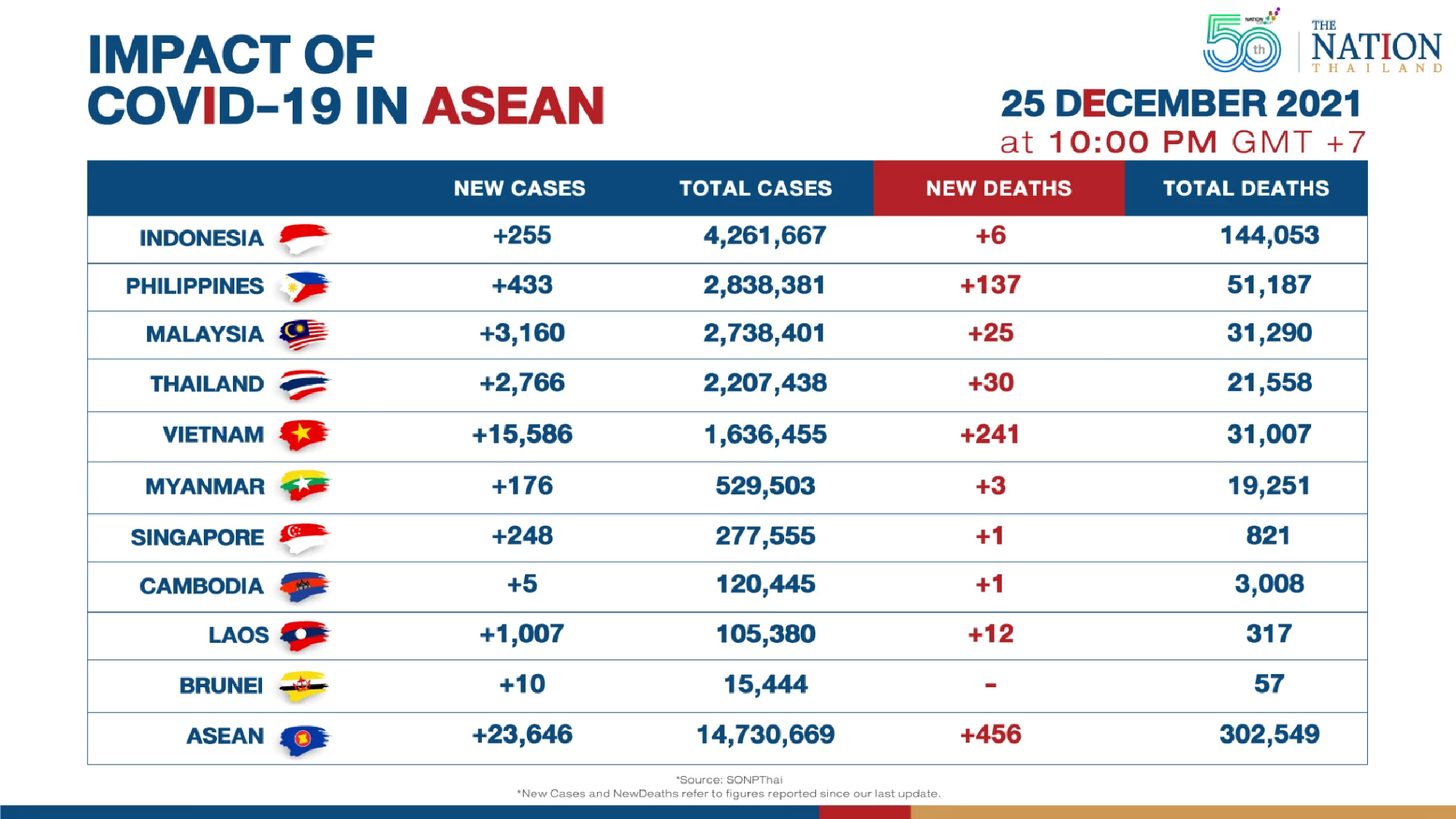
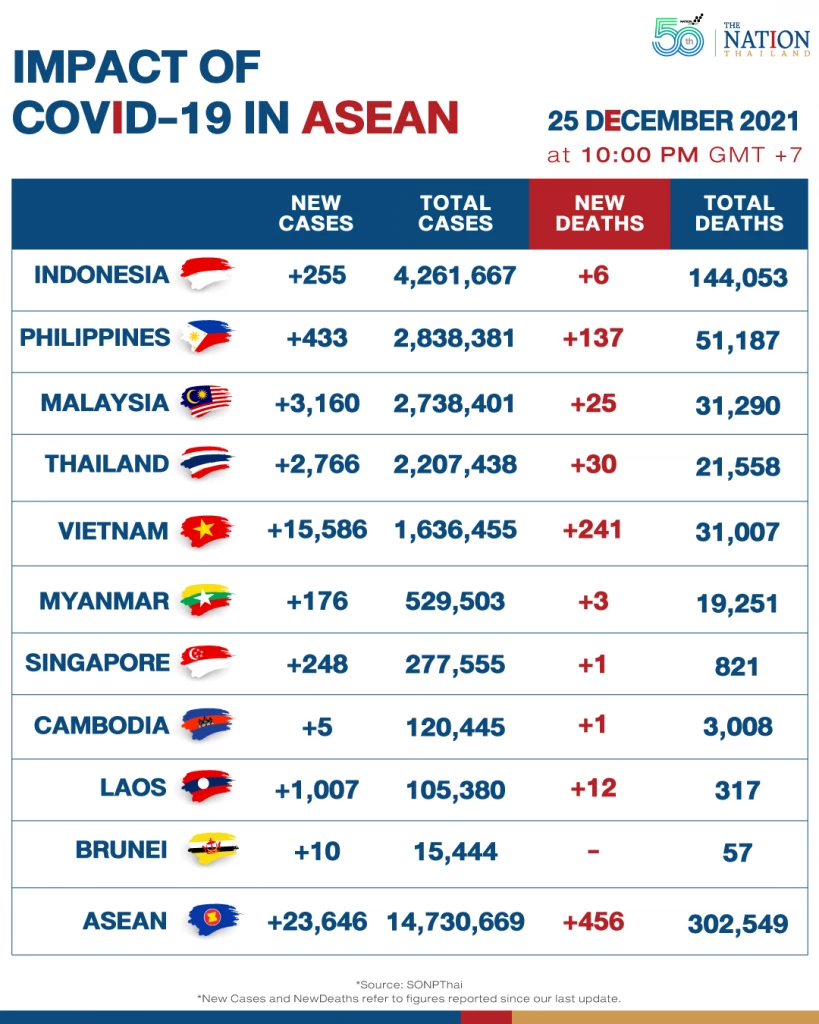
The number of Covid-19 cases crossed 14.73 million across Southeast Asia, with 23,646 new cases reported on Saturday (December 25).

Asean reported over 23,000 Covid-19 cases on Saturday

New deaths are at 456, bringing accumulated Covid-19 deaths in Asean to 302,549.

Asean reported over 23,000 Covid-19 cases on Saturday

Published : December 26, 2021

By : THE NATION

NASAs James Webb Space Telescope launches in French Guiana

#SootinClaimon.Com : ขอบคุณแหล่งข้อมูล : หนังสือพิมพ์ The Nation.

https://www.nationthailand.com/tech/40010436


BALTIMORE – NASAs revolutionary James Webb Space Telescope is hurtling away from Earth and toward deep space on a long-awaited, high-risk mission that, if successful, will look deeper into the cosmic past than any telescope before.

NASAs James Webb Space Telescope launches in French Guiana

The Webb blasted off Christmas morning from the European Space Agency’s spaceport in Kourou, French Guiana, on South America’s northeast coast, and early reports from NASA suggest the mission is going swimmingly.

This is, however, an unusually difficult mission involving an extraordinarily complicated instrument, and in the coming days and weeks the telescope will have to transform itself through a series of hardware deployments, each of which is critical to the telescope’s ambitious astronomy.

Though relieved by the successful launch, NASA deputy administrator Pam Melroy acknowledged what everyone involved with the Webb knows: “We have some scary days ahead.”

That NASA chose to forge ahead with a Christmas launch was a sign of how seriously the agency and the global scientific community takes this $10 billion mission, the long-delayed successor to the Hubble Space Telescope. Officials had challenging discussions about launching on a holiday, and amid the rapid spread of the omicron coronavirus variant but decided to go on the first possible day, which after two technical problems and one weather delay turned out to be Dec. 25.

Melroy put a positive spin on it: “It’s not bad that it’s happening on Christmas Day, which should be a day of hope and inspiration.”

The telescope left Earth in a folded position, fully enveloped in the cone of Arianespace’s heavy-lift Ariane 5 rocket, which rolled to the launchpad Thursday. Less than half an hour after launch, it separated from the final booster and was traveling at 22,000 miles per hour, “flying on its own in coast phase,” as NASA put it.

Early reports indicated that everything was “nominal” – precisely the space-jargon term that the thousands of people who have worked on the mission were hoping to hear on launch day.

“It was a perfect ride to orbit,” announced Rob Navias, NASA’s launch commentator.

The separation from the final booster provided a stunning – and, for humanity, probably the final – view of the Webb. A camera on the upper stage of the rocket captured the rear end of the Webb receding, with the Earth on the right side of the frame. Then came a critical deployment – solar arrays jutting from the spacecraft, gleaming brilliantly in full sun and ensuring the telescope will have power out there in the void.

“There it is. There is your critical call. James Webb not only has legs, it has power,” Navias said. “Quite a Christmas present for the world’s astronomers.”

At a news conference in Kourou after the successful launch, NASA science chief Thomas Zurbuchen highlighted that image of the telescope receding into space: “For me that picture will be burned into my mind forever.”

The launch and the deployment of the solar arrays was greeted with cheers at the Space Telescope Science Institute in Baltimore, where officials, industry executives and a smattering of journalists gathered in the institute’s auditorium to watch events on a big screen. Upstairs, in the high-security Mission Operations Center – which took over the mission after the launch team in French Guiana concluded its task – the outcry of joy among the engineers and technicians was intense enough to send a rumble through the building.

“My feet have stopped tapping,” planetary astronomer Heidi Hammel, who could not bear to sit down during the launch, said in the institute cafeteria as the Webb flew through space. “It’s all calming down now, and I’m starting to breathe normally.”

More drama is coming, though.

“I want to hear that the covers open on the sun shield and then that the sun shield starts to deploy properly,” Hammel said. And then there’s the less-heralded “secondary mirror,” which has to protrude properly to bounce light from the telescope’s main mirror down through the center of the telescope.

“The secondary mirror has to deploy, otherwise there’s nothing,” Hammel said.

The launch date had been Dec. 18, but a technical mishap at the spaceport – a large clamp coming loose and jostling the telescope – required a four-day delay to ensure that nothing had been damaged. Another glitch with an essential cable delayed the launch for two days, to Dec. 24. Then came the one-day weather delay. Christmas morning dawned cloudy but without storms, and the launch proceeded without a hitch, at 9:20 a.m. local time in Kourou – 7:20 a.m. in Baltimore.

The predawn streets and elevated highways of Baltimore were empty, but by 6 a.m. the Space Telescope Science Institute was bustling. Some news media and scientists dropped out in recent days as the omicron variant spread, and so the hoopla was limited. Visitors were handed KN95 masks and told to take rapid coronavirus tests.

Saturday morning’s prelaunch event at the institute began with remarks by Webb team members, including representatives of Europe’s and Canada’s space agencies, partners in the mission. The speakers emphasized the telescope’s potential to answer fundamental questions about the history of the cosmos.

“Look farther, delve deeper and measure more precisely, and you’re bound to detect something new and wondrous,” said Kenneth Sembach, director of the telescope institute. “It is a gift to everyone who contemplates the vastness of the universe.”

Melroy echoed that: “When we see things with a new lens, we gain new knowledge and new perspectives that can change fundamentally how we see the universe and how we see ourselves.”

The rocket will send the telescope far beyond Earth’s gravity well, and into a gravitationally stable position known as L2, where the telescope will orbit the sun and remain roughly a million miles from Earth on the opposite side of our planet from the sun.

The journey to L2 will take about 29 days. Along the way, the Webb will undergo course corrections and a series of critically important deployments of its hardware, including a sun shield the size of a tennis court.

After the sun shield opens up, NASA will send a command from Earth to unfold 18 gold-plated, hexagonal mirrors, which together will function as a 21-meter light bucket, nearly three times the diameter of the Hubble’s mirror.

This is a novel design, driven by ambitious scientific objectives.

NASA and its partners must overcome 344 potential single point failures, according to an independent review board. That list began with launch, although the Ariane 5 has an excellent track record.

Zurbuchen, who was in French Guiana for the launch, said last month that the agency has tested the telescope and its instruments thoroughly.

“We’ve gone through every systematic analysis that we can think of,” he said.

The Webb, named for NASA’s administrator at the height of the 1960s Space Race, traces its scientific roots to the 1980s, and has been under development since the mid-1990s. It has struggled through multiple delays, and survived one congressional attempt to terminate the mission as its cost soared.

“It’s been a long road, as many of you know, to get where we are. Even so, we planned such a revolutionary telescope that it has stood the test of this time,” Hammel said Thursday during a NASA science webinar on the goals on the mission.

The Webb is an infrared telescope, capturing wavelengths outside the spectral range of the Hubble Space Telescope. With the sprawling sun shield protecting it from the sun’s heat, and with additional help from cooling devices, the Webb will take advantage of extremely cold temperatures, below minus-370 degrees Fahrenheit.

It is designed to see the oldest stars in the universe and scrutinize the formation of the earliest galaxies. It will also study the atmospheres of exoplanets that orbit stars in our galaxy.

It can even look at nearby neighbors, such as Jupiter – where scientists still want to know why the Great Red Spot on the planet is red, Hammel said. Two other targets are Jupiter’s intriguing moon Europa and Saturn’s moon Enceladus, both of which have geysers believed to signal the presence of subsurface oceans.

“If we can put our beam there and detect organics in this plume material that may give us clues to the habitability of subsurface oceans,” Hammel said.

It will take about six months for NASA and its partners to fully commission the telescope and begin delivering the promised images from deep space. In addition to the well-publicized challenges of deploying the sun shield and the mirrors, the spacecraft has to cool itself to extremely low temperatures. The individual mirrors can be adjusted to achieve the kind of resolution that should make the Webb roughly 100 times more powerful than the Hubble.

So a lot of work is still ahead – but Saturday was a giant leap for a telescope that at times looked like it might never get off the ground.

“Tens of thousands of people have committed over 20 years or more on a single project,” Matt Mountain, an astronomer who is part of the team that designed the telescope, said at the telescope institute just minutes before launch Saturday. “And why? Why have they committed this time? We solve incredibly hard problems. It’s part of the human spirit. We’re curious. We explore.”

Published : December 26, 2021

By : The Washington Post

Lalisa offers special Xmas present to her ‘Blinks’

#SootinClaimon.Com : ขอบคุณแหล่งข้อมูล : หนังสือพิมพ์ The Nation.

https://www.nationthailand.com/life/40010445


Lalisa offers special Xmas present to her ‘Blinks’

The “Money Dance Performance (Christmas Ver) for Blinks”, featuring Lalisa in a snow queen costume, was released on the Lilifilm Official YouTube channel and rose to No 1 almost immediately.

As of press time, the clip had been viewed more than 4 million times.

Credit: YouTube channel Lilifilm Official, Lalisa’s official Instagram and Twitter accounts (lalalalisa_m)

Related news:

Lalisa offers special Xmas present to her ‘Blinks’

Published : December 26, 2021

By : THE NATION

Foreign fund flow slowdown, technical signs expected to pressure SET

#SootinClaimon.Com : ขอบคุณแหล่งข้อมูล : หนังสือพิมพ์ The Nation.

https://www.nationthailand.com/business/40010459


Krungsri Securities forecast the Stock Exchange of Thailand (SET) Index on Monday (December 27) would fluctuate between 1,630-1,650 points despite positive news of Covid-19 vaccines and antiviral pills helping alleviate concerns over Omicron variant.

Foreign fund flow slowdown, technical signs expected to pressure SET

It said the index also gained positive sentiment from mass buy-ups of Super Savings Fund and Retirement Mutual Fund to gain tax exemption.

“However, the index would be under pressure due to foreign fund flow slowdown and technical signs at the resistance level,” Krungsri Securities said.

It also recommended buying of the following companies’ shares as an investment strategy:
▪︎ HMPRO, CPN, CRC, AMATA, WHA, VGI, SYNEX, COM7 and JMART, which are domestic play stocks.
▪︎ RCL, LEO, III, WICE, SONIC and JWD, which benefit from rising freight rate.
▪︎ EA, GPSC, AMATA, WHA, AH and SAT, which benefit from the government’s support on electric vehicles.

Published : December 27, 2021

By : THE NATION

86 WTO members agree on 8 e-commerce articles

#SootinClaimon.Com : ขอบคุณแหล่งข้อมูล : หนังสือพิมพ์ The Nation.

https://www.nationthailand.com/business/40010434


TOKYO – A total of 86 World Trade Organization member countries and regions, including Japan, the United States and European nations, agreed earlier this month on eight articles regarding electronic commerce, including consumer protection and government data disclosure.

86 WTO members agree on 8 e-commerce articles

In principle, the WTO requires unanimous consent from its 164 members. However, it is often difficult to reach consensus between developed and developing countries and regions due to conflicting opinions. Considering such a situation, some members who share certain objectives are taking initiatives to put rules in place in specific fields of WTO negotiations.

The eight articles include “online consumer protection,” such as prohibiting fraudulent activities that cause harm to consumers, and “open government data,” which encourages development of mainly small and medium-sized enterprises. The WTO had no common rules on e-commerce even though the volume of cross-border data flows approximately quintupled in the five years to 2020 due to digitization. It is the first time the members have agreed on individual articles.

In the field of e-commerce, about 20 items are viewed as still to be negotiated, including customs duties on electronic transmissions, with the aim of reaching general agreement by the end of 2022.

Concerning domestic rulemaking on services businesses by some WTO member countries and regions, Japan, the European Union and China have been participating in negotiations in all fields, while the United States decided not to participate in some of them. India and South Africa have opposed the framework on the grounds that it is led by only certain countries and regions and therefore does not respect the WTO principle of unanimity.

Tsuyoshi Kawase, a professor of international economic law at Sophia University, said: “If an agreement on trade liberalization is applied only to some countries and regions, it may violate most-favored-nation treatment, which prohibits discriminatory treatment among members. If it is agreed and implemented within the WTO framework, it must be a mechanism that benefits all members.”

Published : December 26, 2021

By : The Japan News