SET remains under pressure from volatile funds flow, despite Fed continuing fiscal policies
The Stock Exchange of Thailand (SET) Index fell by 2.64 points, or 0.17 per cent, to 1,535.14 on Friday morning.
The SET Index closed at 1,537.78 on Thursday, up 0.15 points or 0.01 per cent. Transactions totalled THB79.54 billion with an index high of 1,545.08 and a low of 1,533.94.
Krungsri Securities predicted the index on Friday would fluctuate between 1,530 and 1,550 points despite the US Federal Reserve maintaining its interest rate at 0.25 per cent and continuing with its quantitative easing programme, plus the rising oil price.
It also predicted that the index would be under pressure due to rising domestic Covid-19 cases and volatility in foreign funds flow.
ADVERTISEMENTx
It recommended that investors buy:
▪︎ HANA, KCE, TU, CPF, ASIAN and EPG, which would benefit from the weakening baht.
▪︎ BCH, CHG, BDMS, GLOBAL, DOHOME, BEM, CKP, CBG, OSP, ICHI, GPSC, BEC, GUNKUL, JWD, WICE, SONIC and NER, whose second-quarter business turnover is expected to improve.
Baht expected to weaken but unlikely to dip below 33 to US dollar
The baht opened at 32.87 to the US dollar on Friday, unchanged from Thursday’s closing rate.
The Thai currency is likely to move between 32.80 and 32.95 during the day, Krungthai Bank market strategist Poon Panichpibool said.
Poon said the US dollar was weakening but the Thai currency was unlikely to strengthen soon due to the worsening Covid-19 situation in Thailand.
Foreign investors were still offloading their assets, such as stocks in Thailand, which would lead to a weakening of the baht, he predicted.
But Poon believed the Thai currency would not weaken below 33 per US dollar if investors felt “safe” from the worldwide Covid-19 situation and hence did not need to hold onto safe-haven assets.
Gold gets a boost as dollar weakens after Fed keeps status quo
The price of gold in Thailand rose by THB100 per baht weight on Friday morning.
The Gold Traders Association report at 9.26am showed the buying price of a gold bar at THB28,300 per baht weight and selling price THB28,400, while gold ornaments were priced at THB27,788.28 and THB28,900, respectively.
At close on Thursday, the buying price of a gold bar was THB28,200 per baht weight and selling price THB28,300, while gold ornaments were priced at THB27,697.32 and THB28,800, respectively.
ADVERTISEMENTx
Spot gold on Friday was US$1,828 (THB60,155) per ounce after Comex gold on Thursday rose by $31.2 to $1,835.8 per ounce on the weakening dollar after the US Federal Reserve maintained its interest rate at 0.25 per cent and continued with its quantitative easing programme.
US GDP growth missing forecasts in the second quarter also boosted mass buy-ups of the precious metal.
Hong Kong gold price, meanwhile, rose by HK$70 to $16,940 (THB71,720) per tael, the Chinese Gold and Silver Exchange Society reported.
The world needs coffee but dont look to Vietnam for help
Global coffee consumers seeking more supplies to fill the void left by the devastating frost in Brazil wont get much relief from Vietnam.
Shipments from the country, the biggest robusta coffee grower, are declining because of depleted farmer inventories, a worsening Covid-19 outbreak and a severe container shortage. Exports are likely to continue dropping through September, according to top shippers Intimex Group and Simexco Daklak.
“Farmers say they have run out of beans and so can’t benefit from this surge in prices,” said Do Ha Nam, chairman of No. 1 shipper Intimex Group. “We have bought no beans and sold no beans for more than a month.”
Prices of the milder tasting arabica variety traded in New York rocketed to the highest since 2014 this week after frigid weather destroyed trees in Brazil. That helped lift London prices of the more bitter robusta to the strongest since 2017. Arabica is set to increase 25% this month and robusta to rise about 13%.
“The price rally has not benefited exporters much,” said Phan Hung Anh, chief executive of Quang Minh Coffee Trading in the southern province of Binh Duong. “Surging shipping costs have discouraged importers from purchasing beans in Vietnam. We have no new contracts to buy beans from farmers.”
ADVERTISEMENTx
Sending a container from Vietnam to Europe costs as much as $10,000, six to seven times more than a year ago, according to Anh, who sees his company’s overseas shipments this year shrinking at least 20% from 50,000 tons in 2020.
The country’s exporters haven’t been able to gain much from the jump in the market because stockpiles in their Ho Chi Minh City-area warehouses have been priced already, according to a survey of traders. “We have sufficient beans to fulfill our commitments through the end of the season,” said Le Tien Hung, chairman of the second-biggest shipper Simexco Daklak.
Shippers are worried that the logistics pain may persist through the end of this year when the new harvest rolls in and exports normally rise. An explosive new surge in coronavirus cases is another concern.
The tally in five provinces of the Central Highlands, a key coffee-growing region, jumped to almost 300 as of Wednesday morning from only a few before last week, according to the health ministry. The capital city of Buon Ma Thuot and a district have been under a stay-home order since Saturday.
Stay-home orders may be extended to other coffee areas in Dak Lak, which grows about a third of the country’s coffee, said Trinh Duc Minh, chairman of Buon Ma Thuot Coffee Association. Minh is worried infections may increase as thousands of workers from southern Vietnam, the virus epicenter, flock home to the Central Highlands to shelter from the delta variant.
Harvesting may slow if the virus stays around until the harvest peaks in November, said Simexco’s Hung, who sees a smaller crop because of lower rainfall and a lack of investment. While most traders said it’s too early for a prediction, five of the 11 surveyed expect a good crop, with two seeing a rise of 6-10% from the previous year’s 1.7 million tons. Exports through July this year are running 9% below a year earlier, according to the statistics office.
Published : July 30, 2021
By : Syndication Washington Post, Bloomberg · Mai Ngoc Chau
U.S. GDP trails forecast even as consumer spending surges
U.S. growth missed forecasts in the second quarter as the effects of supply-chain constraints reverberated through the economy and took the shine off one of the biggest gains in consumer spending in decades.
Gross domestic product expanded at a 6.5% annualized rate following a revised 6.3% pace in the first quarter, the Commerce Department’s preliminary estimate showed Thursday.
The report underscores the robust bounce back in household demand as well as the challenges companies are facing keeping pace with that demand. Firms’ inability to keep merchandise stocked and bottlenecks in production have capped the speed at which the U.S. pandemic recovery can grow.
“The downside surprise in the GDP numbers is mostly in the inventory component,” Ian Shepherdson, chief economist at Pantheon Macroeconomics, wrote in a note. “We are not disappointed by the headline GDP growth miss.”
The median forecast in a Bloomberg survey of economists called for an 8.4% increase in GDP. Shepherdson said he expects a big rebound in inventories and is penciling in third-quarter growth of 8% or more.
The S&P 500 climbed after the report, the yield on the 10-year Treasury note rose and the dollar weakened on expectations that the figures will encourage the Federal Reserve to maintain its support for the economy.
Personal consumption exceeded forecasts as Americans had both the wherewithal and the opportunity to ramp up spending on services such as dining out. Vaccinations, government aid and a broader reopening of the economy helped drive an annualized 11.8% gain, the second-largest advance since 1952.
At the same time, inventories took a 1.1 percentage points bite out of second-quarter GDP, while residential investment reduced growth by about 0.5 percentage point.
“The second-quarter GDP report is stronger than it looks, with measures excluding trade and inventory drag far outpacing the 6.5% headline gain,” Bloomberg economists Andrew Husby, Eliza Winger and Niraj Shahwrote in a note. “More ambitious marks like pre-pandemic trend, or closing the gap to some estimates of potential, is in reach within a few quarters.”
ADVERTISEMENTx
The report showed the U.S. economy has recouped its pandemic losses. The inflation-adjusted value of domestically produced goods and services climbed to an annualized $19.36 trillion, eclipsing its pre-pandemic peak.
Looking ahead, economic growth will be challenged by waning federal support, a rapidly spreading variant of Covid-19, and lingering supply and labor constraints. The report showed the saving rate dropped to 10.9% in the second quarter from 20.8%, indicating Americans are spending cash built up during the pandemic.
Businesses have struggled to keep pace with the outpouring of pent-up demand, pushing prices skyward and eroding recent wage gains. The personal consumption expenditures price index excluding food and energy costs, followed closely by Fed officials, climbed an annualized 6.1% in the second quarter, the biggest gain since 1983.
Unlike output, the jobs market is far from reaching its pre-pandemic strength. The Fed held interest rates near zero this week and maintained its pace of asset purchases.
“We’re not there. And we see ourselves as having some ground to cover to get there,” Fed Chair Jerome Powell said at a press conference Wednesday.
ADVERTISEMENT
Supply shortages and logistics challenges are proving to be a lingering headwinds for companies including Apple Inc., Fastenal Co. and Whirlpool Corp., according to recent earnings calls.
Supply is well short of demand, allowing us to keep pricing strong, said Ford Motor Co. Chief Executive Officer James Farley on the company’s earnings call Wednesday. “Given the strength of our product lineup and the demand we see, we expect to have a relatively strong pricing power for the new foreseeable future.”
For the Biden administration, the supply-chain bottlenecks weighing on the figure may support calls for broader infrastructure investment.
Second-quarter growth was also bolstered by continued strength in business investment. Driven by equipment and intellectual property, non-residential outlays rose an annualized 8%, the fourth-straight quarterly advance.
The Commerce Department also released its annual update Thursday, which resulted in mostly minor changes in the pattern of growth and inflation over the last five years. Corporate profits were found to be stronger than originally reported in recent years.
ADVERTISEMENT
Digging deeper:
– Excluding the trade and inventories components of GDP, final sales to private domestic purchasers, a gauge of underlying demand, rose at a 16.5% pace after a 16% gain in the first quarter.
– Net exports subtracted 0.44 percentage point from growth.
– Business outlays for structures declined an annualized 7%.
– Services added 5.1 percentage points to second-quarter growth. Outlays for merchandise remained solid as well, rising 11.6%.
– Motor vehicle output shrank an annualized 16.2% in the second quarter; excluding auto output, GDP advanced 7.2%.
Published : July 30, 2021
By : Syndication Washington Post, Bloomberg · Reade Pickert
Big Oil shows confidence the era of large profits is back
Europes largest oil and gas companies showed confidence that the era of big profits is back by significantly boosting returns to shareholders.
Royal Dutch Shell surprised investors on Thursday with a dividend hike of almost 40% and $2 billion of share buybacks. TotalEnergies didn’t manage quite that level of shock and awe, but promised to divert as much as 40% of its surplus cash to stock repurchases.
This marks a major turnaround for the industry, which is trying to persuade investors to stick with it despite mounting concerns about climate change. Until recently, both companies were focused on paying down debt and strengthening their balance sheets in the aftermath of the oil slump caused by the coronavirus pandemic.
What’s changed is a broad rally in commodity prices, in which the surge in crude has been matched or exceeded by natural gas, metals and other bulk raw materials. It’s not just Shell and Total returning money to shareholders, almost every natural resources group from Rio Tinto to Anglo American is either raising dividends or buying back shares.
“We wanted to signal to the market the confidence that we have in cash flows,” Shell Chief Executive Officer Ben van Beurden said on a conference call. In the oil market “supply is going to be constrained and demand is actually quite strong.”
Shell and TotalEnergies both reported big surges in adjusted net income and cash flow for the second quarter, taking the figures back to pre-pandemic levels. That had been largely expected by analysts, but the big improvement in shareholder returns caught them by surprise.
“We knew Shell was set to raise distributions today, but the scale of the increase is significantly above expectations,” Redburn analyst Stuart Joyner said in a note.
Shell has some catching up to do. Last year, it cut its dividend by two-thirds during the depths of the Covid-19 lockdowns. Modest increases to the payout since then did little to boost the company’s appeal, with its market value today still more than a third below pre-pandemic levels despite a full recovery in oil prices.
TotalEnergies, which entered the Covid-19 crisis with less debt and maintained its payout throughout the downturn, has fared better with investors. The French company may buy back as much as $800 million of its shares by the end of the year, assuming oil averages $66 a barrel, and as much as $1 billion if it averages $68, Chief Executive Officer Patrick Pouyanne said on a conference call.
The dividend will grow only when it’s backed by a “structural increase” in cash flow stemming from additional energy production and sales, Pouyanne said.
Other European oil majors are taking a similar approach. BP and Equinor have already made incremental dividend increases and announced more modest buyback plans.
Wooing investors has seldom been more important for Big Oil. The industry is under increasing pressure to turn away from fossil fuels and embrace clean energy as the world grapples with the evident dangers of a warming planet. Most of the European majors have laid out broad plans to achieve net-zero emissions by the middle of the century, but there are questions about how much it will cost and whether profits from renewable energy can match oil and gas.
These doubts have weighed on the industry’s valuation, which overall is still 22% below its level at the end of 2019, said Banco Santander SA analyst Jason Kenney. A period of strong profits and cash flow will make it much easier for these companies to make the transition to clean energy while keeping investors on board.
“The climate crisis requires significant investment to truly shift to low and no carbon energy,” Kenney said. “But there is a huge wall of cash on the horizon from integrated energy companies in the second half of 2021 and certainly by 2022. And financial frames look credible and attractive at current levels.”
Published : July 30, 2021
By : Syndication Washington Post, Bloomberg · Laura Hurst, Francois de Beaupuy, Javier Blas
U.S. equities rose toward all-time highs as the latest read on the economy eased concerns about inflation and the Federal Reserve scaling back its ultra-accomodative policies.
All of the main American stock indexes advanced, with the S&P 500 and Dow Jones industrial average touching records. Ford Motor Co. rallied after a surprise profit. Facebook Inc. weighed on the Nasdaq 100 after the social-media company gave a cautious outlook. And Amazon.com Inc. fell in extended trading after its sales forecast fell short.
Stocks in the U.S. jumped after gross domestic product data showed that consumer spending was strong in the second quarter even as overall growth trailed expectations. A separate report showed applications for U.S. state unemployment fell last week, but were still higher than forecast. The data comes a day after Fed Chair Jerome Powell said officials are moving closer to when they can start reducing bond purchases but there’s still some way to go before doing so.
Yields on 10-year Treasuries rose, while the dollar weakened. West Texas Intermediate crude extended gains past $73 a barrel as U.S. stockpiles declined.
“The disappointing jobless claims numbers put some firepower behind Powell’s comments yesterday, emphasizing that we have a ways to go for the labor market to recover,” said Mike Loewengart, managing director of investment strategy at E*Trade Financial. “The miss on GDP only puts a finer point on the fact that growth may be stalling.”
Meanwhile, the U.S. Senate voted to move ahead with a broad infrastructure package, after a bipartisan group of senators and the White House reached an agreement on a $550 billion plan.
In other stock moves, Robinhood Markets Inc. had a choppy market debut. The online trading platform slid as much as 12% before climbing back closer to its initial public offering price. PayPal Holdings Inc. slid the most since March after its quarterly revenue missed estimates. Uber Technologies Inc. fell after SoftBank Group Corp. was said to be selling $2.1 billion of its stake in the ride-hailing giant in a block trade through Goldman Sachs.
The Stoxx 600 Europe Index closed at its highest level ever after updates from Royal Dutch Shell Plc and Airbus SE. In Asia, a Hang Seng tech index surged on a report that China will continue to allow local firms to go public in the U.S.
Bitcoin slipped below $40,000.
ADVERTISEMENTx
Here are the main moves in the markets:
Stocks
– The S&P 500 rose 0.4% as of 4:04 p.m. EDT
– The Nasdaq 100 rose 0.2%
– The Dow Jones industrial average rose 0.4%
ADVERTISEMENT
– The MSCI World index rose 0.9%
Currencies
– The Bloomberg Dollar Spot Index fell 0.4%
– The euro rose 0.4% to $1.1888
– The British pound rose 0.4% to $1.3964
ADVERTISEMENT
– The Japanese yen rose 0.4% to 109.47 per dollar
Bonds
– The yield on 10-year Treasuries advanced four basis points to 1.27%
– Germany’s 10-year yield was little changed at -0.45%
– Britain’s 10-year yield was little changed at 0.57%
Commodities
– West Texas Intermediate crude rose 1.7% to $73.61 a barrel
– Gold futures rose 1.6% to $1,832.60 an ounce
Published : July 30, 2021
By : Syndication Washington Post, Bloomberg · Richard Richtmyer, Vildana Hajric
Google.org contributes USD7.5 Million in grants and other support to COVID-19
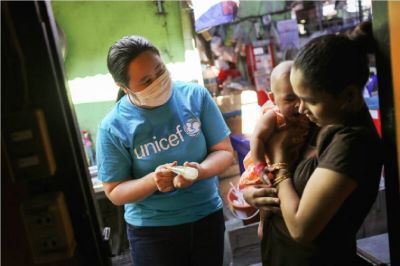
As part of this new commitment, Google.org, Google’s philanthropic arm, is providing a USD$1.5 million grant to UNICEF to support urgent COVID-19 response needs across five countries including Thailand, Malaysia, Vietnam, the Philippines and Pakistan.
With Thailand and other neighbouring countries currently grappling with a surge in COVID-19 cases, Google today announced a total commitment of USD$7.5 million in new grant funding and other support to help alleviate the current pandemic crisis.
As part of this new commitment, Google.org, Google’s philanthropic arm, is providing a USD$1.5 million grant to UNICEF to support urgent COVID-19 response needs across five countries including Thailand, Malaysia, Vietnam, the Philippines and Pakistan. From this grant, USD$300,000 will go to UNICEF to support Thailand’s COVID-19 response. UNICEF will use this grant to procure hygiene supplies such as soap, hand gel, alcohol spray, fabric masks, and disinfectant. In partnership with partner non-governmental organizations, the supplies will be delivered to high risk provinces, severely affected by the latest COVID-19 outbreak. UNICEF will also continue to support governments and communities to control the spread of the virus and minimize morbidity and mortality, including by enhancing preparedness for possible future waves of COVID-19.
ADVERTISEMENTx
Announcing these new commitments, Jackie Wang, Country Director for Google Thailand, said, “The current surge in COVID-19 cases is causing immense pressure on our healthcare system, and this Google.org grant to UNICEF aims to deepen our support for Thailand at this critical time. We’ll also continue to focus on ensuring timely access to information, as well as tools for all Thais to stay informed, connected and safe during this crisis.”
“We are grateful for Google.org’s contribution to UNICEF as we continue to respond tirelessly to the global pandemic by providing fair access to COVID-19 vaccines and services to target populations with a focus on the most vulnerable,” said Karin Hulshof, Regional Director, UNICEF, East Asia and the Pacific. “Only a truly global response can protect and secure the future of every child and the communities in which they live, and we will continue working with our partners and lean on them for their expertise, innovative solutions and flexible funding to help minimize the impact in the region and beyond.” she added.
Beyond this grant to UNICEF, Google.org is also providing an additional USD$1 million to International Federation of Red Cross and Red Crescent Societies (IFRC) to address the urgent need of oxygen supplies and medical equipment in Indonesia. In addition, Google.org will provide USD$5 million worth of Ad Grants to local government agencies and organizations across Southeast Asia, including Thailand, to run public health information campaigns for free. Since last year, Google has provided over USD$27 million in Ad Grants to support local governments including the World Health Organization who served over 343 million public service announcements (PSAs) to reach audiences with messages on how to stay safe and facts about vaccines.
Since the start of the pandemic, Google.org has also funded vaccine distributions in Asia and across the world through Gavi, the Vaccine Alliance. Google has also focused its efforts in ensuring that information serves everyone in Thailand through its tools and products. For example, providing useful information from authoritative sources related to COVID-19 on Google Search and YouTube. Moreover, Google has worked with the Ministry of Education to develop a national online learning platform to ensure continuation of education in Thailand. Lastly, Google worked with the Ministry of Commerce and other private sector partners to develop the Saphan Digital Program to provide comprehensive training for SMEs in Thailand on all necessary skills in order to conduct business online.
SET barely moves despite good day for Asian stocks
The Stock Exchange of Thailand (SET) Index closed at 1,537.78 on Thursday, up 0.15 points or 0.01 per cent. Transactions totalled THB79.54 billion with an index high of 1,545.08 and a low of 1,533.94.
In the morning session, Krungsri Securities predicted the index would fall to between 1,520 and 1,530 points after the US Federal Reserve kept its interest rate at 0.25 per cent and maintained its quantitative easing programme.
Krungsri added that the SET would be under pressure from rising domestic Covid-19 cases and the outflow of foreign funds.
“However, the index would rebound from mass buy-ups of stocks with positive sentiment, such as shares related to exports and businesses whose second-quarter turnover is expected to improve,” it said.
ADVERTISEMENTx
The 10 stocks with the highest trade value today were DTAC, KBANK, ADVANC, PTT, SCGP, AOT, GUNKUL, CPF, AS and KCE.
Other Asian indices were on the rise:
Japan’s Nikkei Index closed at 27,782.42, up 200.76 points or 0.73 per cent.
China’s Shanghai SE Composite Index closed at 3,411.72, up 50.13 points or 1.49 per cent, while the Shenzhen SE Component Index closed at 14,515.32, up 428.90 points or 3.04 per cent.
Hong Kong’s Hang Seng Index closed at 26,315.32, up 841.44 points or 3.30 per cent.
South Korea’s KOSPI closed at 3,242.65, up 5.79 points or 0.18 per cent.
Taiwan’s TAIEX closed at 17,402.81, up 267.59 points or 1.56 per cent.
China will only let pristine, Covid-free Thai fruit across its borders
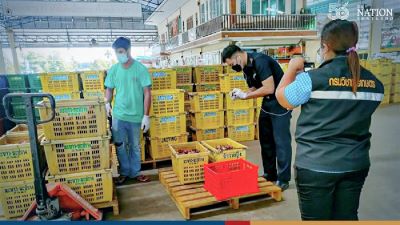
Thai fruit exporters sending shipments to China were warned on Thursday to employ strict measures to ensure their products are not contaminated.
Pichet Viriyapaha, director-general of the Department of Agriculture, said China had tightened measures to contain the spread of Covid-19.
He added that all truck drivers will have to undergo Covid-19 tests at each checkpoint, especially the Mohan checkpoint on the border of China’s Yunnan province.
Chinese importers have been told to ensure Thai exporters disinfect their trucks and product packages before entry.
“If the driver tests positive or signs of the virus are detected on the fruits for the first time, the shipment will be blocked from entering for 10 to 15 days. But the exporter will be banned permanently if this occurs again,” he added.
“Hence, we want to warn exporters to strictly implement Covid-19 prevention measures in each process and ensure their products are not contaminated by the virus.”
ADVERTISEMENTx
China will only let pristine, Covid-free Thai fruit across its borders
He added that the South of Thailand has entered its fruit export season and a lot of durian and mangosteen will be heading overseas in August.
“We have boosted personnel at each checkpoint and extended their working hours to ensure no products are contaminated.





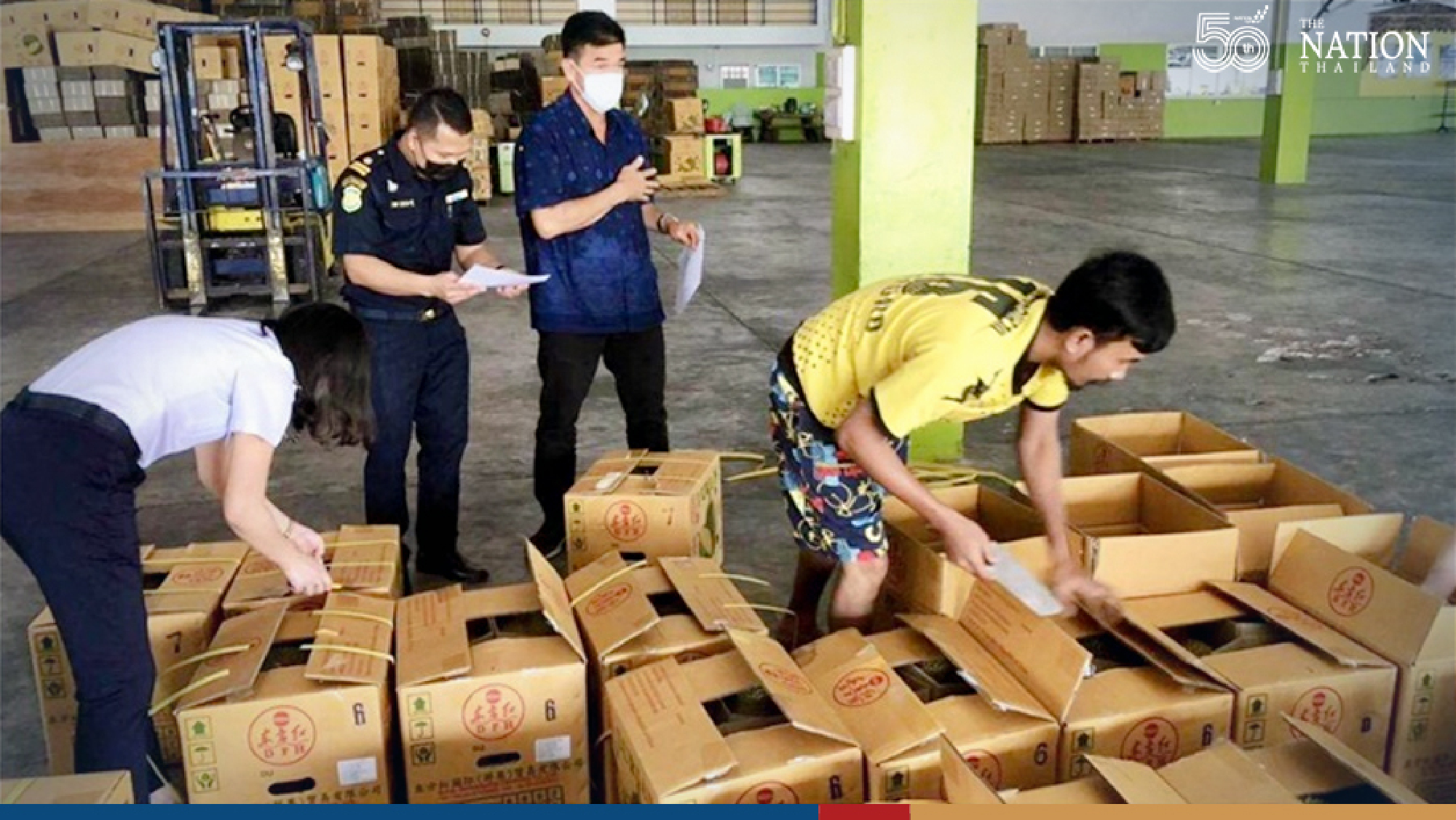 China will only let pristine, Covid-free Thai fruit across its borders
