The Stock Exchange of Thailand (SET) Index closed at 1,591.43 on Tuesday, up 12.15 points or 0.77 per cent. Transactions totalled THB69.48 billion with an index high of 1,594.15 and a low of 1,585.34.
In the morning session, Krungsri Securities forecast the index on Tuesday would fluctuate between 1,570 and 1,590 points after the oil price rose above US$76 per barrel following Opec+’s failure to reach agreement over output cuts.
Uncertainty over higher Covid-19 cases in Thailand and the outflow of foreign funds would pressure the index, Krungsri Securities said.
The 10 stocks with the highest trade value today were CBG, COTTO, KBANK, PTTEP, BANPU, RCL, SSP, GUNKUL, PTTGC and GPSC.
Other Asian indices were mixed:
Japan’s Nikkei Index closed at 28,643.21, up 45.02 points or 0.16 per cent.
China’s Shanghai SE Composite Index closed at 3,530.26, down 4.06 points or 0.11 per cent, while the Shenzhen SE Component Index closed at 14,667.65, down 51.02 points or 0.35 per cent.
Hong Kong’s Hang Seng Index closed at 28,072.86, down 70.64 points or 0.25 per cent.
South Korea’s KOSPI closed at 3,305.21, up 12.00 points or 0.36 per cent.
Taiwan’s TAIEX closed at 17,913.07, down 6.26 points or 0.035 per cent.
KPMG Named Official Data and Analytics Advisor of the LPGA Tour
Game-changing performance insights and analytics program to be launched at the KPMG Women’s PGA Championship and implemented across the LPGA Tour
In partnership with the LPGA, KPMG will further elevate women’s sports by introducing KPMG Performance Insights, a game-changing technology platform that will provide data insights and advanced performance analytics for the LPGA Tour. The solution was launched at the 2021 KPMG Women’s PGA Championship at Atlanta Athletic Club and implemented across all LPGA Tour events.
The LPGA has undertaken an intensive initiative over the past five years to restructure their historical scoring and stats database. The introduction of full-field shot-level data and advanced analytics through KPMG Performance Insights, such as strokes gained, proximity averages and performance indexing, is the next step toward the long-term progression of data on the LPGA Tour and provides critical information for players to diagnose and improve their performance. The statistical insights will also be represented within the LPGA’s media landscape through in-broadcast integration and features, a robust digital and social presence, and deeper insights for media coverage and storytelling for the LPGA.
“Statistics and scoring are key elements in telling truly dynamic stories of our LPGA Tour players. This new partnership will provide us with the next level of advanced data to enhance the storytelling for our players and key stakeholders,” said Kelly Hyne, the LPGA’s Chief Sales Officer. “We are proud to have a partner like KPMG that continues to show their commitment to our players and the women’s game as a whole.”
KPMG Named Official Data and Analytics Advisor of the LPGA Tour
KPMG also will enable the LPGA to maximize their use of this new technology to best serve the needs of the LPGA’s other key stakeholders, including media, broadcast partners, coaches and fans.
“KPMG is delivering this transformative business solution to the LPGA Tour, bringing our firm’s industry-leading capabilities in the data and analytics space to change the game,” said Paul Knopp, KPMG U.S. Chair and CEO. “With KPMG Performance Insights, more data will be captured, analyzed and integrated from every shot and every round than ever before. The platform will change the way in which players, coaches, media and fans experience women’s golf.”
Through the KPMG Women’s PGA Championship, KPMG has been committed to elevating and accelerating the advancement of women in business and the sport of golf. Since the Championship’s inception in 2015, KPMG has been at the forefront of identifying opportunities to enhance the women’s game, including providing network TV coverage, increased purse sizes, and top courses for the best female players to showcase their talents. The KPMG Women’s Leadership Summit, held in conjunction with the Championship, is advancing more women to the C-suite. Additionally, the KPMG Future Leaders Program, funded by proceeds from the Championship and Summit, is developing future generations of women leaders through college scholarships, mentoring and leadership development. KPMG sponsors LPGA Tour athletes including Stacy Lewis, Mariah Stackhouse and Leona Maguire.
“We are proud that a KPMG member firm is able to deliver a cutting-edge solution to propel the sport and advance women in sport,” says Charoen Phosamritlert, Chief Executive Officer, KPMG in Thailand, Myanmar and Laos. “With the close of the Women’s PGA Championship, we hope that the athletes can use the insights from the platform to their benefit. We hope to see more women in sport and are happy that we can play a small part in this achievement.”
Limited upside for SET amid funds outflow due to concerns on Covid situation
The Stock Exchange of Thailand (SET) Index rose by 8.83 points, or 0.56 per cent, to 1,588.11 on Tuesday morning.
The SET Index closed at 1,579.28 on Monday, up 0.79 points or 0.05 per cent. Transactions totalled THB58.23 billion with an index high of 1,582.46 and a low of 1,573.67.
Krungsri Securities predicted the index on Tuesday would fluctuate between 1,570 and 1,590 points despite oil price rising to over US$76 per barrel after Opec+ postponed the meeting due to conflict within the group on extending output cuts.
Uncertainty over higher Covid-19 cases in Thailand and the outflow of foreign funds would pressure the index, Krungsri Securities said.
It recommended that investors buy:
▪︎ PTT, PTTEP and TOP, which benefit from the rising oil price.
▪︎ HANA, KCE, TU, CPF, ASIAN and EPG, which benefit from the weakening baht.
▪︎ BCH, CHG, BDMS, HMPRO, GLOBAL, BEM, CKP, CBG and ICHI, whose second-quarter business turnover is expected to improve.
The price of gold in Thailand rose by THB100 per baht weight on Tuesday morning.
The Gold Traders Association report at 9.26am showed buying price of a gold bar at THB27,250 per baht weight and selling price at THB27,350, while gold ornaments were priced at THB26,757.40 and THB27,850, respectively.
On Monday morning, gold had gained THB50, while at close buying price of a gold bar was THB27,150 per baht weight and selling price THB27,250, while gold ornaments were priced at THB26,666.44 and THB27,750, respectively.
Spot gold on Tuesday was US$1,799 (THB57,780) per ounce.
The US gold market was closed on Monday for Independence Day.
Hong Kong gold price, meanwhile, rose by HK$10 to $16,620 (THB68,719) per tael, the Chinese Gold and Silver Exchange Society reported.
Step back like a billionaire: Previous tech titan exits offer examples for Bezos
SEATTLE – There are few chief executives today as closely tied to their companys image as Jeff Bezos is with Amazon.
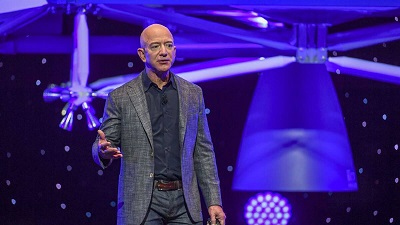
Jeff Bezos at the 2019 introduction of Blue Origin’s lunar lander at the Walter E. Washington Convention Center in Washington, D.C. MUST CREDIT: Washington Post photo by Jonathan Newton
And Bezos’ departure as CEO Monday, handing over the top job to his longtime lieutenant Andy Jassy, likely won’t change that connection anytime soon. Bezos, 57, said he plans to continue working for the company he created as executive chair, a title created for him, where he will focus on innovation and on improving Amazon’s workplace safety record.
The transition isn’t just the most radical shake-up in Amazon’s corporate ranks; it’s the biggest professional shift for Bezos in the three decades that he’s run the company. As Bezos became the world’s wealthiest person with an estimated net worth of $199 billion, according to the Bloomberg Billionaires Index, he’s developed a variety of interests. Those include some wildly expensive ones – such as his space-travel company Blue Origin – that will get more of his focus in the coming years. Bezos plans to ride to the edge of space aboard a Blue Origin rocket just two weeks after stepping down.
He also owns The Washington Post.
There’s not much of a template for business titans who step back from their top jobs. Some have spent time burnishing their image with philanthropy, such as Andrew Carnegie and Bill Gates, who, like Bezos, became lightning rods for criticism of the companies they ran. Others have focused on the playthings of the superwealthy, such as running sports teams or traveling to exotic locales on their yachts. A few, such as former eBay CEO Meg Whitman, even dabbled in politics.
Here’s a look at the post-executive lives of a handful of other billionaire tech bosses:
– Bill Gates
Q: When he did step down as CEO?
A: The Microsoft co-founder began moving away from the software giant in 2000, when he gave the chief executive post to his longtime lieutenant Steve Ballmer. Gates, 44 at the time, took on the role of chief software architect and chairman. Like Bezos, Gates was closely identified with Microsoft, and his departure was carefully orchestrated to ease the transition as the company away from its founder.
In 2008, Gates stepped down as chief software architect and gave up his day-to-day duties at the company to spend the bulk of his work time at the Bill and Melinda Gates Foundation. He stepped down as Microsoft’s chairman in 2014, and left the board altogether last year.
In May, Gates acknowledged through a spokeswoman that he had an extramarital affair with a Microsoft employee nearly 20 years ago, and Microsoft said its board investigated the “intimate relationship” shortly before Gates resigned as a director last year.
Q: What did he do after leaving the CEO job?
A: As Microsoft CEO, Gates had a reputation as a brass-knuckled competitor, so much so that Microsoft became the target of lawmakers and regulators around the globe for using its dominant Windows operating system to crush rivals. In the past two decades, though, Gates has become better known for his philanthropy, creating the Bill and Melinda Gates Foundation with his wife, spending billions addressing global inequity in health care and education. As the coronavirus raged, he emerged as a leading voice for science-based approaches to end the pandemic.
And like Bezos, Gates was the world’s wealthiest person when he left the CEO job.
– Steve Jobs
Q: When did he step down as CEO?
A: The Apple co-founder first left his job as the company’s CEO in 1985 when he was forced out by the board after the commercial failure of the Lisa desktop computer. The 30-year-old Jobs lost a power struggle with his successor, John Sculley.
Jobs returned to Apple a little more than a decade later, and led its revival as it passed ExxonMobil to become the world’s most valuable publicly traded company in August 2011. At the time, Jobs was struggling with complications from pancreatic cancer, and he turned the CEO job over to Tim Cook later that month. Jobs died less than two months later.
Q: What did he do after leaving the Apple CEO job the first time?
ADVERTISEMENT
A: Unlike Bezos, Jobs’ first departure as CEO came early in his career. And he had much to prove.
Jobs quickly launched a new computer company NeXT after his Apple exit. Jobs also moved beyond technology, spending $10 million to acquire Pixar, a graphics supercomputing company owned by the filmmaker George Lucas. Pixar went on to enormous commercial success, sparking the computer-animated movie market with its 1995 hit “Toy Story.” The Walt Disney Company agreed to purchase Pixar for $7.4 billion in 2006.
While NeXT never emerged as a tech power, Apple, without Jobs at the helm, floundered. The company bought NeXT in 1996, and Jobs returned to the company he founded as an adviser. He resumed his CEO responsibilities in 2000, and oversaw Apple’s resurgence as it introduced wildly popular mobile devices such as the iPod, the iPhone and the iPad.
– Larry Page and Sergey Brin
Q: When did they step down as CEOs?
ADVERTISEMENT
A: The Google co-founders stepped down from their jobs running the day-to-day operations of the web search giant in 2019. Page served as CEO of Google’s parent company, Alphabet with Brin as president. Both were 46 at the time.
Page had actually turned over the CEO job once before, in 2001, to Eric Schmidt. He took the post over again 10 years later, when Schmidt stepped down.
At the time, Alphabet was facing investigations from regulators and lawmakers in the United States and abroad for alleged anti-competitive conduct that thwarted the rise of rivals. That scrutiny has only intensified since they stepped back.
Q: What did they do next?
A: Both Page and Brin have remained largely quiet since leaving their executive roles at Google. Like Bezos, Page has been drawn to the skies, putting money behind Kitty Hawk, a flying-car start-up. His investment predates his exit as CEO, though news reports indicate his continued involvement.
Brin, too, has invested in aviation, pouring money into his secretive airship company, LTA Research and Exploration, according to TechCrunch. Brin also began investing in the company before stepping away from his Alphabet duties.
– Mark Cuban
Q: When did he step down as president?
A: Cuban and Broadcast.com CEO Todd Wagner sold their four-year-old audio streaming company to Yahoo for $5.6 billion in 1999. Cuban was 40 at the time.
Q: What did he do next?
A: An avid basketball fan, Cuban used some of his newfound riches to buy the NBA’s Dallas Mavericks in 2000. He has emerged as one of the league’s most outspoken and most recognizable owners.
Bezos, too, has an interest in owning a pro sports team and his name has surfaced as a possible NFL owner.
Cuban also went onto becoming a media figure, starring in “Shark Tank,” the reality television show where he and other successful business leaders support or reject a new entrepreneur’s ideas.
Cuban also occasionally engages in politics. In 2017, Cuban said he was “considering” a presidential campaign. That never came to pass. He’s described his politics as leaning toward libertarianism but with a desire for effective social safety nets, calling himself “independent all the way through.”
– Meg Whitman
Q: When did she step down as CEO?
A: Whitman led eBay for a decade, emerging as one of the tech industry’s most powerful women, before stepping down in 2008. When she left the company, she was 51 and called the move retirement.
But Whitman returned to a CEO post at Hewlett-Packard in 2011, leading the struggling computer printer and server company through brutal cost-cutting phases, and ultimately its breakup into two business. Whitman led the business-technology unit, Hewlett-Packard Enterprise before retiring again in 2018 at 61.
She returned to the CEO post one more time, running the short-lived, short-form video service Quibi last year. Quibi shut down six months after its launch. Whitman was 64 at the time.
Q: What did she do after leaving those jobs?
A: Retirement never seemed to stick for Whitman. After leaving eBay, Whitman declared her candidacy for governor of California, and spent more than $100 million of her own money as a Republican candidate in a losing bid against Jerry Brown.
Whitman joined HP shortly after those political aspirations fizzled. Even so, Whitman remained engaged in politics. She served as finance co-chair of Chris Christie’s presidential campaign during the 2016 Republican primaries, but broke from the party when it nominated Donald Trump. She endorsed Hillary Clinton for president in 2016, and spoke at the 2020 Democratic National Convention in support of Joe Biden.
China targets ride-hailing giant Didi in data crackdown after U.S. listing
China is widening a crackdown on tech companies, as Beijing grows wary of the sprawling reach and power of the countrys Internet giants and signals it is prepared to rein them in despite the financial disruption.
The country’s regulators on Sunday ordered the removal of Didi Chuxing, China’s equivalent of Uber, from domestic app stores, dealing a blow to the company just days after its landmark U.S. listing. On Monday, authorities expanded their sights to at least three other platforms, including truck-hailing apps and a recruitment service.
Didi will remain banned by app stores until further notice as it was found to have “illegally collected and used users’ personal information” in a “grave violation of law and regulation,” China’s cyberspace regulator said in a statement on Sunday after a two-day cybersecurity review. Didi said Monday that it expects the app takedown to “have an adverse impact on its revenue in China,” adding that the app would continue to operate but had suspended new user registrations.
“It’s a bumpy ride for Didi,” said Duncan Clark, a Beijing-based analyst and chairman of consultancy BDA China. “Now, Didi has been asked to put on the seat belt because authorities believe that it was going too fast and too far.”
Didi, a Beijing-based company launched in 2012, raised $4.4 billion last week through an initial public offering in New York – the largest U.S. listing by a Chinese company since Alibaba’s in 2014. The company, which was valued at almost $70 billion after its first day of trading in New York, boasts over 450 million users in China and more than a dozen other markets and is especially popular in China’s larger cities.
The latest regulatory crackdown, which sent Didi shares tumbling, came after Beijing intensified its antitrust campaign against tech giants in recent months, including a record $2.75 billion fine against Alibaba in April. Under a new data security law that comes into effect in September, China plans to set up a “centralized, unified, efficient and authoritative” mechanism for information sharing and risk assessment.
The state-owned Global Times tabloid applauded the regulators’ action, saying that it ensures that the government sets the rules in data collection, not industry leaders such as Alibaba or Didi.
“We still do not know how Didi Chuxing illegally collected users’ personal information,” the nationalist newspaper said in an editorial. “The state will never allow tech giants to collect more detailed personal information in their mega-databases than the state has of the Chinese people.”
Renmin University of China senior researcher Dong Shaopeng told state media that Didi managed “large amounts of data that concerns national security” – such as transportation infrastructure and the flows of people and vehicles – and “might pose threats to China’s national security.” In 2015, Didi raised eyebrows after releasing a big data report of different government ministries based on civil servants’ taxi use.
Didi is not the only company targeted in the latest campaign. The Cyberspace Administration of China said Monday that it was investigating three other platforms – online recruitment company Boss Zhipin and two Chinese truck-hailing apps owned by the New York-listed Full Truck Alliance – which were also ordered to suspend new user registrations, at least throughout the probe.
Shares of Chinese tech companies fell on Monday following the regulator’s intervention. Tencent, which has a stake in Didi, slid nearly 4 percent in Hong Kong, while Meituan slumped 5.6 percent. Japan’s SoftBank, which has a fund that owns stakes in Didi and Full Truck Alliance, also dropped more than 5 percent in Tokyo.
“China is obviously starting a new regulatory front on cybersecurity, which will make it more difficult for Chinese companies to list, or at least drive more investments to Hong Kong rather than New York,” said Clark, the analyst. “Didi has connected people, but there’s no guarantee against intervention, that’s what the regulatory move wants to tell us.”
Online export channel logs orders worth THB10.15bn in first 6 months
Thai exports via a new online channel totalled 10.152 billion baht in the first half of 2021, the Department of International Trade Promotion reported on Monday.
The online export platform www.thaifex-vts.com was used at the THAIFEX Virtual Trade Show on May 25 and will operate until October 3 this year. The platform took orders worth US$2.845 million or 85 million baht at the May 25-29 THAIFEX and expects total orders of $22.515 million (675 million baht) this year.
The offline trade export show will be held at IMPACT Exhibition and Convention Centre, Muang Thong Thani from September 29 to October 3.
Meanwhile, the department has organised 37 online business matching (OBM) forums between Thai exporters and foreign buyers this year. The OBMs covered products such as food, fruit, halal products, medical equipment and auto parts. They generated total sales of 5.94 billion baht, driven by deals for food and fruit worth 4.21 billion baht.
Thailand has lined up a raft of virtual and hybrid online exhibitions in the second half of the year. Highlights include the THAILOG LOGISTIX Virtual Exhibition, TOP Thai Brands, Thailand Week, and Mini Thailand Weeks in Cambodia, Philippines, Indonesia, Myanmar, India and Bangladesh. Meanwhile, Thai exporters will also participate in international trade shows abroad, including digital content fairs in Singapore and South Korea, auto-parts expos in Las Vegas and Dubai, and food product fairs in Australia, Nanning and Shanghai.
SET level as foreign outflows pressure Thai stocks
The Stock Exchange of Thailand (SET) Index closed at 1,579.28 on Monday, up 0.79 points or 0.05 per cent. Transactions totalled THB58.23 billion with an index high of 1,582.46 and a low of 1,573.67.
In the morning session, Krungsri Securities forecast that the SET Index on Monday would fall to between 1,565 and 1,570 points despite a rise in the US non-farm payroll as well as the oil price.
It predicted that uncertainty over the rise in Covid-19 cases in Thailand and outflow of foreign funds would pressure the index.
The 10 stocks with the highest trade value today were KBANK, GUNKUL, GPSC, PTT, SCB, COTTO, BANPU, EA, TTA and SCGP.
Other Asian indices were mixed:
Japan’s Nikkei Index closed at 28,598.19, down 185.09 points or 0.64 per cent.
China’s Shanghai SE Composite Index closed at 3,534.32, up 15.56 points or 0.44 per cent, while the Shenzhen SE Component Index closed at 14,718.66, up 47.95 points or 0.33 per cent.
Hong Kong’s Hang Seng Index closed at 28,143.50, down 166.92 points or 0.59 per cent.
South Korea’s KOSPI closed at 3,293.21, up 11.43 points or 0.35 per cent.
Taiwan’s TAIEX closed at 17,919.33, up 209.18 points or 1.18 per cent.
Uncertain Covid situation puts downward pressure on SET
The Stock Exchange of Thailand (SET) Index rose by 3.00 points, or 0.19 per cent, to 1,581.49 on Monday morning.
The SET Index closed at 1,578.49 on Friday, down 15.26 points or 0.96 per cent. Transactions totalled THB80.92 billion with an index high of 1,596.05 and a low of 1,574.92.
Krungsri Securities forecast that the SET Index on Monday would fall to between 1,565 and 1,570 points despite the rise in US non-farm payroll and oil price.
It predicted that uncertainty over the rise in Covid-19 cases in Thailand and outflow of foreign funds would pressure the index.
It recommended that investors buy:
▪︎ PTT, PTTEP and TOP, which benefit from the rising oil price.
▪︎ HANA, KCE, TU, CPF, ASIAN and EPG, which benefit from the weakening baht.
▪︎ BCH, CHG, BDMS, HMPRO, BEM, CKP, CBG and ICHI, whose second-quarter business turnover is expected to improve.
The baht opened at 32.16 to the US dollar on Monday, strengthening from Friday’s closing rate of 32.19.
The Thai currency is likely to move between 32.10 and 32.25 during the day and between 32 and 32.50 this week, Krungthai Bank market strategist Poon Panichpibool said.
He said the main factors behind the baht’s weakening were the dollar’s strengthening and funds flow from foreign investors in Thailand.
Poon predicted that the dollar will possibly strengthen, since the US economy is recovering well, while other regions in the world – Europe and Asia – are still facing the Covid-19 crisis.
The market strategist added that Thailand should provide at least 500,000 jabs of Covid-19 vaccine a day for foreign investors to buy Thai assets, as they were concerned about the present situation.
Poon added that the baht would slide to 32.50 per US dollar if it weakened to 32.30.



 KPMG Named Official Data and Analytics Advisor of the LPGA Tour