SET boosted by hopes of economic recovery but exit of foreign funds limits upside
The Stock Exchange of Thailand (SET) Index rose by 11.41 points, or 0.74 per cent, to 1,563.26 at 10am on Tuesday. The volume of total transactions was THB4.56 billion with an index high of 1,564.70 and a low of 1,561.56.
Krungsri Securities predicted the day’s index to fluctuate between 1,545 and 1,560 points despite hopes of an economic recovery, as many countries launch mass vaccination campaigns.
It added that energy and petrochemical shares, meanwhile, gained positive sentiment from the rising oil price.
However, uncertainty over the MSCI’s move to reduce investment in Thai shares by 0.1 per cent on May 27 and the outflow of foreign funds would pressure the index, Krungsri Securities said.
It recommended that investors buy:
▪︎ BDMS, BCH and CHG, which gained positive sentiment from the mass vaccination.
▪︎ SCGP and CBG, which will be listed on the MSCI Index on May 27.
▪︎ OR, SCGP, KEX, JR, NEX, NRF, RT, SA and SO, which will be listed on the FTSE Index on June 18.
The SET Index closed at 1,551.85 on Monday, down 0.59 points or 0.04 per cent. The volume of total transactions was THB78.74 billion with an index high of 1,559.60 and a low of 1,547.14.
Thai gold cheaper by THB50 despite rise in spot price
The price of gold in Thailand dropped by THB50 per baht weight on Tuesday morning despite the weakening dollar and the decline in US bond yield.
The Gold Traders Association report at 9.28am showed buying price of a gold bar at THB27,700 per baht weight and selling price at THB27,800, while gold ornaments were priced at THB27,197.04 and THB28,300, respectively.
At close on Monday, the buying price of a gold bar was THB27,750 per baht weight and selling price THB27,850, while gold ornaments were priced at THB27,257.68 and THB28,350, respectively.
Spot gold price on Tuesday was US$1,875 (THB58,748) per ounce compared to Monday when it rose by $7.8 to $1,884.5 per ounce.
Hong Kong gold price on Tuesday dropped by HK$50 to $17,390 (THB70,183) per tael, the Chinese Gold and Silver Exchange Society reported.
China targets speculators and hoarders to stop commodity boom
China stepped up its fight against soaring commodities prices, summoning top executives to a meeting that threatened severe punishment for violations ranging from excessive speculation to spreading fake news.
The government will show “zero tolerance” for monopoly behavior and hoarding, the National Development and Reform Commission said after leaders of top metals producers were called to a meeting in Beijing with multiple government departments on Sunday.
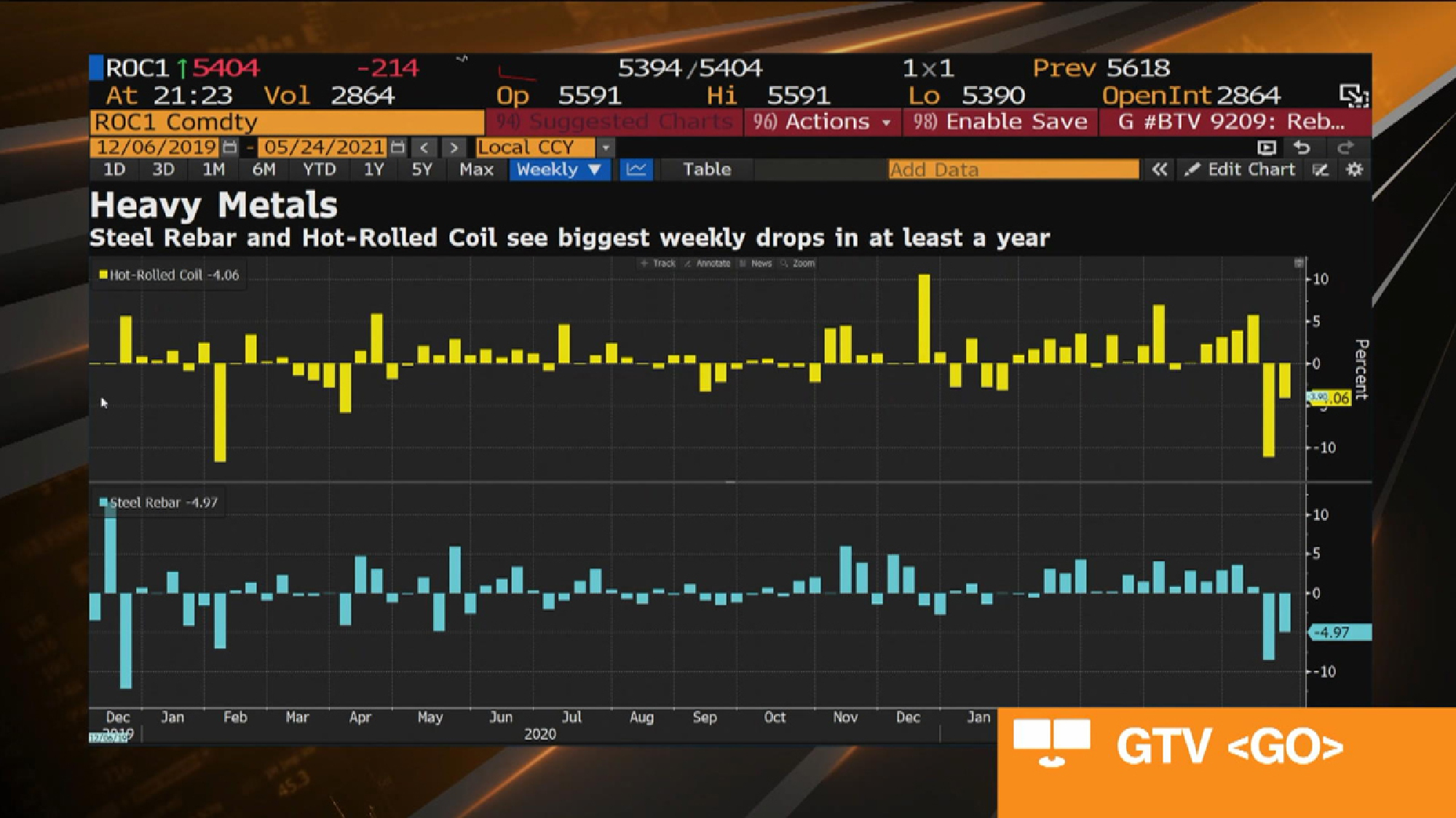
The push to rein in surging metals prices rippled across markets — with steel dropping as much as 6% and iron ore tumbling by close to the daily limit — before prices steadied later in the session. Most base metals were also under pressure.
“With policy risk shifting toward government intervention, prices will surely be affected by market sentiment,” said Li Ye, an analyst at Shenyin Wanguo Futures in Shanghai. “The rapid surge in commodity prices has badly affected manufacturers and market orders, leading to losses and defaults.”
There’s been a steady drumbeat of government warnings about the consequences of commodity prices that are near the highest level in almost a decade. But aside from changes to trading rules at futures exchanges, there hasn’t been a lot of action. Beijing is likely to face a “potential exhaustion of policy options” to restrain the rally, Citigroup said in a note.
The warning from the NDRC comes as a broad surge in commodities prices fuels fears that faster inflation could dent economic growth in China and beyond. Investors have been piling into industrial metals on bets that the world will rebound strongly from the pandemic, but concerns about the knock-on impact on demand are rising as manufacturers are forced to raise the cost of finished goods.
“It might not be great for the speculative community, but it’s good news for the world in general,” Amelia Xiao Fu, head of global commodities strategy at BOCI Global Commodities said by phone from London. “I think prices could become calmer, and the room for excessive rallies may be limited.”
In targeting commodity prices, authorities are fighting trends over which they have only partial control as the world economy reboots with supply chains stretched. The government is also tackling the consequences of its own efforts to reduce greenhouse gas emissions, which have contributed to price gains.
The NDRC’s statement is the toughest comment yet from the government, which started warning about higher raw-materials prices in April. The officials from the iron ore, steel, copper and aluminum firms that met with five state agencies in Beijing on Sunday were told excessive speculation and rising international prices were to blame for recent advances.
Key enterprises should “actively fulfill their social responsibilities” and take the lead in maintaining market order, the NDRC said in a statement. “Do not collude with each other to manipulate the prices, fabricate and disseminate price increase information, and do not hoard and drive up prices.”
There’s been an unusual amount of attention from policy makers on commodities in recent weeks. China’s factory-gate prices rose at the fastest pace in more than three years in April, sparking concerns that costlier raw materials could hamper the economic recovery or feed into higher consumer prices.
The deputy governor of the People’s Bank of China pledged a “basically stable” yuan in a statement on Sunday, right after another central bank official said the currency should appreciate to offset the rising cost of commodity imports. The comments from the official were later deleted.
The drive to tackle rising materials prices comes after China’s V-shaped demand rebound last year helped ignite a global commodities rally. Stimulus support for metal-intensive sectors is showing signs of cresting, however, and authorities are now starting to worry about imported inflation.
That Beijing is also dealing with a problem partly of its own making is most evident in steel, where prices spiked to records after the government set targets on output curbs and ordered production to fall this year. Instead, output surged to record levels in April.
“Another week, another Chinese government announcement trying to soothe the self-inflicted wounds caused by regular statements on steel capacity reforms, which fueled steel prices and margins,” said Atilla Widnell, managing director at Navigate Commodities.
Bitcoin investors were strapped into another roller-coaster ride of sudden drops this weekend, as the price dove below $32,000 before recovering somewhat Monday.
Leveling around $38,000 in afternoon trading, the most valuable cryptocurrency is still up more than 30 percent for the year. But the most recent sell-off highlights the staggering volatility of the crypto market and the huge losses that investors can suffer in the span of just days or hours. Bitcoin holders have seen their investments slide more than 40 percent since the high of $65,000 set in April.
Overall, the crypto market has battered investors over the past week as world governments signal increasing scrutiny and traders liquidate their holdings, halting the frenzy that pushed prices skyward. The total value of all cryptocurrencies tumbled by more than $400 billion over the past seven days, according to CoinMarketCap, a cryptocurrency price tracker.
After a three-day losing spell and a negative week, Wall Street is on track to extend its gains from Friday, as the Dow Jones industrial average climbed more than 200 points, or 0.8 percent, during the afternoon trading session. The S&P 500 rose by 52 points, or 1.3 percent, while the tech-heavy Nasdaq increased by 234 points, or 1.7 percent.
After clawing back some losses late last week, stock investors continue to gauge the rate of the economic recovery and the rollout of coronavirus vaccines.
Jeff Buchbinder, an equity strategist for LPL Financial, said a strong economic recovery lies ahead as businesses reopen further, bolstering projections for future earnings and raising company valuations. But that optimism is checked by the potential for inflation to rise in the second half of the year, alongside the possibility of rising interest rates, he said, adding that as “this bull market gets a little older, the pace of stock market gains will likely slow and come with more volatility.”
Last week, the Federal Reserve released the minutes of its April meeting, revealing that officials began to discuss the possibility of easing off its monthly bond purchases, intended to boost the economy. But Fed Chair Jerome Powell has said that the Fed was not even “thinking about thinking about” reducing its bond buying.
“Fed minutes last week seemed to have been shrugged off as the Fed continues its wait-and-see posture, which added wind beneath the tech sector’s wings,” said Chris Larkin, a managing director at E-Trade Financial. “Interestingly, though, we did see some discord among Fed officials – how the market interprets that in the coming days remains to be seen.”
The plunge in cryptocurrency prices comes as U.S. Treasury officials announced a new tax compliance plan to raise an additional $700 billion, including a measure to enhance reporting requirements on cryptocurrency. Under the initiative, announced Thursday, companies that receive cryptocurrency with a fair market value of more than $10,000 would be required to provide the Internal Revenue Service with more financial information.
The report described digital currency as a “significant concern.” “Cryptocurrency already poses a significant detection problem by facilitating illegal activity broadly including tax evasion,” the report said.
On the same day, officials at the Bank of Canada said that the rapid evolution of cryptocurrency markets “is an emerging financial vulnerability.” While the central bank acknowledged that the markets are not of systemic importance to the nation as an asset class or a means of payment, officials said that could change if, for instance, a giant tech company issued a cryptocurrency of its own that became widely adopted.
Potentially rattling investors further, government proposals put forward Friday would limit cryptocurrency exchanges based in Hong Kong to serve only those users who are professional investors – those who already have a significant investment portfolio – knocking retail investors out of the regulated market.
Dogecoin, a popular cryptocurrency that began as a joke, was also down significantly from its all-time high. The token was trading around 33 cents Monday afternoon, down from a record 74 cents reached during the run-up to billionaire executive Elon Musk’s appearance on “Saturday Night Live.”
Technology shares led gains in U.S. stocks as inflation anxiety appeared to be easing. Bitcoin surged after a weekend rout.
Ten out of the 11 groups in the S&P 500 rose, while the Nasdaq 100 outperformed major equity benchmarks amid a rally in giants such as Apple Inc., Amazon.com Inc. and Tesla Inc. The world’s largest cryptocurrency soared after plunging as much as 18% on Sunday. Benchmark 10-year Treasury yields and the dollar retreated.
While several analysts are warning it may be too early to signal the all-clear on inflation pressures, weaker-than-expected economic data have helped quell investor worries. Federal Reserve Governor Lael Brainard, Atlanta Fed President Raphael Bostic and St. Louis’s James Bullard said they wouldn’t surprised to see bottlenecks and supply shortages push prices up in coming months as the pandemic recedes and pent-up customer demand is unleashed — but much of those price gains should prove temporary.
“The Fed continues its wait-and-see posture, which added wind beneath the tech sector’s wings,” said Chris Larkin, managing director of trading and investing product at E*Trade Financial. “Stocks head into the final full week of the month trying to break a two-week bull-bear stalemate.”
For Tom Essaye, a former Merrill Lynch trader who founded “The Sevens Report” newsletter, inflation fears will remain a head wind for stocks until it becomes clear that any potential price pressures won’t last long.
“Until then, expect a more volatile market,” he wrote in a note to clients. “But at this point, strong policy support for stocks remains very much in place, and that’s a good thing.”
Some other corporate highlights:
– Virgin Galactic Holdings Inc. soared after the company founded by British billionaire Richard Branson conducted a test flight to space for the first time in more than two years.
– Beyond Meat Inc. jumped as the plant-based protein producer was upgraded to outperform at Bernstein.
These are some of the main moves in markets:
Stocks
– The S&P 500 rose 1% as of 4 p.m. EDT
– The Nasdaq 100 rose 1.7%
– The Dow Jones industrial average rose 0.5%
– The MSCI World index rose 0.7%
Currencies
– The Bloomberg Dollar Spot Index fell 0.2%
– The euro rose 0.3% to $1.2216
– The British pound was little changed at $1.4158
– The Japanese yen rose 0.2% to 108.77 per dollar
Bonds
– The yield on 10-year Treasurys declined one basis point to 1.61%
– Germany’s 10-year yield declined one basis point to -0.14%
– Britain’s 10-year yield declined two basis points to 0.81%
Commodities
– West Texas Intermediate crude rose 3.7% to $66 a barrel
– Gold futures rose 0.4% to $1,886 an ounce
Published : May 25, 2021
By : Syndication Washington Post, Bloomberg · Rita Nazareth, Vildana Hajric
Commerce Minister upbeat over export growth this year
Commerce Minister Jurin Laksanawisit said in the latest episode of THAN TALK, broadcast on Nation TV on Monday, that Thailand’s export market has shown signs of revival in the first quarter. He put this down to two factors – improvement in the global economy and management of the sector by his ministry.
Global demand for Thai food products has improved not just because the global economy is recovering but also because more people are working from home, he said.
In addition, converting agencies into “provincial salesmen” has also helped add more local products to the export market, Jurin added.
The Thai export market hit its lowest point at -23 per cent in June last year but rose to -17 per cent, -11 per cent and -7 per cent in the subsequent three months, before entering the positive territory in December.
This year, exports hit 8.47 per cent in March and 13.09 per cent in April.
“Though export figures last year were negative, things are getting better this year. The Commerce Ministry has set a growth target of 4 per cent in total export this year. The export sector is now the hope and key driver of the economy during the pandemic. We have to wait until tourists start returning, so the economy can be revitalized,” Jurin added.
Thai vegetable exports rise in Q1 as Chinese demand doubles
Thailand’s free trade agreements helped vegetable exports grow to US$506 million in the first quarter of this year, driven by a doubling in demand from China, the Commerce Ministry reported on Monday.
Vegetable exports to China grew 96 per cent to US$471 million in January-March from the same period last year.
China is now Thailand’s No 1 foreign vegetable market, accounting for 81 per cent of exports, followed by Asean and Japan.
Thailand’s Q1 vegetable exports to other FTA partners also grew, including to Asean by $30 million or 60 per cent, Hong Kong ($3 million/+1%), South Korea ($2 million/+23%) and India ($0.7 million/+12%).
The increase was driven by an 86 per cent rise in cassava shipments worth US$387 million, mainly to China and Japan. Meanwhile, chilli exports valued at $31 million rose 708 per cent, with China and Malaysia as main markets, while baby corn exports were worth $9 million (+13%), with Japan and Singapore driving demand.
Meanwhile, under the Regional Comprehensive Economic Partnership (RCEP) signed in November 2020, Thailand is urging FTA partners to cut more import restrictions. In response, South Korea will reduce import tariffs on frozen cassava from 45 per cent to zero within 20 years, while Cambodia will do the same for tomatoes, onions, cabbage and beans.
First-quarter exports of Thai vegetables are already worth more than half the total recorded in 2020, of $1.006 billion.
SET edges down as virus surge saps foreign inflows
The Stock Exchange of Thailand (SET) Index closed at 1,551.85 on Monday, down 0.59 points or 0.04 per cent. The volume of total transactions was THB78.74 billion with an index high of 1,559.60 and a low of 1,547.14.
In the morning session, Krungsri Securities forecast the SET Index on Monday would fluctuate between 1,545 and 1,565 points despite hopes of economic recovery after manufacturing data for the US and Europe showed strong improvement.
It said the index would be under pressure due to the outflow of foreign funds, concern the US Federal Reserve may raise the interest rate, and Thailand’s surge in Covid-19 cases.
The 10 stocks with the highest trade value today were KCE, KBANK, KTC, HANA, PTT, U, SCGP, BEC, CPALL and OR.
Other Asian indices were mixed:
Japan’s Nikkei Index closed at 28,364.61, up 46.78 points or 0.17 per cent.
China’s Shanghai SE Composite Index closed at 3,497.28, up 10.73 points or 0.31 per cent, while the Shenzhen SE Component Index closed at 14,506.61, up 89.15 points or 0.62 per cent.
Hong Kong’s Hang Seng Index closed at 28,412.26, down 46.18 points or 0.16 per cent.
South Korea’s KOSPI closed at 3,144.30, down 12.12 points or 0.38 per cent.
Taiwan’s TAIEX Index closed at 16,338.29, up 36.23 points or 0.22 per cent.
Limited upside for SET amid foreign funds outflow and Covid crisis
The Stock Exchange of Thailand (SET) Index rose by 3.49 points, or 0.22 per cent, to 1,555.93 at 10am on Monday. The volume of total transactions was THB8.46 billion with an index high of 1,559.60 and a low of 1,554.27.
Krungsri Securities forecast the SET Index on Monday would fluctuate between 1,545 and 1,565 points despite hopes of an economic recovery after the US and Europe showed strong economic data, especially the Purchasing Managers Index in both manufacturing and services.
It said the index would be under pressure due to the outflow of foreign funds, the US Federal Reserve’s move to raise the interest rate and Thailand’s rising Covid-19 cases.
It recommended that investors buy:
▪︎ BDMS, BCH and CHG, which gained positive sentiment from mass vaccination.
▪︎ SCGP, IRPC and COM7, which will be listed on the MSCI Index on May 27.
▪︎ OR, SCGP, KEX, JR, NEX, NRF, RT, SA and SO, which will be listed on the FTSE Index on June 18.
The SET Index closed at 1,552.44 on Friday, down 2.10 points or 0.14 per cent. Total transactions amounted to THB80.93 billion with an index high of 1,560.51 and a low of 1,546.55, as the index fell for a third straight day.