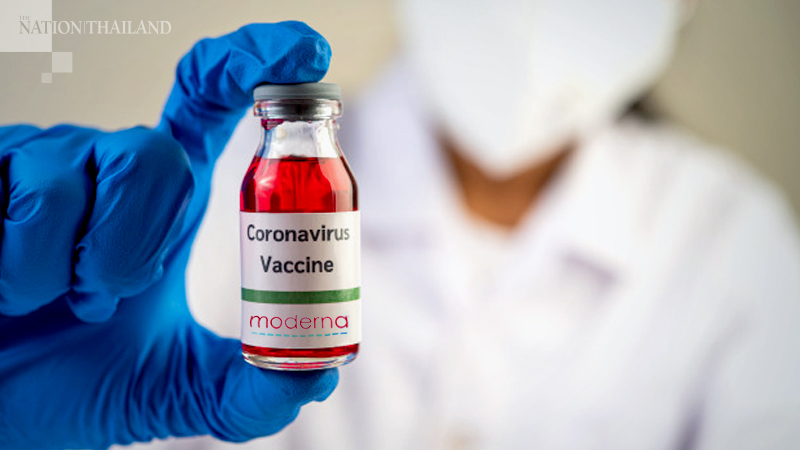
Pfizer says its coronavirus vaccine is safe and 95% effective, will seek regulatory review ‘within days’ #SootinClaimon.Com

#SootinClaimon.Com : ขอบคุณแหล่งข้อมูล : หนังสือพิมพ์ The Nation.

Pfizer says its coronavirus vaccine is safe and 95% effective, will seek regulatory review ‘within days’

InternationalNov 19. 2020
By The Washington Post · Carolyn Y. Johnson, Laurie McGinley · BUSINESS, HEALTH, HEALTH-NEWS

WASHINGTON – Pharmaceutical giant Pfizer said Wednesday that it will seek emergency authorization for its coronavirus vaccine within days, after reporting that its latest analysis showed that the vaccine is 95% effective at preventing illness and causes no major safety problems.
The experimental vaccine, which Pfizer developed with German biotechnology firm BioNTech, had shown promise in a preliminary analysis announced last week, but the trial sped to completion faster than anticipated because of a spike in coronavirus cases. The new data showed that the vaccine was 94% effective among people over 65, a group at high risk of serious illness, and prevented severe as well as mild cases.

The encouraging report was in sharp contrast to bleak news about the pandemic. Mayor Bill de Blasio, a Democrat, announced Wednesday on Twitter that classrooms in New York City – the nation’s largest school district – will close Thursday because of rising coronavirus infection rates in the city, and that all students will learn remotely for an indefinite period.

And the nation headed toward a once-unthinkable milestone of 250,000 deaths linked to covid-19, the disease caused by the coronavirus. On Wednesday alone, more than 1,500 people succumbed to the virus. And the nation registered more than 142,000 new cases, with more than 72,000 people hospitalized.

Globally, alarms were sounded in Australia, Japan and South Korea as case numbers increased, with Yasutoshi Nishimura, who is leading Japan’s coronavirus response, noting “a very strong sense of crisis.”

Pfizer’s findings on its experimental vaccine have not yet been published or peer-reviewed but will be scrutinized by the Food and Drug Administration and an independent advisory committee that makes recommendations to the agency.

That influential panel of outside experts is likely to meet publicly on the Pfizer application during the second week of December, according to people with knowledge about the process who spoke on the condition of anonymity because details have not been finalized. The committee might scrutinize data from biotechnology company Moderna the following week. Moderna said this week that an early analysis of its vaccine showed that it was nearly 95% effective.

Health and Human Services Secretary Alex Azar, in a briefing with reporters, said the two vaccines could be authorized by the FDA and be ready for distribution “within weeks.”

“It looks great. It looks like a home run,” Peter Hotez, dean of the National School of Tropical Medicine at Baylor College of Medicine in Houston, said of the Pfizer data. Together, the Pfizer and Moderna data suggest that “there is an end date” to the pandemic.

Among 170 cases of covid-19, in the Pfizer trial, 162 were in the placebo group and eight were in the vaccine group. There were 10 cases of severe illness in the trial, nine of which were in the placebo group and one in the vaccine group. Those findings provided a signal that the vaccine was providing protection against the virus.

“We continue to move at the speed of science to compile all the data collected thus far and share with regulators around the world,” Pfizer chief executive Albert Bourla said in a statement.

U.S. government officials anticipate having 40 million doses of both vaccines – each requires two doses – by the end of the year, enough to vaccinate 20 million people. Pfizer aims to create 50 million doses globally, with the United States receiving about half.

The frenetic speed of the vaccine development is infusing the regulatory part of the process, which will now move to the fore.

Even before receiving applications from the vaccine makers, the FDA has asked its advisory panel to keep Dec. 8-10 open for possible meetings about Pfizer. The session may take up only one of those days. The panel may consider data from Moderna, which is running about a week behind Pfizer, the following week.

The FDA would not comment on the timing of the meetings.

In advance of the committee meetings, the FDA will electronically send the panel – called the Vaccines and Related Biological Products Advisory Committee – voluminous briefing packets with reams of safety and efficacy data. The packets also will contain FDA and company views about the information.

Getting ready for a committee meeting requires extensive work by FDA staff members, said Norman Baylor, president and chief executive of Biologics Consulting and a former director of the FDA’s Office of Vaccines Research and Review.

“They are literally swamped,” he said. “Plus, the pressures are coming from all sides. It will be very intense.”

Often, the FDA staff examines vaccine data for a year – or years – before consulting with its advisory committee, experts said.

“If someone says, ‘We are not rushing,’ that is not true,” Baylor said. “They are rushing.”

The FDA will be asking the committee whether the safety and efficacy data of the vaccines justifies the granting of emergency use authorizations, he added. The agency doesn’t have to follow the recommendations of the advisory committee but often does. FDA officials have said it could take a couple of weeks or more for the agency to make a final decision after the advisory committee meets.

The FDA’s emergency use authorization is a temporary approval used to accelerate the availability of medical products during a public health emergency. Such authorizations require less data and can be done far more quickly. Since February, the FDA has used this power to authorize hundreds of coronavirus tests and a few treatments. But it has authorized a vaccine that way only once – in 2005, against anthrax – and that was under much different circumstances.

Some experts have expressed qualms about using an emergency authorization for a coronavirus vaccine that will be given to hundreds of millions of people, but such criticism has become more muted as the pandemic has raged, killing thousands of Americans a week.

Peter Marks, director of the FDA center that oversees vaccines, has said he would insist on an emergency standard for a vaccine roughly equivalent to what’s needed for a full licensure.

Even so, the amount of safety data – two months’ follow-up on half of the trials’ participants after their second shots – is less than what is submitted for full approvals. And some questions, such as the duration of protection, cannot be answered now, with such data collected as the trials continue.

Earlier this week, the FDA said it would publicly disclose reviews of the scientific data used to authorize drugs and vaccines.

That followed criticism, most notably from the Government Accountability Office, that the FDA had not been sufficiently transparent in disclosing the data used to decide whether to grant or revoke authorizations involving coronavirus treatments.

In a briefing on Operation Warp Speed, the government initiative to accelerate the development and distribution of vaccines, Azar said plans to deploy the shots are coming together rapidly. He said, for example, that nursing homes have flocked to sign up for a program in which chain pharmacies CVS Health and Walgreens administer coronavirus vaccines to residents of long-term care facilities.

“Using pharmacy networks allows us to expand access beyond just stand-alone brick-and-mortar pharmacies, because pharmacists, pharmacy interns and pharmacy technicians also provide vaccinations in places like grocery stores,” Azar said. “The ultimate goal here is to make getting a covid-19 vaccine as convenient as getting a flu shot.”

Eric Topol, director of the Scripps Research Translational Institute, said the vaccine data, along with other developments in recent days, shows that “things are looking up. It’s a really good turning point right now. We are hitting on all cylinders.” In addition to the vaccine data from Pfizer and Moderna, he mentioned the FDA’s authorization of an at-home coronavirus test and its recent approval of the first monoclonal antibody treatment, which is designed to keep people with mild disease out of the hospital.

Britain’s power grid needs investment to deliver Johnson’s Green Plan #SootinClaimon.Com

#SootinClaimon.Com : ขอบคุณแหล่งข้อมูล : หนังสือพิมพ์ The Nation.

Britain’s power grid needs investment to deliver Johnson’s Green Plan

InternationalNov 19. 2020An employee monitors electricity output and usage data on a screen at the National Grid Plc control center in Wokingham, England, in 2015. MUST CREDIT: Bloomberg photo by Simon DawsonAn employee monitors electricity output and usage data on a screen at the National Grid Plc control center in Wokingham, England, in 2015. MUST CREDIT: Bloomberg photo by Simon Dawson 

By Syndication Washington Post, Bloomberg · Rachel Morison · BUSINESS, WORLD, EUROPE

Boris Johnson’s green industrial revolution will strain the U.K.’s electricity network with a huge boost in consumption that will require billions of pounds of investment in new transmission lines and systems.

The program aimed at decarbonizing the economy by 2050 calls on more parts of the economy to use electricity. It brings forward by 10 years the target for phasing out cars that run on diesel and gasoline, favoring electric vehicles, a quicker shift than industry had been anticipating.

All told, power demand will jump by a third by 2050 in the U.K., according to BloombergNEF. That will require a transformation of the way power networks and utilities work, the power grid, forcing them to cope both with thousands of new wind and solar farms and millions of things that people need to plug in.

“There will need to be substantial upgrade to the transmission network, and that needs to happen sooner rather than later,” Alistair Phillips-Davies, chief executive officer of the utility SSE, said Wednesday on a call with reporters. “We should definitely see the regulator looking more favorably on upgrading the network, particularly enabling the connections of offshore wind and strengthening the grid on the coast of the U.K.”

The government and utilities led by National Grid, Electricitie de France and SSE will have to focus on two things: adding power generation capacity that’s fed by renewables and upgrading the distribution grid so that it has the flexibility to balance a system where supply and demand patters are in constant flux.

“The U.K.’s energy networks are the foundation on which the prime minister’s plans for climate action will be built,” said Randolph Brazier, head of innovation at the Energy Networks Association, which represents grid operators in the U.K. and Ireland. “Accelerating the roll-out of electric vehicles and heat pumps, and connecting four times the amount of offshore wind will only be possible with significant investment in the networks.”

On generation, the government’s program to build a huge 40 gigawatt fleet of offshore wind farms will go some way to adding the supply needed and replacing the coal plants coming off line by the middle of this decade. The plan outlined on Wednesday also included incentives for nuclear power, though developers are looking for more specifics on how plants would get funding before agreeing to build additional reactors.

The distribution grid also needs to shift away from relying on a handful of large power plants. Instead, electricity is increasingly feeding into the system from wind and solar farms as well as home-energy systems where consumers have more energy than they can use.

One challenge will be how to keep the system balanced as the rising use of renewables makes the flows into the grid more variable. Regulator Ofgem is set to approve as much as $46 billion (35 billion pounds) planned projects for the five years to 2026. The network companies say this isn’t enough and they’ll need more to achieve what’s being asked of them by government.

Another emerging issue is how and when people charge their electric cars. This will require smart charging and real-time retail electricity pricing so that consumers have information and incentives for when it would be best to plug in their vehicles.

“Rather than placing a strain on the grid, EVs can play a key role in decarbonizing both transport and electricity supply, with smart charging and vehicle to grid technology helping us use renewable energy more efficiently, charging when the sun shines or the wind blows and discharging back to the grid at times of peak demand,” said Fintan Slye, director of National Grid’s Electricity System Operator.

Europe accelerates electric-car shift with subsidies, bans #SootinClaimon.Com

#SootinClaimon.Com : ขอบคุณแหล่งข้อมูล : หนังสือพิมพ์ The Nation.

Europe accelerates electric-car shift with subsidies, bans

InternationalNov 19. 2020An electric charging plug refuels a Mercedes-Benz AG E-Class electric automobile at the automaker's showroom, operated by Daimler, in Boeblingen, Germany, on Sept. 29, 2020. MUST CREDIT: Bloomberg photo by Andreas Gebert.An electric charging plug refuels a Mercedes-Benz AG E-Class electric automobile at the automaker’s showroom, operated by Daimler, in Boeblingen, Germany, on Sept. 29, 2020. MUST CREDIT: Bloomberg photo by Andreas Gebert. 

By Syndication Washington Post, Bloomberg · Craig Trudell, Stefan Nicola · BUSINESS, WORLD, US-GLOBAL-MARKETS, EUROPE

Europe is taking unprecedented steps to phase out gasoline and diesel cars and bring an end to the almost 150-year-long era of the internal combustion engine.

The U.K.’s 2030 ban on cars lacking a plug and Germany’s four-year extension of subsidies for electric vehicles reflect the carrot-and-stick approach governments are taking to getting auto companies to embrace batteries. Regulatory pressure already has helped EVs seize a greater share of passenger-car sales in Europe than any other developed auto market in the world.

The industry has pleaded for the help because sales are sliding again due to the pandemic. There also will be drawbacks: the need for fewer workers to manufacture battery-powered cars will spur tens of thousands of job cuts over the coming years. And while costs are coming down, EVs are still years away from reaching price parity with the gas and diesel cars consumers are used to.

“In the long term, the days of the internal combustion engine in Europe are numbered,” Colin McKerracher, head of advanced transport for BloombergNEF, said by phone. “While the policy is driving the supply side, there is also a real demand for these vehicles. The people who are buying EVs love them.”

The political pushes and pulls driving Europe’s EV sales momentum are starting to lure battery-manufacturing investments that suppliers have for years been reluctant to make. China’s SVolt Energy Technology said Tuesday it will join larger peer Contemporary Amperex Technology in opening a factory in Germany in the coming years. Tesla cell supplier Panasonic Corp. also may start up a battery business in Norway.

While the U.K. is moving up its gas- and diesel-car ban by a decade, its 10-point plan to foster a “green industrial revolution” doesn’t take an entirely prohibitive approach. Prime Minister Boris Johnson announced almost $3.2 billion (2.4 billion pounds) of subsidies and support for charging infrastructure, EV development and production.

That amount of backing will only partially offset Brexit uncertainties gripping the industry and pales in comparison to Germany’s aid. Chancellor Angela Merkel’s government is offering carmakers and suppliers $5.9 billion (5 billion euros) to help weather the coronavirus crisis and invest in electric cars.

“Germany is developing into the lead market for e-mobility!” Volkswagen Chief Executive Officer Herbert Diess wrote in a LinkedIn post. “The federal government’s plan to electrify private transport is working,” he said, pointing to electric and plug-in cars seizing 17.5% market share.

Others in the industry are less sanguine. Electric vehicles account for only about 5% of sales in the U.K., with prohibitive cost and a dearth of charging infrastructure holding back demand, said Mike Hawes, chief executive officer of the Society of Motor Manufacturers and Traders.

“All the conversations we have with customers, with drivers, all they’re concerned about is availability of charging,” Hawes said in an interview with Bloomberg Television.

Automakers similarly pushed back in September after the European Union released plans to set stricter emissions limits for the next decade. To reduce carbon-dioxide emissions by 55% from 1990 levels rather than the previously planned 40%, the European Commission sees carmakers needing to gradually phase out combustion engines.

While EVs including the Tesla Model 3, VW ID.3 and Renault Zoe are having some success, U.K. carmaker Jaguar Land Rover has struggled to get much traction with its I-Pace electric crossover. Electric and plug-in hybrid cars were just 6% of sales last quarter.

“It’s not our job to defend the internal combustion engine,” BMW CEO Oliver Zipse said at an event Wednesday hosted by the newspaper Sueddeutsche Zeitung. “We will make what the customer wants to buy.”

Merkel under fire as virus strategy sparks anger from all sides #SootinClaimon.Com

#SootinClaimon.Com : ขอบคุณแหล่งข้อมูล : หนังสือพิมพ์ The Nation.

Merkel under fire as virus strategy sparks anger from all sides

InternationalNov 19. 2020Armin Laschet, state premier of North Rhine-Westphalia, pauses during a news conference in Duisburg, Germany, on Aug. 28, 2020. MUST CREDIT: Bloomberg photo by Sarah Pabst.Armin Laschet, state premier of North Rhine-Westphalia, pauses during a news conference in Duisburg, Germany, on Aug. 28, 2020. MUST CREDIT: Bloomberg photo by Sarah Pabst. 

By Syndication Washington Post, Bloomberg · Arne Delfs, Raymond Colitt · BUSINESS, WORLD, HEALTH, US-GLOBAL-MARKETS, EUROPE, HEALTH-NEWS

Chancellor Angela Merkel came under pressure as a protest over her strategy to quell the coronavirus turned violent and a close ally issued a public rebuke.

Berlin police used water cannons to break up a large demonstration near Brandenburg Gate on Wednesday. Participants — which totaled 14,000 people, according to police — refused to abide by distancing and hygiene rules, while some threw bottles and other objects.

Pressure has been growing on German authorities, which are facing a crunch meeting next week to lay out a long-term plan to fight the pandemic. With restrictions likely to be extended and intensified, public anger and political tensions are rising.

The demonstration was organized to oppose a law being debated by the Bundestag that would expand the government’s powers to place restrictions on the public. Critics say the measures go too far. The far-right Alternative for Germany likened the legislation to policies under authoritarian regimes.

While the freedom of assembly must be guaranteed, social distancing and other rules to contain the spread of the virus must also be respected, government spokeswoman Ulrike Demmer said during a regular news conference.

Two weeks into a partial shutdown — which closed bars and restaurants but kept schools and most shops open — Germany’s contagion rates are still nearly triple the level authorities have determined to be manageable.

While activists on the streets carried signs of Merkel in prison uniform, Armin Laschet — the premier of Germany’s most populous state and a leading candidate to succeed her as chancellor — addressed a conference on Wednesday, calling Merkel’s pandemic strategy into question.

He said the costs of shutting down chunks of the economy risk running out of control. He also took aim at Merkel’s proposals earlier this week to impose strict restrictions on children, saying participants lined up against the chancellor.

“The state will not be able to afford months of paying billions to compensate lost revenue,” Laschet said. Payments of more than 10 billion euros ($11.9 billion) for reimbursing restaurants are “a major effort that won’t be repeatable in this form in December, January and February.”

Laschet’s comments represent a rare attack by the moderate premier of North Rhine-Westphalia, who is one of the top candidates to run Merkel’s Christian Democratic party. The post would put him in a strong position to lead Germany’s conservative bloc into next year’s elections. His main rival is long-time Merkel critic Friedrich Merz.

Merkel drew widespread criticism from state leaders for proposing at a Monday meeting that children limit their playmates to one other kid and masks should be mandatory throughout schools.

“We will have to learn to live with the virus, knowing that infection rates are there, but still maintain social and economic life,” Laschet said.

Health Minister Jens Spahn defended the latest virus strategy, including the legislation, urging citizens and lawmakers to work together to tackle the pandemic.

“The virus is dynamic, and we must be too,” Spahn said in a speech in the lower house of parliament. “We need the authority and instruments to act and make decisions to protect our citizens.”

SEC pushes urgent plan that could delist Chinese companies #SootinClaimon.Com

#SootinClaimon.Com : ขอบคุณแหล่งข้อมูล : หนังสือพิมพ์ The Nation.

SEC pushes urgent plan that could delist Chinese companies

InternationalNov 19. 2020Transaction figures are displayed on a screen at the gala event for Alibaba's annual November 11 Singles' Day online shopping event in Hangzhou, China, on Nov. 12, 2020. MUST CREDIT: Bloomberg photo by Qilai ShenTransaction figures are displayed on a screen at the gala event for Alibaba’s annual November 11 Singles’ Day online shopping event in Hangzhou, China, on Nov. 12, 2020. MUST CREDIT: Bloomberg photo by Qilai Shen 

By Syndication Washington Post, Bloomberg · Robert Schmidt, Ben Bain · NATIONAL, BUSINESS

The Securities and Exchange Commission is pushing ahead with a plan that threatens to kick Chinese companies off U.S. stock exchanges, setting up a late clash between Washington and Beijing as the Trump administration winds down.

By the end of this year, the SEC intends to propose a regulation that would lead to the delisting of companies for not complying with U.S. auditing rules, according to people familiar with the matter.

Agency officials have been moving quickly on a rule since August, when the President’s Working Group on Financial Markets — a regulatory council whose members include SEC Chairman Jay Clayton and Treasury Secretary Steven Mnuchin — urged the regulator to pass restrictions that could take effect as soon as 2022, said the people who asked not to be named in discussing private deliberations.

The move is unusual because most agencies stop issuing major new policies after a presidential election, especially when a new party is taking power. It’s unlikely the rule will be finalized before President Donald Trump’s term ends on Jan. 20. Clayton, who plans to step down by the end of the year, will also be gone before any regulation is finished. That would leave completing it to an SEC chief picked by President-elect Joe Biden.

The Nasdaq Golden Dragon China Index fell 0.9% Tuesday, compared with a 0.5% drop for the benchmark S&P 500 index. The gauge, which tracks Chinese companies listed in the U.S., closed at a record high at the end of last week. China’s main stock index was little changed on Wednesday.

At issue is the problem that has vexed U.S. regulators for more than a decade: China’s refusal to let inspectors from the Public Company Accounting Oversight Board review audits of Alibaba Group Holding Ltd., Baidu Inc. and other firms that trade on American markets. It has gained added urgency due to rising tensions between the two countries and following this year’s high-profile accounting scandal at Luckin Coffee Inc.

By pushing through a vote, Clayton would force the SEC’s Republican and Democratic commissioners — all of whom have years left on their terms — to go on record in stating whether they support tougher rules for Chinese companies. Issuing a proposal also requires the SEC to seek public comment and investor advocates would be expected to flood the agency with letters backing Clayton’s plan.

Plus, unlike many policies in this era of heightened partisanship, cracking down on China appeals to both Republicans and Democrats on Capitol Hill. In May, the U.S. Senate approved a bill without opposition that directs the SEC to start the process of delisting Chinese companies whose audits aren’t inspected by American regulators. All of these factors could put pressure on Clayton’s Democratic successor.

The SEC declined to comment on the rulemaking plan.

Fang Xinghai, the vice chairman of the China Securities Regulatory Commission, sounded a positive note on resolving the issue at a panel discussion earlier this week, saying it’s important to ensure that Chinese companies have access to international capital markets.

“I think during the Biden administration we should be able to resolve that problem because it’s not an intractable problem,” Fang said at the New Economy Forum. “All it takes is good will on both sides and a willingness on both sides.”

At a briefing on Wednesday in Beijing, Foreign Ministry spokesman Zhao Lijian said China believes that it’s “important to improve” the qualities of the securities market and regulators and that cross-border regulatory mechanisms are “essential.”

He added that China has in the past reached out to the SEC and other authorities and has never prevented any auditing because it’s committed to building a sound environment.

Chinese stock listings have attracted Trump’s attention, as he ratchets up his attacks on China over the coronavirus pandemic and other grievances. Last week, he signed an order barring American investments in Chinese firms owned or controlled by the military. The SEC’s work on a proposal was reported earlier by the Wall Street Journal.

The fight over audit inspections dates back to the 2002 Sarbanes-Oxley Act, which overhauled regulation of public company audits after the collapses of Enron Corp. and WorldCom Inc. The law set up the PCAOB and required it to conduct regular inspections of the firms that review companies’ books. Though it applies to businesses across the world if they tap the U.S. markets — and more than 50 foreign jurisdictions permit the reviews — China has refused to comply, citing strict confidentiality rules.

U.S. and Chinese officials have repeatedly failed to come up with a compromise. In the meantime, Chinese companies have continued to go public via U.S. stock exchanges even though American law is being ignored. They’ve raised about $12 billion in IPOs this year, the highest since 2014 when Alibaba debuted.

The President’s Working Group report that’s driving SEC action recommended that exchanges such as the New York Stock Exchange and Nasdaq establish enhanced standards to prevent the listing of companies that don’t adhere to U.S. rules. The report called on the SEC to pass new rules, but said they shouldn’t take effect until January 2022 to prevent market disruptions.

U.S. investors’ exposure to Chinese stocks is growing, according to the SEC. More than 150 of the country’s companies, with a combined value of $1.2 trillion, traded on American exchanges as of 2019.

A further clampdown by the U.S. could provide a boost to China’s stock exchanges and the one in Hong Kong. The financial hub has already seen a spate of homecomings from Chinese juggernauts such as NetEase Inc. and JD.com., which have sought secondary listings in the city amid increased tension.

Companies looking to tap the U.S. for customers or added visibility are likely to want to comply, but those who don’t consider America to be a target market could move listings to places like Hong Kong, said Benjamin Quinlan, chief executive officer of Quinlan & Associates, a strategy consultant in Hong Kong.

“I do think Hong Kong exchange in particular as well as some of the local and domestic exchanges in China will be key beneficiaries,” said Quinlan.

Analysts also say there’s plenty of cash in Asia to back listings, both in the region and from abroad.

“Some of these Chinese companies are highly competitive, have been growing strongly and leveraged to some very exciting themes of the future,” said Chetan Seth, Asia-Pacific equity strategist at Nomura Holdings Inc. “I expect that there will always be interest from global investors in some of these names. Potential delistings from U.S. exchanges shouldn’t materially impact the fundamentals of the companies.”

Japan cases hit record as Tokyo plans to raise virus alert #SootinClaimon.Com

#SootinClaimon.Com : ขอบคุณแหล่งข้อมูล : หนังสือพิมพ์ The Nation.

Japan cases hit record as Tokyo plans to raise virus alert

InternationalNov 19. 2020The Sapporo TV Tower is illuminated in Sapporo, Hokkaido, Japan, on Nov. 4, 2020. MUST CREDIT: Bloomberg photo by Kentaro Takahashi.The Sapporo TV Tower is illuminated in Sapporo, Hokkaido, Japan, on Nov. 4, 2020. MUST CREDIT: Bloomberg photo by Kentaro Takahashi. 

By Syndication Washington Post, Bloomberg · Lisa Du, Go Onomitsu, Rie Morita · BUSINESS, WORLD, HEALTH, US-GLOBAL-MARKETS, ASIA-PACIFIC, HEALTH-NEWS

Japan’s daily Covid-19 cases rose to a record of more than 2,000, according to local media tallies, as the nation that had previously shown success in containing the virus now faces a rapid spread of the pathogen.

Infections in Tokyo jumped by 493 — surpassing a previous daily high set in August — while other regions in Japan including Kanagawa and Shizuoka prefectures also reported records.

The capital is making arrangements to raise the city’s Covid-19 alert to the highest level, the Nikkei newspaper reported. Officials are expected to make the decision on Thursday at a meeting of experts. Among the measures considered is requesting businesses to close early, the paper reported, citing several unidentified people.

Tokyo and its neighboring prefectures account for about a third of the nation’s gross domestic product, so any increased spread in the region could deal an additional blow to the Japanese economy, especially if officials take more stringent policy measures.

Investors sent Japanese shares lower as the deteriorating virus situation overshadowed optimism that Covid-19 vaccines are near.

Virus cases have been picking up rapidly over the past weeks. NHK reported Wednesday’s nationwide count as 2,189, topping the previous record on Saturday.

The rise in cases comes as the virus is surging globally with the onset of colder weather in the northern parts of the world. While Japan’s numbers are low compared with other countries, the increase is a reminder that, in the absence of an effective vaccine, even the most successful countries at containing the virus are vulnerable to resurgences. South Korea, whose strategy has also been admired across the world, on Wednesday reported the highest number of cases since August.

Japan has drawn attention for its ability to control the spread of the virus without mass-testing or enforced lockdowns. Despite two previous flareups, deaths and serious cases remain low, and hospitals haven’t been pushed to capacity. Life had been returning to normal, with sporting matches resuming and workers returning to offices.

But in recent weeks, officials have expressed concern over the increasing variance of infection clusters, with cases rising in nursing homes, hospitals and schools. Experts have pointed to a rising spread among younger adults tired of social distancing, as well as within foreign communities, which may struggle due to language barriers and more limited access to health services.

Officials appear to be acting with greater urgency than during Japan’s earlier Covid-19 waves this year. In the government’s strongest warning yet, Yasutoshi Nishimura, the minister overseeing the country’s coronavirus response, said last week that more stringent steps would be needed if infections continued to rise.

A raised alert level isn’t expected to lead to harsh lockdown measures, however. The government lacks the legal means in Japan, and is anxious to get the country’s recessionary economy back on track. When the country declared a state of emergency in April to contain the first wave of the virus, it didn’t compel people to stay home or businesses to shut. Businesses nonetheless complied to government requests to close or shorten hours, while many citizens refrained from going out.

This time around, government officials so far have taken incremental steps toward restrictions. As cases have picked up on Japan’s northern island of Hokkaido, the city of Sapporo is requesting that residents stay home as much as possible.

Regions including Aichi and Osaka are planning to limit eligibility of the nation’s “Go To” eat campaign — aimed at getting residents to dine out — to parties of four or less. And the Japan Tourism Agency is asking travel agencies to implement measures such as prohibiting eating and drinking on buses, NHK reported. Chief Cabinet Secretary Katsunobu Kato said Wednesday however that there is no need to stop travel between regions across the board.

Japan is also looking at infection controls for next year, in anticipation of the Olympic Games in Tokyo, which were delayed from this summer. International Olympic Committee President Thomas Bach met this week with Prime Minister Yoshihide Suga, saying the two sides were compiling a “huge toolbox” to counter the pandemic and possibly allow spectators to attend.

Biden warns that ‘tough guy’ approach to the coronavirus leads to deaths #SootinClaimon.Com

#SootinClaimon.Com : ขอบคุณแหล่งข้อมูล : หนังสือพิมพ์ The Nation.

Biden warns that ‘tough guy’ approach to the coronavirus leads to deaths

InternationalNov 19. 2020President-elect Joe Biden departs a virtual roundtable with front-line health-care workers Wednesday, Nov. 18, 2020, in Wilmington, Del. MUST CREDIT: Washington Post photo by Salwan GeorgesPresident-elect Joe Biden departs a virtual roundtable with front-line health-care workers Wednesday, Nov. 18, 2020, in Wilmington, Del. MUST CREDIT: Washington Post photo by Salwan Georges 

By The Washington Post · Anne Gearan · NATIONAL, HEALTH, POLITICS, SCIENCE-ENVIRONMENT

WILMINGTON, Del. – An emotional President-elect Joe Biden praised Republican governors and others who have bucked President Donald Trump to endorse more-stringent measures to control the spread of the coronavirus, while warning Wednesday that a “tough guy” approach contributes to preventable deaths.

Biden contrasted restrictions imposed by Ohio Gov. Mike DeWine, a Republican, and a growing number of other Republican leaders with what he suggested is Trump’s negligence.

“Now you have the governor of North Dakota, you have others figuring it out, that this is real. We’ve got to do something,” Biden said as he led an on-screen briefing with nurses, a firefighter, a home health aide and others with firsthand experience dealing with the pandemic.

“And it’s not a political statement. It’s not about, you know, whether you’re a tough guy or not a tough guy,” Biden said, breaking off. “. . . It’s about patriotism. If you really care about your country, what you want to do is keep your neighbors and your family safe.”

Sounding frustrated, Biden said that tens of thousands more Americans could die before he takes office in January, and that some of those deaths could have been prevented.

More Republican governors are now requiring people to wear masks, including some who had earlier said it was futile or unacceptable to require people to do so.

They include Iowa Gov. Kim Reynolds, who for months dismissed mask mandates as “feel good” measures and appeared at indoor Trump events unmasked. On Monday, she ordered Iowans to wear masks indoors for at least three weeks. The state’s senior U.S. senator, 87-year-old Charles Grassley, a Republican, said Tuesday he had tested positive for the virus.

Rules about mask use have been tightened elsewhere in the Midwest, as well as in Utah, North Dakota and West Virginia.

Biden plans to meet by video with some of the nation’s governors Thursday.

On Wednesday, Biden choked up as Mary Turner, an intensive care nurse from Minnesota, described having to reuse protective masks and told Biden she had not yet been tested for the coronavirus, despite potential exposure since February.

“You’re kidding me,” Biden said, before musing about his experience in intensive care when he had two life-threatening brain aneurysms in 1988 and the challenges faced by doctors and nurses caring for the sickest patients.

“You’re heroes,” he said with a catch in his voice.

Biden has focused on the pandemic as the greatest challenge facing the country, a campaign message made more urgent as the nation suffers a wide surge in cases and hospitalizations that began before the election.

“The words of a president matter,” Biden said as he promised to prioritize the needs of workers like those who spoke with him Wednesday. He reiterated that he will urge mandatory mask-wearing and wider use of testing and tracing to control the spread of the virus.

Biden’s message of alarm has become more complicated, however, amid promising news of coronavirus vaccines and as many Americans appear ready to flout public health guidance to gather for Thanksgiving.

About 40% of Americans plan to attend a large Thanksgiving gathering, despite the warnings from public health officials. Biden said he had decided to limit his own family gathering to three people this year.

Public health experts predict another surge in infections after the holiday next week, propelled by the larger gatherings and the travel involved in convening them.

Roughly 1 in 100 Americans are contagious with the coronavirus now, a level not seen since the initial peak in the United States in the spring, according to estimates by separate research teams at Columbia University and the University of Washington.

Experts have warned that the advent of a vaccine may make some people complacent, just as cases are spiking.

Vaccines will not be widely available at least until the first months of Biden’s presidency next year, and then they will be in limited supply. Biden has been unable to plan fully for that rollout because Trump refuses to concede the election and begin the normal process of handing over power.

On Tuesday, Biden’s lead advisers on the pandemic told reporters that the vaccine rollout faces huge hurdles aside from Trump’s refusal to cooperate now.

“For the first time we can see an end to this pandemic,” former Food and Drug Administration commissioner David Kessler said as he congratulated those involved in the massive public-private effort that has sped two vaccine candidates to the brink of distribution in record time.

But Kessler echoed Biden in warning that “there is all the difference in the world between a vaccine and a vaccination.”

“Getting everyone vaccinated who wants to be vaccinated is a daunting challenge under the best of circumstances,” Kessler said, noting that there is no universal national system for vaccinating adults.

In an interview Wednesday, Kessler expanded on those challenges, including overcoming skepticism from a variety of constituencies about taking a vaccine when one is available.

“Effectively executing the administration of a vaccine can change the course of this pandemic, but it will be the most complicated undertaking in recent history in the federal government,” Kessler said, noting that full protection will require two spaced injections.

“Getting 300 million people vaccinated with two injections is a huge mission, and we have no time to waste,” he said.

And the lack of visibility into current federal efforts means that for now, Kessler and his colleagues advising Biden cannot reliably predict when the pandemic will turn the corner because enough Americans are vaccinated or immune, Kessler said.

“We have to have a very transparent process both to keep the medical community informed as the vaccine becomes widely available and to boost public trust that the vaccine is safe and will work,” he said.

Trump has both welcomed the vaccine news and complained that it came too late to help him in the Nov. 3 election.

The likelihood of a near-term vaccine was the subject of the president’s lone public appearance at the White House since the election. On Wednesday, his reelection campaign cited the development as part of a political fundraising effort.

“This is UNPRECEDENTED success, and it’s all because of OUR President, who tore down bureaucracy, regulations and barriers to deliver a safe and effective vaccine for YOU,” an email appeal for donations to “defend the election” said.

America’s ‘zombie’ companies have racked up $1.4 trillion of debt #SootinClaimon.Com

#SootinClaimon.Com : ขอบคุณแหล่งข้อมูล : หนังสือพิมพ์ The Nation.

America’s ‘zombie’ companies have racked up $1.4 trillion of debt

InternationalNov 18. 2020Customers exit a Macy's store at the Crystal Mall in Waterford, Conn., on Aug. 26, 2020. MUST CREDIT: Bloomberg photo by Johnny MilanoCustomers exit a Macy’s store at the Crystal Mall in Waterford, Conn., on Aug. 26, 2020. MUST CREDIT: Bloomberg photo by Johnny Milano 
By Syndication Washington Post, Bloomberg · Lisa Lee, Tom Contiliano · BUSINESS

They were once America’s corporate titans. Beloved household names. Case studies in success.

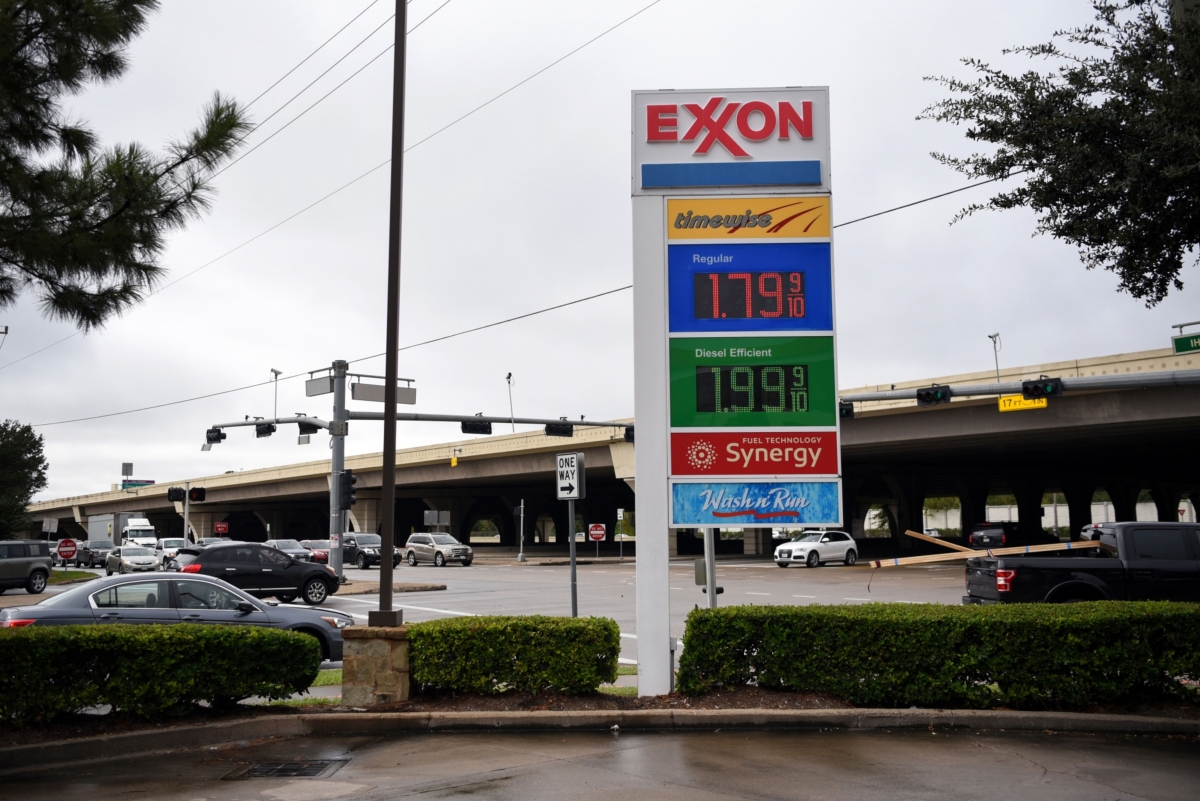
Signage at an Exxon Mobil gas station in Houston on Oct. 28, 2020. MUST CREDIT: Bloomberg photo by Callaghan O'Hare

Signage at an Exxon Mobil gas station in Houston on Oct. 28, 2020. MUST CREDIT: Bloomberg photo by Callaghan O’Hare

But now, they’re increasingly looking like something else — zombies. And their numbers are swelling.

From Boeing, Carnival and Delta Air Lines to Exxon Mobil and Macy’s, many of the nation’s most iconic companies aren’t earning enough to cover their interest expenses (a key criterion, as most market experts define it, for zombie status).

Almost 200 corporations have joined the ranks of so-called zombie firms since the onset of the pandemic, according to a Bloomberg analysis of financial data from 3,000 of the country’s largest publicly traded companies. In fact, zombies now account for nearly 20% of those firms. Even more stark, they’ve added almost $1 trillion of debt to their balance sheets in the span, bringing total obligations to $1.36 trillion. That’s more than double the roughly $500 billion zombie companies owed at the peak of the financial crisis.

The consequences for America’s economic recovery are profound. The Federal Reserve’s effort to stave off a rash of bankruptcies by purchasing corporate bonds might very well have prevented another depression. But in helping hundreds of ailing companies gain virtually unfettered access to credit markets, policymakers may inadvertently be directing the flow of capital to unproductive firms, depressing employment and growth for years to come, according to economists.

“We have come to the point that we should ask, ‘what are the unintended consequences?'” said Torsten Slok, chief economist at Apollo Global Management Inc. “The Fed, for stability reasons, decided to step in. They knew they were going to create zombies. Now the question becomes, ‘what about the companies that have been kept alive that otherwise would have gone out of business?”‘

While zombie firms are more commonly associated with 1990s Japan, post-crisis Europe or even China in recent years, their ranks in the U.S. have been increasing for over a decade, fueled in part by years of ultraloose monetary policy.

Zombie companies get their nickname because of their tendency to limp along, unable to earn enough to dig out from under their obligations, but still with sufficient access to credit to roll over their debts. They’re a drag on the economy because they keep assets tied up in companies that can’t afford to invest and build their businesses.

Of course, not every company that becomes a zombie is destined to stay one forever. There are plenty of comeback stories, from Boston Scientific Corp. to Sprint Corp. Many firms that have seen earnings wiped out due to the coronavirus outbreak are likely to rebound once a vaccine allows the global economy to return to a more normal footing, and may ultimately not need all the debt they raised.

Yet the sheer amount of borrowing undertaken by struggling corporations in recent months will almost certainly limit the capacity of some to make capital expenditures and adapt to shifting consumer habits as covid-19 alters how Americans spend their money.

Bloomberg’s analysis looked at the trailing 12-month operating income of firms in the Russell 3000 index relative to their interest expenses over the same period.

The results paint a grim picture. More than a sixth of the index, or 527 companies, haven’t earned enough to meet their interest payments. That compares with 335 firms at the end of last year. The $1.36 trillion they collectively now owe dwarfs the $378 billion of debt zombie firms reported before the pandemic laid waste to balance sheets.

Boeing 737 Max airplanes are parked at Boeing Field in Seattle on July 27, 2020. MUST CREDIT: Bloomberg photo by David Ryder

Boeing 737 Max airplanes are parked at Boeing Field in Seattle on July 27, 2020. MUST CREDIT: Bloomberg photo by David Ryder

Boeing has seen its total obligations balloon by more than $32 billion this year, while Carnival’s debt burden has increased $14.8 billion, Delta has added $24.2 billion, Exxon $16.2 billion and Macy’s $1.2 billion, according to data compiled by Bloomberg.

A spokesperson for Boeing directed Bloomberg to the company’s third quarter earnings call, in which Chief Financial Officer Greg Smith said that managing liquidity and balance-sheet leverage are top priorities, and reducing debt will be a key focus once cash generation returns to more normal levels.

Representatives from Carnival and Delta declined to comment

Exxon referred Bloomberg to comments last month from Senior Vice President Andy Swiger during the company’s earnings call in which he highlighted the oil producer’s efforts to reduce operating expenses and increase divestments while keeping gross debt levels stable.

A spokesperson for Macy’s said that the company is confident in its financial position, and expects to have sufficient liquidity to fund operations and retire debt maturities due in the coming years.

Among new entrants, all four major U.S. airlines, with a combined $128 billion of debt, have become zombies in 2020. And movie theaters and other entertainment companies on the list grew from 2 last year to 10, accounting for nearly $28 billion of additional debt.

“We distinguish between the walking wounded and the walking dead,” said Ken Monaghan, a portfolio manager at Amundi Pioneer, which oversees about $85 billion. “The question is whether the business model has changed so significantly as a result of the pandemic that survival comes into question. Few sectors are likely to die, but some may require a radical transformation to survive and attract capital.”

Economists have long warned that zombies are less productive, spend less on physical and intangible capital and grow less in terms of employment and assets than their peers.

But new research from the Bank for International Settlements shows that zombies may be even more damaging to an economy than previously thought.

Not only are firms staying in a zombie state for longer than in years past, but of the roughly 60% of firms that do manage to ultimately exit zombie status, many nonetheless experience prolonged weakness in productivity, profitability and growth, leading to long-term underperformance.

Moreover, recovered firms are three-times more likely to become zombies again compared to firms that have never been one, according to the September study, which examined companies in 14 advanced economies over three decades.

“The zombie disease seems to cause long-term damage also on those that recover from it,” the BIS’s Ryan Banerjee and Boris Hofmann wrote in the report. Therefore, “a firm’s viability should be an important criterion for its eligibility for government and central bank support.”

A representative for the Fed declined to comment.

Passengers stand on their balconies of the Carnival Corp. Grand Princess cruise ship docked at the Port of Oakland in Oakland, California, U.S., on Monday, March 9, 2020. The cruise ship that spent days circling the waters off San Francisco with people sickened by the new coronavirus returned to land at an isolated dock, to begin the long process of offloading passengers into quarantine. Photographer: David Paul Morris/Bloomberg

Passengers stand on their balconies of the Carnival Corp. Grand Princess cruise ship docked at the Port of Oakland in Oakland, California, U.S., on Monday, March 9, 2020. The cruise ship that spent days circling the waters off San Francisco with people sickened by the new coronavirus returned to land at an isolated dock, to begin the long process of offloading passengers into quarantine. Photographer: David Paul Morris/Bloomberg

Some say the concern over the spread of zombie companies is being overhyped.

While they accounted for 41% of U.S. firms in a UBS Group AG analysis based on their interest-coverage ratios as of the second quarter, weighted by assets the percentage declined dramatically, to just 10%. And when using the bank’s preferred methodology, which looks at debt to enterprise value, the share fell to just 6%, close to average levels since the late 1990s.

“The zombie problem is fairly benign in the U.S.,” said Matthew Mish, a strategist at UBS. “I don’t think the problem looks any worse than the last two recessions.”

Others aren’t so sure.

“The zombie question is one of the great open issues regarding the legacy of the pandemic,” said Nathan Sheets, chief economist at PGIM Fixed Income. “Will our economy coming out of the pandemic be as dynamic and flexible as before? I’m cautiously optimistic because competition is deeply embedded in the U.S. system.”

Still, corporate deleveraging in the years ahead will result in slower growth, subdued inflation and low rates “for as long as the eye can see,” he added.

Moderna vaccine offers possible antidote to deep-freeze problem #SootinClaimon.Com

#SootinClaimon.Com : ขอบคุณแหล่งข้อมูล : หนังสือพิมพ์ The Nation.

Moderna vaccine offers possible antidote to deep-freeze problem

InternationalNov 18. 2020

By Syndication Washington Post, Bloomberg · Chris Kay, Lisa Du · NATIONAL, BUSINESS, HEALTH, HEALTH-NEWS

One of the biggest challenges to delivering a promising coronavirus vaccine based on unprecedented technology to millions around the world just got easier.

When Pfizer Inc. announced effective preliminary results for its vaccine candidate last week, the downside was that it must be stored at ultracold temperatures, posing significant logistical issues. But Moderna Inc. on Monday one-upped its rival, offering a vaccine based on the same technology that appears to be equally effective, but which also can be stored at regular refrigerated temperatures for up to a month.

The difference is significant. Delivering normal vaccines to populations in the remotest regions from India to Africa is difficult enough just on supply and transport issues. The temperature factor introduces a more daunting hurdle, requiring countries to build storage and transportation networks that can maintain temperatures far colder than that required for frozen meat. The massive investment and coordination needed raised the likelihood that only rich nations would be guaranteed access.

“The Moderna vaccine is a much more viable option for low- and middle-income countries than the Pfizer vaccine,” said Rachel Silverman, a Washington-based policy fellow at the Center for Global Development. “Cold-storage needs are less extreme.”

Not only can Moderna’s vaccine remain stable in the fridge for 30 days, it can also be kept in ordinary freezers for long-term use. Pfizer’s vaccine has to be kept at negative 70 degrees and could only be refrigerated for up to five days — at least until its researchers are able to match Moderna’s breakthrough.

“The Moderna vaccine can be accommodated within the existing vaccine distribution networks,” said Ayfer Ali, an assistant professor and specialist in drug research at Warwick Business School in the U.K. “Even in remote and underdeveloped areas, fridges are available or can be supplied cheaply.”

Although Moderna has only cut deals with a handful of developed countries for its vaccine, it received funding from the nonprofit Coalition for Epidemic Preparedness Innovations and may therefore be bound to help enable access in low-middle income countries, said Silverman.

The Boston-based biotech company’s vaccine uses the same new and experimental messenger RNA mechanism as Pfizer’s. The emergence of two promising candidates is helping ease concerns that a single vaccine won’t be nearly enough to meet global demand.

“We will need to use all of the capacity that we have and all of the vaccines that are effective as they come online,” Ali said.

Pfizer could also make its vaccine more viable by reformulating it — possibly to a freeze-dried form — to avoid the refrigeration issue, said Gillies O’Bryan-Tear, chair of policy and communications at the Faculty of Pharmaceutical Medicine in the U.K.

Meanwhile, hundreds of covid-19 vaccines are in the pipeline, and it’s possible that another, more cost-effective candidate will emerge that uses proven technology and is easier to manufacture and ship, experts said.

“I think it will become clear in the next couple of months, there are other vaccines that are in the pipeline that are in Phase III,” said Saad Omer, director of the Yale Institute for Global Health. “There will be decisions about costs of waiting versus acting. Some might decide to wait based on broader characteristics and the need for ultracold chain, I think that will be a big calculation.”

Other vaccine options may be essential, as not many existing drugmakers have production facilities for messenger RNA technology.

Adar Poonawalla, chief executive officer of the Serum Institute of India Ltd. — the world’s largest vaccine producer by volume — said he had no plans “to dabble with any messenger RNA candidates” for at least 2.5 years when a new facility the company is building has been completed.

“This kind of innovation is great for the long term,” Poonawalla said in an interview. But it remains a question how many of them are going to be “usable” in a practical sense, he said.

U.S. retail sales rose in October at slowest pace in six months #SootinClaimon.Com

#SootinClaimon.Com : ขอบคุณแหล่งข้อมูล : หนังสือพิมพ์ The Nation.

U.S. retail sales rose in October at slowest pace in six months

InternationalNov 18. 2020

By Syndication Washington Post, Bloomberg · Katia Dmitrieva · BUSINESS

U.S. retail sales rose in October at the slowest pace in six months, suggesting consumers are becoming more hesitant amid a surging pandemic and lack of fresh federal stimulus.

The value of total sales increased 0.3% from the prior month, when there was a downwardly revised 1.6% gain, Commerce Department figures showed Tuesday. The median estimate in a Bloomberg survey of economists called for a 0.5% increase. Excluding autos and gasoline, sales rose 0.2%, compared with estimates for a 0.6% gain.

Weaker momentum in consumer spending — which accounts for two-thirds of the economy — indicates growth could slow more sharply following the third quarter’s record jump in gross domestic product. November and December could prove tougher with states and cities reimposing restrictions on indoor dining and nonessential business to contain a rampant coronavirus, while hopes for additional fiscal stimulus this year keep fading and political uncertainty hangs over government policy.

U.S. stock futures and 10-year Treasury yields extended declines after the data. Other data Tuesday morning are due to deliver additional readings on the U.S. economy, including industrial production for October and home builder sentiment for November.

The subdued government figures follow strong quarterly results earlier Tuesday from two large retailers — Home Depot Inc. and Walmart Inc. Home Depot’s comparable sales jumped 24.1% in the latest quarter from a year ago as the home-improvement retailer benefited from a surge in renovation activity, while Walmart’s sales also climbed more than projected as online demand soared at the world’s largest retailer.

The retail report provides a snapshot of activity in October: eight of the 13 major retail categories decreased, led by clothing and sporting goods and hobby stores. Nonstore retailers — which include online vendors like Amazon.com Inc. — recorded the biggest increase, at 3.1%.

Restaurants and bars recorded the first decline since the initial depths of the pandemic in April, a sign that colder weather is discouraging the outdoor dining that kept many businesses afloat during the summer.

So-called control group sales — often a more reliable gauge of underlying demand — increased 0.1% from the prior month, missing forecasts. That figure excludes food services, car dealers, building-materials stores and gasoline stations.

While overall retail sales rose 5.7% from a year earlier, several categories remain well below pre-pandemic levels, including gasoline stations, clothing stores and restaurants.

The data point to spending that’s moderating at the start of the fourth quarter as coronavirus cases rise in every U.S. state, prompting some, including California and New Jersey, to issue new restrictions. Other regions have paused full reopenings.

Early trials from companies including Moderna Inc. have proven effective, though a vaccine must be developed and deployed in scale before consumers feel comfortable enough to regain regular activity. In the meantime, an elevated savings rate is likely to continue supporting some spending.