Lindsey Graham proposal could expose Apple, Facebook to lawsuits #ศาสตร์เกษตรดินปุ๋ย

#ศาสตร์เกษตรดินปุ๋ย : ขอบคุณแหล่งข้อมูล : หนังสือพิมพ์ The Nation

https://www.nationthailand.com/edandtech/30381334?utm_source=category&utm_medium=internal_referral

Lindsey Graham proposal could expose Apple, Facebook to lawsuits

Jan 31. 2020
Sen. Lindsey Graham, a Republican from South Carolina, at the U.S. Capitol in Washington, on Jan. 24, 2020. MUST CREDIT: Bloomberg photo by Andrew Harrer.

Sen. Lindsey Graham, a Republican from South Carolina, at the U.S. Capitol in Washington, on Jan. 24, 2020. MUST CREDIT: Bloomberg photo by Andrew Harrer.
By Syndication Washington Post, Bloomberg · Ben Brody, Naomi Nix 

Sen. Lindsey Graham, a top ally of President Donald Trump, is targeting giant internet platforms with a child protection measure that could threaten tech companies’ use of encryption and a liability exemption they prize.

The draft bill from Graham, the South Carolina Republican who chairs the Senate Judiciary Committee, mounts a double attack against encrypted services such as Apple’s iCloud and Facebook’s WhatsApp chat. It removes technology companies’ immunity to lawsuits by victims for violating child exploitation and abuse statutes and it lowers the standard to bring such cases.

The bipartisan measure, which was obtained by Bloomberg and hasn’t yet been formally introduced, would affect a wide range of social media companies, cloud service providers, email and text platforms and other technology services. It could put Facebook in the government’s crosshairs for its plans to encrypt all of its messaging apps and undercut Apple’s refusal to create back doors into its devices and services.

Graham’s bill, which Democratic Sen. Richard Blumenthal of Connecticut is also working on, calls for Congress and the administration to establish a commission to determine best practices for tech companies to prevent online exploitation of children and allows the attorney general to modify the recommendations.

“The absolute worst-case scenario could easily become reality,” said Berin Szoka, president of TechFreedom, a libertarian think tank aligned with technology companies. “DOJ could effectively ban end-to-end encryption.”

Although the measure doesn’t directly mention encryption, it would require that companies work with law enforcement to identify, remove, report and preserve evidence related to child exploitation — which critics said would be impossible to do for services such as WhatsApp that are encrypted from end-to-end.

If technology companies don’t certify that they are following the best practices set by the 15-member commission, they would lose the legal immunity they currently enjoy under Section 230 of the Communications Decency Act relating to child exploitation and abuse laws. That would open the door to lawsuits for “reckless” violations of those laws, a lower standard than contained in current statutes.

The timing of the bill’s introduction remains unclear with senators serving as jurors in the Trump impeachment trial.

Facebook and other companies have extensive systems to find, remove and report child-abuse images, as well as other prohibited content such as terrorist propaganda. Their monitoring ability, however, doesn’t extend to systems that are encrypted end-to-end. Online safety experts have said Facebook’s efforts to root out this content will suffer as the company pivots to closed communications modeled on its WhatsApp chat service.

That move “will make it harder to detect — and stop — child abuse and similar crimes,” Manhattan District Attorney Cy Vance said in prepared testimony before Graham’s committee in December. In addition, Apple’s encryption had stymied a sex trafficking investigation that authorities wanted to pursue after hearing a prison telephone call by a suspect, he said.

Attorney General William Barr is taking aim at both encryption and the liability shield as he increases scrutiny of technology companies. The Justice Department has tentatively scheduled a meeting on the future of Section 230 for Feb. 19, according to a person familiar with the plans.

A spokeswoman for Graham’s committee emphasized that the document is a draft and isn’t final. The Justice Department declined to comment.

Barr has pressured Apple to provide back-door access to encrypted data for law enforcement investigations, urging the company to unlock iPhones used by the gunman behind a Dec. 6 terrorist attack on a Florida Navy base.

Facebook Chief Executive Officer Mark Zuckerberg has conceded the company’s moves may make it harder to find offensive content, but he nonetheless pledged on a Wednesday earnings call to uphold his most controversial positions, including “standing up for encryption, against those who say that privacy mostly helps bad people.”

The Information, a technology news website, earlier reported some details of Graham’s bill, known as the Eliminating Abusive and Rampant Neglect of Interactive Technologies Act, or EARN IT Act.

The draft bill represents the latest effort to weaken liability protections for technology platforms after a 2018 measure that pared the exemption for content related to online sex trafficking.

Passage of that law indicated that the rules are changing for an industry that had been the darling of Washington but is now facing a broad, bipartisan backlash.

On Tuesday, a top House Democrat, Rep. Jan Schakowsky of Illinois, said she’s reviewing whether the provision should be further revised to stem election misinformation.

Lawmakers have also raised concerns about whether the shield fosters online drug sales and other issues. There have also been complaints from conservatives of political bias. Sen. Josh Hawley, a Missouri Republican, has introduced his own bill to withdraw the legal immunity if companies can’t prove to the U.S. that they moderate content in a politically neutral way.

While there are signs there’s bipartisan support to tackle the issues raised by encryption and the liability shield, Congress doesn’t appear to have a unified approach and passage of the measure could be difficult in an election year.

Facebook has agreed to pay $550 million to settle class-action privacy lawsuit, days after Supreme Court declined to take case #ศาสตร์เกษตรดินปุ๋ย

#ศาสตร์เกษตรดินปุ๋ย : ขอบคุณแหล่งข้อมูล : หนังสือพิมพ์ The Nation

https://www.nationthailand.com/edandtech/30381281?utm_source=category&utm_medium=internal_referral

Facebook has agreed to pay $550 million to settle class-action privacy lawsuit, days after Supreme Court declined to take case

Jan 30. 2020
By The Washington Post · Tony Romm · NATIONAL, BUSINESS, TECHNOLOGY, COURTSLAW

Facebook has agreed to pay roughly half a billion dollars to settle a class-action case alleging the company violated Illinois law in the way it collected data for its facial-recognition tools, the tech giant said Wednesday.

The $550 million settlement – revealed by company executives during their latest earnings call – comes after Facebook tried, and failed, to quash the lawsuit in a petition to the Supreme Court that might have made it harder for other Web users to bring similar legal actions. It must still be reviewed by a judge.

Under Illinois law, tech giants and other companies must obtain explicit permission before collecting a wide array of biometric data, including scans of one’s face. Plaintiffs alleged that Facebook ran afoul of those rules as part of a feature meant to spot, identify and recommend tags of users in photos that had been uploaded to the social-networking site.

The case quickly evolved into a major test of the Illinois Biometric Information Privacy Act, known as BIPA, and its provisions allowing users to sue, known as a private right of action, an idea that consumer-advocates and regulators around the country increasingly tout as a critical way for people to seek justice for major digital abuses. Tech giants vehemently oppose such private lawsuits, and in Illinois, Facebook sought to rebuff the case on grounds that users could not prove they had been directly, sufficiently harmed.

Facebook tried to take the matter to the Supreme Court, but the nation’s top justices rejected the case last week. Their decision essentially would have allowed the lawsuit to proceed on the merits before the tech giant announced it had been settled in principle as part of its fourth quarter 2019 earnings, during which it reported roughly $21 billion in revenue.

Jay Edelson, a lawyer whose firm represented plaintiffs in the class-action lawsuit, said late Wednesday that “biometric privacy is one of the biggest fights of the day,” adding: “We are proud of this settlement and hope that others will follow Facebook’s lead.”

Facebook did not provide further details. “We decided to pursue settlement as it was in the best interest of our community and our shareholders to move past this matter,” spokesman Andy Stone said in a statement.

Warren issues new disinformation pledge, promising to hold Facebook, Google and Twitter responsible #ศาสตร์เกษตรดินปุ๋ย

#ศาสตร์เกษตรดินปุ๋ย : ขอบคุณแหล่งข้อมูล : หนังสือพิมพ์ The Nation

https://www.nationthailand.com/edandtech/30381274?utm_source=category&utm_medium=internal_referral

Warren issues new disinformation pledge, promising to hold Facebook, Google and Twitter responsible

Jan 30. 2020
File Photo : Democratic presidential candidate Elizabeth Warren /Getty Images

File Photo : Democratic presidential candidate Elizabeth Warren /Getty Images
By The Washington Post · Tony Romm, Isaac Stanley-Becker · NATIONAL, TECHNOLOGY 

Democratic presidential candidate Elizabeth Warren pledged Wednesday that her campaign would not share falsehoods or promote fraudulent accounts on social media, part of a new plan to battle back disinformation and hold Facebook, Google and Twitter “responsible” for its spread.

Four years after Russian agents weaponized those services in a bid to undermine the 2016 election, Warren expressed fresh alarm that Silicon Valley’s efforts only “nibble around the edges,” failing to fully combat online threats that mislead voters or stoke conflict, including among Democrats competing for the White House in 2020.

“Anyone who seeks to challenge and defeat Donald Trump in the 2020 election must be fully prepared to take on the full array of disinformation that foreign actors and people in and around the Trump campaign will use to divide Democrats, suppress Democratic votes, and erode the standing of the Democratic nominee,” said Warren, the senator from Massachusetts. “And anyone who seeks to be the Democratic nominee must condemn the use of disinformation and pledge not to knowingly use it to benefit their own candidacy or damage others.”

One of her Democratic rivals, former Vice President Joe Biden, issued a similar pledge last summer, saying he would not “fabricate, use or spread data or materials that were falsified, fabricated, doxed or stolen” and would not use doctored visuals, including so-called “deep fakes,” or “bot networks to disseminate messages.”

But the party as a whole has not set guidelines. State Democratic chairs last year backed a resolution on election integrity urging the Democratic National Committee to establish a “framework which would discourage and prevent … illicit campaign tactics.” But the proposal never came up for a vote before national party leaders.

Still, the DNC has stepped up its efforts to protect campaigns and state parties from deceptive online attacks, including issuing recommendations in December on combating disinformation. The advice for campaigns included tasking a digital staffer with monitoring social media traffic and being more active in pushing back against false narratives online. The party has its own team that uses online monitoring tools to track the spread of falsehoods, providing information to individual campaigns.

Along with her personal commitment, Warren said Wednesday her presidency would push for civil and criminal penalties for those who seek to mislead people online about when, where and how to vote. She also promised to seek sanctions against countries, including Russia, that attempt to undermine U.S. elections with online propaganda.

In the meantime, Warren called on Facebook, Google, Twitter and other tech giants to take immediate steps to bolster their disinformation defenses, including notifying users who have interacted with fake accounts or the manipulated content they share.

Warren’s call to action – issued days before Iowans are set to cast the first votes of the presidential election – reflects a growing trepidation among Democrats about the digital landscape in 2020.

In October, Facebook acknowledged fresh efforts by agents tied to the Russian government to seed posts, photos and videos designed to exacerbate tensions between Democratic candidates and their supporters. Along with new foreign threats, Democrats also have struggled to contend with repeated broadsides from President Trump’s campaign, which has purchased numerous ads on Facebook that contain lies about his Democratic foes.

Seedy accounts on Twitter spread duplicitously edited video of former Vice President Joe Biden earlier this year. Warren’s opponents similarly tried to rile black voters against her candidacy using a highly doctored photo. And backers for Sen. Bernie Sanders and his 2020 bid have been some of the most aggressive online, weaponizing features on Facebook to share viral, hostile memes about his fellow Democratic contenders.

Top Democrats publicly have blasted Facebook, Google and Twitter for failing to take aggressive action against disinformation. Each company in recent years has hired more content reviewers, and with the aid of artificial intelligence, acted more aggressively to thwart what Facebook calls “coordinated inauthentic behavior.”

DNC heads to Iowa to help protect caucuses from digital attacks and disinformation #ศาสตร์เกษตรดินปุ๋ย

#ศาสตร์เกษตรดินปุ๋ย : ขอบคุณแหล่งข้อมูล : หนังสือพิมพ์ The Nation

https://www.nationthailand.com/edandtech/30381272?utm_source=category&utm_medium=internal_referral

DNC heads to Iowa to help protect caucuses from digital attacks and disinformation

Jan 30. 2020
Nellwyn Thomas
By The Washington Post · Joseph Marks · NATIONAL, TECHNOLOGY, POLITICS
WASHINGTON – The Democratic National Committee’s top cybersecurity and disinformation experts will head to Iowa to help protect the caucuses against digital attacks from Russia and other U.S. adversaries.

The team will run a rapid response operation out of the Iowa Democratic Party’s main operations center in Des Moines on caucus night, the DNC’s chief technology officer Nellwyn Thomas said in an interview.

The team will be standing by to act on any reports of possible hacking of caucus technology. It will also flag for social media companies anything that violates their policies and work with the state party and campaigns to punch back at phony narratives that spread online.

“All eyes are on Iowa,” Thomas told me. “Any doubt about the outcome or especially about the legitimacy of the process could really cast a shadow, so we’re doing everything we can to be ready for it.”

Iowa’s first-in-the-nation caucus will mark the DNC’s greatest challenge so far in efforts to guard its presidential contenders from the same fate that befell Hillary Clinton in 2016 when her campaign was upended by a Russian-backed hacking and disinformation effort.

The DNC has surged its work on cybersecurity since then and even intervened to quash Iowa state Democratic Party plans to allow some people to caucus remotely using smartphone apps over security concerns. The national party has also held biweekly calls with campaigns to talk about cybersecurity and disinformation and run anti-disinformation war rooms during the Democratic debates, Thomas told me.

But Monday’s caucuses will be the first time those efforts come face to face with the actual voting process, and threats to the 2020 contest are already emerging. Social media companies are already seeing evidence of Russian attempts to sow disinformation about Democratic candidates, notably an October campaign uncovered by Instagram that spread false narratives about former Vice President Joe Biden, Sen. Elizabeth Warren, D-Mass., and Sen. Kamala Harris, D-Calif., who has since dropped out of the race.

Microsoft also reported in October that Iranian hackers tried to penetrate email address associated with a presidential campaign — which Reuters identified as the Trump campaign. And intelligence officials have warned that Russia, China, Iran, and other nations “will seek to interfere in the voting process or influence voter perceptions” in 2020.

“This is the highest stakes because what’s on the line is the will of the Democratic electorate, and there’s nothing more important than that,” Thomas said. “The most important thing is making sure that we have truth and accuracy coming out of such an important milestone in our nomination process.”

Thomas declined to say how many DNC security and disinformation staffers will be on the ground in Iowa, but said it will be a decent portion of the 55-member team dedicated to those issues. The team will be especially focused on disinformation operations, she said. That’s partly because caucuses are less dependent on technology than primaries and thus less in danger of hacking. It’s also because they involve a highly complicated process of allotting delegates that’s not well understood by the public and “makes them ripe for misinterpretation and misinformation,” Thomas said.

They will be in close contact with the party’s voter protection teams who will be monitoring caucus sites and can report back about whether online reports about difficulties registering or accessing caucusing sites or other problems are legitimate or made up.

The team will be be on the lookout for coordinated disinformation campaigns from abroad — and for less coordinated efforts that seek to undermine public confidence in the results, including by suggesting caucus results were tallied wrong or that a candidates’ supporters were disenfranchised. Those could come from disgruntled Republicans or even from Democrats who aren’t happy about how the night is going for their preferred candidate, she said.

“There’s a full spectrum of potential false narratives and we’re going to be monitoring all of them. What we’re really focused on is any false narrative about the legitimacy of the results,” Thomas told me. “That could be really detrimental to voters’ trust in this process.”

The DNC plans to run similar efforts to protect other primaries and caucuses but is waiting to see what happens in Iowa before finalizing those plans, Thomas told me.

Its Iowa efforts are also part of a broader government plan to protect the caucus. The Department of Homeland Security’s main cybersecurity division will run an online chat room throughout the night for election and campaign officials to sort through reports of suspicious activity.

The state party has also spent months working with the DNC and cybersecurity experts to test and safeguard digital systems that will transmit caucus results, Iowa Democratic Party Chair Tom Price told me in a statement.

“Iowa has the honor of holding the first-in-the-nation state party contest and we take our responsibility to protect the integrity of our democratic process and secure Iowans’ votes very seriously,” Price said. “We continue to work closely with security experts to prepare our systems, and we are confident in the security systems we have in place.”

Apple holiday results top estimates on rebounding iPhone demand #ศาสตร์เกษตรดินปุ๋ย

#ศาสตร์เกษตรดินปุ๋ย : ขอบคุณแหล่งข้อมูล : หนังสือพิมพ์ The Nation

https://www.nationthailand.com/edandtech/30381248?utm_source=category&utm_medium=internal_referral

Apple holiday results top estimates on rebounding iPhone demand

Jan 30. 2020
An Apple logo is displayed at the company's store at Yorkdale mall in Toronto on Aug. 22, 2019. MUST CREDIT: Bloomberg photo by Brent Lewin.

An Apple logo is displayed at the company’s store at Yorkdale mall in Toronto on Aug. 22, 2019. MUST CREDIT: Bloomberg photo by Brent Lewin.
By Syndication Washington Post, Bloomberg · Mark Gurman 

Apple shares jumped to a record high Wednesday after reporting holiday-quarter revenue that beat Wall Street expectations on rebounding iPhone demand and surging sales of wearable devices.

The results are a remarkable comeback from a year ago, when the most valuable technology company missed its own targets. A sales forecast for the current quarter also exceeded analysts’ projections, while services revenue came in slightly below expectations.

The shares, which have more than doubled over the past year, gained as much as 3% to $327.25 at 9:37 a.m. in New York. That’s the highest intraday valuation since the stock started trading in the 1980s, according to data compiled by Bloomberg.

“The strength is coming from the iPhone and continued really strong growth in wearables and the App Store,” said Shannon Cross of Cross Research. “The iPhone was very strong.”

The Cupertino, California-based company reported $91.8 billion in revenue for the fiscal first quarter, up 9% from a year earlier. Wall Street was looking for $88.4 billion, according to data compiled by Bloomberg. Profit was $4.99 a share, also beating analysts’ expectations.

For the fiscal second quarter, Apple said sales will be between $63 billion and $67 billion. Analysts estimated $62.3 billion, on average.

After years of rapid growth, Apple’s expansion has slowed as demand for smartphones waned and competition from Chinese rivals intensified. Under Chief Executive Officer Tim Cook, the company’s strategy has evolved. It now aims to sell new handsets to customers every three to five years, and then offer as many services and accessories as possible in the intervening years.

On Tuesday, Cook said Apple saw “strong demand” for the latest iPhones and noted that a base of more than 1.5 billion devices has been “a great driver of our growth across the board.”

Cook addressed the coronavirus during a conference call with analysts, saying Apple is following developments in China. The company is working closely with employees and partners in the region, he added. Virtually all iPhones are made by Foxconn’s Hon Hai Precision Industry Co. in Zhengzhou, China, and by Pegatron Corp. at an assembly site near Shanghai.

Chief Financial Officer Luca Maestri said the revenue range projected for the fiscal second quarter was wider than usual due to uncertainty created by the spread of the virus.

Analysts have been particularly excited about wearable accessories, such as the Apple Watch and AirPods.

However, the iPhone still generates the majority of Apple’s revenue. And this crucial business has improved from a dire performance in last year’s holiday period. The iPhone 11 and 11 Pro models were well received in their debut in the fall and demand in China has been particularly strong, outselling 2018’s releases in a market that has otherwise been shrinking.

Apple generated $56 billion in revenue from the iPhone in the fiscal first quarter, up 8% from a year earlier. That was a lot better than the 2018 holiday period, when sales of the handset dropped about 15%. Apple cut the price of its entry-level flagship iPhone by $50, luring buyers. There are also millions of older iPhones that are losing software support from the company, spurring new purchases.

Wearables, including AirPods, and other accessories generated $10 billion in revenue in the holiday quarter, up 37% from a year ago.

The company reported Services revenue of $12.7 billion, up 17% from the same period last year. That missed analysts’ forecasts. This business still mostly relies on older offerings such as the App Store, iCloud storage and Apple Music. It’s unclear how well Apple TV+, the Apple Card and the Apple Arcade gaming subscription are performing, but there have been signs of weak demand for Apple News+, the company’s digital magazine subscription.

“One note of caution in an otherwise strong report was that Services, which included Apple TV+, grew slightly below expectations,” said EMarketer principal analyst Yoram Wurmser. “This miss could be attributed to the competition from Disney+, which launched at roughly the same time.”

เตือน นั่งเฝ้าหน้าจอนานๆ สุขภาพเสี่ยง #ศาสตร์เกษตรดินปุ๋ย

#ศาสตร์เกษตรดินปุ๋ย : ขอบคุณแหล่งข้อมูล : หนังสือพิมพ์คมชัดลึก

https://www.komchadluek.net/news/lifestyle/412303?utm_source=category&utm_medium=internal_referral&utm_campaign=lifestyle

เตือน นั่งเฝ้าหน้าจอนานๆ สุขภาพเสี่ยง

27 มกราคม 2563 – 00:00 น.
นั่งเฝ้าหน้าจอนานๆ สุขภาพเสี่ยง
เปิดอ่าน 310 ครั้ง

เตือน นั่งเฝ้าหน้าจอนานๆ สุขภาพเสี่ยง คอลัมน์…  อินโนสเปซ โดย…  บัซซี่บล็อก

รู้หรือไม่? นั่งเฝ้าหน้าจอนานๆ ใม่ว่าจะเป็นจอทีวี จอคอมพ์ หรือจอโทรศัพท์มือถือ เท่ากับเป็นการทำร้ายสุขภาพตัวเอง เป็นตัวจุดระเบิดทั้งโรคอ้วน เบาหวาน ไปจนถึงมะเร็ง รวมทั้งอาจลามไปถึงภาวะจิตตก หดหู่ ซึมเศร้าอีกด้วย

โลกยุคปัจจุบันที่แทบทุกกิจกรรมในชีวิตประจำวันของคนทุกช่วงวัย ถูกผูกติดกับหน้าจอด้วยความสะดวกสบายแค่ปลายนิ้ว ทำให้แต่ละวันเราก็นั่งติดอยู่กับที่เป็นจำนวนชั่วโมงที่นานขึ้นๆ โดยเมื่อเร็วๆ นี้ มีการเปิดเผยข้อมูลผลการวิจัยที่ใช้เวลารวบรวมข้อมูลมาต่อเนื่องร่วม 15 ปี ในวารสารของสมาคมการแพทย์อเมริกัน (Journal of the American Medical Association) ระบุว่า จากการวิเคราะห์ฐานข้อมูลที่รวบรวมจากกลุ่มตัวอย่างชาวอเมริกันกว่า 50,000 คน ครอบคลุมทั้งเด็ก วัยรุ่น และวัยผู้ใหญ่ ระหว่างปี 2544-2559 แต่ละคนใช้เวลาไปกับการนั่งอยู่กับที่เพิ่มขึ้นเรื่อยๆ โดยเฉพาะวัยรุ่นใช้เวลานั่งเกาะหน้าจอเฉลี่ยนานถึงวันละ 8 ชั่วโมง

งานวิจัยชิ้นนี้ยังได้ข้อสรุปอย่างหนึ่งว่า เหตุผลสำคัญที่ทำให้คนทุกช่วงวัยในยุคนี้นั่งติดหน้าจอนานขึ้นๆ โดยไม่รู้ตัว ก็เนื่องมาจากการใช้งานคอมพิวเตอร์ หรือสื่อสารผ่านออนไลน์ นอกเหนือจากในเวลาทำงานหรือในห้องเรียนเพิ่มขึ้นเรื่อยๆ นั่นเอง

“แนวโน้มนี้ไม่ได้กำลังเกิดขึ้นเฉพาะในสหรัฐ แต่เราพบบริบทเดียวกันนี้ทั้งในยุโรปและออสเตรเลียเช่นกัน” Lin Yang ผู้เชี่ยวชาญในสาขางานบริการสาธารณสุข และหนึ่งในผู้ทำงานวิจัยฉบับนี้กล่าว

ข้อมูลนี้สอดคล้องกับที่ นายภุชพงค์ โนดไธสง รองปลัดกระทรวงดิจิทัลเพื่อเศรษฐกิจ และสังคม (ดีอีเอส) กล่าวระหว่างการประชาสัมพันธ์งานกิจกรรมเดิน-วิ่งการกุศล “Digital Run2020” ว่าปัจจุบันคนส่วนใหญ่ใช้เวลาอยู่กับเทคโนโลยีและหน้าจอมือถือ/แท็บเล็ตวันละนานๆ โดยไม่ทันตระหนักว่าจะเกิดผลกระทบต่อสุขภาพร่างกาย รวมถึงเกิดผลเสียต่อพัฒนาการของเด็ก ซึ่งการนั่งอยู่กับที่เป็นระยะเวลานาน เป็นต้นเหตุของน้ำหนักเกิน และโรคไม่ติดต่อเรื้อรัง (NCD) หลายโรค อาทิ โรคเบาหวาน โรคหัวใจ

ทั้งนี้เคยมีผลสํารวจจากนีลเส็น ซึ่งเป็นบริษัทวิจัยการตลาดระดับโลก พบว่าประชากรวัยผู้ใหญ่ใช้เวลาอยู่กับหน้าจอโดยเฉลี่ยวันละประมาณ 11 ชั่วโมง ขณะที่ งานวิจัยจากนักวิชาการมหาวิทยาลัยคาลการี (Calgary) ประเทศแคนาดา ระบุว่า ทั้งผู้ใหญ่และเด็กมีแนวโน้มใช้เวลานั่งเกาะติดหน้าจอเพิ่มขึ้นเรื่อยๆ ซึ่งปัจจัยด้านการทํางานและการเรียนก็เป็นส่วนหนึ่งที่ทำให้ต้องใช้เวลากับหน้าจอคอมพิวเตอร์ แท็บเล็ต หรือมือถือครั้งละนานๆ และละเลยการออกไปทํากิจกรรมกลางแจ้ง

ด้าน Erin O’Loughlin นักจิตวิทยาด้านการออกกำลังกาย (exercise psychologist) มหาวิทยาลัยคอนคอร์เดีย มอนทรีออล ประเทศแคนาดา บอกว่า คนเรามีแนวโน้มที่จะคิดว่าตัวเองใช้เวลาไปกับการออกกำลังกายมากกว่าการนั่งอยู่กับที่ ดังนั้นจึงคิดกลยุทธ์เพื่อจูงให้เด็กและวัยรุ่นออกห่างจากหน้าจอ และออกมาทำกิจกรรมกลางแจ้งให้มากขึ้น โดยใช้วิดีโอเกมเป็นเครื่องมือ โดยเลือกใช้เกมประเภท “exergames” หรือเกมเกี่ยวกับการออกกำลังกาย เพื่อทำให้ผู้เล่นเกิดความสนุกและสนใจกับการเกาะติดข้อมูลการออกกำลังกายของตัวเองผ่านแอพได้อย่างง่ายดาย

“การเล่นกีฬาหรือกิจกรรมกีฬาเป็นเรื่องที่ดี แต่ถ้าคนเรารู้สึกว่ามันไม่ใช่ตัวเอง ก็คงไม่อยากทำ ดังนั้นเมื่อคนเพลิดเพลินกับการอยู่หน้าจอ เราก็เอาทั้งสองอย่างมาผสานเข้าด้วยกันเพื่อกระตุ้นให้เกิดการเคลื่อนไหวหรือขยับร่างกายด้วยการออกแบบเป็นวิดีโอเกมสำหรับให้พวกเขาเล่นกัน”

  Digital Run2020
ส่งต่อสุขภาพดียุคดิจิทัล

กระทรวงดิจิทัลฯ ชวนร่วมงาน “Digital Run 2020” ส่งต่อสุขภาพดียุคดิจิทัล โดยร่วมกับมูลนิธิพัฒนานวัตกรรมสุขภาพ เตรียมจัดงานเดิน-วิ่งการกุศล “Digital Run2020” ในวันอาทิตย์ที่ 29 มีนาคม มุ่งหวังให้เป็นกิจกรรมส่งเสริมการออกกําลังกายแก่ประชาชนทุกกลุ่ม สร้างความตระหนักในการรักษาสุขภาพและเป็น เป็นเวทีประชาสัมพันธ์นวัตกรรมสุขภาพด้านการสื่อสารความรู้สุขภาพเฉพาะบุคคล (Health for You)

โดยผู้สนใจสามารถสมัครเดิน-วิ่ง แบ่งเป็น 2 ระยะทาง ได้แก่ ระยะทาง 5 กม. และมินิมาราธอน ระยะทาง 10 กม.สําหรับบุคคลทั่วไป ค่าสมัคร 600 บาท และสําหรับผู้พิการทางการเคลื่อนไหวหรือร่างกาย (วีลแชร์) หรือผู้พิการทางการมองเห็น ไม่เสียค่าใช้จ่ายสามารถสมัครออนไลน์ ผ่านทาง race.thai.run/DIGITALRUN19 รายได้ส่วนหนึ่งจากกิจกรรมจะนําไปบริจาคให้มูลนิธิคนพิการไทย

“หนึ่งในวัตถุประสงค์ของการจัดกิจกรรมครั้งนี้เพื่อสร้างความตื่นตัวเรื่องการออกกําลังกายมากขึ้น อีกทั้งการวิ่งเป็นการออกกําลังกายที่ทุกคนสามารถทําได้ง่ายๆ”

Remote-Controlled Forklift via 5G – Thailand’s First Industrial Use Case by AIS/SCG/PSU Offering Mor #ศาสตร์เกษตรดินปุ๋ย

#ศาสตร์เกษตรดินปุ๋ย : ขอบคุณแหล่งข้อมูล : หนังสือพิมพ์ The Nation

https://www.nationthailand.com/recommended/823?utm_source=category&utm_medium=internal_referral

Remote-Controlled Forklift via 5G – Thailand’s First Industrial Use Case by AIS/SCG/PSU Offering Mor

Jan 27. 2020
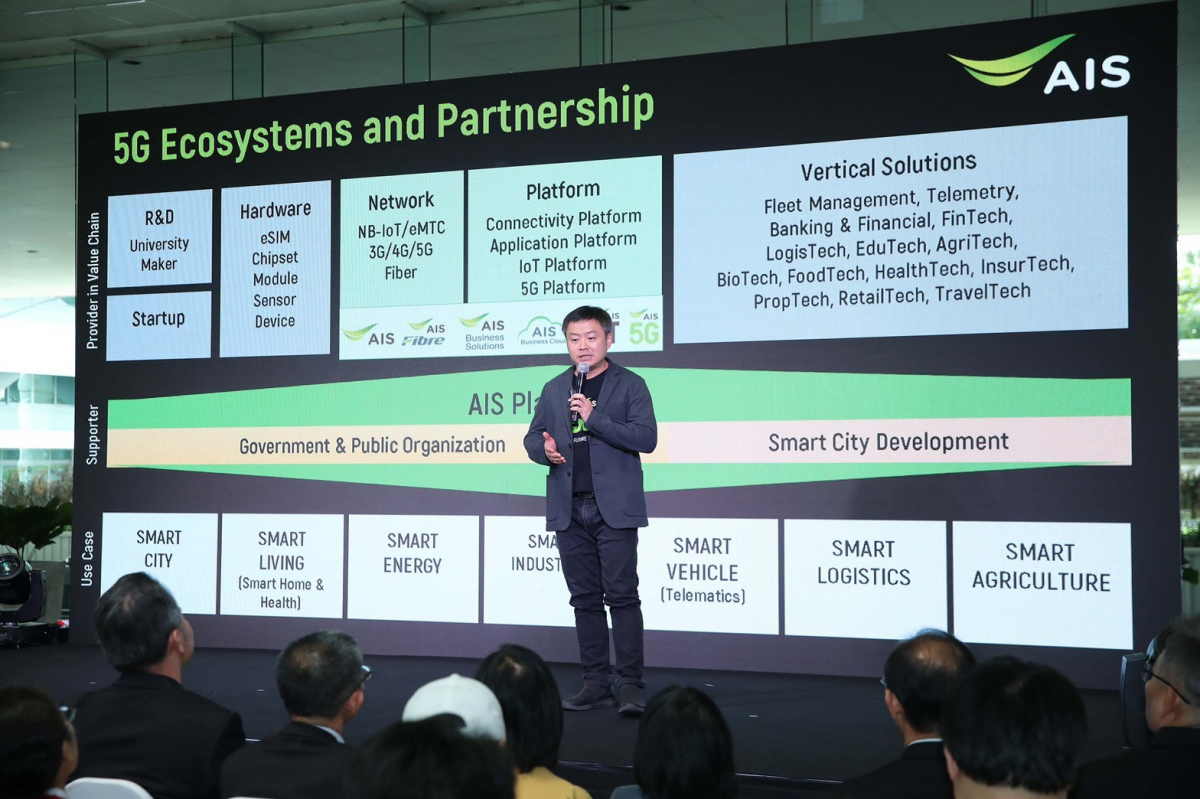
  • Thailand has gained another crucially technological advancement made possible by no. 1 digital technology, AIS and leading business conglomerate in the ASEAN, SCG in collaboration with Prince of Songkla University (PSU). For the first time in Thailand, the three organizations have successfully demonstrated the use of 5G technology for industry. The experiment was endorsed by the National Broadcasting and Telecommunications Commission (NBTC).

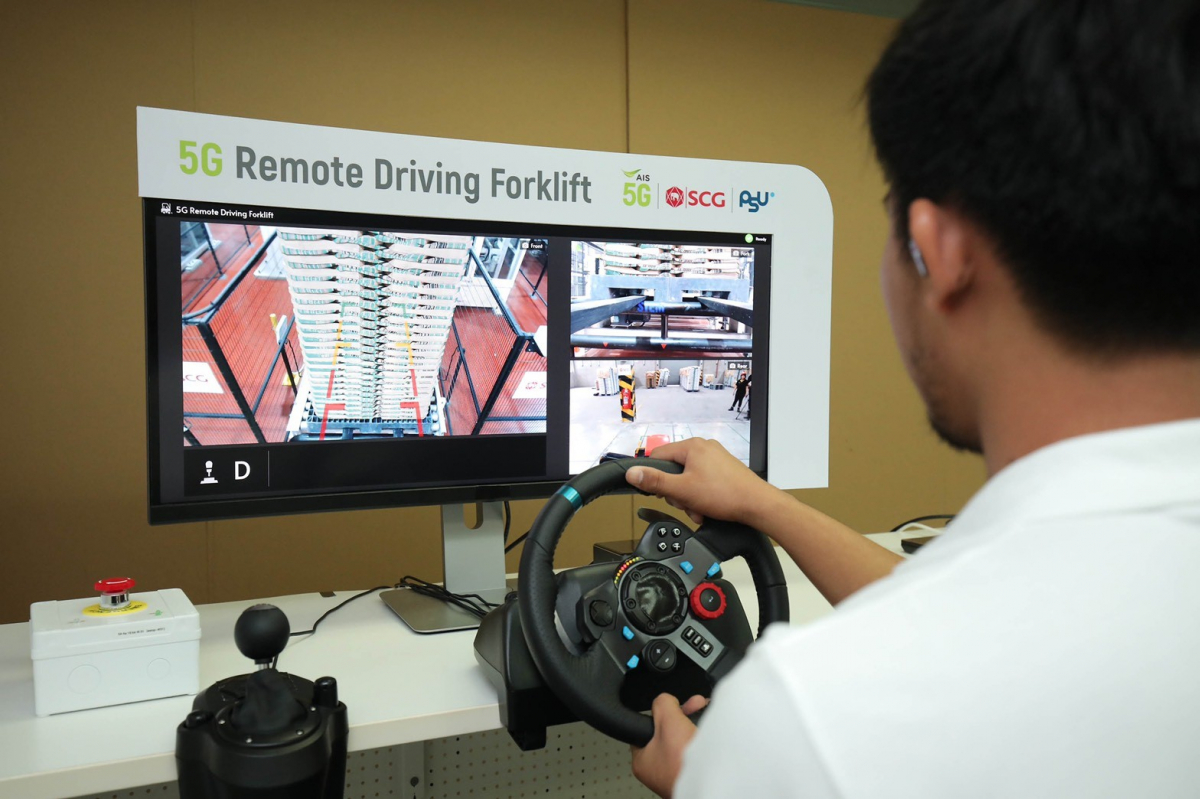
  • 5G technology was utilized to operate an unmanned forklift via AIS 5G network. The unmanned forklift was parked at SCG plant in Saraburi while the operator attempted to control it at SCG Headquarters in Bangsue, Bangkok. SCG operator was able to operate the forklift fluidly, maneuvering palettes from point A to point B accurately in real-time. This 5G industrial test paves way to increased productivity and safety, and opportunity for staff remote-training. It has become an important model for other industries to follow.
  • AIS and SCG have signed an MOU in research and innovation development using 5G network for multiple projects, plus staff competency to put Thai performance at the world’s frontline. The two giants intend to build 5G ecosystem together to enhance sustainable innovations and increase Thailand’s industrial competitiveness as well as the living quality of Thai people.

Mr. Wasit Wattanasap, Head of National Network Operation and Support at AIS said, “5G technology will dramatically change the way we do things in Thailand. It is capable of revolutionizing national industry and fulfilling Thailand 4.0 policy. Users will benefit in three ways: faster data speed, IoT connectivity, and stable and responsive network. As national leader in digital technology, AIS is committed to bring advanced technology to support driving of Thailand 4.0 policy for the benefits of Thai people.

AIS is the first to complete 5G testing nationwide. We welcome developers, researchers, students and individuals to work with us, testing 5G in multi-dimensions to understand how it works and how it can better digital economy and living quality of Thai people. AIS has proven ready to be the center for creating ecosystem specializing in innovation and delivering best customer experiences to users of all generations and all regions.

The collaboration among AIS, SCG and PSU marks a significant milestone in Thailand’s 5G test. Through NBTC consent, the 2.6 gigahertz bandwidth was utilized to demonstrate forklift’s remote operation in Saraburi province while the operator was controlling it in Bangkok, about 110 kilometers away. The result was a success, reiterating that 5G technology will definitely play an important role in Thailand’s future businesses. Needless to say, developing 5G ecosystem involves a few players including government, companies, and academic. Everyone has a part to play to promote and support 5G innovation, and to make Thailand capable to compete in the global market.”

Mr. Attapong Sathitmanothum, Director – Mechanization Automation & Robotics (MARs) and Industry 4.0, SCG said, “SCG aims to improve work operations in various fields and across business units including cement and building materials, packaging, and chemicals. We would like to enhance our company’s capabilities steadily and sustainably. A working group in Mechanization, Automation, and Robotics or MARs, along with Industry 4.0, has been established in 2016 to be a catalyst in leveling production process up to achieve Smart Factory by integrating MARs technology and Industry 4.0 together. With an investment over 860 million baht during the first three quarters of 2019, SCG has achieved several solutions including a predictive maintenance to notify us before the machine breakdown (Smart Maintenance), use of robot in laboratory (Smart Laboratory), automated dispatching system that provides cement to customers automatically (Smart Dispatching), and use of digital technology enabling data accessibility throughout supply chain so that everyone can utilize the same data as single source of truth, perform data analytics to improve our  competitiveness, and enhance our responsiveness to customers’ needs.

SCG stresses the importance of cooperative networking with intelligent and skilled organizations towards work success and speediness. Hence, it is a good initiative when SCG collaborates with AIS on this regard so SCG customers can receive products and services more efficiently and Thailand’s industry can leap further from our collaboration and optimization.

The project of remote-controlled forklift via 5G took place first at SCG plant in Saraburi where large numbers of raw materials and products are subject for moving. Forklift was chosen as a prototype due to its ease of operation in material mobility. If succeed, SCG could move on to applying 5G technology with other equipment and aspects. The forklift test confirms fast response in real-time and accuracy in data transfer necessary for advanced automated configuration. In addition, the proven capability in remote controlling can increase work productivity as drivers can operate forklifts from any location, and trainers can provide long-distance trainings to staff in various locations simultaneously and conveniently.

5G technology can strengthen SCG efficiency in many ways. Workers will be safer managing information in real-time and centralization. Customers will be more satisfied because logistics will become more effective. For example, SCG can incorporate IoT into Smart Home to provide convenience as well as safety to home living. Lastly, 5G will benefit SCG people development programs tremendously, truly aligning with our Industry 4.0 direction.”

Associate Professor Dr. Peerapong Teekasakul, Director of Innovation Hub at Council of University Presidents of Thailand said, “In the past, Prince of Songkla University through the Institute of Research and Digital Innovation has been actively conducting research and development with private- and industry sectors. We co-study and co-test 5G technology in many dimensions with our goals to building and preparing the new technology ready for actual industrial usages which, in turn, will increase competitiveness for Thailand’s industry. PSU receives funding for 5G study from Innovation Hub, Ministry of Higher Education, Science, Research and Innovation, to create an advanced intelligence platform for vehicles operable with low-latency controlling system via 5G AIS network. We hope the test results will lead to use cases in Thailand’s industry in the near future.”

The Kremlin has its hands in the internet around the world, and it’s also trying to control cyberspace at home #ศาสตร์เกษตรดินปุ๋ย

#ศาสตร์เกษตรดินปุ๋ย : ขอบคุณแหล่งข้อมูล : หนังสือพิมพ์ The Nation

https://www.nationthailand.com/edandtech/30381107?utm_source=category&utm_medium=internal_referral

The Kremlin has its hands in the internet around the world, and it’s also trying to control cyberspace at home

Jan 27. 2020
In Kirkenes is a Norwegian monument honoring the soldiers of the Soviet army who liberated the town from Nazi German occupation in 1944. MUST CREDIT: Photo for The Washington Post by Ksenia Ivanova

In Kirkenes is a Norwegian monument honoring the soldiers of the Soviet army who liberated the town from Nazi German occupation in 1944. MUST CREDIT: Photo for The Washington Post by Ksenia Ivanova
By The Washington Post · Isabelle Khurshudyan · WORLD, TECHNOLOGY, EUROPE

MOSCOW – On a stretch of Norway’s Arctic border known for its views of the Northern Lights is the small town of Kirkenes. Its population is under 4,000 and the local online newspaper has a staff of just two.

And it’s here that Russia is signaling what the future may hold: a wider hand in trying to censor the internet at home.

At issue is the Barents Observer, which publishes in English and Russian, and a story about an openly gay man who twice contemplated suicide but then changed his mind and is now speaking out to promote mental health. Russia’s state telecommunications regulator, Roskomnadzor, flagged the story for propagating suicide and blocked the entire Observer website in Russia last year.

Kirkenes, Norway, is home to the Barents Observer, an online newspaper that publishes in English and Russian. MUST CREDIT: Photo for The Washington Post by Ksenia Ivanova

Kirkenes, Norway, is home to the Barents Observer, an online newspaper that publishes in English and Russian. MUST CREDIT: Photo for The Washington Post by Ksenia Ivanova

But the editor of the Barents Observer wonders whether the website was targeted because of anti-Kremlin positions in the past.

From Japanese comics to political opposition web addresses to a small Norwegian publication that had roughly 20,000 Russian readers per month, Russia’s so-called “blacklist” has eclipsed 300,000. But although Moscow has become notorious for meddling in the global internet, doing so at home isn’t as easy – especially in a society that’s already used to online freedoms.

The view from a pier at Kirkenes. The Barents Observer has lost two-thirds of its Russian audience since being put on Russia's Internet blacklist. MUST CREDIT: Photo for The Washington Post by Ksenia Ivanova

The view from a pier at Kirkenes. The Barents Observer has lost two-thirds of its Russian audience since being put on Russia’s Internet blacklist. MUST CREDIT: Photo for The Washington Post by Ksenia Ivanova

Russia so far has tread relatively carefully in its censorship efforts. Still, internet freedom monitors in Russia fear its new “sovereign internet” law could one day rival Chinese and Iranian online oversight. The London-based rights monitor Freedom House ranked Russia 51st out of 65 countries on its internet-freedom rating last year.

The legislation came into force in November, but it could be a year before the technology is in place. It aims to route Russian web traffic and data through points controlled by state authorities and to build a national domain name system. This, supporters claim, would give Russia greater control of internet content and traffic.

Authorities backing the bill have described it as a cybersecurity measure needed to defend Russia by building a fenced-off network.

But critics see it as the government’s way of further cracking down on one of the few free sources of information remaining in the country.

Cable news channels are state-run, and the television audience is gradually declining, according to the Levada Center, an independent Russian pollster. Its study of the Russian media landscape in 2019 also revealed that social networks have replaced television as the main news source for young Russians, and although 80 percent of the population had confidence in television as a news source 10 years ago, that figure is now 55 percent.

“Cyber activity has been harnessed by the Russian government to target governments and activists externally but now those same tools are turned inward,” said Heather A. Conley, director of the Europe Program at the Center for Strategic and International Studies. “Russian officials have seen how the internet and social media can be used by civil society to share information, organize grass-roots protests across Russia and as an instrument of transparency against Russian corruption.”

An uprising more than eight years ago over election-rigging allegations sparked Russian authorities’ first efforts to wield more control over the internet. Russian President Vladimir Putin started to see the web as “a potential threat” and consider regulations, said former lawmaker Ilya Ponomarev.

Around the same time, the first measures were introduced to block undesirable content on the internet, specifically targeting child pornography, drug-related material and anything that could be considered as encouraging suicide.

The blacklist was supposed to be implemented by nongovernmental organizations, but the role instead went to watchdog Roskomnadzor. More than 10 state agencies can ask Roskomnadzor to block a website.

“That particular legislation did nothing wrong, but it was used as a model to introduce further initiatives,” Ponomarev said. “They were introducing laws but already for the political cases – what they called extremism, terrorism and this kind of stuff, which led to the establishment of real censorship.”

The result has been a loose definition of what can be blocked. Some Japanese manga has been added to the blacklist as child pornography. News websites run by Kremlin critics Mikhail Khodorkovsky and Garry Kasparov are inaccessible to Russians because they’ve been categorized as “extremism.”

And the Barents Observer was punished for allegedly promoting suicide even though the subject of its story was doing the opposite.

Thomas Nilsen, the editor, suspects the real trouble dates to 2014, when a Russian official publicly accused the website of anti-Russian reporting because it used terms such as “Putinism” and was critical of the country’s annexation of Crimea from Ukraine.

“We are located in probably the most remote corner of Europe,” Nilsen said. “But not because we chose to end up in this situation, we feel that, yeah, we are on the border to Russia but we are also on the border to the fight for freedom of the internet.”

Not all of Russia’s Internet blockades have been successful.

After the Telegram messaging app, especially popular in Russia, refused to give authorities access to its users’ encrypted messages in 2018, Roskomnadzor unsuccessfully attempted to block it but inadvertently denied Russians access to a slew of unrelated online services.

Telegram remains widely used by Russians, including many officials – even Roskomnadzor head Alexander Zharov is on the app. The country blocked LinkedIn in 2016 because it stores the user data of Russian citizens outside of Russia, but it’s been hesitant to take the same action with more popular social platforms Facebook and Twitter.

“They perfectly understand that 90 percent of (online) users are apolitical,” Khodorkovsky said. “But if you deprive them of a beloved product, they can politicize, which no one wants.”

Artem Kozlyuk of Roskomsvoboda, a group that fights censorship on the internet and promotes freedom of information, said that the new sovereign internet law “opens up a new chapter of regulation” because it involves infrastructure control through deep-packet inspection technology – an advanced way to filter traffic.

He doubts that Russia will actually have the capability to cut itself off from the global web, as the country’s authorities have claimed. But service could go dark in some regions for a short time.

That’s already happened during protests in Moscow and Ingushetia, a republic in the Caucasus region.

A block had devastating consequences for the Barents Observer. The publication has lost two-thirds of its Russian audience since being put on the internet blacklist.

Nilsen, the Observer’s editor, said he’d rather that happen than to succumb to self-censorship.

“We have decided never to compromise on what we are writing,” he said. “We are following what we believe is good ethics of journalism. And we don’t want to change anything because Roskomnadzor disagrees with us.”

A virus, fires and protests: The perils confronting college study-abroad programs #ศาสตร์เกษตรดินปุ๋ย

#ศาสตร์เกษตรดินปุ๋ย : ขอบคุณแหล่งข้อมูล : หนังสือพิมพ์ The Nation

https://www.nationthailand.com/edandtech/30381079?utm_source=category&utm_medium=internal_referral

A virus, fires and protests: The perils confronting college study-abroad programs

Jan 26. 2020
File Photo Credit China Daily: People wait for trains to return home on Jan 23, 2020. [Photo/sipaphoto.com]

File Photo Credit China Daily: People wait for trains to return home on Jan 23, 2020. [Photo/sipaphoto.com]
By  The Washington Post · Lauren Lumpkin · WORLD, EDUCATION 

A novel, potentially lethal virus in China. Bush fires in Australia. Political protests in Hong Kong.

Amid turmoil in different corners of the world, universities that send students to far-flung destinations have temporarily curtailed some programs while closely monitoring others.

Nine American University students studying in Beijing are hundreds of miles from the center of a coronavirus outbreak in Wuhan, China. But they have been encouraged to wear surgical masks, wash their hands frequently and avoid large crowds, said Mark Hayes, director of the school’s study-abroad programs.

“None of them are in the affected areas that have been quarantined,” Hayes said. “We have been working to give them information.”

Three students from Georgetown University are studying in Beijing, said Meghan Dubyak, a spokeswoman. The school issued a campuswide advisory in recent days urging students and faculty to get flu shots and to rely on International SOS, a platform that provides medical alerts and evacuation services for students and faculty abroad.

Authorities in Wuhan have halted regional travel, and hundreds of flights from the city’s international airport were canceled Thursday. In Beijing, officials have canceled mass Lunar New Year celebrations, hoping to limit the spread of the airborne illness.

China’s leader, Xi Jinping, warned Saturday of an “accelerating spread” of the virus that has claimed at least 56 lives. Infections have been confirmed in cities throughout China – including Beijing – and in Japan, Thailand, Malaysia, Singapore, South Korea, Taiwan, Vietnam, Nepal, Australia, France and the United States.

The response to the coronavirus has been rapidly evolving: On Saturday, Hong Kong announced schools would be closed until mid-February.

Leaders at George Washington University have shared safety information with students studying in China and other countries, Crystal Nosal, a spokeswoman, said in an email.

“Students were encouraged to stay aware and seek the most up-to-date information from their programs about the changing conditions while in the country or traveling through the region,” Nosal said. “The health and welfare of our community members is our utmost priority.”

But even before the emergence of a new coronavirus was widely recognized, several campuses in the District of Columbia – American, Catholic, George Washington and Georgetown universities – were suspending academic programs for another reason: explosive protests in Hong Kong that have gained international attention.

The demonstrations were triggered by legislation that would have allowed the extradition of criminal defendants to mainland China. Hong Kong’s government formally withdrew the proposal in October, but protesters want officials to meet other demands – including an independent investigation into police conduct and direct elections for government leaders.

Study-abroad program directors must tread a fine line between obstructing students’ ability to explore new places and keeping them safe.

In November, the peaceful protests in Hong Kong took a turn when a student at the Hong Kong University of Science and Technology died after demonstrators clashed with police.

“The protests moved onto college campuses,” said Grace Schneider, director of education abroad at Catholic University. “Hong Kong is one that, obviously, it was a long time ramping up. The protests started small, nonviolent, and went on for months.”

Leaders at Georgetown evacuated a group of students who were studying at the Chinese University of Hong Kong in November, said Livvy Gordon, a junior and global business major at Georgetown.

“We had been in Hong Kong for almost three months at that point, and I had seen one protest from afar,” Gordon said. “We were shocked once it began to escalate and once things moved to campus.”

Some students see political unrest as a learning opportunity. Rohit Seth, a 19-year-old sophomore at American University, said he wants a chance to understand, firsthand, the tension between pro-Brexit and pro-European Union voters in London. Hundreds of thousands of protesters filled the streets of London in October to decry the Brexit referendum authorizing the United Kingdom to withdraw from the EU.

“With everything happening with Brexit, I think it’s important to be abroad when all this big stuff is happening,” Seth said at an information session for students looking for study-abroad opportunities.

AU’s Hayes said his office has warned students about potential travel issues in the region. Brexit could affect students’ ability to travel across Europe and return to their host school in London.

AU in recent years discontinued a study-abroad program in Aleppo, Syria, and evacuated students from Beirut amid safety concerns. Catholic suspended its program in Chile this semester after protesters fought a subway fare increase in October.

Two popular study-abroad sites in Australia – Sydney and Melbourne – have not been directly affected by bush fires engulfing parts of the country, but program directors are still monitoring the flames.

Four Howard University students are studying in Sydney, about 50 miles away from the fire zone, said Maraina Montgomery, assistant director of study-abroad programs.

Officials do not expect programs to be upended by fires but are concerned about air quality. Reports from Melbourne said air quality in mid-January was six times worse than what’s considered healthy. In recent days, conditions have improved.

Bryony Whitelaw, a junior at AU, said her host school in Melbourne has sent information about where the fires are roaring and how far those sites are from campus.

“I’m not looking forward to it if it is as bad as it has been the last few days, but I should be fine,” Whitelaw said about the air quality in mid-January.

Scientists have cited climate change as the underlying cause of an outbreak of fires that have cost more than two dozen people their lives and destroyed upward of 2,000 homes. Whitelaw views it as a learning opportunity.

“Maybe it’s an opportunity for the world to get together and say we need to make some radical changes there,” Whitelaw said.

At the Institute for the International Education of Students, also called IES Abroad, faculty are encouraged to embrace the chaos, said William Hoye, executive vice president and chief operating officer. The nonprofit offers study-abroad programs in 34 locations around the world.

“We’re often focused on our faculty making sure what’s happening in the country has a teachable moment,” Hoye said. “We want the faculty and staff to not just understand where the protests are, but why the protests are.”

IES suspended summer programs in Hong Kong and is offering students in Sydney the option to move their studies to neighboring New Zealand, Hoye said.

Foreign universities that host American students regularly issue safety tips to prospective students. Study-abroad offices at Washington-area schools reported sharing a host of resources with students, including State Department travel advisories and travel insurance, in case programs are abruptly cut short.

“When countries are more unstable, we’ll be a little more cautious with students, letting them know upfront about the situation and that we don’t necessarily know yet what’s going to happen,” Catholic University’s Schneider said.

Toshiba develops real-time speech recognition AI #ศาสตร์เกษตรดินปุ๋ย

#ศาสตร์เกษตรดินปุ๋ย : ขอบคุณแหล่งข้อมูล : หนังสือพิมพ์ The Nation

https://www.nationthailand.com/edandtech/30380962?utm_source=category&utm_medium=internal_referral

Toshiba develops real-time speech recognition AI

Jan 23. 2020
By The Nation

As the world approaches an era where more people can live beyond a hundred years, concerns have been raised over the challenge of labour shortages due to low birth rates and an ageing population.

RPA (Robotics Process Automation) — using robots to automate work processes —has been touted as a possible way to solve the issue of labour shortages and, at the same time, increase productivity by transforming the way we work.

It has been introduced in finance and other fields, producing great results in automating document creation and data entry tasks.

Nevertheless, many companies still need to carry out tasks such as recording minutes of meetings and transcribing speeches. While AI and software that automatically converts speech to text are already available on the market, converting speech to text accurately still needs to be done manually.

How can we solve this issue and help create a society that is easy to work in?

Toshiba provides an answer with its newly-developed speech recognition AI.

In an interview, Taira Ashikawa, head of Research and Hiroshi Fujimura, lead researcher of the Toshiba Corporate R&D Centre’s Media AI Laboratory, which developed AI, talked about the history of speech recognition using AI and the breakthroughs they had made during development.

Smooth speech transcription with a fast, easily readable display: Toshiba has a history of working on media intelligence, a field which makes use of human voices and images that have undergone information processing. The foundation the company has cultivated in the field over many years plays a big role in the creation of this voice recognition AI.

Toshiba first began developing AI in 2015. At the time, there was increasing momentum around the world in the field of information accessibility, which aims to create environments that enable people that are deaf and hard of hearing to access and input information. Toshiba has started “Universal Design (UD) Adviser System” since 2007 to enable employees with disabilities to participate in product development. The company believes in promoting diversity and inclusion in the workplace and develops UD-friendly products and services through the years.

“When we interviewed the hearing-impaired people in UD Adviser System, we found out that they wanted to participate in meetings and lectures in real time, and not just read the transcripts provided subsequently. So we tried to provide a function that would automatically display easy-to-read subtitles in real time. To assist the hearing-impaired people in collecting and providing information, we need to do two things: expand information accessibility for the hearing-impaired, and increase productivity. The development of speech recognition AI started from these two points in mind.” Ashikawa said.

Taira Ashikawa, Head of Research, Media AI Laboratory, Toshiba Corporate R&D Center

Taira Ashikawa, Head of Research, Media AI Laboratory, Toshiba Corporate R&D Center

The technology behind the accuracy in speech recognition: When you describe speech from people’s conversations during meetings and lectures, you will end up with a text that is hard to read. Anyone who has ever transcribed speeches can tell you that. There is a lot of unnecessary content that gets in the way of getting information such as meaningless filler words like “Uh,” and “Umm” and expressions of agreement that add nothing to the content.

The speech recognition AI Toshiba developed is able to recognise speech with high accuracy and detect fillers and hesitation markers as well. This is an essential function when it comes to increasing productivity. Algorithms form the core of AI, and the development team explored a variety of approaches to increase accuracy.

“At first we hit a wall because the level of accuracy of recognition just wouldn’t increase no matter what we did. Our primary goal was to provide users with something that they could use conveniently. By using the increasingly popular model known as LSTM (*1) as well as CTC learning (*2), we tried to teach AI about speech peculiarities such as fillers and hesitation markers that are exclusive to human beings.” Fujimura said.

(*1) LSTM (Long Short-term Memory): one of the developed forms of RNN (Recurrent Neural Network), which has a recursive structure in a hidden layer. It is able to learn long-term dependency relationships which are difficult for conventional RNNs to do.

(*2) CTC (Connectionist Temporal Classification): A method for training RNN to solve problems where sequence lengths differ during input by introducing null characters and adjusting loss functions.

Hiroshi Fujimura, Lead researcher, Media AI Laboratory, Toshiba Corporate R&D Center

Hiroshi Fujimura, Lead researcher, Media AI Laboratory, Toshiba Corporate R&D Center

Up until now, speech recognition has worked by analysing sound wave patterns and parsing them by identifying that this part is “a,” this other part is “i” and so on. However, fillers and hesitation markers have an endless variety of patterns, and it would take a long time to learn about them one by one.

“We used LSTM to capture information such as ‘this is what fillers are like,’ ‘this is what it sounds like when someone hesitates over a word,’ as a statistical model and then used CTC learning to make the AI learn it as a model. Through that, the AI became capable of detecting the countless patterns of fillers and hesitation markers as well,” Fujimura said.

“There is still plenty of room for improvement in development and technology to achieve a fully accurate speech recognition offering. Our speech recognition AI can recognize speech in Japanese, English and Chinese for now. We strive to develop an environment where speakers of different languages will be able to enjoy a smooth conversation with one another. When we develop AI, we dream of taking something like that, which you only see in futuristic science fiction or comic books, and making it a reality”.

This is how the AI evolved into speech recognition AI with superior accuracy. When the development team used lectures as an opportunity for verification testing, the AI achieved an average speech recognition ratio of 85%. That means it was able to recognize the contents of speech above a certain level without editing or advance learning. Now that they have raised the accuracy of the speech recognition, they are considering applying it to the communication AI known as RECAIUS™.

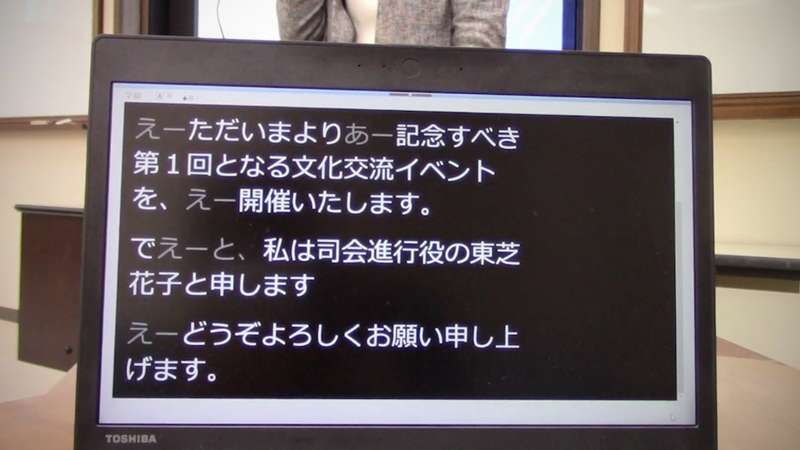
They developed applications where a representative affair is a real-time subtitle display function for the hearing-impaired people. They harness AI to display speech clearly with fillers and hesitation markers reflected in faint, non-obtrusive subtitles. This was a user-friendly specification introduced following detailed discussions with users.

Automatic speech subtitling system (left) and image of displayed subtitles (right)

Automatic speech subtitling system (left) and image of displayed subtitles (right)

“As far as we’re concerned, filler words like “umm” and “uhh” just get in the way. However, what the hearing-impaired people really want is to get as much information as possible. When they read the subtitles while following the movements of the speaker’s lips, they get stressed when fillers and hesitation markers are cut out because they feel that the speaker is saying something that isn’t being reflected in the text,” Ashikawa said.

“So we decided to leave the fillers and hesitation markers in the subtitles but is displayed faintly to make the text easier to read. However, when we record them as transcribed documents, we remove the filler and hesitation markers. That way, we get brief and concise documents.”

AI shows its true worth in manufacturing as well: In March 2019, Toshiba collaborated with Dwango Co Ltd and held a live broadcast of the 81st National Convention of the Information Processing Society of Japan on video website “niconico”. Subtitled videos were distributed online in real time. They are planning to deploy it not only for office tasks but for use in manufacturing settings as well.

“It’s rare to see speech recognition being used as a service in offices today. So it would be ideal for us if users would trust our product and use it, and if it could become something they used in everyday business without being conscious that it’s a speech recognition AI. For example, the words we are speaking right now could become a text polished enough to be used as a business document, with the speakers clearly identified to show who said what. We hope to create a speech recognition AI that is handy and reliable,” Ashikawa said.

“The use of speech recognition hasn’t been applied in manufacturing sites. However there is a need for hands-free voice collection and recording in factories during maintenance and inspections. So I think there’s room for this speech recognition AI to be adopted there as well,” Fujimura said.

We hope to use our knowledge and know-how about manufacturing facilities to seamlessly integrate speech recognition into their operations. We can do that because we have spent a long time developing speech recognition AI and accumulated knowledge about manufacturing and infrastructure settings. ’Why does Toshiba work on speech recognition?’ I think this will provide one of the answers to that fundamental question”.

With the numerous potential applications and benefits, there is no doubt that this speech recognition software will be making its presence increasingly felt in more offices and manufacturing sites in the near future.