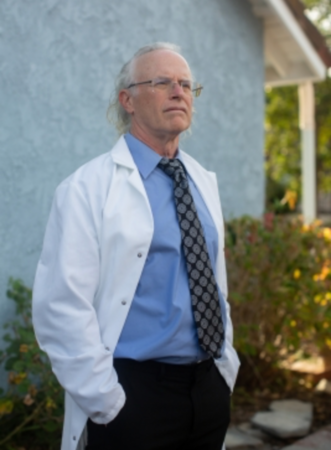
Mike Wasserman, past president of the California Association of Long Term Care Medicine, says the coronavirus vaccination process for such facilities is “a mess.” MUST CREDIT: Photo for The Washington Post by Allison Zaucha
By The Washington Post · Fenit Nirappil, Yasmeen Abutaleb · NATIONAL, HEALTH, HEALTH-NEWS
More than 3 million elderly and infirm residents of nursing homes and other long-term-care facilities may face delays in getting coronavirus vaccines as the facilities confront the difficult task of obtaining consent, which consumer advocates, operators and some health officials say should have been simplified and started earlier by the federal government.
Obtaining consent presents one of the toughest hurdles as officials mobilize to inoculate residents of these facilities, many of whom have dementia or Alzheimer’s disease.
Facilities must track down relatives or attorneys in those cases, which could take days or weeks. In some instances, they may need to resolve disputes when family members disagree on whether their loved ones should receive a vaccine.
Even residents of sound mind may be anxious about a new vaccine and need time to weigh risks and benefits and consult with relatives.
Federal health officials gave top priority for vaccines to long-term-care residents and staff after outbreaks ravaged facilities, killing more than 113,000 residents and staff and accounting for more than a third of all U.S. covid-19 deaths. Health and Human Services Secretary Alex Azar recently said the government has the capacity to inoculate all long-term-care residents by Christmas. But the retail pharmacies administering the vaccines have indicated the process will likely take several months as a result of logistical and consent challenges that will require multiple visits to facilities. That process will be occurring over what is projected to be the deadliest period of the pandemic.
“It’s a mess,” said Mike Wasserman, medical director of a California facility and past president of the California Association of Long Term Care Medicine who has talked to other nursing homes about the rollout. “The federal government just hasn’t provided good direction, and the direction keeps changing every day. And you get different stories from different people at different levels.”
Operators of nursing homes and other long-term-care facilities have been scrambling to resolve the conflicting directions.
The government’s partnership with Walgreens and CVS to distribute vaccines gave the companies discretion to secure permission however they wanted. The Centers for Disease Control and Prevention, which oversees that partnership, advised that verbal consent is enough.
But the pharmacies wanted more, imposing onerous consent rules far stricter than what nursing homes have used for seasonal flu shots, operators said. The pharmacies eased up after complaints.
Advocates say the Trump administration could have prevented this confusion had they instructed pharmacies at the outset that verbal permission was sufficient.
“We knew months ago, before any vaccine was approved, that these complex logistical issues were going to have to be dealt with once a vaccine was rolled out,” said Mike Dark, a staff attorney with California Advocates for Nursing Home Reform. “If people who need the vaccine don’t get it, we are going to see more deaths and more transmission.”
Dark said the federal government could have taken steps to reach out to facilities ahead of the vaccinations with a coordinated education campaign and by encouraging safe family visits so residents could discuss the decisions in person.
CVS originally said it would require three hard-copy written consent forms from each resident or their proxy. They planned to mail the forms to the facilities, which some nursing home operators fretted hadn’t arrived a week before the shots were to be administered. Homes and advocates complained that those requirements were burdensome, particularly when they would need to track down family members for signatures.
CVS now allows residents capable of decision-making to give verbal consent and will accept emailed consents from medical decision-makers for those who are not capable of giving permission, a spokesman said.
A Walgreens spokeswoman said forms are distributed to facilities several days ahead of vaccination clinics and can be marked to note verbal consent. Walgreens executive Ed Kaleta said last week that the pharmacy has become more flexible about what it will accept to indicate consent.
“A number of long-term facilities have said the consent form can be done orally or electronically, so for those facilities that are allowing that to occur, we’re obviously complying with that because it is making it easier,” he said during a webinar hosted by the Alliance for Health Policy.
Peter Van Runkle, executive director of the Ohio Health Care Association, a long-term-care trade group, said facilities that need ample time for consent were left confused by the changing directions.
“A couple of days before the clinic works fine if you are talking about people who are there in person and capable,” Van Runkle said. “When you have to go outside to find someone and get their consent, a couple of days doesn’t work. It would have been helpful to have more time to get consent.”
HHS and Operation Warp Speed officials, who are overseeing the distribution of vaccines, did not answer questions about whether the federal government should have streamlined consent rules at the outset.
Several HHS officials said they had warned it would take time to obtain consent in long-term-care facilities, especially because they were hearing that some residents and employees were hesitant to get the vaccine, according to two senior administration officials who spoke on the condition of anonymity because they were not authorized to discuss the issue. They said they raised those concerns with Warp Speed officials and said there could have been high-level coordination ahead of the Food and Drug Administration’s authorization of the Pfizer-BioNTech vaccine that would have enabled nursing homes to begin the process earlier.
Scott Gottlieb, a former FDA commissioner under President Donald Trump, also said HHS could have been more proactive in confronting potential delays.
“They could have started to get those consents in place sooner, but they would have needed to clear a fact sheet on the vaccine through FDA, to properly disclose the anticipated risks and benefits to the patients’ families,” he said.
But some officials cautioned that such a fact sheet would not have helped the process if the FDA’s review of Pfizer’s vaccine produced additional data and risks that were not yet known.
“FDA’s staff were reviewing the terms of the authorization and Pfizer-BioNTech’s fact sheets – which contain many important details that providers need, including risks providers must know prior to administering the vaccine to a patient – up until the time of authorization,” said Stephanie Caccomo, an FDA spokeswoman. “This information absolutely must be accurate and complete – incomplete or outdated information would be detrimental to the delivery of vaccines to recipients.”
Warp Speed officials declined to address the issue on the record. A senior Trump administration official said the rollout could have been even more chaotic had staff given out such fact sheets and then been forced to go back to relatives and residents after the FDA evaluation to describe new side effects.
“It was not a slam-dunk plan that I think some Monday morning quarterbackers are suggesting,” said the official, who spoke on the condition of anonymity to talk candidly.
Vaccinations began at a handful of nursing homes last week, including in Florida and Ohio.
Gen. Gustave F. Perna, who oversees logistics for the federal vaccine distribution effort under Operation Warp Speed, said Wednesday that 1,100 of 70,000 facilities would receive vaccines by Monday before expanding to “thousands” a day. West Virginia, Florida, Ohio and Connecticut are the first states, he said.
Suzanne Messenger, West Virginia’s long-term-care ombudsman, said some nursing home networks had to draw up their own consent forms – which are no longer necessary – while they were waiting for clearer guidance.
“It seems like folks had ample opportunity to have something, a skeleton consent form, so our facilities are able to roll out vaccines as soon as possible,” Messenger said.
Some nursing home operators said they have found other ways to get things moving. Sunrise Senior Living, which operates 275 U.S. facilities, sent a survey to residents and family members to gauge interest in vaccines, finding that 92 percent wanted them when available.
David Grabowski, a Harvard Medical School professor who has been monitoring nursing homes during the pandemic, said early conversations about consent are important for vaccine rollouts.
Lines of communication between facilities and families have been disrupted with restricted visitations, which put greater demands on nursing home staff. Some patients able to make their own decisions may resist the vaccine if they feel they are being rushed into it.
“We shouldn’t be figuring out how to fly the plane while we’re in the air,” he said. “We should have been doing it before takeoff.”
Health & BeautyDec 20. 2020Dr. Val Briones-Pryor, an internal medicine specialist, is pictured outside of the University of Louisville hospital in Louisville, Ky., on Dec. 17, 2020. MUST CREDIT: Photo by Luke Sharrett for The Washington Post
By The Washington Post · As told to Eli Saslow · NATIONAL, HEALTH, SCIENCE-ENVIRONMENT, HEALTH-FEATURES
I was one of the first people to get vaccinated in Kentucky. The whole thing was surreal. It happened in a small auditorium, and the governor gave a speech. I walked onstage and pulled up my sleeve with the cameras rolling. A few people clapped when the needle went in. Some of us were crying. It felt like this amazing victory celebration, and then I went back to check on my patients.
One coded on me that morning. Oxygen deprivation. He was my 27th covid death. Then I had another guy who’s been with me 14 days, and I thought he was finally getting better, but covid schools me all the time. Suddenly, he couldn’t breathe while he was doing physical therapy, and we had to rush him onto 100 percent oxygen to get him stabilized. Then I checked on a patient who can’t keep anything down. She’s young, and her breathing is fine, and she should have gone home by now, but that’s not how this virus works. Lately, it feels like my batting average isn’t very good. I sent one patient home, but I had four more going in the other direction and getting worse, so I transferred them to the ICU.
So, yeah. That’s how it’s gone lately. I guess the best part of my day was a little arm soreness.
I’m desperate for this to be over. That’s why I’m so thankful for this vaccine. It’s safe. It’s effective. It’s incredible. I wish I could sit here and say: “OK! That’s it! We’re done!” But even with the vaccine, the reality in our hospital hasn’t changed, and we’ve got months more to go. I’ve been in charge of our covid unit since we opened March 17th. It’s wave after wave. Treat covid. Study covid. Worry about covid. That’s all I do. I shower at work, change clothes, and wrap my son in a blanket before I give him a hug so I don’t bring covid home.
We started our covid unit with 15 beds, and that was enough for a while. Then we moved to another unit that had 22 beds, and now we need both. I usually get patients in that eight-to-14-day window after they’ve contracted the virus, when they could go either way. They come through the emergency room and get admitted to me. Most of them are here for a while – could be a week or 10 days. We use steroids and sometimes an anti-viral, but a lot of hospital medicine comes down to observation. You’re examining a patient and looking for clues. What are their breathing patterns? How do they look when they’re eating? Has their color started to change? Our nurses are so dedicated, and they monitor these patients 24 hours a day. They’re not allowed to have any visitors, so I try to sit in their rooms when I can. I get to know them. I do a lot of watchful waiting.
I started thinking back over some of my patients while I was getting the vaccine – my list of 27. In a normal year, I might lose a total of four or five. It’s been a lot to handle. A few weeks ago, I had nine deaths in nine days. It’s been a lot of older people, and some had made the decision that they didn’t want to be on a ventilator. We had an older Hispanic gentleman, and he didn’t speak English, so I had to communicate to him using an iPad as our interpreter. He got so scared at the end that he couldn’t be alone. He didn’t want the nurses to leave his room. I had a 33-year-old who kept getting worse for a while, and then I had to tell him he was going to the ICU. He tried to negotiate with me. He was wearing this high-flow oxygen mask, and he was crying all over it. He said: “Please, give me one more day. I know I can get better.”
One of my first deaths was a Catholic priest. He’d come from a nursing home that had an outbreak, and four of those patients died. It was my mission to make sure he got anointed before he passed. I called up my supervisor and said, “I know we’re not allowing visitors, but I really need this favor.” Luckily, we were able to get a priest who volunteered to come, and we got him all dressed up in PPE, and he gave last rites. It was beautiful. I’m Catholic, and after everybody left, I sat there and held his hand. I’m a cantor at my church. I sang to him and told him it was okay to go.
I try my best to be connected. It’s an honor to be with someone in those last moments, but it should be a loved one. It shouldn’t be me.
This pandemic has taken me through the stages of grief. There was that initial denial, and some people got stuck there. Then it was anger, and I definitely had that. I was mad at my neighbors because they were having people over. Then I was bargaining – maybe if we lock down or do this or that, it won’t be so bad. Then depression. Then acceptance.
But the problem with acceptance when you’re in the middle of a pandemic is you start to get numb. I’ve gotten numb to where I almost couldn’t feel anything. For a while, I could just come in to work and do my job and put that smile on my face and deal with it, but eventually it gets to you. I worked 21 days in a row at one point. You get beaten down. It’s never-ending. You discharge four people and then five more cases come in. At some point, you almost have to depersonalize it, and that doesn’t feel right, either. You start thinking: “I’m done. I’m on empty. I don’t know how much longer I can do this.”
A few weeks ago, I started having heart palpitations. It’s something I see in my patients, because covid can impact your heart, so the first thing I thought was: “Oh no. What if I finally got it?” My son overheard me talking to my husband, and he started to cry. He said, “I don’t want you to die.” He’s 7, but he’s smart, and he pays attention to everything. He sees how we’ve changed everything to avoid this virus, so now he thinks that way.
I got tested and it was negative. I went to see my cardiologist. My blood pressure was up. My doctor said it was probably stress built up over all these months. We were up to having, like, 35 covid patients between the two units at that point. My husband was getting worried about me. One of my partners said: “You can’t keep going like this. It’s too much.” We decided I’d hand over the second covid unit, so now I’m just in charge of one, and that’s enough. I’m exhausted.
I needed something good to happen – something to pull me out. As soon as I heard we were getting a shipment of the vaccine, I put my whole heart into that. I’ve been waiting for this a long time. I mean – I’m tearing up now just thinking about it. It’s great to know I’ll have protection against this virus, but it’s more than that. It’s a profound relief. I can finally see a way out of this, even if we aren’t there yet. It’s a reason to hope.
By The Washington Post · William Booth · WORLD, HEALTH, EUROPE
LONDON – Faced with a newly emerging coronavirus mutation with “significantly faster” transmission rates, Britain on Saturday announced tightened pandemic restrictions that returned London and parts of the country to virtual lockdown and reversed earlier promises for relaxed rules over the holidays.
The new mutation, or variant, was first detected in southeast England in September and is quickly becoming the dominant strain in London and other regions in Britain. Experts said it does not appear more deadly or resistant to vaccines.
At a news conference from 10 Downing Street, British Prime Minister Boris Johnson said the new variant “may be up to 70 percent more transmissible” than previous versions of the virus here.
“This is spreading very fast,” he said, announcing local and international travel bans and other extreme measures for about 18 million people in England beginning Sunday. Wales and Scotland followed with their own tightened restrictions, including banning all but essential movement around the isle.
Many countries have reimposed tough social distancing measures as coronavirus cases roared back in second and third waves. Britain, however, appears to be the first to point to a specific coronavirus variant for a surge in infections and the need to bring back the toughest measures.
“We have alerted the World Health Organization and are continuing to analyze the available data,” said England’s chief medical adviser, Chris Whitty. It was not immediately clear if the new variant had moved beyond Britain.
Britain’s chief science adviser, Patrick Vallance, said the “virus has taken off” after being observed for months.
“And it’s moving fast and has led to a sharp increase in hospitalizations,” he said, calling the need for new restrictions a “horrible moment.”
He went on, however, to say that the outbreak of the new strain “is controllable and there is light at the end of the tunnel with the vaccinations having started.” Britain was the first to approve the new Pfizer-BioNTech vaccine and the first to begin a mass immunization program earlier this month.
The researchers stressed that this kind of mutation is not surprising. Sharon Peacock, director of the Covid-19 Genomics UK Consortium and a professor of microbiology at the University of Cambridge, stressed that thousands of mutations in the coronavirus have been identified since it emerged.
“The vast number have no impact,” she said. “Mutations are a part of natural life.”
Many viruses mutate and evolve, becoming more transmissible but less deadly. But to date, the decline in mortality among infected people during the pandemic has been attributed to improvements in treatments.
Johnson and his government have been fighting to “save Christmas.” They put Britain in countrywide lockdown in November, hoping that would slow transmission and allow for a greater relaxation of restrictions for a five-day period during the holidays, to allow families and friends to gather.
Now London and the southeast and east of England will enter the highest level of “Tier 4” restrictions.
That means all nonessential shops will be closed, as will gyms, hair salons, pubs, restaurants and theaters. Travel to and out of the Tier 4 areas will not be allowed. People should leave their homes only to shop for food and medicines, attend medical appointments, take outdoor exercise and travel to and from work, if they cannot work from home. Gatherings are banned, though there are exceptions for religious services. People will be able to meet only one other person from another household in an outdoor space only.
Christmas gatherings of more than one family will be banned in the Tier 4 zone – but permitted for one day in other areas.
“We, of course, bitterly regret the changes,” Johnson said.
“When the virus changes its method of attack, we as a country have to change our method of defense,” he said.
British scientists have been following the spread of the new variant for nearly three months, eventually seeing it in samples taken from more than 1,100 people, most of whom lived in the southeast of England.
John Edmunds, an infectious diseases expert at the London School of Hygiene & Tropical Medicine, told reporters that scientists need to answer three questions: Is the variant more deadly, can it bypass previous infection antibodies or vaccination, and is it transmissible?
“At present we have no information on the first two questions, but over the last few days we have begun to get an answer for the third, and the answer is very bad news,” he said. “It looks like this virus is significantly more infectious than the previous strains.”
On Saturday, the chief science adviser said there were 23 different mutations in this new variant. Most were in a segment of the virus’s genome that encodes for the spike protein, the protruding structure essential to the pathogen’s ability to bind with the receptor cells in a person who gets exposed and then infected.
The virus trackers briefed reporters from various media, including The Washington Post, in recent days. What surprised them was the sudden prevalence of the variant.
“This lineage came up quite rapidly,” said Nick Loman, a professor of microbial genomics at the University of Birmingham.
Peter Openshaw, professor of experimental medicine at Imperial College London, called the British government’s data on the new variant “of great concern,” noting that the “variant does seem about 40 to 70 percent more transmissible.”
He said the number of cases could double in “just six or seven days” at the current rate.
“So it is really vital that we get this under control,” he told science reporters on Saturday.
By The Washington Post · Carolyn Y. Johnson, Laurie McGinley
WASHINGTON – A second coronavirus vaccine received emergency authorization Friday, an unprecedented scientific feat that gives the United States two powerful tools to fight a pandemic that emerged almost exactly a year ago, sparked by a few cases of mysterious pneumonia that exploded into the biggest global public health crisis in a century.
The Food and Drug Administration’s decision to clear the vaccine, developed by Massachusetts biotechnology company Moderna in partnership with the National Institute of Allergy and Infectious Diseases, arrives at the end of a historic week in medicine – as health-care workers began receiving inoculations of the first coronavirus vaccine, developed by Pfizer and BioNTech, which was cleared by the agency Dec. 12.
The first shots in a national mass vaccination campaign this week delivered great hope but also exposed the distribution and supply challenges that will now move to the forefront, as companies, the federal government and states attempt to work in concert to maintain ambitious timelines. Two health-care workers in the United Kingdom had treatable allergic reactions after being vaccinated with the Pfizer-BioNTech shot a little over a week ago. In the United States, the FDA said Friday night, the agency is investigating “about five” reports of allergic reactions. The cases highlight the challenges that could lie ahead as public health experts work to build trust in the vaccines.
“To get another very important vaccine into play is just, yet again, another step toward what the ultimate goal is: to get enough people vaccinated so you could essentially end the epidemic as we know it in this country,” Anthony Fauci, director of the National Institute of Allergy and Infectious Diseases, said. “I believe that’s possible.”
The authorization of a second vaccine – which came as the death toll from the virus in the United States surpassed 312,000 – will have an immediate practical impact that may begin to ease some of the logistical challenges, doubling to roughly 20 million the number of people government officials say they can vaccinate with a first shot before the end of the year. It will free the country from the precarious position of being reliant on a single manufacturer as production ramps up of a type of vaccine that has never been made on a massive scale. And it adds a vaccine that can be stored in a regular freezer, making it easier to distribute to large swaths of the country, in contrast to the specialized ultracold freezers and dry ice coolers needed for the Pfizer-BioNTech vaccine.
The successes also represent a decisive moment in scientific history. Scientists took a novel technology and leveled it against a new virus, developing and deploying in under a year two vaccines that are 94% to 95% effective in clinical trials, rivaling some of the most effective vaccines in the world’s medicine cabinet.
“It’s astonishing. Not in our wildest dreams would we imagine the results that we received,” said Lisa Jackson, a senior investigator at Kaiser Permanente Washington Health Research Institute who has worked on more than 60 vaccine trials. In mid-March, she launched what could be the most consequential one – a small safety test of the Moderna vaccine in 45 healthy, young volunteers. “To have two such vaccines – it’s just amazing.”
In a media call Friday night, FDA officials called the authorization of a second vaccine a milestone and said they are looking into reports of allergic reactions related to the Pfizer-BioNTech vaccine. Peter Marks, director of the FDA’s Center for Biologics Evaluation and Research, which regulates vaccines, said the FDA and the Centers for Disease Control and Prevention have met daily to evaluate the reports, including a case in Alaska in which a woman was hospitalized.
He said scientists don’t know what might be causing the reactions but speculated a possible “culprit” could be polyethylene glycol, a component in both the Pfizer-BioNTech and Moderna vaccines. The substance is commonly used in pharmaceutical preparations, and scientists are wondering if more people react to it than was thought.
The FDA, in its patient information sheets, says individuals who know they are allergic to any components in the authorized vaccines should not receive the shots. The government requires that medical supplies to treat severe allergic reactions be available wherever vaccines are being administered.
The development of the vaccines is a testament to a single-minded focus by private industry and the government, which built on decades of basic research to accomplish an urgent goal. Tens of thousands of volunteers agreed to roll up their sleeves in hopes they could play a small part in bringing the world back to normal. One of those volunteers was Jennifer Haller, 44, of Seattle, who was the first person to receive the Moderna vaccine March 16 – at a time when it remained unclear what trajectory the pandemic would take.
“This was a way that I could contribute,” Haller said. “I have a lot of stability in my life – I have a full-time job, friends and family nearby. I wanted to take a risk like this when so many others can’t. They have so many more pressing, immediate needs that they need to take care of.”
The first doses of the Moderna vaccine, which is authorized for people 18 and older, will probably ship this weekend, with nearly 6 million expected to be distributed during the first week to health-care workers and nursing home residents. An additional 2 million doses of the Pfizer-BioNTech vaccine are expected to be shipped. The clearance of both vaccines marks a transition from an uncertain scientific quest to a massive logistics enterprise – one that already experienced missteps this week as several trays of the Pfizer-BioNTech vaccine shipped to Alabama and California got too cold, and had to be returned, and states questioned why their shipments for next week had been slashed.
In that way, the Moderna vaccine offers a clear advantage. While the Pfizer-BioNTech vaccine must be kept at ultracold temperatures in specialized freezers or carefully maintained dry ice containers, the Moderna vaccine can be stored at regular freezer temperatures long-term and at refrigerator temperatures for up to a month. That will expand the settings where it can be used to rural areas, pharmacies or medical offices that lack specialized equipment.
“Moderna is much easier in terms of transportation; it has a more forgiving cold chain. It doesn’t have to be kept as cold,” Amesh Adalja, senior scholar at the Johns Hopkins Center for Health Security, said.
At an FDA advisory committee meeting Thursday on the Moderna vaccine, Gwen Schell, a nurse from Panhandle Health District’s home health care in Idaho, said the shots are desperately needed in rural areas. “We have very limited nursing staff in this part of the United States,” Schell said. “We have seen an uptick in people being sent home from the hospital who are not meant to be home.”
Having a second supplier, particularly at a time when there are not enough doses, could ease the delays and hiccups that many vaccine experts think are likely to occur over the next months. Bloomberg News reported Thursday that 400,000 doses of a recent manufacturing batch from Moderna had to be tossed after a filtration problem.
Bruce Lee, a professor of health policy and management at City University of New York Graduate School of Public Health and Health Policy, said that during the 2009 H1N1 pandemic, he was part of a team trying to project where limited vaccine doses could have the greatest impact. A recurring theme was vaccine companies missing their targets, requiring last-minute recalculations.
“On a weekly basis, we would get updated vaccine production numbers – and it was consistently, week after week, delayed,” Lee said. “We would basically run scenarios to show folks at [the Department of Health and Human Services], ‘This is what it means, given the fact you have limited vaccines, about who should get the vaccines first: In these neighborhoods, it would have a greater impact on the pandemic.'”
Kendall Hoyt, a vaccine and biosecurity expert at Dartmouth College, said the addition of vaccine manufacturers such as Moderna to Pfizer-BioNTech’s pioneering effort is badly needed because there is no way to know how vaccine makers will be affected by what she predicted could be severe supply shortages.
“There is going to be a global crush of demand for all the ingredients – the vials, the syringes, the raw materials,” she said. “We have never tried to make as much vaccine at once.”
One of the challenges of scaling up vaccine production is that the technology in the Pfizer-BioNTech and Moderna vaccines has never been used in approved medical products or produced in such large amounts at pharmaceutical quality standards.
Since 1961, scientists have known about messenger RNA, genetic material that makes life possible, taking instructions inscribed in DNA and delivering them to the protein-making parts of the cell. Both the Moderna and Pfizer-BioNTech vaccines harness this natural process in a vaccine, delivering to the body’s cells synthetic RNA that carries the blueprint to build the spiky proteins on the coronavirus surface. The cells follow the instructions to make the spike proteins, and the immune system learns from those spikes to recognize the real thing.
There isn’t yet a long safety track record for the technology, but the platform has been in human tests for years, including in tens of thousands of people in the coronavirus vaccine trials in recent months. While most infectious-disease experts are focused on finding ways to deploy the technology as quickly as possible so that vaccines can begin to blunt the crisis this winter, many are also thinking of the inevitability of the next pandemic – and the proof-of-concept that these two successes represent.
“This is all we’ve been doing for nine months: It’s eat, sleep, vaccinate, and that’s been an exhilarating but exhausting time for all of us,” said Buddy Creech, director of the Vanderbilt Vaccine Research Program. “When we got word that the vaccines were over 90% effective, I think there was a collective sigh across all of vaccinology that recognized both the impact for this pandemic but also how we can respond very quickly to future pandemics.”
Krutika Kuppalli, an infectious-disease specialist at the Medical University of South Carolina, said there is intense interest among health workers to be vaccinated quickly. She said 600 to 700 health-care workers were vaccinated with the Pfizer-BioNTech shots Tuesday, the first day of inoculation. Slots for coming days are filling rapidly, she said.
With demand for coronavirus vaccines sure to outstrip demand for many months and beyond, Kuppalli welcomed the authorization of the Moderna product. “We are going to need multiple vaccines” to inoculate the nearly 8 billion people on Earth, she said.
The FDA authorization capped months of frenzied activity at the agency, whose vaccine experts have been working intensely with manufacturers to bring coronavirus vaccines to market.
Pfizer-BioNTech applied to the agency for emergency authorization Nov. 20, and Moderna filed its request just 10 days later. Federal officials have said two more manufacturers – Johnson & Johnson and AstraZeneca – could seek FDA clearance early next year. Novavax is expected to start its large trial in coming weeks, but a sixth vaccine backed by the U.S. government from Sanofi and GlaxoSmithKline has been delayed after its shot failed to trigger a strong enough response in older adults.
Operation Warp Speed, the Trump administration’s initiative to accelerate the availability of vaccines, has invested almost $4.1 billion in Moderna’s vaccine development, clinical trials and manufacturing. The government has bought 200 million doses of the vaccine and retains options for hundreds of millions more. In a break from traditional practice, manufacturing began while the vaccine still was being tested in a clinical trial – to speed distribution once cleared by the FDA.
“หน่อง”อรุโณชา ส่งต่อพลังบวกจากดวงอาทิตย์อันเจิดจรัสผ่านงานออกแบบ “The Sun Collection”
19 ธันวาคม 2563 – 16:39 น.
“หน่อง”อรุโณชา ส่งต่อพลังบวกจากดวงอาทิตย์อันเจิดจรัสผ่านงานออกแบบ “The Sun Collection” เครื่องประดับคอลเลคชันแรกในชีวิต ภายใต้แบรนด์ Arunosha x Iris Gold
“หน่อง” อรุโณชา ภาณุพันธุ์ ผู้จัดละครหญิงเก่งยืนหนึ่งของเมืองไทยส่งต่อพลังบวกและพลังแห่งความสำเร็จในทุกมิติผ่านเครื่องประดับคอลเลคชันแรกในชีวิต The Sun Collection ภายใต้แบรนด์ Arunosha x Iris Gold เพื่อส่งต่อพลังบริสุทธิ์แห่งการสร้างสรรค์ ผ่านงานออกแบบเครื่องประดับอันประณีตงดงามโดยใช้ตัวเรือน Pink Gold ผสานการตกแต่งด้วยอัญมณีมงคลเสริมอำนาจในทุกมิติ เพื่อให้ “The Sun Collection” เป็นผลงานมาสเตอร์พีซที่เปี่ยมด้วยพลัง นำมาซึ่งความสุขสมหวังและความสำเร็จแก่ผู้ครอบครอง โดยคอลเลคชั่นสุดพิเศษนี้ เป็นผลงานการออกแบบของคุณหน่อง ในฐานะดีไซน์เนอร์ ด้วยความร่วมมือในฐานะผู้ผลิตจาก บริษัท ไอริส โกลด์ จำกัด ผู้นำด้านการผลิตเครื่องประดับทองคำรูปพรรณระดับพรีเมียม
หญิงแกร่งแห่งวงการที่ประสบความสำเร็จเป็นอย่างสูงทั้งในการทำงานและชีวิตส่วนตัว โดยเฉพาะในฐานะผู้จัดละครที่สร้างปรากฏการณ์ “บุพเพสันนิวาสฟีเวอร์” อันโด่งดังไปทั่วประเทศ “คุณหน่อง”อรุโณชา ภานุพันธุ์ เป็นธิดาของหม่อมเจ้าอรุณแสงไข ภาณุพันธุ์ และความที่ตราราชสกุลเป็นรูปพระอาทิตย์ ทำให้ดวงอาทิตย์เปรียบเสมือนแรงบันดาลใจในการทำงานของคุณหน่องเสมอมาและตระหนักอยู่เสมอว่าการประสบความสำเร็จนั้นต้องไม่ใช่การโดดเด่นอยู่เพียงคนเดียว หากต้องแบ่งปันสู่คนรอบข้างเพื่อให้ทุกคนส่องประกายแห่งความสำเร็จไปด้วยกัน ซึ่งแนวคิดนี้ก็ได้กลายมาเป็นคอนเซ็ปต์การออกแบบของ “The Sun Collection” ในครั้งนี้
นอกจากชื่อและราชสกุลมีความเกี่ยวพันกับพลังแห่งพระอาทิตย์ซึ่งเป็นตัวแทนของพลังบวกที่นำมาซึ่งความสำเร็จทั้งความสำเร็จในหน้าที่การงาน ครอบครัว ความรัก สุขภาพ ฯลฯ คุณหน่องยังยึดมั่นในแนวคิดที่ท่านแม่สอนคือให้มีสติและอย่าเสียกำลังใจเมือต้องเผชิญกับปัญหาที่วิกฤติมากเพียงใด จึงเกิดไอเดียในการรังสรรค์นามธรรมเชิงบวกเหล่านี้ออกมาเป็นรูปธรรมที่จับต้องได้ ผสานกับความหลงใหลในจิลเวลรี่และความฝันที่จะมีคอลเลคชันของตนเอง และด้วยความร่วมมือกับทีมงานทุกฝ่ายที่มีความเป็นมืออาชีพจึงเกิดเป็น The Sun Collection ขึ้นมา โดยความลงตัวที่สมบูรณ์แบบของการผสมผสานตัวเรือน Pure Pink Gold เป็นตัวแทนพลังบวกของดวงอาทิตย์และพลอยมงคลเพื่อเสริมพลังบวกในด้านต่าง ๆ ของชีวิต
“แนวคิดการออกแบบตัวเรือน The Sun Collection มาจากแสงพระอาทิตย์ทรงกลด 7 แฉก และออกแบบให้หมุนได้โดยรอบเสมือนดวงอาทิตย์ที่ส่องรัศมีอันบริสุทธิ์สู่พื้นโลกจากทุกทิศทาง โดยมีถึง 4 คอลเล็กชันให้เลือกสรร มีการใช้พลอยที่คัดสรรมาอย่างดีถึง 3 สี คือสีแดง เหลือง และม่วง” คุณหน่อง-อรุโณชา ภาณุพันธุ์ กล่าว
Covid-19 is devastating communities of color. Can vaccines counter racial inequity?
Health & BeautyDec 19. 2020In Haywood County, Tenn., which includes downtown Brownsville, the covid-19 fatality rate is 50 percent higher than the state average. MUST CREDIT: Photo by William DeShazer for The Washington Post.
By The Washington Post · Isaac Stanley-Becker, Lena H. Sun
Haywood County, a majority-Black community not far from Memphis, has one health department, one nursing home and no hospitals. The fatality rate from covid-19, the disease caused by the coronavirus, is 50 percent higher than the state average.
But a supply of vaccines based strictly on its population would leave the county in the Tennessee Delta, site of the first known slaying of an NAACP member for civil rights activities, woefully short. There would be too few doses to make a dent in the disease’s burden on residents of color, who have been “devastated, both young and old,” said Gloria Jean Sweet-Love, who lives in Brownsville, the county seat, and serves as president of the NAACP’s state conference.
“Can you believe it?” she asked. “In the richest country in the world.”
To account for the disparity, state officials are doing something unusual. They are taking a portion of their share of shots off the top and rushing it to places beset by poverty, poor housing and other factors most linked to the pandemic’s disproportionate toll on people of color. Explaining the move recently, Michelle Fiscus, who leads Tennessee’s immunization program, said, “Covid-19 has revealed that great disparity in outcomes for Black Americans.”
The approach illustrates the urgent effort by public health agencies to make sure inoculation against a virus that has ravaged communities of color – killing 1 in 1,000 Black Americans by the fall – saves the lives of the most at-risk people. The task is made more difficult by the need to reverse the inequities endangering people of color without enshrining an explicit system of racial preferences in the distribution of shots, which could prompt political blowback and legal challenges. It is harder still because of the limited initial supply of the vaccine, which is pitting essential workers, who are disproportionately people of color, against older Americans.
A Centers for Disease Control and Prevention advisory group has signaled it will recommend prioritization of certain essential workers, in part to address racial disparities exposed by the pandemic. People of color are overrepresented in industries such as food processing and transit, in jobs impossible to do from home. Some of these workers could gain access to the shots early in the new year, after health-care workers and residents and staffers at long-term care facilities.
The Advisory Committee on Immunization Practices is scheduled to vote Sunday on recommendations for the next priority groups, heightening the pressure on state officials to refine their plans. The focus on essential workers as a way to advance equity has gained support from all 14 members of the independent panel of experts. Beth Bell, a clinical professor of global health at the University of Washington who chairs the panel’s vaccine working group, bluntly expressed the calculus: “If we’re serious about valuing equity, we need to have that baked in early in the vaccination process.”
Or, as Sweet-Love put it, “These are the folks at the bottom of the totem pole.”
The limited supply of shots, as most Americans head into winter unprotected from the deadly virus, has turned allocation decisions into ethical quandaries. The pandemic, by highlighting how racial fault lines warp the body politic, “also offers a moment to address and dismantle those inequalities so that everyone has a fair and just opportunity for health,” said J. Nadine Gracia, deputy assistant secretary for minority health under President Barack Obama.
Accounting for these inequities in state vaccination plans, Gracia said, is a “moral and economic imperative.”
The Haywood Park Community Hospital in Brownsville, Tenn., has been closed for more than six years, forcing Haywood County residents to seek covid-19 treatment in Jackson, Tenn., or in Memphis. There are plans to reopen the hospital. MUST CREDIT: Photo by William DeShazer for The Washington Post.
All the places where the pandemic has disproportionately harmed people of color – not just Tennessee – are confronting dilemmas about how explicitly immunization should be aimed at rectifying racial inequality.
In California, experts are devising ways to ensure communities of color “disproportionately are benefited” from vaccine distribution, Gov. Gavin Newsom (D) vowed, “because of the impact they have felt disproportionately” during the pandemic. New York Gov. Andrew Cuomo (D) went as far as to threaten to sue the Trump administration over its national distribution plan, which he said failed “Black and Brown communities that were first on the list of who died.”
But it was in Tennessee, far from the made-for-TV promises of blue-state governors, that health officials put a number on their ambitions. They committed to setting aside 5 percent of their vaccine supply for areas with high scores on a CDC social vulnerability index – areas such as Haywood County, where the primary crop is still cotton and the closest emergency room is a half-hour away by car.
The index, originally developed to identify communities most in need of assistance after natural disasters, was recommended by the National Academies of Sciences, Engineering and Medicine for use in vaccine allocation because it incorporates factors “most linked to the disproportionate impact of covid-19 on people of color.” Those include minority status, crowded housing and lack of access to a vehicle – all factors that burden Haywood County, best known as the childhood home of singer Tina Turner.
The county, whose lone hospital closed in 2014, is already at a disadvantage because it cannot handle the two-dose vaccine regimen from Pfizer-BioNTech, which comes in 975-dose batches and must be stored at Antarctic temperatures. Distributing shots made by Moderna – the biotechnology company with a vaccine poised for federal authorization – based just on population would bring enough initial shots to Haywood County for not quite half of the county’s health-care workers, Fiscus said. That outcome would not be “as equitable as possible,” she said during a panel discussion this month on vaccine allocation and social justice.
The revised approach setting aside a portion of the state’s allocation to supplement the neediest areas was widely embraced in the deep-red state.
State Rep. Cameron Sexton (R), speaker of the Tennessee House, said he favored use of a clear index over “government picking winners and losers based on arbitrary facts.” Focusing on vulnerable populations, he said, “doesn’t make distribution a race issue. There’s no putting one over another. It’s based on health conditions.”
Others, meanwhile, said they were drawn to the approach precisely because it made race central to the allocation of the vaccine.
“Covid is not race-blind, and we need to act accordingly,” said Michael Caldwell, Nashville’s public health director. In meetings, he said, state health leaders have made it “crystal clear” that using social vulnerability as a guide to vaccine allocation is designed to focus attention on “inequities and disparities.”
The clashing views capture the way a National Academies committee wrestled with the issue. A race-based system of priorities would have prompted a backlash and created the appearance that “populations that already have mistrust of our health system were being told to go to the front of the line,” said Helene Gayle, president and chief executive of the Chicago Community Trust and a committee co-chair.
The approach is politically savvy, said Harald Schmidt, a bioethics expert at the University of Pennsylvania. By “baking metrics that grapple with race into the hardware of vaccine distribution decisions,” states can avoid the perception that they are favoring one group over another, Schmidt said.
Tennessee was the first state to commit in writing to using the CDC index to rush a set-aside share of the state’s supply to the most vulnerable areas, according to an analysis of state plans by specialists in medicine, bioethics and statistics. In draft plans, other states discuss the national index or metrics similar to it, said Schmidt, the paper’s lead author.
California intends to use its own equity metric. Georgia’s draft includes an equity statement that suggests there will be geographical prioritization based, in part, on “race and ethnicity,” but it offers no details, and the state health department did not respond to a question about how the equity aspiration would be realized.
Federal blueprints offer only vague language. The CDC playbook sent to states listed “critical populations” at increased risk from the coronavirus, including “racial and ethnic minority groups.” Just four states – Delaware, Missouri, Montana and Nebraska – retained this language in their plans, according to Ariadne Labs, a Boston center for health system innovation run jointly by Brigham and Women’s Hospital and the Harvard T.H. Chan School of Public Health.
“It could be somewhat random, but looking at those particular states, it could also reflect attention paid to tribal populations,” said Kate Miller, a senior scientist at Ariadne Labs.
Ariadne Labs found that plans in 19 states referred to a disadvantage index, whether to identify priority populations or monitor uptake of the vaccine in underserved areas. Tennessee makes explicit how the index determines the most basic question of all – the allocation of doses.
ill Rawls, mayor of Brownsville, Tenn., said he remains hopeful people reluctant to take a coronavirus vaccine will change their minds. MUST CREDIT: Photo by William DeShazer for The Washington Post.
When Sandra Lindsay, a Black critical-care nurse in New York, became the face of the first coronavirus vaccinations this week in the United States, she took note of the dual nature of her role. She wanted to inspire other nurses, she said in an interview, and to send a message to “minorities, people that look like me,” who may be “hesitant to take vaccines” because of mistreatment by the medical establishment.
Her words illuminated the lessons embedded in allocation plans that, on their face, say little about race. Across the country, some said justice was being done by sticking to deliberate phases putting workers, and especially health-care workers, first.
Stephen Williams, Houston’s health director, smiled recently as he drove past the light-rail station within the Texas Medical Center and saw that many of the waiting passengers were people of color, like him. Soon, he knew, many of the people on the platform would be vaccinated against covid-19 – not because of their skin color but because they are health-care workers.
“Look at how hospitals are staffed,” said Williams, who sits on the state panel making recommendations about vaccine allocation. “The people in their uniforms, getting on the train or bus after their shift – there are a lot of people of color in that group.”
Whether the people operating the buses go next is a more difficult question – and one even more freighted with issues of race and equity.
“The deeper you get, the more complexity there is,” said Nancy J. Cox, a virologist and former CDC official. “A lot of essential workers don’t have the same voice, they don’t have the same political pull, and those kinds of things may be coming into play here.”
Transportation is among the front-line occupations in which workers of color are most overrepresented, accounting for 56.7 percent of bus drivers and other transit workers, according to the Center for Economic and Policy Research, a District of Columbia think tank. More broadly, about 4 in 10 front-line workers are Black, Hispanic, Asian American or Pacific Islander, the group estimated.
Many, like Bruce Caines, also have underlying health conditions. The 61-year-old, who has diabetes, works at a Trader Joe’s on Manhattan’s Upper West Side. During his shift, from 3 to 11 p.m., he unloads deliveries, stocks shelves, rings up customers. The elderly are not the only ones at risk, said Caines, who suffered a mild case of covid-19 in February and does not want to get sick again. “In my store, we already lost one crew member, a young guy in his early 20s,” he said.
Targeting front-line workers such as Caines, who is Black, “will be taking an equity approach,” said Richard Besser, who is chief executive of the Robert Wood Johnson Foundation, the nation’s largest philanthropy focused exclusively on health, and a former top CDC official. “It would be a tragedy if communities of color that have been disproportionately affected by the pandemic are not viewed as a priority for receiving the vaccine.”
The CDC advisory group estimates there are about 87 million essential workers, and states may choose to prioritize some over others. Many states, meanwhile, are building more-granular priorities into each phase, seeking to dodge the choice between front-line workers and elderly people.
Tennessee’s draft plan makes adults with chronic conditions a priority before “critical infrastructure workers” and gives preference to people 65 and older within each phase. California’s draft puts essential workers and people 65 and over in the same phase, betting on expanded supply early in the new year, though Newsom has recently spoken about the need to give particular consideration to teachers, farmworkers and grocery workers.
Gov. Ron DeSantis (R) of Florida, and close ally of President Donald Trump, said at a recent White House summit he would like to see the vaccine reach the “broader senior population” by the end of December, an ambitious target that would probably involve passing over many front-line workers. Participating in a panel with three other Southern governors, he was the only one not to outline how vaccine allocation would address the needs of underserved communities when that question was posed by Health and Human Services Secretary Alex Azar. Instead, he decried “shutdowns that are totally unscientific.”
“I could see how this could become a political hot potato,” said Jennifer Kates, a senior vice president at the Kaiser Family Foundation, a nonprofit health policy organization.
The pressure is heightened by constraints on the vaccine supply, driven by international demand. Some of the thorniest political differences, however, are local.
David Smith, who runs the ambulance authority in Haywood County, said nine of the unit’s workers have fallen ill with covid-19, among a staff of about 27. Still, only three of the workers who respond to calls for emergency medical service intend to be vaccinated, he said. He is not among them, he added, citing concerns about how quickly the vaccines are being developed.
Brownsville’s mayor, Bill Rawls, said he hopes many will change their minds by the time the shots arrive in the county, which could be around Christmastime. So far, only the regional hospital, a half-hour away, has received doses of the Pfizer-BioNTech vaccine.

















 Dr. Val Briones-Pryor, an internal medicine specialist, is pictured outside of the University of Louisville hospital in Louisville, Ky., on Dec. 17, 2020. MUST CREDIT: Photo by Luke Sharrett for The Washington Post











 In Haywood County, Tenn., which includes downtown Brownsville, the covid-19 fatality rate is 50 percent higher than the state average. MUST CREDIT: Photo by William DeShazer for The Washington Post.


