โดยเครื่องประดับชิ้นเอกที่รังสรรค์ได้อย่างวิจิตรบรรจงสำหรับคอลเลคชั่นนี้ได้แก่ สร้อยคอไข่มุกอะโกย่าประดับเพชร (Akoya Pearl Necklace with Diamond) ที่ได้รับแรงบันดาลใจจากกลีบกุหลาบ ที่ลอยอยู่ในอากาศ และปลิวร่วงหล่นที่ Place Vendôme เพชรที่ประดับบนกลีบกุหลาบ เปล่งประกาย ระยิบระยับ หรูหรา เพิ่มความสง่างามให้กับผู้สวมใส่ได้เป็นอย่างดี , สร้อยคอไข่มุกเซาธ์ซีส์สีทองประดับเพชร (Golden South Sea Pearl Necklace with Diamond) โดดเด่นด้วยดีไซน์พิเศษสุดคลาสสิค ด้วยการนำเพชรและพลอยสีมาจัดแต่งเป็นรูปดอกไม้เคียงคู่ไข่มุกเซาธ์ซีส์สีทองทรงบารอค ออกมาในรูปแบบสร้อยคอได้อย่างสวยงามชวนหลงใหล, สร้อยคอไข่มุกเซาธ์ซีส์สีทองประดับเพชร (Golden South Sea Pearl Necklace with Diamond) ไข่มุกกลมเกลี้ยงสีทองร้อยเรียงสลับเพชรรูปดอกไม้ เพิ่มเสน่ห์แห่งความอ่อนหวาน พร้อมประกายความวับวาวล้ำค่าได้เป็นอย่างดี และ สร้อยคอไข่มุกเซาธ์ซีส์สีขาวประดับเพชร (white South Sea Pearl Necklace with Diamond) ไข่มุกเซาธ์ซีส์คุณภาพดีที่สุดของโลก ร้อยเรียงลดหลั่นบนตัวเรือนทองคำขาว 18 เค ประดับด้วยเพชร ส่องประกายแวววาว หรูหรา ออกแบบในสไตล์คลาสสิกแต่แฝงไว้ด้วยความโมเดิร์นผสานกับจินตนาการอันล้ำลึก
เชิญสัมผัสและชื่นชมความงดงามอันล้ำค่าของเครื่องประดับชั้นสูงที่รังสรรค์ขึ้นอย่างวิจิตรบรรจงเพื่อหญิงสาวผู้เปี่ยมรสนิยมกับคอลเลคชั่น “HIGH JEWELRY 2020” ได้ที่ มิกิโมโต้ บูติค ชั้น M ศูนย์การค้าสยามพารากอน สอบถามข้อมูลเพิ่มเติมได้ที่ โทร. 02-129-4444-5 Facebook: MIKIMOTO.thailand Website: https://www.mikimoto.co.th/th_th/ Line ID: @mikimoto.th
By The Washington Post · Isabelle Khurshudyan, Carolyn Y. Johnson · WORLD, HEALTH, EUROPE, HEALTH-NEWS
MOSCOW – Russian President Vladimir Putin claimed Tuesday that Russian scientists achieved a breakthrough in the global vaccine race, announcing that the country has become the first to approve an experimental covid-19 vaccine and that his own daughter has already taken a dose.
Officials have pledged to administer the possible vaccine to millions of people this summer and fall – including tens of thousands of teachers and front-line health-care workers in the coming weeks before even finishing clinical trials – with the formula developed by the Gamaleya Institute in Moscow.
But Russia’s hard charge toward a potential vaccine has raised alarm among global health experts that the country is jumping dangerously ahead of critical, large-scale testing that is essential to determine whether a possible covid-19 protection is safe and effective. Few details of the Gamaleya research have been made public or underwent peer review.
Russia’s Health Ministry did not respond to requests for comment, and the Gamaleya Institute referred an interview request to the ministry.
Konstantin Chumakov, a member of the Global Virus Network, an international coalition working on viral threats, said “it is scientifically impossible to prove efficacy” without widespread trials, known as Phase 3.
“Using it in general population before the results of Phase 3 trials are fully studied is a gamble,” he said. “A Russian roulette, if you will.”
The vaccine is named Sputnik V, a reference to the first orbital satellite, which was launched by the Soviet Union in 1957 and set off the global space race. The name also evoked how Putin’s government has seen the vaccine race as a point of national pride and competition on a global scale, with labs in the United States, Europe, China and elsewhere are also in the hunt for a potential vaccine.
“Of course, what counts most is for us to be able to ensure the unconditional safety of the use of this vaccine and its efficiency in the future. I hope that this will be accomplished,” Putin said at a meeting with government members Tuesday, adding that one of his two daughters had received the potential Gamaleya vaccine. He didn’t identify which daughter.
Russian labs race to find a vaccine by fall, but concerns raised about fast-track methods
The aggressive strategy from a country eager to declare a victory amid one of the worst outbreaks in the world has been criticized by outside scientists who worry that shots could be harmful or give people a false sense of security about their immunity. China has already authorized one vaccine for use in its military, ahead of definitive data that it is safe and effective.
“This is changing the rules. This is cutting corners,” said J. Stephen Morrison, senior vice president at the Center for Strategic and International Studies. “It’s a major development, and it starts with Putin. He needs a win.
“It’s hearkening [back to] the Sputnik moment,” he added. “It’s harking back to the glory days of Russian science, it’s putting the Russian propaganda machine into full gear. I think this could backfire.”
– – –
The international jockeying to find a vaccine has sharpened concerns about vaccine nationalism, in which countries’ need to declare victory over the pandemic could bypass long-standing safeguards to protect people from unproven medical products by ensuring that their benefits outweigh the risks.
For Russia, leading the vaccine race is an avenue for greater geopolitical clout. But the country is also looking to avoid appearing dependent on Western powers, with whom relations are historically poor, analysts said.
Last month, security officials from the United States, Britain and Canada accused hackers linked to a Russian intelligence service of trying to steal information from researches working to produce coronavirus vaccines in those countries.
Russian officials denied that, and Kirill Dmitriev, head of the Russian Direct Investment Fund that bankrolled the country’s vaccination effort, dismissed international scrutiny of Russia’s own vaccine efforts as political.
“For countries, it’s difficult to acknowledge that, ‘How is it possible that Russia, which has been always shown as this backward, authoritarian country, can do this?'” Dmitriev said last week.
Dmitriev said Russia has received preliminary applications for more than 1 billion doses of the vaccine from 20 countries and is prepared to manufacture more than 500 million doses of the vaccine per year in five countries.
Russia’s move could potentially increase political pressure on other countries to take a similar bet on an unproven vaccine.
That’s a huge concern because any adverse effects from the vaccine are far less likely to be transparently reported if it is given outside of a rigorous trial. There’s also concern, Morrison said, that people will be coerced to take an unproven and potentially dangerous vaccine to keep their jobs.
“We’re seeing, in all countries, the tension between the political need to demonstrate to the public you’re doing something useful and the scientific hesitancy to only act when a vaccine is shown to be safe and effective,” said Mark Poznansky, director of the Vaccine and Immunotherapy Center at Massachusetts General Hospital.
– – –
At a congressional hearing this month, Anthony Fauci, director of the National Institute of Allergy and Infectious Diseases testified that it would be problematic if countries made a vaccine available before extensive testing.
“I do hope that the Chinese and the Russians are actually testing the vaccine before they are administering the vaccine to anyone, because claims of having a vaccine ready to distribute before you do testing, I think, is problematic at best,” Fauci said.
Driven by the urgency of the pandemic, countries around the world are placing massive advance orders for vaccines and spending billions of dollars to help companies scale up production before they are proven safe and effective.
The risk is mainly a financial one – if the vaccines do not succeed in large-scale clinical trials, they will not be used.
The leading Russian vaccine candidate has so far been tested in small, early clinical trials designed to find the right dose and assess any safety concerns. It was given to scientists who developed it, in self-experimentation that is unusual in modern science, as well as to 50 members of the Russian military and a handful of other volunteers.
Dmitriev said Russia will go ahead with Phase 3, a larger trial involving thousands of participants normally considered an essential precursor to receive regulatory approval. Parallel trials are planned in Saudi Arabia, the United Arab Emirates and possibly Brazil and the Philippines, he said.
The southern Brazilian state of Paraná announced that it will begin producing the possible Russian vaccine in November.
Russia also intends to start using the potential vaccine on willing front-line medical workers and teachers, who will be asked to document how they’re feeling.
But while Russian officials have repeatedly assured that the vaccine is safe, Dmitriev was unable to say whether it was tested on someone already infected with the coronavirus. Some vaccines, such as one developed for dengue fever and used in the Philippines, can make the disease more severe.
“We will have tens of thousands of people already vaccinated like this in August,” Dmitriev said.
The World Health Organization still lists the Gamaleya vaccine as being in Phase 1.
WHO spokesman Tarik Jasarevic said at a briefing in Geneva that, “We are in close contact with Russian health authorities and discussions are ongoing with respect to possible WHO prequalification of the vaccine.”
“But again,” he continued, “prequalification of any vaccine includes the rigorous review and assessment of all required safety and efficacy data.”
– – –
Most of what outside scientists know about the experimental vaccine is from secondhand sources and not from published medical studies. Dmitriev acknowledged that while that may be unusual elsewhere, Russia is traditionally secretive in its scientific endeavors.
The results from Phases 1 and 2 will be published by the end of this month, he said, adding that the delay was waiting for formal registration.
“You have to think a little bit about the Russian system; after Sputnik was flying for five days, only on day five did Russia acknowledge that there is a satellite flying,” he said.
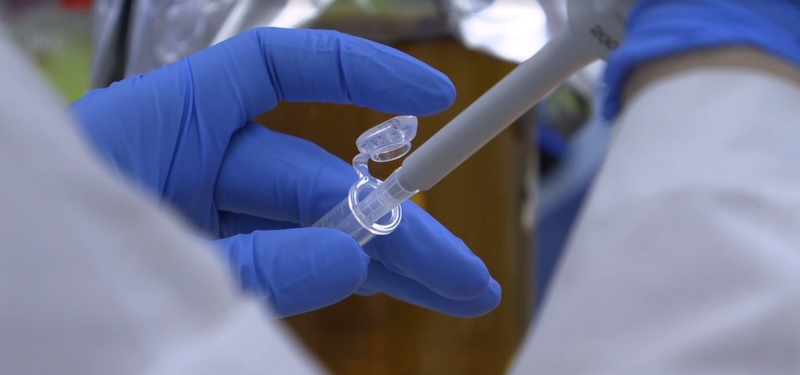
Russia’s vaccine uses two doses to deliver different harmless cold viruses, or adenoviruses, that have been engineered to carry into cells the gene for the spiky protein that studs the outside of the coronavirus.
The approach was inspired by the Ebola vaccines Gamaleya developed in 2015 and 2018. But while Putin boasted earlier this year that Russia’s Ebola vaccine “proved to be the most effective in the world,” the WHO still lists it as a “candidate vaccine” on its website.
Adenoviruses are also being used by scientists at the pharmaceutical giant Johnson & Johnson, the Chinese company CanSino Biologics and the University of Oxford in their vaccine candidates.
But those other efforts have published data on how vaccines perform in animals that range from mice to monkeys, and also presented data from early human trials showing the severity of any reactions, ranging from soreness at the injection site to fevers.
The CanSino vaccine uses one of the same harmless viruses the Russians are using in its vaccine, and its results have been disappointing to some scientists.
Dmitriev said his personal confidence in Russia’s vaccine was so high that he, his wife and his parents, both over the age of 70, were test subjects. He said just his wife reported a mild fever the first night of the injection.
“It’s not some crazy Russians using some crazy not proven stuff,” Dmitriev said. “Adenovirus existed with humans for thousands of years, and we made a bet on this proven platform because we understand that it takes very little time to develop, given the challenges.”
By The Washington Post · Eli Rosenberg · NATIONAL, BUSINESS, HEALTH, HEALTH-NEWS
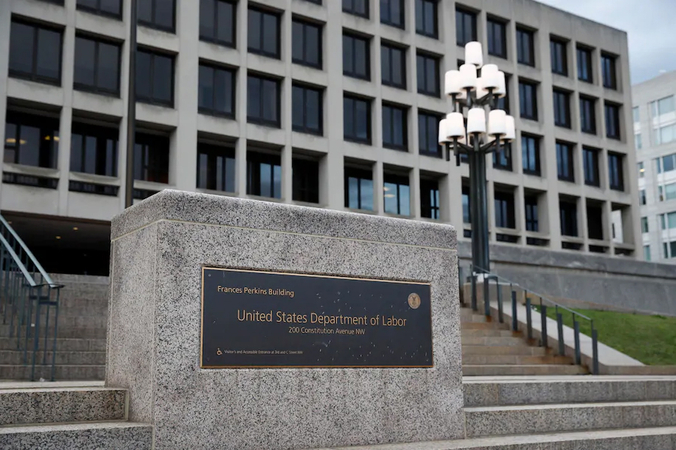
WASHINGTON – A government watchdog said in a new report out Tuesday that the Labor Department “significantly broadened” an exemption allowing millions of health-care workers to be exempted from paid sick leave as part of the law Congress passed in March to help workers during the coronavirus pandemic.
Congress passed the Families First Coronavirus Response Act back in March to ensure workers at small and medium sized companies were able to take paid leave if they or a family member became sick with coronavirus. The law exempts health-care providers as well as companies with more than 500 employees.
But an Office of the Inspector General report noted that a move by the Labor Department to more broadly expand how they categorize health care providers ended up leaving far more workers without a guarantee of paid sick leave than the agency’s estimate of 9 million.
While existing federal statutes define health care workers as doctors, someone practicing medicine or providing health care services, the Labor Department’s exemption from paid sick leave included anyone employed at a doctor’s office, clinic, testing facility or hospital, including temporary sites. The report also found the agency also exempted companies that contract with clinics and hospitals, such as those that produce medical equipment or tests related to Covid-19, the OIG found.
The report also suggested that the Labor Department is not doing enough to enforce the paid-sick-leave provisions, as well as its existing laws on pay and overtime issues.
In an effort to be socially distant, the federal agency acknowledged it has been foregoing fact-finding, on-site investigations, where an investigator examines all aspects of whether an employer is complying with federal labor laws. Instead the agency has been using so-called conciliations, which are telephone-only reviews limited to looking into a single issue affecting one or a few employees, with no fact-finding.
Critics of the Labor Department more hands-off approach to the pandemic have seized on the report as another indication of the ways in which the Trump administration has abandoned its commitments to worker safety.
“The Inspector General’s report makes clear that the Department of Labor went out of its way to limit the number of workers who could take emergency paid leave,” Rep. Robert Scott, D-Va., the chairman of the House Education and Labor Committee, said in a statement. “This absence of meaningful enforcement of our nation’s basic workplace laws creates a major risk to workers who are already vulnerable to exploitation amid record unemployment.”
Before the pandemic, limited or full on-site investigations, a more robust way the agency looked into pay and overtime issues, made up about 53 percent of its inquiries. But since March 18, only 19 percent of those inquiries have been on-site investigations.
Actions taken to enforce the sick leave provisions in the Families First Coronavirus Response Act have skewed even further away from investigations: 85 percent have been resolved through conciliation.
The agency’s Wage and Hour Division responded to the OIG’s findings, noting that they were “developing and sharing models for conducting virtual investigations,” and they also pledged to maintain a backlog of delayed on-site investigations to be tackled when it was safer to conduct those reviews.
But critics suggest the pandemic alone is not sufficient excuse for the drop-off in investigations, some aspects of which could be done remotely.
“These numbers just look so different than the numbers that I’m used to seeing in terms of conciliations versus investigations,” said Sharon Block, a senior Obama administration labor department official. “It really does jump out. That 85 percent is just a really big number.”
The issue about expanding who gets to opt out of offering paid sick leave has been the subject of complaints, according to the OIG report, as well as a federal lawsuit filed by New York Attorney General Letitia James. That lawsuit argued that the Department of Labor overstepped its authority by defining health-care providers in such broad terms, saying it could be skewed to include workers like teaching assistants or librarians at universities, employees who work in food services or tech support at medical schools, and cashiers at hospital gift shops and cafeterias.
Federal Judge Paul Oetken, of New York’s Southern District, struck down Department of Labor’s definition, as well as three other provisions last week – but confusion remains about whether his ruling applies only to employers in New York.
In an internal response to the OIG report, that predates the New York ruling, the Labor Department said that it agreed with many of the OIG’s recommendations and that it would continue to use its definition of health-care providers until the resolution of the federal lawsuit.
The Department of Labor did not reply to requests for comment about whether it planned to contest the judge’s ruling, or the other findings in the report.
The Inspector General pointed to other ways that the Department is not doing enough to adjust to the challenges of the post-pandemic world.
The OIG report said that while the agency’s Wage and Hour Division referenced the coronavirus in an operating plan in late May, it pointed out that the division “focuses more on what the agency has already accomplished rather than thinking proactively and describing how it will continue to ensure FFCRA compliance while still maintaining enforcement coverage,” the report noted.
The DOL did not provide any goals about the enforcement nor provide any requirements for tracking and reporting the new violations created by the FFCRA.
“With the predicted surge of covid-19 cases nationwide in upcoming months as more Americans return to work and as a consequence, an anticipated increase in complaint call volume to WHD, it would be expedient of the agency to devise a detailed plan as to how it intends to address this issue,” the OIG noted.
The report is the latest to spotlight the Trump administration’s employer-friendly approach to worker safety and protections.
The Occupational Safety and Health Administration, the part of the Department of Labor which investigates and is charged with upholding worker safety, has been criticized by workers and advocates for failing to issue citations for worker safety issues during the pandemic in significant numbers. It had only issued four citations out of more than 7,900 coronavirus-related complains according to figures from July 21.
LivingAug 12. 2020A Howard University yearbook contains Kamala Harris’s photo. MUST CREDIT: Washington Post photo by Marvin Joseph
By The Washington Post · Valerie Strauss · NATIONAL, POLITICS, EDUCATION, RACE Kamala Harris, the California senator tapped by Joe Biden on Tuesday to join him on the Democratic presidential ticket, attended schools with majority-White populations from elementary school through high school. But when it came time to go to college, she was determined to have a different experience: She wanted to attend a Historically Black College or University (HBCU).
So in the early 1980s, she chose Howard University in Washington, at the time perceived as the most prestigious HBCU, once called the “Black Harvard.”
“When you’re at an HBCU,” Harris was quoted as saying in a 2019 Washington Post article, “and especially one with the size and with the history of Howard University – and also in the context of also being in D.C., which was known forever as being ‘Chocolate City’ – it just becomes about you understanding that there is a whole world of people who are like you. It’s not just about there are a few of us who may find each other.”
Now she is the first graduate of an HCBU tapped for a presidential ticket.
It was not necessarily an obvious choice for her. Her father, from Jamaica, was an economist at Stanford University, while her mother, from India, did graduate work as a cancer researcher at the University of California at Berkeley and later taught at McGill University in Canada.
The schools Harris attended from kindergarten until college had majority-White student populations – including Thousand Oaks Elementary School, which she attended as part of an experiment with school busing
After her parents divorced, she moved with her mother to Quebec for middle and high school, where her mother, who wanted her to learn to speak French, enrolled her in a middle school for French speakers, Notre-Dame-des-Neiges, or Our Lady of the Snows. She wrote in her recent memoir, “The Truths We Hold: An American Journey,” that she did not know much French when she got to the school: “I used to joke that I felt like a duck, because all day long at our new school I’d be saying, ‘Quoi? Quoi? Quoi?’ ”
She attended suburban Westmount High School – where until now Leonard Cohen was the most famous graduate – and finished in 1981.
When it was time to go to college, she wanted a different experience. At Howard, she majored in political science and economics – and became a social justice activist as soon as she got there. She spent many weekends protesting against apartheid in South Africa on the National Mall in Washington, and she took part in a 1983 sit-in at an administration building to protest the expulsion of the student newspaper’s editor.
Harris wrote in the memoir: “That was the beauty of Howard. Every signal told students that we could be anything – that we were young, gifted, and black, and we shouldn’t let anything get in the way of our success.”
After graduating from Howard in 1986, she moved back to California and attended the University of California’s Hastings College of the Law in San Francisco, and became a lawyer in 1990.
Here’s what The Post’s Robin Givhan wrote in 2019 about Harris’s choice of Howard:
“Kamala Harris wanted to go to a black school. That’s what black folks called Howard University in the early 1980s when Harris was a teenager considering her future.
“Harris, she would say later, was seeking an experience wholly different from what she had long known. She’d attended majority-white schools her entire life – from elementary school in Berkeley, Calif., to high school in Montreal. Her parents’ professional lives and their personal story were bound up in majority-white institutions. Her father, an economist from Jamaica, was teaching at Stanford University. Her mother, a cancer researcher from India, had done her graduate work at the University of California at Berkeley, where the couple had met and fallen in love. And Harris’s younger sister would eventually enroll at Stanford.
“Harris wanted to be surrounded by black students, black culture and black traditions at the crown jewel of historically black colleges and universities.”
 13 สิงหาคม 2563 – 13:55 น.


 13 สิงหาคม 2563 – 09:19 น.


 13 สิงหาคม 2563 – 00:00 น.


 12 สิงหาคม 2563 – 17:37 น.


 12 สิงหาคม 2563 – 13:00 น.


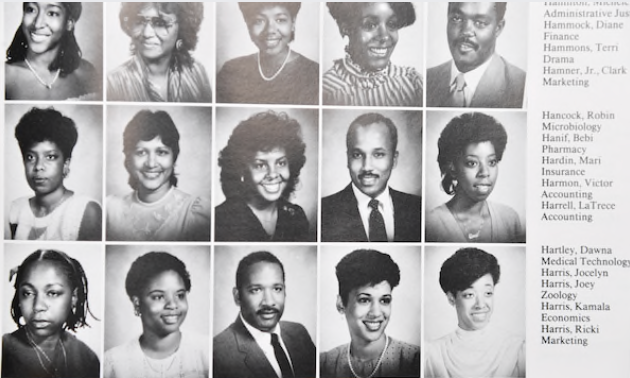 A Howard University yearbook contains Kamala Harris’s photo. MUST CREDIT: Washington Post photo by Marvin Joseph
 11 สิงหาคม 2563 – 18:13 น.


