วันที่ 25 มิ.ย. 2563 เวลา 11:30 น.เปิดแล้ว!! Nike Bangkok at Siam Center แฟล็กชิปสโตร์ใหม่ใหญ่ที่สุดในไทย ตื่นใจกับ Nike By You ให้ Customize ใส่ความเป็นคุณลงบนไอเท็มโปรด
โพสต์ทูเดย์ ชวนสัมผัสประสบการณ์ช้อปปิ้งเต็มรูปแบบ จุใจในแฟล็กชิปสโตร์ที่ใหญ่ที่สุดในประเทศไทย ภายใต้แบรนด์ Nike ที่ย่านใจกลางกรุงเทพฯ กับ Nike Bangkok at Siam Center แฟล็กชิปสโตร์ใหม่ที่มาในคอนเซ็ปต์ Innovative Sport จัดใหญ่ด้วยพื้นที่กว้างขวางกว่า 9,000 ตารางฟุต จัดเต็มกับสินค้า Nike พร้อมนวัตกรรมสุดล้ำทุกรูปแบบ หลากหลาย และครบครันมากที่สุดเท่าที่เคยมี
ตื่นตาตื่นใจไปกับบริการสุดเอ็กซ์คลูซีฟอย่าง Nike By You ครั้งแรกในประเทศไทยที่ให้ Customize ไอเท็มโปรดคู่กายแบบยูนีคไม่ซ้ำใคร เรียกได้ว่าใส่สไตล์ความเป็นตัวเราลงในผลิตภัณฑ์ของ Nike ที่อาจมีแค่หนึ่งเดียวในโลก
ใครไม่อยากเอ้าท์แนะนำให้ไปสัมผัสความล้ำสมัยในคอนเซ็ปต์ Innovative Sport แล้วเลือกช้อปจุใจแบบจัดเต็มกันได้แล้ววันนี้ ที่สยามเซ็นเตอร์ ชั้น G เปิดบริการทุกวัน เวลา 10:00-21:00 น. หรือรับชมข่าวสารจากไนกี้ประเทศไทยได้ทาง LINE OFFICIAL : @nikethailand
By The Washington Post · Derek Hawkins, Felicia Sonmez · NATIONAL, HEALTH
With coronavirus cases rising across the country and the U.S. death toll topping 137,000, President Donald Trump on Sunday dismissed concerns about the spike in infections, telling Fox News that “many of those cases shouldn’t even be cases.”
“Many of those cases are young people that would heal in a day,” the president told Fox News host Chris Wallace in an interview. “They have the sniffles and we put it down as a test.”
While young people make up an increasing share of new cases, the virus has affected people in all age groups. A surge of infections is driving deaths back up again after months of decline, and hospitals in hard-hit states such as Florida, Texas and Arizona are facing an influx of patients that health officials say could soon overwhelm medical systems. Nationwide, hospitalizations were on track to exceed their previous peak of roughly 60,000, reached in the pandemic’s early months.
Here are some other significant developments:
The Trump administration is trying to block billions of dollars for states to conduct testing and contact tracing in an upcoming coronavirus relief bill, people involved in the talks said Saturday. The administration is also trying to block billions that GOP senators want to allocate for the Centers for Disease Control and Prevention, the people said.
A growing number of Americans disapprove of Trump’s handling of the pandemic. Currently, 38 percent approve of his handling, and 60 percent disapprove, according to a new Post-ABC News poll.
A study from South Korea could bolster those who argue that reopening classrooms in much of the United States is too risky, suggesting that while children under 10 are less likely to spread the coronavirus, those between ages 10 and 19 will spread it similarly to adults.
Georgia’s presentation of its coronavirus data is again under scrutiny, with a viral tweet pointing out how the color-coding of a government map has evolved. At the beginning of the month, for instance, a county needed at least 5,959 coronavirus cases to be colored red in the state’s map of the outbreak. Now, a county needs at least 9,597 – with the result that no other county has newly joined the four that have been colored red since July 1, even as the state’s cases have jumped by more than 37 percent in that period.
Health authorities are seeking to conduct testing faster while conserving resources. The Food and Drug Administration on Saturday reissued an emergency use authorization to Quest Diagnostics for a coronavirus test to be used in pool testing, which involves combining samples from several people and testing them all at once.
Trump’s remarks came after another week of grim data highlighting the uncontrolled spread of the virus. Infections rose in states from every region of the country, with more than a dozen states on Saturday reaching record highs in their seven-day averages for new daily cases.
Georgia, Missouri, Wisconsin, North Carolina and Kentucky reported new single-day case records on Saturday, while states from Vermont to North Dakota to Oregon showed significant increases in their weekly averages, according to tracking by The Washington Post.
More than 20 states are reporting seven-day averages in coronavirus-related deaths that are higher than at the end of June, underscoring the turnaround since May and June, when deaths declined nationally – which Trump had touted as a sign of progress.
Rep. Donna Shalala, D-Fla., whose district encompasses parts of Miami with widespread infections, pushed back on the notion that the new cases were limited to young, healthy people and weren’t a cause for concern.
“It’s the working poor, it’s seniors, it’s now young people, and it’s totally out of control,” Shalala, a former health and human services secretary, said on ABC News’s “This Week.” “We need to close down again … That’s our worst nightmare, and we’re going to have to do that.”
In Sunday’s interview, Wallace noted that new cases had far outpaced increases in testing over the past month. He also confronted Trump about his incorrect and oft-repeated predictions that the virus would “disappear.”
“I will be right eventually,” Trump told the host. “You know I said, ‘It’s going to disappear.’ I’ll say it again.”
“Does that discredit you?” Wallace asked.
Trump said he didn’t think so. “It’s going to disappear, and I’ll be right,” he said.
The president’s dismissive attitude toward the coronavirus appears to be costing him public support as the 2020 presidential election draws closer. The approval rating for his handling of the pandemic has dropped 28 points since March as he has disregarded health experts and sowed confusion about the importance of public health measures, according to a new Post-ABC News poll. Thirty-eight percent of Americans currently approve of his handling of the pandemic, compared with 60 percent who disapprove.
The White House’s approach to the pandemic is also starting to put Trump at odds with fellow Republicans as Congress debates another round of coronavirus relief funding. The administration is seeking to block billions of dollars for states to conduct testing and contact tracing, along with billions of dollars that Republican lawmakers want to allocate for the Centers for Disease Control and Prevention. Officials speaking on the condition of anonymity to reveal confidential deliberations said the administration’s stance had angered some Republican senators, who were pushing to secure the funds.
The country’s already feeble coronavirus testing system is under increased strain from the wave of new infections, with labs in some places taking a week or more to provide results to patients. Health experts say such wait times render tests useless in efforts to control the spread of the virus.
“The national testing scene is a complete disgrace,” Colorado Gov. Jared Polis, a Democrat, told NBC News’s “Meet the Press” on Sunday, adding that tests sent to out-of-state private labs were taking as many as nine days to return results.
Once a test is delayed for more than 48 hours, it becomes “not very useful for clinical decision-making,” former Food and Drug Administration commissioner Scott Gottlieb said on CBS News’s “Face the Nation.”
“We’ve had plenty of time to get this right,” he said. “What we don’t have is excess capacity that we can surge into these epidemic cities.” Testing companies were falling behind not just in hotbeds such as California, Florida and Texas, he said, “but now they’re pulling testing out of other regions and you’re seeing delays there.”
With little leadership from the federal government, state and local officials were pressing forward with a patchwork of efforts to control their own outbreaks.
In Los Angeles, where cases have reached record levels, Mayor Eric Garcetti, a Democrat, warned that the city was “on the brink” of another stay-at-home order. He told CNN’s “State of the Union” that the city reopened too quickly and called for patience as businesses shuttered again. “We have to be as vigilant today as we were the first day,” he said.
A growing number of states have instituted mask requirements, with governors from both major parties urging people to stop politicizing the issue. “It shouldn’t be about politics,” Arkansas Gov. Asa Hutchinson, a Republican, who last week issued a statewide requirement for people to wear face masks in public, told ABC on Sunday. “It’s not popular, it’s not something that we want to do, it’s not the first lever we pull, but it is one that when the data says it’s necessary, we do it, and I think this is the right approach that we have to take.”
#ศาสตร์เกษตรดินปุ๋ย : ขอบคุณแหล่งข้อมูล : หนังสือพิมพ์ The Nation.
‘Superspreading’ events, triggered by people who may be asymptomatic, propel virus pandemic
Health & BeautyJul 19. 2020Health officials say a covid-19 cluster has left at least 186 people infected. Photo by: The Washington Post — The Washington Post
By The Washington Post · Ariana Eunjung Cha · NATIONAL, HEALTH
It wasn’t until Day 7 of her team’s coronavirus investigation when it dawned on Linda Vail, the health officer for Michigan’s Ingham County, that this was going to be a big one. It had started with just two infections at the college bar on June 18, not long after the state began reopening. But the numbers quickly jumped to 12, then 18, then 34.
As of Friday, she was staring at a spreadsheet with 187 infected at Harper’s Restaurant and Brew Pub.
“The tables were six feet apart, but no one stayed there,” she said. “The DJ was playing music so people were shouting, the dance floor started to get crowded. We had flattened the curve and then boom.”
Photo by: The Washington Post — The Washington Post File Size: 0.12 Mb
The East Lansing case is what’s known as a superspreading event – possibly the largest so far in the United States among the general public. Many scientists say such infection bursts – probably sparked by a single, highly infectious individual who may show no signs of illness and unwittingly share an enclosed space with many others – are driving the pandemic. They worry these cases, rather than routine transmission between one infected person and, say, two or three close contacts, are propelling case counts out of control.
More than 1,000 suspected clusters – ranging from the single digits to thousands – have been logged in a database compiled by a coder in the Netherlands. A megachurch in South Korea. A political rally in Madrid. An engagement party in Rio de Janeiro. Nearly all took place indoors, or in indoor-outdoor spaces.
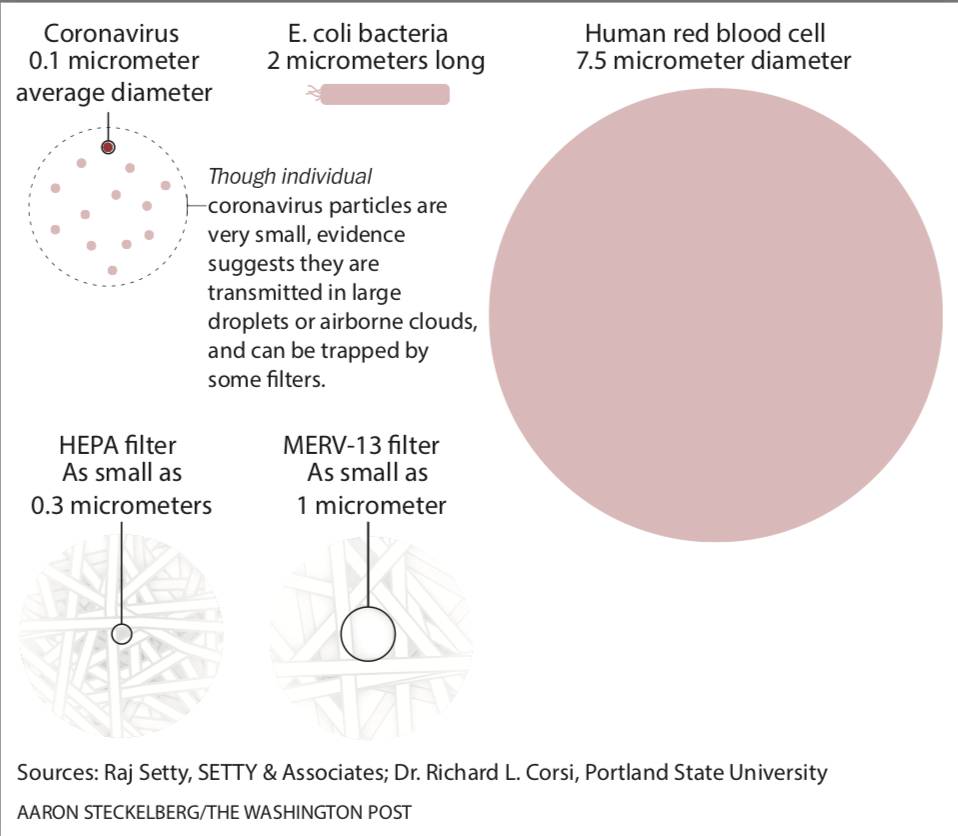
Virus sizes compared Photo by: The Washington Post — The Washington Post
Even as the Trump administration pressures schools to reopen this fall, the latest research suggests that understanding how and why these events occur – and how to prevent them – is key to reopening safely. In recent days, governors from at least 18 states, including Michigan, have backtracked on plans to loosen restrictions due to outbreaks.
But even those efforts may fail if people ignore the most common ways the virus is considered to spread. Transmission, it turns out, is far more idiosyncratic than previously understood. Scientists say they believe it is dependent on such factors as an individual’s infectivity, which can vary person to person by billions of virus particles, whether the particles are contained in large droplets that fall to the ground or in fine vapor that can float much further, and how much the air in a particular space circulates.
Donald Milton, a professor of environmental health at the University of Maryland, and other experts have wondered if superspreading events could be the “Achilles’ heel” of the virus. If we could pinpoint the conditions under which these clusters occur, Milton argued, we could lower the transmission rate enough to extinguish the spread.
“If you could stop these events, you could stop the pandemic,” Milton said. “You would crush the curve.”
One key factor in such events may be airborne transmission – an idea gaining new adherents but that has not been proved conclusively. The World Health Organization has described most infections as occurring from close face-to-face contact involving large, virus-laced respiratory droplets that drop to the ground within a few feet of the person expelling them due to gravity. But this month, a group of prominent scientists made the case that superspreading clusters suggest the virus is sometimes being transmitted over longer distances through the air in far smaller and more numerous particles.
The coronavirus does not appear to be airborne in the same way as measles or tuberculosis, which have much higher rates of transmission. But the proponents of airborne transmission say it appears the virus could act similarly in some environments – a theory with major implications for the reopening of businesses and schools, as well as for nursing homes and residences dependent on ventilation systems that recirculate air.
Jose-Luis Jimenez, a researcher at the University of Colorado Boulder, was one of 239 scientists who penned an open letter to the WHO, calling for greater recognition of the role that clouds of fine aerosols containing the virus may play in its spread, prompting the agency last week to acknowledge “emerging evidence” of airborne transmission.
“It is becoming clear that the pandemic is driven by superspreading events, and that the best explanation for many of those events is aerosol transmission.” Jimenez said.
As we enter the seventh month of the global pandemic, scientists are still frustratingly in the dark when it comes to key aspects of how the virus is transmitted.
Why, for instance, didn’t the earliest infections in the United States, or the infamous Lake of the Ozarks party, spur lots of cases, while a much smaller gathering at a Michigan bar produced nearly 200? Why out of countless large gatherings held – church services, soccer games, choir rehearsals, and Zumba classes – did only a fraction ignite significant infections?
Part of the uneven spread of the coronavirus – and the phenomenon of superspreading – can be explained by extreme individual variation in infectivity, researchers say.
Some people will not transmit the virus to anyone, contact tracing has shown, while others appear to spread the virus with great efficiency. Overall, researchers have estimated in recent studies that some 10% to 20% of the infected may be responsible for 80% of all cases.
Scientists are only starting to understand the different factors – physiological, behavioral, environmental – that play a role in amplifying transmission.
An infected person’s viral load can impact how much they “shed”; the differences have been shown to be on a scale of billions of virus particles. A recluse is less likely to spread the virus than a social butterfly. And being outdoors with masks, as we’ve been told countless times, is less likely to lead to spread than being indoors.
When many U.S. states imposed stay-at-home orders in mid-March, epidemiologists stressed the importance of the R0. Known as the basic reproduction number and pronounced “r-naught” (a Britishism for the number zero), it is a measure of how many people on average a single individual infects. In measles, that number is very high – somewhere between 12 to 18. In Ebola, it’s about 1.5.
For the novel coronavirus, it’s thought to be somewhere in between, around two to three. But researchers say that number obscures what is really happening on the ground.
A growing body of evidence suggests that SARS-CoV2, like other coronaviruses, expands in a community in fits and starts, rather than more evenly over space and time. Adam Kucharski of the London School of Hygiene and Tropical Medicine has estimated that the value of what’s known as the k-parameter – a measure of how much a virus tends to cluster – indicates that just 10% of people may be responsible for 80% of novel coronavirus cases.
Real world data corroborates the skewed transmission pattern.
In a detailed analysis of outbreaks in Hong Kong, for example, researchers found three distinct groups of incidents. The superspreading individuals, representing 20% of the total, were responsible for 80% of transmissions. A second group, involving about 10% of cases, transmitted the virus to one or two others. The final group, 70%, did not infect anyone else at all.
In Israel, investigators looking at 212 cases concluded that they could be linked back to 1% to 10% of people. And in an outbreak in a South Korea office tower, investigators found that about 45% of 216 workers got the virus from a single person. In the United States, an analysis from five counties in Georgia found that superspreading appeared to be “widespread across space and time,” and that 2% of the infected seeded 20% of the cases.
Most of these events took place in coronavirus hot spots of which most people are now aware: buildings where people live in close quarters, such as nursing homes, prisons, worker dormitories and cruise ships. There have been a fair number of clusters at meat-processing and frozen food factories, as well as at a curling event in Edmonton, Canada, leading some to speculate that temperatures could be a factor.
“It is possible that the cold atmosphere in this setting has facilitated the spread of the virus,” Gwenan Knight and others at the London School of Hygiene and Tropical Medicine wrote in an analysis of 201 events that was published in Wellcome Open Research.
The rest of the known superspreading events were set in a hodgepodge of social venues where people gather in crowds: concerts, sports games, weddings, funerals, churches, political rallies, restaurants, shopping centers. And nearly all took place indoors, or in venues with indoor-outdoor spaces.
Stanford researcher Morgan Kain, who focuses on mathematical modeling of disease transmission, said his analysis shows that regions that have not been greatly affected by the pandemic are most vulnerable because almost everyone would theoretically be susceptible to infection and a single unlucky confluence of an infectious person in the right environment could very quickly set off a chain reaction of transmissions. Kain and others argue that out-of-the-box ideas are needed to combat such spread.
“That’s why it’s particularly dangerous in the United States that places that don’t have cases are opening up, going back to indoor restaurants, bars, gyms where infected people move about,” he said.
One proposal, from a Moscow State University professor, calls for shifting testing resources from the general public to efforts to identify potential “super emitters” with high viral loads by using randomized testing. Other proposals focus on limiting people’s more random interactions, such as on public transit, or at bars and restaurants, while loosening restrictions on their regular contacts, such as through work or school. This would still pose some risk but would theoretically help contain it to certain social “bubbles.”
Scientists are also looking to technology to help prevent superspreading events. Several teams in far-flung parts of the world are trying to build breathalyzers or special paper that can detect active virus. Numerous governments and companies are experimenting with ultraviolet lights hooked up to ventilation systems to try to kill the virus as it passes through air conditioning and heating systems.
Yuguo Li, a professor at the University of Hong Kong who studies infection control and air, steers clear of the space between two tall buildings where there’s no wind. He prefers to take his walks by the sea. And he avoids city buses.
After spending several months scrutinizing some of the most famous superspreading cases involving the coronavirus, Li is convinced virus transmitted through the air played a role in many of them.
In a case involving a restaurant in the Chinese city of Guangzhou where families from three adjacent tables were infected, for example, he describes how air currents near people flow in an upward plume, lifted by the warmth of the human body. He suspects the particles went into the air conditioning, which blew them toward those tables. None of the other diners or wait staff were affected.
He believes ventilation may also be to blame for a case involving a young man from China’s Hunan province, who sat in the back of a bus but ended up infecting seven others in various areas of the vehicle and then two more on a second minibus he hopped onto next. Li interviewed the patient, driver, passengers and reviewed video footage and found it odd that few of those who became infected were nearby. In fact, at least one passenger who fell ill was as far away as possible at the front of the bus – 31 feet away – from the coronavirus-positive man.
Similar inferences have been made about the outbreak at the Skagit Valley Chorale in Washington state, where 52 of the 61 singers who attended a 2½-hour practice became ill. The U.S. Centers for Disease Control and Prevention wrote that the act of singing may have “contributed to transmission through emission of aerosols, which is affected by loudness of vocalization.”
In addition, the researchers wrote, that “super-emitters, who release more aerosol particles during speech than do their peers, might have contributed to this and previously reported covid-19 superspreading events.”
William Nazaroff, an environmental engineer from the University of California at Berkeley, explained that when people are indoors, they are literally breathing the same air as everyone else in the room. If the virus can be airborne, which he believes it can, then he said we need to consider whether every building that’s open should modify its ventilation systems to be able to filter out more virus or use ultraviolet lights to kill it.
“It has to do with the plume of what is emitted and the extent it can infringe on your breathing zone,” Nazaroff said.
While it’s often impossible to identify the person who triggered an outbreak, there have been some commonalities among those who have been pinpointed as the likely source in studies. They tend to be young. Asymptomatic. Social.
Scientists suspect these “super-emitters” may have much higher levels of the virus in their bodies than others, or may release them by talking, shouting or singing in a different way from most people. Research based on the flu, which involved college students blowing into a tube, showed that a small percentage tended to emit smaller particles known as aerosols more than others. These particles tend to hang or float, and move with the flow of air – and therefore can go much farther and last longer than larger droplets.
In a study published in Emerging Infectious Diseases by Japan’s Hitoshi Oshitani at Tohoku University of 22 superspreading individuals with the coronavirus, about half were under the age of 40, and 41% were experiencing no symptoms.
Julian Tang, a virologist at University Hospitals of Leicester in Britain, emphasized that whether someone triggers an outbreak often comes down to happenstance. Unlike some other viruses that may be contagious for a lifetime or months, the coronavirus has a very short window of infectivity – at most, four to nine days – according to multiple studies.
Tang said studies of other diseases have shown the asymptomatic can sometimes shed more virus for longer periods, although whether this applies to the coronavirus is unknown.
“Normally if you get very sick, you clear the virus quickly,” he explained. “Ironically, if you are quite mildly ill, or not ill at all, your immune system might tolerate it more and you will shed longer with higher viral loads.”
He said Typhoid Mary, the asymptomatic cook who was a superspreader of Salmonella typhi, was known to have a quirk in her immune system that did not allow her to clear the bacteria as well as others, so it was still present and more readily transmissible.
In the case of the Hunan man who transmitted the virus while riding two buses, Li said that “amazingly” after that four-hour window of infectivity, he is not known to have infected anyone else at all.
“Like autumn leaves suddenly all falling off,” he said.
In the case of Ingham County, where the superspreading event occurred at the college bar, the surrounding community of about 280,000 had mostly experienced slow transmission throughout the pandemic. But even after the owners of Harper’s Restaurant and Brew Pub in East Lansing closed June 20 after the outbreak – and after Michigan Democratic Gov. Gretchen Whitmer shut indoor bar service throughout most of the state July 1 – the outbreak continued to spread.
Of the 187 total cases traced back to Harper’s Restaurant as of Friday, 144 were among people who had been at the venue. The other 43 were their family members, friends, co-workers and other contacts. The infected spanned hundreds of miles and 16 counties.
Investigators were told there were 225 customers on two floors with a normal capacity of 950. The air conditioning was on, and some people were out on a deck. There was a line outside of people waiting to be let in.
Harper’s did not respond to request for comment but said in a Facebook post that it is working to modify its heating and air conditioning system with air purifying technology.
Health officials have yet to find the first patient but are focusing on a few possibilities. Vail said it may be impossible to find the original source given that about a third of the initial cases were asymptomatic, as were 19% of people who caught it from those at the bar.
“It’s just crazy,” she said of how quickly infections climbed.
While the numbers have continued increasing for more than three weeks, Vail takes comfort in the fact that most people they have reached are providing lists of their contacts, and that new cases appear to be slowing down.
“I guess I might have thought that was going to go higher,” she said, “which tells me that at least people paid attention when we told them to quarantine.”

 เภสัชกรชี้ “วิตามิน” ไม่ใช่ “ยา” ความคล้ายที่ทำให้หลายคนเข้าใจผิด พร้อมแนะใช้ให้ถูกวิธีเพื่อสุขภาพที่ดีและปลอดภัย


 เปิดแล้ว!! Nike Bangkok at Siam Center แฟล็กชิปสโตร์ใหม่ใหญ่ที่สุดในไทย ตื่นใจกับ Nike By You ให้ Customize ใส่ความเป็นคุณลงบนไอเท็มโปรด


 คนทำงานต้องรู้!! กูรูด้านที่ปรึกษาด้านประชาสัมพันธ์ เผย “ทำเรื่องยาก ให้เป็นเรื่องง่าย” หัวใจของงานพีอาร์ยุค New Normal
 20 กรกฎาคม 2563 – 10:47 น.


 20 กรกฎาคม 2563 – 09:08 น.


 19 กรกฎาคม 2563 – 19:47 น.


 President Trump /File photo
 Health officials say a covid-19 cluster has left at least 186 people infected. Photo by: The Washington Post — The Washington Post