Idea of vaccine unites skeptics in Germany #ศาสตร์เกษตรดินปุ๋ย

#ศาสตร์เกษตรดินปุ๋ย : ขอบคุณแหล่งข้อมูล : หนังสือพิมพ์ The Nation.

Idea of vaccine unites skeptics in Germany

Health & Beauty

Jul 04. 2020

By The Washington Post · Loveday Morris, William Glucroft · WORLD, EUROPE 

STUTTGART, Germany – While much of the world is aching for a coronavirus vaccine, Lilia Löffler is adamant that her three children won’t be getting any jabs.

Shrugging off light rain to join a two-hour bike protest shutdown restrictions, Löffler said that previously she vaccinated all her kids. But she changed her mind after what she’s been hearing at demonstrations and reading on the Internet during the pandemic. She noted that her 6-year-old son is supposed to get a shot for measles ahead of school in the fall.

“But he won’t get that,” she said. Or any other vaccination.

The possibility that Germany’s anti-vaccination movement may gain new adherents like Löffler has been a concern for health authorities, as the coronavirus unites a mishmash of groups resistant to the prospect of a vaccine, from far-right conspiracy theorists to hippie moms. 

Germany already had a fervent anti-vaxx movement, reflecting a historic skepticism of government control and an affinity for alternative medicine. Now, health experts have warned that even if a coronavirus vaccine gets approval, refusals could open the way to a resurgence while threatening efforts to keep other preventable diseases in check. 

“With such a bad pandemic, there were people that said it would make anti-vaxxers wake up and see that vaccines are important,” said Heidi Larson, director of the London-based Vaccine Confidence Project. “But it’s actually done the opposite.” 

Anti-vaxx groups have become highly “active and aggressive,” she said. “I think we are in a vulnerable spot right now.”

In Germany, conspiracy theories over a vaccine abound. Attila Hildmann, a vegan chef, has become one of the leading voices of the resistance, accusing the health minister of promoting a surveillance state and forced-vaccination program at the behest of Bill Gates. 

Amid the fervor, the German government has assured the public that any coronavirus vaccine would be voluntary. “The government is accused of secretly plotting to introduce mandatory vaccination,” representative Ulrike Demmer said. “There will be no obligatory vaccination against the coronavirus.”

That’s different from the approach Germany has taken with measles. To address what health officials warned was one of the worst efforts to combat measles in Europe, Germany last year made the measles vaccine mandatory for children entering preschools or kindergarten. Parents who do not follow the rules face fines of 2,500 euros, about $2,800. 

Isolde Piechotowski is an infectious-disease expert with the health ministry in Baden-Württemberg, a southwest German state known for a particularly strong anti-vaxx community. She said her office was inundated with calls and emails after the measles announcement. Since the coronavirus pandemic began, there has been another deluge. 

“The messages from these people – they suppose that there will be a mandatory vaccination. That’s the contents of a lot of emails and letters right now,” she said. “They are trying to influence those decisions, even though there is no such decision to be made right now.” 

Surveys of Germany conducted by the University of Erfurt found that in late June, 64 percent of respondents said they would be willing to get a hypothetical coronavirus vaccine – down from 79 percent in mid-April. The notion of mandatory vaccination was rejected by 38 percent of respondents.

“Even with a perfectly functioning vaccine, this might not be enough for herd immunity,” said lead researcher Cornelia Betsch.

That echoes a warning for the United States by Anthony S. Fauci, the government’s top infectious-disease specialist. On Sunday, Fauci told CNN that while he’d “settle” for a vaccine that is 70 to 75 percent effective, if a third of Americans are reluctant to get vaccinated, as some opinion polls suggest, achieving herd immunity would be “unlikely.”

Germany’s vaccination rates for childhood diseases appear to be somewhat higher than those for the United States, according to comparative data compiled by the OECD. But Germany’s reported figures may overstate vaccination rates – and underestimate anti-vaxx sentiment.

German health insurer Barmer calculated that, based on its patient databases, 89 percent of 6-year-olds were adequately immunized against measles in 2017, before the measles mandate. That’s far lower than Germany’s reported measles vaccination rate of 97 percent for that year and falls short of the 95 percent target for population herd immunity.

The Robert Koch Institute (RKI), Germany’s federal agency for disease control, acknowledges that its official data reflects only what families indicate on vaccination cards at school entry and excludes those who don’t present a card. Assuming all those without cards are not fully vaccinated would mean a “worst case” rate of 81 percent, health officials said. 

RKI says its data from a wider range of health insurance companies estimates full measles coverage at 93 percent at school age – still below the 95 percent target. Health authorities single out late vaccinations as a particular problem, with only 74 percent of children receiving their second measles dose in the recommended time period. 

One of the hubs of Germany’s anti-vaxx movement is Baden-Württemberg, a wealthy region bordering France and Switzerland and home to auto giants Daimler and Porsche. During the peak of Germany’s anti-shutdown protests in May, the largest crowds congregated in the regional capital of Stuttgart. More than 5,000 people marched through the streets, bolstered by a contingent of anti-vaxxers.

Those tracking growing resistance to a hypothetical vaccine say people may feel a vaccine has become less urgent since Germany managed to flatten its coronavirus curve.

But vaccine attitudes in Germany are complicated by the country’s political history, with the Third Reich leaving behind a legacy of unease over government mandates.

Resistance is also tied up with the country’s alternative and holistic medicine traditions. Samuel Hahnemann, the father of homeopathy – whose statue sits on Washington’s Scott Circle – was a German from the eastern state of Saxony. And it was in Stuttgart that Rudolf Steiner, an Austrian who devised anthroposophical medicine, opened his first Waldorf School 100 years ago.

While the Waldorf institution has distanced itself from anti-vaxxers, the Steiner philosophy is rooted in free will and independence of thought, and some of his followers are vaccine skeptics. In Baden-Württemberg, infectious-disease specialist Piechotowski said, low vaccination rates can be attributed, in part, to “quite a high number of people who are following the anthroposophic philosophy.”

“It’s become very common, in the past 20 years, to think that typical child illnesses are good for healthy development,” said Natalie Grams, formerly a practicing homeopathic doctor who now speaks out against what she sees as pseudoscience. “People are trying to avoid early vaccinations, and this comes from homeopathic and anthroposophic thinking, very much. There’s a common thought that early vaccinations harm little babies.” 

Grams said she is concerned how the movement appears to have expanded in just the past few months.

“The movement is getting far more political influence,” she said. It’s no longer just 2 to 4 percent of the population against vaccines, she added. “It’s far more people. The situation is much more intense than if it was just the anti-vaxx movement spreading disinformation about a coronavirus vaccine.” 

The government needs to build support for a coronavirus vaccine even before one exists, she added, so people wary of a hastily developed medical intervention don’t turn to conspiracy theorists or hardcore anti-vaxxers to fill the knowledge gap. 

In an interview at Steiner House, Christoph Hueck, a Waldorf educator who has spoken at anti-shutdown demonstrations, said he sees a chance to get his message out and doesn’t mind who is in the audience as long as he speaks his “truth.”

“The only thing is to make my point of view as clear as possible,” he said. “As spread out as possible. I don’t feel like I’m a conspiracy theorist.” 

But his talking points touch on conspiracy theories involving Bill Gates, the World Health Organization and vaccine tattoos. The risk of the coronavirus is overblown, he said. He said he hopes people will start to demonstrate and take off their masks. 

He said he’s not anti-vaccine but against compulsory vaccination. 

“You cannot send your kid to school anymore unless they are vaccinated,” he said. “The state wants to control its citizens. This is the dictatorship of health, which sets itself above the value of freedom.” 

Nadine Schmid, 37, who runs a “natural medicine” practice just outside Stuttgart, said she thought carefully about vaccines for her 3- and 7-year-old. The eldest has had a measles shot, the youngest only tetanus. 

She said there has been tense discussion in her community since the measles vaccine became mandatory. “Corona has accelerated that debate,” she said. For a vaccine, everyone should be able to choose, she said, but it’s “not for me or my children.”
Hospitalization rise is cause for concern #ศาสตร์เกษตรดินปุ๋ย

#ศาสตร์เกษตรดินปุ๋ย : ขอบคุณแหล่งข้อมูล : หนังสือพิมพ์ The Nation.

Hospitalization rise is cause for concern

Health & Beauty

Jul 03. 2020

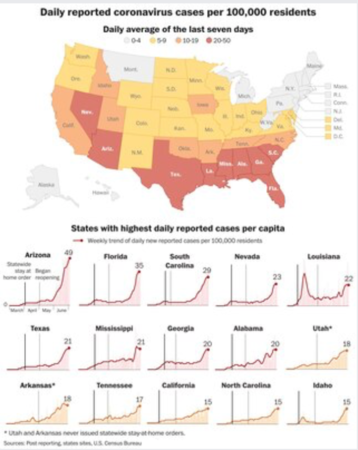
Coronavirus cases in United States

Coronavirus cases in United States

By The Washington Post · Anne Gearan, William Wan, Jacqueline Dupree · NATIONAL, WORLD, HEALTH, SCIENCE-ENVIRONMENT 

Patients suffering from covid-19 are rapidly filling hospitals across the South and West, with Mississippi, Tennessee, Texas, Nevada and Arizona setting records for hospitalizations Thursday, a sign that the coronavirus pandemic is entering a dangerous new phase. 

In Arizona, where the virus appears to be spreading out of control, hospitals rushed to expand capacity and adopted practices similar to those employed at the height of the outbreak in New York City and Italy, including doubling up hospital beds in rooms, pausing elective surgeries and bringing in health-care workers from other states.

Perhaps most chillingly, at the urging of doctors and advisers, state officials this week activated “crisis standards of care” protocols, which determine for hospitals which patients get ventilators and care as the system becomes overwhelmed under the crush of patients.

“I think it’s pretty obvious that we are not going in the right direction,” Anthony Fauci, the country’s top infectious-disease expert, said during a YouTube live stream.

The coronavirus continued its recent surge across swaths of the United States, with more than 55,000 new cases reported Thursday, eclipsing the record for the largest single-day total that was set on Wednesday. 

Deaths, which had declined steadily for several months, also are rising. States reported that 700 people died Thursday of covid-19 – an increase of more than 25 percent compared to the previous seven-day average. 

“We are not flattening the curve right now,” Brett Giroir, the U.S. government’s coronavirus testing coordinator, said during a House hearing. “The curve is still going up.”

Not all states report on the number of current covid-19 hospitalizations, but even with incomplete data the increases are alarming, since they may presage a rise in deaths following the documented explosion in cases in the South and West and increases in scattered states elsewhere.

“There’s a lag between confirmed case and hospitalization, and between hospitalization and death. So you look at the numbers and you can see how hospital capacity could quickly become strained in coming weeks,” said Saskia Popescu, an epidemiologist at University of Arizona.

As hospitals have become overwhelmed, deaths have risen – not just among covid patients who get insufficient care, but among those facing other medical crises who don’t seek care from an overwhelmed system because they think they won’t receive it.

The Centers for Disease Control and Prevention estimated that since Feb. 1, about 20,000 to 49,000 more people have died of all non-covid-19 causes than would have been expected. 

The fear is the same will soon happen in states such as Arizona, Texas and Florida as their health-care systems are strained to capacity.

In Arizona, if hospitalizations push past capacity, patients will be given a score based on life expectancy and underlying conditions.

“You look at what happened in Lombardy, Italy. What happened in New York. That’s what is about to happen here. People are going to die because our system is overwhelmed,” said Will Humble, who was director of Arizona Department of Health Services for six years under its previous Republican governor. “It’s important for other states to learn from us. This wasn’t bad luck. It was avoidable. Don’t let this happen to you. You look back at the past few months and we’re an example of what not to do.”

In a pair of public appearances at the White House on Thursday, President Donald Trump downplayed the danger, saying: “We have some areas where we’re putting out the flames or the fires, and that’s working out well.”

Trump also hailed a stronger than expected jobs report Thursday, and promised a robust economic rebound in the third quarter, even though numerous states are moving to slow the reopening of their economies or shut down bars and other businesses in a desperate attempt to bring the outbreak under control.

“Today’s announcement proves that our economy is roaring back. It’s coming back extremely strong,” Trump said during a news conference in the White House press room, after receiving word that the U.S. economy added 4.8 million new jobs in June.

The new jobs sent the June unemployment rate down to 11.1 percent, from a high of 14.7 percent at the height of the coronavirus lockdown in April. But new data also released by the Labor Department showed that 1.4 million people filed unemployment claims for the first time last week, marking the 15th straight week of claims that exceeded 1 million.

With new infections surging, economists are growing increasingly concerned that temporary layoffs are turning into permanent job losses. Earlier this week, Federal Reserve Chair Jerome Powell warned Congress that unless the virus is brought under control, the nation’s economic outlook is “extraordinarily uncertain.”

Florida on Thursday reported 10,109 new cases, marking a new single-day record for the state. There were 68 new deaths, for a total of 3,718.

Thursday marked the 25th consecutive day that Florida has set a record high in its seven-day rolling average, and Gov. Ron DeSantis, a Republican, said Thursday that perhaps Floridians had been a bit too lax in recent weeks. 

“I think the end of May, beginning of June, coronavirus kind of fell off the headlines a little bit and people said, ‘Hey, it seems good.’ And I think that some of the behaviors that have been preached, I think some of that eroded a little bit,” DeSantis said.

Hosting Vice President Mike Pence in Tampa for an emergency visit to discuss the pandemic, DeSantis did not, however, second-guess his own decisions to lift stay-at-home restrictions beginning in May. 

Pence endorsed Florida’s moves to reimpose some restrictions and urged caution over the July 4 holiday weekend. It was a similar message to one he had delivered Wednesday in Arizona as part of a public show of support for hard-hit states.

Asked whether he would advise older or potentially vulnerable Republicans to skip the planned Republican National Convention next month in Jacksonville, Fla., Pence avoided a direct answer.

“We’re excited about coming to Jacksonville,” he said, adding that Florida and the rest of the country are well-equipped to handle the current rise in cases.

“No one wants to see these numbers where they are or no one wants to see them go up,” Pence said.

Texas Gov. Greg Abbott, a Republican, reversed course Thursday and ordered masks be worn in public. The order applies in counties with 20 or more positive covid-19 cases. “Wearing a face covering in public is proven to be one of the most effective ways we have to slow the spread of COVID-19,” Abbott said in a news release.

In Texas, the number of hospitalizations was 60 percent higher this week over last week.

Fauci attributed rising case numbers in the United States at least partially to American lockdown measures being more lenient than those in some European countries.

“If you look at the different curves between the European Union, the U.K. and others, how they’ve handled the outbreak, they’ve had big spikes and then they’ve brought it down almost or even to baseline in some countries,” Fauci said in an interview the BBC released Thursday. “The situation in the United States has been more problematic.”

Fauci said while some countries in Europe locked down around 97 percent of activity to control the virus, even the strictest U.S. lockdowns only shut down about 50 percent.

“That allowed the perpetuation of the outbreak that we never did get under very good control,” he said. The United States has been hit worse than any other country in terms of case numbers and deaths, he noted.

In few places is that more evident than in Arizona, where bars were packed before some restrictions went back into effect and where Trump held a crowded indoor political rally last week where very few people wore protective masks.

After insisting for weeks that hospitals had adequate capacity, Arizona Gov. Doug Ducey, a Republican, said for the first time last week that hospitals could reach surge capacity “very soon.” 

Banner Health – the largest health-care delivery system in Arizona with 17 hospitals across the state – said Thursday they are exploring “all options” to increase beds, including repurposing pediatric beds, using spaces in their hospitals not usually used for care.

Other hospital systems said they are enacting similar surge plans. And state leaders are now preparing to reopen a shuttered Phoenix hospital – St. Luke’s Medical Center – as a field hospital.

“We would like to continue to remind the community that we cannot fight this virus alone,” said Banner Health spokeswoman Becky Armendariz, who pleaded for residents to avoid gatherings, wash hands and wear masks.

For months, missteps marred Arizona’s response, experts say. Health officials abruptly cut off data access from a university modeling team when its projections showed a rising caseload. Even as the state moved aggressively to reopen businesses, few restrictions were put in place and almost none enforced.

Until recent days, cities and counties were forbidden from passing local ordinances requiring masks.

“It was clear to anyone with any observational skills that this was coming,” said Humble, the former Arizona health official. “You think back to Memorial Day, when bars and night clubs were filled at capacity with zero mitigation. Clearly the voluntary, honor system approach to mitigation was not working.”

Administration makes it easier for drugmakers to profit from publicly funded coronavirus drugs, critics say #ศาสตร์เกษตรดินปุ๋ย

#ศาสตร์เกษตรดินปุ๋ย : ขอบคุณแหล่งข้อมูล : หนังสือพิมพ์ The Nation.

Administration makes it easier for drugmakers to profit from publicly funded coronavirus drugs, critics say

Health & Beauty

Jul 02. 2020

By The Washington Post · Christopher Rowland · NATIONAL, BUSINESS, HEALTH

WASHINGTON – The Trump administration is weakening taxpayer safeguards in its agreements with companies working on novel-coronavirus drugs, which could prevent regulators from curbing prices for future vaccines and treatment, a consumer group said Wednesday.

In its race to control covid-19, the disease the virus causes, the federal government is spending billions in agreements with pharmaceutical companies to subsidize development of medicines.

At the same time, it is employing a looser standard of federal contracting – called “other transaction authority” – that avoids some contracting rules that protect taxpayer investments, said Knowledge Ecology International, a consumer advocacy organization that obtained copies of government agreements with industry under a Freedom of Information Act request.

“The amount of money the government is throwing at companies is unprecedented,” said James Love, KEI’s director. “Normally when you write bigger checks you should have more leverage, not less leverage.”

Unlike many other countries, the United States does not control prices of drugs invented or developed with taxpayer dollars. A potential exception is contained in a 40-year-old law called Bayh-Dole. The law grants government power to license a generic competitor if a company is not making a taxpayer-funded drug available to the public on “reasonable” terms.

The government has never exercised the authority, called “march-in rights,” and the limits of the power are disputed. But consumer advocates said they believe the mere threat can serve as a check on drug prices, especially in an emergency like the current pandemic.

KEI said march-in rights appear to be weakened in the “other transaction authority” agreements it reviewed between the Biomedical Advanced Research and Development Authority (BARDA) and drug companies Johnson & Johnson, Roche and Regeneron.

“The government has limited its ability to intervene if the pharmaceutical companies . . . charge unreasonable prices for the resulting covid-19 vaccines or treatments,” KEI said in its news release Wednesday.

The companies did not respond to requests for comment.

BARDA is part of the Department of Health and Human Services. The department responded in an emailed statement that its flexible contracting approach has allowed BARDA to quickly shift gears toward the most promising coronavirus countermeasures.

“Agreements under other transaction authority save time and tax dollars by providing flexibility that is not available in typical federal contracts to purchase material,” the department said. The HHS “has been able to enter into partnerships with companies to access entire portfolios of potential products and technologies in the company’s development pipeline. If the science on one potential product doesn’t work out or a new threat emerges, the work can shift quickly to develop a different product candidate in the portfolio to meet the nation’s health security needs.”

The statement continued, “HHS always seeks best value to the taxpayer, and when purchasing products that are manufactured with companies’ financial resources, one of the considerations in the price is any federal funding that was provided to develop the product.”

J&J has a $456 million contract with BARDA to develop a coronavirus vaccine and a $152 million contract to conduct screening of drug compounds that could be covid-19 treatments, according to the BARDA website. Regeneron has contracts worth up to $130 million to develop two therapies for the disease. Roche has contracts worth $47 million to develop a pair of therapies.

J&J has said it does not intend to profit from its vaccine, although that assertion has been challenged by advocacy groups who say it stands to gain billions in revenue if it is successful.

KEI said it also obtained agreements BARDA has with Moderna and Sanofi and found those contracts do contain Bayh-Dole taxpayer safeguards.

The Washington Post reported last year that use of “other contracting authority” agreements has jumped in defense contracting under the Trump administration. A report by the Center for Strategic and International Studies said the Defense Department’s use of OTAs had increased by about 350% since President Donald Trump took office, totaling about $26.8 billion last year.

Virginia prepares to enter Phase 3 as D.C. worries and cases spike in region #ศาสตร์เกษตรดินปุ๋ย

#ศาสตร์เกษตรดินปุ๋ย : ขอบคุณแหล่งข้อมูล : หนังสือพิมพ์ The Nation.

Virginia prepares to enter Phase 3 as D.C. worries and cases spike in region

Health & Beauty

Jul 01. 2020Ralph NorthamRalph Northam

By The Washington Post · Antonio Olivo, Patricia Sullivan, Rebecca Tan · NATIONAL, HEALTH 

Bar areas inside Virginia restaurants and taverns will not join the state’s next phase of reopening Wednesday, Gov. Ralph Northam said, a reversal in policy that followed a Delaware decision to shut down recently reopened bars in beach communities.

After federal officials said Tuesday that bars were the source of coronavirus outbreaks in other states across the country, Northam said people in Virginia will continue to be prohibited from congregating inside bar areas unless they are eating at high-top tables that are at set at least six feet apart.

“I am watching what is happening in other states-we are taking a cautious approach as we enter Phase Three, and maintaining the current restrictions on bar areas,” the Democratic governor said in a news release Tuesday evening.

“In Virginia, our hospitalization rates have fallen, our percentage of positive tests continues to trend downward, and we are conducting more than 10,000 tests each day,” the release said. “We want these trends to continue, but if our public health metrics begin moving in the wrong direction, I will not hesitate to take action to protect the health and safety of our communities.”

The decision to keep shutdown restrictions in place for drinking areas came as Virginia headed warily into a more expansive phase of reopening from the coronavirus shutdowns – and amid a small resurgence of infections that includes an outbreak among Loudoun County residents recently back from a South Carolina “beach week.”

With the Fourth of July holiday also a big beachgoing weekend, Democratic Delaware Gov. John Carney on Tuesday ordered bars in Rehoboth, Dewey and other beach areas to close indefinitely starting Friday, citing a recent spike in infections there.

“We have a little bit of a fire that’s been starting in our beach communities, and we need to put it out,” said Carney, expressing frustration that bar patrons have not worn masks since those establishments were allowed to reopen June 1.

Among other things, the new phase in Virginia means groups of as many as 250 people may gather, swimming pools and gyms can operate at 75% capacity, and other nonessential businesses can run at full capacity with physical distancing measures in place. The neighboring District of Columbia and Maryland, which remain in the second phase of their reopening plans, are watching warily. 

Average rates of infections, hospitalizations and deaths in Virginia plateaued at their lowest levels since mid-April. But the seven-day averages for newly reported infections and fatalities have since crept back up – a trend that continued Tuesday, when health officials reported 598 new cases and 23 deaths. 

The seven-day average for new daily infections was 541, compared with 498 on June 21. The seven-day average for daily reported fatalities was 17, up from nine on June 21.

Overall, the Washington region’s tally of known cases reached 140,673 Tuesday, with 5,504 fatalities, after Maryland recorded 15 deaths and D.C. reported none.

News that at least 100 teenagers and young adults tested positive in Loudoun County, Va., after traveling to hard-hit Myrtle Beach, S.C., in recent weeks sent fresh ripples of worry through communities in northern Virginia.

But local officials said the longer-term signs suggest that the virus’s spread has slowed, while area hospitals appear to be well-equipped. Those factors, most said, merit continuing to reopen, so long as people continue to wear masks and stay on guard against infection. 

“Anybody who is not concerned has not been paying attention,” said Libby Garvey, the Democratic chair of the Arlington County Board. “But we have to live with this virus, and all trends are good, with the numbers going down.”

David Goodfriend, director of Loudoun’s health department, called his county’s new outbreak “a warning for all of us.”

“As we’re moving forward to reopening our communities, there are more opportunities for folks to get together, whether it’s in bars or restaurants, Fourth of July celebrations or parties in people’s homes.” he said.

Goodfriend said it’s too soon to know whether those who caught the virus in Myrtle Beach have infected any of their relatives or friends, and whether there are more people who contracted the virus at the beach and have not yet been tested. So far, 174 county residents between the ages of 16 and 20 have tested positive since June 15, with about 100 of them saying they were recently at Myrtle Beach, he said.

In Alexandria, Va., Democratic Mayor Justin Wilson said he is “definitely hearing angst” from residents who have been monitoring news of spikes in Arizona, Florida and other states – leading the nation’s top infectious-disease expert, Anthony Fauci, to warn Tuesday that the country may soon see 100,000 new cases per day.

Fauci also warned against allowing bars to reopen. “Bars: really not good, really not good,” he told a Senate committee. “Congregation at a bar, inside, is bad news. We really have got to stop that. We really gotta stop that right now when you have areas that are surging like we see right now.”

Wilson said many Alexandria restaurants will see little change in Phase 3, because the state’s physical distancing restrictions – which require tables to be kept six feet apart – remain in place. “I talked to the owner of a 24-seat restaurant today who opened with 12 seats a week ago,” Wilson said. “Phase 3 allows him to add four more seats.”

In Fairfax County, Supervisor James Walksinshaw said the limited airflow inside restaurants and taverns is part of a “trifecta of unsafe circumstances” that also includes a tendency to flout mask wearing and, in some cases, cramped quarters that keeps patrons close together.

“While waitstaff must wear masks to protect patrons, they are unprotected from their patrons who are not wearing masks while eating or drinking,” Walkinshaw, a Democrat, said in a Facebook post Tuesday.

Jeff McKay, chair of Fairfax’s county board, said it’s important for Virginians to remember that “Phase 3 is not a return to normal.”

“We must wear masks, socially distance, and wash our hands,” the Democrat said in a statement. “That said, if we notice any changes to our numbers, we will certainly weigh in with that data.”

D.C. Health Director LaQuandra Nesbitt said she had asked Northam administration officials to reconsider allowing bars to operate and to keep large entertainment venues closed. Phase 3 restrictions allow concert halls and other large venues to reopen if they limit crowds to half capacity or 1,000 attendees, whichever is lowest.

“We’ve had several conversations in terms of our porous borders,” she said. “Our hope is to delay high-risk activities like bars, night clubs, large venues across the national capital region until we have no to low evidence of [widespread community transmission].” 

Nesbitt said D.C. will remain in its second phase of reopening – with museums and other tourist-related venues closed, as well as bars – until there are no signs of community transmission of the virus.

“If you are observing the type of activities we have permitted in Phase 2, they’re not the type of activities that attract tourists,” Nesbitt said. “Most are geared toward our own residents. This is an approach that we were very strategic about.”

Republican leaders now say everyone should wear a mask even as Trump refuses and mocks those who do #ศาสตร์เกษตรดินปุ๋ย

#ศาสตร์เกษตรดินปุ๋ย : ขอบคุณแหล่งข้อมูล : หนังสือพิมพ์ The Nation.

Republican leaders now say everyone should wear a mask even as Trump refuses and mocks those who do

Health & Beauty

Jul 01. 2020White House press secretary Kayleigh McEnany takes questions from journalists who are wearing masks and practicing social distancing at the White House on Tuesday, June 30, 2020. MUST CREDIT: Washington Post photo by Jabin BotsfordWhite House press secretary Kayleigh McEnany takes questions from journalists who are wearing masks and practicing social distancing at the White House on Tuesday, June 30, 2020. MUST CREDIT: Washington Post photo by Jabin Botsford

By The Washington Post · Philip Rucker, Seung Min Kim · NATIONAL, HEALTH, POLITICS 

WASHINGTON – The most recent former Republican vice president, Dick Cheney, and his Wyoming congresswoman daughter, Liz, say wearing masks is manly. 

Senate Majority Leader Mitch McConnell, R-Ky., says there should be no stigma associated with covering one’s face as public health experts advise, and House Minority Leader Kevin McCarthy, R-Calif., says doing so is essential to fully reopening the economy.

The GOP-led city of Jacksonville, Fla. – which President Donald Trump recently selected to host many of the Republican National Convention festivities in part because of its relatively lax public health restrictions – is now mandating that people wear masks at indoor public spaces. And even Sean Hannity and Steve Doocy, two of Trump’s most fervent and loyal boosters on Fox News Channel, have joined the chorus of mask advocates.

“I think that if the president wore one, it would just set a good example,” Doocy said Tuesday on “Fox & Friends” as he interviewed Republican National Committee Chairwoman Ronna McDaniel. “MAGA should now stand for ‘masks are great again.’ Let me give you some marketing advice right there.”

McDaniel chuckled and said she would “take that under consideration” – but her laugh underscored the reality that Trump is unlikely to change his campaign slogan.

The president has refused to trumpet his own administration’s recommendation that people cover their faces. He he has set an example by not wearing a mask at public events, and he has used his bully pulpit to mock others who do and to cast doubt on the efficacy of masks.

But with coronavirus cases soaring across the nation – and most precipitously across Florida, Texas and other parts of so-called Trump Country – many prominent Republicans are now echoing the pleas National Institute of Allergy and Infectious Diseases Director Anthony Fauci and other health experts that people wear masks to slow the spread of the virus and to help the economy reopen safely. 

The recent shift on the political right has left Trump isolated, with the president and his White House staff openly resisting the calls for mask-wearing. 

“The president has said he has no problem with masks, that he encourages people to make whatever decision is best for their safety and to follow what their local jurisdictions say,” White House press secretary Kayleigh McEnany said Tuesday. “CDC guidelines are still recommended but not required, and the president is the most tested man in America.” 

That is a marked contrast in tone from other elected Republicans, who have been talking about the issue in recent days with fresh urgency. Particularly among GOP senators, there has been a noticeable uptick in public comments and social media posts proactively encouraging the public to adorn masks as the number of infection rises nationwide. 

Sen. Tim Scott, R-S.C. – who usually wears a flag-emblazoned mask on Capitol Hill – tweeted Monday that wearing a mask is “one of the simplest and easiest ways to help stop the spread of #COVID19.” Sen. Chuck Grassley, R-Iowa, the second-oldest member of the Senate, on Monday posted a photo on Instagram of himself wearing a mask with the logo of the University of Northern Iowa with the caption, “everybody’s got to do their share.” 

McConnell told reporters on Tuesday, as he waved his Washington Nationals logo mask, “What we’re all trying to demonstrate for everybody in the country is, the single most important thing you can do – not only to protect yourself but to protect others – until we get a vaccine, is put on a mask. It’s not complicated.” 

At a coronavirus hearing Tuesday, Senate Health Committee Chairman Lamar Alexander, R-Tenn., said, “Unfortunately this simple lifesaving practice has become part of a political debate that says: If you’re for Trump, you don’t wear a mask. If you’re against Trump, you do. That is why I have suggested the president should occasionally wear a mask even though there are not many occasions when it is necessary for him to do so. The president has millions of admirers. They would follow his lead.”

Sen. Marco Rubio, R-Fla., told reporters last week, “Everyone should just wear a damn mask.” 

Michael Steele, a former RNC chairman, said Republican leaders have hardened their position on masks simply because the virus is infecting “the heart of their base, which we all knew it would.”

Residents in so-called red states, Steele said, “don’t have superpowers and aren’t somehow immune from the ravages of covid-19. That’s why it was paramount for the president to be the voice of leadership here, not to undermine the scientists, not to berate the Dr. Faucis of the world. And now Fox says the president should set a good example and put on a mask. Really, now? After 120,000 deaths? After a million-plus people get infected?”

The rise in cases has not changed the thinking inside the White House. Officials there have long defended the rejection of masks by Trump and many on his staff members by arguing that he and anyone who comes into close contact with the president is regularly tested for the coronavirus.

Vice President Mike Pence has worn a mask on several recent occasions, including a trip over the weekend to Texas, one of the nation’s virus hot spots. He decides when to cover his face based on state and local guidelines as well as a predetermination of whether social distancing can or cannot be maintained, according to a White House official.

When Trump travels Friday to South Dakota to participate in an Independence Day fireworks celebration at Mount Rushmore, masks will be available but not required, and there will be no social distancing mandates.

“We told those folks that have concerns that they can stay home, but those who want to come and join us, we’ll be giving out free face masks, if they choose to wear one. But we won’t be social distancing,” South Dakota Gov. Kristi Noem, a Republican, said Monday on Fox News.

At Saturday’s “Salute to America” fireworks extravaganza, which Trump is hosting at the White House, social distancing will be observed and facial coverings and personal hand sanitizer will be provided to guests, according to White House spokesman Judd Deere.

The enthusiasm for mask-wearing among congressional Republicans is not universal. Sen. Rand Paul, R-Ky., is one of a very small minority who regularly does not cover his face on Capitol Hill. Paul, who was diagnosed with the coronavirus this year, insists that he is now immune and therefore cannot spread the virus to others, though the medical data on immunity is inconclusive.

Sen. Tom Cotton, R-Ark., one of the youngest members of the Senate, usually does not wear a mask on Capitol Hill, though he wears one in situations where he is unable to maintain much distance from others. Sen. Ron Johnson, R-Wis., was spotted carrying – not wearing – his mask into a senators-only lunch on Tuesday and said, “I haven’t seen how particularly effective these are.”

Health experts worldwide have strongly pushed for the use of masks to limit the spread of the novel coronavirus, and the strategy has been deployed aggressively in many countries that have been more successful in combating the virus than the United States. In the U.S., one June 16 study by researchers at the University of Iowa found that states with mask mandates had an associated decline in the growth rate of coronavirus cases.

Mask-wearing is popular with the public. An ABC News-Ipsos poll released last week found that 89% of adults who left home in the previous week said they wore a face mask, which was up from 55% in early April. 

A Pew Research survey in mid-June found that 71% of Americans overall say people in their community should wear masks at least most of the time when they go out to public places where they may be near others; 52% of Republicans said masks should be worn at least most of the time compared with 86% of Democrats. 

And an Axios-Ipsos poll released Tuesday found that 53% of Americans said they are wearing a mask “at all times” when leaving their home while 83% report wearing a mask at least “sometimes.” Democrats are about twice as likely to say they wear a mask “at all times,” 71% compared with 35% of Republicans. 

Margie Omero, a Democratic pollster whose firm, GBAO, has been regularly surveying the public on masks and other coronavirus topics, said, “Mask-wearing didn’t have to be partisan. The data about mask-wearing hasn’t changed. But Trump has been critical of masks, and many have been taking their cues from him. So when you see Republican leaders now suggesting people wear masks, you have to wonder whether they are just getting caught up on the science, or whether they’re making a different political calculation.”

Alex Castellanos, a veteran Republican strategist, said the divide over whether to cover one’s face is, like many things in the Trump era, political.

“Mask wearing has become a totem, a secular religious symbol,” Castellanos said. “Christians wear crosses, Muslims wear a hijab, and members of the Church of Secular Science bow to the gods of data by wearing a mask as their symbol, demonstrating that they are the elite; smarter, more rational, and morally superior to everyone else.”

Jeff Bezos’s wealth soars to $171.6 billion to top pre-divorce record #ศาสตร์เกษตรดินปุ๋ย

#ศาสตร์เกษตรดินปุ๋ย : ขอบคุณแหล่งข้อมูล : หนังสือพิมพ์ The Nation.

Jeff Bezos’s wealth soars to $171.6 billion to top pre-divorce record

Living

Jul 03. 2020Jeff BezosJeff Bezos

By Syndication Washington Post, Bloomberg · Berber Jin, Jack Witzig · BUSINESS 

Jeff Bezos’s net worth has smashed through its previous peak, even after he relinquished a quarter of his stake in Amazon.com Inc. as part of a divorce settlement last year.

Shares of the Seattle-based retailer surged 4.4% to a record $2,878.70 Wednesday, boosting the founder’s world-leading fortune to $171.6 billion. That tops his previous high of $167.7 billion, set on Sept. 4, 2018, according to the Bloomberg Billionaires Index.

His gains — $56.7 billion this year alone — underscore a widening wealth gap in the U.S. during the worst economic downturn since the Great Depression. Initial public offerings and buoyant equity markets have bolstered mega-fortunes, even as tens of millions of people have lost their jobs. This week, after receiving complaints about ending pandemic hazard pay, Amazon said it would spend about $500 million to give one-time $500 bonuses to most front-line workers.

The company declined to comment on its founder’s wealth.

Amazon has been on a tear, with the pandemic accelerating the consumer shift to e-commerce from brick-and-mortar retail. Bezos owns 11% of the stock, which comprises the bulk of his fortune.

Most of those with the biggest wealth gains also hail from the tech sector. They include Tesla Inc. Chief Executive Officer Elon Musk, who added $25.8 billion to his fortune since Jan. 1, and Zoom Video Communications Inc. founder Eric Yuan, whose wealth has almost quadrupled to $13.1 billion.

Mackenzie Bezos, who acquired a 4% stake in Amazon after the couple split, has a net worth of $56.9 billion and climbed to No. 12 in Bloomberg’s ranking. She recently leapfrogged Alice Walton and Julia Flesher Koch to become the world’s second-wealthiest woman, and now trails only L’Oreal heiress Francoise Bettencourt Meyers.

Not every billionaire has come out ahead this year. Spain’s Amancio Ortega, the titan behind the Zara fast-fashion brand, has lost $19.2 billion, the most of anyone on the Bloomberg index. Berkshire Hathaway Inc. Chairman Warren Buffett has dropped $19 billion and French luxury-goods tycoon Bernard Arnault is down $17.6 billion.

But most have weathered the downturn. The collective net worth of the world’s 500 richest people now stands at $5.93 trillion, compared with $5.91 trillion at the beginning of the year.

Men’s makeup goes mainstream with CVS rollout #ศาสตร์เกษตรดินปุ๋ย

#ศาสตร์เกษตรดินปุ๋ย : ขอบคุณแหล่งข้อมูล : หนังสือพิมพ์ The Nation.

Men’s makeup goes mainstream with CVS rollout

Health & Beauty

Jun 30. 2020Axel Getz, 24, is part of a growing number of men interested in makeup. A recent poll showed about one third of men under 45 are willing to try cosmetics. MUST CREDIT: Bloomberg photo by Adam Glanzman
Axel Getz, 24, is part of a growing number of men interested in makeup. A recent poll showed about one third of men under 45 are willing to try cosmetics. MUST CREDIT: Bloomberg photo by Adam Glanzman

By Syndication Washington Post, Bloomberg · Gerald Porter Jr. · BUSINESS, FEATURES 

Men’s makeup is going mainstream in America.

CVS, the country’s largest drugstore chain, is making the biggest bet on the category in the U.S. yet, by adding a cosmetics line from Stryx, a brand launched last year, to 2,000 stores (about a quarter of its total). The retailer is giving more legitimacy to a small, but growing, group of products that had mainly been sold through high-end stores.

With this move, CVS likely has potential customers such as Max Belovol in mind. The 23-year-old grew up wearing dazzling eyeshadows and foundation for figure-skating competitions, but didn’t become truly comfortable with wearing makeup during work until the coronavirus lockdown.

“It’s a Zoom effect,” said Belovol, a law student based in Atlanta, who prefers concealer and its subtle look. “People don’t have to worry about how they look at work. You can paint your nails, and nobody on the Zoom call is going to know.”

Belovol is part of a growing shift-about one third of U.S. men under 45 said they would consider trying makeup, according to a survey by Morning Consult in September. Chalk it up to quarantine boldness, like Belovol, and the continued evolution of traditional masculinity that has already created a $9.3 billion U.S. men’s grooming and skincare market.

“It’s simple for cosmetics-men are a growth industry,” said Ben Parr, co-founder of marketing firm Octane AI, who points to the millennial generation’s embrace of men wearing makeup as a major catalyst. “You’re seeing that impact starting now.”

Getting into a nationwide chain marks a quick ascent for Stryx. Just three years ago, 25-year-old Devir Kahan woke up on his wedding day with a pimple and couldn’t find a quick fix. The episode convinced him that he’d discovered an underserved market-guys looking for a product to make their skin look better, especially during a breakout.

Kahan co-founded Stryx in 2017 and has raised about $1 million from investors, including venture firm XRC Labs. Now its concealer tool ($19.99) and tinted moisturizer ($24.99) will be in CVS locations alongside shaving cream and razors. It’s the “ultimate validation,” said Kahan, also chief executive officer of Stryx, and will help normalize a stigmatized practice that’s flown under the radar for years.

“It’s not about a full face of makeup or color,” Kahan said. “We’re talking about improving blemishes, fixing up under-eye bags, a zit-all these sorts of things.”

For decades, men’s grooming in the U.S. equated to having a tight shave free of cuts and razor bumps, a practice that revolved around just two products: shaving cream and after-shave from giant brands, like Gillette and Old Spice. That Mad Men-era mentality began fading at the turn of the century when more men embraced fashion and skincare. The term metrosexual went mainstream.

“We didn’t just take a women’s product and slap a ‘For Men’ label on it.”

In response, brands introduced a broader array of products, spanning wrinkle creams, moisturizers and hair serum. The market has grown about 13% over the past five years. However, revenue is projected to decline by 1% in 2020 due to softer razor sales as beards remain popular, according to Euromonitor International.

In the U.S., where male ruggedness is part of the country’s DNA, online search data shows a surging interest around men’s cosmetics. Queries for “male makeup looks” jumping almost 80% in April compared to about about a year ago, according to data from market analytics firm Moz. Other top requests include “covering redness,” “hiding acne” and “hiding bags under eyes.” America appears to be catching up to other countries, like Japan, where there are fewer taboos around men wearing makeup.

Makeup is a “natural extension” of men enhancing their beauty regimens over the past two decades, according to Parr, the marketing executive. It’s also bound to gain popularity, as society continues moving away from gender norms, he said.

“Men’s grooming has seen incredible growth during this stay-at-home period,” CVS said in a statement. Adding Stryx is part of a strategy to go after that market by bringing in more emerging brands that focus on guys. “Men are a top customer focus at CVS Beauty.”

Even though Stryx is pitching a product traditionally made for women, its presentation is stereotypical male. The packaging is black, grey and dark blue. The concealer tool is pitched as sleek and discreet and could be easily be mistaken for a black pen, clip included. A photo on Stryx’s website rests the makeup on a wooden desk, next to a leather-bound notebook and rocks glass half-filled with booze. A slogan reads: “Handsome made easy.”

“We didn’t just take a women’s product and slap a ‘For Men’ label on it,” Stryx says on its website. “Our products are meticulously formulated for male skin.”

Formen, a men’s cosmetics company founded in 2010, uses an antlered deer head-like you’d find stuffed on a wall-as its logo. A fluid foundation comes in a black vile shaped like a skull. The brand, found mostly in Canada, also promises discreteness, and touts the sturdiness of its concealer’s heavy weight aluminum container.

Axel Getz, a 24-year-old environmental consultant, became a makeup convert last year after a beauty-store clerk convinced him to try a tinted moisturizer from a women’s line. His skin turned “angelic,” the New York resident said, and a day later friends complimented his appearance without a single mention of the makeup.

“A lot of guys just never give themselves the chance, and that goes for men of all sexualities,” said Getz, who had that same hesitancy until he tried that tinted moisturizer.

“From that point on, I was like: ‘Oh damn, I’m sold on this.'”

The virus that shut down the world #ศาสตร์เกษตรดินปุ๋ย

#ศาสตร์เกษตรดินปุ๋ย : ขอบคุณแหล่งข้อมูล : หนังสือพิมพ์ The Nation.

The virus that shut down the world

Health & Beauty

Jun 28. 2020Forecasted change in GDP between 2019 and 2020
Photo by: The Washington Post — The Washington PostForecasted change in GDP between 2019 and 2020 Photo by: The Washington Post — The Washington Post
By The Washington Post · Anthony Faiola · NATIONAL, WORLD, HEALTH, SCIENCE-ENVIRONMENT 
Not long ago, to step through the lushly planted Green Wall at Singapore’s Changi Airport was to walk into an ever-more-globally connected future.

Millions of passengers each month rushed to and from destinations throughout the world via the most advanced travel experience on Earth – traversing Changi’s new $1 billion terminal meant checking in, dropping bags and boarding flights with just the touch of a few buttons.

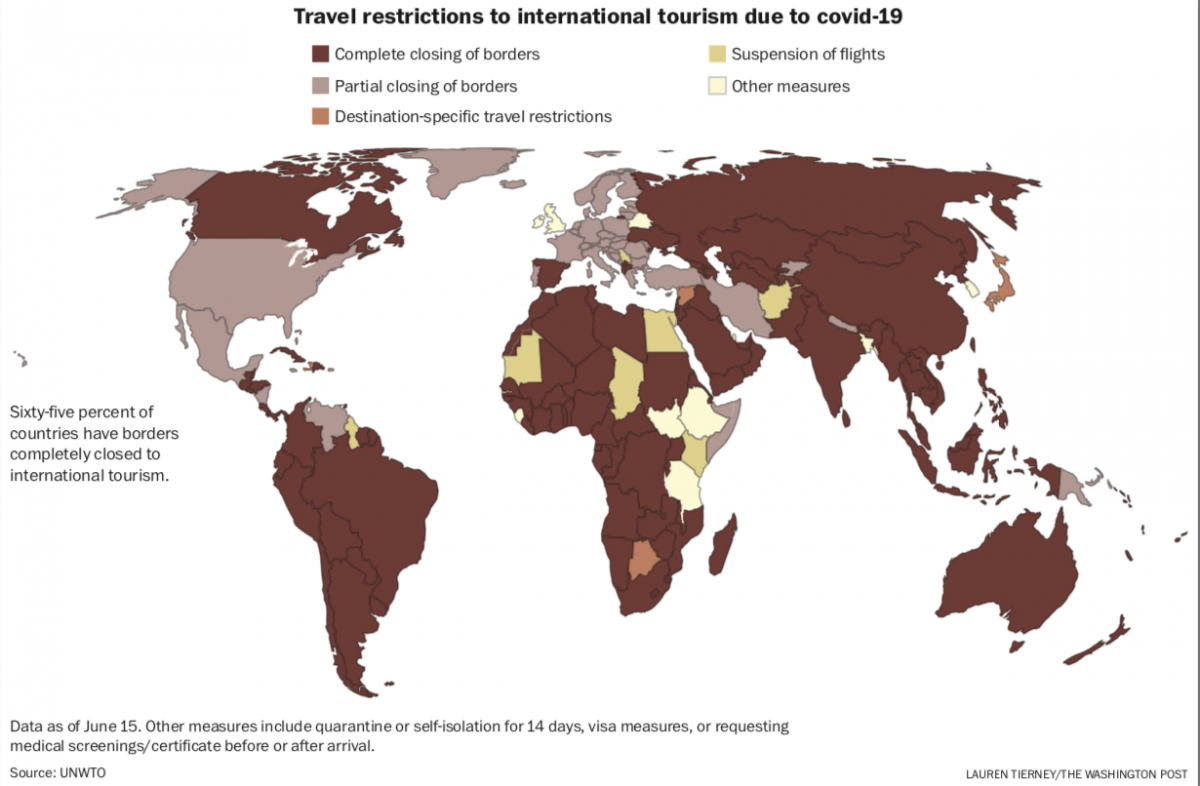
Travel restrictions

Travel restrictions

Long layover? Good problem. You could linger at the airport’s Changi Jewel, with its jungle canopy and 131-foot Rain Vortex, the world’s tallest indoor waterfall. Wander up to a rooftop swimming pool and plane spot. Or leave the airport for a free tour of the ethereal towers of the city-state at the center of the world’s financial and trade systems.

But like fire through Notre Dame, the coronavirus pandemic of 2020 has now silenced this cathedral of interconnectedness – turning Changi into an emblem of what analysts say could now be a lost decade of travel, trade, investment and migration as decades of globalization give way to a new era of global distancing.

“In the absence of warfare between major powers, we have never seen anything like this,” said Adam Posen, president of the Peterson Institute for Economics in Washington.

At Changi, one of the world’s great travel hubs, traffic plunged from 5.9 million passengers in January to a mere 25,200 in April – a 99.5 percent drop. The number of airlines serving the airport collapsed from 91 to 35. Two of the four main terminals have been temporarily mothballed; plans for a fifth have been set back at least two years.

“Industries that depend on travel, like aviation, hotels and tourism, will take a long time to get back on their feet, and may never recover fully,” warned Singaporean Prime Minister Lee Hsien Loong.

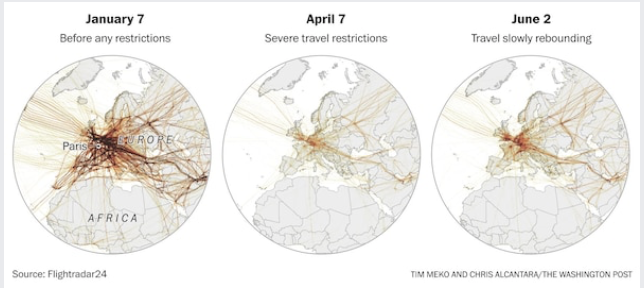
Travel is one of the clearest ways to show how the coronavirus has disrupted the world. This globe shows the disappearance of flights over a five-month period, as covid-19 emerged in China and restrictions on global travel began to take hold.

Travel is one of the clearest ways to show how the coronavirus has disrupted the world. This globe shows the disappearance of flights over a five-month period, as covid-19 emerged in China and restrictions on global travel began to take hold.

But travel is only one way that the coronavirus is disrupting global interconnectedness. The pandemic is interrupting the flow of workers, money and goods that increasingly bound the postwar world, helped to lift more than a billion people out of poverty since the fall of the Berlin Wall and delivered unprecedented stability and prosperity to much of the planet. To encapsulate: U.S. investment in China raised demand for soybeans that enabled Brazilian farmers to buy German cars.

Rising economic nationalism was already chipping away at globalization before the first patients in Wuhan, China, began to fall ill in December. But the coronavirus, which has sickened at least 9.6 million people and killed more than 487,000, is now reshaping long-standing cultural, economic and political relations in an increasingly polarized world.

“The pandemic has made it so that you now have an additional excuse to block human-to-human contact and intellectual and economic exchange,” Posen said. “It’s a corrosion of globalization, but it’s also an acceleration of a realignment that was already happening.”

The golden era of globalization brought prosperity, but it also brought hubris. The Great Recession of the late 2000s, when frantic over-borrowing by people and governments, combined with cheap, easy and toxic financial instruments and weak regulation, led to a collapse that hollowed out personal savings and national reserves. The decade that followed saw a resurgence of protectionism; global trade patterns and foreign direct investment never really got their groove back.

But that might be nothing compared to what comes next.

Few are suggesting a complete unwinding of globalization. The pandemic’s substantial but relatively shallow hit to shipping, as compared to travel, show a world of people, companies and countries still prepared to do business with one another. Yet even as rebounding stocks and reopening businesses suggest a desire for a rapid return to normality, the way we travel, work, consume, invest, interact, migrate, cooperate on global problems and pursue prosperity has likely been changed for years to come.

– – –

Passenger numbers suggest what happens when the world freezes in place.

The pandemic has impacted global travel like no other event in history: By spring, every country in the world had thrown up some sort of entry restriction, according to the United Nations World Tourism Organization. In April, international air passenger travel fell to levels not seen since the 1970s.

Analysts now project a record year-over-year drop in international tourist arrivals of as much as 80 percent. Compare that to the Great Recession of 2009, when arrivals dropped only 4 percent, or the SARS pandemic of 2002, when they fell 0.4 percent.

Chile’s LATAM, Colombia’s Avianca, Virgin Australia and Britain’s Flybe airlines have all declared bankruptcy. But the collapse of travel endangers not only airlines and hotels – it also threatens conservation efforts in places such as Namibia, for example, where tourist dollars allowed a poor nation to maintain vast natural preserves for the world’s largest population of black rhinos. It threatens cultural exchanges, such as the semester- and year-abroad programs that send hundreds of thousands of American students overseas each year, now suspended, postponed or canceled.

And it threatens business and other communications. Daniel Runde, director of the Project on Prosperity and Development at the Center for Strategic and International Studies, recalled a recent Zoom call that brought together 20 people from the United States, Brazil and Colombia for a conference on the future of the Amazon rainforest.

“There is no pulling people aside before the meeting to work things out,” he said. “You can’t pick up on body language from a grainy video image. Nonverbal communication is lost, and there were tensions on the call, maybe because of it.

“Afterwards, you can’t just go upstairs and finish the conversation. It feels like you’re missing 50 percent of the information you need to do your job.”

Across the globe, third- and fourth-tier cities – Cordoba, Argentina; Krakow, Poland; Austin, Texas – face a long, slow climb back to full connection with the wider world.

But this is about more than just air travel. Vehicular and pedestrian traffic at U.S. land borders with Mexico and Canada fell in April to their lowest levels on record. New barriers that have shot up on the once-open borders of the European Union might prove far more difficult to take down.

“What it does is increasingly isolate, and leads us to insular protectionist attitudes across the globe in everything that we do,” said John Grant, senior analyst for the British travel data provider OAG. “All of the wonderful learning and sharing, of history, of knowledge, of multiracial sharing of cultural experiences, is heading for a setback.”

– – –

National lockdowns have also slowed the irregular flow of people across borders – undocumented immigration. On the U.S.-Mexico border, the number of people apprehended or expelled by the U.S. Border Patrol fell to 15,862 in April, down 47 percent from March – the largest one-month drop in at least 20 years, according to the Pew Research Center. In one striking move, Saudi Arabia announced this week it would slash the number of people allowed to make the Hajj, the annual pilgrimage to Mecca, to no more than 10,000. The pilgrimage, which able-bodied, practicing Muslims are expected to make at least once in their lives, drew 2.5 million people last year.

Data collected by the International Organization for Migration at 35 key transit points across West and Central Africa showed a decrease in migration of 48 percent from January to April. The number of irregular border crossings along Europe’s main migratory routes fell by 75 percent in April to about 1,470 people – the lowest number since Frontex, the European border agency, began collecting data in 2009.

Some of those drops are proving to be temporary. Irregular arrivals into Europe, for instance, bounced back up to 4,260 in May – still unseasonably low, but a number that suggests that in some developing countries, rising food insecurity is beginning to weigh more heavily on people than the risks of crossing borders in the midst of a pandemic.

The irregular flow could grow as legal routes become more complicated. Wealthier nations have closed migration and asylum offices and consular services, worsening backlogs that in some cases already ran into years. At least two countries – Japan and South Korea – have suspended the validity of previously issued visas.

Some Chinese students are suddenly facing new obstacles to American educations, and President Donald Trump’s move to halt many new green cards and visas for foreign workers, although said to be temporary, has clouded the immediate futures for Swedish advertising executives and Brazilian jujitsu masters seeking to build new lives in the United States.

As poor migrants languish in unemployment or return home, the World Bank expects remittances to low- and- middle-income countries to decline by almost 20 percent this year – the largest decline on record. That virtually assures more of the world’s poorest families will have less access to food and medicines. As a share of GDP in those nations, remittances this year are set to fall to their lowest level since 1999.

Behind those numbers lies unspeakable hardship. Venezuelan migrants, refugees from a humanitarian crisis that has placed them at the bottom of Latin America’s socioeconomic ladder, are also heading home, after finding themselves jobless in neighboring countries suddenly mired in recession. Luis Medina, a 21-year-old Venezuelan laborer, fled the collapsing socialist state last year for Guayaquil, Ecuador. He managed to secure a job as a house painter; the majority of his earnings – $160 a month – went home to his mother, for food, and to aid her battle against cancer.

When the coronavirus ravaged Ecuador, the country locked down, and Medina’s work dried up.

“I could no longer afford the rent or the food,” he said.

He called an end to his immigrant’s dream. Lacking even the money for a bus ticket, he set out in mid-March on the 1,700-mile walk home on foot.

Two months later, he’s still walking.

“I’m returning with empty pockets,” he said from Colombia, with 900 miles left to go. “The future is uncertain, and I’m afraid. For myself, but especially for my family.”

– – –

Perhaps more painful for the global economy is the slowdown in the flow of capital, goods and services. World trade is projected to fall 13.4 percent this year, its steepest drop in at least 60 years, kicking volumes back to 2014 levels. Foreign direct investment in emerging markets – the new bridges, roads, factories and ports that bring the developing world a chance for prosperity – is expected to plunge by about 20 percent, to levels not seen since 2006. Foreign direct investment as a share of GDP is expected to fall to the lowest level since the early 1990s. 

The massive Vaca Muerta project, projected to create 22,000 jobs and double Argentina’s oil and gas output in six years by tapping into the world’s second-largest shale deposits, was clouded by the country’s economic woes before the pandemic hit. But after lockdowns sent global oil prices plummeting, foreign firms are rolling back planned investment.

Developing countries are particularly worried about a possible pullback in Chinese investment, one of the main drivers of infrastructure projects in emerging markets. Analysts cite a massive port planned for Lima, Peru, and a railroad project intended to link inland farmers and miners in Brazil’s impoverished Bahia state to an Atlantic port and global markets.

The Brazil project “requires a lot of financing and it’s not begun to be constructed, and there are plenty of reasons to not begin it,” said Margaret Myers, director of the Asia and Latin America Program at the Inter-American Dialogue in Washington. “When you look at the various risk factors, those are the kinds of projects most likely to fail now.”

Announcements of new investment projects and cross-border mergers and acquisitions both dropped by more than half year-over-year in the first months of 2020, according to the U.N. Conference on Trade and Development.

The pandemic is threatening international cooperation on global concerns. Argentina, plunged into a brutal recession and self-isolating, has halted the rollout of alternative energies to fight climate change indefinitely. The International Energy Agency forecasts that the amount of new renewable electricity added to global capacity will decline by 13 percent in 2020, the first deceleration since 2000.

Global distancing – of people, of goods, of capital – is deepening the brutal economic impact of lockdowns, fueling soaring joblessness and weakening demand. The global economy is suffering its deepest recession since World War II, according to the World Bank, with most countries experiencing downturns at one time since 1870. It’s the fourth deepest recession in the last 150 years, twice as deep as the Great Recession of the late 2000s.

Up to 100 million people globally are poised to fall into extreme poverty, the first increase since the Asian and Latin America financial crises of the 1990s, and the biggest increase since the World Bank began tracking the number in 1990.

“Whatever progress we have made over the past decades, we might end up losing that progress,” said Ayhan Kose, director of the Prospects Group at the World Bank. “There is no way some of the gains won’t disappear. The threats to globalization are quite important.”

– – –

Even before the pandemic, growing economic protectionism after the Great Recession and the return of trade wars – chiefly, between the United States and China – had begun to clog the pipes through which goods, services and capital flowed. Now, in the shadow of covid-19, some wounded nations are moving as never before to protect their own industries.

Italy has long scrutinized foreign investments in its security, defense, transportation and telecommunication sectors. But as the country languishes in a brutal recession and mourns its dead, an emergency decree has vastly expanded the government’s authority to veto meaningful foreign investment in any firm working in electricity, water, health, media, data collection, aerospace, elections systems, banks, insurance, robotics or biotechnology.

“There’s a need to raise a shield against predatory colonization, both from countries of the East and European neighbors,” said Adolfo Urso, a senator of the right-wing Brothers of Italy party.

The coronavirus, he said, has changed the very definition of what constitutes a critical national asset.

“Say the vaccine industry is threatened by hostile takeovers,” Urso said. “Well, today, that’s as strategic as any defense company.”

The new restrictions have raised an alarm among Italian industrialists, who say their country’s long-stagnant economy will need more foreign capital, not less, to emerge from this crisis.

“That’s the whole of our economy right there, in that list, with the exception of Giorgio Armani’s jackets, and some Brianza-made chairs and sofas,” said Antonio Calabrò, deputy head of Assolombarda, a Milan-based group of industrialists. “It’s the opposite of open markets.”

– – –

At the onset of the pandemic, the sudden worldwide need for ventilators, masks and other personal protective equipment, coupled with the inability of companies that make everything from tractors to computers to secure parts from shuttered factories in China, caused a global mad dash to scoop up whatever substitutes could be found – often at whatever price. As factories reopen and supply chains stabilize, the experience has left countries and companies traumatized, empowering calls to bring manufacturing jobs home – or at least to spread them among more and mostly closer countries.

That could mean a new set of winners and losers. Pressure will increase on some companies to shift away from China, where growing wages and land costs have already moved jobs to lower-wage countries such as Vietnam and Indonesia. For companies targeting U.S. markets, Mexico – which sends goods across the border by land, sea and air – could see more jobs.

Yet actually repatriating globalized jobs can be far more difficult than politicians tend to portray. Carlton Solle found out the hard way.

G95, the company Solle runs just outside of Atlanta, should have had a corona moment: It makes apparel – hoodies, scarfs – fitted with a special filtration technology ideal for pandemic times. When his Chinese suppliers were locked down, Solle attempted to move production to Michigan. The effort quickly bogged down in production delays, poor quality and soaring costs.

The cost of making the company logo alone jumped from 20 cents in China to $3.40 in the United States. Solle says he was forced to raise prices, and his profit margin still took a hit.

He restarted production in China in May.

“At the end of the day, the thing the Chinese do really well is know how to mass-produce items,” he said. “Trying to shift to the U.S. was a monumental task for us as a company. I don’t know. We’re going to keep looking for options in the U.S. and other countries nearby.

“We’d like to do more here, but I just don’t know.”

One-third of black adults know a covid-19 victim #ศาสตร์เกษตรดินปุ๋ย

#ศาสตร์เกษตรดินปุ๋ย : ขอบคุณแหล่งข้อมูล : หนังสือพิมพ์ The Nation.

One-third of black adults know a covid-19 victim

Health & Beauty

Jun 27. 2020

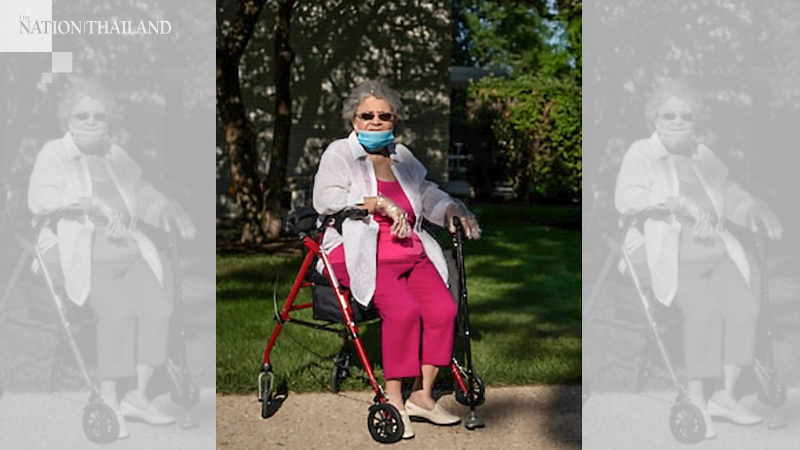
Lois Travillion, 82, a retired Chicago math teacher and school administrator, has had two friends die of covid-19.

Lois Travillion, 82, a retired Chicago math teacher and school administrator, has had two friends die of covid-19. “A lot of people have lost folks, and who knows who will be next?” she said. MUST CREDIT: Photo by Youngrae Kim for The Washington Post

By The Washington Post · Amy Goldstein, Emily Guskin · NATIONAL, HEALTH 

Nearly 1 in 3 black Americans know someone personally who has died of covid-19, far exceeding their white counterparts, according to a Washington Post-Ipsos poll that underscores the coronavirus pandemic’s profoundly disparate impact.

The nationwide survey finds that 31 percent of black adults say they know someone firsthand who has been killed by the virus, compared with 17 percent of adults who are Hispanic and 9 percent who are white.

Photo by: The Washington Post — The Washington Post
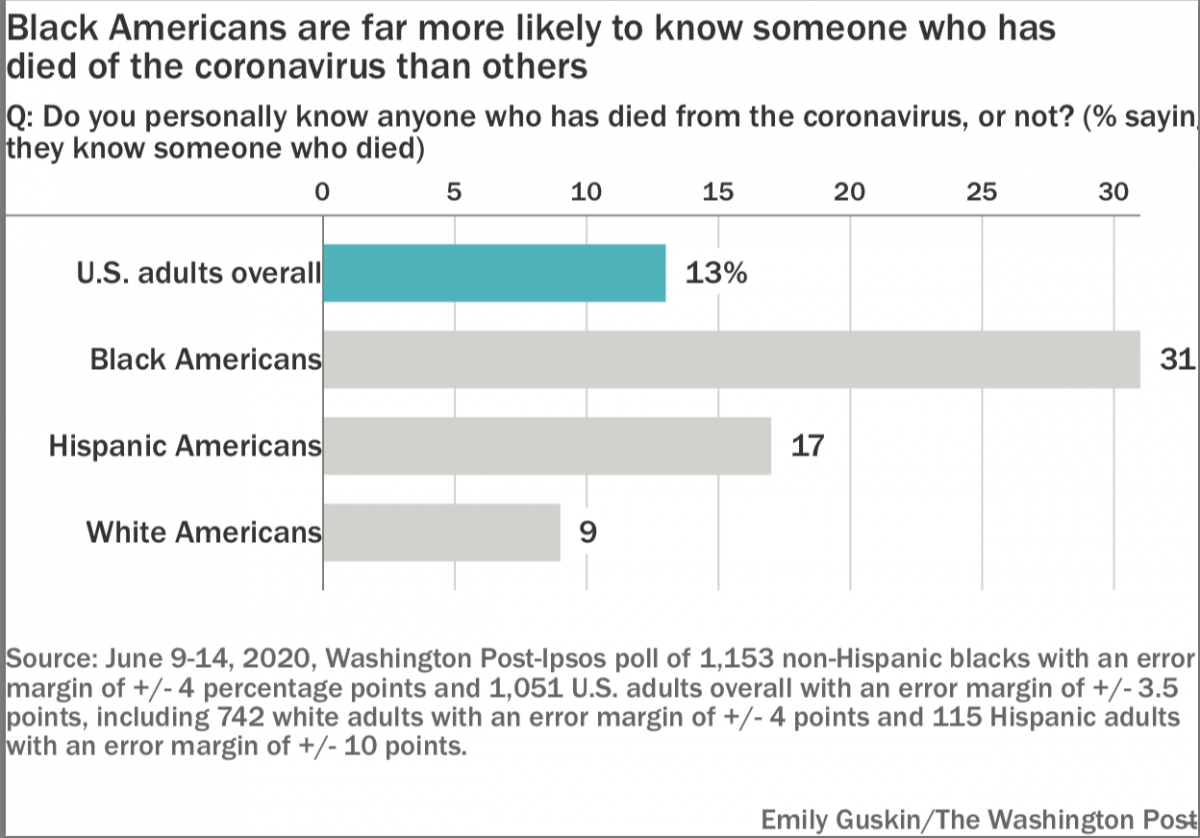
Photo by: The Washington Post — The Washington Post
Adding in those who know someone with symptoms consistent with covid-19, slightly more than half of black Americans say they know at least one person who has gotten sick or died of the disease caused by the novel coronavirus. Fewer than 4 in 10 white or Hispanic Americans say they do.

Taken together, the poll’s findings attest to sharp racial differences in the sense that the virus is close at hand, after nearly a half-year in which it has sparked the nation’s worst public health calamity in more than a century.

According to authorities on health disparities, those differences arise from the nation’s deep-seated socioeconomic inequality and help explain the recent spasm of unrest across much of the country in a drive for racial justice.

“This pandemic has really unearthed – shone a real bright light on – the ways these disparities should not be accepted and are not tolerable,” said Joseph Betancourt, vice president and chief equity and inclusion officer at Massachusetts General Hospital in Boston.

The differing close-up exposure to the virus’s ravaging effects is accompanied by divergent attitudes about the best way for the country to recover. Asked whether it is more important to try to control the spread of the coronavirus or to try to restart the economy, even if one hurts the other, 83 percent of black Americans say trying to control the virus is a higher priority.

By contrast, when the same question was asked in a Washington Post-ABC News poll last month, just about half of white Americans said trying to control the virus is more important.

The differences in proximity to coronavirus sickness and death align, too, with political attitudes, the survey shows. More than 8 in 10 black Americans say that, in deciding which presidential candidate to vote for in the November election, the coronavirus outbreak will be one of the most important factors or very important. Nearly as many Americans who are Hispanic say they hold that view – but fewer than 6 in 10 who are white say the same.

The survey “tells us a lot about how the life experiences of individuals in the United States are different by race,” said Georges C. Benjamin, executive director of the American Public Health Association. “Life experiences drive a lot about how you view the world, how you make decisions and what you do.”

The poll’s central findings – the frequency of knowing someone killed by the virus – hold a mirror to the well-established pattern that the coronavirus has made its deepest inroads in the United States among black Americans. The virus has been more likely to infect black Americans and more likely to have a devastating effect on their bodies if they contract it.

“A lot of people have lost folks, and who knows who will be next?” said Lois R. Travillion, 82, a retired Chicago math teacher and school administrator who has had two friends die of covid-19.

In early April, Travillion got a call that a former co-worker in the Chicago school system – a man whom she still saw now and then and still played in his own band – had died of the virus.

Travillion said the other was a man, sharp and mobile in his mid-80s, who always sat two seats away from her at the monthly seniors breakfast, followed by Bible study that she attends at St. Stephen AME Church. Next thing she knew, he was infected, in the hospital, on a ventilator. On one of the last days of April, he died.

She found out just last Sunday that a member of her own church, Kelly Woodlawn United Methodist, had tested positive and is quarantining at home. And another man she knows, Travillion said, “was on a ventilator for a long time – and we thought he wasn’t going to make it, but by the grace of God, he pulled through.”

When she was a young woman still living in Mississippi, she took part in a 1963 Woolworth lunch counter sit-in to protest segregated seating. When she was new to Chicago in the late 1960s, she took part in the Black Manifesto, a set of demands to improve education at a high school where she taught.

The past months, she has shut herself in against the virus, relying on a former student to bring her groceries, wearing a mask when she walks down the hall to empty trash in the incinerator in the complex where she lives near Lake Michigan.

“People’s lives are more important” than focusing on restoring the economy, Travillion said. “There are so many people who have died. You won’t even need the economy because there won’t be anybody around.”

Lester Danner, 28, who lives in northwest Mississippi, has the same view. “It’s important to control the virus because we have a walking-dead society with the virus in the air,” he said. “A lot of people have died.”

Early on, a cousin got infected working in a nursing home laundry, Danner said. But she did not develop symptoms.

Then, an aunt called to tell him a family friend’s brother had died. He got sick in March, held on for a month in a hospital, then succumbed. The man and Danner’s father were born on the same day 66 years ago.

And now, just across the Tennessee line in Shelby County, cases are spiking – 400 new cases one day this week, more than twice as many as any day in March, April or May. Last week, the city council in Memphis, the county seat, voted to require residents to wear masks in public.

“People, they were so excited to be out of quarantine, they probably thought it would be okay, but now we are getting another wake-up call,” said Danner, who does branding and marketing work. “You can’t take anything for granted.”

According to the poll, there is not much difference among racial and ethnic groups in the proportion of people saying they know someone who has had possible symptoms of covid-19 but do not know anyone who died. Among white Americans, 28 percent say they know someone with symptoms. That is slightly higher than among black and Hispanic Americans, both at 21 percent.

It is the proximity to death that is stark. Among black Americans, the percentage knowing someone who died increases steadily with age. Nearly 1 in 4 adults younger than 35 say they know someone, compared with more than 4 in 10 people 65 and older.

The findings are “a true indication of reality,” said Betancourt, of Massachusetts General Hospital.

He said people of color in the United States tend to live with “a series of preconditions” that put them at greater risk of becoming infected with the virus and of then faring poorly. They include higher rates of poverty and the varied effects of structural racism, Betancourt said. The downstream effects, he said, include crowded housing, more frequent asthma, diabetes and other chronic diseases, and a greater likelihood of being in jobs that do not allow them to work from the greater safety of home.

The Post-Ipsos poll was conducted June 9-14 through Ipsos’s KnowledgePanel, a large online survey panel recruited through random sampling of U.S. households. Results among the sample of 1,153 non-Hispanic black adults have a margin of sampling error of plus or minus four percentage points; the error margin is 3.5 points among the parallel sample of 1,051 U.S. adults overall, four points among the sample of 742 white adults and 10 points among the sample of 115 Hispanic adults.

CDC chief says coronavirus cases may be 10 times higher than reported #ศาสตร์เกษตรดินปุ๋ย

#ศาสตร์เกษตรดินปุ๋ย : ขอบคุณแหล่งข้อมูล : หนังสือพิมพ์ The Nation.

CDC chief says coronavirus cases may be 10 times higher than reported

Health & Beauty

Jun 26. 2020

By The Washington Post · Lena H. Sun, Joel Achenbach · NATIONAL, HEALTH, SCIENCE-ENVIRONMENT 
WASHINGTON – The number of people in the United States who have been infected with the coronavirus is likely to be 10 times as high as the 2.4 million confirmed cases, based on antibody tests, the head of the Centers for Disease Control and Prevention said Thursday.

CDC Director Robert Redfield’s estimate, shared with reporters in a conference call, indicates that at least 24 million Americans have been infected so far.

The antibody tests examine a person’s blood for indicators that the immune system has mounted a response to an infection. The serological surveys are being done around the country as epidemiologists try to measure the reach of the virus to date. Redfield said he believes 5 to 8 percent of the population has been infected so far. 

Significantly, that would mean 92 to 95 percent remain susceptible to a coronavirus infection. Experts say this is the critical data point showing that the pandemic remains in its early stages and people need to continue to try to limit the viral spread. 

The CDC director’s comments came as case counts continued to surge to record levels in many states, particularly in the South and West, during warm-weather months that many had hoped would provide a lull in the pandemic.

Alabama, Nevada and Missouri reported single-day records for new coronavirus cases, a day after the national total hit a single-day high of 38,173 cases.

Amid signs that Texas has lost control of the epidemic, Gov. Greg Abbott, a Republican, announced the state would pause its reopening to try to halt the flow of infections. He said he is focused on strategies to slow the viral spread “while also allowing Texans to continue earning a paycheck to support their families. The last thing we want to do as a state is go backwards and close down businesses.”

As part of that pause, he suspended elective surgeries at hospitals in hard-hit Bexar, Dallas, Harris and Travis counties – home to the cities of San Antonio, Dallas, Houston and Austin, respectively. The rolling average of daily new cases in Texas has increased 62 percent from the past week, jumping from 2,610 on June 18 to 4,227 on Thursday, according to data tracked by The Washington Post. The daily count has set a record each day for 13 consecutive days.

The economic crisis triggered by the pandemic continues to roil the corporate sector. Macy’s said it is laying off 3,900 corporate employees and managers. Chuck E. Cheese’s parent company filed for bankruptcy protection. Both actions were due to the virus’s impact on sales, the companies said.

Apple said Thursday it is re-closing 14 stores in Florida. The state reported a second consecutive day of more than 5,000 new confirmed coronavirus cases.

Larry Kudlow, the White House’s top economic official, said during an appearance on Fox Business Network that the administration does not anticipate a second wave of infections, which has been projected by health experts, and that new hot spots popping up across the country are scenarios Americans will “just have to live with.”

Some officials in the Trump administration, including the president, argue the surging cases simply reflect expanded testing. But infectious-disease experts, including Anthony S. Fauci, director of the National Institute of Allergy and Infectious Diseases, dispute that, saying they also reflect increased community transmission. 

Redfield said that younger people are the leading edge of that transmission. “Young people, many newly mobile after months of lockdowns, have been getting tested more often in recent weeks and driving the surge in cases in the South and West,” he said. 

“In the past, I just don’t think we diagnosed these infections,” he said.

Redfield’s comments oscillated between downplaying the latest news bulletins and declaring that the rising numbers are indeed worrisome. 

He said that a color-coded map of infections can make the country look as though the surge is widespread – “substantial portions of the United States are in red” – but said that only 3 percent of counties nationwide have actually become “hot spots.” 

He also repeatedly pointed out that young people, who are less likely to have a severe outcome from the virus, are getting tested more often. But under questioning, he said he was not downplaying the significance of the surge in cases in places such as Texas, Florida and Arizona.

“This is a significant event,” he said. “We had a significant increase in cases. . . . We need to interrupt that.”

Redfield said Americans need to weigh their individual risks as they go about their lives. “When you must go out into the community, being in contact with few people is better than many, [and] shorter periods are better than longer,” he said.

Above all, he said, people should maintain social distancing, wash hands frequently and properly wear a face covering when they are unable to socially distance.

The death toll nationally from covid-19, the disease caused by the novel coronavirus, has dropped since it peaked in April, during the catastrophic outbreak in New York City and nearby areas. Many experts have warned that the effects of the reopening of the economy in May and the increased mobility and decline in social distancing could reverse that recent trend. Covid-19 can lead to a protracted illness, and in those cases there is typically a lag of several weeks between an infection and death.

On Thursday, the CDC also made significant changes in how it categorizes people at elevated risk of a severe outcome from covid-19. The agency had previously said that people over 65 face higher risk. But it removed that age marker, saying that risk increases steadily with age.

Conditions that pose a higher risk for serious illness include chronic kidney disease, serious heart disease, COPD (chronic obstructive pulmonary disease), a weakened immune system from a solid organ transplant, Type 2 diabetes, obesity and newly added: sickle cell disease, an inherited blood disorder that affects 90,000 to 100,000 people in the United States, mainly African Americans.

Officials clarified that obesity means a body mass index of 30 or higher. Roughly 40 percent of the adult population is obese under that definition. A person who is 5-foot-5 and weighs 180 pounds has a BMI of 30. That same person who weighs 240 pounds would have a BMI of 40. 

For the first time, agency officials said pregnant women with covid-19 may face a higher risk of hospitalization and treatment in intensive care units and respiratory help with a mechanical ventilator. The same data, however, shows that pregnant women are not at higher risk of dying. Officials said they are still researching the effects on newborns. 

Although pregnant women are at risk for severe disease associated with other respiratory illnesses, such as influenza, there has been limited data related to covid-19 on pregnancy until now, health experts said.

In the CDC report on pregnancy and covid-19 released Thursday, researchers compared the impact of the disease on more than 8,000 pregnant women and 83,000 nonpregnant women from Jan. 22 to June 7.

Pregnant women were over five times as likely to be hospitalized as nonpregnant women, 1.5 times as likely to be admitted to intensive care units, and 1.7 times as likely to require mechanical ventilation, the report said. There was no higher risk for death among the pregnant women.

The CDC report also found that black and Hispanic pregnant women appear to be disproportionately hit by covid-19.

“This is the most convincing evidence that pregnant women with covid-19 are more likely to have severe disease, although the absolute risk is still low,” said Denise Jamieson, chair of the gynecology and obstetrics department at Emory University School of Medicine and chief of gynecology and obstetrics for Emory Healthcare, who was not involved in the report.

Among pregnant women with confirmed infections who reported race or ethnicity, 46 percent were Hispanic, 22 percent were black and 23 percent were white. That suggests the disproportionate impact of the disease on blacks and Latinos: In 2019, white women accounted for 51 percent of those who gave birth, compared with 24 percent who were Hispanic, and 15 percent who were black.