Respiratory specialist Dr Manoon Leechawengongs urged the government via Facebook to administer more vaccines to elders.
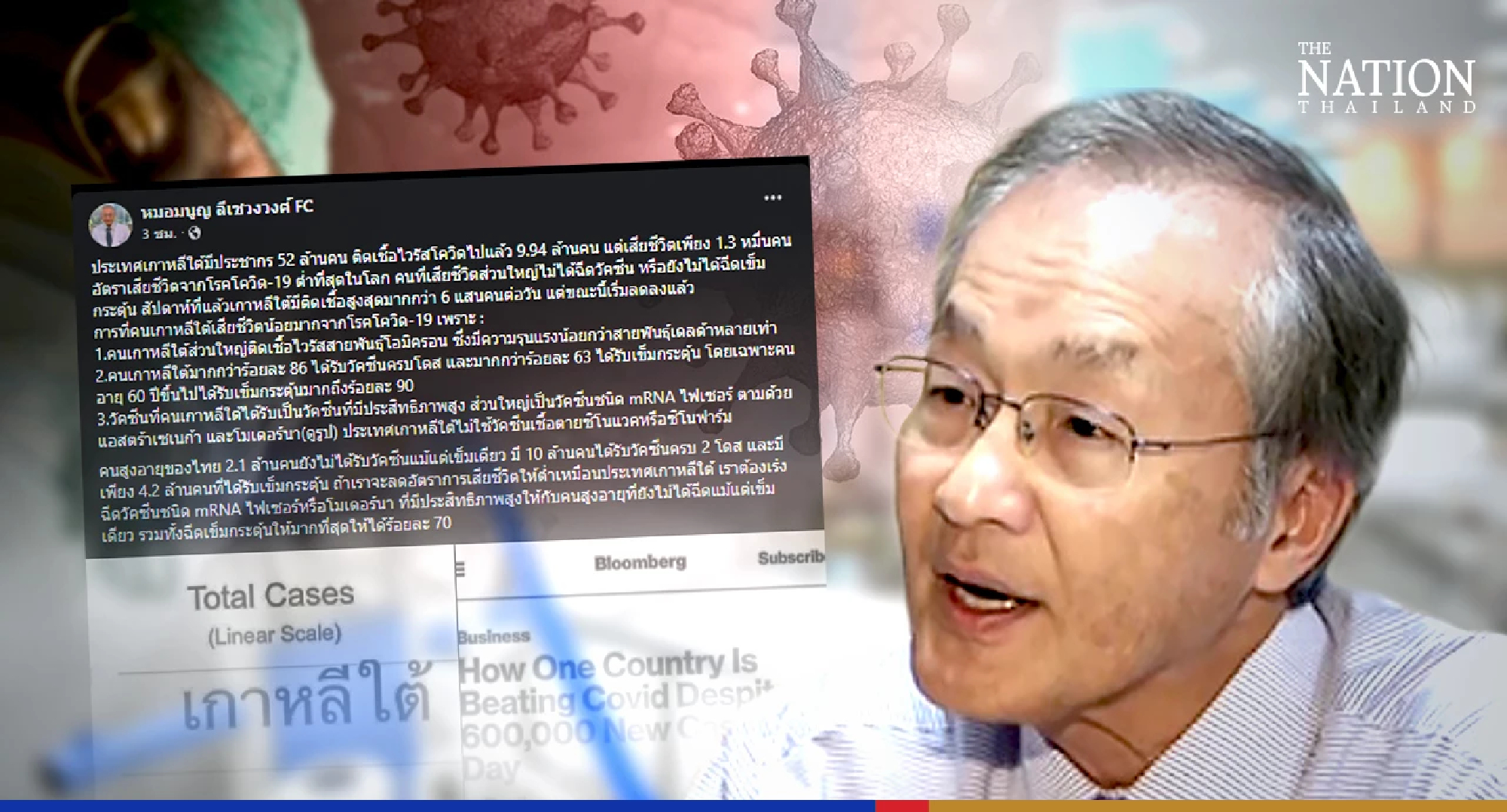
Manoon cited South Korea as an example, saying its population of 52 million had a total 9.94 million patients, but there were only around 13,000 deaths.
He said that country had the lowest fatality rate in the world as most deaths were unvaccinated patients or patients who had not received a booster dose. South Korea’s daily infections have also started to decrease.
Manoon gave three reasons why South Korea has the lowest Covid-19 fatality rate:
Most South Koreans are infected with the Omicron variant, which is much less severe than Delta.
86 per cent of South Koreans are fully vaccinated, with 63 per cent having already received a booster dose. Moreover, 90 per cent of elders aged over 60 have received a booster.
South Koreans have received efficient vaccines, with most being administered the mRNA vaccine Pfizer, followed by AstraZeneca and Moderna. The country does not use inactivated vaccines such as Sinovac or Sinorpharm.
Manoon said 2 per cent of Thai elders have not been administered a single dose, while 10 million elders are fully vaccinated. Only 4.2 per cent have received a booster.
To reduce the fatality rate to bring it on par with South Korea, Manoon said Thailand must hasten to administer highly efficient mRNA vaccines such as Pfizer or Moderna to elders who have not received any vaccine.
Furthermore, Thailand should provide 70 per cent of the elderly with a booster dose, he advised.
New preclinical authentic “live” virus data from Washington University’s School of Medicine demonstrated that Evusheld injection (combination of tixagevimab and cilgavimab) is potent in neutralising the highly transmissible Omicron BA.2 subvariant. The data also showed that Evusheld is effective against BA.1 and BA.1.1 subvariants.
In addition, in vivo (live organism) data generated using mice infected with Omicron BA.1, BA.1.1 and BA.2 demonstrated that Evusheld significantly reduced the viral burden and limited inflammation in the lungs for all three subvariants. Covid-19 viral load is associated with increased disease severity and mortality as well as post-Covid conditions (long Covid).
The study used a transgenic mouse model to evaluate Evusheld in pre-exposure prophylaxis (prevention) of Covid-19, similar to how Evusheld is used in the clinic. These are the first in vivo data evaluating Evusheld’s efficacy against the Omicron variants versus previous in vitro neutralising activity assays in cultured cells.
The Washington University findings were reported on bioRxiv, a preprint server.
Michael S Diamond, a professor at Washington University’s departments of Medicine, Molecular Microbiology, Pathology & Immunology, said: “These new in vivo mouse model data confirm previous in vitro neutralisation activity results for Evusheld against Omicron. The findings demonstrate that Evusheld was effective at protecting against infection in the lungs, a critical disease site for severe Covid-19, across all Omicron subvariants tested.”
John Perez, senior vice president and chief of Late Development, Vaccines & Immune Therapies for AstraZeneca, said: “These important data show that Evusheld reduced viral burden and limited inflammation caused by Omicron. The findings further support Evusheld as a potentially important option to help protect vulnerable patients such as the immunocompromised who may face poor outcomes if they were to become infected with Covid-19.”
Additional “live” virus data from Aix-Marseilles University and pseudovirus data from the US Food and Drug Administration also demonstrated that Evusheld neutralises BA.2. According to the World Health Organisation, cases of BA.2 have been identified in 85 countries to date, with prevalence increasing in several parts of the world.
Evusheld is authorised for pre-exposure prophylaxis (prevention) of Covid-19 in the US and several other countries. Evusheld is intended for vulnerable populations who have a medical condition or are receiving immunosuppressive medications or treatments and may not mount an adequate immune response to Covid-19 vaccination, as well as those individuals for whom Covid-19 vaccination is not recommended.
Though Covid-19 infections and deaths are surging in Thailand and the authorities have put the country under the highest alert level, the government is still hoping to declare the virus endemic by July.
The Centre for Covid-19 Situation Administration (CCSA) announced alert level 4 on February 21, but came up with a roadmap for declaring the virus endemic last week.
Dr Chakrarat Pittayawonganon, director of the Bureau of Epidemiology, said that the Omicron sub-variant BA.2 is to blame for the surge in infections.
He said this sub-variant is as severe as BA.1 and 1.4 times more easily transmissible. Most Covid-19 patients in Thailand have contracted BA.2, he said, adding that this number is likely to rise during Songkran holidays due to close contact in families and communities, with the elderly and people with chronic conditions most at risk.
He also said that an analysis of the number of cases during the week of February 13-19 showed that for every 100,000 people in provinces, at least 100 had contracted Covid-19.
On February 21, 32 people had succumbed to Covid-19, most of whom were elderly or people with chronic disease. Of the victims, 60 per cent were unvaccinated, while the rest had not received a booster.
On Tuesday, the number of deaths surged to 83, with 21,382 confirmed new infections.
Hence, it may not be advisable for the government to rush into downgrading Covid-19 as an endemic disease any time soon.






 SootinClaimon.Com