Want business growth? Boost gender equity, say Apec CEO Summit speakers
FRIDAY, NOVEMBER 18, 2022
Jarupong Krisanaraj
The government and private sectors must improve gender equity to boost sustainable growth in the Asia-Pacific region, speakers at the Apec CEO Summit in Bangkok said on Friday.
Timothy D Dattels, Canada’s Apec Business Advisory Council member, told the session on “Creating Gender Equity to Drive Growth” that the issue had reached a tipping point in his country thanks to Prime Minister Justin Trudeau’s commitment to gender equality within the Cabinet.
“PM Justin Trudeau ran a campaign on gender equality and delivered,” he told delegates at downtown Bangkok’s Athenee Hotel.
He also highlighted the link between gender parity and business performance.
North American companies in the top quartile for gender equity outperform their peers by 27%, he pointed out.
“Organisations need to rethink training, hiring and incentivising structures, particularly to address gaps at the entry level,” he said.
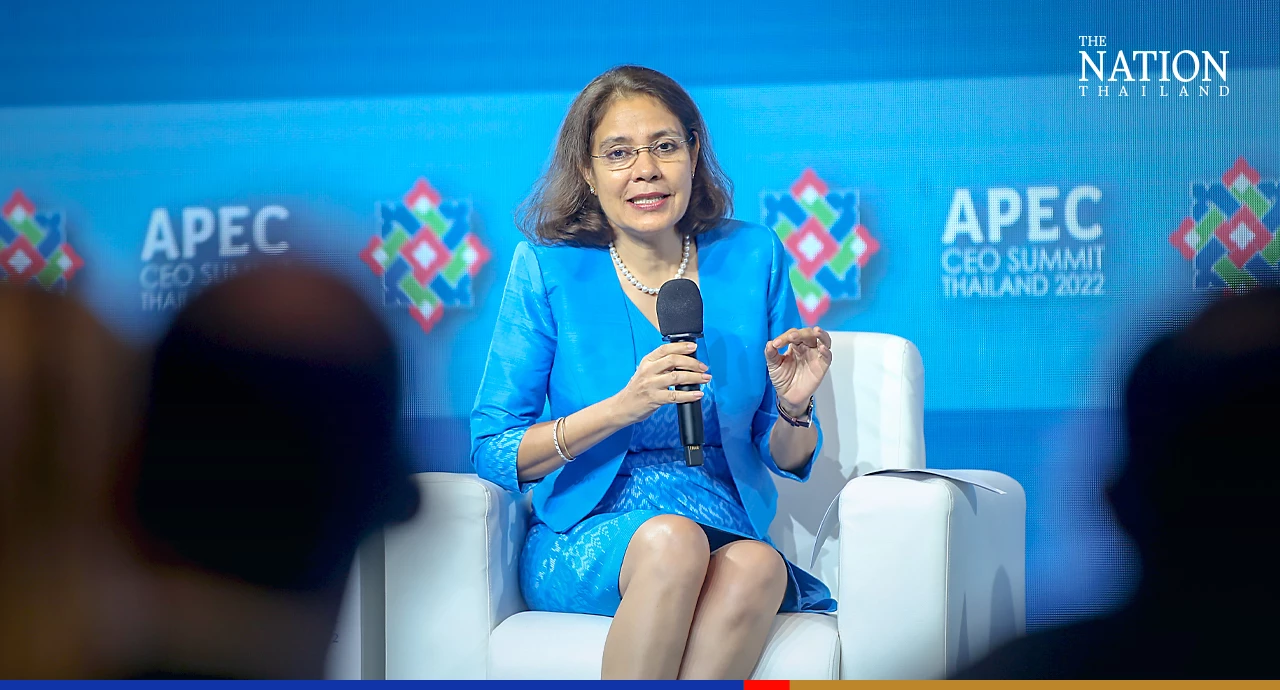
Gita Sabharwal
Meanwhile, United Nations Resident Coordinator in Thailand, Gita Sabharwal, said sustainable development starts by promoting gender equality in organisations.
She said social protection programmes are needed to promote gender equality as many women work in the informal economy where social welfare is lacking.
“In Asia, every other woman works in the informal economy, with low pay, low skills and very little social support,” she said.
She advised upskilling women in information communication technology (ICT) and STEM (science, technology, engineering and mathematics) to allow greater participation in developing industries.
“Financing for female entrepreneurs also should be strengthened to open new opportunities,” she added.
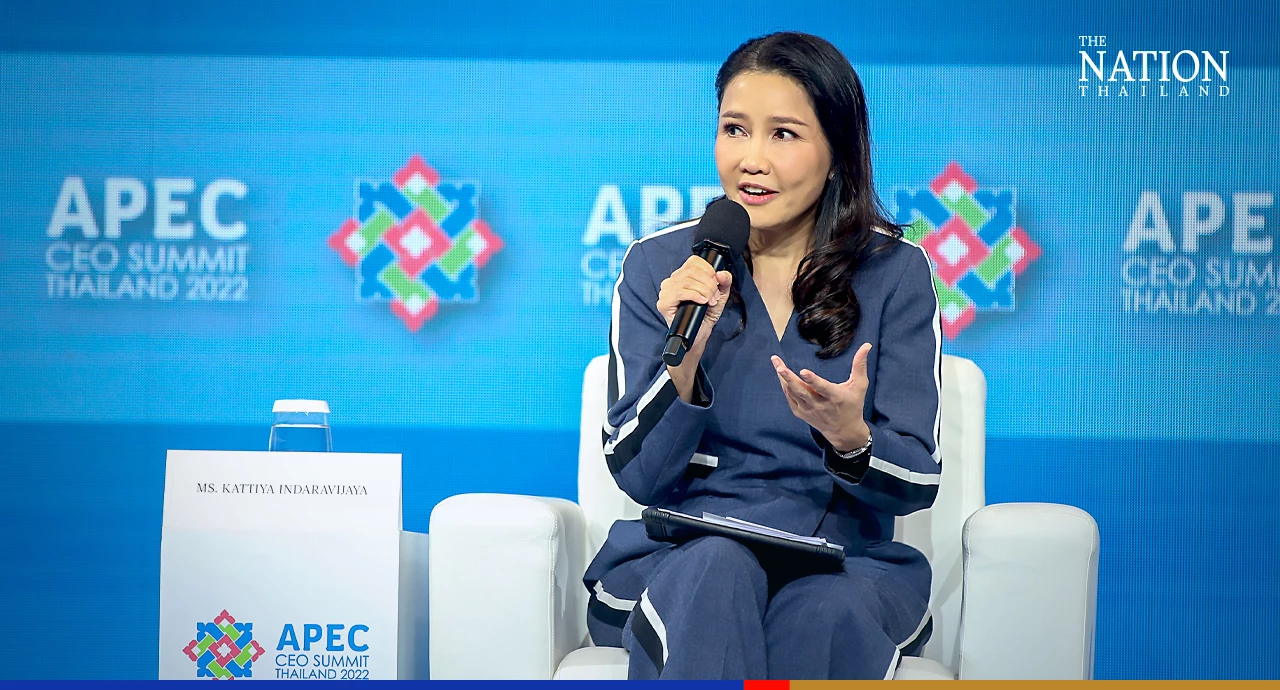
Kasikornbank (KBank) CEO Kattiya Indaravijaya argued that equal opportunities should be offered to women at the education level as well as in the workforce.
“Equality extends not just to women, but also LGBTQ+ identities as well,” she said. “All genders, including LGBTQ+, should have equal opportunities.”
She added that equal opportunity among all genders is crucial to driving sustainable growth.
“When we talk about growth, it is not just about the economy but people’s well-being and happiness,” said the bank chief.
AMATA group has their sights set on the BCG Model.
Amata Corporation is a co-sponsor of APEC 2022. Their strategy for driving sustainable development goals’ impact.They are committed to fostering business and socioeconomic development as well as harmonious cohabitation between industries and neighboring communities on the basis of respect for natural resources and environmental preservation.
Macron urges Apec to repair battered multilateral world order
FRIDAY, NOVEMBER 18, 2022
Nongluck Ajanapanya
France’s President Emmanuel Macron highlighted the importance of a multilateral world and urged Apec countries to join hands for win-win solutions on Friday.
Macron made the plea in his keynote speech, “Navigating a Turbulent World”, for the Asia Pacific Economic Cooperation CEO Summit at the Athenee Hotel in Bangkok.
The French leader said the world faced a turning point over three scenarios: the Russia-Ukraine war, climate change, and the confrontation of superpowers. All three were undermining the global order, trade and investment, he added.
Macron said the US-China trade conflict had done damage by forcing other countries to choose sides.
“Are you on the US or the China side?” was the question asked, said Macron, who added, “But we need a single global order.”
Countries must re-establish international rules and multilateralism in order to maintain global peace and stability, he told the CEO summit.
To avoid new conflicts, it was imperative to establish a new equilibrium and stability at the regional level, he said.
” A dynamic balance is the best way for nations to avoid being forced to choose between superpowers. Countries have to pursue inclusive, sustainable development to address inequality and instability,” he said. “You compete, all of us want to win. But you have to respect the sovereignty of the other one.”
He also told business leaders at the summit that capitalism’s DNA must be recalibrated to make global trade and development more inclusive, equal and sustainable.
Kishida balances improving ties with China with domestic backlash
FRIDAY, NOVEMBER 18, 2022
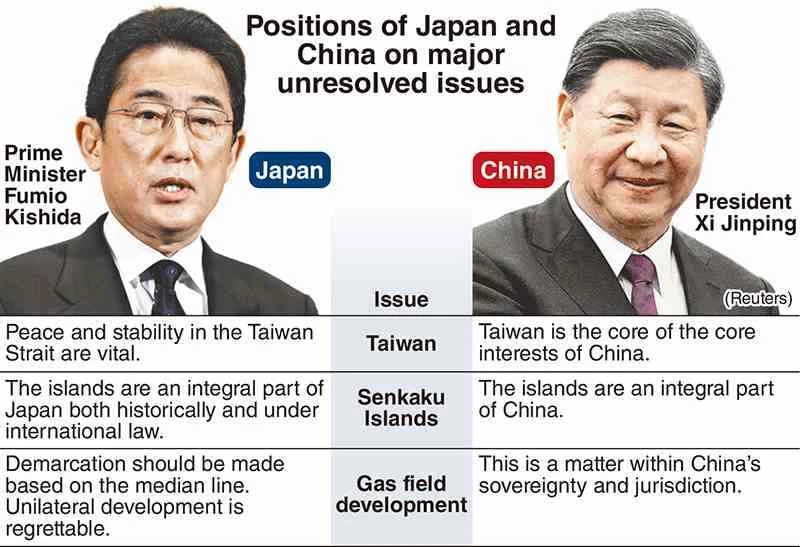
Prime Minister Fumio Kishida’s meeting with Chinese President Xi Jinping, the first official in-person meeting between leaders of the two nations in almost three years, was a first step toward repairing strained relations, but ironing out several major pending issues looks unlikely to happen anytime soon.
During their talks Thursday on the sidelines of the Asia-Pacific Economic Cooperation leaders meeting in Bangkok, Kishida and Xi agreed on the necessity of stably developing bilateral ties.
However, the road to improving relations, especially when concessions do not appear forthcoming on matters such as Taiwan and the Senkaku Islands in Okinawa Prefecture, could be long and bumpy.
Kishida put a positive spin on the talks, telling reporters afterwards that the meeting was a “good start” for advancing dialogue to build a “constructive and stable” relationship between Japan and China.
In addition to directly telling Xi about Japan’s serious concerns over Chinese pressure on the Senkaku Islands and other issues, Kishida also emphasized the importance of maintaining peace and stability in the Taiwan Strait.
Kishida appeared proud that he had followed through on his publicly declared plan to “say what needs to be said.”
The two leaders saw eye-to-eye in opposing Russian use of nuclear weapons in Ukraine. Other fruits of the meeting included confirming efforts to maintain close and open communications, such as making arrangements for Foreign Minister Yoshimasa Hayashi to visit China.
There had been no face-to-face summit talks since then-Prime Minister Shinzo Abe met with Xi in December 2019, and bilateral ties had chilled in the meanwhile. “We’re finally at the start line for improving relations and avoiding confrontation,” a senior official of the Prime Minister’s Office said.
The wheels for making the Kishida-Xi talks a reality began turning on Aug. 17, when Takeo Akiba, secretary general of the National Security Secretariat, met with Yang Jiechi, China’s top diplomat and a then member of the Chinese Communist Party’s Politburo, in Tianjin, China.
According to Foreign Ministry sources, Akiba informed Yang during a meeting that lasted for almost seven hours that Kishida was prepared to engage in talks, even though there was “a risk of criticism from conservative circles.” Yang reportedly welcomed the idea.
In early August, Beijing showed its displeasure to the visit by U.S. House of Representatives Speaker Nancy Pelosi to Taiwan by conducting military drills around the island. The Chinese fired five ballistic missiles that fell within Japan’s exclusive economic zone, and scheduled talks between the Japanese and Chinese foreign ministers were shelved.
While it appeared that channels for dialogue had been severed, Akiba and Yang reaffirmed in their meeting that bilateral talks would continue. In the following months, the groundwork for the Kishida-Xi talks was carefully cultivated, with Xi even sending Kishida his message of sympathy when the Japanese leader contracted the novel coronavirus in August.
Conducting summit talks in conjunction with an international meeting in a third nation in Southeast Asia lessened the burden on both sides. China informed Japan about a week before the APEC meeting in Thailand that the bilateral talks would go ahead.
U.S. presence
Although the summit talks took place, a full-scale “thaw” in relations — such as resolving pending bilateral issues — remains a long way off.
During U.S.-China summit talks held on the Indonesian island of Bali on Monday, U.S. President Joe Biden and Xi traded blunt comments over Taiwan. At a time when the United States, Japan’s close ally, remains locked in a staredown with China, it becomes difficult for Kishida to exhibit a reconciliatory stance toward Beijing.
Further complicating the situation, the Liberal Democratic Party faction Kishida heads has traditionally been seen as friendly toward China.
This leaves any attempts to build warmer ties with Beijing vulnerable to pushback from domestic conservative forces.
During the East Asia Summit held in Cambodia on Sunday, Kishida mentioned China by name in criticizing activities “continuing and intensifying in the East China Sea that infringes on Japan’s sovereignty.” This was all said with Chinese Premier Li Keqiang in attendance.
It seems Kishida is going to pains to strike a balance between reaching out to Beijing and staying keenly aware of domestic public opinion on China’s actions.
In General Election 15, 222 parliamentary seats in Dewan Rakyat (Lower House) are up for grabs, with the polling day set for Nov. 19. A simple majority of 112 (50 % plus one) is needed for any parties or coalition(s) to form the next government.
Out of the 222 seats, the Malay-Muslim seats in Peninsular Malaysia only comprise 117 constituencies (53 % of the total; 95 seats in Peninsular Malay and 22 seats in the Northeast). This becomes a predicament to any Malay-based parties or coalition(s), apart from deep-seated divisions among the Malay-Muslim vote, lately.
Historically, Barisan Nasional (National Front – BN) leaders were successful at winning elections through gerrymandering and malapportionment. This continued even with the removal of constitutional restrictions to have a more balanced number of voters among constituencies in the 1970s. Consequently, rural constituencies (mostly comprised of Malay-Muslims, Sabahans and Sarawakians) were generally given more weightage and seats during electoral redelination exercises.
Beginning in the 1980s, Parti Islam Se-Malaysia (Pan-Malaysian Islamic Party – PAS), the main competitor to United Malays National Organisation (UMNO) over the Malay electorate, had turned more Islamic and fundamentalist than its nationalist past. The Mahathir-led BN in this decade responded by coopting Islamist Anwar Ibrahim to spearhead BN’s version of Islam, hypothetically based on moderation.
Simultaneously, BN skillfully provoked Democratic Action Party (DAP), its main contender for the non-Muslim electorate in the Peninsular Malaysia, to gravitate more toward the Chinese Malaysian population at the expense of its image to the Malay-Muslims. This was done by questioning the DAP’s “Malaysian Malaysia” ideology.
Out of the 222 seats, the Malay-Muslim seats in Peninsular Malaysia only comprise of 117 constituencies (53 % of the total; 95 seats in Peninsular Malay and 22 seats in the Northeast). This becomes a predicament to any Malay-based parties or coalition(s), apart from deep-seated divisions among the Malay-Muslim vote, lately.
Historically, Barisan Nasional (National Front – BN) leaders were successful at winning elections through gerrymandering and malapportionment. This continued even with the removal of constitutional restrictions to have a more balance number of voters among constituencies in the 1970s. Consequently, rural constituencies (mostly comprised of Malay-Muslims, Sabahans and Sarawakians) were generally given more weightage and seats during electoral redelination exercises.
Beginning in the 1980s, Parti Islam Se-Malaysia (Pan-Malaysian Islamic Party – PAS), the main competitor to United Malays National Organisation (UMNO) over the Malay electorate, had turned more Islamic and fundamentalist than its nationalist past. The Mahathir-led BN in this decade responded by coopting Islamist Anwar Ibrahim to spearhead BN’s version of Islam, hypothetically based on moderation.
Simultaneously, BN skillfully provoked Democratic Action Party (DAP), its main contender for the non-Muslim electorate in the Peninsular Malaysia, to gravitate more toward the Chinese Malaysian population at the expense of its image to the Malay-Muslims. This was done by questioning the DAP’s “Malaysian Malaysia” ideology.
Fast forward to the 1990s, Mahathir announced an integrationist political vision for Malaysia’s future (popularly known as “Vision 2020”) with the creation of “Bangsa Malaysia” (Malaysian nation) as its utmost agenda. This forward-looking stance, apart from political stability and economic development, enabled BN to garner large support from the non-Muslim electorate.
However, when PAS started gaining traction back in the Northeast in this decade, the number of constituencies in that region was sustained to check PAS’s advances, despite the significant increase in the number of voters there. On the contrary, more seats were created in the Peninsular Diverse in 1990s and early 2000s, while more parliamentary seats were provided to East Malaysia following the BN electoral support and its projection.
Thus, despite the remarkable coordination of the opposition during GE10 in 1999 – with massive Malay frustration against the government – BN was still able to maintain its two-thirds majority thanks largely to the support of non-Muslim voters throughout the country.
BN lost its two-thirds majority in the parliament 2008 GE12 and in GE13 the then-opposition Pakatan Rakyat (the People’s Alliance) won the popular vote albeit unsuccessful in unseating BN. Several regional states have fallen to the opposition in this period, mostly in the more urban regions of the West Coast of the Peninsular, despite BN’s reigning popularity in the Peninsular Malay region and East Malaysia. The BN split in 2015 and opposition coordination with the BN defectors in the Peninsular and Sabah, however, had enabled the opposition to make the historic breakthrough in GE14.
In the coming election, most of the Malay-Muslim seats in the Peninsular will be contested by four main coalitions – the Zahid Hamidi-Ismail Sabri’s BN, Muhyiddin Yassin-Abdul Hadi Awang’s Perikatan Nasional (National Alliance – PN), Anwar Ibrahim-led Pakatan Harapan (Alliance of Hope) and Mahathir’s Gerakan Tanah Air (Homeland Movement – GTA). This means there will be at least a four-corner fight in every constituency.
However, the deep-seated elite division and hyper-fragmentation of limited number of Malay-Muslim constituencies in Peninsular Malaysia naturally pushed the parties, including the religious conservative elements in PN, particularly Parti Pribumi Bersatu Malaysia [Malaysian United Indigenous Party – Besatu]) and GTA, particularly Parti Pejuang Tanah Air [Homeland Fighters’ Party – Pejuang]), to be more inclusive not only to Sabahans and Sarawakians but also to non-Muslims.
Its implication can be seen in the recently launched coalition manifestos, which are not distinct from one another. These manifestos are largely focused on elevating the material well-being of the population through good governance and upholding the tenets of the constitution, albeit in varying degrees.
The PN manifesto, for example, while highlighting the importance of the position of Islam as the official religion of the federation, does not intend to change the status quo by introducing more Islamization, hudud bill, or transforming Malaysia into an Islamic state as per PAS’ politics in 1980s and 1990s. This is despite PAS being one of the components of the PN coalition.
Additionally, lessons from Mahathir’s syncretic politics, coordination with non-Muslim parties as well as the importance of Sabah and Sarawak votes seem to have provisionally downplayed the Malay-Muslim politics among PN, GTA and BN, all of which are Malay-dominated coalitions.
The GTA coalition is arguably the weakest contender, with the only possibility of winning around three or fewer constituencies, particularly in Kedah. Without any support from a larger and more established coalition, GTA has a feeble grip on society and must rely solely on the personae of its candidates such as Mahathir in Langkawi and his son Mukhriz in Jerlun.
In Northeast’s Terengganu, fierce fighting is expected particularly among PN and BN candidates, with a possibility for PH to capture a few seats. The electoral contests in Terengganu are always heated, whereby the state government and Dewan Undangan Negeri (State Legislative Assembly – DUN) change hands many times between PAS and BN since the 1955 election.
As both parties are equally strong and well-rooted in Terengganu, addressing critical issues are important to help fence-sitters make their decisions. In GE14, for example, Najib Razak’s corruption scandals saw the state swing to PAS, which it lost to BN in GE13.
This time around, both PN and BN are wracked with major issues but UMNO is seen to have more potential to improve its number of seats in the state despite PAS’ association with Bersatu. On the same reasoning, PAS (through PN) is seen to have the advantage of being the largest winner in Kelantan, albeit with less popular vote and the potential for BN to wrest some seats.
Nonetheless, several factors would shape the overall results of the coming election. These are the voter turnout, the sentiment of new and young voters, and candidates’ credibility.
For example, low voter turnout would be a boon to BN. This is because BN’s opposition is mostly out-stationed voters. The voting trend of new and young voters, which consists of around 25 % of the total registered voters, is still uncharted as many did not turn out to vote in the recently held Melaka and Johor state elections.
Simultaneously, due to the constant party-hopping and changes of alliances since early 2020, party identification among voters has been significantly reduced while voters gravitate toward candidates’ credibility and personae instead. In the other words, Malaysia’s GE15 is expected to be less on an ideological battle like in GE 14, but more on contestants’ performance, though those from stronger parties would have an added advantage.
Anwar Ibrahim, for instance, is contesting in a risky constituency in Tambun (Perak), which is an unavoidable move for PH in more Malay-Muslim seats in his coalition bid to Putrajaya. BN is betting on the popular Khairy Jamaluddin in Sungai Buloh, an urban Malay-Muslim constituency of Selangor, in their effort to steal several seats in the PH stronghold.
‘US is here to stay, says Kamala, promising more regional engagement
FRIDAY, NOVEMBER 18, 2022
Stephanie Adair
In her opening remarks at the Apec CEO Summit, US Vice President Kamala Harris said Southeast Asia and the Indo-Pacific hold critical importance to the United States.
In her speech on Friday, she said the US has an “enduring economic commitment … measured not in years, but in decades and generations” to the region.
“The US is here to stay,” Harris promised as she stressed Washington’s previous efforts in the region, such as the Indo-Pacific Economic Framework, which is dedicated to equitable growth and high environmental and labour standards.
She also cited the Quad Vaccine Partnership launched last year in response to the Covid-19 pandemic.
“Our message is clear. The US has an enduring economic commitment to the Indo-Pacific, one that is measured not in years, but in decades and generations,” she said.
Strengthening partnerships with the private sector is also crucial to the United States’ plan to engage with the region, the vice president said.
“The US is here to stay. Strengthening our economic relationships in this region and partnering with the private sector is a top priority for the US and a bipartisan one,” Harris said.
The Biden administration is also pioneering new models in economic cooperation, including the Indo-Pacific Economic Framework launched earlier this year to promote fair trade, supply chain resilience, clean energy and anti-corruption, she said.
The US and Japan have this year also signed a digital trade agreement that covers data flow, e-commerce and privacy issues. The US is committed to supporting new infrastructure investment in the developing world and has called on the private sector to help strengthen supply chains and promote clean energy, she added.
Citing the US Chips and Science Act and Inflation Reduction Act, Harris said a stronger US economy would benefit not just Indo-Pacific partners but the entire region.
She added that the US government is committed to efforts that increase foreign direct investment and the free flow of capital. She also called on economies to ensure growth is equitable across society.
“As we go forward together, companies and economies in this region will find a US that brings immense opportunities for growth, a US that will uphold the rules of the road and a US that will help build prosperity for everyone,” the vice president said.
Apec 2022 is being held at Bangkok’s Queen Sirikit National Convention Centre and wraps up on Saturday.
Cambodia’s Phka Rumduol jasmine variety has been crowned the World’s Best Rice for the fifth time at the TRT (The Rice Trader) World Rice Conference in Phuket, Thailand on November 17, according to leaders of the Kingdom’s apex rice industry body.
Phka Rumduol is a type of long-grain jasmine rice that has emerged as a top choice of international buyers and is one of the varieties exported under the “Angkor Malys” certification mark. The Cambodian Agricultural Research and Development Institute says it released the variety for farmer use only in 1999, after 10 years of development and testing.
Speaking to The Post on the same day, Cambodia Rice Federation (CRF) president Song Saran hailed the award as a “great honour” for the local rice sector.
“We’d like to thank the CRF team, the farmers, rice mill members, the agricultural community, and the agriculture and commerce ministries for supporting the production of the ‘best rice’, allowing us to participate in the competition and bring home the award to Cambodia,” he said.
Phka Rumduol had previously won the award four times, for three consecutive years from 2012-2014, and then again in 2018 in Hanoi, Vietnam. The jasmine variety took second place three years in a row from 2015-2017.
“Andy” Lay Chhun Hour, CRF vice-president and CEO of Battambang-based City Rice Import Export Co Ltd, Cambodia’s largest rice exporter, is seen as the main person behind Phka Rumduol’s participation in this year’s competition.
Chhun Hour took great pride in the Cambodian rice sector’s role in achieving this year’s award, telling The Post that the accolade would translate into an uptick in exports and many other benefits for the community.
“This reputation will further help promote the quality of Cambodian rice” and recognition thereof, he said, noting that the locally-grown grain must pass a host of inspections for shape, texture, smell, and taste to clinch the award.
Minister of Agriculture, Forestry and Fisheries Dith Tina on November 17 took to Facebook to “profoundly congratulate” Phka Rumduol on its fifth coronation as World’s Best Rice, saying the honour would “bring pride to Cambodia”.
Mak Chamroeun, chairman of agriculture value chain management company AgriBee(Cambodia) Plc, voiced delight at the results of this year’s World Rice Conference, telling The Post that the decoration would provide a leg-up for the Kingdom’s milled rice export sector to better compete with other countries.
Milled-rice exports have been performing well this year, amounting to 509,249 tonnes in the first 10 months of 2022, up 10.67 percent from the 460,169 tonnes registered in the same time last year, as reported by the agriculture ministry on November 17.
Chamroeun said this fifth-time victory is a “great source of pride” for the CRF and government, and posited that it cements the reputation of Cambodian milled rice as a go-to option.
“I’d like to congratulate the CRF, partners and members, the agricultural community, as well as farmers who work hard for the cultivation and processing of rice to ensure quality and standards,” he said.
Ratsadon protesters fume over arrest of leader after being blocked from marching to QSNCC
FRIDAY, NOVEMBER 18, 2022
The Ratsadon Yoot Apec (People Stop Apec) group, which has gathered in Bangkok to protest against the Thai government, on Friday defied security restrictions and marched towards Queen Sirikit National Convention Centre (QSNCC) in Bangkok, the venue of the Apec Summit.
They were intercepted by riot police and one of their leaders, Worawan “Pa Pao” Sae-aung, was arrested.
The arrest enraged protesters who shouted at the police to release her. A monk tried to push into the police shield but he was pushed back.
The protest leaders told their guards to gather at the front of the parade.
They also gave the police 20 minutes to respond to their demands, which included:
Immediate withdrawal of police from the area.
Police must allow them to walk safely to Queen Sirikit National Convention Centre
Police must prostrate themselves at the feet of the protesters
The clashes gradually aggravated as the protesters tried to push into the line of riot police stopping them.
Police reportedly fired one rubber bullet at the protesters while five protesters were caught and pulled along the ground.
Apec’s biggest social media hits? Hun Sen’s Covid and banner typo
SATURDAY, NOVEMBER 19, 2022
Social media analysis has revealed the top five topics of interest in the Apec Summit, which wraps up in Bangkok today.
Analytics company Wisesight used its Zocial Eye tools to collect data from social media users in Thailand between November 1 and 16.
The top five trending topics related to Apec were:
1. Leaders/representatives of 21 Apec economies, especially regarding who would come to the summit, with almost 4.5 million engagements (4,474,794). Popular topics included Cambodian Prime Minister Hun Sen’s positive Covid test, and US President Joe Biden not attending the summit in Bangkok.
2. Special holidays during Apec Summit week, at 1,345,202 engagements. The government announced November 16-18 as special holidays in Bangkok, Nonthaburi and Samut Prakan to reduce traffic congestion during the summit.
3. Locations of Apec and related meetings, at 1,096,628 engagements. Popular topics included the removal of electricity poles on Vibhavadi Rangsit Road and the renovation of roads and sidewalks to prepare for the summit. Many netizens complained that the government should work this fast on other city renovation projects around Thailand.
4. Traffic closures during Apec week, at 897,652 engagements. Several roads, expressways, public areas and an MRT subway station have been closed around the summit venue, Queen Sirikit National Convention Centre, to facilitate travel of Apec leaders.
5. The huge typo in a banner welcoming Apec leaders on Chalong Rat Expressway, at 565,798 engagements. The red-faced Expressway Authority of Thailand (Exat) quickly fixed the “Welcom” typo, but internet memes of the gaffe went viral and Exat threatened to sue.
Wisesight detected almost 5.5 million (5,466,785) Apec-related engagements on Thai social media, or 502,241 engagements per day. Facebook was the most popular platform with 54.31% of the engagements, followed by Twitter (25.43%), YouTube (7.98%), and others (12.28%).
The majority of posters were male (61.4%), while people aged 18-24 years posted the most Apec-related messages at 43.34%, followed by those aged 25-34 years at 32.93%.



 Gita Sabharwal