Japan farmers serve brown rice up as healthy beverages, noodles to boost demand

#SootinClaimon.Com : ขอบคุณแหล่งข้อมูล : หนังสือพิมพ์ The Nation.

https://www.nationthailand.com/world/asia-pacific/40021367

Japan farmers serve brown rice up as healthy beverages, noodles to boost demand

Japan farmers serve brown rice up as healthy beverages, noodles to boost demand

TUESDAY, OCTOBER 25, 2022

Products made from brown rice are being developed in Mie Prefecture as part of efforts to cultivate demand for locally grown grain, with noodles and a coffee-like beverage being some of the items to hit shelves.

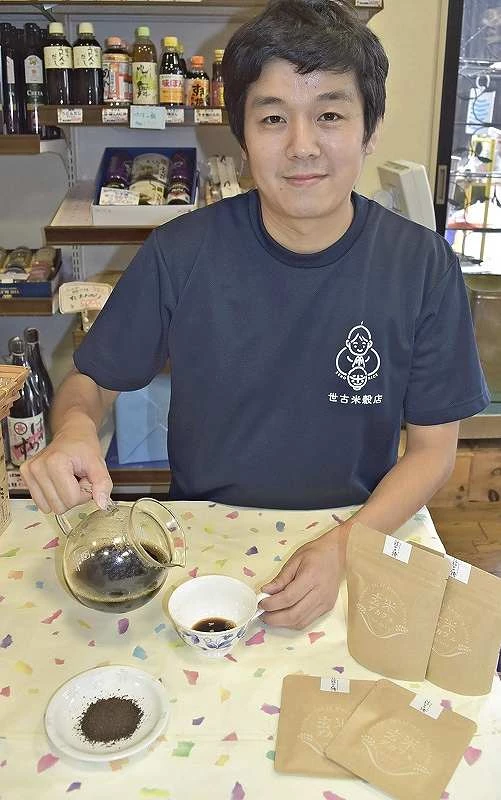
A group of rice dealers in their 30s and 40s released a beverage made from roasted brown rice in September that is being touted as a caffeine-free alternative to coffee.

The Mie Rice Club, which was formed last year by Daisuke Seko from Owase, Shinsuke Ishikawa from Kuwana and Norihide Tominaga from Nabari, organises activities and studies strategies to promote rice, amid a nationwide decline in consumption.

The group began developing a beverage made from brown rice in November last year, focusing on the locally grown Musubi-no-kami brand, which has a light flavour.

With the help of a specialist roaster in Yamagata Prefecture, the group developed a fragrant caffeine-free drink that has the flavour of brown rice and the aroma of grilled mochi.

“I hope this drink will make people want to eat Musubi-no-kami,” said Mie Rice Club member Seko, 37.

Meanwhile, in Kumano, farmer Ta-tsuya Hashimoto has developed noodles made from brown rice that he grows without chemicals.

Hashimoto, 43, began growing rice in a mountainous part of the municipality seven years ago, and last year, enlisted a specialist in Hiroshima Prefecture to help make noodles with his crop.
Japan farmers serve brown rice up as healthy beverages, noodles to boost demand

The noodles contain only brown rice and starch from potatoes, both of which are cultivated without chemicals. They have a light flavour and a firm texture similar to that of regular wheat noodles, making them a good match for Japanese cuisine and dishes from other Asian countries.

“The rice is carefully cultivated and [the noodles are] highly nutritious,” Hashimoto said.

Another noodle made with rice from the prefecture is produced by the Matsuzaka-based “konnyaku” specialist Uenoya, which started developing the product in 2017 and launched its Konnyaku Kahada Men noodles in 2019.

Konnyaku, a gelatinous food product made from a tuber of the same name, comes in various forms, including noodles. Uenoya’s rice noodles contain konnyaku and brown rice grown in the Kahada valley, a natural park in the prefecture.

From the product’s launch until the end of the last year, the company has sold more than 140,000 packs of noodles, which have the aroma of brown rice and the texture of conventional konnyaku noodles.

“With the farmers’ thoughts at the forefront of our minds, we’d like to convey the appeal of rice from this region,” said Uenoya’s Kotaro Sasaki, 44.

The Japan News

Asia News Network

Future leaders discuss human rights on the World Day against the Death Penalty

#SootinClaimon.Com : ขอบคุณแหล่งข้อมูล : หนังสือพิมพ์ The Nation.

https://www.nationthailand.com/world/europe/40021363

Future leaders discuss human rights on the World Day against the Death Penalty

Future leaders discuss human rights on the World Day against the Death Penalty

TUESDAY, OCTOBER 25, 2022

Bangkok, October 25 – On the occasion of the World Day against the Death Penalty, on October 10, 2022, the Delegation of the European Union to Thailand (EU), in collaboration with the Rights and Liberties Protection Department (RLPD) of the Ministry of Justice, organised a dedicated event for university students to enhance their knowledge on human rights and alternatives to capital punishment.

The event reaffirmed the EU’s strong opposition to the death penalty, which is cruel, inhuman and degrading, as well as irreversible and fails to act as a deterrent to crime. It also highlighted Thailand’s commitment to moving towards the abolition of the death penalty as stated in the 4th National Human Rights Plan (2019-2023).

The half-day event, titled “Death Penalty: The Road to Abolition”, was attended by over a hundred undergraduate students from Chiang Mai University, Chulalongkorn University, Mahidol University, Ramkhamhaeng University and Thammasat University.

In her opening remarks, Ms Sara Rezoagli, Chargée d’affaires (a.i.) of the EU Delegation to Thailand, reiterated that “the EU has put the abolition of the death penalty at the very centre of its human rights policy, as we firmly believe that the abolition of capital punishment is essential for the enhancement of human dignity. Death penalty is a violation to the right to life, enshrined in the Universal Declaration of Human Rights. It is irreversible in case of errors and it fails to act as a deterrent of crime. The EU conducts active diplomacy and engages international partners to promote discussion and raise awareness towards the abolition of capital punishment worldwide, as illustrated by this event.”

Ms Sujittra Kaewkrai, Deputy Director-General of the Rights and Liberties Protection Department of the Ministry of Justice, stated that “capital punishment is not a definitive means to eliminate crimes. Therefore, it is crucial to actively raise public awareness and promote better understandings of the adverse impacts of the death penalty among citizens at every age, particularly the young generations who play a key role in the future of change.”

Ms Marta Santos Pais, Commissioner of the International Commission against the Death Penalty (ICDP), delivered a keynote speech to inaugurate the discussion, emphasising the interconnection between the rule of law and abolition, which is reflected in the worldwide trend towards universal abolition. She stressed that “the vast majority of countries have abolished the death penalty, either in law or in practice. And over the recent past, we have witnessed visible progress, with a growing number of States introducing a legal ban on capital punishment and many others pledging to the same goal. Guided by international human rights standards, universal abolition of the death penalty is within reach.”

Prominent experts who took part in the panel were: Ms. Karen Gomez-Dumpit, Executive Committee Member of the Anti-Death Penalty Asia Network (ADPAN) and former Commissioner of the Commission on Human Rights of the Philippines; Dr Kattiya Ratanadilok, Director of Justice Research and Development Institute, Office of Justice Affairs, Ministry of Justice; Dr Mark Charoenwong, Provincial Public Prosecutor, Office of Chiang Rai Provincial Juvenile and Family Litigation; and Dr Khemthong Tonsakulrungruang, lecturer of the Faculty of Political Science, Chulalongkorn University.

The discussion, moderated by Ms Sanhawan Srisod, Legal Adviser of the International Commission of Jurists (ICJ), took stock of the global trend in favour of abolition. More than two thirds of all countries, including all EU Member States, have abolished the death penalty in law or in practice. The panel also touched upon the situation in Southeast Asia. Cambodia and the Philippines have officially abolished the death penalty, while Laos and Brunei have practically done so, having not carried out executions in decades. Malaysia has also announced plans to abolish it. Singapore and Myanmar, however, resumed executions in 2022.

“The anti-death penalty movement should watch closely and respond quickly to all actions that may cause a reversal in the trend towards universal abolition. Case in point is the Philippines, even with ratification of the Second Optional Protocol Aiming at the Abolition of the Death Penalty, the anti-death penalty collective must remain watchful. The ASEAN Region has recently seen such reversals with trials and executions negatively impacting on the rule of law and respect for human rights. Cross-regional cooperation around these reversals is needed to reach universal abolition in both law and practice,” said Ms Karen Gomez-Dumpit.

In Thailand, current law allows capital punishment for 60 offences, though it is rarely carried out, with restrictions on who can be sentenced to death, such as pregnant women and anyone under eighteen. Furthermore, the number of people under sentence of death continued to decrease significantly for the third consecutive year.

The event was facilitated by European Union Policy and Outreach Partnership (EUPOP) with the financial support of the European Union.

Winter expected to begin from Oct 29 and last until Feb-end

#SootinClaimon.Com : ขอบคุณแหล่งข้อมูล : หนังสือพิมพ์ The Nation.

https://www.nationthailand.com/thailand/general/40021418

Winter expected to begin from Oct 29 and last until Feb-end

Winter expected to begin from Oct 29 and last until Feb-end

WEDNESDAY, OCTOBER 26, 2022

Winter is expected to arrive in Thailand on Saturday (October 29), two weeks later than normal, the Thai Meteorological Department said on Wednesday.

The department said Thailand can expect cold weather until late February, adding that the temperature would drop to the lowest point between December this year and January next year.

“The temperature on mountain peaks and hilltops may drop to as low as 8 degrees Celsius,” the department said, “Greater Bangkok, meanwhile, can expect lows of 17 to 19 degrees Celsius.”

The department added that the weather in some areas of the upper South would be cold on some days.

Winter expected to begin from Oct 29 and last until Feb-end

The met department will hold a press conference on the arrival of winter on Friday (October 28).

Toyota leads the field as auto sales rev up in the first nine months of the year

#SootinClaimon.Com : ขอบคุณแหล่งข้อมูล : หนังสือพิมพ์ The Nation.

https://www.nationthailand.com/thailand/economy/40021413

Toyota leads the field as auto sales rev up in the first nine months of the year

Toyota leads the field as auto sales rev up in the first nine months of the year

WEDNESDAY, OCTOBER 26, 2022

The domestic automotive market has grown 19 per cent year on year in the first nine months of 2022 with total sales of 633,687 vehicles, in line with the continuous recovery of the economy from the impact of the Covid-19 pandemic.

The Automotive Industry Club of the Federation of Thai Industries (FTI) reported on Tuesday that 74,150 vehicles were sold in September alone, a 15.6 per cent jump from the previous month.

Toyota dominates Thailand’s auto market with 208,619 units sold in nine months, growing 25.3 per cent year on year.

Isuzu was second with 163,627 units sold, growing 24.4 per cent. Honda is in third place with 61,281 units sold this year, down 0.1 per cent year on year.

Notably, EV and hybrid manufacturer Great Wall Motor was in 10th place, enjoying a whopping 614.4 per cent growth year on year with 8,094 units sold.

Surasak Suthongwan, executive vice president of Toyota Motor Thailand, said that the surge in growth in the domestic auto market was due to manufacturers introducing new models while offering sales promotional campaigns, as the Covid-19 situation in Thailand is continually improving since the start of the fourth quarter.

FTI auto club vice president and spokesman Surapong Paisitpattanapong added that the easing of travel restrictions had boosted domestic travel, product transport, and influx of foreign investors, thus increasing the demand for vehicles among businesses and consumers.

“Furthermore, the manufacturing and import of automotive parts have met delivery targets this year, thus allowing the uninterrupted production of new vehicles in the market,” said Surapong.

The FTI would release its updated estimates on automotive output in 2022 at the end of October, he said.

Thailand’s exports in September grow 7.8 per cent but higher import bill widens trade deficit

#SootinClaimon.Com : ขอบคุณแหล่งข้อมูล : หนังสือพิมพ์ The Nation.

https://www.nationthailand.com/thailand/economy/40021408

Thailand’s exports in September grow 7.8 per cent but higher import bill widens trade deficit

Thailand’s exports in September grow 7.8 per cent but higher import bill widens trade deficit

WEDNESDAY, OCTOBER 26, 2022

Thailand’s exports expanded by 7.8 per cent year on year in September with a total value of US$24.919 billion, Deputy Prime Minister and Commerce Minister Jurin Laksanawisit said on Wednesday.

Jurin said imports in September had a total value of $25.772 billion, an increase of 15.6 per cent, compared to the same month last year.

Jurin said Thailand had a trade deficit of $853.2 million in September.

During the first nine months of this year, Thailand’s exports were valued $221.366 billion, a 10.6 per cent increase compared to the same period last year.

Imports from January to September were valued at $236.351 billion, a 20.7 per cent increase year on year, Jurin said, adding that the deficit during the first nine months stood at $14.984 billion.

The minister added that there was still room for export growth for the rest of this year and that exports would drive the Thai economy to grow by 4 per cent as targeted this year.

Thailand could soon become world’s top pet food exporter: Jurin

#SootinClaimon.Com : ขอบคุณแหล่งข้อมูล : หนังสือพิมพ์ The Nation.

https://www.nationthailand.com/thailand/economy/40021407

Thailand could soon become world’s top pet food exporter: Jurin

Thailand could soon become world’s top pet food exporter: Jurin

WEDNESDAY, OCTOBER 26, 2022

Thailand aims to surpass Germany and United States as world leader in pet food exports after seeing an over 34 per cent growth year on year in the first nine months of 2022.

Commerce Minister Jurin Laksanawisit said on Wednesday that from January to September this year, pet food exports had reached 74.97 billion baht, increasing 34.4 per cent year on year and was on the rise for 37 consecutive months.

United States is the biggest market (21.5 billion baht) followed by Japan (8.41 billion baht) and Italy (4.82 billion baht). Dog and cat foods dominate total exports at 65.27 billion baht, while 9.7 billion baht are from foods for other animals.

Thailand could soon become world’s top pet food exporter: Jurin

“Currently Thailand is the world’s third largest pet food exporter behind Germany and the US. Our products target both middle and upper markets, especially in the functional food sector for owners of alternative pets,” he said. “Thai products meet international safety standards with a manufacturing process that ensures environmental sustainability, which help establish trust in quality among global pet owners.”

“With continued support from the government and close cooperation between the ministry and the Thai Pet Food Trade Association [TPFA], I am confident that soon Thailand will take the lead and become the world’s biggest pet food exporter,” said Jurin.

Thailand could soon become world’s top pet food exporter: Jurin

Jurin was speaking at the Pet Fair Southeast Asia 2022, which will be held until Friday (October 28) at Bangkok International Trade & Exhibition Centre in Bangna, Bangkok.

TPFA, who organised the fair for the first time in Thailand since its establishment in 2019, said over 150 companies from 35 countries will be opening product and service booths. It estimated more than 1.3 billion baht worth of business deals will be achieved at the fair among over 3,000 participants.

Thailand could soon become world’s top pet food exporter: Jurin

Jurin added that his ministry and the TPFA will seek cooperation from the Thai Chamber of Commerce and the Federation of Thai Industries in hosting the pet fair in the coming years on a larger scale, aiming to become an international event for pet lovers from around the world.

Thailand could soon become world’s top pet food exporter: Jurin

Thai business councils say Xi’s 3rd term will benefit trade, investment

#SootinClaimon.Com : ขอบคุณแหล่งข้อมูล : หนังสือพิมพ์ The Nation.

https://www.nationthailand.com/thailand/economy/40021403

Thai business councils say Xi’s 3rd term will benefit trade, investment

Thai business councils say Xi’s 3rd term will benefit trade, investment

WEDNESDAY, OCTOBER 26, 2022

The Federation of Thai Industries (FTI) and the Thai Chamber of Commerce (TCC) welcomed Xi Jinping retaining the post of Chinse president for a third term, saying it would lead to a continuity in policies that would benefit Thai businesses.

The positive reactions were expressed by FTI president Kriengkrai Thiennukul and TCC chairman Sanan Angubolkul.

Xi was confirmed as leader for a third term after a week-long meeting of the ruling Chinese Communist Party strengthened his political hand.

Kriengkrai said Xi would continue to bring about stability in China’s foreign and economic policies.

The FTI chief said only aged administrators in the Chinese government were replaced.

He said with Xi continuing to lead China, the Asian superpower would become the globe’s technology leader by 2035.

Thailand expects Beijing to ease its anti-Covid measures next month and to see Chinese tourists return late this year, but reports have it that the Communist government would continue its stringent Zero-Covid policy until March, Kriengkrai said.

The FTI president added that Xi’s continued leadership and the on-going trade war between China and the United States would continue to benefit Thailand.

The trade war has prompted Chinese investors to seek new manufacturing bases, especially in Southeast Asia, Kriengkrai said.

“This was reflected in the ratio of foreign direct investments, which showed China was top on the list of foreign investors in the kingdom,” he noted.

Once Beijing eases its Zero-Covid policy, more Chinese investors would travel to Thailand, Kriengkrai believed.

He said Chinese tended to invest in electrical vehicle manufacturing and high-tech industries in the kingdom.

“Thailand remains the top choice for Chinese investors because of good ties between the two countries. Chinese investors love the investment environment in Thailand and we believe more investments will flow from China into Thailand, but it would also depend on the geopolitical situation between China and the US,” Kriengkrai hastened to add.

Sanan said he believed Xi retaining the leadership would benefit both Chinese and Thai economies because China would continue its trade, investment and tourism policies.

Thailand would benefit from a Chinese recovery and this would play a part in helping the Thai economy expand by at least 4 per cent, Sanan said.

He noted that China’s economy had been growing at the rate of between 6 and 9 per cent, but dropped to 2 per cent because of its Zero-Covid policy. Yet the policy was still positive because it showed Beijing was serious about controlling the outbreak.

Sanan said the TCC expects more than 5 million Chinese tourists to return to Thailand next year once that country fully reopens.

Chinese are the biggest group who have invested in Thailand with several big corporations investing in the kingdom, Sanan pointed out.

For example, he said, BYD decided to invest in EV manufacturing in Thailand and several other Chinese firms, including medical equipment manufacturers, will use Thailand as a supply chain.

Sanan added that the Thai government has improved the law to make it more convenient for foreign investors to buy land so that they can use the kingdom as a strategic area linking other Asean countries.

True-Dtac merger will benefit customers, insists NBTC former vice-chairman

#SootinClaimon.Com : ขอบคุณแหล่งข้อมูล : หนังสือพิมพ์ The Nation.

https://www.nationthailand.com/thailand/economy/40021395

True-Dtac merger will benefit customers, insists NBTC former vice-chairman

True-Dtac merger will benefit customers, insists NBTC former vice-chairman

WEDNESDAY, OCTOBER 26, 2022

The former vice-chairman of the National Broadcasting and Telecommunications Commission (NBTC) said he agreed with the True-Dtac merger because it is “based on laws and will be beneficial to consumers”.

The NBTC last week voted 3:2 to “conditionally acknowledge” a planned merger between True Corporation and Total Access Communications (Dtac) after nine months of deliberation.

Colonel Settapong Malisuwan, the vice-chairman of the House committee on communications, telecommunications and digital economy and society and former NBTC vice-chairman, said on Tuesday that the NBTC had taken a step in the “right direction” as it had followed the laws and regulations while also being non-discriminatory.

Settapong said the process needed to follow the 2018 NBTC regulation on mergers, which allows businesses wishing to merge to only notify the regulator, not seek its approval.

He said the 2006 anti-monopoly directive that requires businesses to seek approval has been cancelled.

“This decision by the NBTC will be the right norm for working under the laws. All cases must be considered equally and be non-discriminatory. When we have rules and regulations, we must follow them.”

Settapong mentioned that the True-Dtac merger was not the first under the 2018 NBTC regulation. It had been enforced when he was the NBTC’s vice-chairman. He said there have been nine previous mergers.

He explained that the NBTC must be informed according to the law as the latest planned merger was an amalgamation under the 2018 NBTC regulation. The companies must send a report to the commission and inform its secretary-general for at least 90 days about developments, he added.

True-Dtac merger will benefit customers, insists NBTC former vice-chairman

Settapong said the NBTC clearly has the power to set conditions or measures for mergers to protect the public.

He believed customers will benefit from certain conditions (a price ceiling and price controls) and this could be applied to all players in the industry for fairness.

However, Settapong said the NBTC must release follow-up regulations and monitor the merger so it will be beneficial to the public. The commission must also step in immediately if the merger affects people’s rights, he made it clear.

As for concerns about monopoly or high service prices, he said all operators must follow laws and regulations and they cannot fix prices freely.

Thai, Lao PMs to lay foundation stone for new Mekong bridge

#SootinClaimon.Com : ขอบคุณแหล่งข้อมูล : หนังสือพิมพ์ The Nation.

https://www.nationthailand.com/thailand/economy/40021391

Thai, Lao PMs to lay foundation stone for new Mekong bridge

Thai, Lao PMs to lay foundation stone for new Mekong bridge

WEDNESDAY, OCTOBER 26, 2022

The foundation stone for the fifth Thai-Lao Friendship Bridge will be laid by the prime ministers of both countries on October 28.

Government spokesperson Anucha Burapachaisri said on Tuesday that Prime Minister General Prayut Chan-o-cha will travel to Bueng Kan province on Friday to participate in the foundation stone laying ceremony of Thai-Lao Friendship Bridge No 5 together with his Lao counterpart Phankham Viphavanh.

The bridge running over Mekong River will connect Bueng Kan’s Muang district with Laos’s Bolikhamsai province. It has a total length of 1.35 kilometres – 0.815km on Thai territory and 0.535km on the Laos side. It will serve as another transport route that links Thai-Lao-Vietnam Highway R8, which terminates in China’s Guangxi region, and promote key cross-border trading among the four countries.

Construction work began in June 2020 and is expected to be completed in April 2024.

The 3.65-billion-baht project covers the construction of roads, a customs checkpoint, a concrete bridge, and a multi-purpose area under the bridge.

Anucha said talks to hold the foundation stone laying ceremony took place during Phankham’s official visit to Thailand in June.

He added that after the ceremony Prayut will discuss bi- and multi-lateral ties with Phankham.

Baht could continue strengthening: market strategist

#SootinClaimon.Com : ขอบคุณแหล่งข้อมูล : หนังสือพิมพ์ The Nation.

https://www.nationthailand.com/thailand/economy/40021385

Baht could continue strengthening: market strategist

Baht could continue strengthening: market strategist

WEDNESDAY, OCTOBER 26, 2022

The baht opened at 38.05 to the US dollar on Wednesday, strengthening from Tuesday’s close of 38.29.

The currency will likely move between 37.90 and 38.15 against the greenback during the day, Krungthai market strategist Poon Panichpibool predicted.

He said the baht had strengthened faster than expected because the dollar declined as the market was in a risk-on state.

If the market continues to be open to more risks, foreign investors might come back to purchase Thai stocks and this would support the baht’s strengthening, Poon said.

However, he speculated that the strengthening of the Thai currency would be limited to between 37.80 and 37.90 to the dollar as importers were gradually purchasing the dollar now that the month is drawing to a close.

Furthermore, some big investors have returned to a “wait and see” state as they closely watch results of key central bank meetings involving the European Central Bank and the Bank of Japan at the end of the week.

Poon advised investors to use hedging tools such as options to manage risks in a highly volatile currency market.