
Remdesivir can help keep unvaccinated, high-risk people with covid-19 out of the hospital, study finds

#SootinClaimon.Com : ขอบคุณแหล่งข้อมูล : หนังสือพิมพ์ The Nation.

https://www.nationthailand.com/international/40010307


The antiviral drug remdesivir can help keep unvaccinated people at risk of severe covid-19 out of the hospital, according to a new study that found the treatment reduced hospitalization and death by 87% when given soon after diagnosis.

Remdesivir can help keep unvaccinated, high-risk people with covid-19 out of the hospital, study finds

Early in the coronavirus pandemic, remdesivir, an infusion therapy developed by Gilead Sciences, was the first coronavirus treatment authorized by federal regulators for use in hospitals. Wednesday’s study, published in the New England Journal of Medicine, is the first to show that remdesivir can be useful when given on an outpatient basis in the community.

The findings are based on research that predates the delta variant that proliferated during the summer and omicron, the variant spreading with great speed globally. But the study’s main author and other researchers said remdesivir is likely to remain effective even as omicron proves resistant to most medicines in a group known as monoclonal antibodies that have helped prevent people from needing to be hospitalized. Many hospitals are bulging with patients and short on staff.

The study focused on unvaccinated patients, the group most likely to become seriously ill or die if infected.

“If you are going to be a skydiver and jump out of your own plane, it’s best to pack a primary chute as well as a secondary chute,” said the study’s principal investigator, Robert L. Gottlieb, the therapeutic lead for covid-19 research at Baylor Scott & White Health, a medical system in Dallas.

“Vaccines are a primary chute,” Gottlieb said, while therapies such as remdesivir “are the secondary chute.”

Shyam Kottilil, director of the division of clinical care and research at the University of Maryland School of Medicine’s Institute of Human Virology, said, “Infectious-disease doctors would really like to treat people for covid-19 outside the hospital. Any measure that would accomplish that is really beneficial.”

Kottilil, co-author of an editorial in the New England Journal of Medicine accompanying the study, cautioned that the findings do not establish how well remdesivir would work early on with coronavirus patients who are vaccinated and boosted but experience breakthrough infections.

Another limitation of the findings, he said, is that remdesivir is administered by infusion, and it could be cumbersome for sick patients to go to a location to get such treatment three days in a row. The three-day regimen is shorter than the treatment period in earlier research into the drug. Still, Kottilil said, “We would rather have something by mouth, that would be an easier medication to take.”

The Food and Drug Administration on Wednesday authorized the first antiviral pill to treat covid-19, a drug known as Paxlovid developed by Pfizer that must be taken shortly after symptoms develop.

And Tuesday, scientists from the Johns Hopkins Bloomberg School of Public Health and Johns Hopkins University School of Medicine published data from a clinical trial suggesting that convalescent plasma, taken from blood donated by people who have recovered from the virus, could be effective against omicron when given to outpatients soon after becoming infected.

The remdesivir findings were based on a study, sponsored by Gilead, involving 562 unvaccinated covid-19 patients from September 2020, to April, who were randomly selected to receive the three-day infusion therapy or a placebo. The trial initially was designed to include more than twice as many patients but was halted early once monoclonal treatments were available and vaccines had become more widely accessible. With those options available, giving half the study participants a placebo seemed unwise.

All the participants were at high risk for developing a severe case because they were 60 or older or had at least one other condition that makes covid-19 more dangerous, such as high blood pressure, cardiovascular disease, diabetes or obesity.

Nearly a month after joining the study, two of 279 people treated with remdesivir were hospitalized for reasons related to covid-19, compared with 15 of 283 who received the placebo. No one in either group died within that time frame.

Overall, the risk of hospitalization or death – the main outcomes the study set out to measure – was 87% lower in the group that got the treatment.

Symptoms also eased more quickly with the treatment, with 36% of those getting remdesivir reporting improved symptoms by the end of the study’s second week, compared with 20% among those who did not.

On the other hand, the amount of virus in patients’ bodies – known as the viral load – did not differ depending on whether people were treated.

Gottlieb, the principal investigator, said the FDA has the study’s data. Because the drug has full FDA approval, doctors already may prescribe it for other uses. This week, the European Commission widened its “conditional marketing approval” of remdesivir, marketed as Veklury, to include high-risk patients beyond those who need extra oxygen while in the hospital, Gilead announced.

Gottlieb said that, early in the pandemic, people who had the virus but were not sick enough to be in a hospital were advised to quarantine at home.

“The message for going into 2022,” Gottlieb said, is that people with covid-19 and any risk factors for a serious case should “perform a more active quarantine” by contacting their doctor quickly to find out whether treatment is available that could prevent them from becoming seriously ill or dying.

Published : December 23, 2021

By : The Washington Post
Israel says it will become first nation to offer fourth coronavirus vaccine dose

#SootinClaimon.Com : ขอบคุณแหล่งข้อมูล : หนังสือพิมพ์ The Nation.

https://www.nationthailand.com/international/40010306


TEL AVIV, Israel – In what its calling a global first, Israels Health Ministry on Tuesday announced that it will offer a fourth coronavirus vaccine shot to citizens 60 and older and other at-risk groups as concerns about the omicron variant proliferate.

Israel says it will become first nation to offer fourth coronavirus vaccine dose

Prime Minister Naftali Bennett said he ordered the government to immediately prepare for distributing fourth doses.

“As we did with the booster in the delta surge, we intend to be active and groundbreaking, and do everything to win,” he tweeted. “The world will follow us.”

The Health Ministry’s advisory committee recommended a fourth dose to people 60 and older, those with compromised immune systems, and health-care workers. It required all eligible recipients to have gone four months since their third dose.

The Health Ministry has reported 341 confirmed, and hundreds more suspected, cases of the omicron variant as of Tuesday, citing a “fifth wave” of coronavirus infections.

News of a fourth dose comes the same day as a hospital in the country announced its first omicron-related death. Soroka Hospital, in the southern city of Beersheba, said a 65-year-old patient died after two weeks of hospitalization.

The man reportedly had a host of medical conditions that contributed to his death.

“His morbidity stemmed mainly from preexisting sicknesses and not from respiratory infection arising from the coronavirus,” the hospital said in a statement.

He had received only two vaccine doses, and more than six months had elapsed since receiving the second dose, according to Israeli media outlets.

On Tuesday, Israel’s coronavirus cabinet also approved new restrictions, including limits on crowd sizes in shopping centers and on in-office employees in the public sector.

Health Ministry officials have estimated that the omicron variant makes up between 10% and 15% of all coronavirus infections in Israel. They expect it to be the dominant variant in Israel within two weeks.

The ministry has said that the majority of omicron cases had come from travelers who returned from abroad. On Monday, Israel added 10 countries, including the United States and Canada, to its “red list,” which also includes several European countries and almost all of Africa.

Travel from Israel to red countries is forbidden without permission from a special committee. Israeli citizens flying from a red country must enter a seven-day quarantine even if they are fully vaccinated. Entry of noncitizens has been banned since last month.

The definition for “fully vaccinated” in Israel requires travelers to be 12 years or older and have received a booster shot at least one week prior or be within six months of having received a second vaccination shot. Last month, Israel opened up vaccinations to children as young as 5.

In January, Israel launched the world’s most rapid and widely reaching immunization campaign through the mobilization of its well-organized, meticulously digitized national health-care system.

Last month, Health Minister Nitzan Horowitz said Israel’s decision to begin offering booster shots in July, as the delta variant was spreading across the globe but before they were authorized by the U.S. Food and Drug Administration, was “justified.”

Clalit, Israel’s largest HMO, has found that a third shot of the Pfizer-BioNTech vaccine is 92% effective in preventing serious illness and 93% effective in preventing hospitalization, compared with waning protection from only two doses, according to a large-scale study published in the Lancet medical journal in October.

Out of a population of 9.3 million, 6.4 million have received their first shot, 5.8 million their second and 4.1 million their third, according to the Health Ministry.

Israel has recorded at least 8,235 coronavirus deaths since the start of the pandemic.

Published : December 23, 2021

By : The Washington Post

AstraZeneca and Oxford making version of coronavirus vaccine that targets omicron

#SootinClaimon.Com : ขอบคุณแหล่งข้อมูล : หนังสือพิมพ์ The Nation.

https://www.nationthailand.com/international/40010305


AstraZeneca and Oxford University have started developing a version of their coronavirus shot that targets omicron, as researchers study the efficacy of existing vaccines against the latest variant.

AstraZeneca and Oxford making version of coronavirus vaccine that targets omicron

“Together with Oxford University, we have taken preliminary steps in producing an Omicron variant vaccine, in case it is needed and will be informed by emerging data,” the AstraZeneca pharmaceutical company based in England said in an email.

The World Health Organization says omicron is spreading faster than the delta variant, though the extent to which it causes severe illness remains unclear. U.S. biotech firm Moderna and pharmaceutical giant Pfizer, along with its German partner BioNTech, have said they are tailoring their shots and working to understand the level of protection they provide.

The Oxford-AstraZeneca vaccine, widely used in European countries and others such as Canada and India, is not approved in the United States.

“Like with many previous variants of concern . . . we have taken preliminary steps in producing an updated vaccine in case it is needed,” Sandy Douglas, who leads a vaccine manufacturing research group at Oxford, told the Financial Times earlier on Tuesday.

He said adenovirus-based vaccines, such as the Oxford-AstraZeneca shot, “could in principle be used to respond to any new variant more rapidly than some may previously have realized.”

The head of the European medicines regulator, Emer Cooke, has said it would take time to reach a consensus on the need for variant-specific vaccines. She added that AstraZeneca had not applied so far for its shot to be used as a booster in the European Union, which along with Britain has largely used Pfizer and Moderna’s mRNA vaccines as boosters. The United States is also using Pfizer and Moderna along with the vaccine from Johnson & Johnson.

Global health officials, who say vaccines remain the best tool to combat the virus, have urged people to get boosters if they can, while the spread of omicron has highlighted inequality in access to vaccines worldwide.

Moderna said earlier this week that a booster dose of its vaccine significantly raised antibody levels against the omicron variant, according to preliminary data, though it did not have the clinical data to speak to its vaccine’s protection against hospitalization or death.

Douglas and his team have published a preprint paper, which has not yet undergone a peer review, outlining the feasibility of producing a vaccine at large scale after a new virus is identified, which they said could enable making millions of doses within 100 days. The Oxford team said the research shows the potential “speed and volume of production of adenovirus-vectored vaccines against new virus variants or other future pandemics.”

Published : December 23, 2021

By : The Washington Post

U.S. moves to expand Afghan aid in hopes of easing humanitarian crisis

#SootinClaimon.Com : ขอบคุณแหล่งข้อมูล : หนังสือพิมพ์ The Nation.

https://www.nationthailand.com/international/40010304


The Treasury Department on Wednesday issued new licenses to loosen sanctions restrictions on assistance to Afghanistan, following a wave of appeals from aid organizations, lawmakers and others to prevent economic collapse and mass starvation.

U.S. moves to expand Afghan aid in hopes of easing humanitarian crisis

The licenses expand the definition of allowed humanitarian assistance to education, including salary payments to teachers, and permit a broader use of U.S. funds received by aid organizations working inside the country.

The United Nations and international financial institutions have warned that prohibitions of economic dealings with the Taliban, and the freezing of Afghanistan’s $10 billion in foreign reserves – most of it held in the United States – have brought the country to the brink of disaster.

The Biden administration, joined by much of the world, has said that the militant government that took over the country in August cannot be recognized unless it ensures the human and civil rights of all Afghanistans, including minorities and women, and breaks ties with terrorist organizations such as al-Qaida.

But the abrupt cessation of foreign-aid funding that provided 40% of all government revenue and more than 75% of all public spending has brought most banking and commerce to a halt and left many without jobs or working without paychecks amid a prolonged drought, the ravages of the coronavirus pandemic and the onset of Afghanistan’s harsh winter.

Last week, dozens of U.S. lawmakers and former top U.S. military and diplomatic officials who served in Afghanistan joined the United Nations and humanitarian organizations in appealing for changes in administration policy.

In Islamabad Monday, Martin Griffiths, the U.N. undersecretary for humanitarian affairs, told a special session of the Organization of Islamic Cooperation foreign ministers that Afghanistan’s economy was in “free-fall” and warned that “if we don’t act decisively and with compassion” it would “pull the entire population with it.”

While the humanitarian response in terms of food, shelter and medical supplies sent to Afghanistan were crucial, Griffith said, it was not enough. He called for flexible donor funding that could be used to pay salaries for public sector workers and support basic services including health, education, electricity and livelihoods.

Addressing the meeting, convened especially to discuss the Afghanistan situation, Pakistani Prime Minister Imran Khan called the crisis “man-made,” and said it is “being created despite knowing that it can be averted if [Afghanistan’s U.S.-based] accounts are unfrozen and liquidity is put into their banking system.”

The OIC set up a special fund for Afghanistan, and urged member states to contribute.

Secretary of State Antony Blinken told reporters Tuesday that the administration is “looking intensely at ways to put more liquidity into the Afghan economy, to get more money into people’s pockets, and doing that with international institutions, with other countries and partners, trying to put in place the right mechanisms to do that in a way that doesn’t directly benefit the Taliban but does go directly to the people.”

The Treasury actions announced Wednesday expand on earlier measures authorizing noncommercial cash remittances to individuals in Afghanistan, and assurances issued to the international commercial banking community that many transactions with Afghanistan could continue without violating U.S. sanctions.

The United Nations Security Council on Wednesday also unanimously approved a U.S.-sponsored resolution, effective for one year, that largely duplicated the Treasury actions. The Taliban is sanctioned as an organization, as are about 130 members of its leadership.

According to a Treasury Department fact sheet, the sanctions do not “prohibit the export or reexport or goods or services to Afghanistan, moving or sending money into and out of Afghanistan, or activities in Afghanistan, provided that such transactions or activities do not involve sanctioned individuals, entities or property in which sanctioned individuals and entities have an interest.”

Newly authorized transactions, it said, “explicitly do not authorize financial transfers to the Taliban or the Haqqani Network,” an affiliated organization.

The United Nations has appealed for funding to expand a program it set up in October to pay the salaries of tens of thousands of health care workers, with money going directly to them and not through the Taliban government.

“It’s taken time to figure out the mechanisms,” said a senior Biden administration official, speaking on the condition of anonymity under rules set by the administration. “As the situation evolves, we’re going to find new ways to assist.”

Officials have said the administration is not currently considering unfreezing Afghanistan’s frozen reserve funds, noting that they are the subject of litigation by victims of the Sept. 11, 2001 terrorist attacks and have been attached by federal courts.

Published : December 23, 2021

By : The Washington Post

South Africas huge omicron wave appears to be subsiding just as quickly as it grew

#SootinClaimon.Com : ขอบคุณแหล่งข้อมูล : หนังสือพิมพ์ The Nation.

https://www.nationthailand.com/international/40010303


NAIROBI, Kenya – South Africas huge wave of omicron cases appears to be subsiding just as quickly as it grew in the weeks after the country first announced to the world that a new coronavirus variant had been identified.

South Africas huge omicron wave appears to be subsiding just as quickly as it grew

South Africa’s top infectious-disease scientist, who has been leading the country’s pandemic response, said Wednesday that the country had rapidly passed the peak of new omicron cases and, judging by preliminary evidence, he expected “every other country, or almost every other, to follow the same trajectory.”

“If previous variants caused waves shaped like Kilimanjaro, omicron’s is more like we were scaling the North Face of Everest,” Salim Abdool Karim said in an interview, referring to the near-vertical increase in infections that South Africa recorded in the first weeks of December.

“Now we’re going down, right back down, the South Face – and that is the way we think it may work with a variant like omicron, and perhaps even more broadly what we’ll see with subsequent variants at this stage of the pandemic,” he said.

Just a week ago, South Africa was seeing skyrocketing positivity rates and massive lines for testing. But during the first days of this week, there has been a turnaround in rates and stress on testing facilities. In addressing the surge of infections, South Africa had decided not to impose a lockdown or other major restrictions, although many countries, including the United States, imposed restrictions on travelers originating in South Africa and neighboring countries.

On Monday, the United States’ top infectious-disease expert, Anthony Fauci, said the Biden administration was considering lifting those travel restrictions, given that community spread of the variant was occurring in many countries.

“We likely are going to pull back on that pretty soon because we have enough infections in our own country,” Fauci told reporters at the National Press Club. “We’re letting in people from other countries that have as much or more infection than the Southern African countries. So [it is] likely we are going to look at that very carefully to see if we can pull back.”

Also on Wednesday, South Africa’s National Institute for Communicable Diseases released a study – not yet peer-reviewed – that bolstered earlier findings from the country that omicron was causing fewer hospitalizations and instances of severe side effects than previous coronavirus variants.

The study found that the omicron variant was 80% less likely to lead to hospitalization than the delta variant and that for patients who were hospitalized, the risk of severe illness was 30% lower.

Karim said that both the quick peaking of cases and omicron’s lower severity could be due to multiple country-specific factors in South Africa, the most prominent being that more than 70% of South Africans have been infected by previous variants, probably giving a greater proportion of the population a more robust antibody response.

“In South Africa, variants, even highly mutated ones, will run out of people pretty quickly,” he said. “Pretty much by the end of last week it was running out of steam; there just aren’t enough people left to infect.”

Karim noted that omicron accounted for nearly every new coronavirus case in South Africa last week. Recent data from the United States showed that more than 70% of new U.S. cases were caused by the variant.

“By the time we knew about it, it was fully established,” Karim said. “Based on the proportion of sequences that come back as omicron, I’d say we are probably between two and three weeks ahead of the U.S., about two ahead of Norway and Denmark, and substantially ahead of, probably up to four weeks, the U.K. and the rest of Europe. But what we’re seeing here in South Africa at least tentatively should be good news for everyone.”

Biden administration officials have closely studied the South Africa data, looking for clues about omicron case growth and the severity of infections, said three officials involved with the U.S. coronavirus response.

While the early South African results are heartening, with hospitalizations increasing far less than the overall case count, the officials cautioned that it remains too early to base U.S. policy on the overseas data alone because of differences in demographics and other factors. For instance, a greater proportion of South Africans have likely been infected by earlier strains of coronavirus than Americans and may retain more protection against omicron as a result, two officials said.

“Data from South Africa is critical. Data from South Africa, the Netherlands, the United Kingdom, and New York paint a more complete picture,” said an official who was not authorized to comment on the record.

Since South African scientists announced the detection of the omicron variant less than a month ago, European governments have imposed new restrictions, in part because most of the data and research on omicron is so new and unproved.

In Britain and elsewhere in Europe, a dramatic increase in omicron infections has prompted a wave of travel restrictions and lockdowns. In Britain, scientists warned that without stricter measures, infections could reach 600,000 to 2 million cases a day by the end of this month.

Denmark, considered by health officials to be a test case for highly vaccinated countries, also has experienced a massive rise in case numbers, unlike in previous waves. Scientists say this is due in part to omicron’s higher transmissibility.

Published : December 23, 2021

By : The Washington Post

Real-world data from U.K. suggests omicron is less likely than delta to send people to the hospital

#SootinClaimon.Com : ขอบคุณแหล่งข้อมูล : หนังสือพิมพ์ The Nation.

https://www.nationthailand.com/international/40010302


LONDON – Researchers looking at real-world coronavirus cases in Britain reported Wednesday that the omicron variant appears to be less severe than the once dominant delta strain.

Real-world data from U.K. suggests omicron is less likely than delta to send people to the hospital

Early evidence from Scotland and England suggests that omicron is sending fewer people to the hospital with severe symptoms.

That surveillance tracks well with the latest observations from South Africa, where public health officials have reported that omicron is tending to result in milder illness. Scientists had not been sure whether that finding would hold elsewhere.

“This is a qualified good news story,” said Jim McMenamin, National Covid-19 Incident Director at Public Health Scotland and one of the co-authors of the Scottish study.

Public health experts remain worried that a sudden, massive surge of a highly infectious but less virulent omicron variant could still flood hospitals with very sick patients. New daily coronavirus cases recorded in Britain exceeded 100,000 on Tuesday for the first time in the pandemic.

Prime Minister Boris Johnson has said his government is watching the data but would not call for stricter measures to fight spread until after Christmas at the earliest.

The early research from Scotland was led by the scientists at the University of Edinburgh, in a well-vaccinated population not too different from the United States. The study, which has not yet been peer reviewed, found that people infected with omicron were almost 60% less likely to enter the hospital than those infected with delta, the dominant strain around the world for much of 2021.

The Scottish scientists said recently vaccinated people appear to have some protection against symptomatic infection from omicron, but less so than against delta. A third dose or booster of an mRNA vaccine was associated with a 57% reduction in the odds of developing symptomatic covid. Boosters gave better protection against the delta variant – more than 80%.

The researchers estimated the potential for reinfection 10 times more likely with omicron than with delta.

The numbers they were working with were small but statistically significant, they said – if omicron acted the same as delta, they would expect 47 people to have been admitted to hospital so far. Currently, there are only 15.

The scientists said there were not enough omicron infections and hospitalizations among those over 60 years to reach confident conclusions, but they expected the overall trend would hold.

The evidence that omicron was causing less severe illness in England came out of Imperial College London.

That group, led by Neil Ferguson, reported that those infected by omicron were 15 to 20% less likely to go to an emergency room with severe symptoms and 40% less likely to be hospitalized overnight, when compared to those infected by delta.

Ferguson also urged caution.

“Our analysis shows evidence of a moderate reduction in the risk of hospitalization associated with the omicron variant compared with the delta variant,” he said. “However, this appears to be offset by the reduced efficacy of vaccines against infection with the omicron variant.”

Ferguson stressed that given the high transmissibility of the omicron virus, “there remains the potential for health services to face increasing demand if omicron cases continue to grow at the rate that has been seen in recent weeks.”

South Africa’s top infectious-disease scientist, who has been leading the country’s pandemic response, told The Washington Post on Wednesday that the country had rapidly passed the peak of new omicron cases and, judging by preliminary evidence, he expected “every other country, or almost every other, to follow the same trajectory.”

South Africa, though, has a younger average age than countries in Europe or the United States, and it was not in the middle of a delta surge when omicron arrived.

Published : December 23, 2021

By : The Washington Post

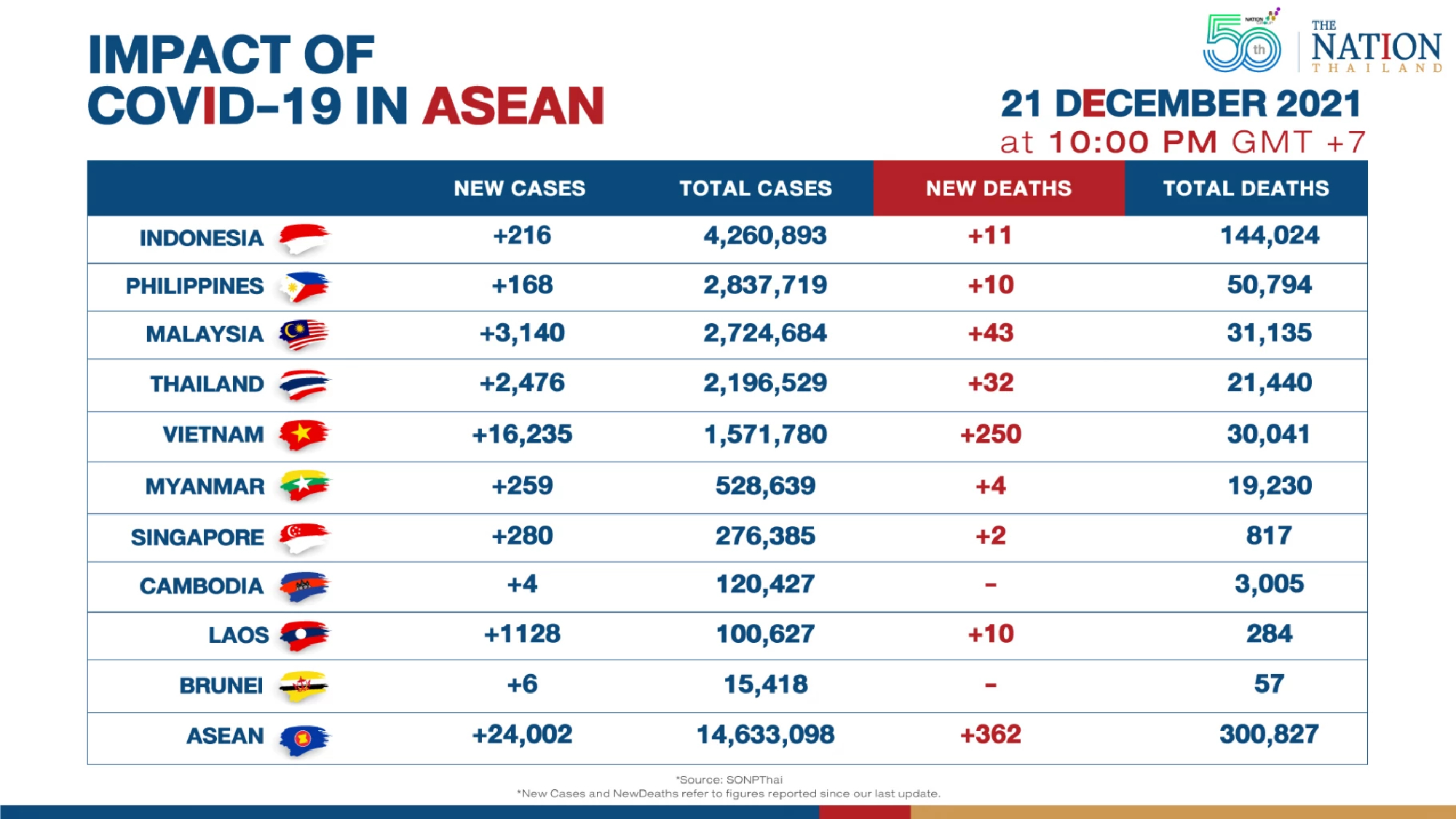
Asean reported over 24,000 new Covid-19 cases on Tuesday

#SootinClaimon.Com : ขอบคุณแหล่งข้อมูล : หนังสือพิมพ์ The Nation.

https://www.nationthailand.com/international/40010267


The number of Covid-19 cases crossed 14.63 million across Southeast Asia, with 24,002 new cases reported on Tuesday (December 21). New deaths are at 362, bringing accumulated Covid-19 deaths in Asean to 300,827.

Asean reported over 24,000 new Covid-19 cases on Tuesday

Severe cases of Covid-19 recorded in Vietnam’s Hanoi are on the rise, with some hospitals concerned about overcrowding. The city recorded 1,612 new cases of Covid-19 on Monday, the second consecutive day on which the city recorded the highest number of daily infections nationwide. 

Hanoi Field Hospital’s deputy head said the increasing number of new cases led to more severe cases. The number of severe cases often accounted for three per cent of the total infections.

Meanwhile, Malaysia’s Finance Minister announced that the National Trust Fund allocation will be increased to RM6bil from RM5bil previously to ensure a sufficient supply of vaccines, including booster doses, for not only the adult population but also teenagers. Based on the current assessment, it is critical for everyone to be given a booster dose, especially with the emergence of the Omicron variant.
 

Published : December 22, 2021

By : THE NATION

Dubai leader saddled with record breaking $700 million divorce settlement

#SootinClaimon.Com : ขอบคุณแหล่งข้อมูล : หนังสือพิมพ์ The Nation.

https://www.nationthailand.com/international/40010265


LONDON – A British judge on Tuesday shed light on the lavish lifestyle of Dubais ruling family by awarding a record-breaking settlement worth in excess of $720 million to a princess in her custody battle with the ruler of the emirate.

Dubai leader saddled with record breaking $700 million divorce settlement

The settlement concludes a long-running and acrimonious case that has played out in British courts between Princess Haya Bint al-Hussein, 47, daughter of the late King Hussein of Jordan, and her ex-husband, multibillionaire Dubai ruler Sheikh Mohammed bin Rashid al-Maktoum.

During the trial, the court heard details of the immense luxury in which the princess lived before she fled Dubai with her two children, Zayed, 9, and Jalila, 14.

But the case also exposed a dark side to the glittering image of the Dubai royal family, including Mohammed’s abusive behavior toward his wife and children, which prompted Haya to file for divorce and flee to Britain in 2019, saying that she feared for their lives.

The judge agreed that she faced genuine risks and awarded the bulk of the settlement toward providing potentially a lifetime of security for the princess and her children, including armored cars, cyber-protection, cameras and ballistic safeguards and bodyguards.

In October, a court ruled that Mohammed had used Israeli company NSO Group’s Pegasus spyware to hack the phones of Haya, along with those of the closest members of her inner circle.

The court also heard evidence that Mohammed had abducted and brought back to Dubai two of his daughters, Princesses Latifa and Shamsa. Mohammed allegedly sought to buy a property neighboring one of Haya’s homes and issued threats to her life, including a text message that said, “We can find you anywhere.”

Justice Philip Moor, the High Court judge who presided over the case, said in his statement detailing the award that there is no question that Haya and her children face an ongoing threat to their safety from her former husband. “The main threat they face is from [Mohammed], not from outside sources,” he said.

Mohammed, who did not attend any of the hearings, has denied all the charges through his lawyer. In a statement on Monday, a spokesman for the sheikh did not contest the amount. He said that Mohammed had “always ensured that his children are provided for” and requested that the media respect their privacy.

In total, the award comprises a lump sum of $333 million to cover living costs as well as annual payments for the children’s education and security, to be secured with a guarantee of $385 million. Because it is unclear how long the annual payments will last, it is difficult to put a final total on the amount, but lawyers say it ranks as the largest single divorce payout in in British legal history.

In justifying the amounts, Moor cited the need to preserve the “truly opulent and unprecedented standard of living enjoyed by these parties.”

In addition to security, the amounts are intended to cover the costs of the upkeep of Haya’s two homes, near Kensington Palace in London and in the suburban town of Egham in Surrey, as well as vacations, clothes, horses and salaries for staff. The costs were diligently itemized – $500,000 for food during vacations; $368,000 to maintain three horses and other pets for the children; $51,000 to replace two Somersault Sunken trampolines they had owned at their palace in Dubai.

Haya had originally sought in excess of $1.1 billion, but the judge reduced many of her claims. A request for $42 million to replace the haute couture wardrobe she was forced to leave behind in Dubai was cut to $1.3 million because, the judge said, he was unable to put a price on the items of clothing he was shown in a video.

A request for $26 million worth of jewelry was reduced to $18 million. A budget for the costs of hiring private planes for vacations was cut from $2.3 million to $1.3 million. Moor said he did not believe children should go on vacation too often, especially when they have school examinations coming up.

Among the requests the judge threw out was the cost of a car collection for Haya’s son because, he noted, it wasn’t necessary for a 9-year-old to own cars.

It was, however, important, he said, that the children “should be able to have a lifestyle that is not entirely out of kilter with that enjoyed by them in Dubai.”

But Moor allowed the cost of a $1.9 million renovation to Haya’s kitchen in London, including a pizza oven. “I remind myself that money was no object during the marriage,” he said, by way of explanation.

While living in Dubai, Haya, who was Mohammed’s sixth and youngest wife, received an annual budget of more than $100 million to run her household, and her children were given allowances in excess of $10 million a year each, the court had been told.

She would routinely spend vast amounts on vacations, including the hiring of private yachts and travel by helicopter. The hotel bill for one vacation in Italy came to more than $800,000, the judge noted. He awarded her $6.7 million to spend on vacations.

Her lawyer, Nicholas Cusworth, told reporters that Haya was not, “in the context of this case, wealthy.” She had been forced to sell jewelry and racehorses worth $20 million while waiting for the settlement, and he said her legal fees had amounted to more than $90 million.

Mohammed’s lawyer Nigel Dyer described some of Haya’s claims as “absurd” and said she was seeking to enrich herself in the guise of providing for her children. He cited an allegation, which was not mentioned by the judge in his ruling, that Haya had an affair with a bodyguard and paid more than $8 million to blackmailers to stop them from revealing the liaison.

Moor ruled that the fabulous wealth enjoyed by the princess and her children before the divorce “takes this case entirely out of the ordinary.”

“It will be quite impossible to replicate, pound for pound, the standard of living enjoyed before their parents separated,” he said.

Published : December 22, 2021

By : The Washington Post

French police uncover 182,000 fake covid health passes

#SootinClaimon.Com : ขอบคุณแหล่งข้อมูล : หนังสือพิมพ์ The Nation.

https://www.nationthailand.com/international/40010264


French police have uncovered 182,000 fake health passes since the documents were introduced this summer in a bid to control the spread of the coronavirus.

French police uncover 182,000 fake covid health passes

President Emmanuel Macron introduced the official passes in July, and they have become necessary to gain access to numerous venues, including bars, restaurants and many long-distance trains. They can be obtained through vaccination, recovery from covid-19 or a recent negative test.

Interior Minister Gérald Darmanin last week asked police to step up their investigations into the criminal networks or individuals behind the fake passes, as concerns grow about the highly contagious new omicron variant. On Monday, he said the fake documents were detected “as part of the 400 ongoing investigations.” The minister didn’t provide details on any arrests or individuals involved. He has previously said some cases had been traced to health professionals.

“Using, procuring or selling false health passes, in particular via social networks, is punishable by 5 years in prison and a 75,000 euro fine,” Darmanin said in a statement posted on Twitter. He has previously condemned the fake documents as “death passes.”

The introduction of France’s health pass prompted weeks-long nationwide protests this summer. Even though the rallies have shrunk in size, incidents of vandalism against vaccination centers and other sites continue to be reported.

The police crackdown on fake passes comes as France, and other nations, are tightening restrictions in the face of the highly transmissible omicron variant, which is spreading at lightning speed across the European continent.

The Netherlands was the first to enter a full-scale lockdown on Sunday, with all nonessential stores, bars and restaurants closed at least until Jan. 14. Scientists are pushing British Prime Minister Boris Johnson to take tougher measures to slow the exploding number of new infections, although so far he has said no rules would change.

Officials in Paris are reluctant to impose new curfews or lockdowns on people who have been vaccinated. But officials argue that the threat of omicron means authorities have to increase pressure on those refusing vaccination. France recorded 367,297 new cases in the past week, according to Johns Hopkins University data, shy of a previous weekly record of 422,681 set in November 2020.

French Prime Minister Jean Castex said on Friday the government will propose a bill in parliament in January to change the official health pass into a “vaccine pass,” meaning only vaccinated people will be allowed to enter indoor public places such as bars, restaurants and cinemas.

About 72 percent of the country is fully vaccinated, according to Washington Post data.

Marine Le Pen, the leader of France’s far-right nationalist party, has said from the outset that the health pass was a “backward step for individual freedoms” and views the planned vaccine pass as akin to mandatory vaccination.

“French people are losing individual freedoms,” she said on cable TV channel BFM over the weekend.

Published : December 22, 2021

By : The Washington Post

Sunak unveils 1 billion pounds for companies hit by omicron fallout

#SootinClaimon.Com : ขอบคุณแหล่งข้อมูล : หนังสือพิมพ์ The Nation.

https://www.nationthailand.com/international/40010263


Rishi Sunak announced a billion pounds ($1.3 billion) of support for U.K. hospitality businesses struggling with slumping demand triggered by a record wave of Covid-19 infections, as he declined to rule out further curbs to tackle the fast-spreading omicron variant.

Sunak unveils 1 billion pounds for companies hit by omicron fallout

Pubs, restaurants and other eligible hospitality and leisure businesses will be able to claim cash grants worth up to 6,000 pounds each, the U.K. Chancellor of the Exchequer said Tuesday in a pooled broadcast interview. He also unveiled extra cash for cultural institutions and to compensate companies for sick pay.

The move aims to end a growing clamor from firms for more support, amid what the Confederation of British Industries has called a “lockdown by stealth” as Britons steered clear of social gatherings to avoid the virus. Until now, the Treasury had pointed to measures already in place including grants, lower sales tax and business rates relief, but companies had called for more.

“The current situation is very difficult, especially for those in the hospitality industry,” Sunak said. Asked about the prospect of new restrictions, Sunak repeated Boris Johnson’s message that ministers can’t rule anything out. “We’re just dealing with an enormous amount of uncertainty at the moment.”

Sunak did, however, hint that the Treasury is prepared to step in with more assistance if tighter curbs are introduced, saying he will “always respond proportionately and appropriately to the situation that we face.”

Sunak said the grants are comparable in size to those in place earlier this year when businesses were required to shut. A further 30 million pounds will go into a pot to help cultural institutions such as museums and theaters.

The lobby group UKHospitality said Monday that December is set to be a “disaster” for the industry, with many businesses losing 40% to 60% of their trade. It warned companies would fold without government support.

The opposition Labour Party has criticized Sunak for his “radio silence” on the crisis, while the Night Time Industries Association urged him to “come out of hiding.” The chancellor was ultimately forced to cut short a work visit to California to jet back for talks with industry groups.

The assistance announced Tuesday falls short of demands by business groups who also wanted to see extensions to tax breaks beyond March and relaxed repayment terms on government-backed loans. Some industry chiefs had also wanted to see a return of Sunak’s flagship furlough program, through which the government splurged 70 billion pounds, paying up to 80% of the wages for 11.7 million jobs through to its end in September this year.

The new economic measures come with Johnson’s cabinet in disagreement over when and whether to bring in new curbs to stem the omicron surge. Doing so would be politically risky for the prime minister, who is also boxed in by opposition in his Conservative Party, with ministers — including Sunak — demanding further data on the severity of omicron.

The government’s Scientific Advisory Group for Emergencies, or SAGE, warned last week that “more stringent measures would need to be implemented very soon” to avoid daily Covid hospitalizations rising to at least 3,000, piling pressure on the National Health Service.

Johnson on Monday held off on bringing in new restrictions, saying that while his ministers didn’t exclude doing so if needed, for now they needed more information, even as daily cases soar above 90,000.

Earlier, Cabinet minister Steve Barclay suggested no steps will be taken before Christmas, telling LBC Radio: “We’re saying to people they should continue with Christmas, but in a cautious way.” He later told the BBC ministers must be “clear-eyed” about the economic consequences of any curbs.

SAGE said bringing back some of the restrictions used earlier in the year — including limits on household mixing and the closing of hospitality venues — could “substantially reduce” the peak in cases.

One option they suggested was going back to so-called Step 2 restrictions in Johnson’s roadmap for emerging from the last lockdown. That included pubs and restaurants only being able to serve customers outdoors, a ban on indoor mixing between households and a maximum of six people or two households being allowed to interact outdoors.

Johnson has so far resisted imposing some of the measures recommended by his scientists, and he’s promised Parliament would get a chance to vote on new curbs if he did bring them in. Recalling MPs would need at least a day’s warning, and U.K. papers have reported that may come after Christmas, with new rules taking effect before January.

Published : December 22, 2021

By : Bloomberg