Debenture issue raises Bt5 billion for Frasers Property #ศาสตร์เกษตรดินปุ๋ย

#ศาสตร์เกษตรดินปุ๋ย : ขอบคุณแหล่งข้อมูล : หนังสือพิมพ์ The Nation

https://www.nationthailand.com/business/30380592?utm_source=category&utm_medium=internal_referral

Debenture issue raises Bt5 billion for Frasers Property

Jan 15. 2020
Sopon Racharaksa, president of FPT

Sopon Racharaksa, president of FPT
By THE NATION

Frasers Property (Thailand) Plc or “FPT”, a leading provider of integrated real estate platform, has raised Bt5 billion through the issue of debentures.

The debentures have maturity tranches ranging from three years to 10 years at an average coupon of 2.5 per cent.

The debentures were made available on January 7-8 and were more than two times oversubscribed, with strong interest from institutional investors, leading financial institutions, fund management companies and insurance companies.

United Overseas Bank Limited and Bangkok Bank Pcl were the underwriters to the issue. TRIS Rating assigned a rating on the proposed issue of debentures at A- with a stable outlook.

Sopon Racharaksa, president of FPT, said that the overwhelming response reflected the confidence investors had in Frasers Property Thailand.

The company will continue to grow its property platform in Thailand and extend its footprint through JV investments and strategic partnerships, Sopon said, adding, the funds from the debenture issuance will be used to support FPT’s capital expenditure and business operations.

Nok Air expects to raise Bt2.2 billion from rights issue next month #ศาสตร์เกษตรดินปุ๋ย

#ศาสตร์เกษตรดินปุ๋ย : ขอบคุณแหล่งข้อมูล : หนังสือพิมพ์ The Nation

https://www.nationthailand.com/business/30380583?utm_source=category&utm_medium=internal_referral

Nok Air expects to raise Bt2.2 billion from rights issue next month

Jan 15. 2020
By THE NATION

Nok Air aims to raise Bt2.2 billion through a rights share issue, the company’s shareholders decided on Tuesday (January 14).

At an extraordinary meeting of shareholders, Nok Airlines Pcl decided to increase the company’s registered capital from Bt3.408 billion to Bt4.197 billion, as well as issue 888,147,358 ordinary shares at face value of Bt1 per share to existing shareholders on rights basis at the ratio of one new ordinary share for 3.5 existing ordinary shares. The offer price is Bt2.50 per share, with combined value not exceeding Bt2.22 billion. The shares are expected to be offered from February 3-7.

Nok Airlines chief executive officer Wutthiphum Jurangkool said the company expects to raise Bt2.2 billion from the rights issue, which will turn the shareholders’ equity from negative Bt659 million (as of September 2019) to positive. “We also expect that this move will help remove the ‘C’ [caution] letter from our [shares’] status,” he added.

Currently Thai Airways International (THAI) holds 15.94 per cent of Nok’s shares and remains the major shareholder. Wutthiphum said he had already presented the fundraising plan to THAI.

“As for the business plan this year, we are still focusing on a turnaround strategy by using software technology to manage the cost, and positioning ourselves as an on-time airline,” he said. “Furthermore, we will continue buying fuel via THAI at a competitive price, which should help in overall cost reduction since fuel is responsible for 30 per cent of total cost.”

Wutthiphum added that next month he will present the 2020 fleet plan to the board of directors. “This year we expect to buy a maximum of three new Boeing 737-800s to cover two new destinations in Asean, which will open around mid-2020,” he said. “Currently we have 16 737-800s and eight Q400s.”

When even Target misses, it’s time to worry #ศาสตร์เกษตรดินปุ๋ย

#ศาสตร์เกษตรดินปุ๋ย : ขอบคุณแหล่งข้อมูล : หนังสือพิมพ์ The Nation

https://www.nationthailand.com/business/30380632?utm_source=category&utm_medium=internal_referral

When even Target misses, it’s time to worry

Jan 16. 2020
Empty shopping carts at a Target store in the Queens borough of New York on Nov. 28, 2019. MUST CREDIT: Bloomberg photo by Bess Adler.

Empty shopping carts at a Target store in the Queens borough of New York on Nov. 28, 2019. MUST CREDIT: Bloomberg photo by Bess Adler.
By TARGET-COMMENT/
Syndication Washington Post, Bloomberg Opinion · Andrea Felsted

There’s an old saying in retail that despite all the bluster, not much really changes over the holiday shopping season: Those store groups that have been winning keep on doing so, while the losers continue to suffer.

Target Corp. just became the exception to this rule.

The big-box retailer has been a consistently strong performer over the past couple of years, but in the latest holiday season it stumbled badly. Same store sales in November and December rose by just 1.4 % – significantly below expectations. The shares fell more than 6 percent in morning trading.

Target seems to be suffering from issues across the market. But if the company – one of the more resilient of the bunch – is feeling the pinch, that bodes ill for weaker store chains, or those that have been less proactive in adapting to changing consumer tastes. The slip also suggests there may be limits to how much more its turnaround efforts can achieve.

Same-store sales in electronics fell by more than 6%. This wasn’t helped by an uninspiring technology lineup – there was no one big standout game or gadget. Toys was also a difficult area, and there have been signs in Europe that demand is moving away from traditional playthings to tech.

But Target has made a big bet on toys, in order to capture the customers who would previously have shopped at Toys R Us. Although it said it gained share over the holidays, if demand is permanently shifting away from this category, this looks like a rare misstep. Moreover, given that Target has invested heavily – it pledged in 2017 to spend $7 billion over three years on in its stores, products and online offerings – it should be outperforming even in these more challenging categories.

The one silver lining is that both toys and electronics are low margin segments. So although Target cut its forecast of same store sales growth in the fourth quarter to 1.4%, from its previous expectations of as much as 4%, it maintained its profit guidance for the final quarter and the full year.

What’s troubling about Target’s performance is that while it could have made some changes in the run-up to the holiday – given the highly competitive landscape and Black Friday falling later – it is generally doing the right things. It’s one of the few retailers investing in giving consumers the products they actually want to buy. In areas such as clothing, beauty and food, where it has been revitalizing its exclusive brands and overhauling departments, same-store sales rose.

Target, as mentioned, has also been spending on revamping its stores. That might be counterintuitive, but it is sensible. When consumers do want to go to a physical outlet, they want that to be a pleasant experience. And it hasn’t neglected its digital offerings, particularly in areas such as click and collect, where customers order online but pick up their purchases at a store. While the digital performance was disappointing – up just 19% in November and December – same-day delivery options were up 50%.

Even before the holiday miss, Target was facing a challenge to maintain momentum. It is entering the final year of its big store refurbishments, and it will be coming up against difficult sales comparisons going forward. But a knee-jerk reaction, say curbing investment in stores, products, and digital, would be a mistake. It probably has more to go for in food, and can capture more sales from department stores and mid-market clothing brands.

Analysts see little gain in Trump’s trade war #ศาสตร์เกษตรดินปุ๋ย

#ศาสตร์เกษตรดินปุ๋ย : ขอบคุณแหล่งข้อมูล : หนังสือพิมพ์ The Nation

https://www.nationthailand.com/business/30380629?utm_source=category&utm_medium=internal_referral

Analysts see little gain in Trump’s trade war

Jan 16. 2020
President Donald Trump signs a trade agreement with Chinese Vice Premier Liu He at the White House on Wednesday, Jan. 15, 2020. MUST CREDIT: Washington Post photo by Jabin Botsford

President Donald Trump signs a trade agreement with Chinese Vice Premier Liu He at the White House on Wednesday, Jan. 15, 2020. MUST CREDIT: Washington Post photo by Jabin Botsford
By TRADE-ANALYSIS/The Washington Post · Heather Long 

One of the most basic questions as President Donald Trump and China’s Vice Premier Liu He formally sign the “phase one” trade agreement is whether Trump’s trade war was worth it.

The White House released a 94-page deal on Wednesday, and there are some big gains for the United States: China has agreed to buy about $200 billion more of U.S. goods over the next two years, and U.S. companies will get more access to the Chinese market and a bit more intellectual property protection. In return, the U.S. has agreed to hold off on more tariffs on China and to reduce tariffs on some items, notably clothing.

Looking strictly at the numbers, the deal doesn’t look so great. China’s additional purchases make up for a fraction of the trade war’s hit to the economy over the past two years, analysts say. And many critics have pointed out that China was offering to buy more agricultural and energy back in spring 2018 – before Trump escalated the trade war substantially.

But where this agreement has the potential to be game-changing is in reshaping trade relations with China. Trump has shifted the dialogue about China. There is now a wide consensus in the United States to challenge China on its worst actions. After this agreement, U.S. firms in China are no longer supposed to be forced to hand their technology over to Chinese companies, a longstanding problem. The tariffs have also caused what some are dubbing a “partial divorce” between the U.S. and China, with supply chains once rooted in China now moving to other nations, especially Vietnam and Taiwan, making the U.S. slightly less reliant on China for daily goods.

“Today we take a momentous step with China, one that has never been taken before China,” Trump said Wednesday before signing the deal in a lengthy ceremony. “We mark a sea change in international trade.”

Yet, leading up to this point, the trade war inflicted a lot of pain, pretty much everyone agrees. As Trump hiked tariffs on China, U.S. economic growth slowed, business investment froze, and companies didn’t hire as many people. Across the nation, a lot of farmers went bankrupt and the manufacturing and freight transportation sectors tumbled into a recession. Trump’s actions amounted to one of the largest tax increases in years.

Oxford Economics and Moody’s Analytics calculate that the U.S.-China trade war shaved 0.3% off growth – the equivalent of $65 billion – last year. And that is likely to grow to $85 billion in 2020, according to Gregory Daco of Oxford Economics, since this deal does not end the trade war. Many of the tariffs will remain in place, covering about two-thirds of Chinese imports, meaning there will be an ongoing drag on the economy this year.

Given all of this, economists say this trade conflict has been a net loss to the economy, albeit a modest one, in the short term.

Even Trump and his team ultimately acknowledged that the U.S. did suffer from the trade war. But they claimed that the benefits to the United States from a deal would outweigh the costs and that the tariffs were hurting China more.

Trump points out that Presidents George W. Bush and Barack Obama didn’t get this far with the Chinese and that there’s the prospect of new punishments if China does not do what it promised, in the form of more tariffs. Also, the White House says it will launch “phase two” negotiations to address deeper structural problems in the Chinese economy that hurt competition, but there’s a lot of skepticism about whether another pact can be secured.

The trade deal has loomed large on Wall Street over the past two years. And the markets applauded the deal, sending stocks soaring to new highs, mainly because of relief over a trade truce with China. Tariffs are unlikely to go higher and could even come down after the election, Trump hinted.

“I am much more positive and optimistic than you might think,” Blackstone chief executive Stephen Schwarzman said on Fox Business. “I think the Chinese will honor this deal.”

Critics of the deal, though, point out that it is far more modest than what Trump promised, that China has a history of not following through and that there is little in the deal that alters President Xi Jinping’s ambitious “Made in China 2025” plans. For example, one of the biggest problems is how much the Chinese government subsidizes certain industries. The deal doesn’t address that.

China promised to purchase “at least” $200 billion more of American products ― more meat, soybeans, energy, manufactured goods and services. But in remarks at the White House, China’s vice premier went out of his way to say that Chinese firms will buy more “based on market conditions,” which already suggests some hesitancy to do exactly what was written down.

And this $200 billion promise of Chinese purchases doesn’t necessarily mean new sales that wouldn’t have happened. Many experts say U.S. farmers, manufacturers and others will simply sell to China what they would have sold to other nations, significantly lessening the economic gains.

“Let’s not forget that the $200 billion is a promise that will likely come from trade diversion rather than trade creation,” Daco said in an email.

Some industries make out well in the agreement. Financial services and insurance companies have long wanted to get access to China’s market without having to partner with a local bank. JPMorgan Chase is already making moves to enter China, a huge potential market. And China has agreed to lift restrictions on American dairy products, infant formula and beef, enabling U.S. farmers to sell more in China.

On paper, China has also agreed to increase its punishments for intellectual property theft, including larger fines and even imprisonment to deter stealing. And it said it would allow witness testimony in civil cases. China also agreed to “market-based” exchange rates. China’s government used to devalue its currency regularly to gain more trade advantage, though that has not been a problem recently.

Trump’s trade war with China has been going on for nearly two years, causing U.S. companies to lose their foothold in China as firms from Europe, Canada, Brazil and other nations swoop in to take advantage. And the trade war continues as the truce leaves in place tariffs on $360 billion worth of Chinese imports.

Whether this deal ultimately pays off depends on whether U.S. firms and farmers really do get more access to China. That remains to be seen.

U.S. stocks hit records amid China trade pact optimism #ศาสตร์เกษตรดินปุ๋ย

#ศาสตร์เกษตรดินปุ๋ย : ขอบคุณแหล่งข้อมูล : หนังสือพิมพ์ The Nation

https://www.nationthailand.com/business/30380628?utm_source=category&utm_medium=internal_referral

U.S. stocks hit records amid China trade pact optimism

Jan 16. 2020
U.S. stocks closed at record highs as investors assessed the details of the partial trade deal with China. Treasuries gained and the dollar weakened.

U.S. stocks closed at record highs as investors assessed the details of the partial trade deal with China. Treasuries gained and the dollar weakened.
By Syndication Washington Post, Bloomberg · Vildana Hajric, Sarah Ponczek

U.S. stocks closed at record highs as investors assessed the details of the partial trade deal with China. Treasuries gained and the dollar weakened.

The benchmark S&P 500 finished short of an earlier all-time intraday high after President Donald Trump presided over a signing ceremony with Chinese officials. The deal commits China to do more to crack down on the theft of American technology and corporate secrets by its companies and state entities, while outlining a $200 billion spending spree to try to close its trade imbalance with the U.S. Soybeans slumped after China signaled purchases would be demand-based.

“While it does not appear that the ‘phase one’ deal addresses many of the structural issues that started the trade spat, it does mitigate the uncertainty that ongoing trade tensions present, namely the threat of new tariffs at a moment’s notice,” said Jason Pride, chief investment officer of private wealth at Glenmede Trust Co. in Philadelphia.

The S&P 500 set an intraday record for the sixth consecutive trading session, largely ignoring disappointing quarterly results from Goldman Sachs Group Inc. and Bank of America Corp. The Nasdaq Composite and Dow Jones Industrial Average indexes also set fresh highs. U.S. markets received an added boost earlier after White House economic adviser Larry Kudlow promoted more tax cuts.

Commodity markets got some numbers on China’s commitments to buy agricultural products, but doubts remain. Currency traders assessed the section that reaffirmed existing G-20 commitments, and investors in tech stocks pored over details on intellectual property concessions.

“It’s anti-climatic,” said Jim Paulsen, chief investment strategist at the Leuthold Group. “It was in there and people knew this for a while now, it’s about what you thought.”

Meanwhile, the Stoxx Europe 600 index finished little changed, while equities across most of Asia fell.

Russia’s currency weakened as much as 0.6% against the dollar. President Vladimir Putin replaced his long-serving prime minister and called for sweeping constitutional changes, fueling speculation that the Russian leader is moving to extend his grip on power beyond the end of his term in 2024.

Oil futures drifted, with West Texas Intermediate trading around $58 a barrel. Gold nudged higher.

Here are some events to watch for this week:

-It’s earnings season for the biggest American financial institutions, with Morgan Stanley and Bank of New York Mellon Corp. still to come.

–The Federal Reserve’s Beige Book report on regional economic conditions is due on Wednesday.

-China GDP, along with key monthly data for December, come on Friday.

-A final reading on the euro-zone’s December inflation is also due on Friday.

There are some of the main moves in markets:

Stocks

-The Dow Jones Industrial Average increased 0.3% to 29,030.28, the highest on record.

-The Nasdaq Composite Index climbed 0.1% to 9,258.70.

-The MSCI All-Country World index advanced 0.1% to 573.80, the highest on record.

-The Stoxx Europe 600 index was little changed at 419.63.

Currencies

-The Bloomberg Dollar Spot index decreased 0.1% to 1,191.76, the lowest in a week.

-The Japanese yen strengthened 0.1% to 109.90 per dollar, the largest rise in more than a week.

-The euro gained 0.2% to $1.1151, the strongest in a week on the biggest gain in more than a week.

-The British pound gained 0.1% to $1.3028.

Bonds

-The yield on two-year Treasuries fell one basis point to 1.56%, the lowest in a week.

-The yield on 10-year Treasuries fell three basis points to 1.78%, the lowest in almost six weeks.

-Germany’s 10-year yield declined three basis points to -0.20%, the biggest drop in more than a week.

-Britain’s 10-year yield decreased seven basis points to 0.654%, the lowest in seven weeks on the largest dip in six weeks.

Commodities

-West Texas Intermediate crude declined 0.4% to $57.96 a barrel, the lowest in six weeks.

-Gold strengthened 0.6% to $1,556.05 an ounce.

U.S. and China sign phase one of trade deal #ศาสตร์เกษตรดินปุ๋ย

#ศาสตร์เกษตรดินปุ๋ย : ขอบคุณแหล่งข้อมูล : หนังสือพิมพ์ The Nation

https://www.nationthailand.com/business/30380626?utm_source=category&utm_medium=internal_referral

U.S. and China sign phase one of trade deal

Jan 16. 2020
President Trump speaks during a signing ceremony for the U.S.-China

President Trump speaks during a signing ceremony for the U.S.-China “phase-one” trade agreement in Washington on Jan. 15., 2020. MUST CREDIT: Bloomberg photo by Zach Gibson.
By Syndication Washington Post, Bloomberg · Shawn Donnan, Josh Wingrove, Saleha Mohsin

The U.S. and China signed what they’re billing as the first phase of a broader trade pact on Wednesday amid persistent questions over whether President Donald Trump’s efforts to rewrite the economic relationship with Beijing will ever go any further.

The deal commits China to do more to crack down on the theft of American technology and corporate secrets by its companies and state entities, while outlining a $200 billion spending spree to try to close its trade imbalance with the U.S. It also binds Beijing to avoiding currency manipulation to gain an advantage and includes an enforcement system to ensure promises are kept.
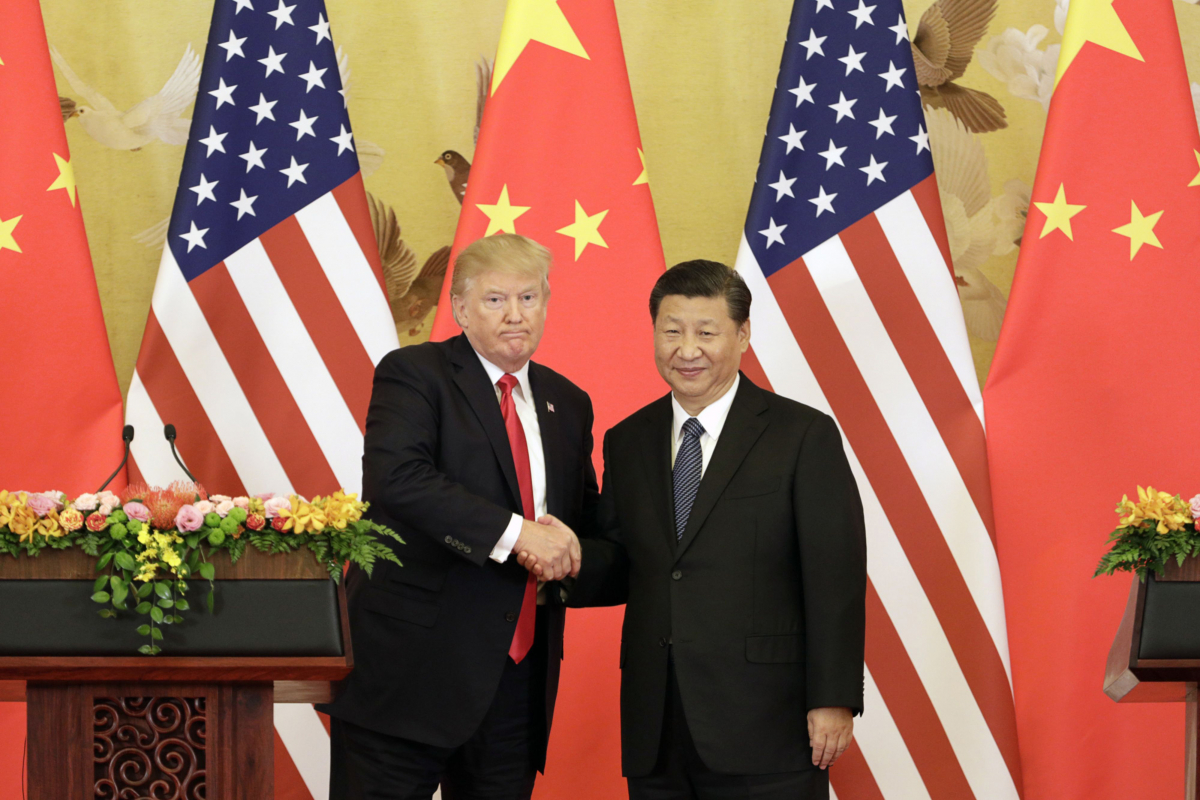
File photo of President Donald Trump, left, and Xi Jinping, China's president, shaking hands during a news conference at the Great Hall of the People in Beijing on Nov. 9, 2017. MUST CREDIT: Bloomberg photo by Qilai Shen.

File photo of President Donald Trump, left, and Xi Jinping, China’s president, shaking hands during a news conference at the Great Hall of the People in Beijing on Nov. 9, 2017. MUST CREDIT: Bloomberg photo by Qilai Shen.

The ceremony at the White House, which included Trump, dozens of American business people and Chinese officials, was a rare moment of friendship lately between the world’s two largest economies. Acrimonious talks stretching back almost three years have roiled financial markets, cast a cloud of uncertainty over investment decisions and hurt growth in both nations.

“This is a very important and remarkable occasion,” Trump said at the signing. “Together we are righting the wrongs of the past.”

The benchmark S&P 500 Index set an intraday record high for the sixth consecutive trading session.

The deal, sealed on the same day the House prepared to refer articles of Trump’s impeachment to the Senate, has already been criticized for what is missing. It does nothing to address areas like what U.S. authorities have long claimed is China’s state-backed hacking of American companies and government institutions. Nor does it require the Asian nation to reform the vast web of state subsidies that form the spine of its model of state capitalism and have helped fuel the rapid growth of Chinese companies compete internationally.

The administration says many of those issues will be covered in a second phase of a deal, though when those talks will begin and how long they will take remains uncertain. In the meantime, the U.S. is also set to maintain tariffs on roughly two-thirds of imports from China.

“As soon as this kicks in we’re starting phase two,” Trump said. “I will agree to take those tariffs off if we’re able to do phase two, otherwise we don’t have any cards to negotiate with. They will all come off as soon as we finish phase two.”

At the ceremony, Chinese Vice Premier Liu He read a letter from President Xi Jinping, stating the two sides have to implement the agreement “in real earnest.”

“I hope the U.S. side will treat fairly Chinese companies,” he said through an interpreter. In his own comments, Liu said China will “strictly honor” the pact.

Trump’s top negotiator, U.S. Trade Representative Robert Lighthizer, told reporters ahead of the signing that the administration was focused on implementing the initial agreement in the short term. Any further negotiations will only come after that, he said.

Officials also insist that they are harvesting significant commitments from Beijing that mean the phase one agreement will benefit U.S. businesses and workers even if discussions never go any further.

The deal requires China to do more to stop the sale of pirated goods and to apply criminal penalties on anyone caught steeling commercial secrets. It also requires Beijing to deliver an action plan withing 30 days of the deal taking effect on how it intends to meet its commitments.

It also requires China to stop pressuring American companies investing in the country to share technology with local joint-venture partners. The agreement stipulates that the Chinese must stop supporting or directing the acquisition of overseas investment aimed at buying up technologies.

“This is an enormous win,” Treasury Secretary Steven Mnuchin told reporters ahead of the signing, pointing to Chinese commitments on IP that will affect the technology sector as well as other reforms on currency, the opening up of the financial services sector to U.S. companies and the promised spending spree.

Other supporters of Trump’s trade policies insist that the initial deal goes a long way toward addressing the IP issues that were at the core of the case brought against China. “Anyone complaining that this doesn’t resolve every U.S.-China issue needs to recall that this entire negotiation was based on a report on China’s IP and techtransfer policies,” said Clete Willems, who until last year was a member of Trump’s national economic council and is now at law firm Akin Gump.

China has already moved to address some U.S. complaints on IP. Over the past year, it has made a rapid-fire series of legal changes amid the negotiations to beef up protection. A new foreign investment law that took effect on Jan. 1 bans administrative agencies from forcing companies to transfer technological knowhow as a cost of entry to the Chinese market. It also exposes officials who disclose or leak trade secrets gleaned from regulatory approvals to potential criminal penalties.

The U.S. is also moving to address remaining issues like industrial subsidies in other ways. On Tuesday the U.S., European Union, and Japan said they had agreed on the content of new stricter global rules on subsidies aimed largely at China and would be mounting a joint push to build support for them internationally.

The Trump administration says what separates its deal most from others is the enforcement mechanism it establishes. Rather than rely on a slow-moving World Trade Organization dispute system that Trump in any case has already hobbled by blocking the appointment of top judges, the new agreement with China would allow the administration to move to punish Beijing with tariffs or other measures within 90 days if officials decided it was breaking its promises.

But even Lighthizer acknowledges how effective that mechanism will be depends on Beijing. “This deal will work if China wants it to work,” he said Wednesday.

The deal is also unique in the breadth of specific Chinese purchase commitments it contains, which some critics in the U.S. see as uncomfortably reminiscent of the sort of state-directed central planning American diplomats have spent decades trying to get China to abandon. Even those purchase promises, the details of which are contained in a secret annex to the agreement signed on Tuesday, face questions.

The text of the deal released Wednesday specifies $77.7 billion in Chinese purchases of manufactured goods including aircraft, $32 billion in agricultural products, $52.4 billion in energy and $37.9 billion in services in the two years through December 2021.

Much of the attention has focused on whether U.S. farm exports to China can reach the $40 billion to $50 billion annual level that Trump has promised, which would mean doubling the $24 billion in agriculture and related products it imported from the U.S. in 2017, before the trade war began.

There are also questions over a Chinese commitment to buy an additional $50 billion in U.S. oil and gas over two years and pledges to step up purchases of cars, planes and other manufactured goods.

To meet the energy target, China would have to import roughly one-third of the 3 million barrels a day of crude that the U.S. exported last year over a two year period, according to Bloomberg calculations. Which is why analysts believe meeting that deal may depend heavily on buying natural gas, which is usually traded via long-term contracts rather than spot purchases.

However, China may not have much appetite for any additional gas right now beyond the long-term contracts it has already committed to as it continues to struggle with a slowing economy and a slowdown in demand growth and already-brimming stockpiles. Likewise, U.S. LNG export plants have most of their volumes tied up in their own long-term contracts and would only be able to provide China with a marginal amount of spot supply over the next two years.

Germany reports its slowest economic growth in six years #ศาสตร์เกษตรดินปุ๋ย

#ศาสตร์เกษตรดินปุ๋ย : ขอบคุณแหล่งข้อมูล : หนังสือพิมพ์ The Nation

https://www.nationthailand.com/business/30380619?utm_source=category&utm_medium=internal_referral

Germany reports its slowest economic growth in six years

Jan 16. 2020
By Syndication Washington Post, Bloomberg · Carolynn Look, Chris Reiter, Iain Rogers

Germany’s economy made a slight recovery in the fourth quarter, ending a year in which manufacturing took a battering and the country was dragged to the brink of a recession.

The statistics office estimates that output registered a small increase in the final three months of 2019, a year that saw growth of just 0.6%. That’s the slowest in six years, amid trade tensions and a broader slowdown in demand that added to fundamental structural challenges the country is battling.

The small increase in GDP at the tail end of 2019 may reinforce hopes that the economy is through the worst of the slump. It also means less chance the government will cave to calls that it provide more fiscal support for the economy.

But the economy, and particularly its industrial heart, are far from out of trouble. Carmakers including Volkswagen AG are facing a critical period as they push sales of electric vehicles, while manufacturers such as Siemens AG are under pressure to adapt to climate change. Geopolitical uncertainty in the Middle East and continued risk of a disruptive Brexit will also weigh on sentiment and momentum.

The figures for 2019 showed investment and exports posted only modest gains. At the same time, private and government consumption as well as construction accelerated. The government recorded a budget surplus of 1.5% of GDP.

“After a dynamic start to the year, and a decline in the second quarter, there were signs of a slight recovery in the second half,” said Albert Braakmann, head of the statistics office’s department that compiles GDP.

The euro was little changed against the dollar following the remarks. German 10-year bonds slipped for a second day, declining three basis points to -0.20%. They’ve been slowly edging back up toward positive territory recently on hopes that the economy is through the worst of the slump.

Business expectations improved at the end of last year and the Economy Ministry has pointed to a slightly better outlook for industrial activity, yet actual data are still largely disappointing. Manufacturing orders continued to decline late last year, and exports dropped.

In the 19-nation euro area, industrial production rose 0.2% in November, less than economists predicted, as output of intermediate and consumer goods declined.

Germany’s outlook for 2020 is barely better than its performance last year. Economists see growth accelerating to only 0.7% this year. The U.S., by comparison, is forecast to expand more than twice that pace.

“Germany’s economy saw a slight recovery in growth in 4Q, according to the statistics office — that’s consistent with our slightly above-consensus expectation for an expansion of 0.2% to be recorded. Leading indicators have turned up into 2020 and we see the worst as being over for for the German economy. Renewed trade tensions are the biggest risk to that view,” said Bloomberg Economics’ Jamie Rush.

Persistent weakness has fed calls for the government to ramp up fiscal stimulus. It’s already pledged to step up investment in infrastructure and education, and committed to spend 54 billion euros ($60 billion) fighting climate change — more than Germany’s stimulus plan following the financial crisis. It’s said more support will be available if the economy deteriorates.

Two weeks into the new year, Germany is among the first of the world’s advanced economies to publish 2019 GDP figures. As the world’s third-largest exporter, it acts as a bellwether for the global economy, which is widely estimated to have had its worst year since the Great Recession a decade ago.

– – –

Bloomberg’s Kristian Siedenburg, Harumi Ichikura and Zoe Schneeweiss contributed to this report.

Mobile apps made $310 billion in 2019 en route to bigger 2020 #ศาสตร์เกษตรดินปุ๋ย

#ศาสตร์เกษตรดินปุ๋ย : ขอบคุณแหล่งข้อมูล : หนังสือพิมพ์ The Nation

https://www.nationthailand.com/business/30380618?utm_source=category&utm_medium=internal_referral

Mobile apps made $310 billion in 2019 en route to bigger 2020

Jan 16. 2020
By Syndication Washington Post, Bloomberg · Vlad Savov

Mobile app spending and usage hit a record in 2019 and show no signs of tapering off this year as faster cellular connections and more big-name video streaming services come online, industry tracker App Annie says.

In the past year, mobile apps accumulated $120 billion of global consumer spending, with games accounting for 72% of that. Advertising brought in $190 billion, said App Annie, forecasting the number to grow to $240 billion this year. China made up half of all consumer spending and is among the fastest-growing markets when it comes to time spent on a mobile device. The global average is now 3.7 hours per person per day, according to the researchers.

Among the headline-grabbers of the year, ByteDance Inc.’s video-sharing platform TikTok racked up 14.5 billion hours of time watched, with its audience growing 200% in the fourth quarter of 2019. Nine out of every 10 minutes spent in the app have come from China, App Annie said. Google’s YouTube Music racked up even more impressive numbers, growing worldwide active users 870% over the 24 months ending Dec. 19.

“Year 2020 will mark the beginning of a mobile-first decade,” said Cindy Deng, managing director for Asia-Pacific at App Annie. “It’s imperative that brands start to adapt their strategy to this growing generation, or risk being left behind.”

Generation Z — the cohort born after 1997 for whom mobile has become the first screen — is fueling the surge. Income from games continued to grow in 2019, when 1,121 mobile titles brought in more than $5 million in earnings, up from 959 two years prior. 139 games went beyond $100 million in revenue for the year, up from 88 in 2017.

But non-gaming apps grew even faster, led primarily by subscription-based revenue models and a rabid appetite for entertainment.

In the U.S., App Annie found Apple Inc.’s iOS platform commanded 79% of non-gaming app revenue versus Google’s Android claiming 21%, with the majority on both platforms coming from subscriptions to the likes of Tinder and Netflix Inc.

The use of mobile finance apps doubled between 2017 and 2019, with users accessing such services 1.1 trillion times in the past year. This has been driven by mobile-first countries like China, India and Brazil, while Indonesia, Japan and Russia are growing fastest when it comes to monthly active users. App Annie analysts said fintech apps designed specifically for mobile screens, such as Monzo or PayPay, were outperforming traditional banks because of their greater ease of use.

Entertainment apps also saw a 120% rise in use over the past two years, and in 2019 Netflix was joined by Apple TV+ and Walt Disney Co.’s Disney+ subscription streaming offerings. The competition will intensify as more mobile-centric services emerge: former HP Inc. Chief Executive Officer Meg Whitman and film veteran Jeffrey Katzenberg’s Quibi, for instance, offers different video perspectives depending on how a phone is held.

Streaming content looks likely to be the big driver for the adoption of 5G networking among mobile users, as App Annie found it growing universally around the globe. On Android phones over the past two years, India streamed nearly 80% more, France and Japan were up more than 50% and the U.S., Canada, and Indonesia all grew by more than 40%. Data consumption on streaming sports was up 80% over the same period, indicating a bandwidth-hungry market that’s far from hitting its consumption ceiling.

Govt presses 45 state enterprises to start investing #ศาสตร์เกษตรดินปุ๋ย

#ศาสตร์เกษตรดินปุ๋ย : ขอบคุณแหล่งข้อมูล : หนังสือพิมพ์ The Nation

https://www.nationthailand.com/business/30380613?utm_source=category&utm_medium=internal_referral

Govt presses 45 state enterprises to start investing

Jan 15. 2020
Deputy PM Somkid Jatusripitak

Deputy PM Somkid Jatusripitak
By THE NATION

Forty-five state enterprises and their subsidiaries were prodded on Wednesday (January 15) to begin disbursing at least Bt100 billion in the first quarter of the year.

The urging came at a meeting at the State Enterprise Policy Office (Sepo) chaired by Deputy Prime Minister Somkid Jatusripitak.

Sepo deputy director Chanvit Nakburee said the state enterprises planned to invest Bt345.14 billion this year.

Among the key mega-projects targeted are the Red Line mass transit extension and double-track railway development.

Sepo director-general Prapas Kong-Ied said Somkid had urged the state enterprises to speed disbursement of funding by giving top priority to projects requiring imported raw materials and those involving overseas investment.

Role of 5G stressed in industrial transformation #ศาสตร์เกษตรดินปุ๋ย

#ศาสตร์เกษตรดินปุ๋ย : ขอบคุณแหล่งข้อมูล : หนังสือพิมพ์ The Nation

https://www.nationthailand.com/business/30380610?utm_source=category&utm_medium=internal_referral

Role of 5G stressed in industrial transformation

Jan 15. 2020
Wichian Premchaiswadi

Wichian Premchaiswadi
By THE NATION

The 5G wireless broadband technology is key to the digital transformation of the industrial sector, said Wichian Premchaiswadi, vice chairman of the Digital Council of Thailand, on Wednesday (January 15).

For instance, factories can deploy 5G to boost the performance of machinery in the production process, he told a seminar on businesses key to economic growth this year, hosted by the Economic Reporters Association.

Speaking at a separate event, the National Broadcasting and Telecommunications Commission (NBTC) secretary-general Takorn Tantasith said the 5G spectrum auction on February 16 is expected to sell at least 25 licences with a total value of Bt54.65 billion.

Proceeds of the auction will be handed over to the state coffer.

The NBTC will call bids for 56 licences, combining 700MHz, 1800MHz, 2600MHz and 26GH bands, worth a total of Bt160.577 billion.

Five companies have picked up the bid document, including the three subsidiaries of True Corp, Advanced Info Service and Total Access Communication. The other two are TOT and CAT Telecom.