By Syndication Washington Post, Bloomberg · Rita Nazareth, Claire Ballentine
A sell-off in some of the world’s biggest technology companies weighed heavily on the equity market, dragging down stocks amid dimming prospects for fresh stimulus.
The S&P 500 slid from a record, while the Nasdaq 100 had its biggest slump in a month. Facebook Inc. sank after being sued by U.S. antitrust officials, while Tesla Inc. tumbled as JPMorgan Chase & Co. called it “dramatically” overvalued. Zoom Video Communications Inc., one of the biggest stay-at-home winners, plunged after an analyst downgrade. The Russell 2000 index of smaller companies was down half as much as the tech-heavy gauge. DoorDash Inc. defied the market weakness — almost doubling in its debut — before Airbnb Inc.’s initial public offering.
Stocks took a nosedive Wednesday as it became clear that a stimulus deal remains elusive amid the most-intense negotiations over a covid-19 package since Election Day. The Democratic and Republican lawmakers working on a relief plan delivered a more-detailed summary of their proposal, but haven’t yet resolved the deadlock over a business liability shield as well as aid to state and local governments.
“To the extent they can’t come to an agreement on stimulus given the heightened urgency, given the recent outbreak, that’s a bad message,” said Mark Heppenstall, chief investment officer for Penn Mutual Asset Management. “I do think stimulus is coming and I think the market was more prepared for it to be this year than next year.
These are some of the main moves in markets:
Stocks
– The S&P 500 declined 0.8% as of 4 p.m. EST.
– The Stoxx Europe 600 Index advanced 0.3%.
– The MSCI Asia Pacific Index climbed 0.5%.
Currencies
– The Bloomberg Dollar Spot Index increased 0.1%.
– The euro dipped 0.2% to $1.2082.
– The British pound gained 0.3% to $1.3401.
– The Japanese yen was little changed at 104.21 per dollar.
Bonds
– The yield on 10-year Treasurys increased two basis points to 0.93%.
– Germany’s 10-year yield rose less than one basis point to -0.61%.
– Britain’s 10-year yield climbed less than one basis point to 0.261%.
Commodities
– West Texas Intermediate crude was little changed at $45.57 a barrel.
By Syndication Washington Post, Bloomberg · Ranjeetha Pakiam, Eddie Spence
Gold declined from a two-week high as investors weighed vaccine roll-outs against surging covid-19 cases and fresh hopes for a U.S. stimulus deal.
U.S. regulators gave early indications they may grant emergency-use authorization to Pfizer Inc.’s shot, calling it highly effective with no safety concerns, although the U.K. said those with a significant history of allergies shouldn’t take it. Trial results found that the vaccine developed by the University of Oxford and AstraZeneca Plc is safe and effective, though more analysis will be required to see how well it works in people over 55.
On the stimulus front, Treasury Secretary Steven Mnuchin presented a $916 billion coronavirus relief proposal to House Speaker Nancy Pelosi, opening up a potential new path to a year-end deal. The offer crucially has the support of Senate Majority Leader Mitch McConnell, though its omission of supplementary jobless benefits remains a sticking point with Democrat leaders.
While vaccine developments have curbed haven demand, bullion is still heading for the biggest annual gain in a decade amid unprecedented amounts of stimulus to prop up economies. Top central banks are embarking on fresh waves of bond-buying, with the European Central Bank expected to increase its purchase plans when it meets on Thursday.
“The gold price is likely to close 2020 with a notable plus, despite the sizable losses in autumn,” Carsten Fritsch, an analyst at Commerzbank AG, wrote in a note. “We do not expect a change in the ultra-expansionary monetary and fiscal policy despite the upcoming vaccinations.”
Spot gold declined 0.7% to $1,857.10 an ounce by 12:43 p.m. in London, after touching the highest since Nov. 23 on Tuesday. Silver dropped 1.5%, platinum fell 1.1% and palladium was little changed. The Bloomberg Dollar Spot Index fell 0.2%.
Thailand’s rubber glove industry is aiming to expand its slice of the global market from 15 per cent to 20 per cent in the next five years.
To meet that target, the Thai Rubber Glove Manufacturers Association (TRGMA) is pushing for increased investment and improved overall competitiveness in the industry.
Association president Veerasith Sinchareonkul said the long-term aim was to grab a 40-per-cent share of the world market.
The move follows a 20-per-cent jump in global demand for rubber gloves to 3.6 million amid the Covid-19 pandemic. Demand is expected to rise by another 10 per cent next year.
Veerasith urged the government to provide more financial support to help manufacturers expand investment. It should also streamline regulations to ease the launch of new factories, he added.
Thailand is the world’s second largest exporter of rubber gloves, driven by 19 manufacturers with combined production capacity of 46 billion per year. Of that total, 90 per cent is exported. Medical rubber gloves account for 88 per cent of total production.
“We want to see Thailand become the world’s production hub of natural-rubber gloves,” he said.
China and Malaysia, the world’s major rubber glove makers, have already expanded their production capacity, he added.
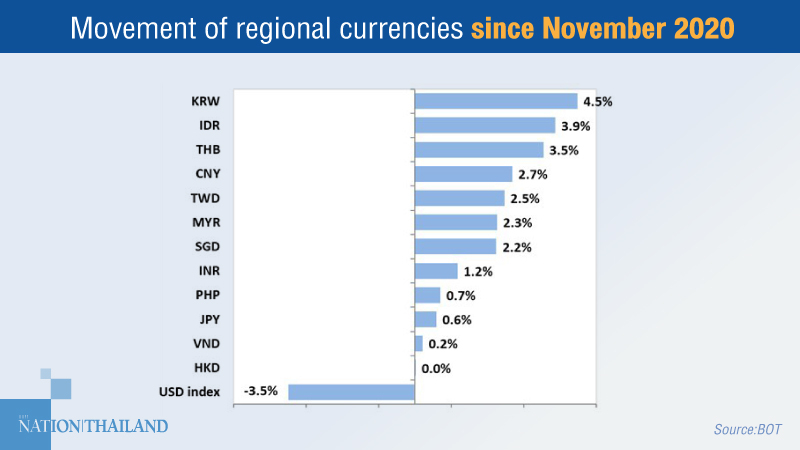
The weakening dollar has seen regional currencies appreciate quickly, with China’s yuan its highest for two and half years, the Korean won and Singaporean dollar strongest in three years, and the new Taiwan dollar at a 23-year high.
Availability of Covid-19 vaccine coupled with signs of global economic recovery in November have caused the US dollar to weaken rapidly, Bank of Thailand (BOT) assistant governor Vachira Arromdee said on Wednesday. The dollar fell to a two-year low against the baht of Bt30.023 on Wednesday, according to BOT figures.Since November, the baht has risen 3.5 per cent, the won 4.5 per cent and Indonesia’s rupiah 3.9 per cent.
Year-to-date, the baht had actually weakened slightly, Vachira noted.
The central bank was closely monitoring currency rates and it would prevent the baht’s value from impacting the economic recovery, she added.
The central bank has introduced a slew of measures to encourage capital outflow in order to balance increasing capital inflows that are driving the baht up.
Thai exporters are complaining that the strong baht makes their products more expensive and less competitive in the global market.
Prime Minister General Prayut Chan-o-cha should follow the example of former PM General Suchinda Kraprayoon who resigned after the deadly Black May crackdown on protesters in 1992, prominent social critic Sulak Sivaraksa said on Wednesday.
He made the remark after attending a ceremony to unveil a monument commemorating the heroic Black May protesters in Bangkok’s Santiporn Park.
He warned that Prayut would suffer the same fate as Suchinda if he did not resign.
“The country can only move forward if the old generation listens to the new generation’s demands. So we ask the government to solve the dispute without violence,” said Sulak.
He accused the government of using the lese majeste law for its own benefit and said it should be scrapped.
More than a dozen pro-democracy protest leaders are currently facing lese majeste (Section 112) charges after calling for Prayut’s removal, a new Constitution and reform of the monarchy.
“We hope that the new generation of military officials will pay the same attention to the nation and democracy as military officials did in 1932,” added Sulak, referring to the Siamese Revolution that abolished absolute monarchy and ushered in constitutional rule.
Meanwhile, the chairman of the Relatives Committee of the May 1992 Heroes said the current political situation was worse than during Black May 1992.
“Relatives of May 1992 heroes are praying for Prayut to resign soon, because no one can remain in their position forever,” said Adul Khiewboriboon.
WASHINGTON – The U.S. government and 48 attorneys general filed landmark antitrust lawsuits against Facebook on Wednesday, seeking to break up the social-networking giant over charges it engaged in illegal, anti-competitive tactics to buy, bully or kill its rivals.
The twin lawsuits filed in federal district court allege that Facebook and its chief executive, Mark Zuckerberg, had behaved as an unlawful monopoly for years – one that repeatedly had weaponized its vast stores of data, seemingly limitless wealth and savvy corporate muscle to ascend into one of the most widely used services around the world.
The state and federal complaints chiefly challenge Facebook’s past acquisition of two companies: Instagram, a photo-sharing tool, and WhatsApp, a messaging service. Investigators said the purchases ultimately helped Facebook remove potential potent rivals from the digital marketplace, allowing the tech giant to enrich itself on advertising dollars at the cost of users, who had fewer social-networking options at their disposal.
The lawsuits together represent the most significant political and legal threats to Facebook in its roughly 17-year history, setting up a high-profile clash between U.S. regulators and one of Silicon Valley’s most profitable firms that could take years to resolve. Antitrust regulators explicitly asked a court to consider forcing Facebook to sell off Instagram and WhatsApp to remedy their competition concerns, seeking a punishment that could severely constrain Facebook’s ambitions.
The Federal Trade Commission, led by Republican Chairman Joe Simons, brought its lawsuit in a D.C. district court. Ian Conner, the director of the agency’s Bureau of Competition, said in a statement the FTC seeks to “provide a foundation for future competitors to grow and innovate without the threat of being crushed by Facebook.”
Letitia James, the Democratic attorney general of New York, led her Democratic and Republican counterparts from dozens of states and territories in filing their complaint in the same venue. Appearing at a news conference, James sharply rebuked Facebook for having put “profits ahead of consumers’ welfare and privacy.”
“Today, we are sending a clear and strong message to Facebook and every other company that any efforts to stifle competition, hurt small business, reduce innovation and creativity, [and] cut privacy protections, will be met with the full force of our offices,” James said.
State, federal antitrust charges against Facebook could come as soon as November, sources say
The lawsuits drew rebuke from Facebook, which pledged to “vigorously defend” its business practices in a sign of conflict to come.
“People and small businesses don’t choose to use Facebook’s free services and advertising because they have to, they use them because our apps and services deliver the most value,” Jennifer Newstead, the company’s vice president and general counsel, said in a statement.
Zuckerberg, appearing frequently on Capitol Hill in recent years similarly has argued that the Web remains sufficiently competitive, bolstered by new companies including TikTok that did not exist years ago. Privately, he has told employees he would “go to the mat” to defend against an antitrust lawsuit he saw as an “existential” threat to the company, according to audio unearthed last year.
The lawsuit reflects the vast dissatisfaction with Silicon Valley that has come to pervade all levels of government in the United States. For years, state and federal regulators had maintained a hands-off approach to the tech industry, even as watchdogs in Europe and around the world began to probe and penalize Facebook and its digital peers for their practices. But a series of high-profile scandals and missteps have brought Democrats and Republicans into rare accord as they seek anew to challenge Silicon Valley over its ever-expanding footprint – and the consequences it poses to corporate rivals and consumers alike.
Last month, the Justice Department filed a similarly sweeping antitrust lawsuit against Google, saying the company struck special deals and engaged in other wrongful tactics to expand the reach of its search and advertising empires. Antitrust watchdogs similarly have set their eyes on Apple and Amazon, raising the potential for additional antitrust action to come. (Amazon CEO Jeff Bezos owns the Washington Post.)
U.S. investigators initiated antitrust probes targeting Facebook last year. Dozens of attorneys general led by James in New York promised a broad review of Facebook’s business, aiming to explore the nexus between its digital dominance and ever-growing efforts to siphon users’ data. The FTC, meanwhile, took aim at Facebook almost immediately after concluding an investigation into the company over its entanglement with Cambridge Analytica, a political consultancy, that forced the tech giant to pay a $5 billion penalty.
Facebook will have to pay a record-breaking fine for violating users’ privacy. But the FTC wanted more.
Immediately, regulators turned their attention to Facebook’s purchase of Instagram for $1 billion in 2012 and WhatsApp for $19 billion in 2014, two deals that the government could have blocked at the time but did not. For Facebook, the two transactions reflected its aggressive attempts at the time to pivot to smartphone devices as millions of users began to spend more time on iPhone and Android apps than desktop computers and traditional websites.
State and federal investigators, however, found that the two acquisitions reflected a troubling strategy at Facebook dating back more than a decade – an aggressive ploy to buy or kill competitive threats, large or small, before they could sap away the social-networking giant’s popularity.
The government lawsuits at times point to correspondence from Zuckerberg himself, who acknowledged in 2012 – before purchasing Instagram – that Facebook had fallen “very behind” in photo sharing and needed to make the critical acquisition to catch up, according to the FTC complaint. In making its move, Facebook sought to wield its “power as a sword,” the state attorneys general said, threatening negative repercussions if Instagram did not agree to a sale.
State and federal investigators detailed a similar troubling pattern with WhatsApp, highlighting additional emails from Zuckerberg, who saw the company and other messaging services at the time as “the next biggest consumer risk” for his social-networking empire. In 2013, a year before the acquisition, the once-independent WhatsApp even had outpaced Facebook’s own messenger product globally as measured by the number of messages sent daily.
In acquiring the company, Facebook initially promised users that it would preserve WhatsApp’s independence and strong privacy protections, state investigators said. But Facebook reversed course years later, frustrating regulators, who said the bait-and-switch had the effect of eliminating a privacy-protective competitor from the digital marketplace.
Facebook on Wednesday sought to rebut the charges: Newstead, the company’s general counsel, stressed that WhatsApp and Instagram became successful precisely because of the tech giant’s massive investments in them.
“This is revisionist history. Antitrust laws exist to protect consumers and promote innovation, not to punish successful businesses,” she said, arguing that federal regulators could have stopped the Instagram and WhatsApp deals but ultimately did not at the time.
“The government now wants a do-over, sending a chilling warning to American business that no sale is ever final,” she said.
The argument has hardly dissuaded the company’s critics, including those in Congress, who found reason for suspicion after concluding their own antitrust investigation this year. The review unearthed a trove of emails from Zuckerberg and his lieutenants apparently plotting against competitors in a series of discussions in which they referenced making a “land grab” for rival apps. Legal experts also said that the government was well within its rights to challenge those transactions on grounds that it ultimately enabled Facebook to act anti-competitively.
Investigators on Wednesday also faulted Facebook for the way in which the company manages its vast trove of user data and the policies that govern when and how third-party app developers and other companies can access it. Such tactics allowed Facebook to stamp out potential rivals before they could become too popular, investigators found.
In 2013, for example, Facebook sought to stop the rise of Vine, a short-video service launched by Twitter, the FTC complaint says. Facebook that January cut Vine off from accessing Facebook’s features, such as users’ friend lists, restricting its growth, according to the federal agency.
“Facebook has hindered, suppressed, and deterred the emergence and growth of rival personal social networking providers, and unlawfully maintained its monopoly in the U.S. personal social networking market, other than through merits competition,” the FTC said.
Johnson fails to get Brexit deal at Supper Summit in Brussels
InternationalDec 10. 2020Prime Minister Boris Johnson/File photo
By The Washington Post · Karla Adam, Michael Birnbaum, William Booth
LONDON – It was another of those make-or-break moments for a Brexit deal that ended in a fizzle. British Prime Minister Boris Johnson traveled to Brussels on Wednesday night for a dinner meeting with European Commission President Ursula von der Leyen, a tête-à-tête the British media dubbed Johnson’s “date with destiny.” The two talked, but no breakthrough was made.
Some feared that the dinner date could be a “last supper” before all hope of a post-Brexit trade and security deal crumbles. But the two sides agreed to send their representatives back to the negotiating table. Britain leaves the European Union in 22 days.
“We had a lively and interesting discussion on the state of play across the list of outstanding issues,” von der Leyen said after the dinner. “We gained a clear understanding of each other’s positions. They remain far apart.”
The European Commission president said in a statement that the two leaders agreed that their negotiating teams “should immediately reconvene to try to resolve these essential issues.”
Johnson left without speaking with reporters. “Very large gaps remain between the two sides and it is still unclear whether these can be bridged,” Downing Street said in a statement, adding that the prime minister “does not want to leave any route to a possible deal untested.”
Johnson and von der Leyen agreed that by Sunday a firm decision should be made about the future of the talks.
And so the British prime minister and the European Commission president did not forge a future relationship based on a bilateral pact. But they had a nice meal. Fish was on the menu – scallops and turbot – and fishing rights at the top of the talks.
Before Johnson left for Brussels, there was much huffing and puffing in London and Brussels over the last-ditch mission, just three weeks before Britain’s 11-month transition period expires at the end of the month.
The dinner between the two leaders was designed to reset the dynamics and unlock further discussions. Others suspected that it could help either side get an edge on the inevitable blame game that will ensue if Britain ends up crashing out without a deal after four decades in the world’s richest trading club.
Tim Bale, a politics professor at Queen Mary, University of London, said, “If they are going to get a deal, it’s best for both sides if it looks as if it was tough negotiating but they pulled off a miracle at the last minute.”
Bale cautioned, “By all accounts, they were quite a long way apart, even on most basic issues, even a few days ago.” He handicapped the possibility for an eventual deal at 50/50.
Both sides insist that an abrupt – and possibly chaotic – departure remains a possibility.
The meeting pitted Johnson against a frugal and precise former German defense minister who started as head of the European Union’s executive branch a year ago.
The two leaders share some basic traits. Like Johnson, von der Leyen spent some of her formative years in Brussels as the child of a senior E.U. official. They went to the same Brussels high school for the children of European bureaucrats, though their tenures did not overlap. Like Johnson, she is the parent of a large family: seven children in her case, six or more – the precise number is uncertain – in his.
But Johnson likes to bluster his way past the facts, and von der Leyen likes to muster them. He likes to live large – big Italian red wines and weekends at Chequers, the prime minister’s official countryside estate. She arranged for a tiny apartment to be constructed at the sprawling European Commission headquarters so she could skip the commute to work.
“You run a tight ship,” Johnson told von der Leyen on Wednesday as they entered their meeting, after he sought to take off his mask without keeping a pandemic-friendly distance from her. She politely corrected him, allowed masks off for a moment for the photographers, then told him to put it back on again as they drew close.
The dinner menu was rich with symbolism: French and British fishermen have clashed in the English Channel over scallops, with access to British fishing waters a major subject of contention in the talks.
Earlier in the day, when Johnson was still in London, he complained to Parliament about the European Union’s demands.
“If they pass a new law in the future with which we in this country don’t comply . . . they want the automatic right to punish us and to retaliate,” he said. “And secondly, they are saying that the U.K. should be the only country in the world not to have sovereign control over its fishing waters.”
These were not terms that “any prime minister of this country should accept,” he said.
Britain wants to be able to “take back control” of its sovereignty – for many Brexiteers, that was the whole point of leaving the bloc.
But Europe appears in little mood for compromise.
The disagreements have touched on areas that have been sore points for years – in some cases centuries.
Belgium’s Flemish fishermen have declared that they have eternal fishing rights in British waters because of a 1666 charter granted by King Charles II to the citizens of Bruges.
“We believe the privilege to still be valid today,” said Flemish Economy Minister Hilde Crevits.
The European Union also does not want Britain undercutting it on issues such as state aid and environmental regulations to gain a competitive advantage. It wants to make sure that British rules stay closely aligned with E.U. ones as a prerequisite for Britain to get relatively unfettered access to the European market.
If a deal is not struck, Britain’s exit could be messy and costly. Its trading relationship with its biggest trading partner would default to World Trade Organization rules, meaning overnight tariffs and quotas that would hit both sides, clogging ports and supply chains.
Time is in short supply. A stripped-down trade deal could be approved by leaders and the European Parliament alone, easing passage by Dec. 31. But if there is a more complicated bargain, some national parliaments would also have to ratify it, increasing the possibility of a misstep that leads to Britain dropping out of the European market on Dec. 31 without a safety net.
Europe seeks to reset relations with U.S., turn page on Trump
InternationalDec 10. 2020President- elect Joe Biden speaks at a news conference on Tuesday, Dec. 8, 2020. MUST CREDIT: Washington Post photo by Demetrius Freeman
By The Washington Post · Michael Birnbaum
European leaders plan to use a summit that starts Thursday to agree on a new strategy to rebuild strained relations with the United States after four years of a divide-and-conquer approach from President Donald Trump.
From rebuilding the Iran nuclear deal to fighting the pandemic to addressing climate change, Europeans are scrambling to seize the moment with the incoming U.S. leader. Because of Joe Biden’s age and history, many in the bloc say he will be more interested in cooperation with Europe than any U.S. president for the foreseeable future, Democrat or Republican.
But leaders on both sides of the Atlantic warn that some of the irritants of the Trump years will remain, and that other divides could still open – especially on what may be the greatest foreign policy challenge of Biden’s presidency, an increasingly aggressive and expansionist Beijing. European countries vary on how they think they should manage relations with China. The most populous and most powerful country in Europe, Germany, also has the closest trading relationship with Beijing.
European leaders also have become embroiled in an intramural debate about the extent to which they should seek independence from the United States, a goal increasingly pushed by French President Emmanuel Macron and opposed by Germany and others.
“We must be able to act multilaterally when we can. This is our preference,” E.U. foreign policy chief Josep Borrell said this week after European foreign ministers discussed transatlantic strategy at a meeting in Brussels. But Europe must also “be able to act autonomously when we must, in order to promote and defend more effectively our interests and values.”
Trump frequently had Europe in his crosshairs, declaring the European Union his greatest “foe” on trade issues and slapping around Germany and others for defense spending that failed to meet NATO pledges. Unlike President Barack Obama, who declared ahead of Britain’s June 2016 referendum on membership within the European Union that he wanted Britain to remain, Trump stoked Brexit.
“Everyone around the world who wishes to see us divided has been opening bottles of Champagne the last few years. That is not OK anymore,” the E.U. ambassador to the United States, Stavros Lambrinidis, said at a panel on transatlantic relations last week.
Although it may be Europe’s turn to pop the bubbly, many policymakers are cautious about how permanent the reprieve from Trumpism may be.
“There’s a sense that this is the last chance,” given the possibility that a Trump ally could recapture the White House in 2024, said Rosa Balfour, the head of the Brussels office of the Carnegie Endowment for International Peace, a think tank.
Many of Biden’s pledges align neatly with E.U. priorities. The European Commission has issued a strategy paper that details a long list of issues it hopes to tackle with the Biden administration.
Europeans want the United States back in the World Health Organization and as a leader in global efforts to combat the pandemic – as Biden has said he would make happen from Day 1. They want Washington to rejoin the Paris climate accord, another first-day plan for the incoming Biden administration. They are laying the groundwork for a revival of the Iran nuclear deal, meeting next week in Vienna to formally invite the United States to rejoin the accord after Trump pulled the plug on U.S. involvement. And they hope Biden will drop Trump’s tariffs on steel and aluminum imports and take a more conciliatory approach to trade issues.
And at NATO, a transatlantic group of strategists released a plan last week to adjust the alliance in the next decade to attune it more toward threats from China, a shift that would bring it more in line with U.S. security preoccupations.
“It’s both wonderful and scary because if we screw up this window, it’ll just be heart-wrenching,” said Anthony Gardner, who was U.S. ambassador to the European Union under Obama and advised the Biden campaign on Europe issues.
But Gardner said some of the biggest issues – including China – may be thorny, in part because Europe itself remains divided.
“We really should be more aligned on China, but getting between that statement of intent and the actual delivery is going to be hard,” Gardner said.
The continent has become more skeptical of Beijing during Trump’s term, but some countries remain dependent on trade with China even as a growing number have agreed to keep Huawei out of their infrastructure systems, a U.S. priority.
“If Europe can’t solve these differences within, it’s very difficult to propose to the U.S. a proactive plan,” Balfour said.
Biden brings a long history to the relationship with Europe, first with his longtime chairmanship of the Senate Foreign Relations Committee and later as vice president, when he was frequently dispatched around the world to resolve thorny issues of international affairs.
That is good and bad for Europe, given that Trump’s anger that Europe is not as active in global security issues was largely an undiplomatic reformulation of frustrations from the Obama years.
When Biden, as vice president, met in Rome with Italy’s then-president, Giorgio Napolitano, shortly after the Arab Spring, he complained that the United States was standing alone against Syrian President Bashar Assad as he stoked a bloody war in his country, according to an adviser to Napolitano.
“Biden told Napolitano, ‘We have said what the red lines are in Syria, but we don’t see anyone raising their hands and saying we’re with you,’ ” said Stefano Stefanini, a former Italian diplomat who was Napolitano’s diplomatic counselor at the time.
Although Europe’s engagement with security issues in its neighborhood is still lagging, Stefanini said, the bigger irritant may be in its relations with Russia.
“Europeans have to realize that given the way the ground has shifted between China and the U.S. in the last four years, the idea that exists in some European corners – to continue trading with China as if the rivalry between the U.S. and China is not Europe’s business – cannot apply,” Stefanini said.
European divisions are deep enough that they may struggle to be a strong partner to the United States on all of Washington’s priorities. At the leaders’ summit Thursday and Friday, they will discuss Brexit, their tumultuous relationship with Turkey and their fight with Hungary and Poland about rule-of-law issues.
Relations with Washington will be one of the few areas of concord.
WASHINGTON – President Donald Trump took office after repeatedly promising to “beat the hell” out of the Islamic State and end the United States’ “endless wars.” But reality proved more complicated.
Although his administration oversaw the destruction of the Islamic State’s caliphate in Syria and a Special Operations raid that killed its leader, Abu Bakr al-Baghdadi, remnants of the group remain active in several countries.
Meanwhile, the U.S. military is still involved in Afghanistan, Iraq, Somalia, Syria, Yemen and other terrorism hot spots after four years of Trump vowing to bring troops home.
President-elect Joe Biden is expected to face a similar landscape – and political pressure – as he takes over the White House.
In similar fashion to Trump, Biden has said it is time to “end the forever wars,” a catchall for 19 years of military operations launched in response to the September 2001 terrorist attacks. Thousands of U.S. troops – and many more civilians – have been killed since then, and trillions of dollars have been spent.
But Biden has indicated that ending the wars does not mean shutting down all counterterrorism operations abroad.
Although the “vast majority” of U.S. troops should come home, the United States must “narrowly define” and continue counterterrorism operations targeting al-Qaida and the Islamic State, Biden wrote in Foreign Affairs magazine in the spring.
“We must maintain our focus on counterterrorism, around the world and at home, but staying entrenched in unwinnable conflicts drains our capacity to lead on other issues that require our attention, and it prevents us from rebuilding the other instruments of American power,” he wrote.
Early on, the Trump administration sought to reorient itself to prioritize “great power competition” with China and Russia above counterterrorism, and defense officials have said they wanted to make the shift “irreversible.”
But many of the longtime areas of conflict remain just as turbulent.
In Afghanistan, Biden must decide how to handle a delicate situation in which Trump signed a deal with the Taliban that calls for the removal of all U.S. troops by May. U.S. officials have said the agreement will be based on the conditions on the ground, but Trump nonetheless announced plans to cut the number of U.S. troops in Afghanistan to 2,500 by the end of his term, overriding concerns from senior U.S. commanders and former defense secretary Mark Esper.
In Iraq, the United States has the approval to keep a residual military force to train Iraqi forces and watch for any resurgence of the Islamic State, Gen. Mark Milley, chairman of the Joint Chiefs of Staff, said recently. But the situation is complicated by Iran, whose proxy forces repeatedly have launched rockets at American military positions. Iran also has vowed revenge for the U.S. killing in Baghdad of Qasem Soleimani, an Iranian general whom U.S. officials have blamed for the deaths of hundreds of Americans.
In Syria, the United States has kept about 1,000 service members deployed in what the Trump administration has said is an effort to protect oil fields from the Islamic State. But the situation is complex, with forces backing the Syrian regime, including Russians, also in the region.
U.S. Special Operations troops also remain in small numbers in Somalia, Yemen and western Africa.
Biden will have to assess risks, including threats to U.S. service members, when examining the future size of any mission, and whether to continue it, said David Maxwell, a retired Special Forces colonel and senior fellow at the Foundation for Defense of Democracies. Arrogance, Maxwell said, has on occasion led to decisions to leave U.S. units without enough support, allowing American fatalities.
“We must be asking: Does this mission fit into our national security strategy?” he said. “It’s a basic equation: Is the benefit [of] conducting this operation worth the cost of conducting it if it goes wrong?”
Michael Nagata, a retired Army general and former director of strategy for the National Counterterrorism Center, said the idea that the United States should focus less on counterterrorism and more on other issues is a “bankrupt premise.” For example, he said, less than three years after the U.S. military withdrew from Iraq, it launched operations there again against the Islamic State in 2014.
“I hear this riff all the time: ‘We’ve got to rebalance,’ as though this is somehow a zero-sum game,” said Nagata, now a distinguished senior fellow with the Middle East Institute. “I understand how attractive that idea is – it’s just completely unrealistic. It never works. It never lasts.”
Poland, Hungary say deal struck on $2.2 trillion EU stimulus
InternationalDec 10. 2020European Union (EU) flags fly at half mast following the death of Valery Giscard d’Estaing, France’s former president, outside the headquarters of the European Commission in Brussels on Dec. 4, 2020. MUST CREDIT; Bloomberg photo by Geert Vanden Wijngaert.
By Syndication Washington Post, Bloomberg · Wojciech Moskwa, Zoltan Simon
Poland and Hungary have agreed on a compromise with Germany to unblock the European Union’s $2.2 trillion budget and pandemic stimulus plan, a senior government official in Warsaw said.
The compromise would end a standoff that saw Budapest and Warsaw threaten to torpedo the EU’s 750 billion-euro ($909 billion) pandemic aid fund and the 2021-2027 budget over objections to attaching rule-of-law conditions to cash.
Polish Deputy Prime Minister Jaroslaw Gowin said an agreement had been clinched with Germany, which holds the EU’s rotating presidency, that would now be presented to the rest of the bloc. A deal could be finalized by Friday by the end of a two-day summit of European leaders in Brussels, he said. A German spokeswoman said a solution hadn’t been reached yet and all member states would need to sign off.
“For now we have agreement between Warsaw, Budapest and Berlin,” Gowin, the government’s biggest advocate of Poland dropping its veto threat, told reporters Wednesday in Warsaw. “I believe this agreement will also include the 24 remaining European capitals.”
The deal was confirmed by a Hungarian official familiar with the state of talks who commented on the condition of not being named. An EU diplomat said officials were waiting for final confirmation that an arrangement had been reached.
A solution would offer a climb-down for Hungarian Prime Minister Viktor Orban and Polish counterpart Mateusz Morawiecki, who’d backed themselves into a corner over their opposition to the money being tied to democratic standards.
EU ambassadors will meet on Wednesday to discuss the budget situation, according to an official.
The proposal being considered would clarify that the rule-of-law mechanism would only apply to new outlays from the EU, with its implementation only happening after the European Court of Justice weighed in, according to two people familiar with the matter who asked not to be named as the discussions are private.
Gowin declined to go into details about the deal, saying only that it keeps “Poland sovereign and the EU united.”
“We know that this veto from Hungary and Poland exists because the financial framework is connected to the rule of law principle,” German deputy government spokeswoman Martina Fietz said in Berlin when asked about whether a deal had been reached. “The chancellor has made clear this morning that she cannot say yet whether a solution will be achieved.”
The zloty jumped 0.7% to the highest level against the euro since September on news of the EU deal. The forint also gained.
The budget holdouts said the link threatened to cut their funding and undermine their governments, which are being probed for alleged violations of the bloc’s norms.
The deadlock threatened at least 180 billion euros that Hungary and Poland were due to receive in the coming years, as well as also payouts that are urgently needed to help ease the record recessions caused by the virus.
It also would have triggered an emergency budget for the EU from Jan. 1, which would have seen funding plunge in almost all areas and potentially put Poland and Hungary at the back of the line for even the limited development aid that would be available in this case.





 Sulak Sivaraksa



 Prime Minister Boris Johnson/File photo
  President- elect Joe Biden speaks at a news conference on Tuesday, Dec. 8, 2020. MUST CREDIT: Washington Post photo by Demetrius Freeman
 European Union (EU) flags fly at half mast following the death of Valery Giscard d’Estaing, France’s former president, outside the headquarters of the European Commission in Brussels on Dec. 4, 2020. MUST CREDIT; Bloomberg photo by Geert Vanden Wijngaert.
  SootinClaimon.Com